
牛津译林版六年级上册英语Unit5 on the farm教案
六年级英语Unit5 复习教案
【教学目标】:重点单词:outing/ around
重点短语:walk on/ give sb. sth
重点句型:feel + 形容词/ Do you want some…/ Please don't…
教学重难点:重点句型 “feel + 形容词”
【教学过程】
同步知识梳理
知识点1:重点单词
1. outing (名词) 外出游玩,远足
【短语】去远足_______________________
【例句】---你们在哪里,萨姆?_____________________________________________
---我们在森林里远足。___________________________________________
Keys: go on an outing
— Where are you,Sam? — We're on an outing in the forest.
2. walk on (动词短语)继续走路
【例句】 (1)午饭后,他们继续赶路。_______________________________________
(2)现在让我们继续走吧。______________________________________________
Keys: After lunch,they walked on.
Let’s walk on now.
3. around (介词) 在.…·周围
【短语】环顾,往四下看________________________
【例句】 (1) 他想周游世界。__________________________________
(2) 李老师带他参观了我们的校园。__________________________________
Keys: look around
He wants to travel around the world.
Miss Li showed him around our school.
知识点2:重点词组
be careful小心 that sign 那个标志
a juice shop 一个果汁店 go in 进入,进去
in a restaurant 在饭店里 No smoking 请勿吸烟
No littering 请勿乱扔垃圾 No parking 请勿停车
No eating or drinking 请勿饮食 on an outing 远足
in the forest 在森林里 look for 寻找
walk on 继续走路 around them 在他们周围
at a shopping center 在一个购物中心
take the juice into the shop 把果汁带进商店 知识点2:重点句型
1. Bobby and Sam are on an outing① in the forest② . It is time for lunch. Bobby feels tired③
and hungry.
波比和萨姆在森林里远足。该是吃午饭的时候了,波比感到又累又饿。
Sam:What are you doing, Bobby?
萨姆:你在干什么,波比?
Bobby:I’m looking for④ my bananas. I brought some for lunch.
波比:我在寻找我的香蕉。我带了一些当午餐。
2. Bobby gives Sam a banana. 波比给了萨姆一根香蕉。
Bobby: Do you want one,Sam? It’s sweet. 你想要一根吗,萨姆?它很甜。
Sam: Thanks, Bobby. 萨姆:多谢了,波比。
3.Bobby and Sam walk on.⑤ They find a sign on a tree.⑥
波比和萨姆继续走路。他们看到树上有个标识。
Sam: Look, Bobby. There’s a sign.
萨姆:看,波比。有一个标识。
Bobby: What does it mean?
波比:它是什么意思?
Sam: It means we can’t eat bananas⑦ here.
Bobby: Why?
波比:为什么?
4. Then, they see a lot of monkeys⑧ around them. They are looking at ⑨Bobby’s bananas.
然后,他们看见在他们周围有许多猴子。它们都在盯着波比的香蕉了!
Bobby: I know why we shouldn’t eat bananas here.
波比:我知道我们为什么不能在这儿吃香蕉了!
【解析】
一、 Bobby feels tired and hungry.波比感到又累又饿。
[解析] “feel + 形容词”意为“感觉...... ”。feel在这里用作感官系动词,是第三人称单数时,要在feel后加s构成第三人称单数形式。
[例句] — How do you feel now, Liu Tao? 刘涛,你现在感觉怎样? — I feel hot and thirsty 我感到又热又渴。
[例题] 根据所设情景,判断正误
( )(1) 你告诉别人你感觉很兴奋,会说: You feel excited.
( )(2) 当你看到别人不舒服时,你会说: What’s the matter?
Keys:×√
二、 Bobby gives Sam a banana.波比给了萨姆一根香蕉。
[解析] give sb. sth.意为“把某物给某人”,也可用“give sth. to sb. "结构。
[例句] (1) Can you give me a pen? 你能给我一支钢笔吗?
(2) Liu Tao gave me a hot dog just now. 刘涛刚才给了我一只热狗。
[例题] 同义句转换。
Mike gave us some toys yesterday.
Mike ________ some toys ________ _______ yesterday.
Keys: gave;to;us
3. Do you want some juice? 你们想喝些果汁吗?
[解析] "Do you want some ... ?”是征求对方意见或建议的一般疑问句式,句中通常用some,而不用any。其同义句为“Would you like some ...?”。其答语为“Yes , please.”或“No , thank you.”。
[例句] 一Do you want some fish?你想吃些鱼吗?
一Yes , please.好的。
[例题]根据所设情景,选择正确答案。
( ) (1)妈妈问你是否想要些米饭,可以说:
( ) (2)你想要吃些面条,可以说:
( ) (3)爸爸建议你喝些水,你不要可以说:
A. I’d like some noodles.
B. No,thanks.
C. Do you want some rice?
Keys: CAB
4. Please don't smoke here. 请不要在这儿吸烟。
[解析] "Please don't…”是祈使句的否定形式的一种表达方式,用来提醒别人不要做某事,意为“请不要……”,也可用“Don't…please.”来表达。其答语为“I’m sorry.”。
[例句] Please don’t litter here,Liu Tao. 请不要在这儿乱扔垃圾,刘涛。
I’ m sorry,Miss Li. 对不起,李老师。
【巩固练习】
( ) 1. The children are __________ new clothes now.
A. wear B. wears C. wearing
( ) 2. Would you like __________ ice cream?
A. any B. a C. an
( ) 3. Did your brother write an email yesterday? __________
A. Yes, he did. B. Yes, he does. C. No, he don’t.
( ) 4. Yang Ling __________ the Bund by car yesterday afternoon.
A. go to B. went C. went to
( ) 5. He __________ a lot of bottles at the party.
A. wear B. wore C. weared
6. I went to the farm for the holiday. (对画线部分提问)
you for the holiday?
7. There were some cows on the farm. (改为一般疑问句并做否定回答)
----- there cows on the farm?
-----No, .
8. My holiday was great fun. (对画线部分提问)
was your holiday?
9. Nancy often__________ (teacher) me English on Sundays.
10.Look! They_____________ (tell) a story.
11.The jacket fits me ______ (good).
12.The lion is nice to ______ (he).
My cat’s name is Lucy. She is a very pretty cat. Her hair is black and yellow. She has four
children. She is very happy with her young babies.
The four children are not all like Lucy very much. The biggest (最大的) child is quite black. It
译林版三年级英语下册第七单元Unit7Onthefarm教案
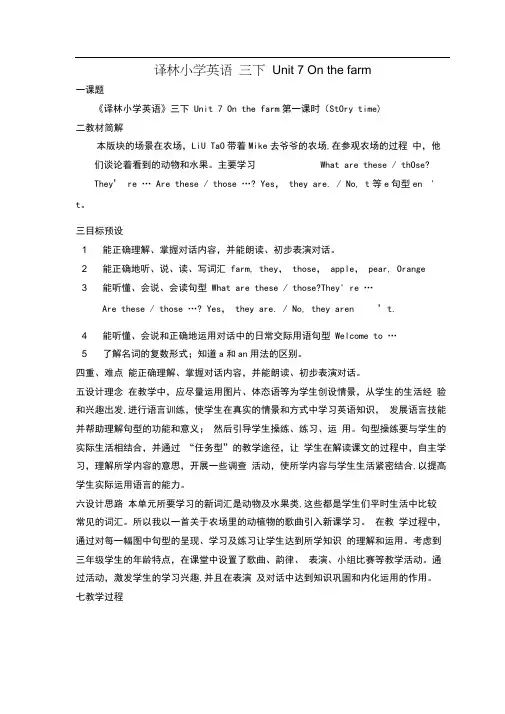
译林小学英语 三下 Unit 7 On the farm
一课题
《译林小学英语》三下 Unit 7 On the farm第一课时(StOry time)
二教材简解
本版块的场景在农场,LiU TaO带着Mike去爷爷的农场,在参观农场的过程 中,他们谈论着看到的动物和水果。主要学习 What are these / thOse?
They’ re … Are these / those …? Yes, they are. / No, t等e句型en '
t。
三目标预设
1 能正确理解、掌握对话内容,并能朗读、初步表演对话。
2 能正确地听、说、读、写词汇 farm, they, those, apple, pear, Orange
3 能听懂、会说、会读句型 What are these / those?They' re …
Are these / those …? Yes, they are. / No, they aren ’t.
4 能听懂、会说和正确地运用对话中的日常交际用语句型 Welcome to …
5 了解名词的复数形式;知道a和an用法的区别。
四重、难点 能正确理解、掌握对话内容,并能朗读、初步表演对话。
五设计理念 在教学中,应尽量运用图片、体态语等为学生创设情景,从学生的生活经 验和兴趣出发,进行语言训练,使学生在真实的情景和方式中学习英语知识, 发展语言技能并帮助理解句型的功能和意义; 然后引导学生操练、练习、运 用。句型操练要与学生的实际生活相结合,并通过 “任务型”的教学途径,让 学生在解读课文的过程中,自主学习,理解所学内容的意思,开展一些调查 活动,使所学内容与学生生活紧密结合,以提高学生实际运用语言的能力。
六设计思路 本单元所要学习的新词汇是动物及水果类,这些都是学生们平时生活中比较
常见的词汇。所以我以一首关于农场里的动植物的歌曲引入新课学习。 在教 学过程中,通过对每一幅图中句型的呈现、学习及练习让学生达到所学知识 的理解和运用。考虑到三年级学生的年龄特点,在课堂中设置了歌曲、韵律、 表演、小组比赛等教学活动。通过活动,激发学生的学习兴趣,并且在表演 及对话中达到知识巩固和内化运用的作用。
译林版英语六年级上册Unit 3 知识梳理与练习
第 1 页
Unit 3 Our animal friends
1. 掌握重点单词/ 词组
2. 掌握重点句型
3. 掌握本单元语法内容
词组
our animal friends 我们的动物朋友 one… the other … 一个…,另一个…
have big eyes 有大眼睛 their bodies 它们的身体
its body 它的身体 no legs or arms 没有胳膊和腿
have a big tail 有一个大尾巴 an animal friend 一个动物朋友
have four legs 有四条腿 a short tail 一条短尾巴
run and jump 跑和跳 long ears 长耳朵
yellow and green 黄色和绿色 two wings 两个翅膀
a big mouth 一张大嘴巴 talk and fly 讲话和飞翔
an arm 一个胳膊 four feet 四只脚
two fish 两条鱼 sunny weather 晴朗的天气
come out 出来 carry an umbrella 带一把伞
rubber duck 橡皮鸭 see pandas 看见熊猫
三年级下册 新教材译林三年级下英语Unit7 On the farm教案五课时
第1页 共11页 小学三年级英语下册备课Unit 7 On the farm第一课时
主 备 人 上课时间 课型 新授
教学内容 Unit 7 On the farm第一课时
教 学
目 标 1.能听懂,会说,会读they
are=they’re,pig ,cows,chicken,duck
内容分析 重点 词汇:farm,they,those chicken,apple ,pear,orange的读音。
难点 a和an用法的区别
教学准备 多媒体,小动物图片,水果图片,农场图片
教 学 过 程
教 师 活 动 学 生 活 动 二次备课
Step 1. Warm up
1.Greeting
2.Free talk
What’s this/that?
It’s a/an...
Step 2.Presentation
1.T:Let’s listen to a song first.
2.教师出示一幅农场的图画。
T:Look,this is a farm.It’s Old
MacDonald’s farm,What’s on the farm?(出示课题)教师领读on the farm.
3.T:Look,what are these?
They’re ducks.(教师边说边把几只鸭子的图片贴到农场上去)。
T:(教师指着一组戴头饰的小朋友,运
学生听歌
学生看图
学习单词farm及词组on the
farm
学生在教师引导下,戴上头饰,边做着小鸭
第2页 共11页 用what are these?提问,引导学生回答They’re ducks.)
4.Learning:cow.chicken,pig
The same method.
精通版小学六年级英语上册unit5revisio学情分析
精通版小学六年级英语上册unit5revisio学情分析
一、教学要求
1、四会单词和词组:holiday、 last 、early、 meet、 before、 did、 taste、
pull up、 milk 、cook及其中动词的过去式。
2、句型what ( else) did you do….? we / i ….
3、三会单词和词组: farm 、carrot、 fun 、camp、 national day
film、 cow、 pick、 wonderful 、volleyball、 mountain
4、三会日常交际用语: did you like the film?
it was a funny cartoon.
we all like it very much.
were there any fruit trees on the farm?
there were apple trees, orange trees and pear trees.
5、能够反杜林论、辨识字母组合igh在单词中的读音
6、会诵读歌谣 last week
二、单元教材分析
1、本单元主要围绕谈论“过去所做的事情”这个话题展开各项活动。对小学生来说,这一课他们将面临以下难点:
a 恰当掌控动词过去式的三种读音;
b正确理解一般过去时的意义;
c 较娴熟的运用本单元所学内容。
在教学的呈现环节中,教师要特别注意身边资源的利用,选择真实、自然的情景,得体、流畅的语言帮助学生理解。在操练和运用环节,教师应结合学生的生活实际,创设各种较为真实并生动活泼的情境,培养学生用英语做事情和用英语进行交流的能力。
unit 5(第1课时)
一、 教学内容
b look read and learn /c ask and answer / f do a survey 二、 教学目标
译林版(三起)三年级下册英语优质教案:Unit 7 On the farm 第4课时
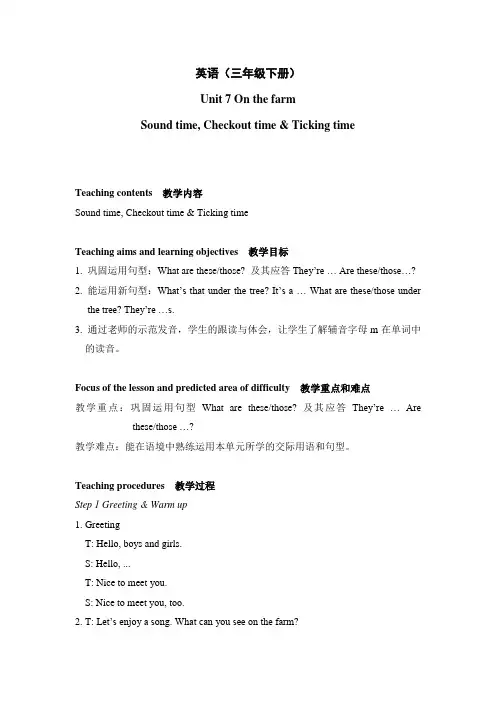
英语(三年级下册)
Unit 7 On the farm
Sound time, Checkout time & Ticking time
Teaching contents 教学内容
Sound time, Checkout time & Ticking time
Teaching aims and learning objectives 教学目标
1. 巩固运用句型:What are these/those? 及其应答They’re … Are these/those…?
2. 能运用新句型:What’s that under the tree? It’s a … What are these/those under
the tree? They’re …s.
3. 通过老师的示范发音,学生的跟读与体会,让学生了解辅音字母m在单词中的读音。
Focus of the lesson and predicted area of difficulty 教学重点和难点
教学重点:巩固运用句型What are these/those? 及其应答They’re … Are
these/those …?
教学难点:能在语境中熟练运用本单元所学的交际用语和句型。
Teaching procedures 教学过程
Step 1 Greeting & Warm up
1. Greeting
T: Hello, boys and girls.
S: Hello, ...
T: Nice to meet you.
S: Nice to meet you, too.
2. T: Let’s enjoy a song. What can you see on the farm? S1: I can see cows.
S2: I can see horses.
T: This farm is very nice. There are many animals. Do you know whose farm it is?
六年级上英语课课练-Unit5On the farm Period 5-译林版

1 / 4 Let's review
一、词汇俱乐部
1. do(过去式)______________
2. were(单数)______________
3. tasted(动词原形)__________
4. go(第三人称单数)_________
5. visit(名词)________________
6. dance(过去式)_____________
二、精挑细选
( )1. The children ________ to music and played table tennis this weekend.
A. listen B. listened C. liked
( )2. He usually ________ his homework at half past six every evening.
A. does B. did C. do
( )3. They ____ their stamps yesterday.
A. show us B. show meC. showed us
( )4. I was ill at home. Liu Tao ________ to see me last weekend.
es B. is comingC. came
( )5. It's time for __________ home.
Let's ________.
to go;go
B.me to go;to go
C. we to go;to go
( )6. My father likes ________ in his free time.
A.taking photos
B.takeing photos
C. taking photoes
重点难点,一网打尽。
三、 对号入座(选用适当的介词填空)
译林英语三年级下册教案Unit7 On the farm
Unit7 On the farm
教材分析
本单元主要是复数物品的询问方法,学会运用句型What are
these/those? They’re…. Are these/those…? Yes, they are./No,
they aren’t.这一单元的句型比较难,一是以前从没有接触过名词的复数形式,二是单词these/those读音较难,三是还要学习复数形式的一般疑问句。因此本单元的难度比较大。除了这些,还要教4个动物类单词和3个水果类单词,要掌握他们的读音,并且要学生学会a和an的用法区别。
教学目标 1.听得懂、会说、会读、会拼写单词farm, they, those, apple, pear,
orange, who
2.听得懂、会说、会读词汇they’re=they are, pig, cow, chicken,
duck, picture, who’s=who is
3.听得懂、会说、会读日常用语Welcome to… What are these/those…?
They’re… Are these/those…? Yes, they are/ No, they aren’t.
4.字母m在单词中的读音。
5.会诵读歌谣On the farm
教学重点
1.词汇farm, they, those, apple, pear, orange, who, pig, cow,
chicken, duck, picture
2.句型What are these/those…? They’re… Are these/those…? Yes,
they are/ No, they aren’t.
3.字母m在单词中的读音。
4.会诵读歌谣On the farm
教学难点
1.句型What are these/those…? They’re… Are these/those…? Yes,
六年级上册英语优质教案 Unit5 Signs(4) 译林版(三起)
课题 Unit5 Signs 课时 5-4 授课日期
教学
目标 1. 能正确完成完成checkout time 练习。
2. 能对照Ticking time 的三个目标进行客观的自我评价。
3. 能理解Culture time的内容,并适当拓展。
3. 能复习并巩固所学公共标识及关于公共标识的提问和回答。
4.能正确使用关于公共标识的句型进行交流。
教学重点教学难点 1.能灵活运用所学公共标识并进行相关提问。
2. 能对照Ticking time 的三个目标进行客观的自我评价。
教学具
准备 课后收集公共场所的标识图片,课件
预习
要求 学生认真预习Culture time, Checkout time & Ticking time
教 学 过 程 二次备课
Step 1: Review
1. 复习Cartoon time
T: Last class, we knew Bobby and Sam were on an outing in the
forest. It was time for lunch. Bobby felt tired and hungry. What
happened to them? Let’s try to act the story.
教师逐图出示请学生表演,其余学生旁白。
2. 复习学过的标识
T:Here’s a public sign.(出示Cartoon time出现的标识)Now try
to say other public signs.
Ss: 让学生说一说已知的公共标识。
T: 学生说的同时引导其余学生就所说的标志再进行解释“It
means …”
3. 归纳公共标识句型结构(课件出示已学过的标识)
公共标识句型常见的有:
No + 名词. No + 动名词.
名词或名词短语.
祈使句:Please do (not) +V… Do (not) + V…
新译林版六年级英语上册 Unit 5 课时1教案(公开课)
Unit 5Signs
Story time &Fun time
一、板块介绍
Story time: Mike, Helen和Tim在逛购物中心的时候看到了很多公共标识。三人互相提醒,防止了危险,也阻止了不当行为。
Fun time: 本板块是一个棋盘游戏,要求学生两人一组,轮流掷骰子,走棋子,就棋盘上的公共标识进行问答。为了让学生更好地完成该活动,建议教师在活动前带着学生复习公共标识的相关知识,为活动的顺利开展做好准备。
二、教学目标
1、能听懂、会说、会读、会写sing, shopping centre, careful, mean, floor, litter, go in,
take … into, restaurant, someone, smoke, smell.
2、能够掌握以下句型:〔1〕---What does it mean
---It means …
(2) ---No littering/parking/…
(3)You can/can’t …
3、能听懂、会说、会读Story time中的故事,并能够熟练复述出来。
4、能够看懂常见的英文指示图标。
5、通过本节课的学习,培养学生关注标示,讨论标示,做遵守公共法规和秩序的社会公民。
三、教学重难点
1、能够在日常生活中熟知并能用英语说出常见的英语标示。
2、学生能够设计并制作公共标示,学以致用,提高公民意识。 四、教学准备
教学课件〔教师可以在优教平台直接调用或下载〕、课文录音、动画、教材图片公共标示图片。
五、教学过程
Step 1: Warm-up/Lead-in
1. 话题导人
教师可以通过简笔画或图片形式呈现假设干公共标识,和学生进行问答,引出单元话题。如:
1〕What’s this
牛津译林版六年级上册英语Unit5 on the farm教案
六年级英语Unit5 复习教案
【教学目标】:重点单词:outing/ around
重点短语:walk on/ give sb. sth
重点句型:feel + 形容词/ Do you want some…/ Please don't…
教学重难点:重点句型 “feel + 形容词”
【教学过程】
同步知识梳理
知识点1:重点单词
1. outing (名词) 外出游玩,远足
【短语】去远足_______________________
【例句】---你们在哪里,萨姆?_____________________________________________
---我们在森林里远足。___________________________________________
Keys: go on an outing
— Where are you,Sam? — We're on an outing in the forest.
2. walk on (动词短语)继续走路
【例句】 (1)午饭后,他们继续赶路。_______________________________________
(2)现在让我们继续走吧。______________________________________________
Keys: After lunch,they walked on.
Let’s walk on now.
3. around (介词) 在.…·周围
【短语】环顾,往四下看________________________
【例句】 (1) 他想周游世界。__________________________________
(2) 李老师带他参观了我们的校园。__________________________________