
复合材料的疲劳损伤模型---英文
Afatiguedamagemodelofcompositematerials
FuqiangWu*,WeiXingYaoKeyLaboratoryofFundamentalScienceforNationalDefense-AdvancedDesignTechnologyofFlightVehicle,NanjingUniversityofAeronauticsandAstronautics,Nanjing210016,China
articleinfoArticlehistory:Availableonline20February2009Keywords:CompositeFatigueAccumulativedamagePredictedlifeabstractThemechanicalpropertiesofcompositematerialsdegradeprogressivelywiththeincreasingofthenum-berofcyclicloadings.Basedonthestiffnessdegradationruleofcomposites,aphenomenologicalfatiguedamagemodelispresentedinthispaper,whichcontainstwomaterialparameters.Theyareproportionaltothefatiguelifeofmaterialsandinverselyproportionaltothefatigueloadinglevel.Thirteensetsofexperimentaldataofcompositestiffnessdegradationwereemployedtoverifythepresentedmodel,andthestatisticalresultsshowedthatthismodeliscapableofdescribingthedamageevolutionofcom-positematerials.Thecharacteristicsofdamagedevelopmentandaccumulationofcompositematerialssubjectedtovariableloadingwerestudiedinthispaper.Foursetsoftwo-levelloadingexperimentaldatawerecitedtoverifythedamagemodel,andtheresultsshowedthatthepredictedlifeisingoodagree-mentwiththeexperimentalones.Ó2009ElsevierLtd.Allrightsreserved.
1.IntroductionThedamageevolutionmechanismisoneoftheimportantfo-cusesoffatiguebehaviorinvestigationofcompositematerialsandalsoisthefoundationtopredictfatiguelifeofcompositestruc-turesforengineeringapplications.Asknown,thefatiguedamageandfailuremechanismofcompositesismorecomplexthanthatofmetalsandfourbasicfailuretypeswilloccurrincompositesun-dercyclicloading,whicharematrixcracking,interfacialdebond-ing,delaminationandfiberbreakage.Basedonagreatdealofexperimentalinvestigations,manydamagemodels[1–8],whichhavebeen,respectively,definedbystrengthdegradation,stiffnessdegradationandenergydissipationofcomposites,havebeenem-ployedtodescribethedamagedevelopmentofmaterialsinthere-centdecades.Thecognitiontodamageevolutionmechanismhadbeendevelopedfromlinearmodeltononlinearmodel.However,mostmodelsarejustsuitedtoaspecialcompositeandarenotcapableoffittingothers.Toobtaintheparametersofthemodels,amassoffatigueexperimentaldataisnecessary.Thefatiguedam-agemechanismofcompositeshasnotyetbeenrecognizedwholly.Inthispaper,thefactorsrelatedtofatiguedamagedevelopmentofcompositeswereanalyzedandaphenomenologicalfatiguedamagemodeldefinedbymaterialstiffnessdegradationisde-scribed.Thirteensetsofexperimentaldatawereemployedtover-ifythemodel,andtheresultsshowthatthemodelcandescribethedamageevolutionofcompositelaminatesunderthedifferentfati-gueloadings.Anditisalsoverifiedthatthemodelcanpredictresidualfatiguelifeofcompositelaminatesquitewellbyfoursetsoftwo-levelexperimentaldata.2.DamagemodelUndercyclicstressorstrain,thenon-inversestructuralchangewilloccurinmicrolocalfieldincompositematerialsandthesechangesleadtofatiguedamageofcomposites.Withanincreaseinthenumberofloadingcycles,thequantityofthischangewillin-creaseandthedamagewillcumulatesynchronously.Theaccumu-lationofdamageleadstoachangeinthemacroscopicmechanicalpropertiesofthecomposites,suchasthedegradationofstrengthorstiffnessofthematerial.Basedontheexperimentalinvestigation,Reifsnider[1]concludedthatfatiguedamageevolutionisnonlin-earincompositematerials.Duringtheinitialperiodoffatiguelife,manynon-interactivecracksoccurinthematrix.Whenthematrixcrackdensityreachessaturation,thefiberfailure,interfacialdeb-ondinganddelaminationoccurinthecomposites.Damagewillrapidlydevelopandthematerialcauses‘‘suddendeath”intheendperiodoffatiguelife,asshowninFig.1.TotestthechangeinYoung’smodulusofmaterials,thedamagedevelopmentofcompositematerialscanbedescribedbystiffnessdegradationofmaterialsinfatiguebehaviorinvestigation.Basedonthistechniquethatspendslessexperimentaltimeandcost,manynonlineardamageevolutionmodels[8]werepresented.Andthemodelsdefinedbystiffnessdegradationofcompositelam-inatesarewidelyinvestigatedtheoreticallyandexperimentallyandtheyfairlydescribedthedamageprogressintheinitialor/andmiddleperiodofthefatiguelife.However,theyarenotcapableoffittingthedamageprogressinthewholeperiod,asshownin0142-1123/$-seefrontmatterÓ2009ElsevierLtd.Allrightsreserved.
doi:10.1016/j.ijfatigue.2009.02.027*Correspondingauthor.Tel.:+862584892576.E-mailaddress:stonefuq@hotmail.com(F.
Wu).InternationalJournalofFatigue32(2010)134–138
ContentslistsavailableatScienceDirectInternationalJournalofFatigue
journalhomepage:www.elsevier.com/locate/ijfatigu
eFig.1.Accordingtothefatiguemechanismsofcomposites,aversa-tilenewfatiguedamagemodelispresentedtodescribethestiff-nessdegradationruleofcompositematerialsintheloadingdirection.TheproposedmodelofthedamageisthatDðnÞ¼E0ÀEðnÞE0ÀEf¼1À1ÀnNBAð1ÞwhereE0isinitialYoung’smodulus,EfisthefailureYoung’smodu-lus,E(n)isYoung’smodulusofthematerialsubjectedtothenthcy-clingloading,nisthecycle,Nisthefatiguelife,AandBaremodelparameters,D(n)isthefatiguedamage,whichequals0whenn=0andequals1whenn=N.3.StatisticalanalysisAccordingtothestiffnessdegradationexperimentaldataofcompositematerials,thematerialfatiguedamagevaluesaregottenunderdifferentcycles.Then,thecurveofEq.(1)canbegottenbytheleastsquaresfitting.ThecomprehensivedatapublishedinRefs.[3,9,10]wereusedtovalidatetheproposeddamagemodel.ThevaluesofAandBinEq.(1)andthecorrelativecoefficientR2arelistedoutinTable1andareshowninFig.2.Eq.(1)iscapableofdescribingthenonlineardamageevolutionmacro-mechanicallyinallperiodsofthefatiguelifeofcompositematerialssubjectedtodifferentfatigueloadings,asshowninFig.2.Duringtheinitialperiodofthefatiguelife,themaindamagetypeismatrixcrackinginthecomposite.ThebiggertheappliedloadingisorthelesstheratioRofstressorstrain(R=rmin/rmaxorR=emin/emax)is,thefasterthedamagedevelopmentis.Whenthecrackdensityissaturatedinthematrix,therateofdamagedevelopmentofthematerialissteadyandslow.Duringthefinalperiodoffatiguelife,fiberbreakingcontrolsthecompositefailure.Thefasterthefracturedrateofthefiberis,theshorterthefatiguelifeis.Withtheincreaseinthenumbersoffracturedfibers,therateofdamagedevelopmentofmaterialincreasesquicklyandagain.Therefore,thechangeruleofthedamagedevelopmentrateincom-positesisfromquicktoslowandtoquickagaininthewholeperiodofthefatiguelife.InEq.(1),thenormalizationfatiguelifen/Nisrewrittenasx=n/N.Then,therateofdamagedevelopmentoflaminateisdDdx¼ABxBÀ1ð1ÀxBÞAÀ1ð2ÞAccordingtothevaluesofparametersAandBinTable1,thedam-agedevelopmentratesofthelaminatescanbegotten,asshowninFig.3.Basedonthecharacteristicsofdamageevolutionofcompositematerials,theratesofdamagedevelopmentbetweentheinitialperiodandthefinalperiodoffatiguelifearesame,asshowninFig.3.Then,anassumptionisproposed,whichisthattheratesatanynormalizationlifex1andx2(0
基于疲劳损伤两段论的复合材料刚度降模型研究

16 基于疲劳损伤两段论的复合材料刚度降模型研究 201O年1月 基于疲劳损伤两段论的复合材料刚度降模型研究 贾宝惠,李顶河,李 伟,徐建新 (中国民航大学航空工程学院,天津 300300) 摘要:本文在疲劳累积损伤模型和刚度降模型的基础上,根据疲劳损伤的两阶段理论,将复合材料的疲劳损伤划分为两 个阶段,并用两种不同的函数分段描述疲劳损伤的过程,建立了疲劳损伤演化两阶段模型。利用试验数据,运用多元函数的最 小二乘法,得到了模型中的各个参数的拟合值和层合板的s.N曲线。疲劳损伤演化两阶段模型计算数据与试验结果吻合 较好。 关键词:复合材料;剐度降;损伤;S-N曲线 中图分类号:TB332 文献标识码:A 文章编号:1003—0999(2010)o1—0016—04 复合材料层压板由于具有较高的比强度和比刚 度,在现代航空航天的各种结构上都得到了广泛应 用 ,2 J,其疲劳问题也逐渐受到人们的重视。层压 板的抗疲劳性能直接关系到结构的安全性和可靠 性,因此预测层合板的强度与疲劳寿命具有重要的 工程实际意义。 复合材料的损伤、断裂和疲劳性能与金属材料 有很大差别,这些差别一方面来自于复合材料自身 的各向异性、非均匀性和较低的层间强度,其损伤模 式主要有 J:基体开裂、纤 基体界面脱胶、分层 和纤维断裂。它们在循环加载中经常同时存在,这 使得从微观角度去定量研究疲劳损伤变得更加困 难,所以目前的研究大多是宏观唯象的。宏观上,剩 余强度和剩余刚度性能与材料的疲劳损伤密切相 关。用剩余强度来度量疲劳损伤具有天然的物理准 则,但实验测量十分费时费力,并且一个试验仅能得 到一个试验数据点,要比较两个试验件的损伤状态 非常困难。而剩余刚度可以在试验中连续测量而不 会影响材料的性能,它随着材料内部损伤的不断积 累而单调下降,因此刚度是 个非常有潜力的宏观 无损检测参数,剩余刚度模型也是复合材料疲劳特 性研究最有前途的方向。已有诸多文献提出了各种 剩余刚度模型,可分为:理论模型 。J、半经验模 型 ¨m 和经验模型[“ 。 在复合材料疲劳损伤累积过程中的第二阶段, 某些原因将导致材料的刚度迅速下降致使这个时候 材料的强度极限小于 ~,而导致材料发生静强度 破坏,这就是为什么疲劳载荷不能消耗材料所有刚 收稿日期:2009—1l一16 基金项目:国家自然科学基金(60979001) 作者简介:贾宝惠(1971-),女,副教授,硕士。 度的原因。本文在刚度降疲劳累积损伤理论基础 上,根据疲劳损伤的两阶段理论,将复合材料的疲劳 损伤划分为两个阶段,并且在此理论的基础上建立 了相应的疲劳模型,从而克服了单一函数在疲劳损 伤末期的缺点和不足。 1分段损伤理论 在研究疲劳损伤变化的规律时,为准确描述损 伤的发展规律,利用分段函数来描述疲劳损伤,这种 方法是对以往单一函数描述的发展。所以为了准确 描述损伤的发展过程,可以把损伤函数构建为分段 函数¨ 。如图1所示的疲劳损伤过程,D,阶段用 指数函数构建,D 阶段用线性函数构建。
钢构件英文缩写

钢构件英文缩写
在钢结构和建筑行业中,钢构件通常有一些常见的英文缩写。这些缩写可能因国家、地区或行业标准的不同而有所变化。以下是一些常见的钢构件英文缩写:
HSS - Hollow Structural Section,空心结构型材(如方管、圆管等)
CHS - Cold-Formed Hollow Section,冷弯空心型材
I-Beam 或 UB - Universal Beam,工字梁(英制称呼,在公制中可能有不同的命名)
UC - Universal Column,H型钢柱(在某些地区这样称呼)
C-Channel 或 UPE - Channel Beam,槽钢
L-Angle 或 Angle Bar,角钢
Plate 或 PL - 钢板
Bar 或 Rod - 圆钢或钢筋
BF - Beam Flange,梁翼缘
BW - Beam Web,梁腹板
BFT - Beam Flange Thickness,梁翼缘厚度
BWT - Beam Web Thickness,梁腹板厚度
RHS - Rectangular Hollow Section,矩形空心型材
SHS - Square Hollow Section,方形空心型材
BSP - Bolt, Screw, or Pin,螺栓、螺钉或销钉
WP - Weld Point 或 Weld Preparation,焊接点或焊接坡口
Gusset Plate 或 GP - 加劲板或连接板 Brkt 或 Bracket - 支架或托架
Truss - 桁架(由多个杆件组成的结构)
Girder - 主梁(通常用于大型结构)
Joist - 次梁或小梁
Purlin - 檩条(屋顶或墙面结构的支撑构件)
Bolt - 螺栓连接件
Nut - 螺母
Washer - 垫圈
Rivet - 铆钉
Weld 或 WLD - 焊缝
Fillet Weld - 角焊缝
复合材料的疲劳寿命预测模型
复合材料的疲劳寿命预测模型
在现代工程领域,复合材料因其优异的性能而得到了广泛的应用。然而,与传统材料相比,复合材料的疲劳行为更为复杂,这使得对其疲劳寿命的准确预测成为了一个关键问题。疲劳寿命预测模型的建立不仅有助于优化复合材料的设计和制造过程,还能提高产品的可靠性和安全性。
复合材料的疲劳损伤机制十分复杂,涉及到多种微观和宏观的失效模式。从微观角度来看,纤维与基体之间的界面脱粘、纤维断裂以及基体开裂等都会逐渐累积,最终导致材料的疲劳失效。在宏观层面,复合材料的各向异性、层间性能差异以及复杂的加载条件等因素也会显著影响其疲劳寿命。
目前,用于复合材料疲劳寿命预测的模型主要可以分为三类:基于唯象学的模型、基于力学的模型和基于概率统计的模型。
基于唯象学的模型通常基于大量的实验数据,通过拟合经验公式来描述复合材料的疲劳寿命与加载条件之间的关系。这类模型相对简单,易于应用,但由于缺乏对疲劳损伤机制的深入理解,其适用范围往往较为有限。例如,SN 曲线就是一种常见的唯象学模型。通过对不同应力水平下的疲劳寿命进行测试,然后将数据绘制成应力幅(S)与疲劳寿命(N)的关系曲线。然而,SN 曲线无法考虑加载频率、加载顺序等因素的影响。 基于力学的模型则试图从复合材料的微观结构和力学行为出发,建立疲劳损伤的演化方程。常见的力学模型包括连续损伤力学模型和断裂力学模型。连续损伤力学模型将材料内部的损伤视为连续变量,通过定义损伤变量来描述材料性能的逐渐劣化。断裂力学模型则关注裂纹的萌生和扩展过程,通过计算裂纹扩展速率来预测疲劳寿命。这类模型虽然能够更深入地揭示疲劳损伤的本质,但往往需要复杂的数值计算和大量的材料参数。
基于概率统计的模型考虑了材料性能和加载条件的不确定性,通过概率分布函数来描述复合材料疲劳寿命的分散性。例如,Weibull 分布、对数正态分布等常常被用于描述复合材料的疲劳寿命分布。概率统计模型可以为设计提供更可靠的依据,但需要大量的实验数据来确定分布参数。
论碳纤维复合材料疲劳损伤理论
第33卷第4期 ・182・ 2 0 0 7年2月 山 西 建 筑 SHANXI ARⅢITE 兀琅E Vbl_33No.4 Feb.2007
文童编号:1009—6825(2007}04—0182—02
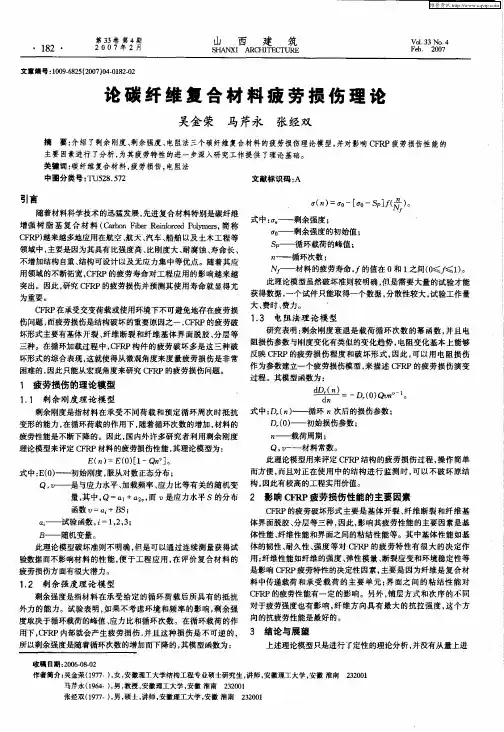
论碳纤维复合材料疲劳损伤理论
吴金荣 马芹永张经双
摘要:介绍了剩余刚度、剩余强度、电阻法三个碳纤维复合材料的疲劳损伤理论模型,并对影响CFRP疲劳损伤性能的
主要因素进行了分析,为其疲劳特性的进一步深入研究工作提供了理论基础。
关键词:碳纤维复合材料,疲劳损伤,电阻法
中圈分类号:Tu528.572
引肓
随着材料科学技术的迅猛发展,先进复合材料特别是碳纤维
增强树脂基复合材料(Carbon Fiber Reinforced Polymers,简称
CFI )越来越多地应用在航空、航天、汽车、船舶以及土木工程等
领域中,主要是因为其具有比强度高、比刚度大、耐腐蚀、寿命长、
不增加结构自重、结构可设计以及无应力集中等优点。随着其应
用领域的不断拓宽,CFRP的疲劳寿命对工程应用的影响越来越
突出。因此,研究CFRP的疲劳损伤并预测其使用寿命就显得尤
为重要。
CFRP在承受交变荷载或使用环境下不可避免地存在疲劳损
伤问题,而疲劳损伤是结构破坏的重要原因之一,CFRP的疲劳破
坏形式主要有基体开裂、纤维断裂和纤维基体界面脱胶、分层等
三种。在循环加载过程中,CFI 构件的疲劳破坏多是这三种破
坏形式的综合表现,这就使得从微观角度来度量疲劳损伤是非常
困难的,因此只能从宏观角度来研究CFI 的疲劳损伤问题。
1疲劳损伤的理论模型
1.1剩余刚度理论模型
剩余刚度是指材料在承受不同荷载和预定循环周次时抵抗
变形的能力,在循环荷载的作用下,随着循环次数的增加,材料的
疲劳性能是不断下降的。因此,国内外许多研究者利用剩余刚度
理论模型来评定CFRP材料的疲劳损伤性能,其理论模型为:
E( ) E(O)[1一Qn ]。
材料专业学术英文词汇

材料专业学术翻译必备词汇 编号 中文 英文 1 合金合金 alloy 2 材料材料 material 3 复合材料复合材料 properties 4 制备制备 preparation 5 强度强度 strength 6 力学力学 mechanical 7 力学性能力学性能 mechanical 8 复合复合 composite 9 薄膜薄膜 films 10 基体基体
matrix 11 增强增强 reinforced 12 非晶
非晶 amorphous 13 基复合材料基复合材料
composites 14 纤维纤维
fiber 15 纳米纳米 nanometer 16 金属
金属 metal 17 合成合成
synthesis 18 界面界面
interface 19 颗粒颗粒 particles 20 法制备
法制备 prepared 21 尺寸尺寸
size 22 形状形状 shape 23 烧结烧结
sintering 24 磁性磁性 magnetic 25 断裂断裂
fracture 26 聚合物聚合物 polymer 27 衍射衍射
diffraction 28 记忆记忆 memory 29 陶瓷陶瓷
ceramic 30 磨损磨损 wear 31 表征表征
characterization 32 拉伸拉伸 tensile 33 形状记忆形状记忆
memory 34 摩擦摩擦 friction 35 碳纤维碳纤维 carbon
36 粉末粉末 powder 37 溶胶溶胶 sol-gel 38 凝胶凝胶 sol-gel 39 应变应变 strain 40 性能研究性能研究 properties 41 晶粒晶粒 grain 42 粒径粒径 size 43 硬度硬度 hardness 44 粒子粒子 particles 45 涂层涂层 coating
46 氧化氧化 oxidation 47 疲劳疲劳 fatigue
针刺C/SiC复合材料拉-压疲劳特性与失效机理
针刺C/SiC复合材料拉-压疲劳特性与失效机理
方光武;高希光;宋迎东
【摘 要】T he tension‐compression fatigue behavior for needled C/SiC
composite at room temperature was studied and compared with the
properties under tension‐tension fatigue loading .The results show that the
tension‐compression fatigue strength of the needled C/SiC composites is
slightly lower than that under tension‐tension loading .Hysteresis
phenomenon can be observed under both loading sta‐tions .The loops
move to the right and their slopes and areas increase as the cycles
increase .The mi‐crostructure of the composites and the morphology of
the fractured surfaces of the failure specimens can be observed by SEM .It
show s that in addition to the matrix cracking and interface debonding , w
hich is vertical to the loading direction ,the meso failure mechanism under
基于内聚力模型的疲劳损伤umat子程序
基于内聚力模型的疲劳损伤umat子程序
疲劳损伤是指材料在受到交变应力作用下逐渐失效的过程。在工程领域中,疲劳损伤是一种非常常见的现象,它对于材料的寿命和安全性都有着重要的影响。对于疲劳损伤的研究和预测显得格外重要。
在材料科学领域中,有许多模型和方法被用来描述和预测疲劳损伤的行为。其中,内聚力模型是一种比较常用的方法之一。内聚力模型是一种基于材料内部微观结构和颗粒间相互作用力的模型。它通过对材料内部微观结构的分析,来预测材料在受到交变应力作用下的损伤行为。这种模型在描述金属、复合材料和岩石等材料的疲劳损伤行为方面有着广泛的应用。
在近年来,随着计算机和数值模拟技术的发展,基于内聚力模型的疲劳损伤umat子程序得到了广泛的应用。umat子程序是一种可以被嵌入有限元分析软件中的子程序,它可以用来描述材料在受到外力作用下的本构行为和力学性能。通过将内聚力模型嵌入umat子程序中,可以对材料的疲劳损伤行为进行更加精确的数值模拟和预测。这种方法不仅可以帮助工程师们更好地理解材料在疲劳加载下的行为,还可以为工程实践提供重要的参考依据。
基于内聚力模型的疲劳损伤umat子程序的研究和应用已经取得了许多重要的成果。下面我们将详细介绍一下这方面的研究现状和进展。
一、内聚力模型的基本原理
内聚力模型是一种描述材料微观结构和颗粒间相互作用力的模型。它通过考虑材料中微观裂纹和颗粒间的相互作用力,来预测材料在外力作用下的损伤行为。内聚力模型的基本原理可以概括为以下几点:
1. 裂纹扩展规律:内聚力模型通常会考虑裂纹在材料内部的扩展规律。它会考虑裂纹扩展的速率、方向和对材料损伤程度的影响,从而对材料的疲劳寿命进行预测。
2. 颗粒间相互作用力:内聚力模型还会考虑材料内部颗粒间的相互作用力。这些相互作用力会对材料的损伤行为产生重要影响,因此对这些力的分析是内聚力模型的重要组成部分。
3. 微观结构参数:内聚力模型还会考虑材料的微观结构参数,如晶界、晶粒大小和形状等。这些参数会影响材料的力学性能和疲劳损伤行为,因此也是内聚力模型考虑的重要因素。
复合材料专业英语词汇
Acetyl||乙酰
Acid-proof paint||耐酸涂料, 耐酸油漆
Acrylic fiber||丙烯酸纤维
Acrylic resin||丙烯酸树脂
Active filler||活性填料
Adapter assembly||接头组件
Addition polyimide||加成型聚酰亚胺
Addition polymer||加聚物
Adjusting valve||调整阀,调节阀
Adhersion assembly||粘合装配
Adhersion bond||胶结
Adjustable-bed press||工作台可调式压力机
Adjuster shim||调整垫片
Adjusting accuracy||调整精度,调校精度
Admissible error||容许误差
Admissible load||容许载荷
Adsorbed layer||吸附层
Advanced composite material||先进复合材料,高级复合材料
Advanced development vehicle||试制车,预研样车
AE(Automobile Engineering)||汽车工程技术
Aeolotropic material||各向异性材料
Aerated plastics||泡沫塑料, 多孔塑料
Aerodynamic body||流线型车身
Aft cross member||底盘/车架后横梁
Air bleeder||排气孔
Air clamp||气动夹具
Air deflector||导流板;导风板,气流偏转板
Air intake manifold||进气歧管
Air servo||伺服气泵
Air-tight joint||气密接头
All-plastic molded||全塑模注的
All polyster seat||全聚酯座椅
chaboche疲劳公式拟合
chaboche疲劳公式拟合
Chaboche疲劳公式是一种用于描述材料在循环加载下的疲劳行为的经验公式。它是由法国学者Chaboche于1986年提出的,被广泛应用于工程实践中。
疲劳是材料在循环加载下发生的损伤与破坏,是工程结构使用的一个重要问题。通过研究材料的疲劳行为,可以预测结构在实际使用中的寿命,从而指导工程设计与维护。
Chaboche疲劳公式是一种基于静态强度学说的扩展,它考虑了材料在循环加载下的强度损失和硬化行为。该公式的基本形式如下:
dε/dN = C(σ - σy)^m(1 - (σ/σu)^n)
其中,dε/dN表示单位循环应变下的损伤速率,C、m和n是与材料性质相关的参数,σ表示循环应力幅,σy是材料的屈服强度,σu是材料的抗拉强度。
Chaboche疲劳公式的优点是能够较好地描述材料的非线性行为和强度损失效应。通过调整参数C、m和n,可以模拟不同材料在疲劳加载下的行为。然而,该公式也存在一些局限性,例如难以准确描述材料的寿命和断裂行为。
在工程实践中,利用Chaboche疲劳公式可以进行疲劳寿命预测和结构安全评估。首先,需要通过实验或试验数据确定材料的参数C、m和n。然后,根据结构的应力状态,计算出循环应力幅σ,并代入公式中,得到单位循环应变下的损伤速率。最后,根据损伤积累理论,累积损伤超过临界值时,材料将发生破坏,从而预测出材料的疲劳寿命。
Chaboche疲劳公式的应用范围广泛,适用于金属材料、复合材料等多种材料的疲劳行为研究。同时,该公式也可以与其他疲劳模型相结合,以提高预测的准确性。
Chaboche疲劳公式是一种常用的用于描述材料在循环加载下的疲劳行为的公式。通过研究材料的疲劳行为,可以为工程结构的设计和维护提供重要参考,提高结构的安全性和可靠性。在实际应用中,需要根据具体材料的参数和应力状态来进行公式的计算和寿命预测。
复合材料与工程专业专业英语
复合材料与工程专业专业英语复合材料原理中文英文复合材料composite material基体matrix增强体reinforcement纤维fiber颗粒particle晶须whisker纳米管nanotube石墨烯graphene复合效应composite effect复合理论composite theory增强机制reinforcement mechanism界面interface界面层interphase界面粘结强度interfacial bond strength界面物理化学interfacial physical chemistry聚合物基复合材料polymer matrix composite (PMC)金属基复合材料metal matrix composite (MMC)陶瓷基复合材料ceramic matrix composite (CMC)碳-碳复合材料carbon-carbon composite (C-C)遗态复合材料biomimetic composite分级结构复合材料hierarchical composite剪切增稠柔性复合材料shear thickening fluid composite (STFC)连续缠绕工艺filament winding process拉挤工艺pultrusion process注射成型工艺injection molding process压缩成型工艺compression molding process热压工艺hot pressing process热等静压工艺hot isostatic pressing process (HIP)化学气相沉积法chemical vapor deposition (CVD)物理气相沉积法physical vapor deposition (PVD)液相浸渗法liquid phase infiltration (LPI)气相浸渗法gas phase infiltration (GPI)反应浸渗法reaction infiltration (RI)自蔓延高温合成法self-propagating high-temperature synthesis (SHS)电泳沉积法electrophoretic deposition (EPD)溶胶-凝胶法sol-gel method复合材料工艺中文英文复合材料工艺学composite material processing science复合材料加工技术composite material processing technology复合材料成型方法composite material forming method复合材料固化方法composite material curing method复合材料后处理方法composite material post-processing method复合材料接头技术composite material joint technology复合材料修复技术composite material repair technology复合材料表面处理技术composite material surface treatment technology复合材料工艺参数composite material process parameters复合材料工艺性能composite material process performance复合材料工艺缺陷composite material process defects复合材料工艺模拟composite material process simulation复合材料工艺优化composite material process optimization手糊法hand lay-up method喷射成型法spray-up method真空吸附法vacuum bagging method自动糊层机法automatic tape laying method (ATL)自动纤维放置法automated fiber placement method (AFP)树脂传输成型法resin transfer molding method (RTM)树脂膜层叠加成型法resin film infusion method (RFI)真空辅助树脂传输成型法vacuum assisted resin transfer molding method (VARTM)真空辅助树脂注射成型法vacuum assisted resin injection molding method (VARI)树脂浸渍拉挤成型法resin impregnation pultrusion method树脂浸渍缠绕成型法resin impregnation winding method树脂浸渍编织成型法resin impregnation weaving method预浸料成型法prepreg molding method预浸料自动糊层机法prepreg automatic tape laying method预浸料自动纤维放置法prepreg automated fiber placement method预浸料真空吸附法prepreg vacuum bagging method预浸料热压成型法prepreg hot pressing method预浸料热等静压成型法prepreg hot isostatic pressing method预浸料自动模具线成型法prepreg automatic mold line method (AML)模塑复合材料成型法molded compound molding method压缩模塑复合材料成型法compression molded compound molding method注射模塑复合材料成型法injection molded compound molding method转移模塑复合材料成型法transfer molded compound molding method挤出模塑复合材料成型法extrusion molded compound molding method热解复合材料制备方法pyrolysis composite preparation method复合材料结构设计中文英文复合材料结构设计composite material structural design复合材料结构分析composite material structural analysis复合材料结构优化composite material structural optimization复合材料结构可靠性composite material structural reliability复合材料结构失效模式composite material structural failure mode复合材料结构失效准则composite material structural failure criterion复合材料结构强度composite material structural strength复合材料结构刚度composite material structural stiffness复合材料结构稳定性composite material structural stability复合材料结构疲劳性能composite material structural fatigue performance复合材料结构断裂韧性composite material structural fracture toughness复合材料结构损伤容限composite material structural damage tolerance复合材料层合板composite material laminate复合材料夹层板composite material sandwich panel复合材料桁架composite material truss复合材料梁composite material beam复合材料板壳composite material plate-shell复合材料管壳composite material tube-shell复合材料网格壳composite material grid-shell复合材料蜂窝板composite material honeycomb panel纤维方向角fiber orientation angle层厚比thickness ratio层间剪切模量interlaminar shear modulus层间剪切强度interlaminar shear strength层间正应力强度因子interlaminar normal stress intensity factor层间剪应力强度因子interlaminar shear stress intensity factor层间断裂韧度interlaminar fracture toughness层间脱层interlaminar delamination层间裂纹扩展速率interlaminar crack propagation rate层间裂纹扩展阻力曲线interlaminar crack resistance curve (R-curve)层内应力分布intralaminar stress distribution层内应变分布intralaminar strain distribution层内失效模式intralaminar failure mode层内失效准则intralaminar failure criterion复合材料力学中文英文复合材料力学composite material mechanics复合材料弹性理论composite material elasticity theory中文英文复合材料弹塑性理论composite material elasto-plasticity theory复合材料粘弹性理论composite material viscoelasticity theory复合材料热弹性理论composite material thermoelasticity theory复合材料非线性力学composite material nonlinear mechanics复合材料动力学composite material dynamics复合材料疲劳力学composite material fatigue mechanics复合材料断裂力学composite material fracture mechanics复合材料损伤力学composite material damage mechanics复合材料微观力学composite material micromechanics复合材料宏观力学composite material macromechanics复合材料多尺度力学composite material multiscale mechanics复合材料本构关系composite material constitutive relation复合材料本构方程composite material constitutive equation复合材料本构模型composite material constitutive model复合材料本构参数composite material constitutive parameter复合材料本构参数识别方法composite material constitutive parameter identification method纤维增强复合材料单元细胞模型fiber reinforced composite unit cell model纤维增强复合材料等效模量计算方法fiber reinforced composite equivalent modulus calculation method纤维增强复合材料等效泊松比计算方法fiber reinforced composite equivalent poisson ratio calculation method纤维增强复合材料等效热膨胀系数计算方法fiber reinforced composite equivalent thermal expansion coefficient calculationmethod纤维增强复合材料等效热导率计算方法fiber reinforced composite equivalent thermal conductivity calculation method纤维增强复合材料等效电导率计算方法fiber reinforced composite equivalent electrical conductivity calculation method纤维增强复合材料等效介电常数计算方法fiber reinforced composite equivalent dielectric constant calculation method颗粒增强复合材料单元细胞模型particle reinforced composite unit cell model颗粒增强复合材料等效模量计算方法particle reinforced composite equivalent modulus calculation method颗粒增强复合材料等效泊松比计算方法particle reinforced composite equivalent poisson ratio calculation method颗粒增强复合材料等效热膨胀系数计算方法particle reinforced composite equivalent thermal expansion coefficient calculationmethod颗粒增强复合材料等效热导率计算方法particle reinforced composite equivalent thermal conductivity calculation method颗粒增强复合材料等效电导率计算方法particle reinforced composite equivalent electrical conductivity calculation method颗粒增强复合材料等效介电常数计算方法particle reinforced composite equivalent dielectric constant calculation method晶须增强复合材料单元细胞模型whisker reinforced composite unit cell model晶须增强复合材料等效模量计算方法whisker reinforced composite equivalent modulus calculation method晶须增强复合材料等效泊松比计算方法whisker reinforced composite equivalent poisson ratio calculation method晶须增强复合材料等效热膨胀系数计算方法whisker reinforced composite equivalent thermal expansion coefficient calculationmethod晶须增强复合材料等效热导率计算方法whisker reinforced composite equivalent thermal conductivity calculation method晶须增强复合材料等效电导率计算方法whisker reinforced composite equivalent electrical conductivity calculation method