
人教版英语八年级下册Unit1知识点
人教版英语八年级下册Unit1知识点 A 1.advice n. 建议,忠告,劝告 (1)advice是不可数名词,表示“一条建议”“两条建议”“一些建议”可用: a piece of advice;two piece of advice;some advice
(2)advice作名词时的常用搭配: ①ask sb. for advice征询某人的建议 ②give sb. some advice= give some advice to sb.给某人提出一些建议 ③give advice on sth.在某方面给出建议 ④take (follow) one’s advice接受某人的建议 e.g. He often gives us some advice.=He often gives some advice to us. 他经常给我们一些建议. ★例题:Your ______ is very helpful. I guess I’ll take it. A. secret B. advice C. promise D. purpose 答案:B 秘密;建议;承诺;目标.由下句“我想我会采纳.”可知“你的建议很有用”.
2.What’s the matter?怎么了? (1)该句用来询问对方所遇到的麻烦,或医生及护士询问病人身体情况,常与with连用,后跟sb./sth.,意为“某人或某物怎么了?” e.g.——What’s the matter (with you)? (你)怎么了? ——I lost my pen./I have a cold. 我把我的钢笔弄丢了./我感冒了.
(2)“(你)怎么了?”各种常见表达: What’s the matter (with you)? =What’s the trouble (with you)? =What’s the problem(with you)? =What’s wrong (with you)?=What’s up? =What happened? ★例题:——Nick is not at school. _______? ——He has a cold. A. Who’s that B. What’s the matter C. How old is he D. How much is it 答案:B 句意:——Nick没来上学.怎么回事? ——他感冒了. ①此类句型中,matter,problem前需加定冠词the,trouble前可加the或形容词性物主代词;wrong是形容词,其前不加任何修饰词. ②此类句型中,what即为句子主语,本身构成陈述语序,故当句子以宾语从句身份出现时,不可将be移至the matter/trouble/problem之后.
3.have a stomachache胃疼 (1)have +a(n)+名词,表示患某种病 e.g. have a cold感冒 have a toothache牙疼 have a fever发烧 have a headache头疼 拓展:sore与pain也可用于表示疾病的短语 e.g. have a sore throat(back/knee…)嗓子疼(背疼/膝盖疼…) have a pain in the back(foot/knee…)背疼(脚疼/膝盖疼) (2)stomachache可数名词,意为“胃疼;腹疼”,是由名词stomach(胃;腹部)加ache(疼痛)构成的复合名词. “身体部位+ache”构成疾病名称 headache头疼 toothache牙疼 backache背疼 ★例题:——Mom,I _____. ——I’m sorry to hear that,dear. We must go to see the dentist right away. A. have a headache B. have a stomachache C. have a toothache 答案:C 由下文“dentist”可知孩子牙疼.
4.foot n. 脚 foot作为可数名词用,其复数形式是feet. e.g. This kind of animal has four feet.这种动物有四只脚. (1)与foot变复数的变化形式相似的词还有:tooth-teeth牙齿 goose-geese鹅 (2)on foot步行,固定短语,相当于walk. e.g. We came here on foot.=We walked here.我们走着来这儿的.
5.fever n. 发烧 e.g. Tom has a fever.汤姆发烧了. (1)have a fever=have a temperature=run a fever发烧 e.g. I had a temperature last night.昨晚我发烧了. ★例题:Nancy took her temperature and found she had a _____. A. cough B. toothache C. cold D. fever 答案:D 由上文“南希量了一下体温”可知发现她发烧了.
(2)拓展:have a high temperature/fever发高烧 6.lie v. 躺,平躺 (1)lie的各种含义: ①lie v. 躺,位于,平放 lay-lain-lying e.g. You should lie down.你应该躺下. His school lies in the north of the city.他的学校位于城北. ②lie v. 说谎 lied-lied-lying e.g. He often lies.他经常说谎 ③lie n. 谎言 lies(复数) e.g. He often tells lies.他经常说谎. ★例题:Look,there is a wallet _____ on the playground. A. lie B. lying C. lay D. lain 答案:B There be…doing sth.为固定句式,lie躺,位于,平放,其现在分词是lying.
(2)拓展:lay v. 下蛋,放置 e.g. The hens lay a lot of eggs every day.母鸡每天下很多蛋. Please lay the table before dinner.饭前请摆好餐具.
7.rest v. & n. 放松;休息 (1)rest作及物动词,意为“使休息”,作不及物动词,意为“休息”. e.g. You should rest your eyes after a lot of reading.在大量阅读之后,你应该休息一下你的眼睛. I’m tired,and I want to rest.我累了,我想休息.
(2)rest也可以作名词,have/take a rest=have/take a break,意为“休息一下”. e.g. Students have a rest/break after each lesson.学生们每节课后都休息一下. 8.feel v. 摸起来 (1)feel常用作系动词,其后跟形容词作表语.其主要用法有: ①表示某物摸起来给人的感觉,通常要以被摸之物作主语,不可用于进行时态. e.g. Your hand feels cold.你的手摸起来很凉. Silk feels soft and smooth.丝绸摸起来柔软平滑. ②表示某人的感觉,以人作主语,可用于进行时态. e.g. I feel fine./I’m feeling fine.我感觉良好./我现在感觉良好.
(2)归纳:常用的感官动词:feel摸起来,look看起来,sound听起来,taste尝起来,smell闻起来. (3)拓展:feel like +n. 意为“摸起来像…” e.g. This wallet feels like leather.这个钱包摸起来像是皮的. ★ A. sounds B. tastes C. feels D. smells 答案:C 句意:这张床摸起来柔软而且舒服.
9.without prep. 没有,缺乏 (1)without后接名词、代词宾格或v.-ing作宾语,其反义词为with. e.g. We got there without any trouble. 我们到了那儿,一路上没遇到任何麻烦. Can you finish your homework without him? 没有他你能完成你的家庭作业吗? She left the room without saying a word. 她一句话没有说就离开了房间. ★例题:The “teacher-free exam”means that students take their exams _____ teachers. Students must be more honest. A. without B. against C. through D. by 答案:A 没有;反对;通过;被.由后句“学生们必须更加诚实”,可知“teacher-free exam”意思是没有老师监考的测试.
(2)拓展:without用于否定句,还可以表示条件,意为“如果没有”,相当于if引导的否定条件句. e.g. We couldn’t live without air.=We couldn’t live if there weren’t air. 如果没有空气,我们就不能活. ★例题:W______ your help,I couldn’t have passed the exam. 答案:Without 句意:如果没有你的帮助,我不能通过考试.
10.hurt v. (使)疼痛;受伤 (1)hurt-hurt(过去式)-hurt(过去分词) (2)hurt作及物动词,表示“使疼痛,受伤;使不快”,后接宾语. e.g. You hurt her feelings because you forgot her birthday. 你伤了她的感情因为你忘记了她的生日. A boy hurt himself in P.E. class.一个男孩在体育课上伤着自己了. (3)hurt作不及物动词,表示“感到疼痛”. e.g. My feet hurt. 我脚疼.
11. …when the driver saw an old man lying on the side of the road. ……,就在此时司机看到一位老人躺在路边. (1)when引导时间状语从句,除常常有“当…时”之意外,放在过去进行时构成的主句之后,还
最全面人教版八年级下册英语第一单元知识点归纳总结
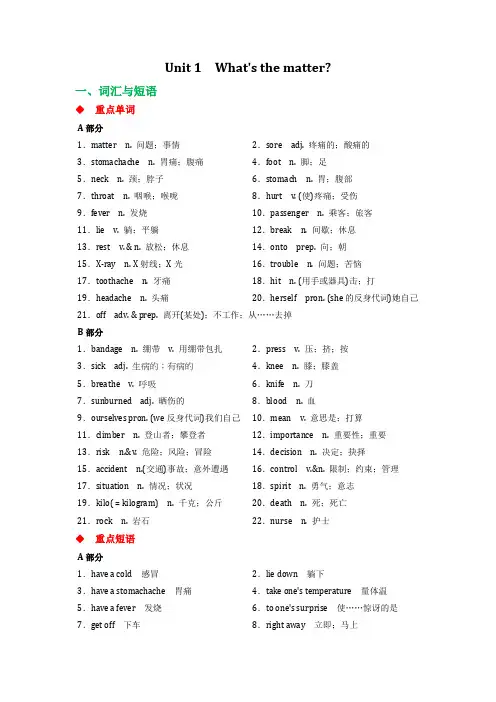
Unit 1 What's the matter?一、词汇与短语◆重点单词A部分1.matter n. 问题;事情2.sore adj. 疼痛的;酸痛的3.stomachache n. 胃痛;腹痛4.foot n. 脚;足5.neck n. 颈;脖子6.stomach n. 胃;腹部7.throat n. 咽喉;喉咙8.hurt v. (使)疼痛;受伤9.fever n. 发烧10.passenger n. 乘客;旅客11.lie v. 躺;平躺12.break n. 间歇;休息13.rest v. &n. 放松;休息14.onto prep. 向;朝15.X-ray n. X射线;X光16.trouble n. 问题;苦恼17.toothache n. 牙痛18.hit n. (用手或器具)击;打19.headache n. 头痛20.herself pron. (she的反身代词)她自己21.off adv. & prep. 离开(某处);不工作;从……去掉B部分1.bandage n. 绷带v. 用绷带包扎2.press v. 压;挤;按3.sick adj. 生病的;有病的4.knee n. 膝;膝盖5.breathe v. 呼吸6.knife n. 刀7.sunburned adj. 晒伤的8.blood n. 血9.ourselves pron. (we反身代词)我们自己10.mean v. 意思是;打算11.climber n. 登山者;攀登者12.importance n. 重要性;重要13.risk n.&v. 危险;风险;冒险14.decision n. 决定;抉择15.accident n.(交通)事故;意外遭遇16.control v.&n. 限制;约束;管理17.situation n. 情况;状况18.spirit n. 勇气;意志19.kilo( = kilogram) n. 千克;公斤20.death n. 死;死亡21.rock n. 岩石22.nurse n. 护士◆重点短语A部分1.have a cold 感冒2.lie down 躺下3.have a stomachache 胃痛4.take one's temperature 量体温5.have a fever 发烧6.to one's surprise 使……惊讶的是7.get off 下车8.right away 立即;马上9.take breaks (take a break) 休息10.talk too much 说得太多11.drink enough water 喝足够的水12.have a very sore throat 嗓子非常疼13.get an X-ray 拍X光片14.see a dentist 看牙医15.drink some hot tea with honey 喝一些加蜂蜜的热茶16.put some medicine on sth.在……上面敷一些药17.feel very hot 感到很热18.sound like 听起来像19.all weekend 整个周末20.in the same way 以同样的方式21.go to a doctor 看医生22.go along 沿着……走23.on the side of the road 在马路边24.shout for help 大声呼救25.without thinking twice 没有多想26.have a heart problem 有心脏病27.thanks to 多亏了;由于28.in time 及时29.save a life 挽救生命30.get into trouble 陷入麻烦31.hurt oneself 受伤32.fall down落下;摔倒B部分1.be used to 习惯于……;适应于……2.in a difficult situation 在困境中3.take risks (take a risk) 冒险4.keep on doing sth. 继续(或坚持)做某事5.run out (of) 用尽;耗尽6.make a decision 作出决定7.cut off 切除8.get hit on the head 撞到头部9.get out of 离开;从……岀来10.be interested in 对……感兴趣11.give up 放弃12.mean doing sth. 意味着做某事13.put a bandage on sth. 用绷带包扎…14.lose one's life 失去生命15.feel sick 感到恶心16.mountain climbing 登山运动17.have problems breathing 呼吸困难18.be in control of 掌管;管理◆重点句子A部分1.What's the matter with you?=What's the trouble with you?=What's wrong with you?你怎么了?2.What should she do? 她该怎么办呢?3.Did you fall down? 你跌倒了吗?4.Should I take my temperature? 我应该量一下体温吗?5.I think I sat in the same way for too long without moving.我想我以同样的姿势一动不动地坐得太久了。
人教版八年级英语下册Unit1知识点
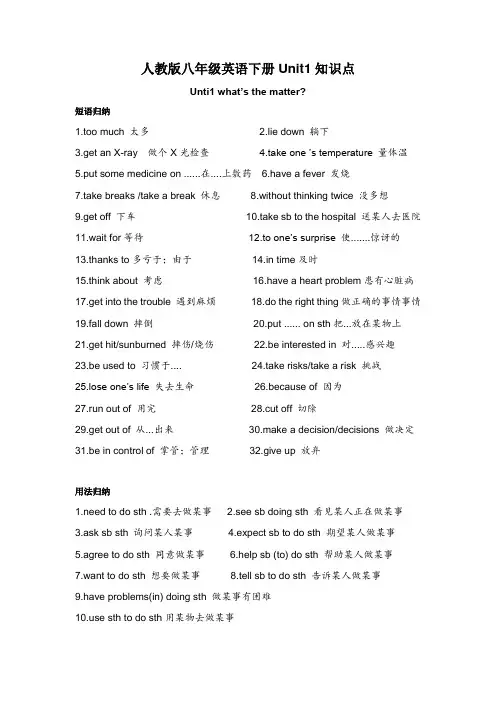
人教版八年级英语下册Unit1知识点Unti1 what’s the matter?短语归纳1.too much 太多2.lie down 躺下3.get an X-ray 做个X光检查4.take one ’s temperature 量体温5.put some medicine on ......在....上敷药6.have a fever 发烧7.take breaks /take a break 休息8.without thinking twice 没多想9.get off 下车10.take sb to the hospital 送某人去医院11.wait for等待12.to one’s surprise 使.......惊讶的13.thanks to多亏于;由于14.in time及时15.think about 考虑16.have a heart problem患有心脏病17.get into the trouble 遇到麻烦18.do the right thing做正确的事情事情19.fall down 摔倒20.put ...... on sth把...放在某物上21.get hit/sunburned 摔伤/烧伤22.be interested in 对.....感兴趣23.be used to 习惯于.... 24.take risks/take a risk 挑战25.lose one’s life 失去生命26.because of 因为27.run out of 用完28.cut off 切除29.get out of 从...出来30.make a decision/decisions 做决定31.be in control of 掌管;管理32.give up 放弃用法归纳1.need to do sth .需要去做某事2.see sb doing sth 看见某人正在做某事3.ask sb sth 询问某人某事4.expect sb to do sth 期望某人做某事5.agree to do sth 同意做某事6.help sb (to) do sth 帮助某人做某事7.want to do sth 想要做某事8.tell sb to do sth 告诉某人做某事9.have problems(in) doing sth 做某事有困难e sth to do sth用某物去做某事11.be/get used to doing sth 习惯于做某事12.seem to do sth 好像做某事13.keep on doing sth 继续做某事14.mind doing sth 介意做某事语法点1.询问某人的健康问题及遇到麻烦的表达方法2.情态动词should的用法3.不定代词的用法精细解读1. What’s the matter (with you)? 怎么了?出什么事了?What’s the trouble/ the problem / wrong with sb./ sth.?2. I had a cold.我感冒了。
八年级英语下册unit1知识点复习(新版人教版)正式版.ppt
• need to do sth.需要做某事,主语通常是 人,表示人主动的动作:You need to listen carefully during class.
• stomach+ache=stomachache head+ache=headache tooth+ache=toothache back+ache=backache后背痛
• 4. much too+ 形容词/副词,意为 太…… , too much+ 不可数名词 ,意为 太多 。
• too many+ 可数名词复数 ,意为 太多 。
• 5. enough【形容、副词】足够的/地, enough放在名前后,形副后。
• good enough足够好,enough money=money money
• 6. lie down躺下, lie 躺,躺着,过去式lay; 过去分词lain,现在分词lying
• 7. maybe “或许”,常用于句首,表示 可能性,后加句子。Maybe you are right.
二、重要短语
1. have a cold 感冒 2. have a stomachache 胃痛
3. see sb. doing sth. 看见某人正在做某事 4. shout for help 呼喊救命 5. expect (sb.) to do sth. 期待做某事 6. to one’s surprise 令某人吃惊的是 7. thanks to … 多亏 8. think about… 考虑
• 8. Xiao Hui, can you introduce _y_o_u_r_s_e_l_f _ to us ?
人教版英语八年级下册unit1单元知识点归纳总结
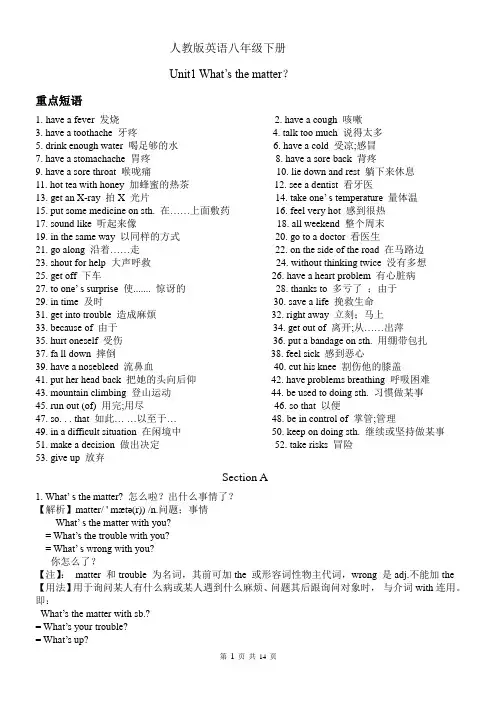
人教版英语八年级下册Unit1 What’s the matter?重点短语1.have a fever 发烧2. have a cough 咳嗽3. have a toothache 牙疼4. talk too much 说得太多5. drink enough water 喝足够的水6. have a cold 受凉;感冒7. have a stomachache 胃疼8. have a sore back 背疼9. have a sore throat 喉咙痛10. lie down and rest 躺下来休息11. hot tea with honey 加蜂蜜的热茶12. see a dentist 看牙医13. get an X-ray 拍X 光片14. take one’ s temperature 量体温15. put some medicine on sth. 在……上面敷药16. feel very hot 感到很热17. sound like 听起来像18. all weekend 整个周末19. in the same way 以同样的方式20. go to a doctor 看医生21. go along 沿着……走22. on the side of the road 在马路边23. shout for help 大声呼救24. without thinking twice 没有多想25. get off 下车26. have a heart problem 有心脏病27. to one’ s surprise 使....... 惊讶的28. thanks to 多亏了;由于29. in time 及时30. save a life 挽救生命31. get into trouble 造成麻烦32. right away 立刻;马上33. because of 由于34. get out of 离开;从……出萍35. hurt oneself 受伤36. put a bandage on sth. 用绷带包扎37. fa ll down 摔倒38. feel sick 感到恶心39. have a nosebleed 流鼻血40. cut his knee 割伤他的膝盖41. put her head back 把她的头向后仰42. have problems breathing 呼吸困难43. mountain climbing 登山运动44. be used to doing sth. 习惯做某事45. run out (of) 用完;用尽46. so that 以便47. so. . . that 如此… …以至于…48. be in control of 掌管;管理49. in a difficult situation 在闲境中50. keep on doing sth. 继续或坚持做某事51. make a decision 做出决定52. take risks 冒险53. give up 放弃Section A1. What’ s the matter? 怎么啦?出什么事情了?【解析】matter/ ' mætə(r)) /n.问题;事情What’ s the matter with you?= What’s the trouble with you?= What’ s wrong with you?你怎么了?【注】:matter 和trouble 为名词,其前可加the 或形容词性物主代词,wrong 是adj.不能加the 【用法】用于询问某人有什么病或某人遇到什么麻烦、问题其后跟询问对象时,与介词with连用。
Unit1知识点归纳人教版八年级英语下册
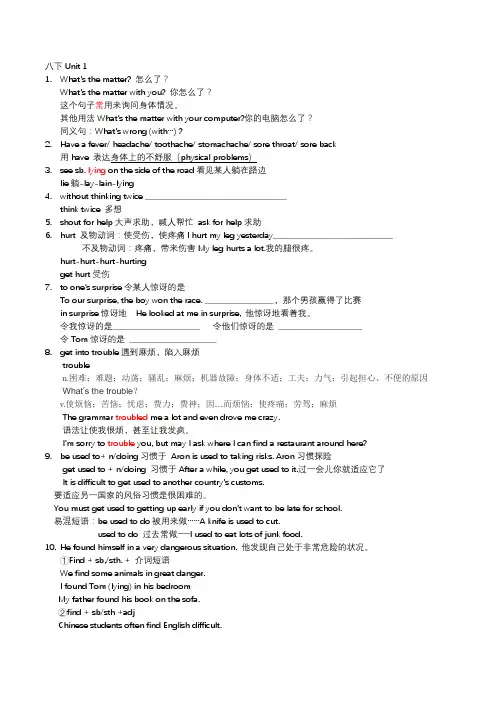
八下Unit 11.W hat’s the matter?怎么了?What’s the matter with you? 你怎么了?这个句子常用来询问身体情况。
其他用法W hat’s the matter with your computer?你的电脑怎么了?同义句:W hat’s wrong (with…) ?2.Have a fever/ headache/ toothache/ stomachache/ sore throat/ sore back用have 表达身体上的不舒服(physical problems)3.see sb. lying on the side of the road看见某人躺在路边lie躺-lay-lain-lying4.without thinking twice _______________________________________think twice 多想5.shout for help大声求助,喊人帮忙ask for help求助6.hurt 及物动词:使受伤,使疼痛I hurt my leg yesterday_________________________________不及物动词:疼痛,带来伤害My leg hurts a lot.我的腿很疼。
hurt-hurt-hurt-hurtingget hurt受伤7.t o one’s surprise令某人惊讶的是To our surprise, the boy won the race. ___________________,那个男孩赢得了比赛in surprise惊讶地He looked at me in surprise, 他惊讶地看着我。
令我惊讶的是________________________ 令他们惊讶的是_______________________令Tom惊讶的是________________________8.get into trouble遇到麻烦,陷入麻烦troublen.困难;难题;动荡;骚乱;麻烦;机器故障;身体不适;工夫;力气;引起担心、不便的原因What’s the trouble?v.使烦恼;苦恼;忧虑;费力;费神;因…而烦恼;使疼痛;劳驾;麻烦The grammar troubled me a lot and even drove me crazy.语法让使我很烦,甚至让我发疯。
Unit1知识点汇总人教版八年级英语下册
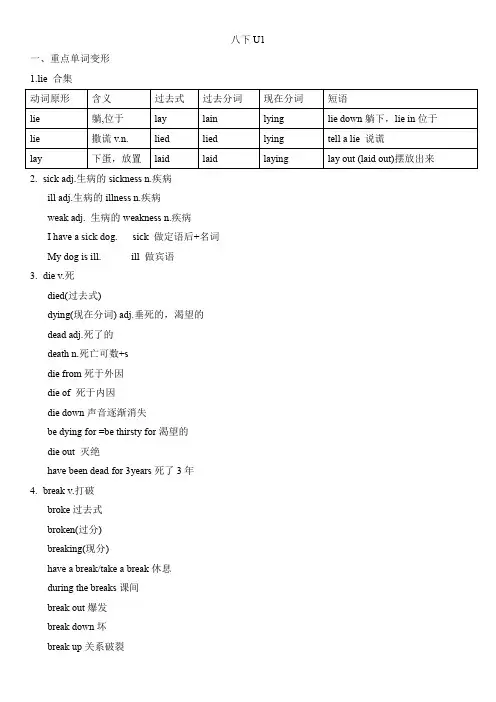
八下U1一、重点单词变形1.lie 合集2.sick adj.生病的sickness n.疾病ill adj.生病的illness n.疾病weak adj. 生病的weakness n.疾病I have a sick dog. sick 做定语后+名词My dog is ill. ill 做宾语3.die v.死died(过去式)dying(现在分词) adj.垂死的,渴望的dead adj.死了的death n.死亡可数+sdie from死于外因die of 死于内因die down声音逐渐消失be dying for =be thirsty for渴望的die out 灭绝have been dead for 3years死了3年4.break v.打破broke过去式broken(过分)breaking(现分)have a break/take a break休息during the breaks课间break out爆发break down坏break up关系破裂5.hurt v.使受伤hurt过去式hurt(过分)hurting(现分)hurt oneself伤害了自己6.hit v.击打hit过去式hit(过分)hitting(现分)hit n.点击量hit sb. on +部位打某人某处7.carry v.拿;提;扛carried过去式carried(过分)carrying(现分)8.cut v.切cut过去式cut(过分)cutting(现分)cut n.伤口cut down砍倒;削减cut out删去cut off切断;中断cut in插嘴;插入cut into把....切成cut up切碎9.important adj.重要的importance n.重要性the importance of ...的重要性more important 比较级the most important 最高级10.c limb v.爬山climber n.登山者11.d ecide v.决定decision n.决定make a decision 做一个决定make up one’s mind 自己做决定做某事decide to do sth. 决定去做某事12.k nife n.小刀knives pl.13.t ooth n. 牙齿teeth pl.toothache n.牙疼have a toothache 患有牙疼的症状14.a ccident n.事故accidental adj.偶然的accidentally adv. 偶然地by accident 偶然15.m ean v.意思是adj. 吝啬的meaning n.意思meaningful adj.有意义的meaningless adj.无意义的mean to do 故意做某事mean doing意味着做...have meaning to do 做某事有意义短语1.an xray一个x光2.keep on doing持续做某事3.go on doing坚持做某事4.run out=run out of =use up 用完用尽5.right away=right now =at once立即马上6.see sb. doing sth看见正在做某事see sb. do sth.看到某人做完某事find sb. doing sth. 发现某人正在做某事watch sb. doing sth.看见正在做某事watch sb. do sth.看到某人做完某事notice sb. doing sth.看见正在做某事notice sb. do sth.看到某人做完某事hear sb. doing sth.听到正在做某事hear sb. do sth.听到某人做完某事7.have a fever 发烧have a toothache牙疼have a cold 感冒have a sore throat喉咙疼have a sore back后背疼have a stomachache胃疼8.get over克服get through处理,完成get off下车get on上车get up起床get dressed穿衣服get into陷入get out of离开;从......出来get out 滚出去9.give up doing 放弃做某事give out=hand out分发give away捐赠give sb. sth=give sth. to sb.把...东西给某人give in 屈服投降10.to one’s surprise让某人惊讶的是be surprised to do sth.做某事感到惊讶in surprise惊讶地=surprisinglybe surprised at sth.惊讶于...11.on time准时in time及时from time to time 有时候at times 有时候all the time 一直12.be in control of处于掌控中out of control of 脱离控制13.have risk 有风险take risks 冒险ed to do 过去常常做某事be /get used to doing现在习惯做某事15.what’s wrong=what’s the matter(trouble)with you?你怎么了(询问身体病情)16.have trouble/problem/difficulty (in)doing sth.在做某事方面有问题17.enjoy oneself玩得开心help oneself自便say to oneself和自己说learn by oneself自学teach oneself自学。
人教版英语八年级下册 Unit 1 What's the matter_知识点总结
Unit 1 What’s the matter? 知识点总结一、询问病症What’s the matter (with sb.)?What’s the trouble(with sb.)?What’s wrong/ up (with sb.)?What happened to sb.?Is there anything wrong with sb.?二、表达病症及事故have/has/had a +病症have a cold/ fever/ cough 感冒、发烧、咳嗽have/has/had a +身体部位+ache have a headache/ toothache/ stomachache头疼、牙疼、肚子疼have/has/had a +sore+身体部位have a sore back/ leg/ throat腰疼、腿疼、喉咙痛其他类疾病或事故cut oneself切到某人自己hurt oneself 伤到某人自己have a nosebleed 流鼻血have a heart problem 有心脏病fall down 摔伤feel sick 感到不舒服get hit on the head by a ball被球击中脑袋get sunburned 晒伤have problems breathing 呼吸困难三、询问及给建议特殊疑问句:What should sb. do? Sb. should ......例:what should I do? You should take your temperature.一般疑问句及答语: Should sb. do..? Yes, sb, should/ No, sb. shouldn’t.例:Should he lie down? Yes, he should./ No, he shouldn’t.对症下药(提建议)You should/ shouldn’t..../ You’d better(not) dotake one's temperature 量体温go to the doctor 看医生drink some hot water with honey 喝带有蜂蜜的热水lie down and rest 躺下休息see a dentist and get an X-ray 看牙医、拍片brush your teeth after meals 饭后刷牙take medicine three times a day 一日喝三次药take breaks away from the computer 远离电脑休息rest for a few days 休息几天put some medicine on the cut 在伤口上敷药Put a bandage on the cut包扎伤口作文输出1、假如你是Lucy,你的好朋友Mary这几天觉得牙疼。
Unit 1 单元知识点总结课件--八年级英语下册(人教版)
02 作表语
描述身体/精神状态或感觉
常放be, feel, seem, look…后
You can be yourself.
03 作同位语
强调作用, 常作主语或宾语 的同位语, 表示“亲自,本人” The story itself is good. .
02
(die- died- died- dying)
She died 2 years ago.
04 dying adj. 垂死的,要死的
This is a dying bird.
2.7 risk
n. 危险,风险
the risk of … …的风险 Staying up will increase the risk of the illness.
lie down and rest / shouldn’t eat so much next time
④ have a toothache
see a dentist and get an X-ray
⑤ have a fever
take one’s temperature
⑥ have a headache
Words
matter, lie, enough, mean…
2.1 matter
n. 问题,事情
-- What’s the matter with you? -- I hurt my leg.
v. 要紧,有关系
It doesn’t matter.
2.2 enough
位置:前形副后
adj. 足够的,充足的 enough + n I have enough money.
人教版英语八年级下册第一单元Unit 1知识点
Unit1What’s the matter知识点Section A1.What’s the matter?怎么啦?出什么事情了?【解析】matter n.问题;事情What’s the matter with you?=What’s the trouble with you?=What’s wrong with you?【注】:matter和trouble为名词,其前可加the或形容词性y物主代词,wrong是adj.不能加the【用法】用于询问某人有什么病或某人遇到什么麻烦、问题其后跟询问对象时,与介词with连用。
即:What’s the matter with sb.?=What’s your trouble?=What’s up?=What happened to sb.?【拓展】matter的用法(1)It doesn’t matter没关系(用来回答别人道歉时的用语)()—I’m sorry to break your pen.—_______ A.That’s right B.It doesn’t matter C.Thank you 答案:B(2)as a matter of fact=in fact事实上,实际上2.I have a cold我感冒了I have a stomachache我患胃痛I have a sore back.我背痛。
【解析】have a cold受凉;感冒have a/an+疾病名词“患……病”(cold/fever/cough)have a sore throat患喉咙痛have a sore back患背痛have a fever发烧have a cold=catch a cold患感冒have a stomachache患胃痛have a toothache患牙痛have a headache患头痛have a backache患背痛①Mike’s sister_________________(not have)a stomachache.答案:doesn't have3.hand n.手hand in hand手拉手V.交给;传递hand in上交hand on依次传递hand out分发4.She talked too much yesterday and didn’t drink enough water.她昨天说话太多了并且没有喝足够的水。
Unit1知识点归纳人教版英语八年级下册
第一单元单元语法点:一. 情态动词should的用法1. 含义:情态动词should意为“应当,应该”,后接动词原形,没有人称和数的变化,否定形式为shouldn’t。
2.1.用法:1)表劝告建议You should eat more vegetables and fruit. You shouldn’t eat too much junk food. 你应该多吃蔬菜和水果,不应该吃太多的垃圾食品。
2)表义务责任We should study hard. 我们应该努力学习。
3)表惊讶等感情I’m surprised that he should say so. 我很惊讶他竟然会这么说。
4)用于主语为第一人称的疑问句中,表示征询意见。
Should we tell her about it? 我们应该告诉她这件事吗?二.反身代词1.含义:表示反射或强调的代词叫做反身代词。
反身代词是由第一人称、第二人称形容词性物主代词或第三人称人称代词宾格形式,词尾加self或 selves组成。
反身代词可译为“本人”、“本身”,为加强语气,也常译为“亲自”、“自己”。
请见下表:3.反身代词的常用搭配:玩的高兴、过得愉快enjoy oneself穿衣服dress oneself自便、自用;自取所需help oneself (to)单独地、独自地by oneself细节知识点:1.What’s the matter? 怎么了?1)本句是常见的口语表达,意为“怎么了/出什么事了?”常用来询问某人患了何种疾病或遇到了什么麻烦,其后可接由介词with引出具体询问的对象。
--What’s the matter with Jenny? 珍妮怎么了?--She has a bad cold. 她得了重感冒。
同义句型:= What’s wrong with sb.?= What’s the trouble / problem with sb.?= What’s one’s trouble?= What’s up with sb.?= What happened to sb.?2)matter 名词,意为“问题;事件”。