
have you ever been to an amusement park八年级英语下册Unit_9
water park
zoo
Have you ever been to…? Yes, I have. / haven’ No, I haven’t.
a quarium a space museum Have you ever been to…?
1.have (has) been to 表示“曾经去过某地”, 意思是过去某个时候去过,现在并没有在那个 地方。与次数,just ,never, ever 连用。 She has been to Shanghai three times.(她已经不 在上海,只说明她曾经去过。) I have ever been to Singapore before. We’ve never been to Japan.
“已经”通常用于肯定句中,放在句中。 已经”通常用于肯定句中 放在句中。 放在句中 already: I have already read this book. 有时,也用在疑问句中表示惊讶。 有时,也用在疑问句中表示惊讶。 Have you eaten up all the food already ?
= neither can she.
注意区别: so+助动词+主语 完全倒装,表示 “也……”用在肯定句中 Mary has gone to Singapore. So has Emily. Mary去新加坡了。Emily也去了。 I’ve been collecting kites for two yest do it now,so must you. 你也必须.
1. My father bought many books for me yesterday . Now , I have a lot to read because my father has bought many books for me. ________________________________ 2. I saw this film last week. Now, I know this film because have seen it before I_____________________. 3. I did my homework yesterday. Now, I can give it to the teacher because I______________ have done it.
Neither I
nor he
has
been to Chengdu.
4. 作副词,“也不”,常用作下列结构:否定 句+neither+助动词/be动词/情态动词+另一主语, 表示 “前者没有/不是/…后者也没有/不是… If you won’t go, neither will I.
=Me neither.
现在完成时用来表示过去发生或已完成的 现在完成时用来表示过去发生或已完成的 动作或状态对现在造成的影响或结果 对现在造成的影响或结果,也就 动作或状态对现在造成的影响或结果 也就 是说,动作或状态发生在过去但它的影响现 是说 动作或状态发生在过去但它的影响现 在还存在. 在还存在
I have lost my wallet. (含义是 现在我没有钱花了 含义是:现在我没有钱花了 含义是 现在我没有钱花了.) Jane has just had lunch. (含义是 简现在不饿了.) 含义是:简现在不饿了 含义是 简现在不饿了 Michael has been ill. (含义是 现在仍然很虚弱 含义是:现在仍然很虚弱 含义是 现在仍然很虚弱) He has returned from abroad. (含义是 现在已在此地 含义是:现在已在此地 含义是 现在已在此地)
2. Have (has) been in 表示 “某人一直呆在某 地多长时间了。 地多长时间了。” eg. I’ve been in this school for 17 years ’ old. They have been in Dalian since two years ago. How long have you been in this school ?
非延续性动词不能与时间段连用: 非延续性动词不能与时间段连用: go/come/begin/start/die/buy/borrow/sell /leave/arrive/receive/become等词语是瞬间动词表 等词语是瞬间动词表 示的动作是一时的,不能延续,不能与for、 示的动作是一时的,不能延续,不能与 、since 等表示一段时间的词连用,也不能用于how long引 等表示一段时间的词连用,也不能用于 引 导的疑问句中。 导的疑问句中。 如不能说: 如不能说:He has borrowed the book for two months.(ⅹ) ⅹ 但可以说: 但可以说:He has kept the book for 2 months. 或:It has been 2 months since he borrowed the book. 或:Two months has passed since he borrowed the book.
so+主语+助动词 不完全倒装,表示“确实如此” ---- Lily likes red. lily喜欢红色. --- So she does. 的确如此. ---Tom will skate in an hour.----So he will.
have (has) gone to, have (has) been to和 have(has) been in的区别:
Has he ever been to the
Great Wall? Yes, he has. / No, he hasn’t.
Have you ever been to …? Have you ever been to …? Yes, I have. No, I’ve never been there. ’
I began to teach I have taught English at this English at this school 17 school for 17 years ago. years.
past
now
1. I am a doctor. I began to work when I was 22.Now , I am 26. I have worked for four years. ________ 2. We went to the USA last Monday. Today is Monday . We _________ have stayed (stay) in the USA since last Monday.
aquarium
A: Have you ever been to…?
B:Yes, I have. How about you ?A; Me too. = So have I.
B: No, I haven’t. What about you?A: Me ’ neither.= Neither have I.
water park zoo
an amusement park
space museum
an aquarium
neither 的用法: 1. 作形容词,与单数名词连用,表示“两者都不,两者中没 有一个”,是both的完全否定形式。Neither sentence is right. Both answers are right. (neither+单数名词+单数谓语动词, (neither+单数名词+单数谓语动词, 单数名词 both+复数名词 复数谓语动词) 复数名词+ both+复数名词+复数谓语动词)
an aquarium
a space museum
a zoo a water park an amusement park
Have you ever been to …? A: No, I haven’t. ’ B: Me neither. Me too. Me neither. =Neither have I.
1.have (has) gone to表示“某人到某地去了 ” 意思是某人去了某地,现在人不在说话的地 点,可能是在某地,也可能还在去某地的路 上,总之不在说话地点。 She has gone to Shanghai .(她可能已在去上海 的路上,或已到上海,总之现在不在这里。)
1.Where‘s your father? He has gone to
Yet:
“仍然,还 ” 用在疑问句和否定句 仍然, 中,放在句末。 放在句末。 I haven’t read this book yet . ’ Have you had breakfast yet ?
She began to work in 2005.
She still works here now. She has worked at this school for 6 years.
用法2: 用法2 过去发生的动作一直延续到现在。 过去发生的动作一直延续到现在。 延续到现在
此用法中谓语动词必须是延续的, 此用法中谓语动词必须是延续的, 且常与表示一段时间的状语连用. 且常与表示一段时间的状语连用. for+时间段 时间段, 如:these days, for+时间段, since+过去时间点或since+一般 过去时间点或since+ since+过去时间点或since+一般 过去时的句子。 过去时的句子。
A: Which would you like, milk or juice? B: Neither , I‘d like tea.
Have you ever been to an amusement park 中学八年级下册英语

4: Read the article and find the
answers to these questions.
1 How does Coco Lee attract fans?
She uses Latin music.
2 How do we know that Hollywood likes Jackie Chan?
1 My English writing is good, but I need to_______ my
decided
listening skills. 2 I don’t________. Could you
rent
explain that again, please? 3 That’s a special cinema.
Have you ever been to an amusement park 中学八年级下册英语课件 课件
下载制作模板
1
Fill in the blanks with the
words given. Then make your own sentences with the words:
understand
4 How do fans choose their favorite MTV stars?
They vote on-line.
5 What do Asian films show that western films don’t?
A common theme in Asian
films is how families and friendships are changed by modern life.
Coco Lee uses Latin music
Have you ever been to an amusement park
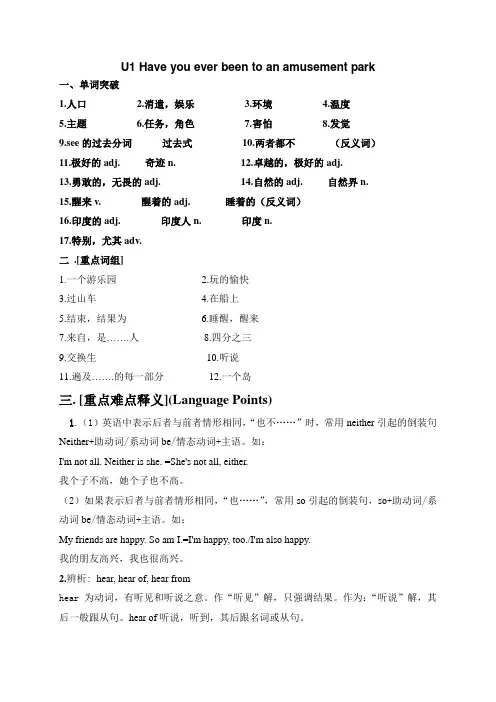
U1 Have you ever been to an amusement park一、单词突破1.人口2.消遣,娱乐3.环境4.温度5.主题6.任务,角色7.害怕8.发觉9.see的过去分词过去式10.两者都不(反义词)11.极好的adj. 奇迹n. 12.卓越的,极好的adj.13.勇敢的,无畏的adj. 14.自然的adj. 自然界n.15.醒来v. 醒着的adj. 睡着的(反义词)16.印度的adj. 印度人n. 印度n.17.特别,尤其adv.二.[重点词组]1.一个游乐园2.玩的愉快3.过山车4.在船上5.结束,结果为6.睡醒,醒来7.来自,是…….人8.四分之三9.交换生10.听说11.遍及…….的每一部分12.一个岛三. [重点难点释义](Language Points)1.(1)英语中表示后者与前者情形相同,“也不……”时,常用neither引起的倒装句Neither+助动词/系动词be/情态动词+主语。
如:I'm not all. Neither is she. =She's not all, either.我个子不高,她个子也不高。
(2)如果表示后者与前者情形相同,“也……”,常用so引起的倒装句,so+助动词/系动词be/情态动词+主语。
如:My friends are happy. So am I.=I'm happy, too./I'm also happy.我的朋友高兴,我也很高兴。
2.辨析: hear, hear of, hear fromhear 为动词,有听见和听说之意。
作“听见”解,只强调结果。
作为:“听说”解,其后一般跟从句。
hear of听说,听到,其后跟名词或从句。
heard from 意为“收到......的信”,“得到......消息”。
注意:hear from 的宾语应该是“人”,而不是“信”。
(2)famous adj. 意思是“著名的,出名的,极好的辨析:be famous for ,be famous as与be famous tobe famous for因为……而出名/著名,for后接表示特点、特长的名词,表示人或物闻名的原因be famous as以……身份出名,for后一般接表示职业的名词。
Have you ever been to an amusement park

Me neither. ( “也不……”)
现在完成时
一般过去时 结构:动词过去式 含义:一般过去时只表示 过去的动作或状态,和现 在不发生关系。它可以和 表示过去的时间状语连用。 I went to Beijing last summer.
结构:have/has+动词 过去分词
含义:表示过去发生或 已经完成的动作对现在 造成的影响或结果。可 与already,never, ever,before,yet 等 状语连用。 Have you ever been to Beijing?
Sarah: Me neither. Let's go to Water City tomorrow!
Claudia: Well, that sounds fun, but I can't swim.
Sarah: Really? I didn't know that. Well, how about the zoo? Have you been to the zoo? Claudia: I've been to the zoo a lot of times. Sarah: Me, too. And I've been to the aquarium also. Claudia: So have I, Sarah. I went there on our last school
Have you ever been to Jilin?
What about you?
No, I haven’t.
Me neither.
Have you ever been to Beijing? Yes, I have. What about you? Me, too.
《Haveyoueverbeentoanamusementpark》SectionA教学设计
《Haveyoueverbeentoanamusementpark》SectionA教学设计《Have you ever been to an amusement park》Section A教学设计教学内容Section A(P68~70)教学目标知识与能力掌握现在完成时态句型Have you ever…? 的答语形式;学会谈论过去发生的事。
过程与方法通过情景导入来引导学生谈论过去发生的事,提出Have you ever…? 问题,继而引出一些新的词汇和句型,然后通过精讲多练的课堂教学来达到本节课的教学目标。
情感态度价值观谈论过去发生的事应是学生很感兴趣的课堂活动,大多数学生喜爱回忆过去并会讲故事。
教学重、难点及突破重点重要句型Have you ever been to Europe? Yes, I have./No, I haven never been to Europe.重点词汇theme park, boats, zoo, European, Holland, houses, travel, space, cartoons, culture, neither, old-fashioned, Peru, rent, South America, visitors, wonderful难点现在完成时态句型Have you ever…? 的答语形式。
教学突破通过情景导入提出Have you ever…? 问题,引导学生积极参与课堂口语交际,学习使用新的词汇和短语,来训练和强化现在完成时态句型Have you ever…? 的答语形式。
教学准备教师准备制作课本2a部分的插图,使用大白纸制作,或制作幻灯片。
也可以直接使用教学挂图。
学生准备预习课本内容,初识新词汇。
教学步骤(第1课时)第一课时教学流程设计教师指导1.情景导入谈论过去发生的事。
2.引导学生进行听力训练。
3.Pairwork小组活动。
Have you ever been to an amusement park PPT课件 16 人教版

•
49、人往往会这样,顺风顺水,人的智力就会下降一些;如果突遇挫折,智力就会应激增长。
•
50、想像力比知识更重要。不是无知,而是对无知的无知,才是知的死亡。
•
51、对于最有能力的领航人风浪总是格外的汹涌。
•
52、思想如钻子,必须集中在一点钻下去才有力量。
•
53、年少时,梦想在心中激扬迸进,势不可挡,只是我们还没学会去战斗。经过一番努力,我们终于学会了战斗,却已没有了拼搏的勇气。因此,我们转向自身,攻击自己,成为自己最大的敌人。
•
54、最伟大的思想和行动往往需要最微不足道的开始。
•
55、不积小流无以成江海,不积跬步无以至千里。
•
56、远大抱负始于高中,辉煌人生起于今日。
•
57、理想的路总是为有信心的人预备着。
•
58、抱最大的希望,为最大的努力,做最坏的打算。
•
59、世上除了生死,都是小事。从今天开始,每天微笑吧。
•
60、一勤天下无难事,一懒天下皆难事。
•
9、永远不要逃避问题,因为时间不会给弱者任何回报。
•
10、评价一个人对你的好坏,有钱的看他愿不愿对你花时间,没钱的愿不愿意为你花钱。
•
11、明天是世上增值最快的一块土地,因它充满了希望。
•
12、得意时应善待他人,因为你失意时会需要他们。
•
13、人生最大的错误是不断担心会犯错。
•
14、忍别人所不能忍的痛,吃别人所不能吃的苦,是为了收获别人得不到的收获。
1. Q: Have you ever been to the dentist(牙科医生)?
A: Yes, I _h_a_v_e_ .
2. Q: Have you ever _b_e_e_n_ to Holland(荷兰)? A: No, I _h_a_v_e_n_’t_.
Have you ever been to an amusement park?知识梳理
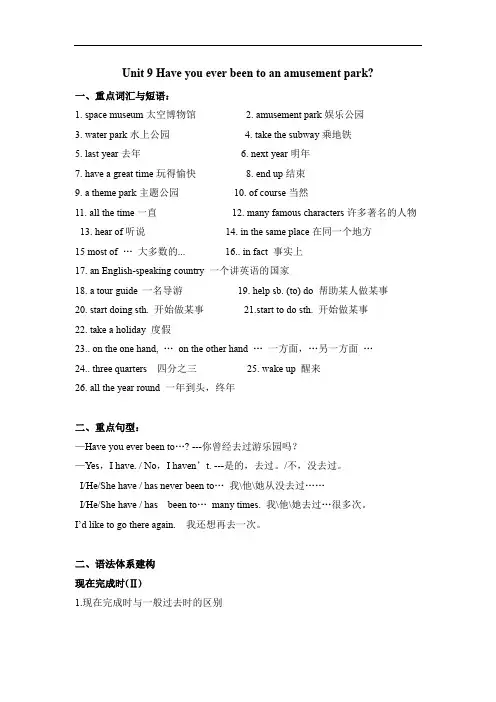
Unit 9 Have you ever been to an amusement park?一、重点词汇与短语:1. space museum太空博物馆2. amusement park娱乐公园3. water park水上公园4. take the subway乘地铁5. last year去年6. next year明年7. have a great time玩得愉快8. end up结束9. a theme park主题公园10. of course当然11. all the time一直12. many famous characters许多著名的人物13. hear of听说14. in the same place在同一个地方15 most of …大多数的... 16.. in fact 事实上17. an English-speaking country 一个讲英语的国家18. a tour guide 一名导游19. help sb. (to) do 帮助某人做某事20. start doing sth. 开始做某事21.start to do sth. 开始做某事22. take a holiday 度假23.. on the one hand, …on the other hand …一方面,…另一方面…24.. three quarters 四分之三25. wake up 醒来26. all the year round 一年到头,终年二、重点句型:—Have you ever been to…? ---你曾经去过游乐园吗?—Yes,I have. / No,I haven’t. ---是的,去过。
/不,没去过。
I/He/She have / has never been to…我\他\她从没去过……I/He/She have / has been to…many times. 我\他\她去过…很多次。
新课标人教版八年级英语下册Have you ever been to an amusement pa
Have you ever been to an amusement park?(3)Section ATalk about past experiences.谈论过去的经历。
1.Have you ever been to an amusement park?你曾到过游乐场吗?(1)本句用现在完成时表示过去发生的事情对现在造成的影响或结果。
have been to 曾到过某地。
例如:I have been to Australia twice.我曾到过澳大利亚两次。
(2)amusement park游乐场,游乐园2.—Have you ever been to a water park?你曾去过水上乐园吗?—No,I haven’t.不,我没有。
—Neither have I.我也没去过。
Neither (Nor)+助动词/情态动词/be动词+主语,表示“……也没有……”。
例如:—I haven’t been to Sanya before.我以前没去过某某。
—Neither has Tom./Nor has Tom.汤姆也没去过。
—They can’t swim.他们不会游泳。
—Neither can I.我也不会。
若前句是肯定句,用so+助动词/情态动词/be动词+主语。
例如:—I went to America last summer. 全析提示ever常用在完成时态中,作为标志词,“曾经”的意思。
全析提示这种结构要注意和so+主语+助动词/情态动词/be动词的区别。
“……是这样”表示同意第一个人所说的情况。
例如:—I can’t find my ticket. —Maybe it’s in your pocket. —So it is.要点点拨the map of ...1 / 12我去年夏天去了美国。
—So did Tina.蒂娜也去了。
—He has been a soldier for two years.他已经当了两年兵了。
Unit 9 Have you ever been to an amusement park 教案
Unit 9 Have you ever been to an amusement park ?i.Teaching goals:Target language :1. Learn to use Present Perfect Tense.2. Wors and expressions:neither,island,especially,wonderful,brave,etc.3. The differences between “so”and“neither” “have been tosw”and“have gone to sw”.4. To know the differnces to use Present Perfect Tense,SimplePast Tense and Present Progressive Tense as future.Language ability goals :Learn to talk about places that someone have been•Have you even been to an aquarium?•Yes, I’ve been to an aquarium.•No, I haven’t.•No,I’ve never been to an aquarium.•I’ve never been to a water park.•Neither have I .Emotional ability goals: To be able to ask for help when having difficulty in learning and be interested in taking part in all kinds of activities in English classii.Teaching important points :1. Learn to use Present Perfect Tense.2. The differences between “so”and“neither”iii.Teaching difficult points :1. Make conversations freely using the target language.2. The differences between “have been to sw”and“have gone to sw”iv.PeriodThe first period:Section A 1a-2cThe second period: Section A 3a,3b,4The third period: Section B 1a-2cThe fourth period: Section B 3a,3b,4The fifth period:self check and readindThe first periodTeaching Goals1) Key vocabulary: amusement; neither, have a good time,etc.2) Target language:Have you ever been to an amusement park? Yes, I have./No, I haven’t. Me neither.3) The differences between “have gone to”and“have been to ”4) To train students’ listening and speaking sk ills.5) To be interested in taking part in all kinds of activities in English class. Teaching ProceduresStep 1 Lead-in1. Greet the class2. Free talk:Do you often visit any places on weekends or holidays?Where do you usually go?Step 2 Pre-taskSB Page 68 , 1a .1. Read each of the words and phrases at the top of the page to the class .2. Ask students to read the sentences in 1a in pairs. And then ask two or threepairs to act in class.3. Read the instructions and make the Ss know what they should do..4. Do a quick check to see where Ss would like most to visit .SB Page 68 , 1b .1. Read the instructions .2. Point out the sample answer .3. Play the recording the first time.Ask Ss to listen and try to find out theanswers.4. Play the tape again for Ss and ask them to correct the answers on theirown.SB Page 68 , 1c .1. Read the instructions for the activity .2. Point to the example in the sample dialogue .Ask two students to read thedialogue to the class .3. Ask and answer questions about the places in the picture in 1c.4. Then have Ss work in pairs .5. Check the answers by calling on several different pairs of students to saytheir conversations to the class .Step 3 While-taskSB Page 69 , 2a .1. Read the instructions .2. Ask 2 Ss to write on the board the names of all the places listed on themap.Say the name of each place and ask students to repeat. Then ask Ss to point to each place’s name on the board as they hear it on the tape.3. Point to the map ,play the recording and ask Ss to circle places on themap .4. Correct the answers .SB Page 69 , 2b .1. Read the instructions .Point out the sample answer .2. Point out the statements about the three conversations .3. Play the recording again .Ask Ss to circle the word true or false after eachstatement .4. Correct the answers .Step 4 Post-taskSB Page 69 , 2c .1. Point to the map and tell Ss they can talk about any of the places on themap .2. Ask Ss to work in pairs .3. Ask several pairs of students to say their conversations to the class .Sample conversation:SA: Have you ever been to the space museum in our city?SB: Yes, I have. I went there last year. But I’ve never been to WaterWorld.SA: Neither have I. I’m going there next Sunday. Would you like to gowith me?SB: Sure. How will we get there?SA: We can take No. 303 bus. The bus stop is near Water World. Step 5 Grammar FocusReview the grammar box .Ask students to say the statements and responses . Explain:a) have gone to表示“到某地去了”,表示到了某地或在去某地的途中,总之不在说话现场,所以一般不用第一或第二人称代词作主语,●Sally has gone to Tianjin for an important meeting.●Jim has gone home.b) have been to表示“曾经去过某地”,说话时已不在去过的地方;可以与ever, never等词连用,●My father has been to New York several times.●I have never been to England.c) 当have gone to与have been to后面接地点副词如here, there,home等时,则省去介词to,●Jim has gone homeStep 6 SummaryT: This class we’ve learned some key words and the target language. And also we’ve reviewed the grammar box. Please read the target language together on the blackboard.Homework: Learn the new words by heart after class.The second periodTeaching goals1) Key vocabulary: character; seen; attraction; cruise; boat; board,etc.2) Target language:I’d like to go on a Disney Cruise.Why do you want to goon that?3) To train students’ reading ability and integrating skills by task-basedactivities.4) To enable to understand the feelings of others in communication. Teaching ProceduresStep 1 Greetings and RevisionGreet the class and check the homework.Step 2 Pre-taskLearn the new wordsShow the new words and read the words and ask students to repeat.(character; seen; attraction; cruise; boat; board; island; travel; theme; take a ride; route; end up)SB Page 70 , 3a .1. Read the instructions .2. Then read the story to the class .After you finish ,ask if Ss have anyquestions about words and phrases in the article .3. Ask Ss to read the story again .Circle all the interesting things .4. Discuss the students’ answers .Step 3 While-taskSB Page 70 , 3b .1. Read the instructions .2. Ask a pair of students to read the example in sample dialogue to the class .3. Then Ss work in pairs . Move around the room checking the progress of thepairs and offering help as needed.4. Ask one or two pairs to say their conversations to the class .SB Page 70 , 4.1. Read the instructions .2. Ask Ss read it in groups.Group A: Have you ever traveled to another province?Group B: Yes, I have.3. Ask a pair of students to talk about something else they have .They shoulduse the phrase : Have you ever …?4. Ask Ss to complete the work in pairs . Move around the room checking theprogress of the pairs and offering help as needed.5. Ask a few students to share their list .You can ask for details andexplanations of their answers .Sample:S A: Have you ever helped someone you didn’t know?S B: Yes, I have.S C: Have you ever traveled to another city of China?S D: No, I have never.Step 4 SummaryT: In this class we’ve read an article. And we’ve learned to talk about something that is interesting or boring.Homework:1. Read the article and remember the important words and phrases in it.2. Translate these phrases into English:玩得愉快结束主题公园当然一直许多著名的人物听说行驶不同的路线在同一个地方The third periodTeaching goals1) Key vocabulary: exchange student2) Target language:I want to …….It’s fun to learn another language.I have to …I need to…3) To train students’ listening, speaking and integrating skills.4) To raise students’ interest of learning English.Teaching proceduresStep 1 Greetings and Revision1. Greet the class as usual2. Check the homework.Step 2 Pre-taskLearn the new words.SB Page 71 , 1a .1. Read the instructions and each sentence to the class .2. Ask the Ss to rank these reasons in the order of importance to them. Putthe numbers 1-5 after the sentences. Put 1after the most important reason that you learn English ,put 2 after the second most important reason and continue the same way .3. Ask a student studying English want to travel to write the reasons on theboard. Do a quick check to see how many students are studying English the same as him? (Students put up their hands and teacher writes the result on the board.)4. Ask the other four questions like this, write the numbers before eachsentence. Then rank the reasons (1-5) in the order of importance to the class.SB Page 71 , 1b .1. Read the instructions.2. Ask two students to read the example in the sample dialogue.3. Ss work in groups .4. Ask several groups to say their conversations .Step 3 While-taskSB Page 71 , 2a .1. Read the instructions and point out the sample answer .2. Play the recording the first time.Ask Ss to circle their answers .3. Play the recording again and check the answers .Suggested answers:These questions should be circled: a, c, d, f.SB page 71 , 2b .1. Read the instructions and point out the questionnaire .Ask a student to readthe headings at the left .2. Play the recording .Ask Ss to fill in the answers .If Ss are not able to writeall the answers the first time through, play it the second time.3. Check the answers. Ask Ss to write the answers on the board .Suggested answers on the screen:Name: ThomasStudying English for: three yearsEnglish-speaking countries visited: the United StatesWhen: when he was thirteenReason for learning English: to travel the worldStep 4 Post-taskSB Page 71 , 2c .Read the instructions. Ask students to give true answers.1. Point to the example in the sample dialogue .Ask two students to read it tothe class .2. Ask Ss to work in small groups .Move around the room checking theprogress of the pairs and offering help as needed.3. Ask several pairs to say their conversations to the class .Step 5 SummaryT: In this class we’ve done some reading, listening and speaking practice using the target language.Homework:1. Write down the target language in your exercise book.2. Finish the exercise of the first 3 periods on your exercise books.The fourth periodTeaching goals1) Key vocabulary: attendant, discover,guide,requirement,take lessons,etc.2) To train students’ listening, speaking and especially writing skills.3) To raise students’ interest of learning English and enable to take an activepart in activities in an English class.Teaching procedures :Step 1 Greetings and Revision1. Greet the class as usual.2. Check the homework. Have students show their written work.Step2 Pre-taskSB Page 72 , 3a .1. Ask different students to read each of the paragraphs to the class .Answerany questions students may have .2. After reading, ask some students to work in pairs to understand theparagraphs.3. Ask Ss read the paragraphs again and answer the questions .4. Correct the answers .Step 3 While-taskSB Page 72 , 3b,3c.1. Ask Ss to review the information in activity 3a .2. Ss write articles about themselves.As they work , move around the roomoffering language support as needed . They can also discuss each other if they have difficulty in doing it.3. Ask some Ss to say out their articles.Step 4 Post-taskSB Page 72 , Part 4 .1. Read the instructions to the class .2. Point out the example in the speech bubbles and have two students read itto the class .3. Give students five minutes to move around the room asking andanswering questions.4. Discuss the answers with the class .Step 5 SummaryT: In this class we’ve done some writing practice using the target language.Read the paragraph in Activity 3a again.Homework:1. Have Ss to practise more with their partners after class.2. Have Ss modify their articles written about themselves,then write on theirexercise books.The fifrth periodTeaching goals1) To check and have a clearer understanding on this unit and make sure thatthey have mastered the important points.2) To speak freely and practice more about Present Perfect Tense.3) To rraise interest of learning English and be able to ask for help whenhaving difficulty in learning.Teaching proceduresStep 1 Revision and lead-in1. Greeting2. Review the groupwork (Section B: 3a,3b) in last period orally.Step 2 Pre-taskSB Page 73 , Part 1 .1. Ask Ss to fill in the blanks on their own .2. Check the answers .3. Ask Ss to make their own sentences with the words .4. Write a number of students’ answers for each word on the boardSB Page 73 , Part 2 .1. Read the instructions with the students .2. Ask Ss to complete the task by interviewing other students .3. Ask Ss to share their results with the class .SB Page 73 , Part 3 .1. Read the instructions and sample answer with the students .2. Ask Ss to complete the task .3. Ask Ss to share their short report with the class .Make sure Ss includedetails .Step 3 While-taskHave you ever been to Singapore ?SB Page 74 , Section 1 .1. Ask Ss if they have ever thought about traveling to a favorite foreigndestination .Elicit ideas as a class .2. Ask the groups to choose one of the capital cities in the box and write fourthings the group knows about it .3. Discuss answer as a class .SB Page 74 , Section 2 .1. Ask Ss to read slowly and thoughtfully .2. They should be aware of the words they are reading as they read .3. Help students to understand the passage and learn the use of the keywords and phrases.SB Page 75 , Section 3 .1. Ask Ss to scan the reading to find more words for the different categories .2. Ask the class for any unusual words that they have found .3. 3c. Tell Ss to first read the false information given in the exercise .Then askthem to scan the reading to find the correct details to write a true sentence .4. Ss complete the task .5. Check the answers .Homework:1. Go over Unit 9.2. Finish the exercise of Unit 9 on your exercise books.。
have you ever been to an amusement park多媒体教学课件
c. Why do you want f. How long have you been
to improve your English?
studying English?
Listen again.
Name: __T_h_o_m__a_s_R__u_z_ic_ Studying English for: ___t_h_r_e_e_y_e_a_rs English-speaking countries visited: __th__e_U_n__it_e_d_S_t_a_t_e_s_ When: __w_h_e_n__h_e__w_a_s_t_h_i_r_te_e_n___ Reason for learning English: __to__t_ra_v_e_l_t_h_e__w_o_r_ld___
Me neither.
traveled to
Yes, I’ve traveled
another province Beijing and…
Writing
Mei Fang has been to an amusement park in Guangzhou. She didn’t enjoy it because it’s boring.
A: Oh. Have you ever been to an Englishspeaking country?
B: Yes, I have. I was an exchange student in the United States for three months.
A: Really? When was that? B: When I was thirteen.
This means that you can find Disney
Unit1Haveyoueverbeentoanamusementpark1
Unit 1 Have you ever been to an amusement park? I.英汉互译游乐园 ________________乘坐地铁 ________________在船/飞机等上 ________________采取不同的路线 ________________结束 ________________以……结束________________一个说英语的国家________________度假________________四分之三的人口 ________________在睡觉 ________________醒着的 ________________醒来 ________________叫醒某人 ________________一年到头________________到中午时 ________________on/at the weekend ________________be crowded ________________look through ________________come along ________________cross a busy street ________________have a hard time doing sth ________________ help sb with sth ________________ at most ________________an exchange student ________________ prepare for ________________根据单词首字母提示和句意完成下面的句子(10分)1. Holland is a E_______ country.2. He likes singing, e________ singing pop songs.3. Our new English teacher can play many m_________ instruments.4. Maybe when I g_________ I’ll be a flight a ________.5. She has never been to an a____________ park. N __________ have I.6. There is an old f___________ car in the museum.7. I d_________ that secret.1. We often go to the _______ (剧院) to see films and to the _______ (博物馆) to see something on show and sometimes we go to an _______ (娱乐) park.2. July _______ ( skate ) since she _______ ( be ) five years old.3. I asked her why she _______ ( want ) to do that.4. Are you able _______ ( organize ) the games for the class party?5. The most important _______ ( require ) is to speak English well.6. Jack got a nice souvenir on his _______ ( nine ) birthday.7. I dislike keeping _______ ( mouse ) at home, they’re terrible.8. This is _______ ( real ) a funny story, I think you’ll love it.9. The city has a p_______ of 400,000. 10. I don’t feel like d_______ milk.II. 单项选择:(20分)1. Mary has gone to t he teacher’s office. ____ has Joan. A. And B. Neither C. So D. But2. He’d like ___________ to the supermarket. A. going B. goes C. go D. to go3. My little brother has never been to ____ amusement park. A. a B. an C. / D. the4. Many of buses and taxis ___________ busy. A. be B. are C. is D. am5. Animal globes are ____________ very popular gifts. A. a kind of B. kind ofC. the kind ofD. kinds of6. There are many _______ for visitors to the beach.A. ride boatB. boat rideC. boat ridesD. the boat rides7. Li Hua’s house is very far. She ________ the subway to school every day.A. takesB. takeC. will takeD. by8. _______ have you been studying English?A. WhenB. HowC. How longD. How many9. Please come here. I need __________ you several questions.A. askB. to askC. askingD. for asking10. I’m feeling better, so I’ve started ________.A. taking lessonsB. to take lessonC. taking lessonD. take lesson1. He hardly hurt himself in the accident, _______?A. doesn’t heB. didn’t heC. did heD. does he2. Lily’s not visited many places of great interest in China. _______.A. So has her twin sister B. Neither is her twin sister C. So her twin sister has D. Neither has her twin sister3. I don’t think he will come here on time, ________?A. won’t heB. will heC. does heD. is he4. --You won’t follow his example, will you?--_________. I don’t think he is right.A. No, I won’tB. Yes, I willC. No, I willD. Yes, I won’t5. If you go to the park tomorrow morning, ______?A. so will heB. so he willC. so he doesD. so does he6. --Jack hasn’t paid for the school things, has he?--________. His father will pay for him.A. Yes, he hasB. No, he hasn’tC. Yes, he didD. No, he didn’t7. --Have you ever been anywhere for a trip?--A trip? I _______ away from my hometown even once.A. wentB. have goneC. have never beenD. have been8. I don’t feel very well. Mum asked me ______ this morning.A. what the matterB. what is wrongC. what was the matterD. what wrong was9. --Where have you _______ these days?--I have _______ to Dazhu with my friends.A. been, goneB. been, beenC. gone, beenD. gone, gone10. How long _______ the film _______?A. did, beginB. has, begunC. has, been onD. has, been11. He _______ our school for two weeks.A. leftB. has leftC. has been away fromD. be away12. Nothing is difficult in the world if you put your heart into it, _______?A. aren’t theyB. are theyC. isn’t itD. is it13. ---I usually go to bed late at night. How about you?--_______. A. So I do B. So do I C. So am I D. So I am.根据句意、汉语和英语提示或首字母填空.IV. 根据句意完成句子(20分)1. 你去过说英语的国家吗?没有去过。