
上海高考英语语法复习11名词性从句
高考语法专题名性词从句

表 语 从 句
表语从句在复合句中作表语的名词性从句,放在系动词之后,一般结构是“主语+连系动词+表语从句”。可以接表语从句的连系动词有be, look, remain, seem等。例如: 1.The question is whether we can make good preparation in such a short time. 2.This is why we can’t get the support of the people. 3.But the fact remains that we are behind the other classes. 4.The reason why he was late for school is that he missed the early bus.
注意: 如主语是reason或why引导的主语从句时,表语从句常用that引导,不用because或why引导
同 位 语 从 句
同位语从句就是在复合句中作名词( fact, news, promise, idea, truth, hope, belief, thought, doubt) 的同位语的名词性从句。
A. how they were excited B. how excited they were C. how excited were they D. they were how excited
高考英语语法知识点:名词性从句
高考英语语法知识点:名词性从句1500字名词性从句是指在句子中充当名词的成分的从句。
名词性从句分为主语从句、宾语从句、表语从句和同位语从句。
在高考英语中,名词性从句是考查的重点之一,我们需要对名词性从句的结构和用法有透彻的理解。
下面是关于名词性从句的一些重要知识点:1.主语从句主语从句在句中充当主语的作用。
主语从句通常以that引导,也可以用whether或if 引导。
例如:- That he is guilty is certain.- Whether we will win the game is yet to be seen.- If it will rain tomorrow is still uncertain.2.宾语从句宾语从句在句中充当宾语的作用。
宾语从句通常以that引导,也可以用whether或if 引导。
需要注意的是,当主句的动词是说、tell、ask、think、believe、know等表示说话、思考、感觉的动词时,常用连词that引导宾语从句,但如果宾语从句的主语与主句的主语相同,可以省略连词that。
例如:- I know that he is a good student.- She asked me if/whether I had finished my homework.- He told her (that) he loved her.3.表语从句表语从句在句中充当表语的作用。
表语从句通常以that引导,也可以用whether或if 引导。
例如:- The fact that he didn't come is disappointing.- The question is whether we should proceed with the plan.- My concern is if/whether we have enough time.4.同位语从句同位语从句用来解释或说明前面名词的具体内容或意义。
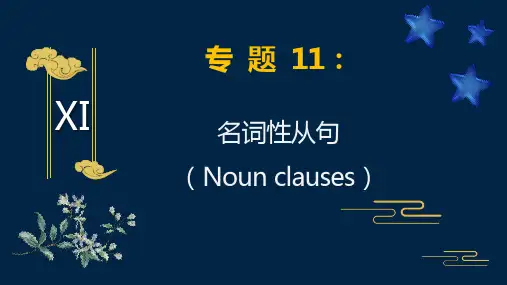
高考英语必考语法点精讲精练:名词性从句(含高考真题)
⑤ We haven’t decided __w_h_e_t_h_e_r__ to take part in the competition. ⑥ No one have settled the question so far w__h_e_t_h_e_r the world will
The important thing in life is that you should have a great aim and the determination to attain it.
Appositive clauses:
e.g.: There is no doubt that he will win the game. He must answer the question why he did that. He failed again due to the fact that he didn’t work hard.
Tips: Nouns can function as subject, object, predicative, appositive.
Definition:
➢What impresses me most is your smile.
TC➢itlpDaosodu:nasey’.sttphuattofuffntciltlitoonmaosrrsouwbwjehcatt,sohboujeldctb,e done
His broad smile suggested that he __h_ad__e_n_c_o_u_n_te_r_e_d____ (encounter) someone he adored.
whether & if(只用whether情况)
高考英语语法之名词性从句总结 共34张PPT
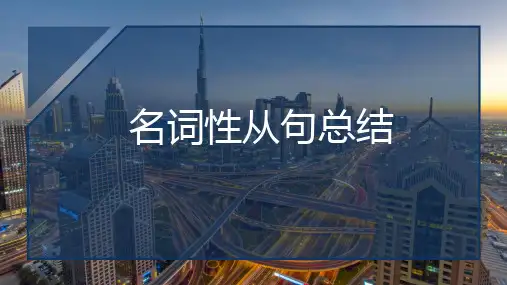
引导词: 连接词:that, whether, if 连接代词:What she saw frightened her. Who has broken the glass is unknown. Whom we should serve is an important question. Which design is the best must be tried in practice. Whose watch was lost is unknown. 连接副词:When the contest will be held still needs to be discussed. Where the contest will be held still needs discussing . How the speech contest will be held still needs discussing . Why the sun rises in the east is interesting.
I’d like to know where the contest will be held.
高考英语语法之名词性从句总结 共34张PPT
高考英语语法之名词性从句总结 共34张PPT
宾语从句虚拟语气
“持令建球都” 后面的宾语从句要用虚拟语气(should)+do
I suggest that we should go tomorrow. The doctor insists that I (should)give up smoking. The seller demanded that payment should be made within five days. 注意:如果suggest作“表明、暗示”讲, insist作“坚持说、坚持认为”讲,则 其后的宾语从句中应该用陈述语气。
高考英语语法复习:名词性从句讲解及提升练习(有答案)
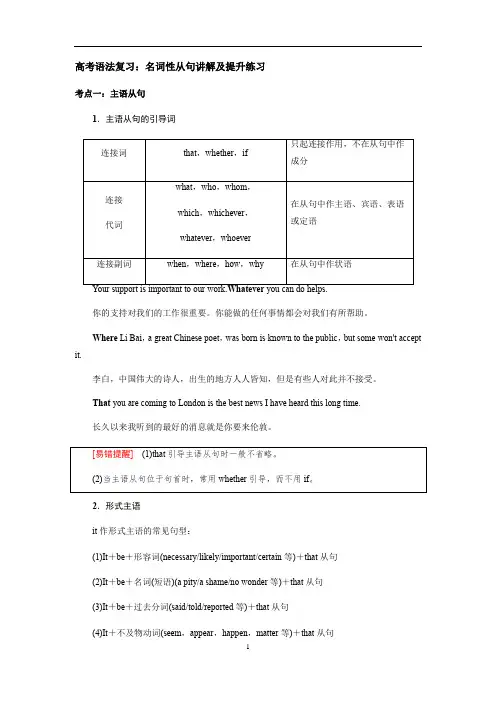
高考语法复习:名词性从句讲解及提升练习考点一:主语从句1.主语从句的引导词你的支持对我们的工作很重要。
你能做的任何事情都会对我们有所帮助。
Where Li Bai,a great Chinese poet,was born is known to the public,but some won't accept it.李白,中国伟大的诗人,出生的地方人人皆知,但是有些人对此并不接受。
That you are coming to London is the best news I have heard this long time.长久以来我听到的最好的消息就是你要来伦敦。
2.形式主语it作形式主语的常见句型:(1)It+be+形容词(necessary/likely/important/certain等)+that从句(2)It+be+名词(短语)(a pity/a shame/no wonder等)+that从句(3)It+be+过去分词(said/told/reported等)+that从句(4)It+不及物动词(seem,appear,happen,matter等)+that从句It is uncertain what side effect the medicine will bring about,although about two thousand patients have taken it.尽管大约两千名患者已经服用了这种药,但是它会带来什么样的副作用还不清楚。
It doesn't matter whether you pay by cash or credit card in this store.在这个商店里你用现金支付还是信用卡支付都没有关系。
考点二宾语从句1.宾语从句的引导词问我是否把书还给图书馆了,我承认我还没有还。
Our teacher always tell us to believe in what we do and who we are if we want to succeed.我们的老师总是告诉我们,如果我们想成功的话,就要相信我们所做的事情以及我们自己。
高考英语语法精品学案:专题11 名词性从句
名词性从句一直备受高考命题者的关注,近几年来的高考题主要考查在具体语境中连接词的选择,尤其是连接词和的辨析,以及与表示“是否”时的区别。
因此,正确区分名词性从句的类型,根据在从句中的作用和所表达的意义,确定恰当的连接词是一轮复习的重点。
此外,名词性从句和定语从句的辨析,也是高考考查的重点。
一、认识各种名词性从句名词性从句相当于名词,可分别作句子的主语、表语、宾语和同位语。
因此,名词性从句具体分为主语从句、表语从句、宾语从句和同位语从句。
名词性从句中的连接词有连词,连接代词() ,连接副词。
从名词性从句在句中所起的作用来说,名词性从句是句子不可缺少的一部分,和句子的其他成分之间也不会用逗号隔开。
而定语从句和状语从句是句子中的修饰成分,去掉之后不会影响句子主体结构的完整性。
这是判断是否是名词性从句最主要的特征。
如:. (宾语从句,不可省去). (定语从句,修饰). (状语从句).主语从句.' . (形式主语代替后面的真正的主语从句)注意:引导主语从句放于句首时,不能省略。
..表语从句..... 宾语从句() .注意:()在引导宾语从句时,常可省略,但如果有两个以上的宾语从句时,最后一个从句的不能省略。
如:() .() 如果动词宾语后又有补语,那么要使用作形式宾语,然后把宾语从句放在补语之后。
如:' .() 如果主句的谓语动词的时态是一般过去时,那么从句的时态要采用相应的与过去有关的时态,但如果从句描述的是客观事实,从句时态不可调整“呼应”。
如:...同位语从句同位语从句在句中作某一名词的同位语,一般位于该名词(如:, , , , 等)之后,说明该名词的具体内容。
如:..注意:在动词:一坚持()、二命令(,)、三建议(,,)、四要求(,,,)后的宾语从句和这些动词的过去分词后的主语从句,以及这些动词的名词引出的表语从句和同位语从句中,谓语部分常用()形式。
如:() .() .() .二、名词性从句的连接词名词性从句的连接词是名词性从句中最核心的问题,也是高考的常考点。
高考英语语法知识点归纳总结:名词性从句
主语从句放在句首,句子常显得笨重,因此一般
连接副词
when
where
why
how
It is known to us how he became a writer.
我们都知道他是如何成为一名作家的。
Where the English evening will be held has not yet been announced.英语晚会将在哪里举行,还没有宣布。
他必须回答他是否同意此事这样一个问题。
同位语从句说明其前面的名词的具体内容,常用的名词如:fact, news, idea, hope, thought,question, order, fear, doubt, word, proof,belief, story等。
特别注意what的双重功能:
①What was once regarded as impossible has now become a reality.
一切要看我们是否有足够的钱。
I don’t know if(whether) it is interesting.
我不知道它是否有意思。
He doesn’t care if it isn’t a fine day.他不在乎天气是否好。
whether常与or not连用,不能用if代替。
作介词宾语要用whether不能用if。
(what为“所……的事”,相当于“the thing that…;all that…;everything that…”)
这就是我们的问题所在。
That is why he didn’t come to the meeting.
那就是他为什么不到会的原因。
高考英语极简语法思维导图与提升专练:第十一章 名词性从句例句练习及答案
【第十一章名词性从句例句】养成良好的答题习惯,是决定成败的决定性因素之一。
做题前,要认真阅读题目要求、题干和选项,并对答案内容作出合理预测;答题时,切忌跟着感觉走,最好按照题目序号来做,不会的或存在疑问的,要做好标记,要善于发现,找到题目的题眼所在,规范答题,书写工整;答题完毕时,要认真检查,查漏补缺,纠正错误。
总之,在最后的复习阶段,学生们不要加大练习量。
在这个时候,学生要尽快找到适合自己的答题方式,最重要的是以平常心去面对考试。
主语从句What Barbara Jones offers to her fans is honesty and happiness.芭芭拉·琼斯给予她的粉丝们的是坦诚和快乐。
Whether you can succeed or not depends on how hard you work at it.你能否成功取决于你努力的程度。
It is said that our school will hold a sports meeting next week.据说我们学校下周要举行运动会。
宾语从句I truly believe that beauty comes from within.我真心相信美来自内心。
Scientists study how human brains work to make computers.科学家通过研究人脑如何工作来制作电脑。
It depends on whether you can finish the project on time.那要取决于你能否按时完成那个项目。
表语从句The question is whether you can afford it.问题是你能否买得起。
But the bottom line is that I shouldn’t lie to my kids in any situation.但是,底线是在任何情况下我都不应该对我的孩子们撒谎。
高考英语语法总复习名词性从句
• 一、名词性从句的种类
• 名词性从句是起名词作用的从句,包括主语从句、宾语从 句、表语从句、同位语从句。
请思考:
1、English is very useful for us . 2、We need to master English well. 3、The subject I am interested in is English. 4、He want to learn the language , English .
• that引导主语从句时,常用it作形式主语,常 见句型有: • ①it+be+形容词(如: obvious,true,natural, surprising,good,wonderful,funny,possible, likely,certain,probable,evident,clear, apparent等)+that从句。 • It is evident that lung cancer is closely related to smoking.
注意:
1. 在口语或非正式问题中,引导宾语从句的that常省略,但 在下面情况下,that 一般不省略 (1) 当一个句子有两个或多个并列的宾语从句时,除第一 个从句的that外,都不可省略。 He told me (that) the power would be cut off and that I should get out. (2)形式宾语it后的that及介词后面的that不能省略。 2. 如果主句主语是第一人称,谓语动词是think ,consider, believe, suppose, expect, fancy, guess, imagine等,后面的宾语 从句含有否定意义,否定转移。 I don't think this dress fits you well. 我认为这件衣服不适合你。
高考英语一轮复习——名词性从句(附答案)
高考英语一轮复习——名词性从句(附答案)I. 考点分析名词性从句包括:主语从句、宾语从句、表语从句、同位语从句,多由连词that,wh- 疑问词或由what,whatever等关系代词引导,其中同位语从句在高考考试中最常见。
1. 主语从句1) 主语从句在句子中充当主语,句子的谓语动词用第三人称单数。
如:Why he refused to work with you is still mystery.Whoever comes is welcome.2) 主语从句前的that不能省略,仅起连接作用,有时为了保持句子平衡,that从句后置,而由it作形式主语。
如:That he became a lawyer may have been due to his mother’s influence.It is not true that he has moved to New York.2. 宾语从句在句子中充当宾语,如:I don’t know where the sound came from.Don’t be satisfied with what you have achieved.3.当从句放在系动词be, look, remain, seem等后即构成表语从句。
The trouble is that I have lost his address.It seemed that the night would never end.4. 1) 同位语从句是对与之同位的名词中心词作进一步解释,能接名词性从句的常见名词有: idea, fact, news, belief, hope, evidence, opinion, problem, truth, answer, proposal, theory, decision, discovery, problem, thought, understanding 等。