
外研版八年级下册《Module 10 Unit 2》说课稿
矿产资源开发利用方案编写内容要求及审查大纲
矿产资源开发利用方案编写内容要求及《矿产资源开发利用方案》审查大纲一、概述
㈠矿区位置、隶属关系和企业性质。
如为改扩建矿山, 应说明矿山现状、
特点及存在的主要问题。
㈡编制依据
(1简述项目前期工作进展情况及与有关方面对项目的意向性协议情况。
(2 列出开发利用方案编制所依据的主要基础性资料的名称。
如经储量管理部门认定的矿区地质勘探报告、选矿试验报告、加工利用试验报告、工程地质初评资料、矿区水文资料和供水资料等。
对改、扩建矿山应有生产实际资料, 如矿山总平面现状图、矿床开拓系统图、采场现状图和主要采选设备清单等。
二、矿产品需求现状和预测
㈠该矿产在国内需求情况和市场供应情况
1、矿产品现状及加工利用趋向。
2、国内近、远期的需求量及主要销向预测。
㈡产品价格分析
1、国内矿产品价格现状。
2、矿产品价格稳定性及变化趋势。
三、矿产资源概况
㈠矿区总体概况
1、矿区总体规划情况。
2、矿区矿产资源概况。
3、该设计与矿区总体开发的关系。
㈡该设计项目的资源概况
1、矿床地质及构造特征。
2、矿床开采技术条件及水文地质条件。
外研版英语八下《Module10Unit2》说课稿

外研版英语八下《 Module 10 Unit 2》说课稿一. 教材分析外研版英语八下《Module 10 Unit 2》的主题是关于环境保护。
本节课主要通过一个关于城市和乡村的对比故事来引导学生关注环境保护问题。
教材内容丰富,包括阅读理解、词汇学习、语法讲解以及相关的文化背景知识。
通过本节课的学习,学生能够提高自己的阅读理解能力,扩展词汇量,了解环境保护的重要性,提高自己的环保意识。
二. 学情分析根据对学生的了解,他们在学习英语的过程中已经掌握了基本的阅读理解技巧,词汇量和语法知识也有一定的积累。
但同时,学生在学习过程中还存在一些问题,如部分学生对环保话题感兴趣程度不高,英语表达能力有限,以及对一些高级语法知识掌握不牢固。
三. 说教学目标1.知识目标:学生能够掌握本节课的重点词汇和语法知识,理解阅读材料的内容,了解城市和乡村的差异以及环境保护的重要性。
2.能力目标:学生能够提高自己的阅读理解能力,增强英语表达能力,提高自己的环保意识。
3.情感目标:引导学生关注环境保护问题,培养学生的社会责任感。
四. 说教学重难点1.重点:本节课的重点是让学生掌握阅读材料的内容,提高阅读理解能力,以及扩展词汇量和语法知识。
2.难点:学生需要理解并运用一些高级语法知识,如现在分词作状语、定语从句等。
同时,对于部分学生来说,关注环保话题、表达自己的观点也存在一定难度。
五. 说教学方法与手段1.教学方法:采用任务型教学法,让学生在完成任务的过程中提高自己的英语能力。
同时,运用启发式教学法,引导学生主动思考、探索问题。
2.教学手段:利用多媒体课件、图片等辅助教学,提高学生的学习兴趣。
六. 说教学过程1.导入:通过展示城市和乡村的图片,引导学生谈论自己对城市和乡村的印象,激发学生的学习兴趣。
2.阅读理解:学生阅读课文,回答相关问题。
教师引导学生关注文章结构,分析文章中的语法现象。
3.词汇学习:学生通过阅读课文,学习并掌握新词汇。
外研版八年级下册《Module10OntheradioUnit2》教学设计
外研版八年级下册《Module 10 On the radio Unit 2 》教学设计一. 教材分析外研版八年级下册《Module 10 On the radio Unit 2》的主题是关于radio节目。
本节课的主要内容是学习不同类型的radio节目以及如何描述radio节目。
教材通过听力练习、口语练习、阅读练习以及写作练习等多种形式,让学生在掌握radio节目的相关词汇和表达方式的同时,提高听、说、读、写四项基本技能。
二. 学情分析学生在学习本节课之前,已经掌握了日常生活中的一些基本词汇和表达方式,具备一定的听说读写能力。
但部分学生对radio节目的了解较少,可能对一些特定词汇和表达方式感到陌生。
因此,在教学过程中,教师需要关注学生的个体差异,适当降低难度,引导学生积极参与课堂活动。
三. 教学目标1.知识目标:学生能够掌握与radio节目相关的词汇和表达方式,如:news, music, talk show, interview等。
学生能够正确使用一般现在时描述radio节目的特点和自己的喜好。
2.技能目标:学生能够在听力、口语、阅读和写作实践中运用所学知识,提高听、说、读、写四项基本技能。
3.情感目标:培养学生对radio节目的兴趣,提高学生英语学习的积极性。
四. 教学重难点学生能够掌握与radio节目相关的词汇和表达方式。
学生能够正确使用一般现在时描述radio节目的特点和自己的喜好。
学生能够听懂并准确运用英语描述radio节目的特点。
学生能够运用所学知识,进行口语和写作实践。
五. 教学方法1.任务型教学法:通过听力、口语、阅读和写作任务,引导学生主动参与课堂活动,提高学生的实际运用能力。
2.情境教学法:创设生活情境,让学生在真实的环境中感受和运用英语。
3.小组合作学习:鼓励学生相互合作,共同完成任务,提高学生的团队协作能力。
六. 教学准备1.教师准备:提前准备好与radio节目相关的听力材料、图片、视频等教学资源。
外研版英语八下Module 10《On the radio》(Unit 2)教学设计
外研版英语八下Module 10《On the radio》(Unit 2)教学设计一. 教材分析《On the radio》(Unit 2)是外研版英语八下的一个单元,主题是关于听广播。
本节课的内容包括听力练习、口语交流、语法学习和词汇拓展。
教材通过丰富的听力材料、真实的生活情境和任务型活动,帮助学生提高听力技能,增强实际运用英语的能力。
二. 学情分析八年级的学生已经具备了一定的英语基础,能够听懂并运用日常生活中的基本词汇进行交流。
但是,对于一些地道的表达方式和口语化的语句还不太熟悉,听力水平有待提高。
同时,学生对于广播这种媒体形式可能了解不多,因此需要教师在课堂上进行引导和拓展。
三. 教学目标1.能听懂、会说、会读本节课的主要词汇和句型。
2.能通过听力练习,提高学生的听力技能。
3.能用英语简单介绍自己喜欢的广播节目,并进行口语交流。
4.增强学生对英语学习的兴趣,提高学生的实际运用英语的能力。
四. 教学重难点1.重点:本节课的主要词汇和句型,听力材料的理解。
2.难点:地道的英语表达方式,听力材料的深入理解,口语交流的流畅性。
五. 教学方法1.任务型教学法:通过完成各种任务,提高学生的听力技能和口语交流能力。
2.情境教学法:通过模拟生活情境,让学生在实际语境中学习英语。
3.互动式教学法:鼓励学生积极参与课堂活动,增强课堂的趣味性。
六. 教学准备1.教材、教学大纲、教学计划2.听力材料、相关广播节目资料3.PPT、黑板、粉笔4.录音机、音响设备七. 教学过程1.导入(5分钟)教师播放一段英语广播,让学生听懂大意。
然后提问学生对广播节目的了解和喜好,引导学生进入本节课的主题。
2.呈现(10分钟)教师通过PPT展示本节课的主要词汇和句型,并进行讲解和示范。
同时,让学生跟读,加深对词汇和句型的记忆。
3.操练(15分钟)教师学生进行听力练习,让学生听懂并回答问题。
对于一些难理解的句子,可以让学生进行小组讨论,互相帮助理解。
外研版八年级下册《Module10OntheradioUnit2》说课稿
外研版八年级下册《Module 10 On the radio Unit 2 》说课稿一. 教材分析外研版八年级下册《Module 10 On the radio Unit 2》的话题是关于广播电台的节目。
本节课的主要内容是让学生能够听懂并运用关于广播电台节目的词汇和表达方式,如host, guest, DJ等,以及能够描述不同类型的广播节目。
同时,学生还需要掌握如何询问和回答关于广播节目的相关信息。
二. 学情分析八年级的学生已经具备了一定的英语基础,对于听力和口语的能力有一定的掌握。
但是,对于一些专业的广播电台相关的词汇和表达方式可能还比较陌生,需要通过课堂的学习来掌握。
此外,学生的学习兴趣和学习积极性也需要通过教学设计和教学手段来激发和提高。
三. 说教学目标1.知识目标:学生能够掌握关于广播电台节目的相关词汇和表达方式,如host, guest, DJ等,并能够运用这些词汇和表达方式进行口语交流。
2.能力目标:学生能够听懂并描述不同类型的广播节目,提高学生的听力理解和口语表达能力。
3.情感目标:通过学习广播电台节目的相关知识,激发学生对英语学习的兴趣,提高学生的学习积极性。
四. 说教学重难点1.重点:学生能够掌握关于广播电台节目的相关词汇和表达方式,并能够运用这些词汇和表达方式进行口语交流。
2.难点:学生能够听懂并描述不同类型的广播节目,提高学生的听力理解和口语表达能力。
五. 说教学方法与手段1.交际法:通过模拟广播电台节目的形式,让学生在实际语境中运用所学知识进行口语交流,提高学生的口语表达能力。
2.任务型教学法:通过完成各种与广播电台节目相关的任务,如讨论不同类型的广播节目,描述广播电台节目的特点等,提高学生的综合语言运用能力。
3.多媒体教学手段:利用多媒体课件和音频材料,为学生提供丰富的学习资源,增强学生的学习兴趣和积极性。
六. 说教学过程1.导入:通过播放一段广播电台节目的音频,引导学生思考并讨论广播电台节目的特点和类型,激发学生的学习兴趣。
Module10Unit2教案外研版八年级英语下册
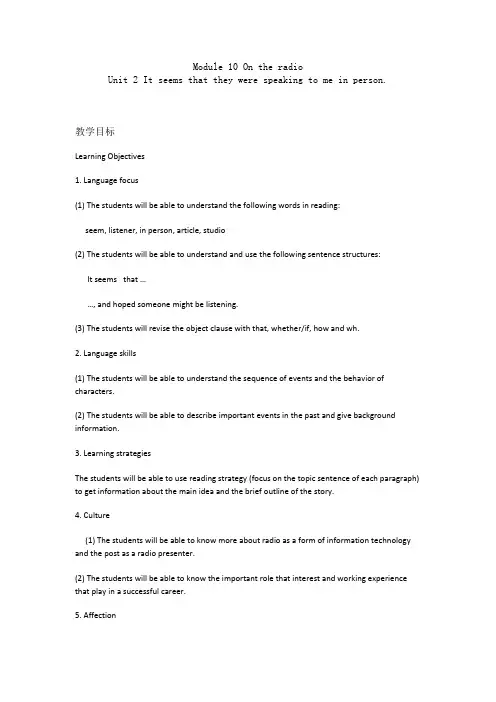
Module 10 On the radioUnit 2 It seems that they were speaking to me in person.教学目标Learning Objectives1. Language focus(1) The students will be able to understand the following words in reading:seem, listener, in person, article, studio(2) The students will be able to understand and use the following sentence structures:It seems that ……, and hoped someone might be listening.(3) The students will revise the object clause with that, whether/if, how and wh.2. Language skills(1) The students will be able to understand the sequence of events and the behavior of characters.(2) The students will be able to describe important events in the past and give background information.3. Learning strategiesThe students will be able to use reading strategy (focus on the topic sentence of each paragraph) to get information about the main idea and the brief outline of the story.4. Culture(1) The students will be able to know more about radio as a form of information technology and the post as a radio presenter.(2) The students will be able to know the important role that interest and working experience that play in a successful career.5. AffectionThe students will have a better understanding of ambition and its value on the road to success.6. ProductThe students will be able to retell the writer’s experience and describe an important event in the past with the help of key phrases.2学情分析1. The students in Grade 8, who know little about radio, may have much interest in the career asa radio presenter. They are eager to learn a lot about how to be a successful presenter.2. They have learnt some words and can read some simple passages, but they don’t know much about the reading strategies or how to guess the new words from the context.3教学过程3.1 第一学时教学活动活动1【导入】Activity 1 Warm-up /Lead-inListen to a short radio program and answer the following questions:Have you ever listened to this program?Who is the presenter?What can we learn from this program?What do you think makes the presenter Xiaojiang so popular with the audience?Ask individual students to answer the questions.Purpose: To mobilize the students’ moods and language for the topic.活动2【导入】Activity 2 Pre-readingLook at the picture and say what it shows:A presenter is on air in the studio.2. Guess where you are likely to see the photo.a) In a book about the history of radio.b) In the life story of a famous radio presenter.c) In a book on how radio works.Purpose: To lead in the topic and impress the students that a life story is aboutsome important events of a person.活动3【活动】Activity3 SkimmingGet students to skim the passage and find out the structure of the passage:How many parts is the passage divided into?Underline the topic sentence of each paragraph.Match the main idea with each part.Purpose: To help the student aware of the function of topic sentences in thereading and writing and cultivate them to learn to summarize the main ideaaccording to the topic sentences.活动4【活动】Activity 4 Intensive readingRead Part1 &3 and answer the questions:(1) What does the event describe?(2) What main questions did the manager ask the writer?He asked…how old the writer was.if/ whether the writer wanted a job in radio.whether the writer should be at school or not.what the writer had for breakfast.(3).What question do all the presenters need to answer before they begin work?(4).What’s the main purpose of this question?(5).From the last part of this passage, we know________.A. The manager is interested in what the writer had for breakfast.B. The man behind the glass wall is a radio presenter, too.C. The writer successfully passed the job interview.D. All the presenters should have breakfast before they begin work.Read Part2 and think:What do you think helped the writer successfully pass the job interview?In what order is the background information organized?Try to find out the timeline of the writer’s growth.Why did the writer say “How could I explain〞? ________A. He didn’t know how to answer the manager’s question.B. It was difficult to tell the manager how he loved the radio.C. He had so many reasons that he couldn’t think of them.D. He was too nervous to express it very well.(5) “It seemed that they were speaking ……but to me in person.〞Which of the following underlined phrases has the same meaning as“in per son〞_________A. It’s better to make decision on your own.B. Can you solve this difficult problem by yourself?C. I have kept in touch with him for some years, but I have never met him in the flesh.(6) Try to list out the writer’s job experiences.a. parttime jobs in small stations.b. job experiences on the internet radio(7) Job experiences on the internet radio.Look at the sentences from the two paragraphs.①One day I learnt about Internet radio.②Once a week, I played my favorite music from my father’s puter, ...③Soon my friends at school started to listen, and then they wanted to help.④Once a week, we prepared a program, doing research on articles about music,…Please find the sentences which show:important events in the pastbackground informationPurpose: 1) To help the students further understand the details about the story.2) To foster the students’ ability of guessing the new words from the context.3) To improve the students’ a bility of analyzing and summarizing the reading materials whiling reading.4) To help the students revise the object clause and its connecting words, order ofspeech and tense.活动5【练习】Activity 5 Post-readingsplete the passage with correct forms of the words and expressions in the box.article at the age of listener purpose seem studioPeter (1) ________ to be very happy with his new job. He works in the (2)________ of a local radio station. He is lucky that (3) ___________ only twenty heis doing something he loves and has a real (4) ________. Every morning when hestarts work, he does a sound check and then he looks for interesting newspaper (5)________ to talk about on the show. The (6) ______ can phone in to talk to Peteror they can send emails to ask him to play their favorite songs. At the end of theshow, he closes down all the equipment and goes home.Purpose: To enhance the use of the new words and expressions in the context.Speaking:Do you think the writer is lucky? Why?What do you think helps him get his first real job?What can you learn from the story?Purpose:To impress the students the role that interest and experience that play in thecareerselection.2) To inspire them the value of ambition on the road to success.3) To improve their ability of speaking as well as to enhance the use of newexpressions and sentence structures.活动6【作业】Activity 5Homework1. Read the passage again and retell the writer’s experience to your partner in a normal order.2. Write a passage describing an important event in the past that made you develop your interest and giving background information.Purpose:To help the students better understand the passage.To enhance their use of the new vocabulary and to improve their writing skills.。
外研版八年级英语下册教案:Module10Unit2

一、教课内容: Unit 2 It seemed that they were speaking to me in person.二、课型: Reading and writing三、教课目的:1、能使用本单元的单词和短语: seem, listener, age, article, studio, purpose, in person, at the age of,It seemed that they were speaking not to lots of listeners but to me in person.2、能够大略认识播音节目和播音员的生活的简单文章,进行简单的阅读技术训练。
3、能够依照提示描绘过去的经历并给出背景信息。
四、教课重难点:1.正确理解文章的事件。
2、能介绍自己的过去经历。
五、教课准备:‘六、教课过程:教课教师活动步骤Show the students somepictures Step 1about radio. Let students look at the Warming pictures and use their own words to -up describe . 学生活动Look at the picturesand use their ownwords to describe .设计企图经过看图片、讨论图片能够培育学生的察看能力和表达能力,能够帮助学生回想所学的知识。
Step 2 Show students some pictures and Look at the pictures toPre- check the new words. learn the new words .reading [ 根源:Z#xx#k.]Step 3 1. Scanning学习新单词和句型,为下面的阅读学习扫清阻碍。
1.要修业生快While- Ask students to read the passage and Scan the passage and 速阅文章,回reading decide where you are likely to see choose the best answer. 答问题,帮助the photo. 学生理解课a) In a book about the history of 文内容。
Module 10 Unit 2 You shouldn’t be late(说课稿)-2022-2
Module 10 Unit 2 You Shouldn’t Be Late 一、教学目标知识目标学生能够:1.掌握单词和短语:late, can’t, want, hurry, worry。
2.能够用英语描述常见的迟到场景。
3.了解有关守时的价值观。
4.能够正确理解并回答有关迟到的问题。
能力目标学生能够:1.通过分组讨论,积极参与课堂讨论。
2.参与课堂小组活动,在小组内表达自己的看法并听取他人意见。
3.能够熟练运用表达迟到场景的语句进行交流。
情感目标学生能够:1.加深对守时的重要性的理解,在生活中树立守时的信念。
2.学会互相尊重、包容和帮助,培养良好的团队合作和沟通能力。
二、教学重难点教学重点1.掌握单词和短语:late, can’t, want, hurry, worry。
2.学会以简洁明了的语言描述常见的迟到场景。
3.了解有关守时的价值观。
教学难点1.能够正确运用表达迟到场景的语句进行口语交流。
(一) Warming-up1.通过导入一些情景(如:下雨天迟到;门口的猫咪或小狗让人分神)让学生了解迟到的场景。
2.询问学生喜欢迟到吗?为什么?帮助学生认识到守时的重要性。
(二) Speaking1.学生分组讨论,假设一些迟到的场景并描述自己的所在地方的不同迟到场景。
比如:迟到上学、迟到上课等。
2.引导学生运用单词和短语:late, can’t, want, hurry, worry进行描述。
如:I’m sorry I’m late for class. I can’t find my pencil case. I want to be on time, but… I hurry to get here, but I’m still late. I worry my teacher will be angry about my late arrival.等等。
3.在讨论中,老师可以随时提问和点评,帮助学生更好地理解单词和短语的用法。
Module 10 Unit 2 She's got an orange sweater (说课稿)
Module 10 Unit 2 She’s got an orange sweater1. 教学目标•知识目标:能够听、说、读、写并掌握单词:sweater、colour、orange,以及句型:She’s got an orange sweater.•能力目标:能够描述物品的颜色,能够用简单的句子来表达自己的服装。
•情感目标:通过学习,增强学生对自己的服装和容貌的自信,激发学生的学习兴趣和积极性。
2. 教学重点•掌握单词:sweater、colour、orange,句型:She’s got an orange sweater.•学生能够用简单的句子来描述自己的服装和颜色。
3. 教学难点•能够准确使用句型:She’s got an orange sweater.,并将其运用到实际生活中。
4. 教学准备•教师:PPT、教材、磁带、录音机、单词卡片、绘本。
•学生:教材。
5. 教学步骤Step 1: Warm-up1.教师根据班级实际情况选择能引起学生兴趣的活动或游戏,以达到热身的效果,例如班级问候、歌唱等。
Step 2: Presentation1.教师出示一个橙色的毛衣,引导学生探究它的颜色,从而引入新词sweater,以及新句型She’s got an orange sweater.。
2.教师用图片或实物等多种形式来展示词汇colours和orange以帮助学生理解并掌握新单词。
Step 3: Practice1.给出三张图片:一张是一个女孩,另外两张是不同颜色的毛衣,引导学生根据图片来模仿句型She’s got an orange sweater.,描述女孩所穿的不同的毛衣的颜色。
2.以小组为单位,让学生进行角色扮演,交流一下自己所拥有的衣服以及它们的颜色,以此来巩固新词汇和句型。
Step 4: Extension1.播放录音,让学生跟读,并根据录音模仿句型She’s got an orange sweater.,说出自己所拥有的衣服的颜色。
外研版英语八年级下册(新)《Module 10 On the radio Unit 2》教学设计
外研版英语八年级下册(新)《Module 10 On the radio Unit 2》教学设计一. 教材分析《Module 10 On the radio Unit 2》主要介绍了关于广播节目的一些内容。
通过本节课的学习,学生能够了解不同广播节目的类型及特点,提高听力技巧,同时能够运用所学知识进行简单的口语交流。
教材内容丰富,贴近生活,能够激发学生的学习兴趣。
二. 学情分析八年级的学生已经掌握了基本的英语语法和词汇,具备一定的听说读写能力。
但部分学生在口语表达方面仍存在困难,听力水平有待提高。
此外,学生对广播节目的了解相对较少,需要在教学中进行引导和拓展。
三. 教学目标1.知识目标:–能够掌握表示广播节目类型的词汇如:news, music, story, joke等。
–能够理解并运用目标句型“What is your favorite radio program?”, “I like … because …”进行交流。
2.能力目标:–提高学生的听力水平,能够听懂并理解不同类型的广播节目。
–提高学生的口语表达能力,能够运用所学知识进行日常交流。
3.情感目标:–培养学生对英语学习的兴趣,增强自信心。
–培养学生热爱生活,关注社会,拓宽视野。
四. 教学重难点•掌握表示广播节目类型的词汇。
•能够运用目标句型进行口语交流。
•提高听力水平,理解不同类型的广播节目。
•运用所学知识进行日常交流。
五. 教学方法1.任务型教学法:通过完成各种任务,激发学生的学习兴趣,提高学生的参与度。
2.交际式教学法:创设真实情境,培养学生运用英语进行交际的能力。
3.听力教学法:采用多种听力练习方式,提高学生的听力水平。
六. 教学准备1.教材:《Module 10 On the radio Unit 2》相关内容。
2.教学多媒体课件。
3.录音机、磁带或音频文件。
4.练习题及答案。
七. 教学过程1.导入(5分钟)利用图片或实物的形式,引导学生谈论他们喜欢的广播节目。
外研版英语八下《 Module 10 Unit 2》教学设计
外研版英语八下《 Module 10 Unit 2》教学设计一. 教材分析外研版英语八下《Module 10 Unit 2》的主题是关于环境保护,通过学习本单元,学生将了解到日常生活中的一些环保行为和观念。
教材内容包含了大量的环保词汇和表达,如recycling、waste、conservation、carbon footprint等,以及一些实用的交际用语,如How can we reduce our carbon footprint?、We should take real actions to protect our environment.等。
此外,本单元还包括一个阅读材料,介绍了英国的一个环保村庄。
通过学习本单元,学生将能够提高自己的环保意识,增强自己的环保行动力。
二. 学情分析学生在学习本单元前,已经掌握了大量的英语词汇和语法知识,具备了一定的听说读写能力。
但是,学生在环保方面的知识储备有限,可能对一些环保词汇和表达感到陌生。
此外,学生的学习兴趣和动机对英语学习起到了关键的作用,因此,在教学过程中,教师需要激发学生的学习兴趣,调动学生的学习积极性。
三. 教学目标1.知识目标:学生能够掌握本单元的重点词汇和表达,如recycling、waste、conservation、carbon footprint等,并能运用这些词汇和表达进行日常交际。
2.能力目标:学生能够听懂、说清、读懂、写出一个关于环境保护的短文。
3.情感目标:学生能够提高自己的环保意识,增强自己的环保行动力。
四. 教学重难点1.重点:本单元的重点词汇和表达,如recycling、waste、conservation、carbon footprint等。
2.难点:如何引导学生运用所学知识进行日常交际,如何激发学生的环保意识。
五. 教学方法1.任务型教学法:通过设定各种环保相关的任务,让学生在完成任务的过程中,自然而然地学习和运用所学知识。