
仁爱版英语七年级上册课件:Unit 4 Topic 2 Section C
【仁爱英语 七年级上册】Unit4_Topic2_同步检测题

旗开得胜
读万卷书 行万里路 1 Unit4 Topic2 同步检测题
(满分100分 时间90分钟)
第一部分 听力 (20分)
Ⅰ.听句子,选择正确图片。每个句子读两遍。(5分)
A. B. C. D. E.
1.____ 2.____ 3.____ 4.____ 5.____
Ⅱ.听句子,选择正确答语。每个句子读两遍。(5分)
( )6. A. All right. B. Thanks. C. You are right.
( )7. A. See you, too. B. Goodbye. C. See you.
( )8. A. Yes, you may. B. Sorry, he isn’t in. C. Yes, I’m
Jack.
( )9. A. What’s up? B. Sure. C. That’s
OK.
( )10. A. There is no time. B. Sorry, I have no time. C. I have
time. 旗开得胜
读万卷书 行万里路 2 Ⅲ.听对话及问题,选择正确答案。每组对话和问题读两遍。(5分)
( )11. A. No, he’s free. B. No, he isn’t. C. Yes, he’s free
tomorrow.
( )12. A. At school. B. At home. C. In a hospital.
( )13. A. Come home. B. Go shopping. C. Go to his
home.
( )14. A. Go fishing. B. Go shopping. C. Sing songs.
( )15. A. Have a picnic. B. Do homework. C. Go to work.
仁爱英语七年级上册Unit 4 Topic 2试题(无答案)

第 1 页 共 4 页 Unit 4 Topic 2 一、单项选择
( ) 1.—May I _________Lily?—I’m afraid you have the wrong(错误的) number.
A.tell to B.speak to C.say to D.ask
( ) 2.—Hello! May I speak to Jane, please?—Yes._________ is Jane.
A.That B.This C.She D.Who
( ) 3.Hello!________ Mary speaking. Who ______?
A.This is; is this B.This is; are you C.I’m; is this D.I’m; are you
( ) 4.—May I speak to Ann, please?—________
A.Yes, I may. B.No, you may not. C.Sorry , she isn’t at home now. D.No, you can’t.
( ) 5.—Is your mother at home? —Sorry. He isn’t .
A.at B.for C.in D.on
( ) 6.— have oranges ? —Good idea.
A.Why not, any B.Why don't , some C.Why not , some D.Do you , some
( ) 7.—Would you like meat ? —Thanks. I would like .
A.some, any B.any, some C.some, some D.any , any
最新仁爱版英语七年级(上册)Unit4Topic2检测试题

==== ====== WORD完美整理版
Unit4HavingFun
Topic2Wouldyouliketocookwithus?
单元测试题 (满分100分 时间90分钟)
第一部分 第二部分 第三部分 总分
题号
Ⅰ Ⅱ Ⅲ Ⅳ Ⅰ Ⅱ Ⅲ Ⅳ Ⅰ Ⅱ Ⅲ 得分
第一部分 听力(20分)
Ⅰ .听句子,选择正确图片。每个句子读两遍。(5分)
A. B. C. D. E.
1.____2.____ 3.____ 4.____
2.听句子,选择正确答语。每个句子读两遍。 (5分)
( )6.A.Allright. B.Thanks. C.Youareright.
( )7.A.No,Idon ’t. B.No,Iwon’t. C.Sure,Iwon’t.
( )8.A.Yes,youmay. B.Sorry,heisn ’tinC..Yes,I’mJack.
( )9.A.Don’tsing. B.What’sup? C.That’sOK.
( )10.A.Thereisnotime. B.I’mafraidIhavenotimeC..Ihavetime.
Ⅲ.听对话及问题,选择正确答案。每组对话和问题读两遍。 (5分)
( )11.A.No,he’sfree. B.No. C.Yes,he’sfreetomorrow.
( )12.A.Athome. B.Atschool. C.Inahospital.
( )ehome. B.Gotohishome. C.Callhimback.
( )14.A.Gofishing. B.Goshopping. C.Gotoplaysoccer.
( )15.A.6. B.7. C.8.
Ⅳ.听对话,完成下列电话留言。对话读三遍。 (5分)
范文范例 参考指导 ==== ====== WORD完美整理版
河南省邓州市腰店第一初级中学七年级英语上册 unit 4-Topic 1 SectionC师生共用教学案(无答案) 仁爱版

Unit 4 Topic 1 What can I do for you?
Section C
教学目标:
1 .学习并掌握用数量词表示名词的量;
2. 继续学习可数名词和不可数名词的用法;
3. 继续谈论购物;能够阅读、书写购物单出示问题:
自主学习:
1 表示数量:
how many + 可数名词(复数)
how much + 不可数名词
How many bottles of milk do you need?
How much rice do you need?
2 Could you help me do some shopping,Ben? 本,你能帮我买些东西吗?
do some shopping 买东西,购物
课堂展示: Can/May I help you?
What can I do for you?
How much …?
Here you are.
Don’t worry.
课堂练习;
一 .用how many/how much完成下列句子
1.__________ rice do you want?
2.__________ hamburgers would you like?
3.__________ water is there in the glass?
4.__________ apples do they need?
二 单项选择
( )1 Could you help me do some shopping? I need______
仁爱英语七年级上册Unit4-topic3知识点讲解及随堂练习
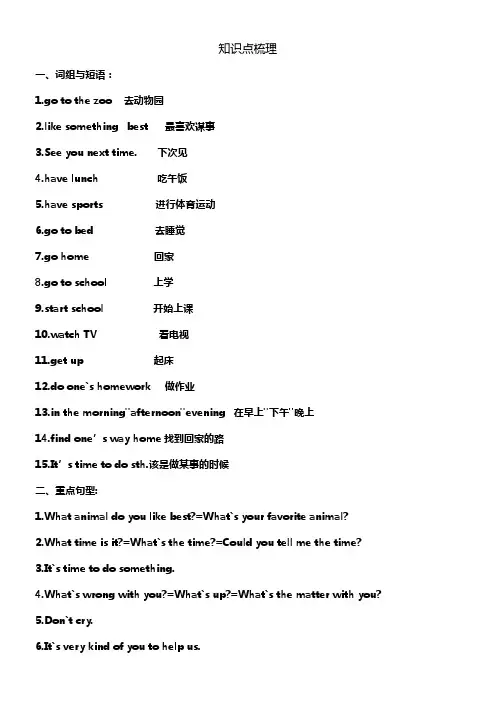
知识点梳理
一、词组与短语:
1.go to the zoo 去动物园
2.like something best 最喜欢谋事
3.See you next time. 下次见
4.have lunch 吃午饭
5.have sports 进行体育运动
6.go to bed 去睡觉
7.go home 回家
8.go to school 上学
9.start school 开始上课
10.watch TV 看电视
11.get up 起床
12.do one`s homework 做作业
13.in the morning"afternoon"evening 在早上"下午"晚上
14.find one’s way home找到回家的路
15.It’s time to do sth.该是做某事的时候
二、重点句型:
1.What animal do you like best?=What`s your favorite animal?
2.What time is it?=What`s the time?=Could you tell me the time?
3.It`s time to do something.
4.What`s wrong with you?=What`s up?=What`s the matter with you?
5.Don`t cry.
6.It`s very kind of you to help us. 7.Here we are.
三、语法:
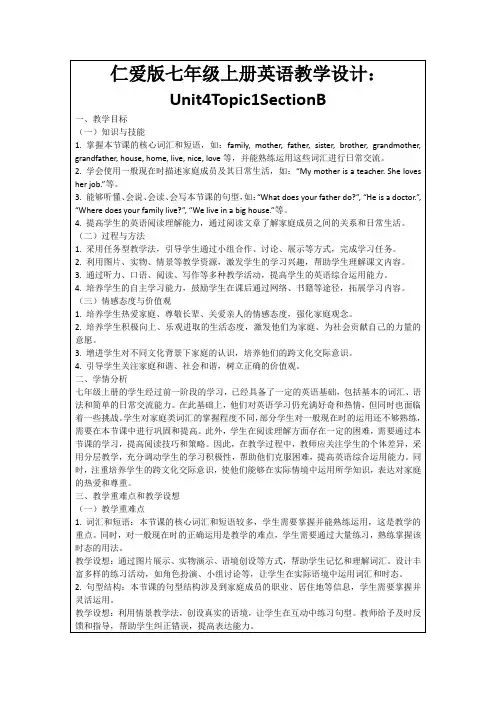
仁爱版七年级上册英语教学设计:Unit4Topic1SectionB
仁爱版七年级上册英语教学设计:Unit4Topic1SectionB
一、教学目标
(一)知识与技能
1. 掌握本节课的核心词汇和短语,如:family, mother, father, sister, brother, grandmother,
grandfather, house, home, live, nice, love等,并能熟练运用这些词汇进行日常交流。
2. 学会使用一般现在时描述家庭成员及其日常生活,如:“My mother is a teacher. She loves
her job.”等。
3. 能够听懂、会说、会读、会写本节课的句型,如:“What does your father do?”, “He is a doctor.”,
“Where does your family live?”, “We live in a big house.”等。
4. 提高学生的英语阅读理解能力,通过阅读文章了解家庭成员之间的关系和日常生活。
(二)过程与方法
1. 采用任务型教学法,引导学生通过小组合作、讨论、展示等方式,完成学习任务。
2. 利用图片、实物、情景等教学资源,激发学生的学习兴趣,帮助学生理解课文内容。
3. 通过听力、口语、阅读、写作等多种教学活动,提高学生的英语综合运用能力。
4. 培养学生的自主学习能力,鼓励学生在课后通过网络、书籍等途径,拓展学习内容。
(三)情感态度与价值观
1. 培养学生热爱家庭、尊敬长辈、关爱亲人的情感态度,强化家庭观念。
2. 培养学生积极向上、乐观进取的生活态度,激发他们为家庭、为社会贡献自己的力量的意愿。
3. 增进学生对不同文化背景下家庭的认识,培养他们的跨文化交际意识。
4. 引导学生关注家庭和谐、社会和谐,树立正确的价值观。
二、学情分析
七年级上册的学生经过前一阶段的学习,已经具备了一定的英语基础,包括基本的词汇、语法和简单的日常交流能力。在此基础上,他们对英语学习仍充满好奇和热情,但同时也面临着一些挑战。学生对家庭类词汇的掌握程度不同,部分学生对一般现在时的运用还不够熟练,需要在本节课中进行巩固和提高。此外,学生在阅读理解方面存在一定的困难,需要通过本节课的学习,提高阅读技巧和策略。因此,在教学过程中,教师应关注学生的个体差异,采用分层教学,充分调动学生的学习积极性,帮助他们克服困难,提高英语综合运用能力。同时,注重培养学生的跨文化交际意识,使他们能够在实际情境中运用所学知识,表达对家庭的热爱和尊重。
仁爱英语教材七年级上册Unit2_Topic3教案
1 Unit 2 Looking different Topic3 Whose jacket is this
第一课时 SectionA
一.目标语言 Target language
(1)重点单词和短语 Words expressions
Whose,his,hers,ours,theirs,yours,mine,then
(3)Key sentences
— Whose …is it/are these/those…?
—It’s (not) mine/hers/yours/these/those are (not)……
(3)Teaching important point
1 学习物主代词,初步了解名词所有格
2 学习谈论物品的所属
3 复习名词的复数形式
(4)Teaching difficult point
1 如何使用名词性物主代词替换掉形容词性物主代词+名词的组合
2 then的用法
3 如何回答Whose引导的特殊疑问句
4 名词单复数形式的变化
二.教学呈现Teaching procedures
Step1:Greating(2分钟)
Step2:Leading(2分钟)
T: I find a pen in my bag. It’s red.
It’s not my pen. It’s not mine. Then whose pen is it?
—Is it your pen Marssar?
—No. It’s not my pen.
—Is it yours, Cline?
—No. It’s my pen.
—Ok.Do you want to find the owner of this pen?
—Yes.
—Then,let’s study our new topic. “Whose jacket is this?”
仁爱版七年级英语上册Unit 4同步及单元综合检测【含答案 4套】
1 Unit 4 Topic 1
(满分100分 时间90分钟)
题号 第一部分 第二部分 第三部分 总分
Ⅰ Ⅱ Ⅲ Ⅳ Ⅰ Ⅱ Ⅲ Ⅳ Ⅰ Ⅱ Ⅲ
得分
第一部分 听力 (20分)
Ⅰ.听句子,选择正确图片。每个句子读两遍。(5分)
A. B. C. D. E.
1. ____ 2. ____ 3. ____ 4. ____ 5. ____
Ⅱ.听句子,选择正确答语。每个句子读两遍。(5分)
( )6. A. Yes, I think they are nice.
B. No, I don’t think they are nice.
C. I like them very much. I’ll take them.
( )7. A. Yes, they’re too heavy. B. Don’t worry. Let me help you.
C. Yes, you are right.
( )8. A. It’s very great. B. Here is fifty yuan. C. It’s fifty yuan.
( )9. A. Yes, please. B. Yes, I’d like to. C. I don’t like its color.
( )10. A. Yes, please. B. I want a bottle of juice. C. I think so, too.
Ⅲ.听对话及问题,选择正确答案。每组对话和问题读两遍。(5分)
( )11. A. In the classroom. B. In a shop. C. At home.
( )12. A. Yes, he does. B. No, he doesn’t. C. He wants the white pair.
仁爱版英语 七年级上册 Unit 4 Topic 2 课文及翻译
第1页/共4页 Unit 4 Having fun 玩的开心
Topic 2 Would you like to cook with us?你愿意和我们一起做饭吗?
Section A
1a
Hello!
你好!
Hello, Jane!This is Kangkang.
简,你好!这是康康。
Hi, Kangkang!
你好,康康!
Are you free this Sunday?
你这周周日有空吗?
Yes. What’s up?
是的。怎么了。
Would you like to go to the West Hill for a picnic?
你愿意去西山野炊吗?
Oh, I’d love to.
哦。我很愿意。
Please tell Maria about it.
请告诉玛丽娜。
Sure. I’ll call her.
当然。我会打电话给她的。
See you then.
到时见。
See you.
再见。
Section B
1a 第2页/共4页 1.
Would you like to sing some songs with me, Kangkang?
康康,你愿意和我唱几首歌吗?
I’m sorry I can’t. I have to cook.
抱歉不能。我要做饭。
2.
Would you like to cook with us?
你愿意和我们一起做饭吗?
Yes, I’d love to.
是的。我很乐意。
3.
Micheal, how about flying a kite with me?
迈克,和我一起放风筝怎么样?
I’d like that, but I’m sorry I have no time. I have to get some water.
我很想,但是抱歉我没有时间。我得去弄些水。
How about you, Bobby?
你呢,波比?
仁爱版初中英语七年级上册Unit4 Topic2 Section C说课稿
仁爱版初中英语七年级上册
如果没有您爱的滋润,怎么会绽放那么多美好的灵魂之花! unit 4 Having fun
Topic 2 Would you like to have a picnic?
Section C
一、教材分析
1.教学内容
仁爱版英语教材的语言教育理念是:知识用于行动,强调语言应用。培养创新实践能力,发展学习策略,它采用任务型教学模式,教材中的每一个话题都设计一个或几个与该话题有关的任务,让学生在完成任务的过程中,使用英语获取信息,用英语进行交流,培养运用英语解决实际问题的能力。今天我将从以下几方面说课:一、教材分析;二、教法渗透;三、学法指导;四、学情分析;五、教学过程;六、板书设计。
本人所选的是湘教版七年级(上)Unit4 Having fun/Topic2 Would you like to have a
picnic?/Section C,本节课主要是以邀请某人参加活动这一话题中心展开。根据教材内容,我进行适当的调整、删减、增加,我将Reading和Written work整合成一堂以读写为基础,侧重训练学生的阅读与写作相结合的读写课。Reading 部分讲述邀请他人参加活动的内容,通过学习本课文,除了让学生掌握 “Would you like to ------? What about-------?等句型对其进行邀请他人参加活动,并能学以致用,更重要的是,培养学生的合作精神和情感。
2.教学目标
根据《英语课程标准》关于总目标的具体描述和英语教学大纲的规定,结合本话题的教材内容,我将本课的教学目标细分为知识目标、能力目标、情感目标三大方面。
a)知识目标: 理解全文并掌握课文涉及的句型及短语:
句型:(1)—Would you like to have a picnic with old McDonald?
—Yes, I’d love to.
—Thanks. That would be very nice.