
仁爱版七年级英语上册优质课件 Unit2__Topic3__SectionA__
仁爱英语七年级上册第二单元Unit2Topic3课文知识点讲解及语法
2014年仁爱英语七年级上册第二单元Unit 2 Topic 3 课文知识点讲解及语法一、知识点梳理:Section A1. —Is this your cap?这是你的帽子吗?—No,it’s not mine.不,不是我的。
在该句子中,your为形容词性物主代词,后面需要跟名词。
mine为名词性物主代词,相当于“形容词性物主代词+名词”,在句中可作主语或表语。
如:This is my coat.=This coat is mine.(表语)这是我的上衣。
His coat is yellow.Mine is green.(主语)他的上衣是黄色的,我的是绿色的。
2. —Whose cap is it,then? 那么,它是谁的帽子呢?—It’s Sally’s.是莎莉的。
这是由疑问词whose引导的一个特殊疑问句。
whose意为“谁的”,表示所属关系,在句中既可单独使用,也可与名词连用;其答语用名词性物主代词或名词所有格。
如:— Whose T-shirt is this? = Whose is this T-shirt?这是谁的衬衫?—It’s hers. / It’s Sally’s. 是她的。
/是莎莉的。
Sally’s名词所有格形式。
名词所有格相当于汉语中“……的”。
其构成方式有:1)一般在单数名词后以及不以s结尾的复数名词的所有格在词尾加’s 。
如:Jane’s bike 简的自行车those women’s clothes那些女士的服装2)以s结尾的单词的复数名词直接加’。
如:the students’books学生们的书3)不以s结尾的复数名词的所有格在词尾加’s。
如:those women’s clothe s 那些女士的服装名词所有格可以作名词,可单独使用。
如:It’s Sally’s.可写成Sally’s. , 意为“是萨莉的”。
Whose作疑问代词,也可单独使用。
如:----This skirt is nice. 这条裙子很漂亮。
仁爱英语七年级上册Unit3_topic2知识点讲解及随堂练习
知识点梳理(一)单词1.职业名称teach (教) → teacher (教师) work (工作)→worker (工人) drive (驾驶)→driver (司机)farm (农场)→ farmer (农民) act(表演) →actor演员2. 对应词:teacher老师—student学生nurse护士—doctor医生waiter男服务员—waitress女服务员salesman 男售货员— salesgirl女售货员3. 家庭成员grandfather -- grandmother grandpa -- grandma father -- motherdad -- mum uncle --- aunt son--- daughter brother --- sister cousinin a school 在学校in a hospital 在医院in an office 在办公室in a shop / store 在商店on a farm 在农场at home 在家2.be home到家3. a photo of my family 一张我家的相片4.the young woman in yellow 穿黄衣服的年轻女士5. on the sofa 在沙发上6. a happy family 幸福的家7. a student in Grade Seven 一名七年级的学生8. live in…居住在9. live with…和……住在一起10. look after…照顾……;保管……(三)句型:1. I'm home. 我回来了.2. What a nice place! 多漂亮的一个地方!3. There are five people in my family.我家有五口人。
There be …“有……”,表示“某处有某人/物”,be动词的单复数形式根据所跟名词的单复数一致;people单复数同形。
仁爱版七年级上册英语-Unit2:Topic3单词汇总+知识梳理
仁爱七上-Unit2 Topic3知识梳理【重点短语】1. give sb. sth. = give sth. to sb.把某物给某人Please give it to her.2. look the same 长相相同look different 长相不同,看起来不一样3. look like 看起来像He looks like his father. = He and his father look the same.4. next to 在……旁边The boy next to me is my good friend.5. in +颜色穿着……颜色的衣服in +a/an +颜色+衣服穿着……颜色的……The boy in a yellow T-shirt and gray pants is my good friend.6. (1) both两者都(be动词之后,实义动词之前)They both have brown hair and black eyes.They are both office workers.(2)all 三者或三者以上都They are all kind to me.7. 数字+(形状、大小)+颜色+n.two big red applesShe has short blond hair.【重点句型】1. Who is your favorite actor?2. We are in the same school, but we are in different grades.3. What do/does +主语+look like? ……长得怎么样?---What does he look like?--- He is not very tall but very strong.4. We don’t look the same, but we are good friends.We look the same, but we are in different clothes.5. ---What color is/are +主语?---It’s/ They’re +颜色.---What color is her hair?---It’s blond.6. This is my cap. = This cap is mine.Is this your cap? = Is this cap yours?---Whose cap is this? = Whose is this cap?--- It’s Sally’s.---Whose are these bananas?--- They’re their bananas/ theirs.7. His pants are blue and mine are white.(mine=my pants)My T-shirt is green and his is brown.(his=his T-shirt)8. I have small eyes, but he has big ones.(ones指代eyes)My jacket is blue and white. That one is blue. (one指代jacket)【重点语法】1. 动词原形和动词第三人称单数形式(1)主语是第三人称单数形式(he、she、it;单一的人;单一的名字;单一的事物),动词要用单三形式。
仁爱英语七年级上Unit1 Topic3 SectionA

eleven twelve
thirteen fourteen
Rules: 学习数字要注意,
11、12、20特殊记,
13至19有规律,
规 five
fifteen 莫忘teen来结尾。
律 six + teen = sixteen
了 吗 ?
seven + teen = eight
nine + teen =
UUnniitt11MMaakkininggNNewewFFrireinednsds Topic 3
How old are you?
Section A
Let’s enjoy and sing a song.
Clap your hands and count again.
one
你 two 发 three 现 four + teen =
I am twelve years old. How old are you?
Name: ___J_a_n_e_____ Age: __1_2_/_tw__e_lv_e__ Class: _4_/_F_o_u_r_____ Grade:__7_/_S_e_v_e_n___ From: __C_a_n_a_d_a____
Listen and match.
Nancy Mark Dick Julia
fifteen twelve thirteen fourteen
Class 16, Grade 9 Class 3, Grade 7 Class 5, Grade 7 Class 11, Grade 8
Listen to 1a and fill in the name card in 1b. 录音(P171a)
科普版七年级英语上册《Topic 3 What would you like to drink. Section A》公开课课件_27
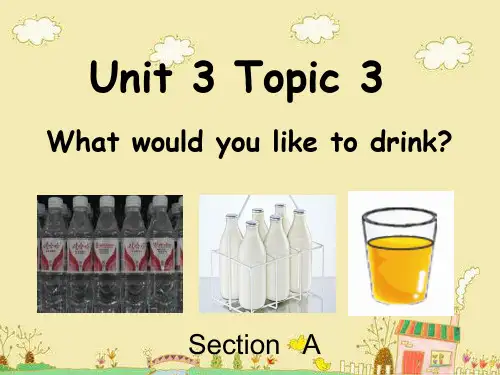
vegetables / ́veʤtəb l/
bananas oranges
bread /bred/
juice
/ʤus
P71-3
a hot dog
apple an orange
eggs two
hamburgers
some bananas (可数名词 water
Would you like +some +名词?
你想要...吗?(提议或邀请) Yes,please./ No, thanks.
希望得到肯定 回答
What would you like to eat / drink?你 想要吃/喝什么?
I would like +some+名词/ I'd like...
①Would you like something to drink? Yes. A glass of apple juice, please. No, thanks.
②What would you like to eat/drink? I’d like some…
③Would you like some…? Yes, please. No, thanks.
some
juice
(不可数名词) rice
fish
chicken
你能把下面的 食物对号入座 吗?
名词
可数名词
只有可数名词有单复数的变化。
some + 可数名词复数
some
eggs vegetables rice
不可数名词 some + 不可数名词
不可数名词没有复数形式, 不能在它后面加-s。
I’d like a glass of juice.
仁爱版初中英语七年级上册Unit2_Topic_1_Section_A_教学设计与反思

Teaching Plan for SectionA,Topic1, Unit2(Project English, Grade Seven)Self-introductionGood morning, ladies and gentlemen. Nice to meet you .I’m very glad to be here sharing my lesson with you. Today I am going to talk about Unit 2 Topic 1 Section A I have a small nose. I prepare to say the lesson from seven parts.Ⅰ、Analysis of the Teaching Material1. Status and function•Unit2 is the real beginning of the whole Junior Middle School English. The content in this unit is not only releated to the students’life , but also interested and colorful. This lesson tells us how todescribe a person and how to talk about possessions. Besideslearning this, students will also learn some words, phrases andexpressions of people's looks and so on. In this lesson, the main job is to understand the simple present tense using “have/has”.I willlead the students to pay attention to the new tense.2、Teaching Aims and Demands(1) Knowledge aimsa. Get the students master the words about parts of the body: nose, eye, head, face, hair, ear, mouth, neckb. Learn the simple present tense with “have/has” and understand some useful sentences:(1)I have a big nose.(2)They have round faces.(3)She has long hair.(4)It has big ears.c. Learn how to describe people’s appearances.(2) Skillful aimsa. Develop the students’ abilities of listening, speaking, reading and writing.b. Train the students’ abilities of communication.(3) Affective aimsa. Develop the students’ habits of paying close attention to the differences between Chinese culture and western culture.b. Strengthen the students’ conception of cooperation.c. Help the students feel the happiness of learning.3. Key points and difficult pointsAccording to the New English Curriculum Criterion and the students’ real situation, I choose the following materials as the key points and the difficult points of this class.(1)Key pointsa. Develop the st udents’ abilities of listening, speaking, reading and writing.b. Learn some information about people’s appearances.(2) Difficult pointsHow to use the simple present tense with “have/has”Part Ⅱ. Analysis of the StudentsThe students in my class are lovely and co-operative. Most of them are interested in English. They have learnt English for nearly three years. And they have learnt some basic skills of listening, speaking, reading and writing. But on one hand, they are eager to show themselves and want to have a try. On the other hand, in the daily life there are few chances for them to speak English and most of them are too shy to speak English in public or are afraid of making mistakes. So I will try my best to create a relaxing environment for them to practice using English.Part Ⅲ. Analysis of Teaching MethodIn this lesson I will mainly use Five Steps Method and Task-Based Language Teaching. I think if I want the students to improve their oral English, I must give them more chances to practice. That is “Learning by doing, learnin g by using”. In this case, by designing tasks according to the New English Curriculum Criterion, I will lead my students to study and cooperate with each other.Part Ⅳ. Analysis of Learning MethodThe main feature of the Task-Based Language Teaching is the students’ participation and creation. So I plan to enable the students to use “self-learning” and “co-operative learning” as their learning methods Thus, the students are required to do as follows:1. Be well prepared for the new lesson, look up some necessary information.2. In the class learning, the students should work actively and finish the tasks efficiently.3. The students should learn to work with others from their bottom of hearts.Part V. Analysis of Teaching ProceduresStep 1 Warming-up and Review(1)Show a table about Jane. Create a proper atmosphere for the new lesson . Then let the students answer the questions according to the table.T: What’s her name?S1: Her name is Jane.T: How old is she?S2: She is twelve.T: Where is she from?S3: She is from Canada.T: What class is she in?S4: She is in Class Four, Grade Seven.T: What’s her telephone number?S5: It’s (010)9267-6929.(2)Let the students look at a picture and review the words: eye, nose, mouth, ear, neck, head, hair.(3) In order to make the students remember the words quickly, I deside to play a game with them. And the name of the game is “Touch your body.”I say “Touch your nose”, the students touch it quickly. I’ll Praise the students with “well done. You are wonderful.Excellent” and so on . Reason: It is necessary for the students to review learned knowledge. Through this activity, the students can be cheered up, too.Step 2 Presentation1. Show some pictures and teach the phrases, such as, “a small nose, a wide mouth, long hair, big eyes, and so on.2. Let the students observe the picture, and try to say:She has long hair. He has a wide mouth.He has short hair. She has big eyes.3. Let the students read 1a after the tape and pay attention to the pronunciation and intonation. At the same time, let the students underline the words and phrases that they don’t understand.4. Read 1a again and complete 1b,check the answers. Encourage the students to get help from their group members.Reason: This step aims to make the students get the general idea of the article.Step 3 Consolidation1.Let the students look at the chart and discuss in groups. Showyourself. They will say: I have a small nose. He has a wide mouth.They have big eyes. She has long hair.2.I’ll let some students come to the front. Other st udents describehim/her using their words. They will feel excited.Reason: The step aims to make the students not only practicetheir speaking ability but also feel the happiness of learning. Step 4 Practice1.Work in groups. Show a picture and let the students writedown her appearance. Let them list as many sentences aspossible in groups.2.I’ll give the students some chances to shoe their passages infront of the students.Reason: Task-based language Teaching Method is used here to develop the students’ ab ility of writing and also their ability of their cooperation will be well trained.Step 5 HomeworkAfter class, I’ll let the Ss Write a passage about Jim’s appearance in the exercise book. I think homework is so important that the Ss should speak English as much as they can in class or after class. It is necessary for the Ss to do some exercises after class to consolidate the knowledge they learned.Blackboard Design:Reason: In this step, I’ll write the important words to help the students understand the present tense with have/has.Reflection about this lesson1. In the teaching process, we should encourage the students to join, observe, practice, think independently and cooperate. Change their thought from “I have to study.” to “I want to study.”2. As teachers, to make our English classrooms shine with vitality, we are laid with heavy burden, and we still have long way to go.Teaching Plan for SectionA,Topic1,Unit2(Project English, Grade Seven)。
Unit2 Topic3 SectionA 同步学与练(解析版) 2023-24仁爱版九年级英语上册
Unit2 Topic3 What can we do at home to protect the environment?Section A【学习目标】By the end of the lesson, students should be able to:Words and phrases: nod, agreement, disagreement, protection, organization, recycle,can, give up, so that, encourage sb to do sth.be harmful to sb./sth.Sentences: We should reduce the waste we produce.We should use both sides of paper and reuse plastic bags.It's a pleasure.Recycling can protect the environment, and it can save money, too.So we encourage students to collect waste paper and soft drink cans.Grammar: compound sentenceDifficult points:根据句子需要,正确地选用连接词。
理解含有定语从句和情态动词被动语态的句子。
【预习导学】必备单词、短语和句子1 ________________ n.保护,防卫2 ________________ n.组织;团体;机构3 ________________ n.回收利用;再利用4 ________________ adj.塑料的5 ________________ n.(美)罐子;罐头modal v. 能6 ________________ v.点头7 ________________ n.同意,一致;协定,协议8 ________________ 赶快,快点9 ________________ 放弃10 ________________ n.电池11.environmental protection ______________________12.work for…________________________13.spread message about…________________________14.reduce air pollution ________________________15.both sides of …________________________16.save money/ energy/ electricity /resources_______________________17.be supposed to do sth. _________________________18.reuse plastic bags _________________________19.encourage students to collect waste paper________________________20.当你离开房间时,请把灯熄灭._________________________________________________21.我们应试使用纸的两面._________________________________________________22.你最好骑自行车去上班,而不是开车__________________________________________________23.购物时,最好带一个布袋.___________________________________________________24.我们鼓励学生收集废纸.__________________________________________________答案:1 protection n.保护,防卫2 organization n.组织;团体;机构3 recycle n.回收利用;再利用4 plastic adj.塑料的5 can n.(美)罐子;罐头modal v. 能6 nod v.点头7 agreement n.同意,一致;协定,协议8 hurry up 赶快,快点9 give up 放弃10 battery n.电池11.environmental protection 环境的保护12.work for…为……工作13.spread message about…宣传有关……讯息14.reduce air pollution 减少空气污染15.both sides of ………的两面16.save money/ energy/ electricity /resources节省钱/ 能源/ 电、资源17.be supposed to do sth. 应当做某事18.reuse plastic bags 重复使用塑料袋19.encourage students to collect waste paper鼓励学生们收集废纸20.当你离开房间时,请把灯熄灭. Please turn off the light when you leave the room21.我们应试使用纸的两面. We should use both sides of paper.22.你最好骑自行车去上班,而不是开车You’d had better ride a bike to work instead of driving a car23.购物时,最好带一个布袋. You’d had better take a cloth bag when you go shopping.24.我们鼓励学生收集废纸. We encourage students to collect waste paper【探究提升】1. We all know that you’re working for an organization that protects the environment.work for...为…工作,为…坚持不懈的努力that在此引导的是定于从句,先行词是an organization,在从句中充当主语成分。
仁爱版九年级英语上册 Unit 3 Topic 2 Section A 课件(共20张PPT)
y uncle ______ to see me. He’ll be here soon.
My mother ______ for London tonight. A. leaves B. is leaபைடு நூலகம்ing C. left A. do you start B. will you starting C. are you starting
1
用括号所给动词的适当形式填空
am moving ( move) to Shanghai next month. A. I ______________
are starting (start) at 8:00 a.m. tomorrow. B. They _____________ are traveling C. We _________________ (travel) to Beijing next Sunday.
are leaving in an hour.
4. The summer holidays are coming soon.
开始:__________________ start, begin 位移动词
go, leave, arrive, take off,return 来去come, :__________________
When ______ ? - In ten minutes.
go to the central park, this weekend
__________________________________________
I am going to the central park this weekend.
Unit 3 English Around the World
仁爱版七年级英语下册课件Unit7Topic3SectionA(19张PPT)
1b. Listen to 1a and match the activities with the
children at Kangkang’s birthday party.
things happened in the past.
• e.g. 1.What did Sally do? She danced.
•
2. What about Tom? He performed some magic tricks.
1.Read 1a, and try to retell 1a in your own words. You may begin like this:
5. Dancing
Judy
6. Piano playing 7. English song 8. Ballet 9. Disco 10. Kung fu
Maria Jane Maria Jack Kangkang
A:What did...do at the party yesterday? B:He/She....
Jack_d_a_n_c_e_d_to disco.
Kangkang_p_e_r_f_o_rm__e_d Chinese kung fu.
1.play-- played
9.study-- studied
2.look-- looked
10.worry-- worried
3.miss-- missed
2. A. Listen and circle the programs you hear in the program list below.
仁爱版七年级英语上册 Unit 3 Topic 3 Section B 课件
Reading
Read 1a again and take notes:
经常=often Kangkang: What do you usually have for breakfast, Michael?
Michael: I usually have milk and bread for breakfast.
No, they don’t.
.
Group work
2
Make a survey in your group and then report it to the class.
A: What do you usually have for breakfast/lunch/dinner? B: I usually have … for breakfast/lunch/dinner.
(2)形容词修饰它,要放到它后面
eg: something wrong, something important
(3)后用动词不定式
eg:something to eat/drink
点餐常用语
1.May I take your order?_________您__可__以__点__菜__了__吗__?_____ 2.Which kind of drink would you like,beer or a soft drink?
[lʌn(t)ʃ] n.午餐
In the evening, we have dinner.
['dɪnə] n.晚餐;晚宴;主餐d /fu:d/ 食物
eggs
fish
vegetables
apples