
中国海洋大学2018年《620 基础英语》考研大纲
矿产资源开发利用方案编写内容要求及审查大纲
矿产资源开发利用方案编写内容要求及《矿产资源开发利用方案》审查大纲一、概述
㈠矿区位置、隶属关系和企业性质。
如为改扩建矿山, 应说明矿山现状、
特点及存在的主要问题。
㈡编制依据
(1简述项目前期工作进展情况及与有关方面对项目的意向性协议情况。
(2 列出开发利用方案编制所依据的主要基础性资料的名称。
如经储量管理部门认定的矿区地质勘探报告、选矿试验报告、加工利用试验报告、工程地质初评资料、矿区水文资料和供水资料等。
对改、扩建矿山应有生产实际资料, 如矿山总平面现状图、矿床开拓系统图、采场现状图和主要采选设备清单等。
二、矿产品需求现状和预测
㈠该矿产在国内需求情况和市场供应情况
1、矿产品现状及加工利用趋向。
2、国内近、远期的需求量及主要销向预测。
㈡产品价格分析
1、国内矿产品价格现状。
2、矿产品价格稳定性及变化趋势。
三、矿产资源概况
㈠矿区总体概况
1、矿区总体规划情况。
2、矿区矿产资源概况。
3、该设计与矿区总体开发的关系。
㈡该设计项目的资源概况
1、矿床地质及构造特征。
2、矿床开采技术条件及水文地质条件。
2018年硕士研究生招生考试大纲
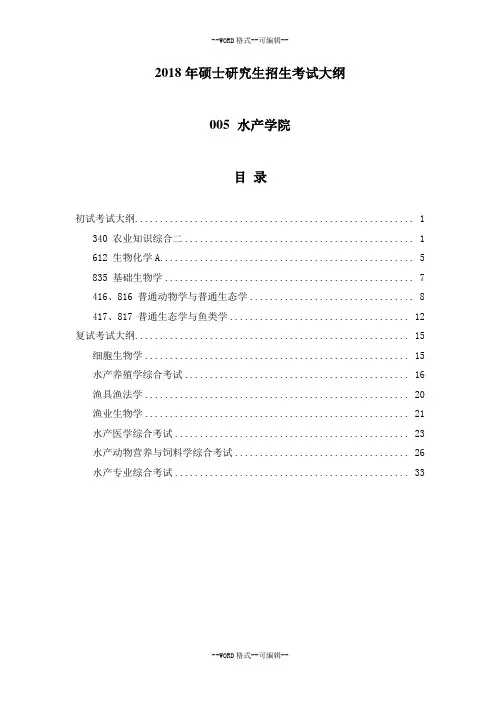
2018年硕士研究生招生考试大纲005水产学院目录初试考试大纲 (1)340 农业知识综合二 (1)612 生物化学A (5)835 基础生物学 (7)416、816 普通动物学与普通生态学 (8)417、817 普通生态学与鱼类学 (12)复试考试大纲 (15)细胞生物学 (15)水产养殖学综合考试 (16)渔具渔法学 (20)渔业生物学 (21)水产医学综合考试 (23)水产动物营养与饲料学综合考试 (26)水产专业综合考试 (33)初试考试大纲340 农业知识综合二一、考试性质《农业知识综合二》是中国海洋大学农业推广(渔业领域)专业硕士研究生入学初试考试的专业基础课程。
二、考察目标《农业知识综合二》侧重于动物生产类综合知识的考查。
考试内容应主要涵盖动物生理学、动物遗传学、动物营养学与饲料学等课程。
要求考生认识生命活动的基本规律,理解和掌握相关生理学、遗传学、营养学基础知识、基本理论和基本方法,能够分析、判断和解决有关实际问题。
考试旨在三个层次上测试考生对动物生理基础、动物遗传学基础、动物营养学等知识掌握的程度和运用能力。
三个层次的基本要求分别为:1、熟悉记忆:动物生理学、遗传学和营养学名词记忆方面的考核。
2、分析判断:利用动物生理学、遗传学和营养学原理分析判断某一具体观点和问题;3、综合运用:利用动物生理学、遗传学和营养学综合分析具体实践问题。
三、考试形式1、试卷满分及考试时间:本试卷满分为150分,考试时间为180分钟。
2、答题方式:答题方式为闭卷、笔试。
试卷由试题、答题卡和答题纸组成,选择题和判断题的答案必须涂写在答题卡上,其他题目的答案必须写在答题纸相应的位置上。
3、试卷结构①《动物生理学》考核比例为33.3%,分值为50分;②《动物遗传学》考核比例为33.3%,分值为50分;③《动物营养与饲料》考核比例为33.3%,分值为50分。
四、考试内容(一)动物生理学1、细胞生理学细胞膜结构与跨膜物质转运、跨膜信号转导、生物电现象与兴奋性、肌肉收缩。
2018年全国考研英语一大纲.doc

全国硕士研究生入学统一考试英语(一)考试大纲(非英语专业)(2018年版)I.考试性质英语(一)考试是为高等学校和科研院所招收硕士研究生而设置的具有选拔性质的全国统一入学考试科目,其目的是科学、公平、有效地测试考生对英语语言的运用能力,评价的标准是高等学校非英语专业本科毕业生所能达到的及格或及格以上水平,以保证被录取者具有一定的英语水平,并有利于各高等学校和科研院所在专业上择优选拔。
II.考查目标考生应掌握下列语言知识和技能:(一)语言知识1.语法知识考生应能熟练地运用基本的语法知识。
本大纲没有专门列出对语法知识的具体要求,其目的是鼓励考生用听、说、读、写的实践代替单纯的语法知识学习,以求考生在交际中能更准确、自如地运用语法知识。
2.词汇考生应能掌握5500左右的词汇以及相关附表中的内容(详见附录1、2)。
除掌握词汇的基本含义外,考生还应掌握词汇之间的词义关系,如同义词、近义词、反义词等;掌握词汇之间的搭配关系,如动词与介词、形容词与介词、形容词与名词等;掌握词汇生成的基本知识,如词源、词根、词缀等。
英语语言的演化是一个世界范围内的动态发展过程,它受到科技发展和社会进步的影响。
这意味着需要对本大纲词汇表不断进行研究和定期的修订。
此外,全国硕士研究生入学英语统一考试是为非英语专业考生设置的。
考虑到交际的需要,考生还应自行掌握与本人工作或专业相关的词汇,以及涉及个人好恶、生活习惯和宗教信仰等方面的词汇。
(二)语言技能①1.阅读考生应能读懂选自各类书籍和报刊的不同类型的文字材料(生词量不超过所读材料总词汇量的3%),还应能读懂与本人学习或工作有关的文献资料、技术说明和产品介绍等。
对所选材料,考生应能:1)理解主旨要义;2)理解文中的具体信息;3)理解文中的概念性含义;4)进行有关的判断、推理和引申;5)根据上下文推测生词的词义;6)理解文章的总体结构以及上下文之间的关系;7)理解作者的意图、观点或态度;8)区分论点和依据。
中国海洋大学研究生英语考试题教学提纲
中国海洋大学研究生英语考试题Final English Exam for Master Candidates ( 工B )(January 2012)Part I Listening Comprehension (25%)Section A Short Conversations (5%)Directions:In this section, you will hear 10 short conversations. At the end of each conversation, a question will be asked about what was said. Both the conversation and the question will be spoken only once. After each question there will be a pause. During the pause, you must read the four choices marked (A), (B), (C) and (D) and then decide which the best answer is. Then mark the corresponding letter on the Answer Sheet with a single line through the center.1. A. He doesn’t like the woman, so he doesn’t want to see her.B. He is shy to meet the woman because he doesn’t know what to sayC. He is busy with his work and wants to spend the time reading.D. He prefers being alone to being alone to being with other people.2. A. She cannot use her computer to meet her deadlines.B. Busy phone lines means she has to call the secretary.C. She has to call tech support for help.D. She needs to take a deep breath, she feels sick.3. A. Go shopping for cooler clothes.B. Look to see how much energy we use.C. Buy and use energy efficient appliances.D. Enjoy the warmer weather.4. A. Vegetables that are grown in dirt are organic.B. Vegetables grown in a greenhouse garden.C. Vegetables that are more expensive than other vegetables.D. Vegetables grown without pesticides or chemical fertilizers.5. A. Because the class was better than her classmate expected.B. Because she wants to use the computer.C. She is excited to be taking biology.D. Because the computer is stranger to her than the microscope.6. A. It doesn’t want to spend money now.B. It doesn’t think it needs to clean up.C. It doesn’t care about air pollution.D. It thinks only poor areas are polluted.7. A. Because he is going to Laos next summer on a bike.B. Because he will ride a bicycle over mountains and it’s dangerous.C. Because he hates to sit still while on vocation.D. Because he will rest himself on this adventure.8. A. Because if we believe intelligence is inherited, nothing else matters.B. Because their parents didn’t choose the right marriage partners.C. Because we have never cared about our children’s environments.D. Because all children will get a good environment at their home.9. A. He can wear jeans to work.B. He has to dress up at work.C. He can wear shorts to work.D. He has to wear a T-shirt.10. A. Low gravity environments are easier to find.B. Natural places for research are easier to find.C. Very clean environments are easier to find.D. Strong fields of gravity are easier to find.Section B Passages (10%)Directions: Listen to the following two passages. Each passage is followed by FIVE statements. Listen to the passage and decide whether the statements are true or false. Write T for true and F for false on the answer sheet.Passage 11.Researchers fit polar bears with radar so they can monitor the effect of globalwarming on them.2.Polar bears come to land earlier this spring because they have developed enoughfat reserves to survive.3.Polar bears are particularly selected for study because they can be followed formany years which help researchers get deeper insight into what is happening. 4.The objective of the Kyoto Protocol on Climate Change is to call on developingcountries to reduce the carbon emission.5.It is hard for polar bears to reproduce due to global warming.Passage 2mercial and recreational fisheries contribute $ 80 billion to the U.S. economyevery year.7. To maintain a sustainable and disease-free seafood supply is a national prioritybecause it has impacts on ocean environment.8. Scientists are researching new ways to improve aquaculture practices to reducepeople’s demand of wild fish.9. Some technologies are applied to forecast the potential disease that might attackfish to protect the health of public.10. The genetic make-up of bacteria that might hit seafood is teased apart byscientists in order to provide us with more nutritious seafood.Section C Compound Dictation (10%)Directions:In this section, you will hear a passage three times. When the passage is read for the first time, you should listen carefully for its general idea. When the passage is read for the second time, you are required to fill in the blanks numbered from 1 to 8 with the exact words you have just heard. For blanks numbered from 9 to 11 you are required to fill in the missing information. For these blanks, you can either use the exact words you have just heard or write down the main points in your ownwords. Finally, when the passage is read for the third time, you should check what you have written.Analysts at the U.S. Census Bureau have a (1)_______forecast for America’s population in 2050, when today’s 25 year-olds will be knocking on the door of age 65. If (2)_________ hold, not only will there be more than TWICE as many people 65-and-over in (3)______numbers as there are now, but their percentage of the population will jump from 12 percent today to 21 percent. That means more than one in five Americans at mid-century will be what we call "senior citizens." And if current demographic trends continue, a much greater (4)_______ of the nation’s elderly will be Hispanic, African-American and Asian-American.Linda Jacobsen at the Population Reference Bureau, a private (5)_____ that helps make sense of demographic data, helped us sort out the (6)________.Primarily, she says, in 2050 a whole lot more people 65 and older will be on the job outside the home. In part, tha t’s because many more than today will be well educated and in (7)____ health, and will simply WANT to keep working.Others won’t have a choice, since they won’t be able to get Social Security benefits as the (8)_______age keeps risin g —quite possibly to 70 or beyond by 2050. And as private companies cut costs,(9)_________________________________________________________ .Today, women more often than men are the ones who stay home to care for Mom and Dad in their last years— while men contribute mon ey to their elders’ care. But in 2050,(10)_________________________________________________________________ __ .So, Linda Jacobsen points out, young Americans had better be saving money right now in the increasing likelihood they’ll have to care for th emselves in their advanced years. But, (11)_____________________________________________________________________ _________ .In 2050, Americans who are 65 may be considered "middle-aged." By then, only what demographers today call the "oldest old"— the 85-and-over crowd— will be thought of as truly "old."Part II Vocabulary (15%)Section ADirections: There are 20 incomplete sentences in this part. For each sentence there are four choices marked A, B, C and D. Choose the ONE that can best complete the sentence. Then mark the corresponding letter on the Answer Sheet with a single line through the center.1.The Sex Discrimination Act has not ____ discrimination in employment.A.MaintainedB. expelledC. eliminatedD. recovered2.To guarantee the compa ny’s success, our Directors developed and ____ stringentpolicies.A.carried aboutB. carried forwardC. implementsD. implementedprovenance B. original C. measures D. donor4.The British police have no ____ over foreign bank account.A.eliminationB. constraintC. incumbentD. jurisdiction5. Amid the _____ job market blues, this is the kind of report that gets my attention.A. persuasiveB. pervasiveC. persuadingD. permanent6. We seek to harness progress in science and technology to ensure effective disaster preparedness and _____.A. intensityB. severityC. excuseD. mitigation7. Asians are right to be proud of their region’s ____ in the global financial crisis.A. resilienceB. occurrenceC. propertyD. deformation8. Most Chinese carmakers are years behind their western counterparts ____________ quality, technology and service.A. in terms ofB. with regarding toC. as toD. in that9. China reaffirmed that it is not looking at pursuing a ____ trade surplus with the United States.A. substanceB. substantialC. subversiveD. subjective10. Tax revenues have ____ significantly due to a severe recession and tax changing policy choices.A. inclinedB. declinedC. being declinedD. been inclining11. Nobody could believe the politician’s ____________A. fishing timeB. crying stinking fishC. fishing in troubled waterD. fish story12. The sea became rougher and the boat rolled from side to side; many passengers began to look__.A. in low waterB. in hot waterC. going by the boardD. white about the gills13. With only half an hour to get everything ready, we’ll need _______ if we want to win the victoryA. all hands to the pumpsB. fish in troubled watersC. go by the boardD. miss the boat14. Hydrogen peroxide is the most widely used commercial _____ agent.A. bleachingB. vulnerableC. actingD. breaching15. Because human skin has weak ____, so that we can protect the skin, prevent the bacteria.A. acidB. acidityC. substanceD. illness16. These small _____ fishes live in open waters and usually consume a variable mix of phytoplankton and both herbivorous and carnivorous zooplankton.A. biotinB. molluskC. pelagicD. bivalve17. Marine construction technology like this is very complex, somewhat___________ to trying to build a bridge under water.A. ameliorateB. analogousC. judiciousD. stringent18. China currently has 11 active actors, _____________ compared with the 104 in the U.S., according to the International Atomic EnergyA. a drop in the oceanB. batten down the hatchesC. go by the boardD. fishing in troubled waters19. I must move to a larger house or spend money extending this one; either will be expensive, so I am ____.A. between the devil and the deep blue seaB. at seaC. any port in a stormD. over head and ears20. We are now striving hard to establish a ______ parliamentary democracy.A. opaqueB. transparentC. understandingD. aboveboardSection BDirection: Complete the following sentences with proper prefixes.1.Loyal armed forces launched a ___-attack against the rebels.A.counterB. upC. homoD. sub2.Somali government forces have failed to ___due militiamen who refuse torecognize government authority in the south of the capital Mogadishu.A.BioB. subC. disD. counter3.The term “__graph” is a word that is spelt like another word but has a differentmeaning from it, and may have a different pronunciation.A.bioB. upC. homoD. sub.4.In some parts of the world, ____gamy is still allowed, which is unfair to women.A.polyB. microC. subD. out5.Although invisible to the human eye, the virus can be seen clearly when examinedunder a ___scope.A.subB. polyC. microD. out6.If you are ___head in your work or achievements, you have made more progressthan you expected to and are performing well.A.aB. enC. overD. in7.It stressed that the government would go on with its task to protect its citizens,___arm terrorists and hold accountable the perpetrators of terrorist acts.A.inB. overC. enD. dis8.This may result in lessons which are too easy, ___relevant, or otherwiseinappropriate, as the research suggest.A.irB. nonC. multiD. over9. A __cultural approach to language learning in education is quite useful.A.overB. ecoC. nonD. multi10.It is the work of forensic scientists to examine the physical evidence, and usingthe methods of science, to ___construct the events that constituted the crime.A.overB. unC. re d. coPart III Reading Comprehension (25%)Section OneDirections:There are 3 passages in this section. Each passage is followed by some questions or unfinished statements. For each of them there are four choices marked A, B, C and D. You should decide on the best choice and mark the corresponding letter on the Answer Sheet.Passage OneTraditional media may be declining in much of the rich world, but in poor countries it is booming. The growth in private media in developing countries has spurred much of the demand, as has new technology. That is stoking journalism training in far-flung places, in many shapes and sizes. They range from full degree programmes to the short-term specialist training offered widely across Asia, Africa and Latin America. Groups offering such courses include the BBC World ServiceTrust, the Reuters and Thomson Foundations, the Institute for War and Peace Reporting (IWPR) and Internews Network, a media-development charity based in America.These days the donors are particularly interested in niches, such as investigative reporting and science writing. But that approach sometimes fails. The need for basic reporting skills is still central. Trainers stress the need for flexibility. Participants in the courses praise the results, while complaining about the lack of focus and co-ordination among some providers. Shapi Shacinda, the Reuters correspondent in Zambia and chairman of the press club in the capital, Lusaka, says that foreign-backed training in business and economic reporting has helped bring more skeptical coverage. Previously, news stories used to be taken straight from officials' statements, he says.But governments are harder to teach. Encouraging students to probe sensitive topics may threaten their lives or livelihoods. An Iraqi journalist trained by and working with the IWPR was shot dead earlier this year. Just this week, Zambia's minister of information asserted that state-run media should not criticize the government. In Russia, an organization founded by Internews has been closed by the authorities, who were apparently suspicious of its American backing. Rich-country governments can be a problem too. Some try to influence the “messages” that trainers deliver, for example by insisting that their diplomats talk to classes on a regular basis. The big training groups insist that they control their own content. Blurring the boundaries can be dangerous both for journalists and the programmes that support them, he notes. But others may be less choosy.More is not always better. Quality varies wildly. Places like Bangladesh and Rwanda have been showered with training in recent years. Gratitude is mixed with the wish for better co-ordination. David Okwemba of Kenya's The Nation newspaper, who also helps train journalists, bemoans(哀叹) overlap between courses andproviders' failure to share information.Some courses aspire loftily to build democratic societies through a free press. The BBC trust says it aims to give a say to the common man by holding institutions—public and private—to account. Such a range of goals makes measuring results difficult. Teaching how to point a camera or write a news story may be easy compared to raising awareness of broader issues such as HIV/AIDS.Many old news hands laugh at the notion of formal journalism education. Awell-stocked and inquiring mind plus sharp writing skills are the main assets, they reckon. But even the most grey-haired veterans of rich-world journalism still seem glad to earn extra money tutoring new hands in poor countries.1. Traditional media is booming in poor countries because of the following reasons except_____A. the private media is developing at a fast pace.B. the new technology provides technical foundation.C. there are many journalism trainings in various shapes and sizes.D. the demand for traditional media has been in steady increase.2. Which one of the following statements is TRUE of the present training in those poor countries?A. The trainers are paying more attention on skills of investigative reporting and science writing.B. The courses are mostly extensive rather than being intensive.C. The training puts emphasis on the flexibility of basic reporting skills.D. Some trainees are satisfactory with the training courses while some are complaining.3. Shapi Shacinda think foreign-backed training in business and economic reporting has helped bring more skeptical coverage because_____A. there is a conservative tradition of news reporting in these countries.B. the foreign-backed training is skeptical about the previous news stories in these countries.C. there exist some problems in the concept of news report in these countries.D. the governments order tha t news stories should be taken from officials’ statements.4. From the third paragraph, it can be inferred that Shapi Shacinda thinks_____A. the training is in short of teaching the tactics to deal with different government.B. it is still common for governments of less-developed countries to interfere with journalism.C. the training had better not involve itself into unnecessary disputes.D. the training should stress more on journalism independence from the government. 5.Towards the journalism training, the attitudes of veterans of journalism can be said to be _____A. critical.B. despicable.C. inconsistent.D. supportive.Passage 2When Princeton, the University of Virginia, and Harvard announced last fall that they would drop their early admissions options because they gave an unfair advantage to wealthy students, many college counselors held their breath. Would early decision go the way of kegs in dormitories? Not for now, at least. Early admission is still going strong at many colleges and universities, including many top-tier schools.Early decision in particular--in which a student commits to a first-choice institution--is often touted as a plus for both schools and students. Colleges can lock up half of their class before January, and acceptance rates are typically higher than under regular admission. The major drawback of early decision is that it leaves students who are in the market for the best financial aid package out in the cold. By applying early, you must enroll if accepted, so comparing awards with those of other schools is out of the question. Schools like that, of course, because it helps their bottom line. But there is a possible end run: Ask if a school will release you from yourobligation should its aid package fall short. In some cases, a school will roll you into the regular admission pool, allowing for comparison shopping come springtime.While some schools admit almost the same percentage of applicants during early and regular admission, many favor the early pool. Johns Hopkins University took 44 percent from its early round and 24 percent from the regular pool. Early birds at Hopkins make up a third of this fall's freshman class. Nonetheless, college counselors have seen borderline students get a boost by applying early decision. "If they aren't legacies, athletes, or an underrepresented minority, early decision may be the only hook that some students have," says Jim Conroy, chair of post-high-school counseling at New Trier Township High School in Winnetka, Ill. But you need to be realistic. "If a school is out of your reach, it's out of reach whether you apply early decision, early action, or regular admission," says Sarah Wilburn, a college counselor at Campus Bound in Quincy, Mass. "Move on and set some new goals."Advantage or not, applying early decision makes sense only if you're convinced that a school is a good fit for you. Erin Murray decided to apply to Dartmouth early despite the advice of her college counselor and others. They wanted her to improve her transcript after she had spent a semester of high school in Italy. But the teenager from Cheyenne, Wyo., wisely played up her experience abroad (her 4.0 GPA and top-class board scores didn't hurt, either) and was accepted. "I probably would have fit well at a number of schools," she admits, "but Dartmouth was the only place I could see myself walking across the greens. It was an instinctive reaction."If you lack the same certainty but clinching a slot before New Year's is appealing, consider other early admissions plans. Early action is a nonbinding alternative that allows you to apply by November 1 and hear back before the regular application deadline. Some highly selective schools require that you submit only one early action application--called single-choice early action--meaning you can't apply early elsewhere. Another option is to apply early to rolling admissions, where an application that arrives in the fall may stand out more than one that arrives with most of the others in January.1. Which one of the following statements is NOT true of early decision?A. Early decision is a common strategy adopted by universities to secure high rate of student enrollment.B. Early decision begins to be abandoned by top American universities.C. Early decision is a special treatment for rich students, athletes and minorities.D. Early decision will still be in practice for a fairly long time.2. The major disadvantage of early decision is that_____A. students can enjoy a less attractive the financial aid package if he chooses early decision.B. it excludes students who are from lower social class or poor family background.C. it does not allow students to choose the other better schools.D. it excludes students who want to have comparison shopping.3. What Sarah Wilburn wants to suggest students is that____A. early decision is not so advantageous as people think.B. students should not regard early decision as the sole way to college.C. students should evaluate themselves objectively before making early decision.D. students should not limit themselves in early decision.4.Wyo applied to Dartmouth because_____A. she was quite confident due to her rich experience of studying abroad.B. the university’s beautiful lawn aroused her affection.C. she found Dartmouth the only one that fit her after researching a bunch of universities.D. her 4.0 GPA and top-class board scores were not so ideal.5. The following options can be adopted by students lacking certainty of which school to apply to except_____A. applying to early action.B. applying to rolling admissions.C. applying to early decision.D. applying single-choice early action.Passage 3The U.N.-sponsored Intergovernmental Panel on Climate Change (IPCC) report released today in Brussels has a familiar ring. As the climate disasters headlined recently—intense hurricanes, drought in the American West, Arctic thawing (融化)—become commonplace in a greenhouse world, plants, animals, and people will suffer. That has been the presumption, but the latest report from the IPCC projecting greenhouse impacts calculates mounting costs that will fall the heaviest on the world’s poor.February’s IPCC report on the physical science of climate firmly links most of the recent warming of the world to human activity. Scientists authoring the second report had a tougher challenge: figuring out the likely consequences. To do that, they considered 29,000 datasets from 75 studies. Of those data series, 89% showed change—receding glaciers or earlier blooming, for example—consistent with a response to warming. Because those responses usually occurred where the warming has been greatest, the scientists concluded that it’s "very unlikely" the changes were due to natural variability of climate or of the system involved. "For the first time, we concluded anthropogenic (人类起源的) warming has had an influence on manyphysical and biological systems," says Cynthia Rosenzweig of NASA’s Goddard Institute for Space Studies in New York City, a coordinating lead author on the report.The IPCC scientists also projected the effects of future warming. Assuming that nothing is done to slow greenhouse emissions, the February report predicted a temperature increase of roughly 3℃ toward the end of the century, drying at lower latitudes, more precipitation at higher latitudes, and rising sea levels. "This report finds that such a warming will bleach most coral reefs by mid-century), drying will begin decreasing crop yields at lower latitudes within a few decades, and sea level riseand tropical cvclone intensification will increase the likelihood of millions of people being flooded out each year on river mega-deltas such as that of the Ganges-Brahmaputra in southern Asia.Bottom line? "You don’t want t o be poor and living on a river delta or the Florida coast," says climate scientist Stephen Schneider of Stanford University, a coordinating lead author. The poor— especially subsistence (生存) farmers—tend to be more vulnerable to climate change, notes the report. And they are least able to adapt, say by building levees (堤坝) against storms or dams for irrigation. Schneider’s other advice: "Try not to go over 2℃ or 3℃ because that triggers the really nasty stuff. With that much warming, the bad effects of this century only get worse, and the rare benefits, such as higher crop yields in wetter areas, fade.1.According to the first paragraph, the IPCC report______.A.sounds familiar to peopleB.has become commonplaceC.warns people of climate disastersD.has been presumed long before2.The latest IPCC report focuses on______.A.the likelihood that plants, animals, and people will sufferB.the heaviest costs of greenhouse impacts on the poor peopleC.the devastating climate disasters resulting from global warmingD.intense hurricanes, drought in the American West, and Arctic thawing3. Many data series show that climate changes, such as Arctic thawing,______.A.are a response to anthropogenic warmingB.result from the natural variability of climateC.influence many physical and biological systemsD.bring about tougher challenges to people4. According to IPCC scientists, the effects of future warming mayinclude______A.bleaching all coral reefs by mid-centuryB.higher crop yields in wetter areasC.more precipitation at lower latitudesD.numerous people in coastal areas being flooded out5. The authors of the IPCC report believe that______.A.the bottom line is not to live on a river deltaB.being richer is less vulnerable to climate changeC.something worse may arise from global warmingD.the warming of the temperature can bring higher crop yields Section Two信息匹配题10个statement匹配10个段落。
中国海洋大学英语专业研究生招生简章
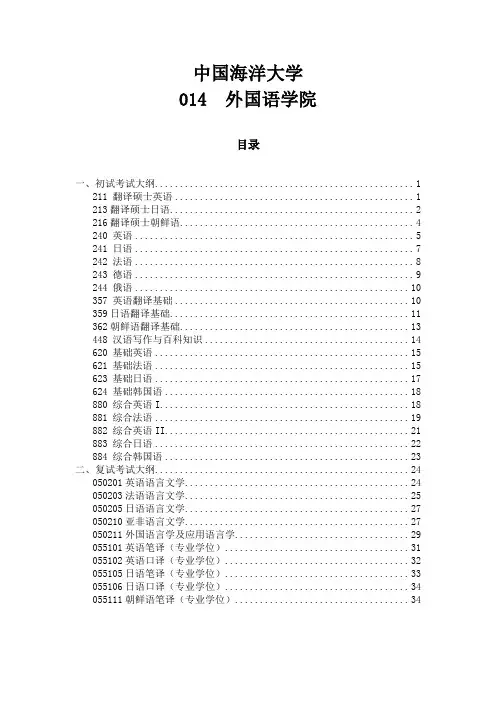
中国海洋大学014 外国语学院目录一、初试考试大纲 (1)211 翻译硕士英语 (1)213翻译硕士日语 (2)216翻译硕士朝鲜语 (4)240 英语 (5)241 日语 (7)242 法语 (8)243 德语 (9)244 俄语 (10)357 英语翻译基础 (10)359日语翻译基础 (11)362朝鲜语翻译基础 (13)448 汉语写作与百科知识 (14)620 基础英语 (15)621 基础法语 (15)623 基础日语 (17)624 基础韩国语 (18)880 综合英语I (18)881 综合法语 (19)882 综合英语II (21)883 综合日语 (22)884 综合韩国语 (23)二、复试考试大纲 (24)050201英语语言文学 (24)050203法语语言文学 (25)050205日语语言文学 (27)050210亚非语言文学 (27)050211外国语言学及应用语言学 (29)055101英语笔译(专业学位) (31)055102英语口译(专业学位) (32)055105日语笔译(专业学位) (33)055106日语口译(专业学位) (34)055111朝鲜语笔译(专业学位) (34)一、初试考试大纲211 翻译硕士英语一、考试目的《翻译硕士英语》作为全日制翻译硕士专业学位(MTI)入学考试的外国语考试,其目的是考察考生是否具备进行MTI学习所要求的英语水平。
二、考试性质与范围本考试是一种测试应试者单项和综合语言能力的尺度参照性水平考试。
考试范围包括MTI考生应具备的英语词汇量、语法知识以及英语阅读与写作等方面的技能。
三、考试基本要求1. 具有良好的外语基本功,认知词汇量在10,000以上,掌握6000个以上(以英语为例)的积极词汇,即能正确而熟练地运用常用词汇及其常用搭配。
2. 能熟练掌握正确的外语语法、结构、修辞等语言规范知识。
3. 具有较强的阅读理解能力和外语写作能力。
2018年华东理工大学612学术型硕士研究生入学考试《基础英语》考试大纲
2018年华东理⼯⼤学612学术型硕⼠研究⽣⼊学考试《基础英语》考试⼤纲学术型硕⼠研究⽣⼊学考试《基础英语》考试⼤纲⼀、考试⽬的:《基础英语》作为全⽇制硕⼠研究⽣⼊学考试的外国语考试,其⽬的是考察考⽣是否具备硕⼠研究⽣阶段学习所要求的外语⽔平。
⼆、考试性质与范围:本考试是⼀种测试应试者单项和综合语⾔能⼒的尺度参照性⽔平考试。
考试范围包括考⽣应具备的外语词汇量、语法知识以及外语读、写、译等⽅⾯的技能以及对经典⽂学⽂本的熟悉。
三、考试基本要求1.具有良好的外语听说读写译基本功,认知词汇量在12,000以上。
2.较好地掌握英美⽂学欣赏基本知识,熟知⼀些经典作品的⽂本。
3.能熟练地掌握正确的英语语法、结构、修辞等语⾔规范知识。
4.具有较强的阅读理解能⼒和英语写作能⼒。
四、考试形式本考试采取客观试题与主观试题相结合,单项技能测试与综合技能测试相结合的⽅法。
五、考试内容:本考试包括以下部分:词汇辨析、⽂学⽂本的熟悉、改错、阅读理解、英语写作等。
I.词汇辨析要求:考⽣的认知词汇量应在12,000以上,其中积极词汇量为6,000以上,即能正确⽽熟练地运⽤常⽤词汇及其常⽤搭配。
II.⽂学⽂本的熟悉要求:熟悉英美⽂学作品中的⽂本。
III.改错要求:考⽣能运⽤语法、词汇、修辞等语⾔知识识别所给短⽂内的语病并提出改正⽅法IV.阅读理解要求:能读懂常见外刊上的专题⽂章、历史传记及⽂学作品等各种⽂体的⽂章,既能理解其主旨和⼤意,⼜能分辨出其中的事实与细节,并能理解其中的观点和隐含意义。
能根据所读材料进⾏判断和推理;能分析所读材料的思想观点、语篇结构、语⾔特点和修辞⼿法;能根据阅读时间要求调整⾃⼰的阅读速度。
IV.英语写作1.要求:考⽣能根据所给题⽬及要求撰写⼀篇议论⽂。
该作⽂要求语⾔通顺,⽤词得体,结构合理,⽂体恰当,表达顺畅。
2018年英语二考研大纲

全国硕士研究生入学统一考试英语(二)考试大纲(非英语专业)(2018年版)I.考试性质英语(二)考试主要是为高等院校和科研院所招收专业学位硕士研究生而设置的具有选拔性质的全国统一入学考试科目。
其目的是科学、公平、有效地测试考生对英语语言的运用能力,评价的标准是高等学校非英语专业本科毕业生所能达到的及格或及格以上水平,以保证被录取者具有一定的英语水平,并有利于各高等学校和科研院所在专业上择优选拔。
II.考查内容考生应掌握下列语言知识和技能:(一)语言知识1.语法知识考生应能熟练地运用基本的语法知识,其中包括:(1)名词、代词的数和格的构成及其用法;(2)动词时态、语态的构成及其用法;(3)形容词与副词的比较级和最高级的构成及其用法;(4)常用连接词的词义及其用法;(5)非谓语动词(不定式、动名词、分词)的构成及其用法;(6)虚拟语气的构成及其用法;(7)各类从句(定语从句、主语从句、表语从句等)及强调句型的结构及其用法;(8)倒装句、插入语的结构及其用法。
2.词汇考生应能较熟练地掌握5500个左右常用英语词汇以及相关常用词组(详见附录相关部分)。
考生应能根据具体语境、句子结构或上下文理解一些非常用词的词义。
(二)语言技能1.阅读考生应能读懂不同题材和体裁的文字材料。
题材包括经济、管理、社会、文化、科普等,体裁包括说明文、议论文和记叙文等。
根据阅读材料,考生应能:(1)理解主旨要义;(2)理解文中的具体信息;(3)理解语篇的结构和上下文的逻辑关系;(4)根据上下文推断重要生词或词组的含义;(5)进行一定的判断和推理;(6)理解作者的意图、观点或态度。
2.写作考生应能根据所给的提纲、情景或要求完成相应的短文写作。
短文应中心思想明确、切中题意、结构清晰、条理清楚、用词恰当、无明显语言错误。
III.考试形式、考试内容与试卷结构(一)考试形式考试形式为笔试。
考试时间为180分钟。
满分为100分。
试卷包括试题册和1张答题卡。
【Selected】2018年考研英语一大纲.doc
全国硕士研究生入学统一考试英语(一)考试大纲(非英语专业)(2018年版)I.考试性质英语(一)考试是为高等学校和科研院所招收硕士研究生而设置的具有选拔性质的全国统一入学考试科目,其目的是科学、公平、有效地测试考生对英语语言的运用能力,评价的标准是高等学校非英语专业本科毕业生所能达到的及格或及格以上水平,以保证被录取者具有一定的英语水平,并有利于各高等学校和科研院所在专业上择优选拔。
II.考查目标考生应掌握下列语言知识和技能:(一)语言知识1.语法知识考生应能熟练地运用基本的语法知识。
本大纲没有专门列出对语法知识的具体要求,其目的是鼓励考生用听、说、读、写的实践代替单纯的语法知识学习,以求考生在交际中能更准确、自如地运用语法知识。
2.词汇考生应能掌握5500左右的词汇以及相关附表中的内容(详见附录1、2)。
除掌握词汇的基本含义外,考生还应掌握词汇之间的词义关系,如同义词、近义词、反义词等;掌握词汇之间的搭配关系,如动词与介词、形容词与介词、形容词与名词等;掌握词汇生成的基本知识,如词源、词根、词缀等。
英语语言的演化是一个世界范围内的动态发展过程,它受到科技发展和社会进步的影响。
这意味着需要对本大纲词汇表不断进行研究和定期的修订。
此外,全国硕士研究生入学英语统一考试是为非英语专业考生设置的。
考虑到交际的需要,考生还应自行掌握与本人工作或专业相关的词汇,以及涉及个人好恶、生活习惯和宗教信仰等方面的词汇。
(二)语言技能①1.阅读考生应能读懂选自各类书籍和报刊的不同类型的文字材料(生词量不超过所读材料总词汇量的3%),还应能读懂与本人学习或工作有关的文献资料、技术说明和产品介绍等。
对所选材料,考生应能:1)理解主旨要义;2)理解文中的具体信息;3)理解文中的概念性含义;4)进行有关的判断、推理和引申;5)根据上下文推测生词的词义;6)理解文章的总体结构以及上下文之间的关系;7)理解作者的意图、观点或态度;8)区分论点和依据。
中国海洋大学2018年《055101英语笔译(专业学位)》考研大纲
中国海洋大学2018年《055101英语笔译(专业学位)》考研大纲听力一、考试性质《英语听力》是旨在考察考生英语听力运用能力的一种水平考试。
二、考察目标考试全面检查考生是否达到英语专业教学大纲所规定的英语听力能力标准的要求。
三、考试形式本考试为闭卷考试,满分为100分(占复试总成绩比例为20%),考试时间为60分钟。
试卷结构:听力50道选择题,每小题2分,共100分。
四、考试内容要求能听懂真实交际场合中各种英语会话和讲话;能听懂VOA、BBC等国外媒体节目中有关政治、经济、文化等专题报道;能听懂有关政治、经济、历史、教育、语言、科技等的大学授课或讲座等。
该部分难度与托福考试中听力测试相当。
五、是否需使用计算器否。
英汉互译一、考试性质《英汉互译》是旨在考察考生翻译实践实际能力的强化型测试。
二、考察目标全面考察考生是否掌握翻译实践的扎实基本功,理解并能贯彻翻译的内在原则及要求。
三、考试形式本考试为闭卷考试,英译汉300个左右单词,汉译英300字左右,满分为100分(占复试总成绩比例为20%),考试时间为100分钟。
试卷结构:文言文翻译40分;英译汉30分;汉译英30分。
四、考试内容1)文言文翻译:给文言文段落加标点、译成现代汉语后再翻译成英文;2)英译汉:原文涉及国际政治、经济、科技、教育、文化等内容;3)汉译英:原文为带有中国情调的散文体裁汉语段落。
文言文翻译考察语内翻译水平和汉译英综合能力。
英译汉考察:1)理解和翻译关键词、较陌生词和词组;2)对原文长句的“拆译”和译文“重组”。
3)再现原文语义连贯;4)再现原文风格或“精神”。
汉译英考察:1)汉语词汇翻译的准确性与灵活度;2)汉英句型转换,避免Chinglish;3)英语长句的驾驭和句群衔接。
4)原文“字里行间”含义的细腻表达、语篇整体效果。
英译汉和汉译英均提倡在“忠实原文”、“表达流畅”基础上适当的“个人创译”。
五、是否需使用计算器否。
文章来源:文彦考研。
中国海洋大学2018年攻读硕士学位研究生考试大纲-医药学院
008 医药学院
目录
初试考试大纲........................................................ 1 614 专业基础综合 A ............................................... 1 958 专业基础综合 B ............................................... 7 复试科目考试大纲................................................... 13 药物化学 ....................................................... 13 药剂学 ......................................................... 17 生药学 ......................................................... 19 药物分析 ....................................................... 21 微生物学 ....................................................... 22 药理学 ......................................................... 23 分子生物学 ..................................................... 26
2
3、糖的研究方法。 (二)脂 1、脂质的定义、分类和生物学意义。 2、各种单脂、复合脂以及萜类和类固醇类脂质的存在、结构特点和功能。 3、脂类的提取、分离与分析的基本方法及原理。 (三)蛋白质 1、蛋白质的生物学意义、元素组成和分子大小和分类。 2、蛋白质的基本结构单位氨基酸,20 种基本氨基酸的结构、命名、简写、 分类、物理性质和肽键的结构、肽的物理和化学性质以及天然存在的活性肽的结构和 功能。 4、蛋白质结构的各组织层次的相关概念、类型、特点和典型例子,研究蛋 白质一级结构和高级结构的蛋白质一级结构的测定的方法, 维持蛋白质结构的作 用力。 5、蛋白质的结构和功能的关系。包括蛋白质一级结构和高级结构的关系, 一级结构和功能关系及其中涉及的基本概念; 抗体的基本结构和利用抗体的检测 方法;蛋白质高级结构与功能的关系;以及其中涉及的有关别构效应等概念。 6、蛋白质的性质。包括蛋白质的酸碱性质及相关概念;蛋白质变、复性概 念及本质、因素和变性蛋白质的特征;蛋白质的胶体性质,沉淀及相关概念(盐 溶、盐析等) ;电泳的概念;蛋白质的颜色反应等。 7、蛋白质的研究方法。包括蛋白质分离纯化的一般原则、基本流程、分离 纯化方法及分析鉴定方法涉及的概念原理和应用;几种重要方法如电泳的分类, 重要的电泳方法的特点; 蛋白质分子量测定的主要方法;蛋白质含量和纯度测定 的方法;生物活性测定中的相关概念等。 (四)核酸 1、核酸的种类和分类、命名、生物功能和在医药领域的应用。 2、核酸的基本组成单位核苷酸的组成、结构和性质。 3、核酸的共价结构和高级结构。包括核酸共价连接的基本方式与一级结构 的书写方式;DNA 的二级结构及其中涉及的概念、简写;核小体的结构;真核生
2018年考研英语一大纲(精品文档).doc
全国硕士研究生入学统一考试英语(一)考试大纲(非英语专业)(2018年版)I.考试性质英语(一)考试是为高等学校和科研院所招收硕士研究生而设置的具有选拔性质的全国统一入学考试科目,其目的是科学、公平、有效地测试考生对英语语言的运用能力,评价的标准是高等学校非英语专业本科毕业生所能达到的及格或及格以上水平,以保证被录取者具有一定的英语水平,并有利于各高等学校和科研院所在专业上择优选拔。
II.考查目标考生应掌握下列语言知识和技能:(一)语言知识1.语法知识考生应能熟练地运用基本的语法知识。
本大纲没有专门列出对语法知识的具体要求,其目的是鼓励考生用听、说、读、写的实践代替单纯的语法知识学习,以求考生在交际中能更准确、自如地运用语法知识。
2.词汇考生应能掌握5500左右的词汇以及相关附表中的内容(详见附录1、2)。
除掌握词汇的基本含义外,考生还应掌握词汇之间的词义关系,如同义词、近义词、反义词等;掌握词汇之间的搭配关系,如动词与介词、形容词与介词、形容词与名词等;掌握词汇生成的基本知识,如词源、词根、词缀等。
英语语言的演化是一个世界范围内的动态发展过程,它受到科技发展和社会进步的影响。
这意味着需要对本大纲词汇表不断进行研究和定期的修订。
此外,全国硕士研究生入学英语统一考试是为非英语专业考生设置的。
考虑到交际的需要,考生还应自行掌握与本人工作或专业相关的词汇,以及涉及个人好恶、生活习惯和宗教信仰等方面的词汇。
(二)语言技能①1.阅读考生应能读懂选自各类书籍和报刊的不同类型的文字材料(生词量不超过所读材料总词汇量的3%),还应能读懂与本人学习或工作有关的文献资料、技术说明和产品介绍等。
对所选材料,考生应能:1)理解主旨要义;2)理解文中的具体信息;3)理解文中的概念性含义;4)进行有关的判断、推理和引申;5)根据上下文推测生词的词义;6)理解文章的总体结构以及上下文之间的关系;7)理解作者的意图、观点或态度;8)区分论点和依据。