
冀教版英语八年级下册《Unit 3 Animals Are Our Friends》拓展阅读试题
阅读文章
Once upon a time, in the forest there lived a baby elephant, who had no friends. ________ of the animals wanted to be his friend because he was too large.
One day, a wild fire happened in the forest. The animals ran to safer places. The dry trees caught fire and the fire was sure to go all around the forest. The baby elephant ran to the nearest river, collected much water in his trunk(象鼻) and rushed to the burning trees. He sprayed (喷) the water on the fire. Finally, he put out the fire.
Later, while he was resting after the
hard job, all the animals and birds came to
him and expressed their thanks for his kind
help in time. They were now ready to have
him as their good friend and their hero. They said, “A friend in need is a friend indeed.”
The baby elephant was happy to get so many friends and played games with them. He walked through the forest, carrying several small animals and birds on his back.
试着做一做
1~2题完成句子;3题回答问题;4题找出本文主题句;5题将文中画线部分译成汉语。
1. ____________ of the animals wanted to be his friend because he was
too large.
2. ________________ was happy to get so many friends and played
games with them.
3. Where did the wild fire happen?
________________________________________________________
4. _______________________________________________________
5. _______________________________________________________
答案
1.None点拨:语境提示法。
前面语境in the forest there lived a baby
elephant, who had no friends提示,可知动物们谁也不想和他做朋友。
2. The baby elephant
3. It happened in the forest.
4. A friend in need is a friend indeed.点拨:主旨归纳题。
故事讲述
了小象经历了从一开始“没有动物和他交朋友”,到见义勇为扑灭火,到最后所有的动物都把他看做他们的“英雄和好朋友”的过程。
短文最后借所有动物之口,揭示出“患难见真情”的文章主旨。
5. 现在他们心甘情愿把他看做他们的英雄和好朋友。
2024八年级英语下册Unit3AnimalsAreOurFriends写作能力提升练课件新版冀教版

总结 In a word, it’s fun to have a pet.
种树 的重 要性
Trees are important to people. Trees can give food to people and animals. They can make the air cleaner. They can make the earth more beautiful. Trees can protect the soil.
members can talk about their pets together. Keeping pets will improve the relationship between the family members.
In a word, it’s fun to have a pet. Do you want one?
句 型: 1. Animals are important in the food chain. 2. We should think of animals as friends. 3. We should do our best to protect animals.
环顾四周,你会发现许多人拥有自己的宠物,请 根据下面的提示,写一篇英语短文来谈一谈养宠物的好 处。可适当发挥。80 词左右。 提示 : 1.To improve yourself. (look after; make friends) 2. Develop a good relationship with family members. (talk
_fl_o_w_e_r_. _B_e_n__b_a_r_k_e_d_a_n_d__j_u_m_p_e_d__i_n_to__th__e_w_a_t_e_r_a_t_o_n__ce_.______ _W__h_e_n_m__y_p_a_r_e_n_t_s_h_e_a_r_d__B_e_n__b_a_r_k_in_g_,_t_h_e_y_r_a_n__t_o_t_h_e_r_i_v_e_r__ _q_u_ic_k_l_y_a_n_d__t_h_e_y_s_a_w__B_e_n__w_a_s__p_u_s_h_in_g__m_e__t_o_t_h_e_b_a_n_k__w_i_t_h__ _it_s_m__o_u_th__. ___________________________________________ _____N_o_w__w_e__lo_v_e__B_e_n__m_o_r_e__th_a_n__b_e_f_o_re_,_a_n_d__w_e__c_o_n_s_id_e_r__it__ _a_s _a_m__e_m__b_e_r_o_f_o_u_r_f_a_m__il_y_._____________________________ ____________________________________________________ ____________________________________________________
冀教版英语八年级下册单元检测卷 Unit 3 Animals are Our Friends(基础)
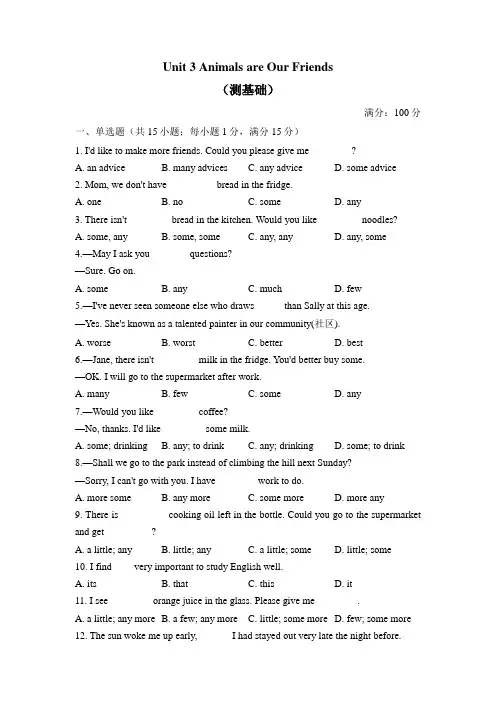
Unit 3 Animals are Our Friends(测基础)满分:100分一、单选题(共15小题;每小题1分,满分15分)1. I'd like to make more friends. Could you please give me ________?A. an adviceB. many advicesC. any adviceD. some advice2. Mom, we don't have _________ bread in the fridge.A. oneB. noC. someD. any3. There isn't ________ bread in the kitchen. Would you like ________ noodles?A. some, anyB. some, someC. any, anyD. any, some4.—May I ask you _______ questions?—Sure. Go on.A. someB. anyC. muchD. few5.—I've never seen someone else who draws _____ than Sally at this age.—Yes. She's known as a talented painter in our community(社区).A. worseB. worstC. betterD. best6.—Jane, there isn't ________ milk in the fridge. You'd better buy some.—OK. I will go to the supermarket after work.A. manyB. fewC. someD. any7.—Would you like ________ coffee?—No, thanks. I'd like ________ some milk.A. some; drinkingB. any; to drinkC. any; drinkingD. some; to drink8.—Shall we go to the park instead of climbing the hill next Sunday?—Sorry, I can't go with you. I have ________work to do.A. more someB. any moreC. some moreD. more any9. There is _________ cooking oil left in the bottle. Could you go to the supermarket and get _________?A. a little; anyB. little; anyC. a little; someD. little; some10. I find ____very important to study English well.A. itsB. thatC. thisD. it11. I see ________ orange juice in the glass. Please give me ________.A. a little; any moreB. a few; any moreC. little; some moreD. few; some more12. The sun woke me up early, ______ I had stayed out very late the night before.A. howeverB. butC. even ifD. although13. He lives _____ in the house, but he does not feel _____ .A. alone; aloneB. lonely; lonelyC. lonely; aloneD. alone; lonely14.—________ have you been in the sports club?—Since the first month I came to the school.A. How oftenB. How longC. How soonD. How many15.—I want to make a tomato milk shake. What do I need?—You need __________ tomatoes and __________ yogurt.A. two;someB. two;manyC. little;manyD. little;some二、完形填空(共10小题;每小题1.5分,满分15分)It is a basic ability for humans to tell more from less. Surprisingly, a number of animals 1 this ability too. They will 2 more of something. Horses, for example, will go for a group of three apples instead of two apples.This ability is 3 to animals in lots of ways. It helps them 4 the larger group of friends. Many fishes, for example, join groups for 5 . If a predator(掠食动物) comes, a fish in a group of 40 is less possible to become lunch than a fish in a groupof 10. So if a fish has a choice between two groups, it's safer to join the 6 one. A sense of number even helps keep the 7 . For example, a monkey group will avoid fights with other groups when they find their 8 is not an advantage.Also, the ability to do simple 9 is a sure thing for some animals. They 10 the difference between one, two, and three.Some others can count much higher than three.1.A.have B.miss C.doubt D.hate2.A.grow B.cook C.pick D.leave3.A.fresh eful C.correct D.direct4.A.hide B.beat C.push D.find5.A.safety B.holiday C.discussion D.exercise6.A.faster rger C.busier D.quieter7.A.secret B.interest C.peace D.record8.A.age B.number C.time D.speed9.A.counting B.jumping C.dancing D.swimming10.A.mix B.like C.ask D.know三、阅读理解(共10小题;每小题2分,满分20分)AMost studies show that many animals can feel the weather changes. Here are some interesting facts about animals.can tell the weather before you or the weather report. If you want to know more about them, you can read more articles about science on School Science Magazine.1. The writer mentions (提到) the following animals EXCEPT (除了) ________.A. birdsB. pigsC. sharks2. If a big storm is coming, sharks will ________.A. swim to upper waterB. jump out of water oftenC. swim to deeper water3. If there are more spiders than usual in autumn and they make larger webs, the weather in the following winter will be ________.A. dry and warmB. warm and wetC. dry and cold4. Which of following is true?A. Scientists can't explain the behaviors of animals.B. If too many birds or animals get together, that means it will rain.C. Few animals can feel the weather changes.5. The best title for the passage is ________.A. Animals and Weather ChangesB. How to Predict a stormC. How to Protect AnimalsBA blind boy sat there with a hat by his feet. He held up a sign which said, "I am blind, please help.There were only a few coins in the hat. A man was walking by. He took out a few coins and dropped them into the hat .He then turned the sign around and wrote something on it. He put the sign back and walked away.Soon the hat began to fill up. A lot more people were giving money to the blind boy. That afternoon the man who had changed the sign came to see how things were. The boy recognized his footsteps and ask, "Are you the one who changed my sign in the morning? What did you do?"The man said, "I only wrote the truth in a different way."What he had written was, "Today is a beautiful day, but I can't see it.Of course both signs told people the boy was blind. But the first sign simply told people to help by putting some money in the hat. The second one told people that they were able to enjoy the beauty of the day, but the boy could not enjoy it because he was blind.The first sign simply said the boy was blind, while the second one told people they were so lucky that they were not blind.There are at least two lessons we can learn from this simple story.Treasure (珍惜) what you have. Someone else has less. Try your best to help those who need your help.Be creative. Think differently. There is always a better way.1. From the passage we know that ________.A. the boy is the man's son.B. the man is one of the boy's neighbors.C. the boy is blind and needs help.D. the boy works for the man.2. On the sign what the man wrote was, "________".A. Treasure what we have already had.B. Today is a beautiful day, but I can’t se e it.C. We are so lucky that we are not blind.D. Try your best to help those who need your help.3. According to the passage, which of the following is TRUE?A. The hat began to fill up after the man wrote some words on the sign.B. The man took away all the few coins from the hat.C. The boy wanted to get enough money to go to school.D. Nobody wanted to give any coins to the blind boy.4. The word "recognized" here in Chinese means ________.A.承认B.接受C.表扬D.辨认出5. The best title for this story is _________.A. Giving makes receiving!B. Be kind and creative!C. Be kind to the blind!D. Do not always get, but offer!四、七选五(共5小题;每小题2分,满分10分)A: Look! This is a picture of my dog. Here.B: ① ______A: I know. He weighs fifty-one kilos,B: Really? That's amazing. ②______A: He's called Max.B: ③______A: Five years. I got him when we moved out of the city. ④______B: Wow! Then Max has more space.A: He's very friendly. He always jumps on you when you come home.B: Woah! Scary!A: ⑤______ I mean, he plays very well with our cat, Kira. He runs after her around.1分,满分5分)1.I think real______________ (友谊) is more valuable than money.2.This question is small but ______(典型的).3.She kept ______ (微笑) at me and made me feel a little nervous.4.Under such ______ (条件), the water will become ice.5.In some countries, black people don’t have the same____________(权利) as whites.六、连词成句(共5小题;每小题2分,满分10分)1.Vera, like, vacation, her, did_______________________________________________?2.some, as gentle as, and, plants, dinosaurs, were, sheep, ate_______________________________________________.3.repaired, afternoon, I, to, get, bike, this, need, my_______________________________________________.4.the, lot, can, a, of, clothes, suitcase, hold_______________________________________________.5.there, the, watch, much, is, over, how_______________________________________________?七、书面表达(共1小题;满分25分)根据中文提示,写一篇60 词左右的小故事。
冀教版初中英语八年级下册Unit3 Animals Are Our FriendsPPT课件

翻译下列的短语。
Today was April Fools’ Day. Jenny and Brian wanted to _p_la_y__a_t_r_ic_k__o_n_ Danny. Danny was
sleeping. Jenny and Brian _w_o__k_e_ him up. They told Danny a bear _e_s_c_a_p_e_d_ from the zoo.
Task 2 Listen and correct the following passage.
fierce
Hale Waihona Puke shortbamboo
plants can’t as fast as
eight
smaller and smaller
Task 3
Read the lesson and fill in the blanks to complete the story.
4. Wait a minute. 等一会儿。
此句为祈使句,还可以说成wait a moment.
5. You are joking, aren’t you?
反义疑问句:陈述句+逗号+省略问句+ 问号
You are from America, aren’t you?
There stands a house and lots of trees, doesn’t there?
冀教版初中英语八年级下册Unit 3 Animals Are Our Friendsword教案 (2)
Unit 3 Animals Are Our FriendsLesson 13 Danny’s Big ScareTeaching content:Mastery words and expressions: scare, doorbell, scream, tiny, sofa, vacation, gentle, loyal Oral words and expressions: amazing, imaginationLearning important and difficult points:1) yet的用法2) ask sb. to do sth. 的用法Teaching difficult points:The imaginary pets.Teaching preparation: picturesTeaching aids:audiotape, flashcards, picturesTeaching type: new lessonTeaching procedures:Step 1. Come to “THINK ABOUT IT”◆ What’s your favorite animal? Why?◆ Do you have a pet?What is its name?◆ What kind of pets would you like to have?Step 2. Listen to the tape and answer the following questions:Step 3. Read the text and check the answers. Then read the text again. Play the tape again and let the students read after it. Play the tape for several times until they can read it correctly and fluently.Step 4. Let some students lead the class to read the text sentence by sentence.Step 5. PracticeWork in pairs. Practice the similar dialogue according to the text.Step 6. Come to “PROJECT”Do you have a pet? Do many animals live with your family? Some people have dogs. Some people have cats. Some people have fish. Some people even have snakes! Do you have a pet?Step 7. Homework1. Finish off the activity book.2. Go on the next reading in the next lesson.Lesson 14 Amazing AnimalsTeaching content:Oral words and expressions:long-eared, jerboa, mouse, kiwi, lay, eggplant, shake, flap, avoid Learning important and difficult points1) remind的用法2) lay的用法Teaching preparation: picturesTeaching aids:audiotape, flashcards, picturesType of lesson: new lessonTeaching procedures:Step 1. ReviewStep 2. Come to “THINK ABOUT IT.”◆ Can you name some animals you have never seen before?◆ What animals do you think are amazing? Why?Step 3. Read the text silently and ask the students to answer the following questions:Step 4. Play the tape and let the students read after it. Pause after every line, and ask the students to repeat.Step 5. Let some students read the text in class and the others listen to see if they have any mistakes. Can they find and correct the mistakes?Step 6. Let the students rewrite the story and read it to the class.Step 7. Discuss the reading with the students. Use as much English as possible. Ask questions to make it easier for students to participate.Step 8. HomeworkWould you like to have a pet?Why or why not?Write a paragraph.Lesson 15 The Zoo Is OpenTeaching content:Mastery words and expressions: danger, dangerous, mainly, bamboo, giraffeLearning important and difficult points:1.take photos2.nearly的用法Teaching preparation: picturesType of lesson: new lessonTeaching procedures:Step 1. Show some pictures of animals to the class. Ask the students:What animals do you like best?What animals can you see in the zoo?Step 2. Come to “THINK ABOUT IT.”▲ Have you ever been to the zoo?▲ What animals do you think are dangerous? Why?▲ What rules should we obey at the zoo?Step 3. Read the text.Step 4. PracticeStep 5. Read the text in roles. The teacher walks in the classroom while they are reading. Help them if necessary.Step 6. Let some students come to the front and act the dialogue out.Step 7. HomeworkPrepare the dialogue in group of three in “Let’s Do It”, and act it the next class.Lesson 16 The Bear Escaped!Teaching content:Mastery words and expressions: escape, fierce, protect, foolLearning important and difficult points:1.escape的用法2.if的用法3.wake upTeaching preparation: picturesTeaching aids:audiotape, flashcards, picturesType of lesson: new lessonTeaching procedures:Step 1. Free talkStep 2. Come to “THINK ABOUT IT.”★ When is April Fools’ Day?★ What do people do on that day?★ Have you ever played a trick on a friend? What did you do?Step 3. Listen to the tape and answer the questionsStep 4. Read the text and check the answers. Then let the students read it loudly in class. Aftera while, ask the students to act it out in front of the class.Step 5. Come to “LET’S DO IT”◆What do you thin k of the idea of April Fools’ Day?◆ Have you ever played a trick on someone? Share a trick with you partner.◆What do you think “ white lie” means?Step 7. HomeworkDo you know any other interesting foreign festivals?Write them down, and share with your partner next class.Lesson 17 Save the TigersTeaching content:Mastery words and expressions: century, fur, symbol, courage, brave, chain, balance, reason, disappear, kill, cut, decreaseLearning important and difficult points:1) the number of2) balance的用法3) danger的用法Teaching preparations: picturesTeaching aids:audiotape, flashcards, picturesTeaching procedures:Step 1. ReviewStep 2. Come to “THINK ABOUT IT.”Where can you usually see a tiger?Do you think tigers need our help? Why or why not?Step 3. Listen to the tape and repeat after it. Play the tape for several until they can read it correctly and fluently.Step 4. Let some students act the dialogue out in front of the class.Step 8. HomeworkWork in groups and discuss some ways we can protect animals. Write down your ideas.Lesson 18 Friendship Between AnimalsTeaching content:Mastery words and expressions: friendship, rhino, skin, warn, insect, relationship, survive, mzee, hippo, tortoise, truly, boundaryLearning important and difficult points:1) use的用法2) warn的用法Teaching preparation: picturesTeaching aids:audiotape, flashcards, picturesType of lesson: new lessonTeaching procedures:Step 1. Come to “THINK ABOUT IT”◆Do you think there is friendship between animals?◆ What different animals have you seen living well together?Step 2. Listen to the tape and let some students retell the main idea about the text. If they can’t do well, don’t publish them. Encourage them and say: “I know it is very difficult for you. It’s also difficult for me. Let’s face the problem together.”Step 3. Read the text silently and answer the questionsStep 4. ExerciseStep 5. HomeworkWhat will you do if you go to the zoo?Do you know anything that we cannot do in the zoo? Why?Think about it, and write a short paragraph.。
Unit 3 Animals Are Our Friends.Lesson13教案冀教版八年级下册

Unit 3 Animals Are Our FriendsLesson 13 Danny's Big ScareLESSON PREPARATIONLANGUAGE KNOWLEDGE掌握词汇:tiny,sofa, vacation接触词汇:scare, doorbell, scream, Zoe,gentle, loyal短语和句型:on a vacation, be afraid ofRESOURCESaudiotape pictures of pet animals LESSON STRUCTURECLASS OPENINGGreeting1)Greet the class and introduce the new unit.Teacher: Good morning/afternoon, class. Today we will start a new unit. Who can tell me the title of Unit 3?Student: I can. The title is "Animals Are Our Friends".Teacher: That's right. Can anyone guess what this unit is about?Students: This unit is about making animals our friends.Teacher: Correct. What does it mean to make animals our friends?Students: It means we treat animals nicely.Teacher: Excellent. Animals are living things that should be treated with respect, care and kindness.Write the words respect, care and kindness on the board. Students should have a good understanding of these words.2)Discuss the picture on the Unit 3 title page.Teacher: Look at the picture for Unit 3. What do you see?Students: A boy holding a cat and a girl petting a dog.Teacher: Right. People often have cats and dogs as pets. People love their pets and take care of them. Does it look like the boy and the girl are nice to their pets? Students: Yes.Teacher: I agree. Now before we get into today's lesson, I'd like to see what you remember from the last unit.ReviewReview the theme from Unit 2.Teacher: In the last unit we talked about our plants, gardening and agriculture. Why are trees and forests important?/What can you tell me about how a plant grows?/What are three steps for planting a tree seedling?/What role does each part of the flower play(i.e. flower head, stem, leaves, roots)?Ask several students to respond. Teacher: Good work, everyone.KEY CONCEPTSFOCUS STRUCTURES:Her family went on a vacation and she asked me to take care of Zoe.Don't be afraid of me.STEP 1: PresentCLASS WORK: Think About ItIntroduce Lesson 13 and discuss the Think About It questions as a class.Teacher: Now let's look at Lesson 13. Does anyone in our class have any pets? If yes, what kind of pet do you have? What's your pet's name? How old is he or she?/If not, would you like to have a pet? What kind of pet would you like and why? What would you name it?Talk to the students about the pets they have or would like to have.Students: I have a dog. His name is Ralph. He is six years old./I don't have any pets, but I would like to have a bird because they are beautiful. I would name my bird Song.Teacher: Good work. Now who can read the title of Lesson 13?Students: I can, it's "Danny's Big Scare".Teacher: Right. How do you say the word"scare"in Chinese?Students:害怕。
八级英语下册 Unit 3 Animals Are Our Friends教案 (新版)冀教版
Unit 3 Animals Are Our FriendsLesson 13 Danny’s Big ScareTeaching content:Mastery words and expressions: scare, doorbell, scream, tiny, sofa, vacation, gentle, loyal Oral words and expressions: amazing, imaginationLearning important and difficult points:1) yet的用法2) ask sb. to do sth. 的用法Teaching difficult points:The imaginary pets.Teaching preparation: picturesTeaching aids:audiotape, flashcards, picturesTeaching type: new lessonTeaching procedures:Step 1. Come to “THINK ABOUT IT”◆ What’s your favorite animal? Why?◆ Do you have a pet?What is its name?◆ What kind of pets would you like to have?Step 2. Listen to the tape and answer the following questions:Step 3. Read the text and check the answers. Then read the text again. Play the tape again and let the students read after it. Play the tape for several times until they can read it correctly and fluently.Step 4. Let some students lead the class to read the text sentence by sentence.Step 5. PracticeWork in pairs. Practice the similar dialogue according to the text.Step 6. Come to “PROJECT”Do you have a pet? Do many animals live with your family? Some people have dogs. Some people have cats. Some people have fish. Some people even have snakes! Do you have a pet?Step 7. Homework1. Finish off the activity book.2. Go on the next reading in the next lesson.Lesson 14 Amazing AnimalsTeaching content:Oral words and expressions:long-eared, jerboa, mouse, kiwi, lay, eggplant, shake, flap, avoid Learning important and difficult points1) remind的用法2) lay的用法Teaching preparation: picturesTeaching aids:audiotape, flashcards, picturesType of lesson: new lessonTeaching procedures:Step 1. ReviewStep 2. Come to “THINK ABOUT IT.”◆ Can you name some animals you have never seen before?◆ What animals do you think are amazing? Why?Step 3. Read the text silently and ask the students to answer the following questions:Step 4. Play the tape and let the students read after it. Pause after every line, and ask the students to repeat.Step 5. Let some students read the text in class and the others listen to see if they have any mistakes. Can they find and correct the mistakes?Step 6. Let the students rewrite the story and read it to the class.Step 7. Discuss the reading with the students. Use as much English as possible. Ask questions to make it easier for students to participate.Step 8. HomeworkWould you like to have a pet?Why or why not?Write a paragraph.Lesson 15 The Zoo Is OpenTeaching content:Mastery words and expressions: danger, dangerous, mainly, bamboo, giraffeLearning important and difficult points:1.take photos2.nearly的用法Teaching preparation: picturesType of lesson: new lessonTeaching procedures:Step 1. Show some pictures of animals to the class. Ask the students:What animals do you like best?What animals can you see in the zoo?Step 2. Come to “THINK ABOUT IT.”▲ Have you ever been to the zoo?▲ What animals do you think are dangerous? Why?▲ What rules should we obey at the zoo?Step 3. Read the text.Step 4. PracticeStep 5. Read the text in roles. The teacher walks in the classroom while they are reading. Help them if necessary.Step 6. Let some students come to the front and act the dialogue out.Step 7. HomeworkPrepare the dialogue in group of three in “Let’s Do It”, and act it the next class.Lesson 16 The Bear Escaped!Teaching content:Mastery words and expressions: escape, fierce, protect, foolLearning important and difficult points:1.escape的用法2.if的用法3.wake upTeaching preparation: picturesTeaching aids:audiotape, flashcards, picturesType of lesson: new lessonTeaching procedures:Step 1. Free talkStep 2. Come to “THINK ABOUT IT.”★ When is April Fools’ Day?★ What do people do on that day?★ Have you ever played a trick on a friend? What did you do?Step 3. Listen to the tape and answer the questionsStep 4. Read the text and check the answers. Then let the students read it loudly in class. Aftera while, ask the students to act it out in front of the class.Step 5. Come to “LET’S DO IT”◆What do you think of the idea of April Fools’ Day?◆ Have you ever played a trick on someone? Share a trick with you partner.◆What do you think “ white lie” means?Step 7. HomeworkDo you know any other interesting foreign festivals?Write them down, and share with your partner next class.Lesson 17 Save the TigersTeaching content:Mastery words and expressions: century, fur, symbol, courage, brave, chain, balance, reason, disappear, kill, cut, decreaseLearning important and difficult points:1) the number of2) balance的用法3) danger的用法Teaching preparations: picturesTeaching aids:audiotape, flashcards, picturesTeaching procedures:Step 1. ReviewStep 2. Come to “THINK ABOUT IT.”Where can you usually see a tiger?Do you think tigers need our help? Why or why not?Step 3. Listen to the tape and repeat after it. Play the tape for several until they can read it correctly and fluently.Step 4. Let some students act the dialogue out in front of the class.Step 8. HomeworkWork in groups and discuss some ways we can protect animals. Write down your ideas.Lesson 18 Friendship Between AnimalsTeaching content:Mastery words and expressions: friendship, rhino, skin, warn, insect, relationship, survive, mzee, hippo, tortoise, truly, boundaryLearning important and difficult points:1) use的用法2) warn的用法Teaching preparation: picturesTeaching aids:audiotape, flashcards, picturesType of lesson: new lessonTeaching procedures:Step 1. Come to “THINK ABOUT IT”◆Do you think there is friendship between animals?◆ What different animals have you seen living well together?Step 2. Listen to the tape and let some students retell the main idea about the text. If they can’t do well, don’t publish them. Encourage them and say: “I know it is very difficult for you. It’s also difficult for me. Let’s face the problem together.”Step 3. Read the text silently and answer the questionsStep 4. ExerciseStep 5. HomeworkWhat will you do if you go to the zoo?Do you know anything that we cannot do in the zoo? Why?Think about it, and write a short paragraph.。
八年级英语下册 Unit 3 Animals Are Our Friends lesson 16 The Pear Escaped全英文教案 (新版)冀教版
Unit 3 Animals Are Our FriendsLesson 16 The Bear Escaped!教学目标1. Master the new words and phrases: escape, fierce, protect, fool, wait a minute, You’re joking, aren’t you?April Fo ols’ Day2. Understand the meaning of text.3. Make the Ss learn about some interesting things in our life.教学重难点【教学重点】Learn about what is April Fools’ Day, and know about what we can do on that day. 【教学难点】Make the Ss learn about some interesting things in our life.教学准备PPT, pictures or cards.教学过程Step 1. Home work checkReview: Ask some Ss to talk about the animals in the zoo, and what did we learn in last lesson?Review the grammar: Indefinite Pronouns (some, any)Step 2. Lead in1.Greet the students in English and make sure they can response correctly.Do the duty report: a student on duty can say whatever he/she likes to say.e to “Think About It!”What do you know about April Fools’ Day?Have you ever played a trick on a friend? What did you do?T:Introduce the April Fools’ Day, and tell the Ss what they can d o on that day. Then we will learn the text about Da nny’s activity on that day.Step 3. New lessonNo. 1 Prepare lessons before class.Teach the new words and phrases. Make sure the Ss can re ad it correctly.No. 2 Text: Give them some time to read the text themselves. Then let them act out the dialogue in groups. Correct their pronunciation when necessar y.At last, the teacher explains the text in Chinese, make sure the Ss can understand the meaning of text.No.3Imp ortant phrases:Danny jumps up and down.Wait a minute. Get out ofYou’re joking, aren’t you?Play a trick/joke......on sb.No. 4 Culture Tip:April Fools’ Day is the first day of April. In most Western countries, people like to play jokes on each other. When you play a joke on somebody, you laugh and they laugh,too.But don’t play jokes that make other people sad or mad. April Fools’ Day is meant to be fun for everyone.No. 5 Finish “Let’s Do I t!”Step 4. Play the tape for the Ss to followMake the Ss listen the text, then let them read follow the tape.Step 5. SummarySum up the text what we learned, the new words, phrases, and sentences.Sum up the grammar.课堂作业Finish the activity book and the practice.Copy the new words and phrases twice.教学反思。
冀教版英语八下Unit 3《Aimals Are Our Friends》单元说课稿
冀教版英语八下Unit 3《mals Are Our Friends》单元说课稿一. 教材分析冀教版英语八下Unit 3《Animals Are Our Friends》是一篇关于动物与人类关系的文章。
本单元的主题是动物是我们朋友,通过学习本单元,学生能够了解不同动物的特点和生活习性,以及如何与动物和谐相处。
教材内容包含了动物的种类、特征、生活习性等方面的知识,旨在培养学生对动物的关爱和保护意识。
二. 学情分析八年级的学生已经具备了一定的英语基础,对于动物的知识也有一定的了解。
然而,学生在英语表达方面还存在一定的困难,尤其是对于一些动物的特点和生活习性的表达。
因此,在教学过程中,需要注重学生的语言表达能力的培养,引导学生运用英语进行思考和表达。
三. 说教学目标1.知识目标:学生能够掌握本单元的重点单词和句型,了解不同动物的特点和生活习性。
2.能力目标:学生能够用英语描述动物的特点和生活习性,提高学生的英语表达能力。
3.情感目标:培养学生对动物的关爱和保护意识,引导学生与动物和谐相处。
四. 说教学重难点1.教学重点:学生能够掌握本单元的重点单词和句型,用英语描述动物的特点和生活习性。
2.教学难点:学生能够正确运用英语表达动物的特点和生活习性,尤其是对于一些特殊动物的特点的描述。
五. 说教学方法与手段1.教学方法:采用任务型教学法,通过学生参与各种活动,提高学生的英语表达能力。
2.教学手段:利用多媒体教学,展示各种动物的图片和视频,帮助学生更好地理解和表达。
六. 说教学过程1.导入:通过展示一些动物的图片,引导学生谈论自己喜欢的动物,激发学生的学习兴趣。
2.新课呈现:教师引导学生通过观察图片和阅读文章,了解不同动物的特点和生活习性。
3.课堂活动:学生分组讨论,用英语描述所学的动物的特点和生活习性。
4.语言练习:学生进行角色扮演,模拟与动物的对话,提高学生的英语表达能力。
5.巩固活动:学生完成相关的练习题,巩固所学知识。
冀教版八年级下册Unit 3 Animals Are Our Friends Lesson 14 A
5. It can jump out of the water and flap its wings up to 70 times a second.它可以 跳出水面,以每秒钟多达七十次的频率 挥动翅膀。 up to表示程度或数量,意思是“多达, 达到……程度或数量”。例如:
Their noses are as big as eggplants.
9. What do these monkeys do when they are happy or excited?
They shake their noses.
4. They are famous for their large noses. 它们以大鼻子而闻名。
Name: Long-nosed monkeys Where do they live? _T_h_e_y_l_iv_e__in__S_o_u_th__ea_s_t_A__si_a_. What makes them amazing? _T_h_e_y__a_r_e_f_a_m_o_u_s__fo_r__th_e_i_r__ _la_r_g_e__n_o_s_es_._T__h_e_ir_n__o_se_s____ _a_r_e_a_s_b__ig__a_s _e_g_g_p_la_n__ts_.____ _W__h_e_n_t_h_e__m_o_n_k__ey_s__a_r_e____ _h_a_p_p_y__o_r_e_x_c_it_e_d_,_t_h_e_y_____ _s_h_a_k_e_t_h_e_ir__n_o_s_e_s._________
冀教版八年级英语下册Unit3AnimalsAreOurFriends优质教案(2)
Unit 3 Animals Are Our FriendsLesson 13 Danny’s Big ScareTeaching content:Mastery words and expressions: scare, doorbell, scream, tiny, sofa, vacation, gentle, loyal Oral words and expressions: amazing, imaginationLearning important and difficult points:1) yet的用法2) ask sb. to do sth. 的用法Teaching difficult points:The imaginary pets.Teaching preparation: picturesTeaching aids:audiotape, flashcards, picturesTeaching type: new lessonTeaching procedures:Step 1. Come to “THINK ABOUT IT”◆ What’s your favorite animal? Why?◆ Do you have a pet?What is its name?◆ What kind of pets would you like to have?Step 2. Listen to the tape and answer the following questions:Step 3. Read the text and check the answers. Then read the text again. Play the tape again and let the students read after it. Play the tape for several times until they can read it correctly and fluently.Step 4. Let some students lead the class to read the text sentence by sentence.Step 5. PracticeWork in pairs. Practice the similar dialogue according to the text.Step 6. Come to “PROJECT”Do you have a pet? Do many animals live with your family? Some people have dogs. Some people have cats. Some people have fish. Some people even have snakes! Do you have a pet? Step 7. Homework1. Finish off the activity book.2. Go on the next reading in the next lesson.Lesson 14 Amazing AnimalsTeaching content:Oral words and expressions:long-eared, jerboa, mouse, kiwi, lay, eggplant, shake, flap, avoidLearning important and difficult points1) remind的用法2) lay的用法Teaching preparation: picturesTeaching aids:audiotape, flashcards, picturesType of lesson: new lessonTeaching procedures:Step 1. ReviewStep 2. Come to “THINK ABOUT IT.”◆ Can you name some animals you have never seen before?◆ What animals do you think are amazing? Why?Step 3. Read the text silently and ask the students to answer the following questions: Step 4. Play the tape and let the students read after it. Pause after every line, and ask the students to repeat.Step 5. Let some students read the text in class and the others listen to see if they have any mistakes. Can they find and correct the mistakes?Step 6. Let the students rewrite the story and read it to the class.Step 7.Discuss the reading with the students. Use as much English as possible. Ask questions to make it easier for students to participate.Step 8. HomeworkWould you like to have a pet?Why or why not?Write a paragraph.Lesson 15 The Zoo Is OpenTeaching content:Mastery words and expressions: danger, dangerous, mainly, bamboo, giraffeLearning important and difficult points:1.take photos2.nearly的用法Teaching preparation: picturesType of lesson: new lessonTeaching procedures:Step 1. Show some pictures of animals to the class. Ask the students:What animals do you like best?What animals can you see in the zoo?Step 2. Come to “THINK ABOUT IT.”▲ Have you ever been to the zoo?▲ What animals do you think are dangerous? Why?▲ What rules should we obey at the zoo?Step 3. Read the text.Step 4. PracticeStep 5. Read the text in roles. The teacher walks in the classroom while they are reading.Help them if necessary.Step 6. Let some students come to the front and act the dialogue out.Step 7. HomeworkPrepare the dialogue in group of three in “Let’s Do It”, and act it the next class.Lesson 16 The Bear Escaped!Teaching content:Mastery words and expressions: escape, fierce, protect, foolLearning important and difficult points:1.escape的用法2.if的用法3.wake upTeaching preparation: picturesTeaching aids:audiotape, flashcards, picturesType of lesson: new lessonTeaching procedures:Step 1. Free talkStep 2. Come to “THINK ABOUT IT.”★ When is April Fools’ Day?★ What do people do on that day?★ Have you ever played a trick on a friend? What did you do?Step 3. Listen to the tape and answer the questionsStep 4. Read the text and check the answers. Then let the students read it loudly in class.After a while, ask the students to act it out in front of the class.Step 5. Come to “LET’S DO IT”◆What do you think of the idea of April Fools’ Day?◆ Have you ever played a trick on someone? Share a trick with you partner.◆What do you think “ white lie” means?Step 7. HomeworkDo you know any other interesting foreign festivals?Write them down, and share with your partner next class.Lesson 17 Save the TigersTeaching content:Mastery words and expressions: century, fur, symbol, courage, brave, chain, balance, reason, disappear, kill, cut, decreaseLearning important and difficult points:1) the number of2) balance的用法3) danger的用法Teaching preparations: picturesTeaching aids:audiotape, flashcards, picturesTeaching procedures:Step 1. ReviewStep 2. Come to “THINK ABOUT IT.”Where can you usually see a tiger?Do you think tigers need our help? Why or why not?Step 3. Listen to the tape and repeat after it. Play the tape for several until they can read it correctly and fluently.Step 4. Let some students act the dialogue out in front of the class.Step 8. HomeworkWork in groups and discuss some ways we can protect animals. Write down your ideas.Lesson 18 Friendship Between AnimalsTeaching content:Mastery words and expressions: friendship, rhino, skin, warn, insect, relationship, survive, mzee, hippo, tortoise, truly, boundaryLearning important and difficult points:1) use的用法2) warn的用法Teaching preparation: picturesTeaching aids:audiotape, flashcards, picturesType of lesson: new lessonTeaching procedures:Step 1. Come to “THINK ABOUT IT”◆Do you think there is friendship between animals?◆ What different animals have you seen living well together?Step 2. Listen to the tape and let some students retell the main idea about the text. If they can’t do well, don’t publish them. Encourage them and say: “I know it is very difficult for you. It’s also difficult for me. Let’s face the problem together.”Step 3. Read the text silently and answer the questionsStep 4. ExerciseStep 5. HomeworkWhat will you do if you go to the zoo?Do you know anything that we cannot do in the zoo? Why?Think about it, and write a short paragraph.。