
辨析Where Did You Go与Where Were You
辨析Where Did You Go与Where Were You
作者:张满胜
来源:《新东方英语》2013年第04期
很多读者都来信问到下面这道题:
When I called you this morning, nobody answered the phone. Where ______ ?
A. did you go
B. have you gone
C. were you
D. had you been
这是2007年高考重庆卷第33道选择题。
读者的疑问主要在于应该选A还是选C。
有读者认为选项A为正确答案,句子补充完整后如下。
a. When I called you this morning, nobody answered the phone. Where did you go?
今天早上我给你打电话时没有人接听。
你当时去哪儿了?
也有读者认为选项C为正确答案,句子补充完整后如下。
b. When I called you this morning, nobody answered the phone. Where were you?
今天早上我给你打电话时没有人接听。
你当时在哪儿?
这两句话似乎都没什么问题,那么到底该选哪一项呢?下面笔者将从两个方面——动作与状态的区别以及when从句的时态与句意——来对选项A和C进行比较,并给出正确答案。
动作与状态的区别
从动作与状态的角度来看,where were you是针对状态提问,而where did you go是针对动作提问。
两者虽然都用的是一般过去式,但含义不尽相同,下面我们来一一分析。
Where were you
既然where were you用的是一般过去式,那么这个针对状态的提问就与一个表过去的具体时间紧密相联。
在文章开头那道题的题干语境中,where were you所指的时间就要与上文this morning这一时间紧密相联,因而整个句子其实在问:“今天早上我打电话的时候你在哪儿?”
Where did you go
与where were you不同,where did you go所指的时间可以有两种理解。
简单来说,where did you go既可以与上文this morning这一时间联系起来理解,也可以与“现在”这一时间联系起来理解,因而会产生歧义。
具体分析如下。
含义一:where did you go所指的时间是前文的this morning。
这样一来,该问题就相当于下面这句话。
Where did you go this morning?
今天早上你去哪里了?
含义二:where did you go所指的时间与“现在”联系起来,指相对于“现在”来说的过去某个时间,而不是特指this morning这个时间。
比如你刚才走了,现在回来了,此时我问你:“刚才去哪里了?”用英文这样表达:“Where did you go?”
总之,where were you在特定的语境中就只有一个含义,即“你当时在哪里”,状态所发生的时间总是指向语境中具体的过去时间;而where did you go所提问的动作既可以发生在语境中具体的过去时间,即“你当时去哪里了”,也可以与“现在”有联系,即“你刚才去哪里了”。
也许有读者会追问:难到where were you就不能像where did you go那样也与“现在”有联系吗?答案是不能,因为where did you go的第二个含义如果是针对状态提问,即“你刚才在哪里”,那应该用where have you been,而不是用where were you。
综上所述,where did you go既包含了where were you的意思,也含有where have you been 的意思。
所以就文章开头那道题来说,选择where did you go会引起歧义,where were you才是最佳答案。
When从句的时态与句意
上文讨论了where were you与where did you go的含义差别。
回到文章开头那道题,对于where did you go来说,即使它所指的时间是上文的this morning,结合语境来看,它的含义与where were you还是有差别的。
这个差别是由when引导的时间状语从句造成的,下面笔者就结合when从句来讨论。
结合题干语境我们可以看到,问句where did you go或where were you不是独立的,而是与上文when引导的时间状语从句有密切关系,于是我们可以把where问句与when从句结合起来,构成下面两个句子。
a. Where did you go when I called you this morning?
b. Where were you when I called you this morning?
这两句话的含义到底有何区别呢?请大家先翻译下面这个句子:“He left when I arrived.”也许有的读者会译成:“我到的时候,他已经走了。
”按照这个译文,left的动作先于arrived的动作而发生。
其实这样理解是错误的,因为when引导的时间状语从句存在下面的规律:如果主句与从句的谓语都是短暂性动词且为一般过去式,此时when从句中的谓语动作先发生。
据此规律,应该是arrived的动作先于left的动作而发生,因此这句话其实是说:“我到了之后他才离开。
”如果要表达“我到的时候,他已经走了”这一含义,主句就需要用过去完成式:“He had left when I arrived.”
根据这一规律,我们现在来看上面a、b两句的含义。
在a句中,go是一个短暂性动作,它与when从句连用且采用一般过去式,此时when从句中的动作先发生,即called的动作先于go的动作而发生。
因此,a句的真正意思为:“今天早晨我给你打了电话之后,你去哪里了?”言外之意是“你”接到了电话,问的是在那之后“你”去了哪里。
在b句中,were表达一个延续性的状态,这句话的意思为:“今天早晨我给你打电话的时候,当时你去哪里了?”言外之意是说:“当时你人在哪里?怎么没有接听电话?”这就与题干中nobody answered the phone的语义吻合了。
因此,从这个角度来看也同样得出选项C是正确答案。
我们再来看下面这个对话。
A: Where were you when the earthquake occurred?
发生地震的时候你在哪里?
B: In my office. I was talking to my assistant. We were working on a report.
在我的办公室,当时我正在和助理谈事情,我们在谈论一份报告。
我们看到,这里用的也是where were you,如果改用where did you go,说成:“Where did you go when the earthquake occurred?”意思就变成:“地震发生之后你去了哪里?”这显然与原句意义不符。
请大家再比较下面两句话。
a. He went to the office when I called him.
b. He was in the office when I called him.
在a句中,called的动作先于went的动作而发生,句意为:“我给他打电话之后他去了办公室。
”该句还可能暗指在“我给他打电话”与“他去办公室”之间存在一定的因果关系。
在b句中,was表达一个状态,句意为:“我给他打电话的时候他在办公室。
”
综上分析我们看到,要选出最佳答案,我们必须准确理解where did you go与where were you的含义差别,既要理解动作与状态的区别以及它们在时间指向上的不同,同时还要掌握when引导的时间状语从句与主句的各种时态及其导致的主从句动作先后的不同。
Unit 1 Where did you go on vacation? Se课件(共26张PPT)
Did you buy anything special? Yes, I bought something for my father.
How was the food?
Everything tasted really good!
Did everyone have a good time? Oh, yes. Everything was excellent.
过去的时间
谈论过去的事情
动词用过去式
1.一般过去时表示 过去 某个时间或某一段时间内发生 的动作或存在的状态,常和表示 过去 的时间状语连用。
2. 一般过去时也表示___过__去____经常或反复发生的动作, 常和often,always 等表示频度的时间状语连用。
e.g.:He always went to work by bus last year.
21. listen — listened
23004
II. 用所给动词的适当形式填空。
1. We _l_i_v_ed__ (live) in Japan last year. 2. Jack_s_t_o_p_p_e_d_ (stop) the car last Sunday. 3. Tom _c_le_a_n_e_d_ (clean) his room and __st_u_d_ie_d__ (study) for the
Unit 1 Where did you go on vacation?
Section A (Grammar~3c)
23004
能掌握复合不定代词的表意功能以及特殊用法。 能学会运用一般过去时态的各种句式来谈论自己 或别人的假期活动。
23004
Grammar Focus
PeriodII-Where-did-you-go-on-vacation-课件-初中英语课件-八年

Alice: I didn’t really see _a_n_y_t_h_in__g I liked.
3b Fill in the blanks in the e-mail message with the words in the box.
anything everything nothing everyone no one
many 很多 few 很少 a few 一些;几 个
little 很少 a little 一些
人 everyone 每人
one 一个(人或 物)
everything 每一件事物;一
切
1. some 和any 既可修饰可数名词复数,也可修饰不 可数名词。some 多用于肯定句,any则多用于否 定句、疑问句和条件从句。例如:
Did the Browns go to the beach on vacation?
3. They were busy yesterday. (改为一般疑问句)
Were theyanks with the words in the box and practice the conversation.
Yes, I bought something for my father. No, I bought nothing.
How was the food?
Everything tasted really good!
Did everyone have a good time? Oh, yes. Everything was excellent.
New York City
Where did he go on vacation ? He went to New York City .
人教版同步教参英语八上-第2讲 Where did you go on vacation 提高篇
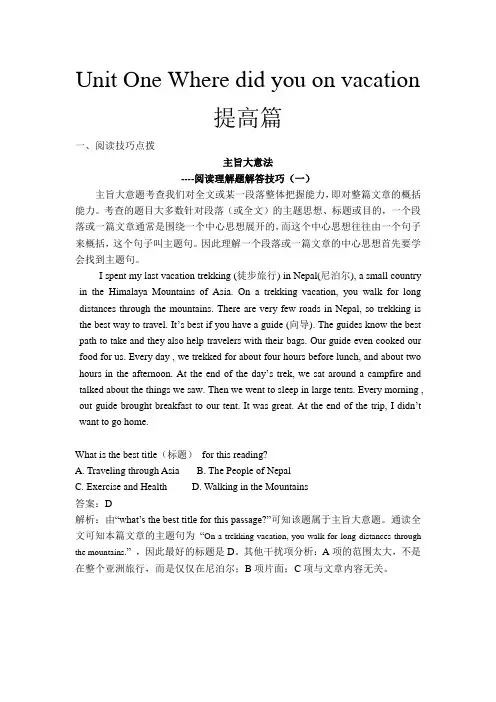
Unit One Where did you on vacation提高篇一、阅读技巧点拨主旨大意法----阅读理解题解答技巧(一)主旨大意题考查我们对全文或某一段落整体把握能力,即对整篇文章的概括能力。
考查的题目大多数针对段落(或全文)的主题思想、标题或目的,一个段落或一篇文章通常是围绕一个中心思想展开的,而这个中心思想往往由一个句子来概括,这个句子叫主题句。
因此理解一个段落或一篇文章的中心思想首先要学会找到主题句。
I spent my last vacation trekking (徒步旅行) in Nepal(尼泊尔), a small country in the Himalaya Mountains of Asia. On a trekking vacation, you walk for long distances through the mountains. There are very few roads in Nepal, so trekking is the best way to travel. It’s best if you have a guide (向导). The guides know the best path to take and they also help travelers with their bags. Our guide even cooked our food for us. Every day , we trekked for about four hours before lunch, and about two hours in the afternoon. At the end of the day’s trek, we sat around a campfire and talked about the things we saw. Then we went to sleep in large tents. Every morning , out guide brought breakfast to our tent. It was great. At the end of the trip, I didn’t want to go home.What is the best title(标题)for this reading?A. Traveling through AsiaB. The People of NepalC. Exercise and HealthD. Walking in the Mountains答案:D解析:由“what’s the best title for this passage?”可知该题属于主旨大意题。
【英语】六年级英语下册人教pep版Unit 3 Where did you go 单元测试卷(答案)
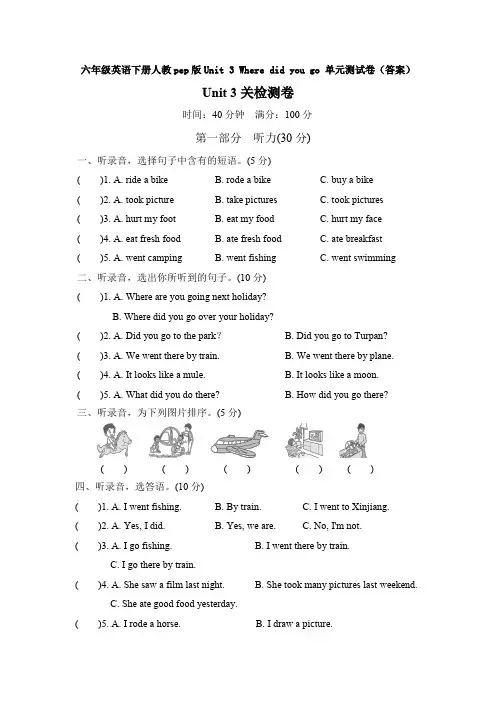
六年级英语下册人教pep版Unit 3 Where did you go 单元测试卷(答案)Unit 3关检测卷时间:40分钟满分:100分第一部分听力(30分)一、听录音,选择句子中含有的短语。
(5分)()1. A. ride a bike B. rode a bike C. buy a bike()2. A. took picture B. take pictures C. took pictures()3. A. hurt my foot B. eat my food C. hurt my face()4. A. eat fresh food B. ate fresh food C. ate breakfast()5. A. went camping B. went fishing C. went swimming二、听录音,选出你所听到的句子。
(10分)()1. A. Where are you going next holiday?B. Where did you go over your holiday?()2. A. Did you go to the park? B. Did you go to Turpan?()3. A. We went there by train. B. We went there by plane.()4. A. It looks like a mule. B. It looks like a moon.()5. A. What did you do there? B. How did you go there?三、听录音,为下列图片排序。
(5分)() () () () ()四、听录音,选答语。
(10分)()1. A. I went fishing. B. By train. C. I went to Xinjiang.()2. A. Yes, I did. B. Yes, we are. C. No, I'm not.()3. A. I go fishing. B. I went there by train.C. I go there by train.()4. A. She saw a film last night. B. She took many pictures last weekend.C. She ate good food yesterday.()5. A. I rode a horse. B. I draw a picture.C. I ride a bike every Sunday.第二部分笔试(70分)五、选出不同类的单词。
新人教版八年级英语上册教案:Unit 1 where did you go…(第4课时)

八年级Unit 1 Where did you go on vacation?Section B 1a-1e (Period four)Teaching and learning Goals:一、功能:Talk about last vacation activities; Describe vacation activities using adjectives and express personal feelings.二、词汇和常用表达:Learn to use words and sentences: “delicious, terrible, cheap, expensive, exciting, boring, sb. went to ------. How was / were ------? It was / They were------! Did you ------? Did everyone have a good time? Everything was excellent.”三、学习策略:Learn to sum up the main patterns and communicative phrases of the tape scripts; Improve listening and speaking skills by pair work and group work.四、文化知识:Help students to know about Hong Kong.Pre-listening activitiesReviewMake a survey. Ask the students to ask their classmates the questions. Where did you go on vacation? Did you go there with anyone? Did you buy anything special? How was your vacation?××went to ------ with his / her ------. He / She bought ------ for ------. He / She thought his / her vacation was ------.(设计意图:学生都喜欢搞个调查活动,这样可以提高学生的参与度,而且全面复习了上节课所学的目标语言。
【英语】六年级英语下册人教pep版Unit 3 Where did you go_ 单元测试卷一(答

六年级英语下册人教pep版Unit 3 Where did you go_ 单元测试卷一(答案)Unit 3综合能力测评时间:40分钟满分:100分Part1 Speaking说(15%)一、跟读下列单词和短语。
(5分)1. went2. fish3. rode4. hurt5. ate6. took7. bought8. gift9. went camping 10. took pictures二、跟读下面的句子。
(5分)1. I fell off my bike last Saturday and hurt my foot.2. It looks like a mule.3. We went to Sanya by plane.4. I took lots of pictures,and I also went swimming.5. We dressed up and made a funny play.三、跟读下列对话。
(5分)A:Where did you go over your holiday?B:I went to Guilin.A:When did you come back?B:Yesterday. Because my grandpa was ill.A:I am sorry to hear that. How did you come back?B:I came back by train.Part2Listening听(30%)一、听录音,给下列图片用数字标号。
(5分)() () () () ()二、听录音,圈出你所听到的单词。
(5分)1. I rode a (horse/bike) yesterday.2. Andy hurt his (leg/foot).3. Did you go to (Turpan/Harbin)?4. Amy went (swimming/fishing) last weekend.5. I ate some (fresh/delicious) food over the holiday.三、听录音,给问句选择正确的答语。
八年级上Unit1 Where did you go on vacation Section A
camped by the lake
went to the library
studied for the math test practiced the piano
You are a boy . These are some of
your photos , ask and answer Jim
-- What did you do last weekend, Jim?
Saturday.1
-- Well, on Saturday morning, I played …ba.sketball
On Sunday morning I …cl.eaned my room
去参加夏令营 go to summer camp
1.Where did you go on vacation?你去哪里度假了? 1)疑问副词where引导的特殊疑问句,where用来询 问地点和场所,放在句首,其后跟一般疑问句。
a. W__h_e_r_e do you _co_m__e_ _f_r_o_m__?你从哪里来? b.W__h_e_re_does he_l_iv_e___?他住在哪里? 2)go on vacation意为“去度假”。去海南度假。
You are a girl . These are some of Saturday your photos , ask and answer
went to the park Sang and played the guitar had a dinner with…
WLuchya’stwdeiedkeyndouw/ashgreeadt.oOonnSaStuartduarydmaoyr/nSinugn,sdhea…y?
《Where did you go on vacation》PPT课件 (共26张PPT)
1b Tapescript Conversation 2 Girl: Where did you go on vacation, Sally? Sally: Nowhere. I stayed at home. Girl: And where did you go, Brad? Brad: I visited my uncle. Conversation 3 Boy 1: Where did you go on vacation, Tom? Tom: I went to summer camp. It was great.
Revision How was your weekend?
It was great / OK /not bad / not very good … What did you do on the weekend?
do my homework clean my room play tennis visit my aunt have a party practice English play soccer go to the beach go to the movies stay at home do some reading study for the test
Fill in the blanks in the conversation. Use “was” or “were” . Example : It was rainy . The mountains were beautiful . was Amy : How_____your vacation, Lin ? Lin : It _____ was pretty good. Amy : How were _____ the beaches? Lin : Theywere _____ fantastic. Amy : How _____ was the weather? Lin : It was _____ hot and humid. Amy : Howwere _____ the people? Lin : Theywere _____ unfriendly.
Unit_1_where_did_you_go_on_vacation知识点详解
U2 Where did you go on vacation?Important phrases: (重点短语)1.去夏令营2.买一些特别的东西3.为考试准备4.跟某人外出5.去纽约市6.好久不见7.度假8.去某个有趣的地方9.大多数时间10.给母鸡喂食11.除—外一无所有12.当然,自然13.似乎有点无聊14记日记15.令人愉快地活动16.到达17.决定去海边18.尝试滑翔伞运动19.感觉像一只小鸟20.想要骑车21.中国商人的房子22.在过去23许多古老的建筑24步行到山顶25.开始下雨26.等了一个多小时的火车27.下大雨28.忘记带一把雨伞29.又湿又冷30.因为恶劣的天气31.带着足够的钱32.足够大33.好像有点饿34.与—一样好35 不如----好36.照了相当多的相片37.停下来喝水38.继续前进39.激动地跳跃40.二十分钟后41.如此---以至于42.升起43.发现--44.尝起来很好吃45.尽力去做某事46.停止做某事47.不喜欢做某事48.继续做某事49.一碗米饭50为某人买某物重点句子1where did you go on vacation?go on vacation 去度假2.Visited my uncle重点:visit为及物动词,“拜访,探望,参观,游览”后接人或地点改错Did you visit in china?3. Did you buy anything special?1)buy 的过去式为boughtbuy sth.for sb.=buy sb sth.我为Tom买了一个礼物2)anything 不定代词“某物,某事”主要用于疑问句和否定句中一旦anything用于可定句中,则意为“任何事,任何东西”Eg You can ask me anything you want to know3)★形容词修饰不定代词要后置4.Oh,did you go anything interesting?这是一般过去时中不含was/were的句子在变一般疑问句时,需用助动词did。
人教版八年级英语上册Where-did-you-go-on-vacation教学设计
Where did you go on vacation?SectionA教课方案教课方案基本信息Where did所教年级八年级上you go on Unit1SectionAvacation?1.整体设计思路、指导依听说明《(新目标)英语》八年级(上)Unit 1 SectionA持续学习如何讨论过去所做过的事情。
对过去的时态进行复习。
这个单元是对七年级最后一个单元的稳固,它是温故知新的加强,应以学生的练习为主,它是一个输出的过程。
所以在本学科中我以任务为中心,创建了大批教课情形,给学生足够的训练时间和学习活动,在小组合作中达成优化教课过程,使学生能随着活动的达成而掌握稳固知识点,同时也获取成就感,激发学生参加、探索与创新。
2.教课背景剖析教课内容剖析:本单元主要让学生经过学习过去时态,能用过去时态描绘过去发生的动做和事件,能正确使用过去式的正确形式。
为学生的写作打下基础。
学生状况剖析:这个阶段的学生开朗好动,好奇心较强。
充足利用他们的特色,发挥小组合作法,其次八年级的学生进入青春期,也进入学习的“分水岭”,拥有过渡性和动乱性的心理特色,学生差别较出现显然的分化,所以教课上要面向全体同学的时候要着重分层教课,充足调换每个学生的踊跃性。
3.教课目的剖析1.知识目标(分层掌握)1)全部学生掌握以下单词: camp , museum , guide , central , exam , rainy , fantastic , awful , unfriendly2)90%以上的学生掌握以下词组: Summer camp , go to the beach, go to Summer camp, visit museum, go to New York City, go to the mountains, stay at home ,on vacation 等;3) 80%以上的学生掌握以下规则和不规则的动词过去式:stay(ed), visit(ed), go(went), do(did), is/am(was) are(were 。