
牛津版英语时态讲解(共42张PPT)
三、现在进行时: (The Present Continuous Tense)
Conclusion
1.结构: be (am, are, is) + doing
2. 用法: 1) 表示现在( 指说话时)正在发生的事情。 eg. We are having English class now. 2) 表示目前这段时间内正在进行的动作,但说 话时动作未必正在进行。
间,持续到现在, 通常用于延续性动词. 常与 表示延续性时间状语连用,如:so far, up to now, recently, in the past 6 years, since…, for… 等等.
eg. I have lived in Zhuhai for 3 years.
2).表示发生在过去的某一动作对现在造成的影响 或结果,常用的时间状语有: just ,already, yet, ever, never, once等等.
eg. We have finished our lunch already. Have you ever tried this method?
- The couple have just left. If you hurry you will catch them.
- You mean when I arrived they _h_a_d_ just _l_ef_t_.
sometimes I _m__i_s_s my families.
Conclusion
一、一般现在时:( The Simple Present Tense)
1.结构: 主语为第三人称单数,谓语动词要变
化,其余人称用原形,即do / does.
2. 用法:
1) 经常性或习惯性的动作,常与表示频率的时 间状语连用,如:often/ usually, every…, sometimes, at…, on Sunday等。
七、一般将来时:
( The Simple Future Tense ) 1. 结构:
Conclusion
①. will / shall do
表示从现在看来以后要发生的动作或
存在的状态。
eg. Tom will come back next week.
②. be going to do “计划,打算,即将做某事” eg. He is going to speak on TV this evening.
in 1982, just now… 现在进行时 now… 过去进行时 this morning, the whole morning, all day,
yesterday, from nine to ten last evening… when, while… 现在完成时 for, since, so far, ever, never, just, yet, till/until, up to now, in the past years, always, recently… 过去完成时 …before, by, until, when, after, once, as soon as… 一般将来时 next…, tomorrow, in… 过去将来时 多用在间接引语中表示发生在谓语动作以后的动 作.
Last Sunday we w__e_r_e_g_o_i_n_g_t_o_visit the Great Wall, but it snowed.
八、过去将来时:
(The Simple Past Future Tense)
1. 结构:
Conclusion
1). Should / would+动词原形
What were you doing on that day?
On August 8, 2008, the 29th Olympic Games was opening in Beijing. We were … on that day.
四、 过去进行时:
(The Past Continuous Tense)
How long have you learnt English?
We have learnt English for many years since we were 8 years old.
English, boring or funny?
ห้องสมุดไป่ตู้
How long has Yang Liping been a dancer?
1. 结构:was/ were + doing
Conclusion
2. 用法: 表示过去某时或某段时间正在进行的动 作或状态。常用的时间状语有:at ten, yesterday, from nine to ten, last evening, when…, while…
eg. We were having a meeting at ten yesterday.
She has been a dancer for 41 years.
Do you know this film? Yes. We have seen the film already.
Conclusion
五、现在完成时(The Present Perfect Tense)
1. 结构: have (has) +done 2.用法: 1). 现在完成时表示一个动作开始于过去某一时
What are they doing now? They are having an English class.
What are they doing now? They are playing basketball.
What are the children doing now? They are listening to the music.
六、过去完成时:
(The Past Perfect Tense)
Conclusion
1. 结构: had + done
2. 概念:表示过去的过去
--------|--------------|---------|--------> 过去之前 过去 现在 将来
When the police arrived, the thieves ___h_a_d__r_u_n_a_w__a_y___(run away).
How is your daily life as a high school student? (3 sentences or more,使用实意动词和系动词, 注意动词形式变化)
Example:
I _s_t_u_d_y_ hard every day and I _g_e_t_
along well with my classmates, but
eg. The boy promised he would
work hard.
I told my parents I should
return early.
2. 用法: 过去将来时表示立足于过去某一时间看
将要发生的动作或存在的状态, 常用于宾语从句
中.
2).其他形式. was (were) going to was (were) to was (were) about to
By Zhang Ye
他昨天来了. He _c_a_m__e_ yesterday. 他已经来了. He_h__a_s_c_o_m__e_ already. 他明天来. He _w__il_l_c_o_m__e_ tomorrow.
汉语借助词汇手段而非词的形态变化来表 示动作的发生,而英语主要通过谓语动词时 态变化来表现.任何句子都要先注意时态.
Dad told me (that) he _w__o_u_l_d__b_u_y_ a
computer for me if I could pass the exam.
Zhao Yazhi was
fifty-eight now. In two years,she w__o_u_l_d_b_e_ sixty. But she is still very beautiful.
eg. The meeting starts at 2:00 p.m.
How did you spend your
childhood?
(3 sentences or more,使用实意动词 和系动词, 注意动词形式变化)
Example:
I __s_p_e_n__t (spend) my childhood happily with my old friends. We always _p__la__y_e_d_(play)
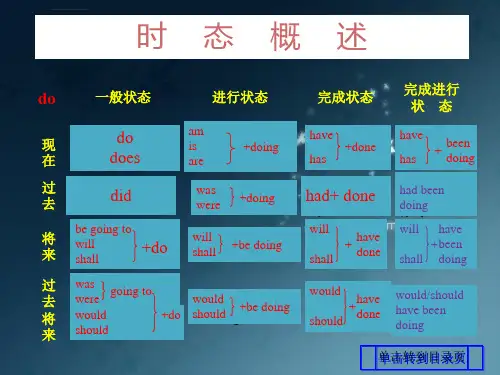
一般现在时_____d_o_/_d_o_e_s_______ 一般过去时_______d_i_d_________
现在进行时__a_m__/_is__/ _a_r_e_d_o_i_n_g__
过去进行时__w__a_s_/_w__e_re__d_o_i_n_g__ Revision
现在完成时___h_a_v_e_/_h_a_s__d_o_n_e___ 过去完成时_____h_a_d__d_o_n_e______ 一般将来时____w_i_ll_/_s_h_a_l_l_d_o____ 过去将来时__w_o_u__ld__/ _s_h_o_u_ld__d_o__
③. be +to do 按计划或正式安排将发生的事。
eg. We are to have an exam this week.
④. be about to do 表示马上做某事, 不能与明确表示将来的 时间状语连用. eg. He is about to leave for Beijing.
Dad said to me, “I will buy a computer for you if you can pass the exam.”
英语语法(牛津版)第十八章过去时态和完成时态
英语语法(牛津版)第十八章过去时态和完成时态一般过去时175形式A规则动词的过去式是在动词原形后加 ed构成的:动词原形:work过去式:worked以e结尾的动词只加d:动词原形:love过去式: loved对所有人称,均无词形变化:I worked you worked he worked等规则和不规则动词的否定式均由 did not/didn t+动词原形构成:I did not/didnt work you did not/didnt work等疑问式则均由 did+主语+动词原形构成:did I work?did you work?等否定疑问式:did you not/didnt you work?等B拼写注意事项加ing时最后一个辅音字母双写的规则(参见第165节)也适用于加ed的场合:admit,admittedstop, stoppedtravel,travelled以y结尾的动词,y前为辅音字母时,在加ed之前要把y变为i:carry, carriedtry, tried但y前面是元音字母时则不变:obey, obeyed176不规则动词不规则动词的一般过去时形式差别很大:动词原形:eat leave see speak过去式:ate left saw spoke因此必须牢记每一个不规则动词的过去式,这样其他问题也就迎刃而解了,因为不规则动词也像规则动词一样,其过去式都没有人称变化。
不规则动词的变化表参见第364节。
177用来叙述过去发生的事件A表示在过去某一特定时间结束的动作,因此可用于:1指明发生在过去的动作:I met him yesterday.我昨天遇见了他。
Pasteur died in 1895.巴斯彻于1895年去世。
2询问过去的特定时间:When did you meet him?你是什么时候见到他的?3动作显然在过去某特定时刻发生时,虽然并末明确提及该时刻:The train was ten minutes late.火车晚点了十分钟。
英语的时态ppt课件
表示公认事实或普遍真理
e.g. Health is more important than wealth. Four plus three equals seven. Water freezes at 0℃.
篮球比赛是根据运动队在规定的比赛 时间里 得分多 少来决 定胜负 的,因 此,篮 球比赛 的计时 计分系 统是一 种得分 类型的 系统
篮球比赛是根据运动队在规定的比赛 时间里 得分多 少来决 定胜负 的,因 此,篮 球比赛 的计时 计分系 统是一 种得分 类型的 系统
时
态
详
解
一 般 现 在 时
一般现在时由谓语动词原形构成,主语是第一、第二人称和第 三人称复数时,动词用原形。当主语是第三人称单数时,须在 动词原形的词尾加-s或-es。
过 去
将 来
wwwwaoaessrue/lwd或egroesihgnooguintlodg加to,
动wo词uld原形
+do
should
wswbhoeoouudulldolddin/sgh+obueldd加oing
w加的wshoh过oouauulvd去llded或加分+sh动词hdoaou词vnleed
would/should have been doing
单击转到目录页
篮球比赛是根据运动队在规定的比赛 时间里 得分多 少来决 定胜负 的,因 此,篮 球比赛 的计时 计分系 统是一 种得分 类型的 系统
常用时态演化示意图1
一过去般 现过现将去在来 时 态
waams is
going to
wearree ddiod
afford it. He didn't use to make that mistake. When he was young, he would rise early and take a walk before breakfast.
英语时态讲解讲义PPT课件

★表示主语现在的状态、能力、爱好、职业、性格。
His mother is a doctor. ★表示客观真理、科学真理、自然界的普片现象或众人所知的
客观事实。
The moon goes around the earth. ★表示格言或警句。
All men die. ★在when, as soon as, before, while, so (as) long as等引导的时间
实意动词
V-s
主语是第三人称单数 + V-es
V-ies
have的第三人称单数为has
2021
7
1. He often __g_oe_s__ (go) to school on foot. 2. His character __is__ (be) like his father. 3. I will tell you when he _c_o_m_e_s(come) back. 4. Good begun __is__ (be) half done. 5. Bitter pills __h_a_v_e(have) wholesome effects. 6. As the old saying _g_o_e_s_ (go). 7. Light _tr_a_v_e_ls(travel) faster than sound. 8. Here c_o_m__es_ (come) the bus. 9. There __go_e_s__ (go) the bell. 10. If it d_o_e_s_n_’t_r_a_in( not rain) tomorrow, we’ll go to have a picnic.
牛津版高中英语语法课件 不定式、现在分词和过去分词

1.I saw him writing a short novel. =that he was writing a short novel. 2.He was reading a novel written by Charles Dickens. =which was written by Charles Dichens.
3.分词的用法比较
A.在时态上
ing分词表“进行” ed分词表“完成”
1.China is a developing country =a country which is developing. 2.Japan is a developed country =a country which has developed. 3.I found him gone. =that he had gone.(表完成)
having gone (不作定语)
ed
只有一般式:(不强调时间 先后,只说明原因、条 件等) 一般式:(与谓语动词(几 乎)同时发生)
×
to make
made(表被动) gone(表完成)
to be made to have been made ×
to go to have gone to be going
▲在概念上,ing.表“抽象、习惯”,不定式表“具体、偶
然、将来”. *Swimming (抽象)is my favourite sport and I like swimming(习惯)every day, but I don’t like to swim(具 体)today, I would like to swim(将来)tomorrow.
牛津 高中三年级下册 二轮复习 时态与语态 PPT课件

A. will install
B. will have been installed
C. are installed
D. have been installed
将来完成时表示到将来某时某事已发生。多见于by+将来时间 e.g. By this time next week, we __w_il_l_h_a_v_e_b_e_e_n__m_a_r_ri_e_d____ a year.
-- Oh, really? I _______ know. I _______ go and visit her.
A. didn’t; am going to
B. don’t; would
C. don’t; will
D. didn't; will
有时并没有时间状语,但具体情况也会影响时态的使用。
C. have painted
D. have been painting
现在完成进行时表示一个由过去某时起一直持续的动作,这动 作可能刚刚停止,也可能还在进行。
Why are your clothes so dirty? What have you been doing? 你的衣服为什么这么脏?你干什么来着?
常常与how long 或long, all一起用。 1. How long has it been raining? 2. Have you been waiting long?
有时表示在持续的一段时间中动作的多次重复(而动作不一定在持续) 1. Jim has been phoning Jenny every night for the past week. 2. We’ve all along been making mistakes like this. 3. Has it been causing problems?
最新情态动词--牛津英语课件ppt

C. would grow D. would have grown 8. I was really anxious about you. You B home without a word.
2.表示"事实上的可能性" It may rain tomorrow. (表示可能会发生) Electric irons could be dangerous,they might give you a severe shock.
3.“预测” Sam might have taken the money, but it seems unlikely.
modal verb+be doing:
对正在发生的事情进行评价、猜测,表示“想必正在、可能正在、 应
当正在”
It's 12 o'clock .They must be having lunch. They may be discussing the problem. He can't be telling the truth.
情态动词专项练习
1. — I hear you've got a set of Australian coins. — B I have a look? — Yes, certainly. A. Do B. May C.Shall D. Should
英语的时态ppt
过去将来进行时
常用时态演化示意图3
过一现去在般完现成在 时 态
have hahsad done
一般现在时 现在完成时 过去完成时
2020/5/25
注:一般现在时态第三人称单数形式——词尾按 规则加-s或-es。
单击转到目录页
常用时态演化练习1
以write为中心动词写出各相应时态的结构:
一般现在时
过去将来时 wwasa/sw/wereereggooininggtoto/w/woouuldld/s/hshoouuldldwdroite
将来进行时
wwilil/ls/shhaalllbbeewdroiitningg
过去将来进行时 wwoouuldld/s/shhoouuldldbbeewdroiitningg
would/should have been doing
单击转到目录页
常用时态演化示意图1
一过去般 现过现将去在来 时 态
waams is
going to
wearree ddiod
wwoiull d
shsohuallld
2020/5/25
注:一般现在时态第三人称单数形式——词尾按 规则加-s或-es。
2020/5/25
时态详解
一 般 现 在 时
一般现在时由谓语动词原形构成,主语是第一、第二人称和第 三人称复数时,动词用原形。当主语是第三人称单数时,须在 动词原形的词尾加-s或-es。
主 要 用 法c
表示公认事实或普遍真理
e.g. Health is more important than wealth. Four plus three equals seven. Water freezes at 0℃.
情态动词 牛津英语(PPT)2-2
1.表示“意愿”
I will call you as soon as possible.
Who will do the job ?
He would not let me ry . 2..表示“请求”
Will you kindly tell me the way to the post office ? Would you give me your address ? (用 would 比 will 表示更客气) 3.表示“预测”或“习惯性”: That would be his mother. (would be 表示肯定是)
should 和ought to的区别
含义大致相同, ought to 强调在客观上(法律,章程和道义),比should语气强。 should强调主观上,表示主语的职责和义务或说话人的劝告。 You ought to go and see Mary tomorrow. You shouldn't judge a man always by the clothes.
He will sit there hour after hour looking at the river.
He would come to see me when he was in London.
used to 与would的区别
used to表示过去情况与现在不同; would只单纯表示过去的情况 People used to think that the earth was flat. She would go out for a walk in the morning when she was in the country.
•
初中英语动词【时态语态】PPT课件
·译林牛津版
④“be going to+动词原形” 也可表示将来时。 a.表示主观意愿、打算等。如: He's going to learn English next term. 下学期他打算学英语。 b.根据已有迹象,可能要发生的情况。如: Look at the black clouds!It __is_g_o_i_n_g_t_o_ rain. 看那些乌云!马上要下雨了。 [提示] 非延续性动词的进行时常表达将来之意,如: come,go,leave,start,finish等。 She's leaving for England next month. 下个月她将去英国。
初中英语动词时态语态
考点
1.掌握动词的第三人称单数形式、过去式、 过去分词和现在分词的构成。
2.掌握动词的8种时态的基本结构及区别。 3.了解过去将来时、过去完成时的基本用 法。
考点一:动词的时态 初中阶段应掌握的时态共有八种,即一般现在时、一般
过去时、一般将来时、现在进行时、过去进行时、过去将来 时、现在完成时和过去完成时。
Tom __w_e_n_t_ to Shanghai last year. 去年汤姆去了上海。
John __d_id_n_'_t_l_iv_e_ here last year. 去年约翰没有住在这里。 Did you see him just now? 你刚才看见他了吗?
·译林牛津版
(2)用法: ①主要用于过去的某个时间发生的动作或存在的状态。 His friend was at work yesterday. 他的朋友昨天在工作。 ②表示过去经常或反复发生的动作,常与often,always 等 表示频度的时间状语连用。 We often went to work by bus last year. 去年我们经常乘公交车上班。 ③和when 等引导的时间状语从句连用。 When he got home,he __h_a_d__ a rest. 当他到家时,他休息了一会儿。