
七年级英语下册 Unit 2 Neighbours Grammar教案 (新版)牛津版
Unit 2 NeighboursGrammarI. Teaching aims and learning objectivesBy the end of the lesson, students should be able to:1. know what the simple future tense is;2. learn how to use the simple future tense correctly;4. talk about things that will happen in the future.II. Teaching contentsNew words and phrases: shall, fire, the day after tomorrow, make a fireIII. Focus of the lesson and predicted area of difficulty1. To use the simple future tense correctly.2. To talk about the actions that will happen in the future.IV. Teaching proceduresA Simple future tense with will and shallStep 1 Revision1. Enjoy a songT: First, please enjoy a song. Let’s sing together. How will the school be today?2. About Simon(1) Where does Simon live?(2) What do you think of his neighbours?(3) Do you think Simon is lucky to live in such a neighbourhood? Why?3. About Simon’s neighboursT: Some of Simon’s neighbours have some problems. How can they get help from the community centre?T: In these sentences, we use be going to and will to talk about things that will happen in the future. This tense is called the simple future tense.【设计意图:从一开始的歌曲中引出will,再通过对Simon和其邻居的提问,创设情境,引出用will和be going to,快速导入本节课的教学内容。
】Step 2 Presentation1. will + verb …T: Neil and Jack are my new friends. Let’s listen to a story about them, and then answer the following questions.(1) How old will Jack be?(2) What will Neil buy for Jack?(3) How many miles will Jack run each day?T: We use will + verb …to express the simple future tense.【设计意图:观看视频,并就视频内容进行问答,向学生呈现含will的句子,并让学生自己讨论总结含will的一般将来时的基本结构。
】2. Will or shall(1) Match the subjects on the left with will or shall on the right.(2) Learn about some short forms about will and shall.(3) Read a chant.【设计意图:用连线的形式,介绍与will和shall连用的主语。
可用比赛读歌谣的形式,激发学生的兴趣,提高他们的课堂参与性。
】3. The basic formComplete the tables about the simple future tense with will or shall.【设计意图:将书上的表格以填空的形式呈现给学生,让学生在练习中学会归纳will和shall的各种句型结构。
】3. The usage of the simple future tense with will or shall(1) Use will or shall to complete the sentences.We use will or shall to talk about things that are sure to happen in the future.(2) Ask and answer in pairs: What will you do this evening?We use will or shall to talk about plans that we are making now.【设计意图:通过设置不同情景,引入will和shall两种用法。
】Step 3 Practice1. Complete the conversationT: Complete the conversation between Mr Lin and Simon with the simple future tense of the verbs in brackets.2. Pair workT: Work in pairs and talk about what you will do this weekend.【设计意图:让学生根据设置的情景编对话,在对话中巩固各句型的用法。
】B Simple future tense with be going toStep 1 Presentation1. More about Neil and JackT: Do you want to know more about Neil and Jack? Let’s watch the video and find out where Jack is going and what he is going to do.T: We use be going to do…to express the simple future tense.2. Match the subjects with be going to3. Learn about some short forms about be going to【设计意图:再次通过视频导出be going to,引导学生自己归纳出be going to的基本结构。
】4. Work out the basic formT: Complete the tables about the simple future tense with be going to.5. The usage of the simple future tense with be going to(1) Use be going to to talk about something we decide to do.(2) Pair workT: Jack will be 500 years old in two days. Work in pairs and talk about what you are going to buy for him.(3) Use be going to to talk about things that will probably happen.(4) Fill the blanks with the correct forms of be going to.Step 2 Practice1. Complete the conversationT: Simon is going to have a day out with his uncle’s family the day after tomorrow.Complete his conversation with Amy by using the correct forms of be going to.2. Plan a day out for Neil and JackT: Is Neil really going to buy a car for Jack?T: Work in groups of four and plan a day out for Neil and Jack. Here are some points which may help you. Remember to use the simple future tense we learned today. 【设计意图:设置情境,让学生利用所学结构进行语言输出。
这样做既发挥了语言的语用功能,同时培养了学生小组合作学习的方式。
】Step 3 SummaryT: Boys and girls, today we’ve learnt the simple future tense.(1) What do we use the simple future tense to talk about?(2) Do you still remember the basic forms of the simple future tense?(3) When shall we use the simple future tense?(4) What time expressions are always used with the simple future tense?【设计意图:通过思维导图的形式,帮助学生复习本节课学习的语法结构。
】V. HomeworkFinish the visiting plan for Neil and Jack.。
2024年unit2精彩教案牛津译林英语七年级下册

2024年unit2精彩教案牛津译林英语七年级下册教案名称:Unit2"Neighbours"教学目标:1.让学生掌握本单元的生词和短语,了解重点句型。
2.培养学生用英语描述邻居和周围环境的能力。
3.培养学生的合作精神和创新意识。
教学重点:1.生词和短语:nextdoor,nextto,acrossfrom,behind,infrontof 等。
2.重点句型:Whereis?It's;Whois?He/Sheis。
教学难点:1.空间方位词汇的运用。
2.描述邻居和周围环境的表达方式。
教学过程:一、导入1.利用多媒体展示一幅描绘社区环境的图片,让学生观察并描述图片中的事物。
2.引导学生用英语表达图片中的空间方位,如nextdoor,nextto 等。
二、生词和短语学习1.教师领读生词和短语,让学生跟读并模仿发音。
2.学生自主朗读生词和短语,巩固记忆。
3.设计一些小游戏,如“单词接龙”,让学生在游戏中复习生词。
三、重点句型学习1.教师通过演示,让学生理解Whereis?It's;Whois?He/Sheis的用法。
2.学生进行角色扮演,练习使用重点句型描述邻居和周围环境。
3.教师选取一些学生的描述,进行点评和纠正。
四、课堂活动1.分组活动:学生自由组成小组,每组选择一个社区环境,用英语描述该环境中的邻居和建筑。
2.各组展示成果,其他学生认真倾听并进行评价。
3.教师选取优秀的小组,给予表扬和奖励。
五、巩固练习1.完成课后练习题,巩固本节课所学内容。
2.学生自主编写一段描述自己社区环境的英语短文,要求运用本节课所学词汇和句型。
六、课后作业1.复习本节课所学生词和短语,熟读重点句型。
2.完成课后练习题。
3.家长签字确认,确保学生完成作业。
教学反思:本节课通过生动的图片导入,激发学生的学习兴趣。
在教学过程中,注重学生的参与和互动,让学生在轻松愉快的氛围中学习英语。
通过课堂活动和巩固练习,使学生能够熟练运用所学知识描述邻居和周围环境。
七年级英语下册Unit2NeighboursGrammar教案牛津版(new)

Neighbours教学目标1、能用will、shall和be going to表示将来。
2、能正确使用一般将来时的肯定、否定、疑问式和肯定、否定回答。
3、能用正确的表达方式谈论将来的计划和打算。
教学内容四会内容词汇:shall fire 词组:the day after tomorrow make a fire 教学准备实现写好的纸条。
教学步骤 A simple future tense with will and shallStep I 复习1、指导学生回顾reading中有关Simon社区中的community centre的情况.2、通过创设语境,帮助学生复习课文,并为下面的学习做准备Step II 呈现1、教师为学生创设情境,其噶他们用will和shall来表达自己的观点。
2、教师引导学生通过黑板上的例句来理解本课时语法项目.3、利用黑板上的例句,教师可以继续呈现.4、指导学生认真阅读A部分,并介绍will和shall的用法.5、指导学生看A部分,鼓励他们自主探究并总结变化规则。
Step III 操练1、指导学生完成A部分中的练习,巩固所学知识.2、安排学生朗读对话。
3、教师为学生提供更多情境,两人一组来问答,练习用will和shall来表达。
Step I 1、教师通过语言描述学生创设情境,2、接着教师引导学生看黑板上的例句并引导他们理解be going to的用法。
启发学生自我总结或看B部分的说明并告知学生用法。
3、创设情境与学生交流,呈现be going to的疑问句和肯定、否定回答,4、指导学生看B部分,鼓励自主探究并总结变化规则。
Step II 操练尊敬的读者:本文由我和我的同事在百忙中收集整编出来,本文档在发布之前我们对内容进行仔细校对,但是难免会有不尽如人意之处,如有疏漏之处请指正,希望本文能为您解开疑惑,引发思考。
文中部分文字受到网友的关怀和支持,在此表示感谢!在往后的日子希望与大家共同进步,成长。
七年级英语下册Unit2NeighboursGrammar教案(新版)牛津版

Unit 2 NeighboursGrammarI. Teaching aims and learning objectivesBy the end of the lesson, students should be able to:1. know what the simple future tense is;2. learn how to use the simple future tense correctly;4. talk about things that will happen in the future.II. Teaching contentsNew words and phrases: shall, fire, the day after tomorrow, make a fireIII. Focus of the lesson and predicted area of difficulty1. To use the simple future tense correctly.2. To talk about the actions that will happen in the future.IV. Teaching proceduresA Simple future tense with will and shallStep 1 Revision1. Enjoy a songT: First, please enjoy a song. Let’s sing together. How will the school be today?2. About Simon(1) Where does Simon live?(2) What do you think of his neighbours?(3) Do you think Simon is lucky to live in such a neighbourhood? Why?3. About Simon’s neighboursT: Some of Simon’s neighbours have some problems. How can they get help from the community centre?T: In these sentences, we use be going to and will to talk about things that will happen in the future. This tense is called the simple future tense.【设计意图:从一开始的歌曲中引出will,再通过对Simon和其邻居的提问,创设情境,引出用will和be going to,快速导入本节课的教学内容。
牛津译林版七年级下册Unit2《Neighbours》(Grammar2)说课稿

牛津译林版七年级下册Unit 2《Neighbours》(Grammar2)说课稿一. 教材分析《Neighbours》是人教版牛津译林英语七年级下册第二单元的Grammar 2部分。
这部分主要讲述了一般现在时和一般疑问句的构成及用法。
通过学习,学生能够掌握一般现在时的构成和基本用法,能够运用一般现在时描述自己的邻居,并能够使用一般疑问句进行询问。
二. 学情分析七年级的学生已经接触过英语一段时间,对基本的语法知识有一定的了解,但还需要进一步巩固。
他们对英语学习的兴趣浓厚,但可能在口语表达和听力方面存在一定的困难。
因此,在教学过程中,需要注重培养学生的口语表达能力和听力技巧。
三. 说教学目标1.知识目标:学生能够掌握一般现在时的构成和基本用法,能够运用一般现在时描述自己的邻居,并能够使用一般疑问句进行询问。
2.能力目标:学生能够听懂、会说、会读一般现在时和一般疑问句,能够在实际情景中运用。
3.情感目标:通过学习,学生能够培养对邻居的关心和尊重,增强社区意识。
四. 说教学重难点1.教学重点:一般现在时的构成和基本用法,一般疑问句的构成和用法。
2.教学难点:一般疑问句的构成和用法,学生对一般现在时在实际情景中的运用。
五. 说教学方法与手段1.教学方法:采用交际法、情境教学法和任务型教学法,让学生在实际情景中学习和运用语言。
2.教学手段:利用多媒体课件、图片、录音机等辅助教学,激发学生的学习兴趣,提高学习效果。
六. 说教学过程1.引入:通过谈论自己的邻居,引出本节课的主题,激发学生的兴趣。
2.讲解:讲解一般现在时的构成和基本用法,一般疑问句的构成和用法。
3.练习:学生进行小组活动,用一般现在时和一般疑问句描述自己的邻居。
4.拓展:通过听力材料,学生听懂、会说、会读一般现在时和一般疑问句。
5.巩固:学生进行课堂练习,运用一般现在时和一般疑问句进行实际交流。
七. 说板书设计板书设计要清晰、简洁,能够突出本节课的主要内容。
七年级英语下册 Unit 2 Neighbours Grammar教案

Unit2 Neighbours Grammar教学目标:理解和掌握一般将来时的用法教学重点:will, shall, be going to 的用法教学难点:将来时的各种句型的变换及实际语境中的灵活运用。
学习与交流1. 通过预习你能说出一般将来时的结构吗?主语+_________或____________________do sth. + 将来时时间。
shall 一般和人称代词_____ 或____连用。
5.翻译下列单词或词组。
Shall__________ will_____ be going to______ 后天____________生火___________1.教师任意板书学生讨论的几个句子,如:I will go to the park.I will/ shall play basketball.He will buy a bike2.让学生看课本第23页的表格,教师通过提问了解学生的掌握情况,然后把第一个句子改为一般疑问句并依据实际情况肯否定回答。
Will you go to the park?Yes I will. No, I will not / won’t.Shall we play basketball?Yes we shall. No, we shall not / shan’t.注意: will not= won’t shall not=shan’t3.两人一组讨论合作,把黑板上另外一个句子变为否定句和一般疑问句,并肯否定回答。
4.完成书23页练习并核对答案。
典型题列概念:一般将来时表示将来某一时刻的动作或状态,或将来某一段时间内经常的动作或状态。
构成:主语+助动词shall(第一人称)或will(第二、三人称)+动词原形+其他。
其具体句型结构为:1,I shall do it tomorrow.否定句:2:She will do it tomorrow.一般疑问句:3;I will do it tomorrow。
牛津译林版七年级英语下册《Unit2 Neighbours》教案
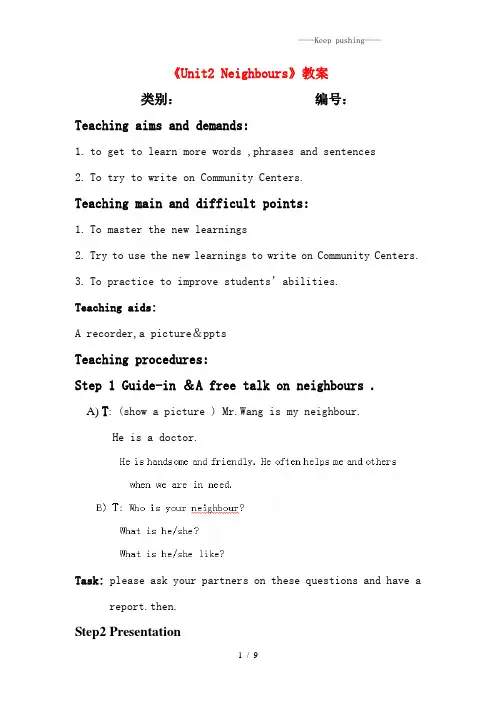
《Unit2 Neighbours》教案类别:编号:Teaching aims and demands:1.to get to learn more words ,phrases and sentences2.To try to write on Community Centers.Teaching main and difficult points:1.To master the new learnings2.Try to use the new learnings to write on Community Centers.3.To practice to improve students’abilities.Teaching aids:A recorder,a picture&pptsTeaching procedures:Step 1 Guide-in &A free talk on neighbours .A) T: (show a picture ) Mr.Wang is my neighbour.He is a doctor.Task: please ask your partners on these questions and have a report.then.Step2 PresentationA)Topic: Who can help me?(To get to know and learn the things in next part)T: My neighbours have some problems .Who can help them ?Do you have any good ideas?(Give out some notes with the problems to some students and,have them act out then)S1: hello! I’m Mrs.Li. My washing machine isn’t working. Who can help me?S2:Good morning! I’m Mr.zhang . There is something wrong with my computer.Who can help me?S3: Hi! My name is Wang Xin. My bike is broken. Who can help me?S4:I’m Miss zhao. Im going to have a party tonight. What shouldI wear?S5:I’m Mike.I don’t know how to design my room, can you help me?S6:Im GrannyLi. I’m not feeling well these days?Have students discuss in groups of six(each group resolve one problem) and then give out their ideas.B)T: People should help each other in a neighbourhood. So thecommunity center is very useful.Read the notices below and try to find more ways to help myneighbours(Listen and read the notices of part A)Have a free talk:(To show what ss have got from the topic.)Ss: Mrs.Li and Wang Xin .can get help from the Fix-it Club. Mr.zhang and GrannyLi should go to the Health Centre to ask for help.Miss zhao and Mike should go to Art&Dsign Group to get some good ideas.C)T: I think a community centre is very helpful.Everything will be better with its help.Itprovides useful information.The volunteers wouldlike to do anything to help us.D) Complete PB(To learn the notices better)Have students try to finish the task on their own. and then show the answers on blackboard.(1)community centre(2) 5 March(3)doctors and nurses(4)make them feel better(5) engineers(6) something wrong(7) styles and colours(8) what to wear to a party(9)how to design the home(10)some ideas(E)Have ss read the blog and show theirdifficulties ,disscuss and solve in groupsGive some notes then:1.feel well/better感觉不错2.make . do sth.使、让某人做某事3.worry about 担心,担忧4.know a lot about sth.很了解某物5.be happy to do sth.做某事很高兴6.give/get some ideas 给、得到一些建议7.how to design your home如何设计你的家8.what to wear穿什么(F) Have ss read the blog and try find out how to write about the community center.Paragraph 1Time and place of the“helping hands”meeting Paragraph 2 Different activities of the“ helping hands”meetingStep 3 Writing(To practice and improve ss’ ability of writing.)Task:假设你是社区的一名志愿者,本周社区将邀请几位专家到社区中心为市区居民提供志愿服务。
牛津译林版七年级下册Unit 2《Neighbours》(Grammar)说课稿
牛津译林版七年级下册Unit 2《Neighbours》(Grammar)说课稿一. 教材分析《Neighbours》是人教版牛津译林英语七年级下册第二单元的核心语法部分。
本节课主要围绕着“There be”句型以及一般现在时的用法进行展开。
通过本节课的学习,学生能够掌握There be句型的结构以及一般现在时的构成,同时能够运用所学知识描述周围的环境以及人物的特征。
二. 学情分析通过对学生的了解,大部分学生在之前的学习中已经接触过一般现在时的概念,但对There be句型的掌握还不够熟练。
因此,在教学过程中,教师需要重点引导学生理解和运用There be句型,同时巩固一般现在时的用法。
三. 说教学目标1.知识目标:学生能够掌握There be句型的结构以及一般现在时的构成,理解其用法。
2.能力目标:学生能够运用There be句型和一般现在时描述周围的环境和人物特征。
3.情感目标:通过学习,学生能够培养对邻居的关心和尊重,增强社区意识。
四. 说教学重难点1.重点:There be句型的结构和一般现在时的用法。
2.难点:There be句型的运用和一般现在时在具体情境中的运用。
五. 说教学方法与手段本节课采用任务型教学法,结合情境教学法和小组合作学习法,充分利用多媒体教学手段,激发学生的学习兴趣,提高学生的参与度和实践能力。
六. 说教学过程1.导入:教师通过提问学生对邻居的了解,引出本节课的主题。
2.新课呈现:教师通过展示一幅住宅区的图片,引导学生观察并描述图片中的环境。
3.语法讲解:教师讲解There be句型的结构和一般现在时的用法,并通过示例进行说明。
4.实践环节:学生分组进行角色扮演,运用There be句型和一般现在时描述邻居的特征。
5.巩固环节:教师设计一系列练习题,让学生进行听力、阅读和写作的训练。
6.总结:教师引导学生回顾本节课所学内容,并进行情感教育。
七. 说板书设计板书设计包括There be句型的结构、一般现在时的构成以及相关例句。
七年级英语下册 Unit 2 Neighbours Grammar导学案 (新版)牛津版
7B Unit2 NeighboursGrammar学习目标:能用will, shall和be going to表示将来能正确使用一般将来时的肯定、否定、疑问形式和肯定、否定回答重点词汇:shall; fire重点短语:be sure to happen一定会发生 watch the film 看电影take an umbrella with sb. 随身带伞 plan a day out 计划一日出行wait for us to call back 等我们回电话 wait for your call等你的电话make a fire 生火 the day after tomorrow 后天some plates and forks 一些盘子和叉子 cook some food煮一些食物语法点:一般将来时(1)基本概念表示将来某个时间要发生的动作或存在的状态,常与一些表示将来的时间状语连用。
例如:I am going to / will watch a football match on TV this evening.今天晚上我将在电视上看一场足球比赛。
(2)基本结构a. “助动词will+动词原形” (will是助动词,不能独立使用,前面的主语不管是什么人称,其后总用will。
在名词或代词后常简缩为’ll,并与主语连写在一起。
will的否定形式是will not,缩略形式是won’t)。
b.“be going to+动词原形” (be going to结构中的be动词很少用原形,它一般有三种形式,即:am,is,are。
当主语是I时用am;当主语是第三人称单数时用is;当主语是其他人称时用are。
)例如:I am going to buy something tomorrow morning.明天早上我打算去买些东西。
He is going to see Mr Wang this afternoon. 她打算今天下午去看望王先生。
牛津译林版英语七年级下册Unit2NeighboursIntergratedskills说课稿
2.邀请学生分享他们在生活中遇到的有趣邻居故事,引导他们用英语进行简单描述,为新课的学习营造轻松愉快的氛围。
3.通过提问方式复习Unit 2所学的词汇和句型,为新课的知识点做好铺垫。
(二)新知讲授
在新知讲授阶段,我将逐步呈现知识点,引导学生深入理解:
(二)媒体资源
我将使用以下教具、多媒体资源和技术工具来辅助教学:
1.教具:实物、图片、卡片等,用于创设情境,激发学生的学习兴趣,帮助学生更好地理解和记忆单词和句型。
2.多媒体资源:英语歌曲、电影片段、动画等,丰富课堂教学内容,提高学生的学习兴趣,帮助学生提高听力水平。
3.技术工具:投影仪、电脑、互动白板等,用于展示教学内容,方便师生互动,提高课堂效率。
3.保持善良和正义:故事中的孩子们始终坚守善良和正义,他们为了拯救世界,不惜冒险和付出。这种精神值得我们学习和传承。
4.珍惜友谊:在故事中,三个孩子建立了深厚的友谊。他们在面对困难和挑战时,互相支持、互相鼓励,共同成长。友谊是他们战胜邪恶力量的重要力量源泉。
(二)学习障碍
学生在学习本节课之前,已经掌握了基本的英语语法知识和一定量的词汇,能够进行简单的日常交流。但在学习本节课时,他们可能存在以下障碍:
1.对一般现在时态的掌握不够熟练,容易混淆动词的形式变化;
2.听力水平有限,对语速较快、生词较多的材料理解困难;
3.口语表达中,语法和词汇的准确性有待提高;
2.情境教学法:情境教学法强调创设情境,让学生在情境中感知、体验和运用语言。这有助于激发学生的学习兴趣,提高他们的参与度。通过设计贴近生活的情境,让学生在实际语境中学习英语,提高语言运用能力。
牛津译林版英语七下Unit 2《Neighbours》(Grammar)教学设计
牛津译林版英语七下Unit 2《Neighbours》(Grammar)教学设计一. 教材分析牛津译林版英语七下Unit 2《Neighbours》主要讨论了与邻居相关的日常交流情景。
通过本单元的学习,学生将掌握如何描述邻居的特点、交流邻居之间的互动以及表达自己对邻居的看法。
本单元的核心语法是现在进行时态,用于描述正在进行的动作或状态。
此外,学生还需熟悉和掌握一些与邻居相关的词汇和表达方式。
二. 学情分析七年级的学生已经具备了一定的英语基础,能够听、说、读、写一些简单的英语句子。
但他们在使用现在进行时态和描述邻居特点方面可能存在一定的困难。
因此,在教学过程中,需要关注学生的个体差异,有针对性地进行教学。
三. 教学目标1.知识目标:–掌握现在进行时态的用法;–学会描述邻居的特点和交流邻居之间的互动;–学会表达自己对邻居的看法。
2.能力目标:–能够熟练运用现在进行时态进行日常交流;–提高听力、口语、阅读和写作能力;–培养合作意识和团队精神。
3.情感目标:–增强对英语学习的兴趣;–学会尊重和理解他人,培养良好的邻里关系。
四. 教学重难点•现在进行时态的用法;•描述邻居特点和交流邻居之间的互动;•表达自己对邻居的看法。
•现在进行时态的运用;•准确描述邻居特点和交流邻居之间的互动。
五. 教学方法1.情境教学法:通过设定真实的邻里场景,让学生在实际语境中学习和运用英语;2.交际教学法:鼓励学生进行角色扮演,模拟邻里之间的交流,提高口语表达能力;3.任务型教学法:通过完成小组任务,培养学生合作意识和团队精神;4.反馈与激励:及时给予学生反馈,鼓励学生积极参与课堂活动。
六. 教学准备1.教材:牛津译林版英语七下Unit 2《Neighbours》;2.多媒体课件:图片、视频、音频等教学资源;3.学习任务单:用于引导学生进行小组讨论和任务完成;4.板书用品:黑板、粉笔等。
七. 教学过程1.导入(5分钟)利用图片或视频展示邻居之间的日常生活场景,引导学生谈论自己的邻居。