
仁爱版英语八年级上册Unit1—Unit2重点知识点归类及复习(有答案)
百度文库 - 让每个人平等地提升自我
1 主要考点复习(Unit 1—Unit 2)
【教材回归 考点过关】
1. 回答病情
I have a cold/ a sore throat/ a fever/ a cough/ the flu/ a
stomach/ a headache/ a toothache/ a backache/ sore
eyes
She/ He has a cold/ a sore throat/ a fever/ a cough/ the
flu/ a stomach/ a headache/ a toothache/ a backache/
sore eyes
2. hope to do sth(希望做什么)
hope + 句子(希望的事情,实现的可能性大)
wish sb sth(希望某人某事)
wish sb to do sth(希望某人干什么)
wish+句子(希望的事情,实现的可能性小表虚拟语气)
I hope to become/ be a teacher.
I hope he will become a teacher.
I wish you good luck.
I wish him to become/ be a teacher.
I wish I were a bird.
3. join sb(加入某人)
join(加入组织)
take part in(参加活动)
He wants to join us.
He joined the Party last year.
Are they going to join the school skating club?
We took part in the high jump last week.
4. get to(到达地点)
arrive in(到达大地点)
arrive at(到达小地点)
reach(到达地点)
上述词后跟home, here, there, back时,都不用介词。后面无地点时用arrive。
They got to Beijing last Sunday.
=They arrived in Beijing last Sunday.
=They reached Beijing last Sunday.
He will get there on time.
=He will arrive there on time.
=He will reach there on time.
When did they arrive?
5. 看见/ 听见某人做某事
see/ hear sb do sth(看见/ 听见某人做某事,表示发生过了)
see/ hear sb doing sth(看见/ 听见某人做某事,表示正在发生) I often hear her sing in the classroom.
Miss Zhang often sees the boys play basketball in the
gym.
My mother heard the baby crying yesterday.
I saw him talking and eating just now.
6.系动词接形容词
Smell(闻起来), sound(听起来),look(看起来),feel(感觉),taste(品尝)
You look pale/ worried/ happy/ shy…
I feel ill/ terrible/ well…
It smelt/ tasted/ terrible/ bad/ good
It sounds great/ good
7. beat sb(赢了某人)
win sth(赢了比赛)
lose sth(输了比赛)
We beat the boys yesterday.
We hope we will win the football tomorrow.
. 8. shall(should)的基本用法
Shall的用法
表征询意见,主要用于第一人称的疑问句中。
Shall I take you to the hospital?
What shall we do this weekend?
Should的用法
1) 表义务。
We should save water.
We should protect the environment.
2) 表提出或征询建议。
You should go to see a doctor.
You shouldn’t always stay at home and keep
playing computer games.
Should I stop him from playing video games?
9.. 医嘱
You should接动词的原形
You had better接动词的原形
You should/ had better lie down/ drink coffee/ have a
good rest/ go to see a doctor/ take some pills/ drink
tea with honey….
You shouldn’t接动词的原形 (should not =shouldn’t)
You had better 的否定直接在better 后面加上not
You shouldn’t/ had better not lift heavy things/ work
too long/
eat hot food/ play too long/ eat too much.
10. maybe,(或许,可能,一般放在句首。)
Perhaps(或许,可能,一般放在句首。) 百度文库 - 让每个人平等地提升自我
2 may be(或许,可能,情态动词))
Maybe/ Perhaps he is our English teacher.
He may be our English teacher.
11. Both my sister and I are sick.
both… and… =Both of… 两者……都……,(谓语一定是复数),可与too, as well的句型转换。
He is in a football team. She is in a football team too.
= He is in a football team, She is in a football team as
well.
=Both he and she are in a football team.
=Both of us are in a football team.
My mother likes watching TV, My sister likes
watching TV too.
=My mother likes watching TV, My sister likes
watching TV as well.
=Both my mother and my sister like watching TV.
=Both of them like watching TV.
12. keep/ stay healthy =keep/ stay in good health 保持健康
health(健康,名词)
healthy(健康的,形容词)
healthily(健康地,副词)
Walking after supper is good for your health.
We must keep healthy.
We must eat healthily.
13. 接双宾语的动词(直接宾语、间接宾语)
get sb sth = get sth for sb
buy sb sth = buy sth for sb
bring sb sth = bring sth to sb
give sb sth = give sth to sb
pass sb sth = pass sth to sb
lend sb sth = lend sth to sb
borrow sb sth = borrow sth for sb
14. call sb=give sb a call/ ring=ring sb up 给某人打电话
Her mother often calls me.
= Her mother often gives me a call.
= Her mother often gives me a ring.
= Her mother often rings me up.
15. too + long/ short/ tired/ angry/ loudly/ clearly…
太……
so + young/ tall/ lazy/ strong/ loudly/ clearly… 如此……
more interesting/ difficult/ important/ popular…
更……
more + loudly/ clearly/ carefully…. 更……
more and more interesting/ difficult/ important/
popular/ loudly/ clearly/ carefully 越来越……(多音节的形容词或副词)
faster and faster, colder and colder, hotter and hotter,
better and better 越来越……
16. after/ if/ as soon as/ when/ not…until… 引导的从句,主句是一般将来式时态,从句只能是一般现在时态。
We will go hiking if it doesn’t rain tomorrow.
I’ll tell her the news when she comes back.
They will play basketball if they have time/ are free
tomorrow.
I will be a doctor when I grow up.
He won’t go to play until he finishes his homework.
My friend will call me as soon as he gets to Beijing.
17. 1) take these things to your brother/ school. 把这些东西带给你的弟弟/ 带到学校去….
take me home 带我回家
八年级上册英语仁爱版u1t2知识点
八年级上册英语仁爱版u1t2知识点
在八年级上册英语仁爱版的第一单元中,我们学习了一些关于学习英语的基础知识,同时还学习了一些与学习英语相关的实用短语。在这个单元的第二个话题中,我们将介绍一些关于学习英语需要掌握的重要知识点。
英文名词复数形式
在英语中,名词复数形式通常以“-s”或“-es”结尾,但也有少数例外。以下是一些常见的名词复数形式:
1. 以辅音字母+y结尾的名词,将y改成i后再加“es”。例如:party-parties,baby-babies,fly-flies等。
2. 以s,x,ch,sh结尾的名词,在词尾加“es”。例如:bus-buses,box-boxes,watch-watches,brush-brushes等。
3. 以元音字母+y结尾的名词,直接在词尾加“s”。例如:key-keys,toy-toys,boy-boys等。
4. 以o结尾的名词,一般变成“-es”。例如:potato-potatoes,tomato-tomatoes,echo-echoes等。但也有一些例外。例如:photo-photos,piano-pianos等。
常见的动词时态
在英语中,动词有多种不同的时态形式。以下是一些常用的时态:
1. 一般现在时:表示现在正在发生的事情或常态。例如:I go
to school every day.
2. 一般过去时:表示在过去某个时间发生的动作或状态。例如:Yesterday, I went to the park.
3. 现在完成时:表示过去某个时间发生的事情与现在仍然有联系或影响。例如:I have seen the movie three times.
4. 过去进行时:表示过去某个时间正在进行的动作或状态。例如:I was studying when he called me.
5. 将来时:表示将来某个时间会发生的事情。例如:I will go
Unit1Topic2知识点总结仁爱版英语八年级上册

U1T2总结
单词
practice练习 shout斥责 certainly当然 angry生气 throw扔
invent发明(动词) inventor发明家 invention发明(名词) finish完成
高频短语
fall ill生病 sports lover运动爱好者 follow the rules遵守规则
practice doing 练习做某事 finish doing完成做某事
mind doing介意做某事 keep doing持续做某事 stop sb from doing阻止某人做某事
come into being 形成;产生 at first 起初,首先
shout at sb斥责某人 be angry with 对某人生气
do one’s best to do 尽最大努力做某事 give sb a hand帮某人忙
have a history of...有多少年的历史 score points得分
such as+(doing) sth例如 for example, +句子 例如
turn...into将……转变成 so that+句子 以便,目的是……
both...and两者都 be sure to 一定,肯定是……
fight with=have a fight with 和某人争吵,打架
双宾结构
1. to 2. for
pass the book to me buy a flower for him
kick the ball to her bring food for/to us
give the present to him sing a song for her
仁爱版八年级英语上册unit2知识点总结
Unit 2 Keeping Healthy
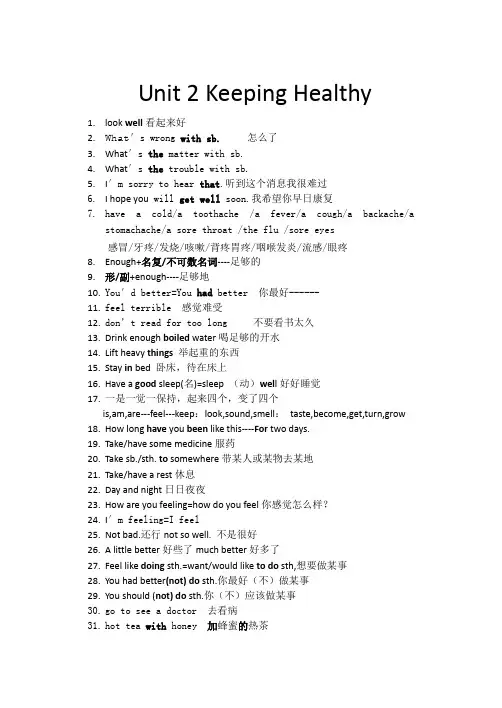
1. look well看起来好
2. What′s wrong with sb. 怎么了
3. What′s the matter with sb.
4. What′s the trouble with sb.
5. I′m sorry to hear that.听到这个消息我很难过
6. I hope you will get well soon.我希望你早日康复
7. have a cold/a toothache /a fever/a cough/a backache/a
stomachache/a sore throat /the flu /sore eyes
感冒/牙疼/发烧/咳嗽/背疼胃疼/咽喉发炎/流感/眼疼
8. Enough+名复/不可数名词----足够的
9. 形/副+enough----足够地
10. You′d better=You had better 你最好------
11. feel terrible 感觉难受
12. don’t read for too long 不要看书太久
13. Drink enough boiled water喝足够的开水
14. Lift heavy things 举起重的东西
15. Stay in bed 卧床,待在床上
16. Have a good sleep(名)=sleep (动)well好好睡觉
17. 一是一觉一保持,起来四个,变了四个
is,am,are---feel---keep:look,sound,smell: taste,become,get,turn,grow
18. How long have you been like this----For two days.
19. Take/have some medicine服药
Unit1 ---unit2重要知识点讲解2021-2022学年仁爱版八年级英语上册
1 2021-2022学年仁爱版八年级英语上册
Unit 1 Playing sports
重要知识点讲解
Topic 1
一、arrive in/at+某地
[点拨]
"arrive in/at+某地"意为“到达某地”,主要的区别如下:
arrive in+大地点 如:arrive in Beijing到达北京
arrive at+小地点 如:arrive at my school 到学校
表示到达某地的词组还有:get to+某地;reach+某地
二、-ed结尾的形容词与-ing结尾的形容词
We are excited to hear the good news.
听到这个好消息我们很兴奋。
It is an exciting story.
这是个令人兴奋的故事。
[点拨]
"-ed结尾的形容词修饰人,-ing结尾的形容词修饰物"
三、用现在进行时表将来的动词
They are leaving for Japan.他们将去日本。
[点拨]
"在英语中有一些表示位置转移的词,如leave,go,come,fly,start.等词可用现在进行
2 2021-2022学年仁爱版八年级英语上册
时表示将来。"
四、be going to结构
I am going to play basketball.我将去打篮球。
[点拨]
"be going to"是将来时态的一种结构,意为“将要”,be动词的单复数与句子主语的人称和数保持一致。
否定形式:be not going to
一般疑问句形式:Be+主语+going to+动词原形?
特殊意为句形式:Wh-疑问词+be going to+动词原形?
表将来的常用结构:will do;be about to do.
五、向对方发出邀请的句型
-Would you like to come and cheer us on?你愿意来为我们加油吗?
Unit2Topic1知识点总结仁爱版英语八年级上册
U2 Topic1总结
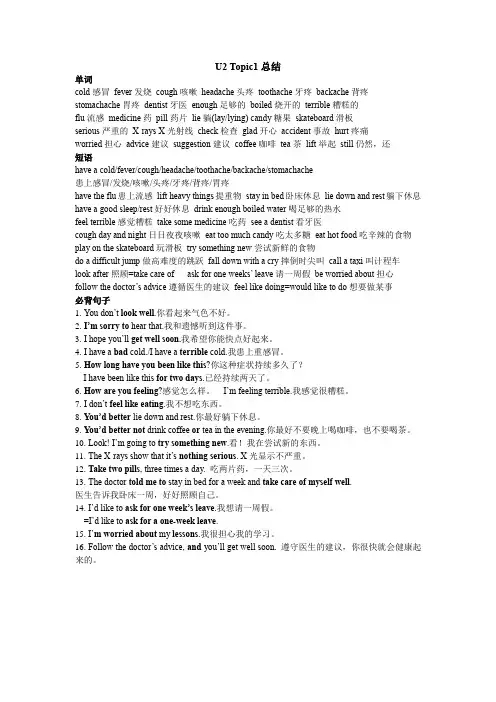
单词
cold感冒 fever发烧 cough咳嗽 headache头疼 toothache牙疼 backache背疼
stomachache胃疼 dentist牙医 enough足够的 boiled烧开的 terrible糟糕的
flu流感 medicine药 pill药片 lie躺(lay/lying) candy糖果 skateboard滑板
serious严重的 X-rays X光射线 check检查 glad开心 accident事故 hurt疼痛
worried担心 advice建议 suggestion建议 coffee咖啡 tea茶 lift举起 still仍然,还
短语
have a cold/fever/cough/headache/toothache/backache/stomachache
患上感冒/发烧/咳嗽/头疼/牙疼/背疼/胃疼
have the flu患上流感 lift heavy things提重物 stay in bed卧床休息 lie down and rest躺下休息
have a good sleep/rest好好休息 drink enough boiled water喝足够的热水
feel terrible感觉糟糕 take some medicine吃药 see a dentist看牙医
cough day and night日日夜夜咳嗽 eat too much candy吃太多糖 eat hot food吃辛辣的食物
play on the skateboard玩滑板 try something new尝试新鲜的食物
do a difficult jump做高难度的跳跃 fall down with a cry摔倒时尖叫 call a taxi叫计程车
look after照顾=take care of ask for one weeks’ leave请一周假 be worried about担心
仁爱版八年级上册英语-Unit2:Topic1单词汇总+知识梳理

仁爱八上-Unit2 Topic1
toothache n.牙痛 [ˈtuːθeɪk]
dentist n.牙科医生 [ˈdentɪst]
backache n.背痛 [ˈbækeɪk]
headache n.头痛 ['hedeɪk]
suggest v.建议,提议 [səˈdʒest]
fever n.发烧;发热 [ˈfiːvə]
cough n.& v.咳嗽 [kɒf]
stomachache n.胃疼 [ˈstʌməkeɪk]
have a cold 患感冒
coffee n.咖啡 [ˈkɒfi]
tea n.茶;茶叶 [tiː]
enough adj.足够的,充分的adv.足够 [ɪ'nʌf]
boil v.沸腾;烧开; [bɒɪl]
lift v.举起,抬起;(云、烟等)消散n.(英)电梯 [lɪft]
hey in.terj.嘿,喂 [heɪ]
terrible adj.糟糕的;可怕的 ['terəbl]
flu n.流行性感冒 [fluː]
medicine n.药 ['medɪsɪn]
suggestion n.建议,提议 [səˈdʒestʃ(ə)n]
day and night 日日夜夜
candy n.糖果 [ˈkændi]
brush v.刷;擦;n.刷子 [brʌʃ]
tooth n.(pl. teeth)牙齿 [tuːθ]
lie n.躺,平躺 [laɪ]
lie down 躺下
while conj.当……时候;而,然而,n.一段时间,一会儿 [hwaɪl]
skateboard n.滑板 [ˈskeɪtbɔːd]
cry n.叫喊,叫声v.哭,喊叫 [kraɪ]
taxi n.出租车 ['tæksi]
X-ray n.X光照片;X射线; [eks-reɪ]
serious adj.严重的;严肃的;认真的 ['sɪərɪəs]
pill n.药丸,药片 [pɪl]
Unit 1 Topic 2 We should learn teamwork(仁爱版八上)
1 Unit 1 Topic 2 We should learn teamwork.(导学案)
Section A
一.课前小测(复习Topic 1重点句型)
1. 我打算打篮球。I _______________________________ basketball.
2. 你打算加入学校划船队吗?__________ you ______________________ the school rowing
team?
3. 你长大时打算做什么?我打算做一名科学家。What ________ you __________________
when you ________ ________? I am going to _________________________.
4. 我希望我们的队会赢。I _________ our team __________ __________.
5. 游泳和划船,你更喜欢哪一项?我更喜欢划船。__________________ do you _________,
swimming ________ rowing? I _______________________.
二.知识点导航
1.But one of my teammates fell ill.但是我的一个队友病了。
one of +the+最高级+ 复数“最……之一” fall ill / be ill生病
练习:1).孙杨是最受欢迎的运动员之一。
Sun Yang is one of _______________________________________________________.
2).她的爷爷病了,她得留在家里照顾爷爷。Her grandfather __________________ and she
________________ stay at home and look after him.
Unit1 Topic2重点词组短语-仁爱版八年级英语上册
Unit1 Topic 2
1. have a soccer game 进行一场足球赛
have a soccer game against… 同…进行一场足球赛
2. fall ill 病倒了(强调动作)be ill病了(强调状态)
be ill in bed 生病卧床
3.be a little far from… 离……有点远
4.right away = at once 立刻;马上
5.miss a good chance 错过一个好机会
6.get/miss a goal 得到/失去一分
7.shame on sb. 为某人感到羞耻
8.do/try one’s best 尽某人最大的努力
do one’s best to do sth.=try one’s best to do sth. 某人尽力去干某事
9.say sorry to sb. 对某人说抱歉
10.be sure to do sth. 确定做某事
be sure about sth. 对某事确信
be sure of/about (doing)sth. 表确信(做)某事
11.be angry with… 生某人的气
12.do the homework 做作业
13.with one’s help = with the help of sb. 在某人的帮助下
14.serve food 上菜
15.turn up/down… 调高/低(音量)
16.keep sb. doing sth. 让某人一直做某事 keep doing sth. 坚持做某事
keep on doing sth. = go on doing sth. 继续做某事
Unit 2 Topic 1 精讲-八年级英语上册单元重难单词短语句型语法精讲(仁爱版)
同步课堂 仁爱版八年级英语上
Unit 2 Keeping Healthy
Topic 1 You should brush your teeth twice a day.
一、重点词语
toothache 牙疼
hear 听见,听到
headache 头疼
suggest 建议,提议
fever 发烧,发热
cough 咳嗽
stomachache 胃疼
coffee 咖啡
tea 茶;茶叶
enough 足够的,充分的。足够
lift 举起,抬起;(云、烟等)消散。(英)电梯
feel 觉得,感到
terrible 糟糕的;可怕的
medicine 药
suggestion 建议,提议
day and night 日日夜夜
candy 糖果
brush 刷;擦。刷子
tooth 牙齿
lie 躺,平躺
while 当……时候;而,然而。一段时间,一会儿
cry 叫喊,叫声。哭;喊叫
taxi 出租车
X-ray X光照片;X射线 serious 严重的;严肃的;认真的
care 照顾,照看;小心,谨慎。关心,关怀;关注,在意
still 仍然,还是
fruit 水果;果实;结果
worry 担心,担忧
advice 忠告,劝告,建议
二、词组
1. have a cold/a toothache /a fever/a cough/a backache/ a stomachache/ a sore throat / the flu /sore eyes
感冒/牙疼/发烧/咳嗽/背疼胃疼/咽喉发炎/流感/眼疼
2. take a rest=have a rest 休息
3. not read for too long 不要看书太久
4. boiled water 开水
仁爱英语八年级上册知识点总结unit1-topic1
文档收集于互联网,已重新整理排版.word版本可编辑.欢迎下载支持.
1文档来源为:从网络收集整理.word版本可编辑. Unit 1 Playing Sports
Topic 1 I’m going to play basketball
Section A
1. be going to +动词原形表示“打算\准备做某事”。如:He is going to write an email tonight. 他打算今晚写封电子邮件。一
2. be going to与will的区别,在表示将来发生的事情时,二者的区别主要是:
1) be going to 用于主观判断,及说话人主观上计划或安排将要去做的事情
will则多用于客观的情况,即客观上将要发生的事情。例如:
I’m not going to ask her. 我不打算去问她。
It will be rainy tomorrow.明天会下雨。
2)be going to 表示近期、眼下就要发生的事情,will 表示的将来时间则较远一些。例如:
He’s going to do it right away. 他马上就去做。
Will she arrive on time next time? 下次她会按时到吗?
3)可表示说话人按照他的意图将要发生或进行的动作时,各有侧重:
若表示没有经过事先计划或考虑,而是在说话的当时临时想到的意图或临时作出的决定时,则要用will。若表示经过事先考虑好的意图时,要用be going to。例如:
I’ll answer the telephone.我去接电话。(事先没经过考虑)
I’m going to meet him at the railway station. 我去火车站接他。(已经过考虑)
4)在有条件从句的主句中一般不用 be going to, 而多用will,因为此时多少带有些意愿。例如: