
小学英语外研版(三起)六年级下册《Module1+Unit2》教案
小学英语外研版(三起)六年级下册教案
Unit 2 What do you want to eat?
一、教学目标
知识目标:
1. 使学生能识读运用单词chicken,vegetable, orange juice, tea.
2. 学生能掌握并能运用以下句型进行对话交流:
-What do you want to eat?
-I want a hamburger,please.
-What do you want to drink?
-I want a cola, please.
能力目标:
学生能够将所学的对话灵活运用到日常生活中进行交流。
情感目标:
在交流中体验学习英语的乐趣,培养学生大胆开口说英语的能力,提高学生学习英语的积极
性。
二、教学重难点
教学重点:
句型What do you want to eat? What do you want to drink?及答语。
教学难点:
能够结合之前所学的句型Can I help you? I want …, please. How much is it? It is ….进行对话,
并且将对话进行拓展。
三、课前准备
教师准备:点菜单一张,一支笔,一个小本,收集学生上节课自制的食物饮料卡,部分简单
常见的中餐小吃英语单词卡,点读机。
学生准备:课堂作业本,作业汇报。
四、教学过程
教学环节 教学活动 设计意图
Step 1:
Warm-up/Rev
ision
1.Let’s listen and chant. 课件
出示chant的内容:
What do you want to eat?
Chant节奏简单,为
本节课的学习做好铺垫,
让学生提前接触本单元的
I want to eat some meat.
And I want a hot dog,please,
with lots and lots of cheese.
知识,在欢快的音乐声中,
复习巩固已学知识,引出
本节课的重点。
2.充分利用课件图片,复习学生
已经学习过的句型:
Can I help you?
I want …, please.
How much is it?
It is ….
复习上节所学内容,为学习
新知做好铺垫。
Step 2:
Presentation
1.Listen to the text
学生带着问题听课
文,任务性强,培养学生
解决问题的能力。
锻炼学生的听力,使学
生模仿到正确的语音语调。
2.Listen again, then answer
questions.
(1)What does Lingling want to
eat and drink?
(2) What does Lingling’s dad
want to eat and drink?
3.Check the answers.
4.Listen and repeat.
5. .观看西餐礼仪,了解中西方不
同的饮食习惯。
Step 3:
Practice
1.学习歌曲《What do you want
to eat?》。
(1)教师播放第一遍录音,请学
生跟着录音朗读歌词。
(2)教师再次播放录音,请学生
跟唱,熟悉儿歌的韵律和节拍。
(3)教师播放第三次录音,请学
生和着节拍大声唱。
通过有节奏的跟唱,
减轻了学生的疲劳感,提
高了他们的兴趣。
2.Game(The big dinner)
教师参照教材P7的Activity5为
学生进行游戏 (课件出示食物图片)。
如:
S1:What do you want?
S2:I want a hot dog.
S3:I want a hot dog too.And I
want a some noodles.
S4:I want a hot dog and some
noodles too. And I want some
vegetables.
…
为了让活动更具有竞赛性质,教
师可以将该活动变为小组间的比赛,
如:将学生分为两个小组,两组间相
对应座位的同学互为对手,由老师问
学生回答。
T: What do you want?
Group1S1: I want a hot dog.
Group2S1: I want a hot dog too.And I
want a some rice.
Group1S2: I want a hot dog and
some rice too. And I want some
vegetables.
Group2S2: I want a hot dog ,
some rice and some vegetables too.
And I want an ice cream.
Group1S3:
Group2S3:
教师采用给优胜组计分或其他鼓
励方式。
以竞争的形式增强学
生的集体荣誉感,通过对句
子和单词的重复也达到了
巩固复习的目的,并且该活
动也有助于培养学生良好
的倾听习惯。
Step 4:
Consolidation
1.listen,choose and write.
(1)播放第一遍录音,学生整体
感知。
(2)播放第二遍录音,学生
choose and write。
既训练了学生听的能
力又训练了学生写的能
力。
2.Do and say.(Role-play)
(1)课件出示一份菜单,让学生利
用句型“What do you want to
eat/drink?”“How much is it?”进行对
话练习(模拟就餐)。
(2)教师拿出收集到的学生上节
课自制的食物饮料卡,让学生进行表
演。(学生试着用第三人称来询问,
如:What does the girl want to eat?
She wants a hamburger.
What does the girl want to eat?
She wants a cola.
学习的最终目的是为
了使用。也是充分体现英
语教学“学中用”“用中学”
的教学理念,给孩子们分
阶层的练习,让他们在练
习中不断巩固这节课的知
识。
Step 5:
Summary
播放录音,让学生再次唱歌曲
“What do you want to eat?”,以歌曲结
束本堂课的教学内容。
强化本课重点句型
Step 6:
Homework
1.三位同学一组表演Activity2的
内容。
2.两位以上的同学成立一个小
组,一名同学表演服务员,其他同学
表演顾客,自编一段6句以上的对话。
作业采用分层布置,
让不同的学生都能有所收
获,体验到学习英语的快
乐。在表演的同时,学生
复习巩固了所学单词及句
型。
四、板书设计
Unit 2 What do you want to eat?
What do you want to eat?
I want a hamburger,please.
What do you want to drink?
I want a cola, please.
五、教学反思
1.充分体现了学生的主体地位。
本节课的每一教学环节都为学生提供了充分的表现机会,关注到每个学生个体,提问面向全
体学生,给每个学生参与的机会。开展活动时,学生积极参与,体现了在学习过程中的主体地位。
2.全面训练学生的语言能力。
本节课进行了充分的听、说、读的练习,而且贯穿于各教学环节之中。这些训练比较全面地
锻炼了学生的能力,实现了本节课的教学目标。
3.准备了实用的教具和多媒体课件使课堂形象生动。
外研版(三起)-英语-六年级下册-Module 2 Unit 1 教学设计

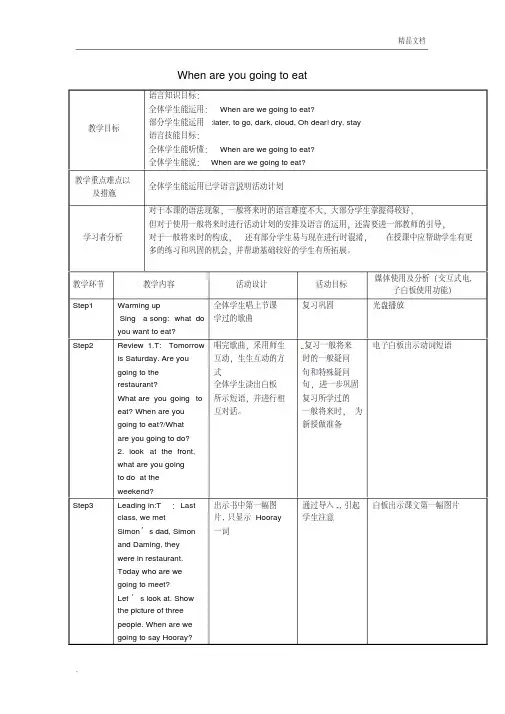
Module2 Unit1教学设计【内容来源】外研版三起点(2013年版)六下Module2 Unit1【主题】When are we going to eat?【课时】此教学设计按单元写,教师可根据实际情况划分课时一、教学目标(Teaching aims)(一)知识目标(Knowledge aims)1. 听、说、读、写单词duck, like;听、说、认读单词dry, pond, cloud, stay, later和词组to go, look like。
2. 听、说、读、写句子When are we going to eat? At half past twelve./ We’re going to eat at half past twelve.(二)能力目标(Ability aims)能用一般将来时谈论意图和计划。
二、教学重难点(Teaching points and difficulties)(一)重点(Points)1. 听、说、读、写单词duck, like。
2. 运用When are we going to …? We’re going to … at …. 谈论意图和计划。
(二)难点(Difficulties)运用When are we going to …? We’re going to … at …. 谈论意图和计划。
三、教学准备(Teaching preparation)课件(教师可以在平台直接调用或下载)四、教学过程Step 1: Warm-up1. 师生相互问候。
教师播放Module1 Unit2活动4歌曲动画,学生跟唱。
2. 教师询问学生:What time is it now? 让个别学生进行回答。
然后在课件上出示一个钟表,把它调成不同的时间,然后用What time is it ?不断询问学生钟面上所表示的时间,从而帮助学生复习有关时间的英文表达法。
同时,询问学生:What are you going to do at …? 提醒学生用I’m going to …句型进行回答。
外研版(三起)(2012)小学英语六年级下册Module2Unit1Whenarewegoingtoeat$%Module2Unit1Wh(20200907102406)
Step11
Homework: 1. Recite the text 2. Look and write
精品文档
高效阅读的第二要务是把握所读内容的重点,甚至几个关键词即可。前三章里面,作者最核心的是提出了学习的两个基本要素:兴趣、专注。兴趣可以让我们更主动、积极,更愿意表达自我,
就好比作者在书中提到:第一年的象棋比赛非常顺利,和同龄人相比,总是战无不胜,或许最关键的因素就是表达自我。专注:连续
握正确的思维方式和训练方法。两种理论的心理学测试对比:
“整体理论”者:遇到困难,更容易急躁甚至放弃。
“渐进理论”者:在困难面前,更愿意迎接挑战。我们每个人的都不一样,存
在着千差万别,而且这种差别只是一个最底层的东西,更重要的是我们要知道自己有学习和改变的能力。虽然每个人在不同领域的起点是不一样的,但每个人可以通过学习改变自己在不同领
域的能力的,这就是渐进理论的观点。本书非常精彩,是一个在两个领域都取得多次世界冠军的大师级人物,在美国有影响力的传奇人物以自己的亲身经历梳理和总结反思学习过程的实践之
做。效果更好,把心理表征这个比较抽象的概念形象具体的进行了一次完整阐释。用的相当准确, 法,绝非死板的办法。学习时如何专注从而调动大脑的学习能力,比赛时如何调整最佳的心理状态。
让学生懂得爱
mountain?
护环境, 保护大
Is he going to show 自然
白板出示华山清洁工人吊着 绳索捡拾垃圾,游人攀爬树 木,乱写乱画,乱扔垃圾的 图片
.
Look at the picture,
Kong Fu?
What is he going to
Is he going to
do? (After the
外研版三起小学英语六年级下册教案 (2).doc
六年级下册英语教案张巧丽小学六年级英语教案Module1Unit1 I want a hot dog please.learning aims:1、能听懂、会读、会说、会写本单元的单词:hamburger \cola \hot dog\ cent \dollar2、能听懂会说:What do you want to eat \drink?I want to…How much is it? It’s…”等句子。
3、能正确、流利地进行情境对话。
教学步骤:Step 1: Warm-up and show the learning aims1. Say “Hello” to the children and talk about some interesting experience during the winter vacation.2. T: Boys and girls, today we are going to learn Module1 Unit 1 I want a hot dog please. (板书课题) First, please look at our learning aims.(出示本课学习目标,教师慢慢读,学生仔细看、认真听。
)Step 2: Learn the new words and the key sentences.1. T: Now I feel hungry and thirsty. I want something to eat and drink. Can you give me some suggestions? (让学生说出他们知道的食物和饮料,并板书在黑板上)2. Ask the students to learn the new words by themselves.① Try to read by themselves.② Listen to the tape and read after the tape.③Let the students read the words in their own small groups.3. (The teacher points to the words in the blackboard): I wanta hot dog, please. (使用这种方式逐一把单词带入句型中,给学生进行重点句型的大量听力输入)4.Pair works: Ask and answer with the key sentences.①What do you want? I want….②How much is it? It’s ….Step 3: Learn the textT: Today Daming , Simon and Simon’s father go to the restaurant to have the meal. The dialogue tells us the story.1. Put the pictures on the blackboard and ask the children to look at the picture carefully. Listen to the dialogue between the waitress and the customers.2. Listen to the tape and circle the new words.3. Listen again and answer some questions.Where are they? Is a hot dog really a dog?What does Daming\Simon\Simon’s father want?4. Pause after each sentence for the children to repeat.5. Practice in groups and act out the dialogue.Step 4 Finish a task1. Recite the new words and the key sentences correctly and skillfully in 5 minutes.2. Group works: Suppose you are in the restaurant and going to have a meal. Then make a dialogue.3. Copy the new words three times. (要求:①在四线格内书写②用手写体书写③书写要认真、细心、端正、漂亮)Blackboard Writing:I want a hot dog, please.New words:hamburger , cola, dollar, cent, enjoyWhat do you want? I want….How much is it? It’s ….教学反思:通过本单元的学习,大部分同学都学会了用英语问价钱:How much is it?,并学会了美元的单位:dollar, cent。
外研版六年级下英语Module1 Unit 2 教案 2
Module Unit 2What do you want to eat?【教学目标】. 知识目标:(). 理解并运用句型:What do you want to eat / drink ? I want …. (2). 掌握询问价格的语言结构,并会做相应答复:How much is it ?It is ….( 3 ) . 能正确理解并流利朗读活动2的句子,能完成活动3和活动5的操练。
2. 技能目标:学生能学习并掌握就餐句型,并能顺利完成活动6的操练。
3. 情感目标:()通过食物的学习了解健康食物和不健康食物。
(2)培养学生热爱生活、增加对快餐店饮食文化的了解、兴趣。
【教学重点】()理解并运用句型:What do you want to eat / drink ? I want ….。
(2)能正确理解并流利朗读活动2的句子,能完成活动3和活动5的操练。
【教学难点】学生能学习并掌握就餐句型,并能顺利完成活动6的操练。
【教学准备】PPT、单词卡片、食品图片容易假设干张、配套资源光盘。
【教学流程】Step Warming up and review. Greetings. (师生间进行简单的问候。
)2. Let’s review .看图片说句子,根据图片完成答句。
3. Let’s chant.:播放 (Activity: Listen and chant) 的歌曲,活泼课堂气氛Step 2 Presentation and PracticeActivity 2、Listen and read. 出示一些实物图片,教师利用一些食物的图片问学生(教师可以多问几个学生)。
T :There is some food for you. What do you want to eat / drink?2. 出示菜单,询问学生食物价格,以可乐为例,教师指着课件上任一种食物,让学生答复。
3. 出示活动2的图片,告诉学生,Lingling and her father 去快餐店用餐,瞧他们正在一家快餐店里点餐,我们先来听听吧。
Module2Unit1Whenareyougoingtoeat(教案)外研版(三起)英语六年级下册
教案:Module 2 Unit 1 When are you going to eat?一、教学目标1. 知识目标(1)能够听懂、会说、会读本课的生词和重点句子。
(2)能够运用一般现在时描述自己的日常活动和计划。
2. 能力目标(1)能够通过图片和情景,理解对话内容,提高听力技能。
(2)能够用英语进行简单的日常交流,提高口语表达能力。
3. 情感目标培养学生的团队协作精神,提高他们对英语学习的兴趣和自信心。
二、教学内容1. 单词:weekend, camp, usually, swim, cook, often2. 句子:When are you going to eat?I'm going to eatWhat are you going to do?I'm going to3. 情景对话:A: When are you going to eat? B: I'm goingto eat A: What are you going to do? B: I'm going to三、教学重点与难点1. 重点:单词weekend, camp, usually, swim, cook, often和句子When are you going to eat? I'm going to eat What are you going to do? I'm going to2. 难点:一般现在时的运用,情景对话的交际能力。
四、教具与学具准备1. 教具:PPT、图片、卡片、录音机、磁带2. 学具:课本、练习册、单词卡片、录音机、磁带五、教学过程1. 热身(5分钟)(1)唱英文歌曲"What are you going to do?"(2)老师提问,学生用中文回答:你周末通常做什么?2. 引入(10分钟)(1)老师出示图片,引导学生说出单词:weekend, camp, swim, cook(2)老师提问,学生用中文回答:你周末通常做什么?3. 呈现(10分钟)(1)老师播放磁带,学生听录音,跟读句子(2)老师出示情景对话,引导学生朗读并理解对话内容4. 操练(10分钟)(1)分组进行角色扮演,学生用英语进行对话(2)学生上台表演,其他学生进行评价5. 巩固(10分钟)(1)完成练习册第1、2题(2)老师出示图片,学生用英语描述图片内容6. 拓展(5分钟)(1)学生分组讨论,计划一次周末活动(2)学生上台展示,其他学生进行评价六、板书设计1. 单词:weekend, camp, usually, swim, cook, often2. 句子:When are you going to eat? I'm going to eat What are you going to do? I'm going to七、作业设计1. 抄写生词和句子2. 完成练习册第3、4题3. 预习下一课八、课后反思本节课通过图片、情景对话和角色扮演等方式,让学生充分参与到课堂活动中,提高了他们的听、说、读能力。
六年级下册英语教案-Module 1第三课时Unit 2 1~2 外研版
六年级下册英语教案-Module 1第三课时Unit 2 1~2 外研版一、教学内容本节课主要内容为外研版六年级下册英语教材 Module 1第三课时 Unit 2 的1~2部分教学。
二、教学目标1.能够听懂、理解、读写本节课所学单词:mouth, ear, nose, eye.2.能够掌握如何用正确发音和语调来表达与五官有关的单词。
3.能够描述身体的部位,如“我的嘴巴是在脸上的”。
4.能够在实际情境中运用所学知识,如与他人伙伴玩憨笑游戏等。
三、教学步骤1. 预热活动•与学生们进行简单问候,询问他们如何度过上个周末,调整好课堂氛围。
2. 学生学习•通过展示课堂屏幕上五官的图片,辅导学生们理解口、耳、鼻、眼与其它身体部位的不同之处。
•呈现听力材料并帮助学生们跟读,加强对五官单词的记忆。
•请学生在纸上画出人脸,然后辅导他们写出人体的不同部位,并在课堂上互相评估,以加深他们对所学知识的理解和把握。
•与学生们分享面部表情,并帮助他们掌握如何表达与五官有关的单词,如“张嘴、闭上眼睛、摸鼻子等”。
3. 运用知识•在课堂上玩憨笑游戏,以帮助学生们在乐趣中运用所学知识,并激发他们对英语学习的兴趣。
•安排1对1对话,辅导学生们根据自己的面部感觉来描述自己的部位,如“我的嘴巴是在脸上的”,以帮助他们将所学知识运用到实际生活中。
4. 总结•与学生们分享所学内容,并帮助他们回忆一些形容词和短语,如“长得漂亮”,“有点小”,“看起来非常严肃”等,以加强他们的口语会话能力。
四、教学评估•分配练习题,如复述课堂上所学定语从句,并要求学生写作,如“我的嘴巴很软,我的眼睛很快”等等。
•对学生完成的作业进行评估,并根据学生的反馈,调整教学策略,以提高他们的学习效果。
五、教学反馈•总结课堂上的亮点和不足,并帮助学生们反思自己的表现,以便日后改进教学策略和提高学习成效。
六、结语英语学习需要不断积累和灵活运用,并需要一位好的英语老师来辅导你,帮助你以最小的代价取得最大收获。
外研版(三起)-英语-六年级下册-Module 1 Unit 2 What do you want to eat 同步教案
Module 1 Unit 2 What do you want to eat 同步教案教学目标:知识目标:1、能够掌握询问别人就餐意愿的句子:What do you want to eat/drink? 并能听懂别人的点餐要求如:I want a hamburger, please.2、识别七种食物单词和四种饮料单词。
能力目标:能将所学的对话灵活运用到日常生活中进行交流。
情感目标:在交流中体验学习英语的乐趣,培养学生大胆开口说英语的习惯,提高学习英语的积极性。
教学重难点:重点:句型What do you want to eat? What do you want to drink?难点:是掌握和熟练运用本模块所学语言知识谈论点餐和就餐的情况Listen and repeat.“模仿秀”看看哪个同学模仿的最好。
播放第三次录音。
每个句子后停顿后,要求学生进行指读和跟读。
并把以下句子进行板书:What do you want to eat/drink? I want …听完后集体或小组或个人进行模仿朗读(运用多种形式让学生进行充分的听说练习,使学生具有良好的语音语调)Step 3:Practice.Practise in groups and Train-practise as quickly as possible.1.pair workHave the Ss practice in pairs.What do you want to eat/ drink?I want to eat/drink...How much is it?It’s……2.Finish activity 3of page six.Ask the children to ask and answer in pairs.3.Play in roles.4.Games幸运大闯关Step 4:Consolidation.T: I’m a little hungry.Let’s go to my lucky restaurant.OK? Let’s go!全体起立做走路状。
外研版(三起)-英语-六年级下册-Module 2 Unit 1 When are we going to eat? 教学设计
外研版(三起)-英语-打印版 M2U1 When are we going to eat?教学设计 一、教学目标: 知识与技能目标: 1. 能听说读写本单元的单词:later、to go 、duck、 pond、cloud等单词,理解课文大意并能准确的认读课文。 2.在复习巩固be going to 句型的基础上掌握文中的重点句型: When are we going to eat? We are going to eat at half past twelve. What are we going to do now? We are going to +动词原形 过程与方法目标 1. 通过回顾复习be going to 句型、提问的方式来理解文中的重点句型。 2. 借助单词卡片、课文插图来理解并认读本单元所学的单词。 3. 通过多次跟读、小组内分角色认读来达到对课文的熟读。 4、通过TPR教学复习动词短语,并复习半点half past及整点o’clock,为学习新知做准备。 5、联系生活实际,让学生运用be going to造句,将所学知识灵活运用于实际生活中。 情感目标 培养学生善于观察生活、体会生活中的语言,对生活中常用句子的理解和应用。 二、教学重难点: 教学重点: 1、能听说读写本单元的单词:later、to go 、duck、 pond、cloud等单词,理解课文大意并能准确的认读课文。 2、复习并巩固be going to 句型,尤其是特殊疑问句的应用。 教学难点: 1.课文的理解和词汇的记忆 2. be going to的灵活运用。 三、教具准备:单词卡片 多媒体 教学插图 四、教 学 过 程: 外研版(三起)-英语-打印版 Step 1:Warm –up: 1. Greetings: T:How are you? S:I am fine,thank you. Step 2:Leading: 1.Review “be going to 句型”,并掌握其结构和用法,为学习新知引出课题做准备。 T: OK, today we are going to learn a new lesson, M2U1 When are we going to eat?.(出示课题), 1、TPR:I say you do (review some verb phrases) have breakfast/lunch/dinner have a picnic get up go to schoolgo to the park eat bananas 2、在复习了be going to 句型及动词短语的基础上,通过课件出示的图片充分练习be going to 的造句。 3、师课件出示一时钟的图片并显示不同的时间。 T: What time is it ? S: It’s … T: When are we going to eat? S: I am going to …(师引导学生用be going to 作答,从而回顾以前所学的be going to 句型) (设计意图; 由复习时间的表达,过渡到When are we going to eat?让学生运用be going to 句型及时间造句。 Ok, let’s look at this picture: Step 3: Presentation(课文学习) 1. Look and listen then circle the words that you can’t read and circle : “be going to …”(整体感知课文)and answer these questions: T: Where are they ? S: They are in the park. T: What are they going to do in the park? S: They are going to have a picnic. T:When are they going to eat? 外研版(三起)-英语-打印版 S:At half past twelve. 2、T: ok, let’s talk about the picnic. 2. 解析课文 Listen part 1 and ask : T: What time is it now ? And when are they going to eat? S:At half past twelve T: From half past eleven to half past twelve , what are they going to do ? S: They are going to have a picnic. T: What’s the weather going to be like ? S: It’s going to rain .(引导学生用It’s going to rain ,并板书) T:But Simon’s mum says: It’s a beautiful day. And what are they going to see ? S: They are going to see some ducks. T: You listen, what are the ducks like ? S: They are … ( 师板书lovely,并领读、拼读、记忆) T: Look at part2 , What’s happening ? listen! S: It’s raining. T: Where are they going ? S: They are going over there. T: look at the ducks , they are eating their picnic. We know it’s raining now , so their food is wet How is their picnic ? Do you think they have a good picnic? Why ? (设计意图: 以时间为线索,采用借助图片,师生问答的形式对be going to .. 展开教学活动,从而理解课文大意,最后以How is their picnic ? 总结提问的形式又回到课前预设的问题中,从而让学生更准确理解课文) Step 4 : practise: 1. 书本练习4(见课件) 2. 师领读,优生领读,小组内互读,互相拼读,检查记忆 Step 5: Read the text 1. listen and repeat the text.(跟读,注意语音语调的模仿) 2. 小组内互读,注意相互纠错。 外研版(三起)-英语-打印版 3. 小组内分角色朗读课文。 Step 6: Summary This class we learnt some new words and phrases: Teacher says Chinese, students say English Step7: Do exercises: 1.Make sentences:be going to … 2. 根据课文大意填空 Daming ,Simon and Simon’s Mum are going to have a picnic in a park. It’s________ past eleven. There is one hour to go. They are going to eat at half past twelve. There are some _______ on the pond. They are __________.And there are some dark ________in the sky.It’s _______now. The ducks are eating our sandwiches .They are __________. Step8:Homework Step9: Blackboard Writing: M2 U1 When are we going to eat? 一般将来时的主要结构: 主语 + be going to + 动词原形+其他 1. 表示即将发生的或最近打算进行的事。 2.标志性词语:tomorrowsoon A:When are we going to eat? B:We are going to eat at half past twelve. It’s going to rain. 短语:on the pond in the sky half past over there
英语六年级下外研版(三起)Module1Unit2第1课时教案
授课时间:年月日(总)第1课时
课题
Unit 2: What do you want to eat?
课型
新授课
本课第1课时
教学目标
知识:1、进一步复习关于食物的单词
2、能熟练的运用A: What do youeat?B:I want a hot dog,please.
2. Listen to the tape and find out the food.
3. Listen to the tape again and answer the questions.
(1)What does Lingling want to eat?
(2)What does Lingling want to drink?
五、Designs:
Module1Unit 2What do you want to eat?
A:What do you want to eat?
B:I want some chicken and rice, please.
A:What do you want to drink?
B:I want a cola, please.
A: What do youdrink?B:I want acola,please.
能力:培养学生学会用英文进行谈论点餐和就餐的情况
思想教育:激发学生的学习热情,了解中西方饮食文化以及价格表达上的异同。
重点
能熟练的运用What do youeat/ drink?
难点
Drink的发音
教学具
Tape recorder
1. Show a restaurant menu to the students.
(外研版 三起)六年级英语下册Module 2 Unit 1教案
外研版三起六年级英语下册Module 2 Unit 1教案教材分析教材背景本单元主题为“Are you free on Saturdays?(你周六有空吗?)”,在学习内容中要求学生掌握有关询问和回答日常活动的表达方式。
教材内容单元1主要涉及以下内容:•询问日常活动:Are you free on Saturdays? (你周六有空吗?)和When do you have English class? (你什么时候上英语课?)•回答日常活动:Yes, I am. / No, I’m not. (是 / 不是)和I have English class on Tuesday. (我星期二上英语课。
)•日常活动的表述方式:watch TV (看电视)、play basketball (打篮球)、run (跑步)、read books (看书)等。
教学目标1.掌握并熟练运用询问和回答日常活动的表达方式。
2.能够熟练表述常见的日常活动。
教学设计课堂活动1.热身活动:学生自由活动,并根据现场点名回答老师的问题。
2.新课讲解:通过幻灯片、图片等方式,介绍本节课的主题、教材内容、以及本课时重点、难点和考察方式。
3.针对问题的讲解:对于学生提出的问题,或者一些常见的错误,老师通过幻灯片、板书等方式进行解答。
4.课堂练习:老师先进行模拟演练,让学生熟悉、掌握相关知识和技巧。
然后,以小组为单位,让学生互相询问、回答并评价,最后上台表演。
5.总结、评价:由老师进行总结和评价,对于表现优异的同学进行表扬,并指出不足之处,提出改进建议。
教学方法本节课采用互动式教学法,以“学生为主体、教师为主导”的教学模式为基础。
通过互动问答、演练、模拟等方式,让学生在课堂上充分参与,并主动提出问题和答案。
同时,促进学生交流,发掘学生的潜力,不断激发潜能。
教学手段为了让学生能够更好地理解和掌握相关知识和技巧,本节课采用了多种教学手段,包括:1.幻灯片:通过图片和文字展示相关知识点和实例。