
2020年7月大学英语四级cet4试题及答案
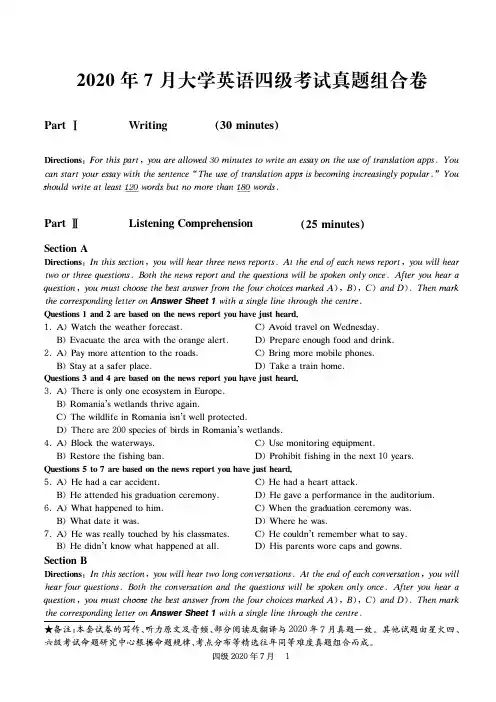
2020年7月大学英语四级cet4试题及答案解析Directions: For this part, you are allowed 30 minutes to write an essay on the use of translation apps. You can start your essay with the sentence "The use of translation apps is becomging increasingly popular. " You should write at least 120 words but no more than 180 words.破题思路:首段:很多人在用翻译APP(现象)中间段:翻译APP的利弊尾段:我的建议参考范文1:The use of translation apps is becoming increasingly popular. Why? Admittedly, in the contemporay society, an increasing number of people, with the help of translation apps, find it convenient to read foreign literature or essays.On the one hand, these apps can bring users greater efficiency and help them save more time or energy, particularly for those who have no knowledge of a foreign language. For instance, a host of people may have a variety of difficulties or troubles in learning English, but with the assistance of these apps, it will not be difficult for them to read and understand English materials. On the other hand, it is these apps that cuase some learners to lose motivation for studying. With Apps in hand, they are not willing to do their utmost to memorize new words, pratice speaking or writing skills every day. Fianlly, they will fail to get a good command of any foreign language.I, as a college student, deem that it is of great necessity for youngsters to use translations apps in a rational way. We should bear in mind that any translation app is merely a tool. Provided that one intends to master a foreign language, it is advisabel to practice each day instead of relying on translation apps.译文:翻译APP的使用变得越来越普遍流行。
为什么呢?不得不承认,在当今社会,在翻译APP 的辅助下,越来越多人发现阅读外语文献或文章变得高效又方便。
一方面,这些APP能带给使用者更高的效率并帮助他们节约时间和精力,尤其是对于根本不懂一门外语的人而言。
例如,很多人在学英语方面有各种困难或麻烦,但有了这些APP,他们读懂或理解英语资料将不是难事。
另一方面,正是这些APP导致一些学习者失去了学习的动机。
有了Apps,他们不愿尽全力每天背生词、练听和说的技能。
最终,他们将无法掌握任何一门外语。
更多考试资料加vx:344647作为一名大学生,我认为年轻人很有必要以理性态度实用翻译Apps。
我们应该牢记在心的是任何翻译APP也只是工具。
假设一个人想要掌握一门外语,明智地做法是每天训练,而不是依赖翻译App。
参考范文2:The use of translation apps is becoming increasingly popular. Why? Admittedly, in the contemporay society, an increasing number of people, with the help of translation apps, find it convenient to read foreign literature or essays.On the one hand, these apps can bring users greater efficiency and help them save more time or energy, particularly for those who have no knowledge of a foreign language. For instance, a host of people may have a variety of difficulties or troubles in learning English, but with the assistance of these apps, it will not be difficult for them to read and understand English materials. On the other hand, it is these apps that cuase some learners to lose motivation for studying. With Apps in hand, they are not willing to do their utmost to memorize new words, pratice speaking or writing skills every day. Fianlly, they will fail to get a good command of any foreign language.I, as a college student, deem that it is of great necessity for youngsters to use translations apps in a rational way. We should bear in mind that any translation app is merely a tool. Provided that one intends to master a foreign language, it is advisabel to practice each day instead of relying on translation apps.译文:翻译APP的使用变得越来越普遍流行。
为什么呢?不得不承认,在当今社会,在翻译APP 的辅助下,越来越多人发现阅读外语文献或文章变得高效又方便。
一方面,这些APP能带给使用者更高的效率并帮助他们节约时间和精力,尤其是对于根本不懂一门外语的人而言。
例如,很多人在学英语方面有各种困难或麻烦,但有了这些APP,他们读懂或理解英语资料将不是难事。
另一方面,正是这些APP导致一些学习者失去了学习的动机。
有了Apps,他们不愿尽全力每天背生词、练听和说的技能。
最终,他们将无法掌握任何一门外语。
作为一名大学生,我认为年轻人很有必要以理性态度实用翻译Apps。
我们应该牢记在心的是任何翻译APP也只是工具。
假设一个人想要掌握一门外语,明智地做法是每天训练,而不是依赖翻译App。
2020年7月大学英语四级听力真题——短篇新闻(斯科特)Part IISection ANews Report 3 (5:30-8:00)Scott Dunn, recently awoke from a medically-induced sleep he'd been in after a car accident. He was heartbroken after realizing he'd missed his high school graduation. His classmates decided to give him a second chance. It was just a month ago that East Juniata High School seniors met in the school's auditorium for graduation. And last week, they did it again. Scott's car accident was on May 22nd, just 3 days before the ceremony. "I remember waking up in the hospital and asking mom, 'What day it was', she told me it was the 28th." He said, "I looked at her and said, ‘I missed my graduation." The school's principal, Mr. Fausey, called Scott's mom Karen and said that everybody wants to do something special for him. Students wore their caps and gowns and sat in the front of the auditorium. Scott's parents, Karen and Scott Senior, sat front and center. After brief speeches, Scott's name was called, only Scott's name. He walked across the stage as the audience cheered.A graduation for one. "I'm speechless," Scott said. "I don’t know how to even explain it. I'm speechless to know that so many people are behind me."Questions 5-7 are based on the news report you have just heard.Question 5: What happened to Scot a month ago?Question 6: What did Scot ask about when he regained consciousness?Question 7: Why was Scot speechless at the graduation ceremony?News Report 2Romania's wetlands are coming back to life, thanks to help from local communities, the World Wildlife Fund and funding from the European Union. 【3】Roughly 2,224 acres of the picturesque Danube Delta – home to 300 species of birds – have filled with wildlife. The land has been connected to the network of lakes and streams in the area. 'A lot of birds have migrated to the area and one doesn't need to travel long hours anymore or go to other lakes to watch the birds, ' says Ion Meuta, Deputy Mayor of Mahmudia. The area around Mahmudia, which is a UNESCO World Heritage site, is the third-most biodiverse in the world, after Australia's Great Barrier Reef and the Galapagos Islands. Groups used earth-moving equipment to restore the waterways. Government officials proposed to protect the area's endangered wild fish by issuing a fishing ban over the next decade.【4】3. What is the news report mainly about?4. What did government's officials propose to do to protect the endangered fish?——短篇新闻News report 1(苏格兰)… parts of Scotland covered by the orange alert to avoid travel on Wednesday, ' this is what he said to us. The orange warning may be raised to red in some areas. That is a warning for snow that has never been seen since the modern system came into place in Scotland. The orange warning has been extended until 6 p.m. on Thursday. Trains, planes and ferries are also likely to be affected, with wind chill that could see parts of Britain feeling as cold as -15℃. The head of road policing said, 'I would urge drivers to take extra care on the roads for their journeys. Drivers should make sure they are prepared for their journey with warm clothing, food and drink, sufficient fuel and a charged mobile phone. There could be significant traffic delays, so please start to plan your journey now to consider if you really need to travel on conditions of this …Question 1: What were people at parts of Scotland advised to do?Question 2: What did the head of road policing urge drivers to do?长对话1——在家办公Conversation 1M:How do you like your new flexible work in arrangement? Do you enjoy working from home?W:Yes and no, I find an isolation challenging at times, apart from my mother, not too many people I know, have time for phone chat during working hour. I tried the library but found I wasn’t really keen on working there.M:No, neither would I. I find the library a bit too quiet. I’d lack inspiration or stimulation, which would be counter-productive to getting a lot of work done.W:I found the same thing. So, lately, I’ve been going out to Cafes occasionally, I love the noise, the people, the busyness of a Café, the sense of being out in the world.M: Coffee shops seem to have affectively become off spaces for so many people in this digital age. Though I’m not sure how Café owners feel about it - having so many people who go to that places to work rather than drink and eat.W:Yes, some people seem to spend a lot of time there and not order much. The most annoying one for Café owners must truly be those, usually only two of them, who occupy a table for six with their laptops and paperwork.M:They should sit at a table for two, not the table for six. Some obviously stay so long, they need to plug the laptops into a power adapter. I nearly tripped over someone’s computer electrical lead the other day in my local café.W:It’s a double-edged sword, no doubt about that, for a Café owner. While remote workers help to keep the café full in quiet times, they can take up valuable table space and busy period.Questions8. What does the woman say is the disadvantage of working from home?9. What does the man say is counter-productive to getting work done in the library?10. What does the woman like about doing one’s work in a café?11. What is most annoying for café owners according to the woman?——听力长对话(离职)Conversation 2W: I’m going to start working for another job. I can’t see myself getting an opportunity to progress on my company anytime in the near future. And I really think my skills and abilities deserve a higher salary.M: You are not going to quit, are you?W: I’m thinking I might as well. Then I can devote more time and energy to find me a better position at another company.M: But you’ve been in your present company less than two years, haven’t you? This would be the third time you’ve left your job in the last five years. If you do several jobs in a relatively short span of time, perspective employers might see that you lack loyalty. That could make them worry and reluctant to employ you.W: Unfortunately, loyalty doesn’t pay. Even if I get a promotion at my company, it’s likely to be less sizeable than if I were to get a job elsewhere. And even if I get a promotion, I’m not guaranteed to get a raise. I had that experience at another company I worked up.M: They want you to take on more work and responsibility but for the same amount of money?W: More or less, yes. The way I see it, through having different jobs, I’ve got a lot of experience, and different jobs and in different industries.M: But potential employers might worry about that experience is not deep, or thorough enough.W: Perhaps, but I feel pretty confident that I can sell myself. You know what they say, fortune favors the brave.Q12: What makes the woman think about changing her job?Q13: What does the man say about people who keep changing their jobs?Q14: What does the woman say would happen even if she got promoted in her current company?Q15: What benefit has the woman gain from changing her jobs frequently?——听力篇章(孤独感)Passage oneThere is a saying that goes something along the lines of ‘You must love yourself first before you can love someone else.’ Similarly, I personally believe that you must be comfortable and happy in your own company before you can truly be yourself in the company of others. There is a massive difference between being lonely and being alone. Loneliness is a horrible feeling. However, you don’t have to actually be alone to feel that way. Many times, I’ve felt lonely when surrounded by a big group of people. In contrast, being alone can actually be a blessing, particularly, when you’ve actively chosen it. In my experience, being bored and alone is dangerous and can easily lead to the feeling of loneliness. The trick is to be active. Get outside, stretch your legs, do something cultural, buy yourself something tasty to eat or something pretty to wear. You don’t have to take anyone else into consideration and can do whatever you please. Spending time alone also allows you to more efficiently take care of problems. And then, when it’s time to be social and meet up with your friends, you will be fully there, because you won’t have too much other stuff floating around in your mind. Having been alone for a bit, you will also appreciate your friends’ company more and chances are your time spent together will be more worthwhile.Question 16: What does the speaker say about being alone?Question 17: What does the speaker say how to reduce one’s feeling of loneliness?Question 18: What is an advantage of spending one’s time alone?——听力篇章(记忆力)短文3Watching more than 3 hours of television a day doubles memory loss in older people, a new study of more than 3,000 adults suggests. Scientist at University College London used memory and fluency tests on the same group of people 6 years apart. They found that those who watched on average less than 3 hours television a day showed a decline ever round 4 to 5 percent, while those who tended to watch more than 3 hours a day declined by an average of 8 to 10 percent. The research team say they believe the alert but passive nature of television watching maybe creating stress on the mind, which contributes to memory decline.Older people who watch more television are also less likely to undertake activities knowing to preserve mental functioning, such as reading or interactive screen base pursuits, such as using the internet or playing video games. The researchers say that television viewing maybe a risk factor for all Alzheimer’s disease, but more researches needed to establish a link.While watching television may have educational benefits and relaxation benefits, the researchers advise that adults over the age of 50 should try and ensure that television viewing is balanced with other contrasting activities. If you’re concerned that the amount of television you’re watching could have a negative impact on your health, you should eliminate the amount of TV watch each day and undertake some healthy hobbies.问题:22. By what means does scientist at University College London measure memory lost?23. What contributed to memory decline in the participants?24. What did the researchers say about their finding concerning the link between TV viewing and xxx this disease?25. What do the researchers suggest older people do?——听力篇章(父亲)When I turned twelve, I worked summers at my father’s small brick cleaning business. I remember the harsh acid smell of the cleaning solution, and the scraping sound of stiff iron brushes against rough brick. It was tempting to have your jobjust finish. But anybody who worked for Thomas Kahoon had to meet his standards, and that include of me. If I messed up, he made me stay late until I got it right.My father wasn’t been me. He demanded the same at himself. Every brick he cleaned on the house stood out like a red jewel in a white setting. It was his signature.In 1970, when I was twenty, I got married. I moved out my parent's modest place into a housing project.Drugs and gang violent were just beginning to plague the projects.Some of my friend went to jail. Some were killed. My wife Verllen, was 18, and nobody gave our marriage a chance. But we believed in each other. And our faith made us strong.When we married, I worked as a stock clerk at Southwest Super Food. It was hard, tedious work. Each Friday night a truck came, with cases of food that had to be unloaded, priced and placed on shelves.Most of stock clerks try to get Friday night off. But I was always ready to work. By Saturday morning, all the kinds and drawers in my aisle would place with a label facing smartly out, like a line of soldiers on review. That was my signature. I took pride in a job nobody wanted.19. What do we learn about the speaker’s father?20. What does the speak say about the housing project?21. What do we learn about the speaker as a stock clerk?四级听力篇章答案:父亲四级听力答案:长对话2(离职)四级听力答案:长对话1(在家办公)四级听力答案:短篇新闻3(斯科特)四级听力答案:短篇新闻2四级听力答案:短篇新闻1(苏格兰) 阅读选词填空答案:科学Part Ⅲ Reading Comprehension (40 minutes)Section ADirections: In this section, there is a passage with ten blanks. You are required to select one word for each blank from a list of choices given in a word bank following the passage. Read the passage through carefully before making your choices. Each choice in the bank is identified by a letter. Please mark the corresponding letter for each item on Answer Sheet 2 with a single line through the centre. You may not use any of the words in the bank more than once.Questions 26 to 35 are based on the following passage.“Science and everyday life cannot and should not be separated." Those were the words uttered by pioneering British scientist Rosalind Franklin, who firmly believed that the pursuit of science should be (26) to all.As a woman working in the first half of the 20th century, Franklin’.s contributions to some of the greatest scientific discoveries of our time - including the structure of DNA - were sadly(27) in her lifetime. One of my proudest moments in my role as universities and science minister was being able to go some way to redress this injustice last month, by unveiling the new Mars rover named after this brilliant British scientist.Today, on International Women’ s Day, it is only right that we recognize the important work of female scientists like Franklin and seek to honour her memory by inspiring more women and girls to follow in her footsteps.More than 60 years after Franklin’ s death, we are (28) living in a different world, where women play an important part in every echelon of our society-not least in science, innovation, higher education and research.UK universities are world leaders when it comes to advancing and (29) gender equality. The Athena SWAN charter, initially established to improve the representation of women in scientific disciplines in higher education, now has 145 members. It has also expanded to promote gender equality in multipledisciplines-including the arts, social sciences, humanities, business and law.In the past decade, we have seen a (30) increase in England in the number of women accepted on to full-time undergraduate degrees in science, technology, engineering and maths (Stem subjects). And in the last academic year, women (31) for more than half of all Stem postgraduates at UK universities. The government is taking further steps to improve women’ s representation in science and has today awarded nine in spiring women £50,000 to develop inventions to tackle the challengesand seize the opportunities we face as a society. From new materials to cut down on plastics pollution to special devices to improve posture and comfort for wheelchair users, these women are at the forefront of creating the new technology for tomorrow.This is significant progress, but access to higher education is only half of the equation. To have real equality in the sector, we need to ensure talented women are able to progress into the academic and leadership roles they desire, and get the remuneration they deserve.Data shows us the (32) to success gets harder for women to climb the further up they go.Although women make up the majority of undergraduates in our universities, just under half of academic staff are female. At (33) levels, only a quarter of professors are women, and black women make up less than 2% of all female academic staff.I welcome the introduction of pro-active strategies like the new initiative at the University ofLeicester, which I am visiting today, to increase the number of female professors by 1.5% each year,with the overall goal of having 30% professorships held by women by 2020.There are also stark differences in pay across grades. The gender pay gap based on median salaries across the sector in 2016-17 was 13.7%, (34) there is still some way to go to ensure women are rising through the ranks to higher grade positions and being paid (35) .答案:26. A) accessible27. J) overlooked28. O) thankfully29. K) promoting30. E) considerable31. B) accounted32. G) ladder33. L) senior34. N) suggesting35. D) appropriately四级仔细阅读考试真题仔细阅读:第一篇:It’s late in the evening: time to close the book and turn off the computer. You’re done for the day. What you may not realize, however, is that the learning process actually continues—in your dreams.It might sound like science fiction, but researchers are increasingly focusing on the relationship between the knowledge and skills our brains absorb during the day and the fragmented, often bizarre imaginings they generate at night. Scientists have found that dreaming about a task we’ve learned is associated with improved performance in that activity (suggesting that there’s some truth to the popular notion that we’re “getting” a foreign language once we begin dreaming in it). What’s more, researchers are coming to recognize that dreaming is an essential part of understanding, organizing and retaining what we learn—and that dreams may even hold out the possibility of directing our learning as we doze.While we sleep, research indicates, the brain replays the patterns of activity it experienced during waking hours, allowing us to enter what one psychologist calls a neural (神经的) virtual reality. A vivid example of such reenactment can be seen in this video , made as part of a 2011 study by researchers in the Sleep Disorders Unit at Pitié-Salpêtrière Hospital in Paris. They taught a series of dance moves to a group of patients with conditions like sleepwalking, in which the sleeper engages in the kind of physical movement that is normally inhibited during slumber. They then videotaped the subjects as they slept. Lying in bed, eyes closed, the woman on the tape does a faithful rendition of the dance moves she learned earlier—“the first direct and unambiguous demonstration of overt behavioral replay of a recently learned skill during human sleep,” writes lead author Delphine Oudiette.Of course, most of us are not quite so energetic during sleep—but our brains are busy nonetheless. While our bodies are at rest, scientists theorize, our brains are extracting what’s important from the information and events we’ve recently encountered, then integrating that data into the vast store of what we already know—perhaps explaining why dreams are such an odd mixture of fresh experiences and old memories. A dream about something we’ve just learned seems to be a sign that the new knowledge has been processed effectively. In a 2010 study published in the journal Current Biology, researchers at Harvard Medical School reported that college students who dreamed about a computer maze task they had learned showed a 10-fold improvement in their ability to navigate the maze comparedto participants who did not dream about the task.Robert Stickgold, one of the Harvard researchers, suggests that studying right before bedtime or taking a nap following a study session in the afternoon might increase the odds of dreaming about the material. But some scientists are pushing the notion of enhancing learning through dreaming even further, asking sleepers to mentally practice skills while they slumber. In a pilot study published in The Sport Psychologist journal in 2010, University of Bern psychologist Daniel Erlacher instructed participants to dream about tossing coins into a cup. Those who successfully dreamed about the task showed significant improvement in their real-life coin-tossing abilities. Experiments like Erlacher’s raise the possibility that we could train ourselves to cultivate skills while we slumber. Think about that as your head hits the pillow tonight.51. What is scientists’ finding about dreaming?A) It involves disconnected, weird images.B) It resembles fragments of science fiction.C) Dreaming about a learned task betters its performance.D) Dreaming about things being learned disturbs one’s sleep.52. What happens when one enters a dream state?A) The body continues to act as if the sleeper were awake.B) The neural activity of the brain will become intensified.C) The brain behaves as if it were playing a virtual reality video game.D) The brain once again experiences the learning activities of the day.53. What does the brain do while we are sleeping?A) It systematizes all the data collected during the day.B) It substitutes old information with new data.C) It processes and absorbs newly acquired data.D) It classifies information and places it in different files.四级翻译真题:火锅火锅中,重庆火锅(hotpot)最著名,也最受欢迎。
2020年7月英语四级参考答案含听力材料来源(听力部分)
1. News ReportNews report 1parts of Scotland covered by the orange alert to avoid travel on Wednesday, ' this is what he said to us. The orange warning may be raised to red in some areas. That is a warning for snow that has never been seen since the modern system came into place in Scotland. The orange warning has been extended until 6 p.m. on Thursday. Trains, planes and ferries are also likely to be affected, with wind chill that could see parts of Britain feeling as cold as -15℃. The head of road policing said, 'I would urge drivers to take extra care on the roads for their journeys. Drivers should make sure they are prepared for their journey with warm clothing, food and drink, sufficient fuel and a charged mobile phone. There could be significant traffic delays, so please start to plan your journey now to consider if you really need to travel on conditions of this …Question 1: What were people at parts of Scotland advised to do?定位句:(1) The transport minister advise people in parts of Scotland covered by the orange alert to avoid travel on Wednesday.Question 2: What did the head of road policing urge drivers to do?定位句:(2)The head of road policing said, I would urge drivers to take extra care on the roads for their journeys. Drivers should make sure they're prepared for their journey with warm clothing, food and drink, sufficient fuel and a charged mobile phone.◆【解读】两题均为细节题,考察了动词原形的动宾短语,由于在选项形式上较为相似,增加了一定的难度。
2020年大学英语四级考试真题及答案(第一套)
大学英语四级考试真题(第一套)Part I Writing (30 minutes)Directions: For this part, you are allowed 30 minutes to write a short essay on the following question. You should write at least 120 words but no more than 180 words.Suppose a foreign friend of yours is coming to visit your campus, what is the most interesting place you would like to take him/her to see and why?Part II Listening Comprehension (30 minutes)Section ADirections: In this section, you will hear 8 short conversations and 2 long conversations. At the end of each conversation, one or more questions will be asked about what was said. Both the conversation and the questions will be spoken only once. After each question there will be a pause. During the pause, you must read the four choices marked A), B), C)and D), and decide which is the best answer. Then mark the corresponding letter on Answer Sheet 1 with a single line through the centre.1. A)They came in five different colors. C)They were a very good design.B)They were good value for money. D)They were sold out very quickly.2. A)Ask her roommate not to speak loudly on the phone.B)Ask her roommate to make her phone calls outside.C)Go and find a quieter place to review her lessons.D)Report her problem to the dorm management.3. A)The washing machine is totally beyond repair.B)He will help Wendy prepare her annual report.C)Wendy should give priority to writing her report.D)The washing machine should be checked annually.4. A)The man fell down when removing the painting.B)The wall will be decorated with a new painting.C)The woman likes the painting on the wall.D)The painting is now being reframed.5. A)It must be missing. C)The man took it to the market.B)It was left in the room. D)She placed it on the dressing table.6. A)Go to a play. C)Book some tickets.B)Meet Janet. D)Have a get-together.7. A)One box of books is found missing. C)Replacements have to be ordered.B)Some of the boxes arrived too late. D)Some of the books are damaged.8. A)The man will pick up Professor Johnson at her office.B)The man did not expect his paper to be graded so soon.C)Professor Johnson has given the man a very high grade.D)Professor Johnson will talk to each student in her office.Questions 9 to 11 are based on the conversation you have just heard.9. A)To buy a present for his friend who is getting married.B)To find out the cost for a complete set of cookware.C)To see what he could ask his friends to buy for him.D)To make inquiries about the price of an electric cooker.10. A)To teach him how to use the kitchenware.B)To discuss cooking experiences with him.C)To tell him how to prepare delicious dishes.D)To recommend suitable kitchenware to him.11. A)There are so many different sorts of knives.B)Cooking devices are such practical presents.C)A mixer can save so much time in making cakes.D)Saucepans and frying pans are a must in the kitchen.Questions 12 to 15 are based on the conversation you have just heard.12. A)Some new problems in her work. C)Her chance for promotion in the bank.B)Cooperation with an international bank. D)Her intention to leave her present job.13. A)The World Bank. C)A U.S. finance corporation.B)Bank of Washington. D)An investment bank in New York.14. A)Supervising financial transactions.B)Taking charge of public relations.C)Making loans to private companies in developing countries.D)Offering service to international companies in the United States.15. A)It is a first major step to realizing the woman’s dream.B)It is an honor for the woman and her present employer.C)It is a loss for her current company.D)It is really beyond his expectation.Section BDirections: In this section, you will hear 3 short passages. At the end of each passage, you will hear some questions. Both the passage and the questions will be spoken only once. After you hear a question, you must choose the best answer from the four choices marked A), B), C)and D). Then mark the corresponding letter on Answer Sheet 1 with a single line through the centre.Passage OneQuestions 16 to 18 are based on the passage you have just heard.16. A)Carry out a thorough checkup. C)Keep extra gas in reserve.B)Try to keep the gas tank full. D)Fill up the water tank.17. A)Attempting to leave your car to seek help.B)Opening a window a bit to let in fresh air.C)Running the engine every now and then.D)Keeping the heater on for a long time.18. A)It exhausts you physically. C)It causes you to lose body heat.B)It makes you fall asleep easily. D)It consumes too much oxygen.Passage TwoQuestions 19 to 21 are based on the passage you have just heard.19. A)They are very generous in giving gifts.B)They refuse gifts when doing business.C)They regard gifts as a token of friendship.D)They give gifts only on special occasions.20. A)They enjoy giving gifts to other people.B)They spend a lot of time choosing gifts.C)They have to follow many specific rules.D)They pay attention to the quality of gifts.21. A)Gift-giving plays an important role in human relationships.B)We must be aware of cultural differences in giving gifts.C)We must learn how to give gifts before going abroad.D)Reading extensively makes one a better gift-giver.Passage ThreeQuestions 22 to 25 are based on the passage you have just heard.22. A)It reflects American people’s view of French politics.B)It is first published in Washington and then in Paris.C)It explains American politics to the French public.D)It is popular among French government officials.23. A)Work on her column. C)Entertain her guests.B)Do housework at home. D)Go shopping downtown.24. A)To report to her newspaper. C)To visit her parents.B)To refresh her French. D)To meet her friends.25. A)She might be recalled to France. C)She might close her Monday column.B)She might change her profession. D)She might be assigned to a new post.Section CDirections: In this section, you will hear a passage three times. When the passage is read for the first time, you should listen carefully for its general idea. When the passage is read for the second time, you are required to fill in the blanks with the exact words you have just heard. Finally, when the passage is read for the third time, you should check what you have written.According to American law, if someone is accused of a crime, he is considered (26)__________ until the court proves the person is guilty.To arrest a person, the police have to be reasonably sure that a crime has been (27)__________. The police must give the suspect the reasons why they are arresting him and tell him his rights under the law. Then the police take the suspect to the police station, where the name of the person and the (28)__________ against him are formally listed.The next step is for the suspect to go before a judge. The judge decides whether the suspect should be kept in jail or (29)__________. If the suspect has no previous criminal record and thejudge feels that he will return to court (30)__________ run away, he can go free. Otherwise, the suspect must put up bail (保释金). At this time, too, the judge will (31)__________ a court lawyer to defend the suspect if he can’t afford one.The suspect returns to court a week or two later. A lawyer from the district attorney’s office presents a case against the suspect. The attorney may present (32)__________ as well as witnesses. The judge then decides whether there is enough reason to (33)__________.The American justice system is very complex and sometimes operates slowly. However, every step is (34)__________ to protect the rights of the people. These individual rights are the (35)__________ of the American government.Part III Reading Comprehension (40 minutes)Section ADirections: In this section, there is a passage with ten blanks. You are required to select one word for each blank from a list of choices given in a word bank following the passage. Read the passage through carefully before making your choices. Each choice in the bank is identified by a letter. Please mark the corresponding letter for each item on Answer Sheet 2 with a single line through the centre. You may not use any of the words in the bank more than once.Questions 36 to 45 are based on the following passage.Global warming is a trend toward warmer conditions around the world. Part of the warming is natural; we have experienced a 20,000-year-long warming as the last ice age ended and the ice ___36___ away. However, we have already reached temperatures that are in ___37___ with other minimum-ice periods, so continued warming is likely not natural. We are ___38___ to a predicted worldwide increase in temperatures ___39___ between 1℃and 6℃over the next 100 years. The warming will be more ___40___ in some areas, less in others, and some places may even cool off. Likewise, the ___41___ of this warming will be very different depending on where you are—coastal areas must worry about rising sea levels, while Siberia and northern Canada may become more habitable (宜居的)and ___42___ for humans than these areas are now.The fact remains, however, that it will likely get warmer, on ___43___, everywhere. Scientists are in general agreement that the warmer conditions we have been experiencing are at least in part the result of a human-induced global warming trend. Some scientists ___44___ that the changes we are seeing fall within the range of random (无规律的)variation—some years are cold, others warm, and we have just had an unremarkable string of warm years ___45___—but that is becoming an increasingly rare interpretation in the face of continued and increasing warm conditions.A)appealing I)meltedB)average J)persistC)contributing K)rangingD)dramatic L)recentlyE)frequently M)resolvedF)impact N)sensibleG)line O)shockH)maintainSection BDirections: In this section, you are going to read a passage with ten statements attached to it. Each statement contains information given in one of the paragraphs. Identify the paragraph from which the information is derived. You may choose a paragraph more than once. Each paragraph is marked with a letter. Answer the questions by marking the corresponding letter on Answer Sheet 2.The End of the Book?A) Amazon, by far the largest bookseller in the country, reported on May 19 that it is now selling more books in its electronic Kindle format than in the old paper-and-ink format. That is remarkable, considering that the Kindle has only been around for four years. E-books now account for 14 percent of all book sales in this country and are increasing far faster than overall book sales. E-book sales are up 146 percent over last year, while hardback sales increased 6 percent and paperbacks decreased 8 percent.B) Does this spell the doom of the physical book? Certainly not immediately, and perhaps not at all. What it does mean is that the book business will go through a transformation in the next decade or so more profound than any it has seen since Gutenberg introduced printing from moveable type in the 1450s.C) Physical books will surely become much rarer in the marketplace. Mass market paperbacks, which have been declining for years anyway, will probably disappear, as will hardbacks for mysteries, thrillers, “romance fiction,”etc. Such books, which only rarely end up in permanent collections, either private or public, will probably only be available as e-books within a few years. Hardback and trade paperbacks for “serious”nonfiction and fiction will surely last longer. Perhaps it will become the mark of an author to reckon with that he or she is still published in hard copy.D) As for children’s books, who knows? Children’s books are like dog food in that the purchasers are not the consumers, so the market (and the marketing)is inherently strange. E)For clues to the book’s future, let’s look at some examples of technological change and see what happened to the old technology.F)One technology replaces another only because the new technology is better, cheaper, or both. The greater the difference, the sooner and more thoroughly the new technology replaces the old. Printing with moveable type on paper dramatically reduced the cost of producing a book compared with the old-fashioned ones handwritten on vellum, which comes from sheepskin. A Bible—to be sure, a long book—required vellum made from 300 sheepskins and countless man-hours of labor. Before printing arrived, a Bible cost more than a middle-class house. There were perhaps 50,000 books in all of Europe in 1450. By 1500 there were 10 million.G) But while printing quickly caused the handwritten book to die out, hand writing lingered on (继续存在)well into the 16th century. Very special books are still occasionally produced on vellum, but they are one-of-a-kind show pieces.H) Sometimes a new technology doesn’t drive the old one out, but only parts of it while forcing the rest to evolve. The movies were widely predicted to drive live theater out of the marketplace, but they didn’t, because theater turned out to have qualities movies could not reproduce. Equally,TV was supposed to replace movies but, again, did not.I)Movies did, however, fatally impact some parts of live theater. And while TV didn’t kill movies, it did kill second-rate pictures, shorts, and cartoons.J)Nor did TV kill radio. Comedy and drama shows (”Jack Benny,”“Amos and Andy,”“The Shadow”)all migrated to television. But because you can’t drive a car and watch television at the same time, rush hour became radio’s prime time, while music, talk, and news radio greatly enlarged their audiences. Radio is today a very different business than in the late 1940s and a much larger one.K) Sometimes old technology lingers for centuries because of its symbolic power. Mounted cavalry (骑兵)replaced the chariot (二轮战车)on the battlefield around 1000 BC. But chariots maintained their place in parades and triumphs right up until the end of the Roman Empire 1,500 years later. The sword hasn’t had a military function for a hundred years, but is still part of an officer’s full-dress uniform, precisely because a sword always symbolized “an officer and a gentleman.”L)Sometimes new technology is a little cranky (不稳定的)at first. Television repairman was a common occupation in the 1950s, for instance. And so the old technology remains as a backup. Steamships captured the North Atlantic passenger business from sail in the 1840s because of its much greater speed. But steamships didn’t lose their sails until the 1880s, because early marine engines had a nasty habit of breaking down. Until ships became large enough (and engines small enough)to mount two engines side by side, they needed to keep sails. (The high cost of steam and the lesser need for speed kept the majority of the world’s ocean freight moving by sail until the early years of the 20th century.)M)Then there is the fireplace. Central heating was present in every upper- and middle-class home by the second half of the 19th century. But functioning fireplaces remain to this day a powerful selling point in a house or apartment. I suspect the reason is a deep-rooted love of fire. Fire was one of the earliest major technological advances for humankind, providing heat, protection, and cooked food (which is much easier to eat and digest). Human control of fire goes back far enough (over a million years)that evolution could have produced a genetic leaning towards fire as a central aspect of human life.N) Books—especially books the average person could afford—haven’t been around long enough to produce evolutionary change in humans. But they have a powerful hold on many people nonetheless, a hold extending far beyond their literary content. At their best, they are works of art and there is a tactile (触觉的)pleasure in books necessarily lost in e-book versions. The ability to quickly thumb through pages is also lost. And a room with books in it induces, at least in some, a feeling not dissimilar to that of a fire in the fireplace on a cold winter’s night.O) For these reasons I think physical books will have a longer existence as a commercial product than some currently predict. Like swords, books have symbolic power. Like fireplaces, they induce a sense of comfort and warmth. And, perhaps, similar to sails, they make a useful backup for when the lights go out.46. Authors still published in printed versions will be considered important ones.47. Some people are still in favor of printed books because of the sense of touch they can provide.48. The radio business has changed greatly and now attracts more listeners.49. Contrary to many people’s prediction of its death, the film industry survived.50. Remarkable changes have taken place in the book business.51. Old technology sometimes continues to exist because of its reliability.52. The increase of e-book sales will force the book business to make changes not seen for centuries.53. A new technology is unlikely to take the place of an old one without a clear advantage.54. Paperbacks of popular literature are more likely to be replaced by e-books.55. A house with a fireplace has a stronger appeal to buyers.Section CDirections: There are 2 passages in this section. Each passage is followed by some questions or unfinished statements. For each of them there are four choices marked A), B), C)and D). You should decide on the best choice and mark the corresponding letter on Answer Sheet 2 with a single line through the centre.Passage OneQuestions 56 to 60 are based on the following passage.The question of whether our government should promote science and technology or the liberal arts in higher education isn’t an either/or proposition(命题), although the current emphasis on preparing young Americans for STEM (science, technology, engineering, maths)-related fields can make it seem that way.The latest congressional report acknowledges the critical importance of technical training, but also asserts that the study of the humanities (人文学科)and social sciences must remain central components of America’s educational system at all levels. Both areas are critical to producing citizens who can participate effectively in our democratic society, become innovative (创新的)leaders, and benefit from the spiritual enrichment that the reflection on the great ideas of mankind over time provides.Parents and students who have invested heavily in higher education worry about graduates’job prospects as technological advances and changes in domestic and global markets transform professions in ways that reduce wages and cut jobs. Under these circumstances, it’s natural to look for what may appear to be the most “practical”way out of the problem: “Major in a subject designed to get you a job”seems the obvious answer to some, though this ignores the fact that many disciplines in the humanities characterized as “soft”often, in fact, lead to employment and success in the long run. Indeed, according to surveys, employers have expressed a preference for students who have received a broadly-based education that has taught them to write well, think critically, research creatively and communicate easily.Moreover, students should be prepared not just for their first job, but for their 4th and 5th jobs, as there’s little reason to doubt that people entering the workforce today will be called upon to play many different roles over the course of their careers. The ones who will do the best in this new environment will be those whose educations have prepared them to be flexible. The ability to draw upon every available tool and insight—picked up from science, arts and technology—to solve the problems of the future, and take advantage of the opportunities that present themselves, will be helpful to them and the United States.56. What does the latest congressional report suggest?A)STEM-related subjects help students find jobs in the information society.B)The humanities and STEM subjects should be given equal importance.C)The liberal arts in higher education help enrich students’ spiritual life.D)Higher education should be adjusted to the practical needs of society.57. What is the main concern of students when they choose a major?A)Their interest in relevant subjects. C)The quality of education to receive.B)The academic value of the courses. D)Their chances of getting a good job.58. What does the author say about the so-called soft subjects?A)They benefit students in their future life.B)They broaden students’ range of interests.C)They improve students’ communication skills.D)They are essential to students’ healthy growth.59. What kind of job applicants do employers look for?A)Those who have a strong sense of responsibility.B)Those who are good at solving practical problems.C)Those who are likely to become innovative leaders.D)Those who have received a well-rounded education.60. What advice does the author give to college students?A)Seize opportunities to tap their potential.B)Try to take a variety of practical courses.C)Prepare themselves for different job options.D)Adopt a flexible approach to solving problems.Passage TwoQuestions 61 to 65 are based on the following passage.Energy independence. It has a nice ring to it, doesn’t it? If you think so, you’re not alone, because energy independence has been the dream of American presidents for decades, and never more so than in the past few years, when the most recent oil price shock has been partly responsible for kicking off the great recession.“Energy independence”and its rhetorical (修辞的)companion “energy security”are, however, slippery concepts that are rarely thought through. What is it we want independence from, exactly?Most people would probably say that they want to be independent from imported oil. But there are reasons that we buy all that oil from elsewhere.The first reason is that we need it to keep our economy running. Yes, there is a trickle (涓涓细流)of biofuel(生物燃料)available, and more may become available, but most biofuels cause economic waste and environmental destruction.Second, Americans have basically decided that they don’t really want to produce all their own oil. They value the environmental quality they preserve over their oil imports from abroad. Vast areas of the United States are off-limits to oil exploration and production in the name of environmental protection. To what extent are Americans really willing to endure the environmental impacts of domestic energy production in order to cut back imports?Third, there are benefits to trade. It allows for economic efficiency, and when we buy thingsfrom places that have lower production costs than we do, we benefit. And although you don’t read about this much, the United States is also a large exporter of oil products, selling about 2 million barrels of petroleum products per day to about 90 countries.There is no question that the United States imports a great deal of energy and, in fact, relies on that steady flow to maintain its economy. When that flow is interrupted, we feel the pain in short supplies and higher prices. At the same time, we derive massive economic benefits when we buy the most affordable energy on the world market and when we engage in energy trade around the world.61. What does the author say about energy independence for America?A)It sounds very attractive. C)It will bring oil prices down.B)It ensures national security. D)It has long been everyone’s dream.62. What does the author think of biofuels?A)They keep America’s economy running healthily.B)They prove to be a good alternative to petroleum.C)They do not provide a sustainable energy supply.D)They cause serious damage to the environment.63. Why does America rely heavily on oil imports?A)It wants to expand its storage of crude oil.B)Its own oil reserves are quickly running out.C)It wants to keep its own environment intact.D)Its own oil production falls short of demand.64. What does the author say about oil trade?A)It proves profitable to both sides.B)It improves economic efficiency.C)It makes for economic prosperity.D)It saves the cost of oil exploration.65. What is the author’s purpose in writing the passage?A)To justify America’s dependence on oil imports.B)To arouse Americans’ awareness of the energy crisis.C)To stress the importance of energy conservation.D)To explain the increase of international oil trade.Part IV Translation (30 minutes)Directions: For this part, you are allowed 30 minutes to translate a passage from Chinese into English. You should write your answer on Answer Sheet 2.中国应进一步发展核能,因为核电目前只占其总发电量的2%。
2020年7月大学英语四级考试真题组合卷答案与解析
Pa
r
tI Wr
i
t
i
ng
【审题立意】
这篇作文要求考生以“
翻译应用程序越来越受欢迎”
为开头对“翻译应用软件的使用”
进行论述。
【思路框架】
第一段:引出话题:对于翻译应用程序是否完全是一件好事存在不同的看法。
第二段:正反两方面分析:① 优点是帮助人们 节 省 时 间 和 精 力;② 缺 点 是 容 易 使 学 习 者 失 去 学 习
s
s
i
s
t
anc
eo
ft
he
s
eapps,i
twi
l
lno
tbed
i
f
f
i
cu
l
t
l
e
a
rne
r
st
ol
o
s
e mo
t
i
v
a
t
i
onf
o
rs
t
udy
i
ng.Wi
t
h Appsi
n
hand,t
hey a
r
e no
t wi
l
l
i
ng t
o do t
he
i
ru
tmo
s
tt
o
memo
r
i
z
enew wo
r
ds,p
r
ongc
onv
i
c
t
i
ont
ha
t…
我坚信……
(
3)He
a
2020年07月英语四级真题(共一套)
2020年7月大学英语四级考试真题(全1套1)Part I Writing (30 minutes) Directions: For this part, you are allowed 30 minutes to write an essay on the use of translation apps.You can start your essay with the sentence “The use of translation apps is becomingincreasingly popular.” You should write at least 120 words but not more than 180 words._____________________________________________________________________________________ _____________________________________________________________________________________ _____________________________________________________________________________________ _____________________________________________________________________________________ _____________________________________________________________________________________ Part II Listening Comprehension (25 minutes) Section ADirections: In this section, you will hear three news reports. At the end of each news report, you will hear two or three questions. Both the news report and the questions will be spoken only once.After you hear a question, you must choose the best answer from the four choices marked A),B), C) and D). Then mark the corresponding letter on Answer Sheet 1with a single linethrough the centre.Questions 1 and 2 are based on the news report you have just heard.1. A. Watch the weather forecast. B. Evacuate the area with the orange alert.C. Avoid travel on Wednesday.D. Prepare enough food and drink.2. A. Pay more attention to the roads. B. Stay at a safer place.C. Bring more mobile phones.D. Take a train home.Questions 3 and 4 are based on the news report you have just heard.3. A. There is only one ecosystem in Europe.B. Romana’s wetlands thri ve again.C. The wildlife in Romania isn’t well protected.D. There are 200 species of birds in Romania’s wetlands.4. A. Block the waterways. B. Restore the fishing ban.C. Use monitoring equipment.D. Prohibit fishing in the next 10 years. Questions 5 to 7 are based on the news report you have just heard.5. A. He had a car accident. B. He attended his graduation ceremony.C. He had a heart attack.D. He gave a performance in the auditorium.6. A. What happened to him. B. What date it was.C. When the graduation ceremony was.D. Where he was.7. A. He was really touched by his classmates. B. He didn’t know what happened at all.C. He couldn’t remember what to say.D. His parents wore caps and gowns.12020年由于疫情原因,原来的6月份四六级考试被拆分成了7月的一次和9月份的一次。
2020年07月英语四级真题
C) Avoid travel on Wednesday.
B) Evacuate the area with the orange alert.
D) Prepare enough food and drink.
2. A) Pay more attention to the roads.
C) Bring more mobile phones.
corresponding letter on Answer Sheet 1 with a single line through the centre.
Questions 16 to 18 are based on the passage you have just heard.
16. A) It's a horrible feeling.
D) It helps us take care of problems more efficiently.
Questions 19 to 21 are based on the passage you have just heard.
19. A) He is a harsh person.
C) He is very demanding in his work.
Part I
Writing
( 30 minutes)
Directions: For this part, you are allowed 30 minutes to write an essay on the use of translation apps. You can start your essay with the sentence "The use of translation apps is becoming increasingly popular." You should write at least 120 words but no more than 180 words.
2020年7月大学英语四级第二套真题和答案

2016年12月大学英语四级试题(第二套)Part I Writing (30minutes)(请于正式开考后半小时内完成该部分,之后将进行听力考试)Directions:For this part, you are allowed 30 minutes to write an essay. Suppose you have two options upon graduation: one is to take a job in a company and the other to go to a graduate school. You are to make a choice between the two. Write an essay to explain the reasons for your choice. You should write at least 120 words but no more than 180 words.Part II Listening Comprehension(25 minutes)Section ADirections:In this section,you will hear three news reports. At the end of each news report,you will hear two or three questions. Both the news report and the questions will be spoken only once. After you hear a question,you must choose the best answer from the four choices marked A),B),C). Then mark the corresponding letter on the Answer sheet1with a single line through the centre..Questions 1 and 2 are based on the news report you have just heard1. A) To satisfy the curiosity of tourists. C) To enable tourists to visit GoatIsland.B) To replace two old stone bridges. D) To improve utility services in the state2. A) Countless tree limbs. C) Lots of wrecked boats and ships.B) A few skeletons. D) Millions of coins on the bottom.Questions 3 and 4 are based on the news report you have just heard3. A)It suspended diplomatic relations with Libya.B)It urged tourists to leave Tunisia immediately.C)It shut down two border crossings with Libya.D)It launched a fierce attack against Islamic State.4. A) Advise Tunisian civilians on how to take safety precautions.B)Track down the organization responsible for the terrorist attack.C)Train qualified security personnel for the Tunisian government.D)Devise a monitoring system on the Tunisian border with Libya.Questions 5 to 7 are based on the news report you have just heard.5. A) An environment-friendly battery. C) A plant-powered mobile phone charger.B) An energy-saving mobile phone. D) A device to help plants absorb sunlight.6. A) While sitting in their school's courtyard. C) While solving a mathematical problem.B) While playing games on their phones. D) While doing a chemical experiment.7. A)It increases the applications of mobile phonesB)It speeds up the process of photosynthesis.C)It improves the reception of mobile phones.D)It collects the energy released by plants.Section BDirections:In this section,you will hear two long conversations. At the end of each conversation,you will hear four questions. Both the conversation and the questions will be spoken only once. After you hear a question,you must choose the best answer from four choice marked A),B),C)and D).Then mark the corresponding letter an Answer sheet1 with a single line though the centre.Question8 to 11 are based on the conversation you have just heard.8. A) He visited the workshops in the Grimsby plant.B) He called the woman and left her a message.C)He used stand-ins as replacements on all lines.D)He asked a technician to fix the broken production line.9. A)Itis the most modern production line. C)It has stopped working completelyB)It assembles super-intelligent robots. D)It is going to be upgraded soon.10. A) To seek her permission. C) To request her to return at once.B) To place an order for robots. D) To ask for Tom's phone number.11. A) She is on duty. C) She is on sick leave.B) She is having her day off. D) She is abroad on business.Question12 to 15 are based on the conversation you have just heard.12. A) He saved a baby boy's life. C) He prevented a train crash.B) He wanted to be a superhero. D) He was a witness to an accident13. A) He has a 9-month-old boy. C) He enjoys the interview.B) He is currently unemployed. D) He commutes by subway.14. A) A rock on the tracks. C) A strong wind.B) A misplaced pushchair. D) A speeding car.15. A) She stood motionless in shock. C) She called the police at once.B) She cried bitterly. D) She shouted for help.Section C,you will Directions:In this section,you will hear three passages. At the end of each passagehear three or four questions. Both the passage and the questions will be spoken only once.),After you hear a question,you must choose the best answer from the four choices marked A B),C)and D).Then mark the corresponding letter on Answer Sheet 1with a single line through the centre.Questions 16 to 18 are based on the passage you have just heard.16. A) She inherited her family ice-cream business in Billings.B)She loved the ice-cream business more than teaching primary school.C)She started an ice-cream business to finance her daughter's education.D)She wanted to have an ice-cream truck when she was a little girl.17. A)To preserve a tradition. C)To help local education.B)To amuse her daughter. D)To make some extra money.18. A)To raise money for business expansion. C)To allow poor kids to have ice-cream too.B)To make her truck attractive to children. D)To teach kids the value of mutual supportQuestions 19 to 21 are based on the passage you have just heard.19. A)The reasons for imposing taxes. C)The various burdens on ordinary citizens.B)The various serious money can buy. D)The function of money in the modern world.20. A)Educating and training citizens. C)Protecting people’s life and property.C)Improving public translation. D)Building hospitals and public libraries.21. A)By asking for donations. C)By selling government bonds.B)By selling public lands. D)By exploiting natural resources.Questions 22 to 25 are based on the passage you have just heard.22. A)It is located at the center of the European continent.B)It relies on tourism as its chief source of revenues.C)It contains less than a square mile of land.D)It is surrounded by France on three sides.23. A)Its beauty is frequently mentioned in American media.B)Its ruler Prince Rainier married an American actress.C)It is where many American movies are shot.D)It is a favorite place Americans like to visit.24. A) Tobacco. B) Potatoes. C) Machinery. D) Clothing25. A)European history. C) Small countries in Europe.B)European geography. D) Tourist attractions in Europe.PARTⅢReading Comprehension (40 minutes)Section ADirections:In this section,there is a passage with ten blanks. You are required to select one word for each blank from a list of choices given in a word bank following the passage. Read the passage through carefully before making your choices. Each choice in the bank is identified by a letter. Please mark the corresponding letter for each item on Answer Sheet 2 with a single line through the centre. You may not use any of the words in the bank morethan once.The ocean is heating up. That's the conclusion of a new study that finds that Earth's oceans now (26)heat at twice the rate they did 18 years ago. Around half of ocean heat intake since 1865 has taken place since 1997, researchers report online in Nature Climate Change.Warming waters are known to (27)to coral bleaching(珊瑚白化) and they take up more space than cooler waters, raising sea (28). While the top of the ocean is studied, its depths are more difficult to (29)The researchers gathered 150 years of ocean temperature data in order to get better (30)of heat absorption from surface to seabed. They gathered together temperature readings collected by everything from a 19th century(31)of British naval ships to modern automated ocean probes. The extensive data sources, (32)with computer simulations(计算机模拟), created a timeline of ocean temperature changes, including cooling from volcanic outbreaks and warming from fossil fuel(33).About 35 percent of the heat taken in by the oceans during the industrial era now residents at a (34)of more than 700 meters, the researchers found. They say they're (35)whether the deep-sea warming canceled out warming at the sea's surface.A )absorb B)combined C)contribute D)depth E)emissionF)excursion G)explore H)floor I)heights J)indifferentK)levels L)mixed M)picture N)unsure O)voyageSection BDirections:In this section,you are gonging to read a passage with ten statements attached to it. Each statement contains information given in one of the paragraphs. Identify the paragraph from which the information is derived. You may choose a paragraph more than once. Each paragraph is marked with a letter. Answer the questions by marking the corresponding letter on Answer sheet 2.The Secret to Raising Smart Kids[A] I first began to investigate the basis of human motivation-and how people persevere after setbacks-as a psychology graduate student at Yale University in the 1960s. Animal experiments by psychologists at the University of Pennsylvania had shown that after repeated failures, most animals conclude that a situation is hopeless and beyond their control. After such an experience an animal often remains passive even when it can effect change-a state they called learned helplessness.[B]People can learn to be helpless, too. Why do some students give up when encounter difficulty, whereas others who are no more skilled continue to strive and learn? One answer, I soon discovered, lay in people’s beliefs about why they had failed.[C] In particular, attributing poor performance to a lack of ability depresses motivation more than does the belief that lack of effort is to blame. When I told a group of school children who displayed helpless behavior that a lack of effort led to their mistakes in math, they learned to keep trying when the problems got tough. Another group of helpless children who were simply rewarded for their success on easier problems did not improve their ability to solve harm math problems. These experiments indicated that a focus on effort can help resolve helplessness and generate success.[D]Later, I developed a broader theory of what separates the two general classes of learners-helpless versus mastery-oriented. I realized these different types of students not only”of intelligence. The explain their failures differently, but they also hold differe nt “theorieshelpless ones believe intelligence is a fixed characteristic: you have only a certain amount, and that's that. I call this a "fixed mind-set(思维模式)."Mistakes crack their self-confidence because they attribute errors to a lack of ability, which they feel powerless to change. They avoid challenges because challenges make mistakes more likely. The mastery-orient children, on the other hand, think intelligence is not fixed and can be developed through education and hard work. Such children believe challenges are energizing rather than intimidating (令人生畏);they offer opportunities to learn. Students with such a growth mind-set were destined(注定)for great academic success and were quite likely to outperform their counterparts.[E]We validated these expectations in a study in which two other psychologists and I monitored 373 student for two years during the transition to junior high school, when the work gets more difficult and the grading more strict, to determine how their mind-sets might affect their math grades. At the beginning of seventh grade, we assessed t he students' mind-sets by asking them to agree or disagree with statements such as "Your intelligence issomething very basic about you that you can't really change." We then assessed their beliefsabout other aspects of learning and looked to see what happened to their grades.[F] As predicted, the students with a growth mind-set felt that learning was more importantgoal than getting good grades. In addition, they held hard work in high regard, Theyunderstood that even geniuses have to work hard. Confronted by a setback such as a disappointing test grade, students with a growth mind-set said they would study harder or trya different strategy. The students who held a fixed mind-set, however, were concerned aboutlooking smart with less regard for learning. They had negative views of effort, believing thathaving to work hard was a sign of low ability. They thought that a person with talent orintelligence did not need to work hard to do well. Attributing a bad grade to their own lack ofability, those with a fixed mind-set said that would study less in the future, try never to takethat subject again and consider cheating on future tests.[G] Such different outlook had a dramatic impact on performance. At the start of junior high,the math achievement test scores of the students with a growth mind-set were comparable tothe those of students who displayed a fixed mind-set. But as the work became more difficult,the students with a growth mind-set showed greater persistence. As a result, their math gradesovertook those of the other students by the end of the first semester-and the gap between thetwo groups continued to widen during the two years we followed them.[H] A fixed mind-set can also hinder communication and progress in the workplace anddiscourage or ignore constructive criticism and advice. Research s hows that managers w hohave a fixed mind-set are less likely to seek or welcome feedback from their employees thanare managers with a growth mind-set.[I] How do we transmit a growth mind-set to our children? One way is by telling stories about achievements that result from hard work. For instance, talking about mathematical geniusesWho were more or less born that way puts students in a fixed mind-set, but mathematicianswho fell in love with math and developed amazing skills produce a growth mind-set.[J] In addition, parents and teachers can help children by providing explicit instructionregarding the mind as a learning machine, I designed an eight-session workshop for 91students whose math grades were declining in their first year of junior high. Forty-eight of thestudents received instruction in study skills only, whereas the others attended a combinationof study skills sessions and classes in which they learned about the growth mind-set and howto apply it to schoolwork. In the growth mind-set classes, students read and discussed anarticle entitled “You Can Grow Your Brain.” They were taught that the brain is like a muscle that gets stronger with use and that learning prompts the brain to grow new connections. Fromsuch instruction, many students began to see themselves as agents of their own brain development. Despite being unaware that there were two types of instruction, teachersreported significant motivational changes in 27% of the children in the growth mind-setworkshop as compared with only 9% of students in the control group.[K]Research is converging(汇聚)on the conclusion that great accomplishment and evengenius is typically the result of years of passion and dedication and not something that flowsnaturally from a gift.36.The author's experiment shows that students with a fixed mind-set believe having to workhard is an indication of low ability.37.Focusing on effort is effective in helping children overcome frustration and achievesuccess.38.We can cultivate a growth mind-set in children by telling success stories that emphasizehard work love of learning.39.Students’ belief about the cause of their failure explains their attitude toward setbacks.-set showed greater perseverance in40.In the author’s experiment, student with a growth mindsolving difficult math problems.-sets41.The author conducted an experiment to find out about the influence of students’on math learning.42.After failing again and again, most animals give up hope.rming students about the brain as a learning machine is a good strategy to enhancetheir motivation for learning.igence is unchangeable.44.People with a fixed mind-set believe that one’s intell45.In the workplace, feedback may not be so welcome to managers with a fixed mind-set.Section CDirections:There are 2 passages in this section .Each passage is followed by some questionsor unfinished statements. For each of them there are four choices maked A),B),C)andAnswer Sheet2D).You should decide on the best choice and mark the corresponding letter onwith a single line through the centre.Passage OneQuestions 46 to 50 are based on the following passage."Sugar, alcohol and tobacco," economist Adam Smith once wrote, "are commoditieswhich are nowhere necessaries o f life, which have become objects of almost universal consumption, and which are, therefore, extremely popular subjects of taxation."Two and a half centuries on, most countries impose some sort of tax on alcohol andtobacco. With surging obesity levels putting increasing strain on public health systems, governments around the world have begun to toy with the idea of taxing sugar as well.Whether such taxes work is a matter of debate. A preliminary review of Mexico'staxation found a fall in purchases o f taxed drinks as well as a rise in sales if untaxed andhealthier drinks. By contrast, a Danish tax on foods high in fats was abandoned a year after its introduction, amid claims that consumers were avoiding it by crossing the border to Germanyto satisfy their desire for cheaper, fattier fare.The food industry has, in general, been firmly opposed to such direct government action. Nonetheless, the renewed focus on waistlines means that industry groups are under pressureto demonstrate their products are healthy as well as tasty.Over the past three decades, the industry has made some efforts to improve the quality ofits offerings. For example, some drink manufactures have cut the amount of sugar in their beverages.Many of the reductions over the past 30 years have been achieved either by reducing theamount of sugar, salt or fat in a product, or by finding an alternative ingredient. More recently, however.Some companies have been investing money in a more ambitious undertaking: learninghow to adjust the fundamental make-up of the food they sell. For example, having salt on theoutside, but none on the inside, reduces the salt content without changing the taste.While reformulating recipes(配方)is one way to improve public health, it should be partof a multi-sided approach. The key is to remember thatthere is not just one solution. To deal with obesity, a mixture of approaches-including reformulation, taxation and adjusting portion sizes-will be needed. There is no silver bullet.46. What did Adam Smith say about sugar, alcohol and tobacco?A)They were profitable to manufacture.B)They were in ever-increasing demand.C)They were subject to taxation almost everywhere.D)They were no longer considered necessities of life.47.Why have many countries started to consider taxing sugar?A)They are under growing pressures to balance their national budgets.B)They find it ever harder to cope with sugar-induced health problems.C)They practice of taxing alcohol and tobacco has proved both popular and profitable.D)The sugar industry is overtaking alcohol and tobacco business in generating profits.48.What do we learn about Danish taxation on fat-rich foods?A)It did not work out as well as was expected.B)It gave rise to a lot of problems on the border.C)It could not succeed without German cooperation.D)It met with firm opposition from the food industry.49.What is the more recent effort by food companies t o make foods and drinks both healthy and tasty?A)Replacing sugar or salt with alternative ingredients.B)Setting a limit on the amount of sugar or salt in their products.C)Investing in research to find ways to adapt to consumers' needs.D)Adjusting the physical composition of their products.50.What does the author mean by saying, at the end of the passage, "There is no silver bullet"(Line 4, Para 7)?A)There is no single easy quick solution to the problem.B)There is no hope of success without public cooperation.C)There is on hurry in finding ways to solve the obesity problem.D)There is no effective way to reduce people's sugar consumption.Passage TwoQuestions 51 to 55 are based on the following passage.You may have heard some of the fashion industry horror stories: models eating tissues or cotton balls to hold off hunger, and models collapsing from hunger-induced heart attacks just seconds after they step off the runway.Excessively skinny models have been a point of controversy for decades, and two researchers s ay a model's body mass should be a workspace health and safety issue. In an editorial released Monday in the American Journal of Public Health, Katherine Record and Bryn Austin made their case for government regulation of the fashion industry.The average international runway model has a body mass index (BMI) under 16-low enough to indicate starvation by the World Health Organization's standard. And Record and Austin are worried not just about the models themselves, but about the vast number of girls and women their images influence."Especially girls and tens", says Record. "Seventy percent of girls aged 10 to 18 reportthat they define perfect body image based on what they see in magazines." That's especially worrying, she says, given that anorexia(厌食症)results in more deaths than does any other mental illness, according to the National Institute of Mental Health.It's commonly known that certain diseases are linked with occupations like lung disease in coal miners. Professional fashion models are particularly vulnerable to eating disorders resulting from occupational demands to maintain extreme thinness.Record's suggestion is to prohibit agents from hiring models with a BMI below 18.In April, France passed a law setting lower limits for a model's weight. Agents and fashion houses who hire models with BMI under 18 could pay $82,000 in fines and spend up to 6 months in jail. Regulating the fashion industry in the United States won't be easy, Record says. But with the new rules in France, U.S. support could make a difference. "A designer can't survive without participating in Paris Fashion Week", she says, adding, "Our argument is that the same would be true of New York Fashion Week."51.What do Record and Austin say about fashion models' body mass?A)It has caused needless controversy.B)It is focus of the modeling business.C)It is but a matter of personal taste.D)It affects models' health and safety.52.What are Record and Austin advocating in the Monday editorial?A)A change in the public's view of female beauty.B)Government legislation about models' weight.C)Elimination of forced weight loss by models.D)Prohibition of models eating non-food stuff.53.Why are Record and Austin worried about the low body mass index of models?A)It contributes to many mental illnesses.B)It defines the future of the fashion industry.C)It has great influence on numerous girls and women.D)It keeps many otherwise qualified women off the runaway.54. What do we learn about France's fashion industry?A)It has difficulty hiring models.B)It has now a new law to follow.C)It allows girls under 18 on the runway.D)It has overtaken that of the United States.55. What does Record expect of New York Fashion Week?A)It will create a completely new set of rules.B)It will do better than Paris Fashion Week.C)It will differ from Paris Fashion Week.D)It will have models with a higher BMI.Part IV Translation (30 minutes)Directions:For this part,you are allowed 30minutes to translate a passage from Chinese into English .You should write your answer on A nswer Sheet 2.在中国文化中,黄颜色是一种很重要的颜色,因为它具有独特的象征意义。
2020年07月英语四级听力真题
2020年07月英语四级听力真题College English Test Band 4大学英语四级考试Part ⅡListening Comprehension第二部分,听力理解Section AA 部分Directions: In this section, you will hear three news reports. At the end of each news report, you will hear two or three questions. Both the news report and the questions will be spoken only once.考试说明:在这一部分,你将听到三篇新闻报道。
每篇新闻的结尾,会有两到三个问题。
新闻和问题只读一遍。
After you hear a question, you must choose the best answer from the four choicesmarked A) , B) , C) and D) . Then mark the corresponding letter on Answer Sheet 1 witha single line through the centre.听到问题后从A、B、C、D 四个选项中选出最佳答案。
然后在答题纸1 上将相应的字母中间划上横线。
News Report One新闻报道一Good morning!早上好!In today's headlines, Scotland's Transport Minister has warned potentially extreme weather conditions as heavy snow is forecast across the country later this week.在今天的头条新闻中,苏格兰交通部长发出警告,本周晚些时候,全国可能出现极端天气,伴有大雪。
2020年7月英语四级真题
大 学 英 语 四 级 考 试COLLEGE ENGLISH TEST—Band Four—(2020年7月)试 题 册敬 告 考 生一、在答题前,请认真完成以下内容:1. 请检查试题册背面条形码粘贴条、答题卡的印刷质量,如有问题及时向监考员反映,确认无误后完成以下两点要求。
2. 请将试题册背面条形码粘贴条揭下后粘贴在答题卡1的条形码粘贴框内,并将姓名和准考证号填写在试题册背面相应位置。
3. 请在答题卡1和答题卡2指定位置用黑色签字笔填写准考证号、姓名和学校名称,并用HB-2B铅笔将对应准考证号的信息点涂黑。
二、在考试过程中,请注意以下内容:1. 所有题目必须在答题卡上规定位置作答,在试题册上或答题卡上非规定位置的作答一律无效。
2. 请在规定时间内在答题卡指定位置依次完成作文、听力、阅读、翻译各部分考试,作答作文期间不得翻阅该试题册。
听力录音播放完毕后,请立即停止作答,监考员将立即收回答题卡1,得到监考员指令后方可继续作答。
3. 作文题内容印在试题册背面,作文题及其他主观题必须用黑色签字笔在答题卡指定区域内作答。
4. 选择题均为单选题,错选、不选或多选将不得分,作答时必须使用HB-2B铅笔在答题卡上相应位置填涂,修改时须用橡皮擦净。
三、以下情况按违规处理:1. 未正确填写(涂)个人信息,错贴、不贴、毁损条形码粘贴条。
2. 未按规定翻阅试题册、提前阅读试题、提前或在收答题卡期间作答。
3. 未用所规定的笔作答、折叠成毁损答题卡导致无法评卷。
4. 考试期间在非听力考试时间佩戴耳机。
全国大学英语四、六级考试委员会Part I Writing (30 minutes)Directions: For this part, you are allowed 30 minutes to write a letter to a foreign friend who wants to teach English in China. Please recommend a city to him. You should write at least 120 words but no more than 180 words.Part II Listening Comprehension (25 minutes)Section ADirections: In this section, you will hear three news reports. At the end of each news report, you will hear two or three questions. Both the news report and the questions will be spoken only once. After you hear a question, you must choose the best answer from the four choices marked A), B), C) and D).Then mark the corresponding letter on Answer Sheet 1 with a single line through the centre.Questions 1 and 2 are based on the news report you have just heard.1. A) Watch the weather forecast. C) Avoid travel on Wednesday.B) Evacuate the area with the orange alert. D) Prepare enough food and drink.2. A) Pay more attention to the roads. C) Bring more mobile phones.B) Stay at a safer place. D) Take a train home.Questions 3 and 4 are based on the news report you have just heard.3. A) There is only one ecosystem in Europe.B) Romania’s wetlands thrive again.C) The wildlife in Romania isn’t well protected.D) There are 200 species of birds in Romania’s wetlands.4. A) Block the waterways. C) Use monitoring equipment.B) Restore the fishing ban. D) Prohibit fishing in the next 10 years.Questions 5 to 7 are based on the news report you have just heard.5. A) He had a car accident.B) He attended his graduation ceremony.C) He had a heart attack.D) He gave a performance in the auditorium.6. A) What happened to him. C) When the graduation ceremony was.B) What date it was. D) Where he was.7. A) He was really touched by his classmates.B) He didn’t know what happened at all.C) He couldn’t remember what to say.D) His parents wore caps and gowns.Section BDirections: In this section, you will hear two long conversations. At the end of each conversation, you will hear four questions. Both the conversation and the questions will be spoken only once. After you hear a question, you must choose the best answer from the four choices marked A), B), C) and D). Then mark the corresponding letter on Answer Sheet 1 with a single line through the centre.Questions 8 to 11 are based on the conversation you have just heard.8. A) Her children’s disruption. C) A sense of isolation.B) Quiet atmosphere. D) Longer working hours.9. A) It doesn’t offer coffee. C) It doesn’t have free Wi-Fi.B) It’s too quiet. D) It lacks the materials he needs.10. A) The sense of being out in the world. C) The coffee table.B) The coffee it provides. D) The comfortable working condition.11. A) People don’t order anything.B) People bring their laptops and paperwork.C) People occupy valuable table space in quiet times.D) People of two occupy a table for six.Questions 12 to 15 are based on the conversation you have just heard.12. A) She is not satisfied with the salary.B) She is not capable of the job.C) She often works overtime.D) She’s received a job offer from another company.13. A) They may be considered as less royal.B) They won’t get the promotion opportunities.D) They will be given hiring priority.14. A) She might have to do extra work every day.B) She might not get a pay rise.C) She might not get enough vacation.D) She might not gain more experience.15. A) Experience. B) Confidence. C) Fortune. D) Opportunity.Section CDirections: In this section, you will hear three passages. At the end of each passage, you will hear three or four questions. Both the passage and the questions will be spoken only once. After you hear a question, you must choose the best answer from the four choices marked A), B), C) and D). Then mark the corresponding letter on Answer Sheet 1 with a single line through the centre.Questions 16 to 18 are based on the passage you have just heard.16. A) It’s a horrible feeling. C) It’s boring and dangerous.B) It can be a blessing. D) It’s the most comfortable state.17. A) To be active. C) To travel abroad.B) To meet up with your friends. D) To seek advice from others.18. A) It provides a chance for people to think deeply.B) It makes us treasure the time.C) It enables one to identify true friends.D) It helps us take care of problems more efficiently.Questions 19 to 21 are based on the passage you have just heard.19. A) He is a harsh person. C) He is very demanding in his work.B) He is mean to others. D) He usually works very late.20. A) He moved out and divorced.B) He was plagued by drugs and gang violence.C) He lived there for 20 years.D) His parents would move into his new house.21. A) He was only responsible for unloading food.B) He had to sign his name on every label.C) It was a hard and tedious job.D) He was required to work at Friday night.Questions 22 to 25 are based on the passage you have just heard.22. A) By recording the time people spend on TV.B) By tracking people’s living habits.C) By using memory and fluency tests.D) By scanning people’s brains.23. A) Watching television for hours. C) Reading books and magazines.B) Playing video games. D) Surfing the Internet.24. A) Television viewing may be a potential factor for Alzheimer’s disease.B) Alzheimer’s patients tend to watch television more than 3 hours a day.C) Some research has confirmed the link between them.D) Television watching is beneficial to Alzheimer’s patients.25. A) Watch television no more than 3 hours each day.B) Balance television viewing with other contrasting activities.C) Watch some educational TV programs.D) Take more physical exercise.Part III Reading Comprehension (40 minutes)Section ADirections: In this section, there is a passage with ten blanks. You are required to select one word for each blank from a list of choices given in a word bank following the passage. Read the passage through carefully before making your choices. Each choice in the bank is identified by a letter. Please mark the corresponding letter for each item on Answer Sheet 2 with a single line through the centre. You may not use any of the words in the bank more than once.Questions 26 to 35 are based on the following passage.“Science and everyday life cannot and should not be separated.” Those were the words uttered by pioneering British scientist Rosalind Franklin, who firmly believed that the pursuit of science should be ___26___ to all.As a woman working in the first half of the 20th century, Franklin’s contributions to some of the greatest scientific discoveries of our time including the structure of DNA were sadly ___27___ in her lifetime.More than 60 years after Franklin’s death, we are ___28___ living in a different world, where women play an important part in every echelon(阶层) of our society—not least in science, innovation, higher education and research. UK universities are world leaders when it comes to advancing and ___29___ gender equality.In the past decade, we have seen a ___30___ increase in England in the number of women accepted on to full-time undergraduate degrees in science, technology, engineering and maths (Stem subjects). And in the last academic year, women ___31___ for more than half of all Stem postgraduates at UK universities.Data shows us the ___32___ to success gets harder for women to climb the further up they go. Although women make up the majority of undergraduates in our universities, just under half of academic staff are female. At ___33___ levels, only a quarter of professors are women, and black women make up less than 2% of all female academic staff.There are also stark differences in pay across grades. The gender pay gap based on median salaries across the sector in 2016-2017 was 13. 7%, ___34___ there is still some way to go to ensure women are rising through the ranks to higher grade positions and being paid ___35___.A) accessible I) nominationB) accounted J) overlookedC) adaptation K) promotingD) appropriately L) seniorE) considerable M) submissionF) effective N) suggestingG) ladder O) thankfullyH) misreadSection BDirections:In this section, you are going to read a passage with ten statements attached to each statement contains information given in one of the paragraphs. Identify the paragraph from which the information isderived. You may choose a paragraph more than once. Each paragraph is marked with a letter. Answer the questions by marking the corresponding letter on Answer Sheet 2.How to Eat WellA) Why do so many Americans eat tons of processed food, the stuff that is correctly called junk (垃圾) and should really carry warning labels?B) It’s not because fresh ingredients are hard to come by. Supermarkets offer more variety than ever, and there are over four times as many farmers markets in the US as there were 20 years ago. Nor is it for lack of available information. There are plenty of recipes (食谱), how-to videos and cooking classes available to anyone who has a computer, smartphone or television. If anything, the information is overwhelming.C) And yet we aren’t cooking. If you eat three meals a day and behave like most Americans, you probably get at least a third of your daily calories (卡路里) outside the home. Nearly two-thirds of us grab fast food once a week, and we get almost 25% of our daily calories from snacks. So we’re eating out or taking in, and we don’t sit down —or we do, but we hurry.D) Shouldn’t preparing—and consuming—food be a source of comfort, pride, health, well-being, relaxation, sociability? Something that connects us to other humans? Why would we want to outsource(外包)this basic task, especially when outsourcing it is so harmful?E) When I talk about cooking, I’m not talking about creating elaborate dinner parties or three-day science projects. I’m talking about simple, easy, everyday meals. My mission is to encourage green hands and those lacking time or memory to feed themselves. That means we need modest, realistic expectations, and we need to teach people to cook food that’s good enough to share with family and friends.F) Perhaps a return to real cooking needn’t be far off. A recent Harris poll revealed that 79% of Americans say they enjoy cooking and 30% “love it”; 14% admit to not enjoying kitchen work and just 7% won’t go near the stove at all. But this doesn’t necessarily translate to real cooking, and the result of this survey shouldn’t surprise anyone: 52% of those 65 or older cook at home five or more times per week; only a third of young people do.G) Back in the 1950s most of us grew up in households where Mom cooked virtually every night. The intention to put a home-cooked meal on the table was pretty much universal. Most people couldn’t afford to do otherwise.H) Although frozen dinners were invented in the ’40s, their popularity didn’t boom until televisions became popular a decade or so later.Since then,packaged,pre-prepared meals have been what’s for dinner.The microwave and fast-food chains were the biggest catalysts(催化剂), but the big food companies—which want to sell anything except the raw ingredients that go into cooking—made the home cook an endangered species.I) Still, I find it strange that only a third of young people report preparing meals at home regularly. Isn’t this the same crowd that rails against processed junk and champions craft cooking? And isn’t this the generation who say they’re concerned about their health and the well-being of the planet? If these are truly the values of many young people, then their behavior doesn’t match their beliefs.J) There have been half-hearted but well-publicized efforts by some companies to reduce calories in their processed foods, but the Standard American Diet is still the polar opposite of the healthy, mostly plant-based diet that just about every expert says we should be eating. Considering that the government’s standards are not nearly ambitious enough, the picture is clear: by not cooking at home, we’re not eating the right things, and the consequences are hard to overstate.K) To help quantify (量化) the costs of a poor diet, I recently tried to estimate this impact in terms of a most famous food, the burger(汉堡包). I concluded that the profit from burgers is more than offset by the damage they cause in health problems and environmental harm.L) Cooking real food is the best defense—not to mention that any meal you’re likely to eat at home contains about 200 fewer calories than one you would eat in a restaurant.M) To those Americans for whom money is a concern, my advice is simple: Buy what you can afford, and cook it yourself. The common prescription is to primarily shop the grocery store, since that’s where fresh produce, meat and seafood, and dairy are. And to save money and still eat well you don’t need local, organic ingredients; all you need is real food. I’m not saying local food isn’t better; it is. But there is plenty of decent food in the grocery stores.N) The other sections you should get to know are the frozen foods and the canned goods. Frozen produce is still produce; canned tomatoes are still tomatoes. Just make sure you’re getting real food without tons of added salt or sugar. Ask yourself, would Grandma consider this food? Does it look like something might occur in nature? It’s pretty much common sense: you want to buy food, not unidentifiable foodlike objects.O) You don’t have to hit the grocery store daily, nor do you need an abundance of skill. Since fewer than half of Americans say they cook at an intermediate level and only 20% describe their cooking skills as advanced the crisis is one of confidence. And the only remedy for that is practice. There’s nothing mysterious about cooking the evening meal. You just have to do a little thinking ahead and redefine what qualifies as dinner. Like any skill, cooking gets easier as you do it more: every time you cook, you advance your level of skills. Someday you won’t even need recipes. My advice is that you not pay attention to the number of steps and ingredients, because they can be deceiving.P) Time, I realize, is the biggest obstacle to cooking for most people. You must adjust your priorities to find time to cook. For instance, you can move a TV to the kitchen and watch your favorite shows while you’re standing at the sink. No one is asking you to give up activities you like, but if you’re watching food shows on TV, try cooking instead.36. Cooking benefits people in many ways and enables them to connect with one another.37. Abundant information about cooking is available either online or on TV.38. Young people do less cooking at home than the elderly these days.39. Cooking skills can be improved with practice.40. In the mid-20th century, most families ate dinner at home instead of eating out.41. Even those short of time or money should be encouraged to cook for themselves and their family.42. Eating food not cooked by ourselves can cause serious consequences.43. To eat well and still save money, people should buy fresh food and cook it themselves.44. We get a fairly large portion of calories from fast food and snacks.45. The popularity of TV led to the popularity of frozen food.Section CDirections:There are 2 passages in this section. Each passage is followed by some questions or unfinished statements. For each of them there are four choices marked A), B), C) and D). You should decide on the best choice and mark the corresponding letter on Answer Sheet 2 with a single line through the centre.Passage OneQuestions 46 to 50 are based on the following passage.The wallet is heading for extinction. As a day-to-day essential, it will die off with the generation who read print newspapers. The kind of shopping where you hand over notes and count out change in return now happens only in the most minor of our retail encounters, like buying a bar of chocolate or a pint of milk, from a corner shop. At the shops where you spend any real money, that money is increasingly abstracted. And this is more and more true, the higher up the scale you go. At the most cutting-edge retail stores Victoria Beckham on Dover Street, for instance you don’t go and stand at any kind of cash register, when you decide to pay. The staff are equipped with ipads to take your payment while you relax on a sofa.Which is nothing more or less than excellent service, if you have the money. But across society, the abstraction of the idea of cash makes me uneasy. Maybe I'm just old-fashioned. But earning money isn’t quick or easy for most of us. Isn’t it a bit weird that spending it should happen in half a blink(眨眼)of an eye? Doesn’t a wallet—that time-honoured Friday-night feeling of pleasing,promising fatness—represent something that matters?But I’ll leave the economics to the experts. What bothers me about the death of the wallet is the change it represents in our physical environment. Everything about the look and feel of a wallet—the way the fastenings and materials wear and tear and loosen with age, the plastic and paper and gold and silver, and handwritten phonenumbers and printed cinema tickets—is the very opposite of what our world is becoming. The opposite of a wallet is a smartphone or an iPad. The rounded edges, cool glass, smooth and unknowable as a pebble(鹅卵石). Instead of digging through pieces of paper and peering into corners, we move our fingers left and right. No more counting out coins. Show your wallet, if you still have one. It may not be here much longer.46. What is happening to the wallet?A) It is disappearing. C) It is becoming costly.B) It is being fattened. D) It is changing in style.47. How are business transactions done in big modern stores?A) Individually. C) In the abstract.B) Electronically. D) Via cash register.48. What makes the author feel uncomfortable nowadays?A) Saving money is becoming a thing of the past.B) The pleasing Friday-night feeling is fading.C) Earning money is getting more difficult.D) Spending money is so fast and easy.49. Why does the author choose to write about what’s happening to the wallet?A) It represents a change in the modern world.B) It has something to do with everybody’s life.C) It marks the end of a time-honoured tradition.D) It is the concern of contemporary economists.50. What can we infer from the passage about the author?A) He is resistant to social changes.B) He is against technological progress.C) He feels reluctant to part with the traditional wallet.D) He feels insecure in the ever-changing modern world.Passage TwoQuestions 51 to 55 are based on the following passage.It’s late in the evening: time to close the book and turn off the computer. You’re done for the day. What you may not realize, however, is that the learning process actually continues—in your dreams.It might sound like science fiction, but researchers are increasingly focusing on the relationship between the knowledge and skills our brains absorb during the day and the fragmented, often bizarre imaginings they generate at night. Scientists have found that dreaming about a task we’ve learned is associated with improved performance in that activity (suggesting that there’s some truth to the popular notion that we’re “getting” a foreign language once we begin dreaming in it). What’s more, researchers are coming to recognize that dreaming is an essential part of understanding, organizing and retaining what we learn.While we sleep, research indicates, the brain replays the patterns of activity it experienced during waking hours, allowing us to enter what one psychologist calls a neural(神经的)virtual reality. A vivid example of such replay can be seen in a video researchers made recently about sleep disorders. They taught a series of dance moves to a group of patients with conditions like sleepwalking, in which the sleeper engages in the kind physical movement that does not normally occur during sleep. They then videotaped the subjects as they slept, Lying in bed, eyes closed, one female patient on the tape performs the dance moves she learned earlier.This shows that while our bodies are at rest, our brains are drawing what’s important from the information and events we’ve recently encountered, then integrating that data into the vast store of what we already know. In a 2010 study, researchers at Harvard Medical School reported that college students who dreamed about a computer maze(迷宫)task they had learned showed a 10-fold improvement in their ability to find their way through the maze compared with participants who did not dream about the task.Robert Stickgold, one of the Harvard researchers, suggests that studying right before bedtime or taking a nap following a study session in the afternoon might increase the odds of dreaming about the material. Think about that as your head hits the pillow tonight.51. What is scientists’ finding about dreaming?A) It involves disconnected weird images.B) It resembles fragments of science fiction.C) Dreaming about a learned task betters its performance.D) Dreaming about things being learned disturbs one’s sleep.52. What happens when one enters a dream state?A) The body continues to act as if the sleeper were awake.B) The neural activity of the brain will become intensified.C) The brain behaves as if it were playing a virtual reality video game.D) The brain once again experiences the learning activities of the day.53. What does the brain do while we are sleeping?A) It systematizes all the data collected during the day.B) It substitutes old information with new data.C) It processes and absorbs newly acquired data.D) It classified information and places it in different files.54. What does Robert Stickgold suggest about enhancing learning?A) Having a little sleep after studying in the day.B) Staying up late before going to bed.C) Having a dream about anything.D) Thinking about the odds of dreaming about the material.55. What can be inferred about dreaming from the passage?A) We may enhance our learning through dreaming.B) Dreaming improves your language ability.C) All sleepwalkers perform dance moves when they are sleeping.D) Taking a nap after learning can help you find the way through the maze.Part IV Translation (30 minutes)Directions:For this part, you are allowed 30 minutes to translate a passage from Chinese into English. You should write your answer on Answer Sheet 2.在中国,火锅已有2,000多年的历史,最早流行于最寒冷的地区,然后在很多地区盛行,出现了具有地方特色的种类。
2020年7月大学英语四级考试历年真题及详解[听力音频]
2020年7月大学英语四级考试历年真题及详解[听力音频]一、PartⅠWriting(30minutes)1.Directions:For this part,you are allowed30minutes to write an essay on the use of translation apps.You can start your essay with the sentence “The use of translation apps is becoming increasingly popular.”You should write at least120words but no more than180words.输入答案内容...【答案】【参考范文】(1)The use of translation apps is becoming more and more popular and this trend arouses a long-term discussion among the public.From my view, whether using translation app or not should depend on personal’s need.(2)There is no doubt that using translation apps may(3)be convenient and efficient when you read some foreign books,which can help you make sense of the books easily.Besides,when people go abroad where they can not speak language of the local,using translation apps can make their journey more smoothly.However,depending on those apps could be bad to improve one’s foreign language and to develop good study habits.Moreover, translation apps are operated by machine,which is inevitable that some translation go against original expression.(4)Just as every thing has two handles,when we choose to use a translation app,we should make full use of it properly.【审题构思】题目要求考生写有关翻译软件的使用,不难看出此次题目所考察的话题很贴合时事——互联网应用,当然从题目本身也可知此次作文主要考查学生的立意和论述角度与立场。
2020年7月大学英语四级考试真题组合卷
2020年7月大学英语四级考试真题试卷Part I Writing(30minutes) Directions:For this part,you are allowed30minutes to write an essay on the use of translation apps.You can start your essay with the sentence"The use of translation apps is becoming increasingly popular."You should write at least120words but no more than180words.PartⅡListening Comprehension(25minutes) Section ADirections:In this section,you will hear three news reports.At the end of each news report,you will hear two or three questions.Both the news report andthe questions will be spoken only once.After you hear a question,youmust choose the best answer from the four choices marked A),B),C)and D).Then mark the corresponding letter on Answer Sheet1with asingle line through the centre.Questions l and2are based on the news report you have just heard.1.A)watch the weather forecast.B)Evacuate the area with the orange alert.C)avoid travel on Wednesday.D)Prepare enough food and drink.2.A)Pay more attention to the roads.B)Stay at a safer Place.C)Bring more mobile Phones.D)Take a train home.Questions3and4are based on the news report you have just heard.3.A)There is only one ecosystem in Europe.B)Romania's wetlands thrive again.C)The wildlife in Romania isn't well Protected.D)There are200species of birds in Romania's wetlands.4.A)Block the waterways.B)Restore the fishing ban.C)Use monitoring equipment.D)Prohibit fishing in the next10years.Questions5to7are based on the news report you have just heard.5.A)He had a car accident.B)He attended his graduation ceremony.C)He had a heart attack.D)He gave a Performance in the auditorium.6.A)what happened to him.B)what date it was.C)when the graduation ceremony was.D)where he was.7.A)He was really touched by his classmates.B)He didn't know what happened at all.C)He couldn't remember what to say.D)His Parents wore caps and gowns.Section BDirections:In this section,you will hear two long conversations.At the end of each conversation,you will hear four questions.Both the conversation andthe questions will be spoken only once.After you hear a question,youmust choose the best answer from the four choices Marked A),B),C)and D).Thenmark the corresponding letter on Answer Sheet1with asingle line through the centre.Questions8to11are based on the conversation you have just heard.8.A)Her children's disruption.B)quiet atmosphere.C)A sense of isolation.D)Longer working hours.9.A)It doesn't offer coffee.B)It's too quiet.C)It doesn't have free Wi-Fi.D)It lacks the material he needs.10.A)The sense of being out in the world.B)The coffee it provides.C)The coffee table.D)The comfortable working condition.11.A)People don't order anything.B)People bring their laptops and paperwork.C)People occupy valuable table space in quiet times.D)People of two occupy a table for six.Questions l2to l5are based on the conversation you have just heard.12.A)She is not satisfied with the salary.B)She is not capable of the job.C)She often works overtime.D)She's received a job offer from another company.13.A)They may be considered as less loyal.B)They won't get the promotion opportunities.C)They should take more responsibility at work.D)They will be given hiring priority.13.A)She might have to do extra work everyday.B)She might not get a pay rise.C)She might not get enough vacation.D)She might not gain more experience.14.A)Experience.B)Confidence.C)Fortune.D)Opportunity.Section CDirections:In this section,you will hear three passages.At the end of each passage, you will hear three or four questions.Both the passage and the questionswill be spoken only once.After you hear a question,you must choose thebest answer from the four choices marked A),B),C)and D).Thenmark the corresponding letter on Answer Sheet1with a single linethrough the centre.Questions l6to l8are based on the passage you have just heard.16.A)It's a horrible feeling.B)It can be a blessing.C)It's boring and dangerous.D)It's the most comfortable state.17.A)To be active.B)To meet up with your friends.C)To travel abroad.D)To seek advice from others.18.A)It provides a chance for people to think deeply.B)It makes us treasure the time.C)It enables one to identify true friends.D)It helps us take care of problems more efficiently.Questions l9to2l are based on the passage you have just heard.19.A)He is a harsh person.B)He is mean to others.C)He is very demanding in his work.D)He usually works very late.20.A)He moved out and divorced.B)It was plagued by drugs and gang violence.C)He lived there for20years.D)His parents would move into his new house.21.A)He was only responsible for unloading food.B)He had to sign his name on every label.C)It was a hard and tedious job.D)He was required to work at Friday night.Questions22to25are based on the passage you have just heard.22.A)By recording the time people spend on TV.B)By tracking people's living habits.C)By using memory and fluency tests.D)By scanning people's brains.23.A)watching television for hours.B)Playing video games.C)Reading books and magazines.D)Surfing the Internet.24.A)Television viewing may be a potential factor for Alzheimer's disease.B)Alzheimer's patients tend to watch television more than3hours a day.C)Some research has confirmed the link between them.D)Television watching is beneficial to Alzheimer's patients.25.A)watch television no more than3hours each day.B)Balance television viewing with other contrasting activities.C)watch some educational TV programs.D)Take more physical exercise.PartⅢReading Comprehension(40minutes) Section ADirections:In this section,there is a passage with ten blanks.You are required to select one word for each blank from a list of choices given in a word bankfollowing the passage.Read the passage through carefully before makingyour choices.Each choice in the bank is identified by a letter.Pleasemark the corresponding letter for each item on Answer Sheet2with asingle line through the centre.You may not use any of the words in thebank more than once.Questions26to35are based on the following passage.“Science and everyday life cannot and should not be separated."Those were the words uttered by pioneering British scientist Rosalind Franklin,who firmly believed that the pursuit of science should be26to all.As a woman working in the first half of the20th century,Franklin's contributions to some of the greatest scientific discoveries of our time including the structure of DN A—were sadly27in her lifetime.More than60years after Franklin's death,we are28living in a different world, where women play an important part in every echelon(阶层)of our society—not least in science,innovation,higher education and universities are world leaders when it comes to advancing and29gender equality.In the past decade,we have seen a30increase in England in the number of women accepted on to full-time undergraduate degrees in science,technology, engineering and maths(Stem subjects).And in the last academic year,women31 for more than half of all Stem postgraduates at UK universities.Data shows us the32to success gets harder for women to climb the further up they go.Although women make up the majority of undergraduates in our universities,just under half of academic staff are female.At33levels,only a quarter of professors are women,and black women make up less than2%of all female academic staff.There are also stark differences in pay across grades.The gender pay gap basedon median salaries across the sector in2016-2017was13.7%,34there is still some way to go to ensure women are rising through the ranks to higher grade positions and being paid35.A)accessibleB)AccountedC)AdaptationD)AppropriatelyE)ConsiderableF)EffectiveG)LadderH)MisreadI)NominationJ)OverlookedK)PromotingL)SeniorM)SubmissionN)SuggestingO)thankfullySection BDirections:In this section,you are going to read a passage with ten statements attached to it.Each statement contains information given in one of theparagraphs.Identify the paragraph from which the information isderived.You may choose a paragraph more than once.Each paragraphis marked with a letter.Answer the questions by marking thecorresponding letter on Answer Sheet2.How to Eat Well[A]Why do so many Americans eat tons of processed food,the stuff that is correctly called junk(垃圾)and should really carry warning labels?[B]It's not because fresh ingredients are hard to come by.Supermarkets offer more variety than ever,and there are over four times as many farmers'markets in the US as there were20years ago.Nor is it for lack of available information.There are plenty of recipes(食谱),how-to videos and cooking classes available to anyone who has a computer,smart phone or television.If anything,the information is overwhelming.[C]And yet we aren't cooking.If you eat three meals a day and behave like most Americans,you probably get at least a third of your daily calories(卡路里)outside the home.Nearly two-thirds of us grab fast food once a week,and we get almost25%of our daily calories from snacks.So we're eating out or taking in,and we don't sit down _or we do,but we hurry.[D]Shouldn't preparing_and consuming_food be a source of comfort,pride, health,well-being,relaxation,sociability?Something that connects us to other humans?Why would we want to outsource(外包)this basic task,especially whenoutsourcing it is so harmful?[E]When I talk about cooking,I'm not talking about creating elaborate dinner parties or three-day science projects.I'm talking about simple,easy,everyday meals. My mission is to encourage green hands and those lacking time or money to feed themselves.That means we need modest,realistic expectations,and we need to teach people to cook food that's good enough to share with family and friends.[F]Perhaps a return to real cooking needn't be far off.A recent Harris poll revealed that79%of Americans say they enjoy cooking and30%"love it";14%admit to not enjoying kitchen work and just7%won't go near the stove at all.But this doesn't necessarily translate to real cooking,and the result of this survey shouldn't surprise anyone:52%of those65or older cook at home five or more times per week; only a third of young people do.[G]Back in the1950s most of us grew up in households where mom cooked virtually every night.The intention to put a home-cooked meal on the table was pretty much universal.Most people couldn't afford to do otherwise[H]Although frozen dinners were invented in the'40s,their Popularity didn't boom until televisions became Popular a decade or so later.Since then,Packaged, pre-prepared meals have been what's for dinner.The microwave and fast-food chains were the biggest catalysts(催化剂),but the big food companies—which want to sell anything except the raw ingredients that go into cooking—made the home cook an endangered species.[I]Still,I find it strange that only a third of young People report preparing meals at home regularly.Isn't this the same crowd that rails against Processed junk and champions craft cooking?And isn't this the generation who say they're concerned about their health and the well-being of the Planet?If these are truly the values of many young People,then their behavior doesn't match their beliefs.[J]There have been half-hearted but well-Publicized efforts by some food companies to reduce calories in their Processed foods,but the Standard American Diet is still the Polar opposite of the healthy,mostly Plant-based diet that just about every expert says we should be eating.Considering that the government's standards are not nearly ambitious enough,the Picture is clear:by not cooking at home,we're not eating the right things,and the consequences are hard to overstate.[K]To help quantify(量化)the costs of a Poor diet,I recently tried to estimate this impact in terms of a most famous food,the burger(汉堡包).I concluded that the Profit from burgers is more than offset(抵消)by the damage they cause in health Problems and environmental harm.[L]Cooking real food is the best defense—not to mention that any meal you're likely to eat at home contains about200fewer calories than one you would eat in a restaurant.[M]To those Americans for whom money is a concern,my advice is simple:Buy what you can afford,and cook it yourself.The common Prescription is to Primarily shop the grocery store,since that's where fresh Produce,meat and seafood,and dairy are.And to save money and still eat well you don't need local,organic ingredients;all you need is real food.I'm not saying local food isn't better;it is.But there is Plenty ofdecent food in the grocery stores.[N]The other sections you should get to know are the frozen foods and the canned goods.Frozen Produce is still Produce;canned tomatoes are still tomatoes. Just make sure you're getting real food without tons of added salt or sugar.Ask yourself,would Grandma consider this food?Does it look like something that might occur in nature?It's Pretty much common sense:you want to buy food,not unidentifiable food like objects.[O]You don't have to hit the grocery store daily,nor do you need an abundance of skill.Since fewer than half of Americans say they cook at an intermediate level and only20%describe their cooking skills as advanced,the crisis is one of confidence. And the only remedy for that is Practice.There's nothing mysterious about cooking the evening meal.You just have to do a little thinking ahead and redefine what qualifies as dinner.Like any skill,cooking gets easier as you do it more;every time you cook,you advance your level of skills.Someday you won't even need recipes.My advice is that you not Pay attention to the number of steps and ingredients,because they can be deceiving.[P]Time,I realize,is the biggest obstacle to cooking for most People.You must adjust your Priorities to findtime to cook.For instance,you can move a TV to the kitchen and watch your favorite shows while you're standing at the sink.No one is asking you to give up activities you like,but if you're watching food shows on TV,try cooking instead.36.Cooking benefits People in many ways and enables them to connect with one another.37.Abundant information about cooking is available either online or on TV.38.Young people do less cooking at home than the elderly these days.39.Cooking skills can be improved with practice.40.1n the mid-20th century,most families ate dinner at home instead of eating out.41.Even those short of time or money should be encouraged to cook for themselves and their family.42.Eating food not cooked by ourselves can cause serious consequences.43.To eat well and still save money,people should buy fresh food and cook it themselves.44.We get a fairly large portion of calories from fast food and snacks.45.The popularity of TV led to the popularity of frozen food.Section CDirections:There are2passages in this section.Each passage is followed by some questions or unfinished statements.For each of them there are fourchoices Marked A),B),C)and D).You should decide on the best choiceand mark the corresponding letter on Answer Sheet2with a sing1e1inethrough the centre.Passage OneQuestions46to50are based on the following passage.The wallet is heading for extinction.As a day-to-day essential,it will die off with the generation who read print newspapers.The kind of shopping—where you hand over notes and count out change in return—now happens only in the most minor of our retail encounters,like buying a bar of chocolate or a pint of milk,from a corner shop.At the shops where you spend any real money,that money is increasingly abstracted.And this is more and more true,the higher up the scale you go.At the most cutting-edge retail stores—Victoria Beckham on Dover Street,for instance—you don't go and stand at any kind of cash register,when you decide to pay.The staff are equipped with iPads to take your payment while you relax on a sofa.Which is nothing more or less than excellent service,if you have the money.But across society,the abstraction of the idea of cash makes me uneasy.Maybe1'm just old-fashioned.But earning money isn't quick or easy for most of us.Isn't it a bit weird that spending it should happen in half a b1ink(眨眼)of an eye?Doesn't a wallet—that time-honoured Friday-night feeling of pleasing,promising fatness—represent something that matters?But I'll leave the economics to the experts.What bothers me about the death of the wallet is the change it represents in our physical environment.Everything about the look and feel of a wallet—the way the fastenings and materials wear and tear and loosen with age,the plastic and paper and gold and silver,and handwritten phone numbers and printed cinema tickets—is the very opposite of what our world is becoming.The opposite of a wallet is a smart phone or an iPad.The rounded edges, cool glass,smooth and unknowable as a pebb1e(鹅卵石).Instead of digging through pieces of paper and peering into corners,we move our fingers left and right.No more counting out coins.Show your wallet,if you still have one.1t may not be here much longer.46.What is happening to the wallet?A)It is disappearing.B)It is being fattened.C)It is becoming costly.D)It is changing in style.47.How are business transactions done in big modern stores?A)Individually.B)Electronically.C)In the abstract.D)Via a cash register.48.What makes the author feel uncomfortable nowadays?A)Saving money is becoming a thing of the past.B)The pleasing Friday-night feeling is fading.C)Earning money is getting more difficult.D)Spending money is so fast and easy.49.Why does the author choose to write about what's happening to the wallet?A)It represents a change in the modern world.B)It has something to do with everybody's life.C)It marks the end of a time-honoured tradition.D)It is the concern of contemporary economists.50.What can we infer from the passage about the author?A)He is resistant to social changes.B)He is against technological progress.C)He feels reluctant to part with the traditional wallet.D)He feels insecure in the ever-changing modern world.Passage TwoQuestions5l to55are based on the following passage.It's late in the evening:time to close the book and turn off the computer.You're done for the day.What you may not realize,however,is that the learning process actually continues—in your dreams.It might sound like science fiction,but researchers are increasingly focusing on the relationship between the knowledge and skills our brains absorb during the day and the fragmented,often bizarre imaginings they generate at night.Scientists have found that dreaming about a task we've learned is associated with improved performance in that activity(suggesting that there's some truth to the popular notion that we're"getting"a foreign language once we begin dreaming in it).What's more, researchers are coming to recognize that dreaming is an essential part of understanding,organizing and retaining what we learn.While we sleep,research indicates,the brain replays the patterns of activity it experienced during waking hours,allowing us to enter what one psychologist calls a neura1(神经的)virtual reality.A vivid example of such replay can be seen in a video researchers made recently about sleep disorders.They taught a series of dance moves to a group of patients with conditions like sleepwalking,in which the sleeper engages in the kind physical movement that does not normally occur during sleep.They then videotaped the subjects as they slept.Lying in bed,eyes closed,one female patient on the tape performs the dance moves she learned earlier.This shows that while our bodies are at rest,our brains are drawing what's important from the information and events we've recently encountered,then integrating that data into the vast store of what we already know.In a20l0study, researchers at Harvard Medical School reported that college students who dreamed about a computer maze(迷宫)task they had learned showed a l0-fold improvement in their ability to find their way through the maze compared with participants who did not dream about the task.Robert Stickgold,one of the Harvard researchers,suggests that studying right before bedtime or taking a nap following a study session in the afternoon might increase the odds of dreaming about the material.Think about that as your head hits the pillow tonight.5l.What is scientists'finding about dreaming?A)It involves disconnected,weird images.B)It resembles fragments of science fiction.C)Dreaming about a learned task betters its performance.D)Dreaming about things being learned disturbs one's sleep.52.What happens when one enters a dream state?A)The body continues to act as if the sleeper were awake.B)The neural activity of the brain will become intensified.C)The brain behaves as if it were playing a virtual reality video game.D)The brain once again experiences the learning activities of the day.53.What does the brain do while we are sleeping?A)It systematizes all the data collected during the day.B)It substitutes old information with new data.C)It processes and absorbs newly acquired data.D)It classifies information and places it in different files.54.What does Robert Stickgold suggest about enhancing learning?A)Having a little sleep after studying in the day.B)Staying up late before going to bed.C)Having a dream about anything.D)Thinking about the odds of dreaming about the material.55.What can be inferred about dreaming from the passage?A)We may enhance our learning through dreaming.B)Dreaming improves your language ability.C)All sleepwalkers perform dance moves when they are sleeping.D)Taking a nap after learning can help you find the way through the maze.PartⅣTranslation(30minutes) Directions:For this part,you are allowed30minutes to translate a passage from Chinese into English.You should write your answer on Answer Sheet2.在中国,火锅已有2,000多年的历史,最早流行于最寒冷的地区,然后在很多地区盛行,出现了具有地方特色的种类。