
八年级英语教案8A Unit 8 Natural disasters
1 八年级英语教案 1 课 题: 8A Unit 8 Natural disasters, Integrated skills 一、教学重点: Learn to how to deal with the danger. 二、教学难点: Different ways to protect ourselves. 三、教学过程: 【预习检查】 1. 根据句意,首字母或中文提示写出单词。 1. I need a __________ (毛巾) to wash my face. 2. Our school __________ (规则) are very strick. 3. He is afraid of __________ (go) out at night. 4. All the people ran away quickly __________ (protect) from the fire. 5. He gave me some __________ (advice) on how __________ (learn) English 6. How can we protect __________ (we) from thick smoke? 7. They’re singing and dancing __________ (happy) in the playground. 8. ___________ (remember) to take your homework, Jack. 9. He ran out of the __________ (burn) house. 10. He asked when __________ (meet) at the gate. 【目标展示】 1. Tell students which telephone number they should dial in different situations. 2. Listen to the tapes, try to finish the table: When they meet fire, they should… When they meet flood, they should… When they meet earthquakes, they should… When they meet traffic accidents, they should… 3. Listen to the tape, finish part A3 What should we do first 4. Try to make a new dialogue about how to deal with the danger 【新知研习】 ( ) 1. If there is someone hurt, we call __________. A. 110 B. 119 C. 120 D. 122 ( ) 2. Look first left and then right when you __________ the road. A. across B. crossing C. cross D. pass ( ) 3. --- What was Jim wearing in the party? --- Nothing ________. He was in his usual shirt and jeans. A. special B. simple C. important D. interesting ( ) 4. What happened __________ August 9? 2
A. in B. on C. to D. for ( ) 5. I don’t know if it ________ tomorrow. If it __________ tomorrow, won’t go out/ A. rains, rains B. will rain, rains C. rains, will rain D. will rain, will rain ( ) 6. The doctor asked him ___________. A. not smoke B. not to smoke C. don’t smoke D. should not smoke ( ) 7. Bad weather sometimes natural disasters. A. makes B. starts C. causes D. gets ( ) 8. The cat is so clever that it can wash ________. A. it B. its C. itself D. it’s 【归纳总结】 1. 尽你所能尽快从屋子里出来。 Try your best _________________ the house _____________________. 2. 火车站着火了。 ______________________ is ________________________. 3.你知道 当我们烧伤自己时我们该做什么? Do you know __________________ when we _______________________? 4. 我们必须遵守交通规则,否则就会有交通事故。 We must _______________________, or there will be some _____________________. 【巩固拓展】 1. 我们应该做什么来保护孩子远离网络的伤害。 What should we do _______________________________ the Internet. 2. 家长们告诉孩子们应该远离火。 The parents should tell the children ________________________ the fire. 3. 我不知道怎样处理这个问题。 I don’t know _________________________ the problem. 4. 当遇到浓烟时用湿毛巾盖住你的鼻子和嘴巴。 _______________________ with _________________ when there is __________________. 【预习指导】 根据汉语意思写出下列单词。 女儿 孙女 黑板 布告栏 周末 工作日 头疼 牙疼 四、板书设计
五、教学反思 3
八年级英语教案2 课 题:8A Unit 8 Natural disasters, Study skills 一、教学重点: 合成词 二、教学难点: 合成词的词义和用法 三、教学过程: 【预习检查】 1. Can you notice the __________ (板) on the wall/ 2. I’ve got a __________ (头痛) and a cough. 3. I couldn’t sleep well with my __________ (牙疼). 4. I burnt my hand when I making __________ (烙饼) at home. 5. My mother do a lot of __________ (housework) in my family. 6. What is your __________ (女儿) going to do when she grow up? 【目标展示】 We can put two words together to create new words. Eg. rail + way = railway earth + quake = earthquake Pan +cake = pancake snow + ball = snowball 【新知研习】 研习1: How to put two words into one 研习2: Know the meanings of the new words. grandmother grandfather grandson granddaughter grandparents at the weekend on the weekdays get/have a toothache/ headache 【归纳总结】 bookshop = __________ + __________ housework = __________ + __________ classroom = __________ + __________ newspaper = __________ + __________ countryside = __________ + __________ pancake = __________ + __________ gentleman = __________ + __________ supermarket = __________ + __________ 【巩固拓展】 Ⅰ.根据中文意思或英文单词完成单词。 1. Can you notice the __________ (板) on the wall/ 2. I’ve got a __________ (头痛) and a cough. 3. I couldn’t sleep well with my __________ (牙疼). 4. I burnt my hand when I making __________ (烙饼) at home. 5. My mother do a lot of __________ (housework) in my family. 6. What is your __________ (女儿) going to do when she grow up?
最新牛津译林初中八年级英语上册 Unit 8 Natural disasters period 8教案

Unit 8 Natural disasters period 8教学目标1. To grasp some useful expressions about the snowstorm.2. To le arn to list notes to organize ideas for writing an article3. To write an article about natural disasters重点难点1. To grasp some useful expressions about the s nowstorm.2. To learn to list notes to organize ideas for writing an article3. To write an article about natural disasters教学过程教师复备Step 1 Lead-in1. Guess what kind of natural dis aster it is according to the sounds and pictures.2.Learn the new words.Read the words and finish exercises.Step 2.Rresentation1.Know about the context.2.Talk about the pictures. Learn some useful words and expressions.3.Help Sandy finish the articl e using the notes in Part A.4.Check the answers in class. R ead it fluently.Step 3Writing structure1.Think about the writing structure.Introduction: Para. 1:During the s nowstorm: Para. 2---3:After the snowstorm: Para. 4:2.Pairs work: talk about what should be written abo ut in each part.Step 4 Practice1.Chooses a topic to write aboutLet’s choose a topic to write.2. Finish the notes.3. Show the notes in class.4.Finish the article.5.Change the article with the partner and correct the article. Step5: Homework1. Recite the useful expressions.2. Complete some exercises.3. Find more useful expressions.教学反思。
牛津译林版英语八年级上册:Unit 8 Natural disasters. 教案1
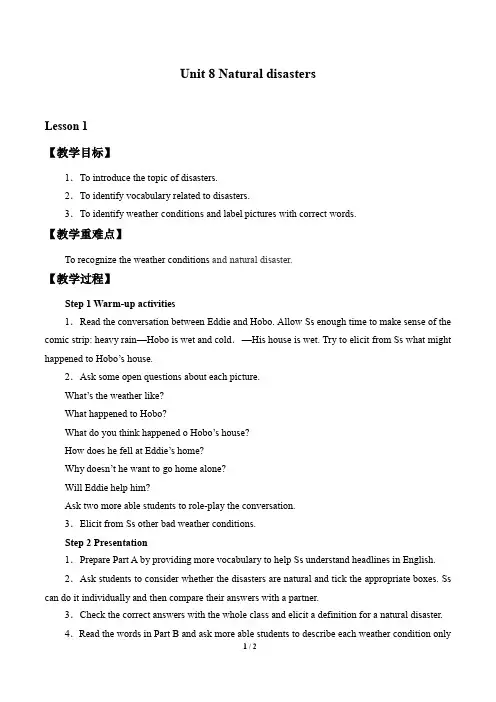
Unit 8 Natural disastersLesson 1【教学目标】1.To introduce the topic of disasters.2.To identify vocabulary related to disasters.3.To identify weather conditions and label pictures with correct words.【教学重难点】To recognize the weather conditions and natural disaster.【教学过程】Step 1 Warm-up activities1.Read the conversation between Eddie and Hobo. Allow Ss enough time to make sense of the comic strip: heavy rain—Hobo is wet and cold.—His house is wet. Try to elicit from Ss what might happened to Hobo’s house.2.Ask some open questions about each picture.What’s the weather like?What happened to Hobo?What do you think happened o Hobo’s house?How does he fell at Eddie’s home?Why doesn’t he want to go home alone?Will Eddie help him?Ask two more able students to role-play the conversation.3.Elicit from Ss other bad weather conditions.Step 2 Presentation1.Prepare Part A by providing more vocabulary to help Ss understand headlines in English.2.Ask students to consider whether the disasters are natural and tick the appropriate boxes. Ss can do it individually and then compare their answers with a partner.3.Check the correct answers with the whole class and elicit a definition for a natural disaster.4.Read the words in Part B and ask more able students to describe each weather condition only1 / 2with simple phrases and words.5.Ask Ss to complete the task on their own and check the correct answers with the class as a whole.Step 3 Language pointsNatural disasters, really warm, for too long, mop it up, lose the game, kill thousands of people, a car accident, crash into a tree, wash the village away, start a big fireStep 4 Homework:1.Learn the language points by heart.2.Preview the Reading Part.2 / 2。
最新牛津译林版中学八年级英语上册 Unit 8 Natural disasters Period 3 Reading Ⅱ教案
Unit 8 Natural disasters (Reading Ⅱ)教学目标:1 .To revise what they learned about the earthquake and help the students to understand the passa ge better .2.To read the passage again and help them to highlight the importantlanguage points and sentence patterns.3.To teach the students to learn to protect themselves when they arein danger教学重点:1.Highlight the important language points and sentence patterns2.Make an interview教学难点:Get the students tohave the first impressions of Past Continuous Tense 教学程序:预习作业:Do some exercises预习交流:Ⅰ.Free talk and ask some questions by using pictures to check if the students get the general meaning of th e reading material.1 What can you see in the picture ?2 What happened ?3 What happened to this building ?4 What kind of sound can you hear ?5 How do you know that there is go ing to be an earthquake ? How will you feel atthe verybeginning ?6 If this building is shaking now , what will you do ? Will you be afraid /befrightened ?Are you going to scream ? Are you going to run/jump ?You should calm down and think what the best way to escape is , so that you can stay alive .7 Suppose you are in danger , that means th ere are lots of bricks around you , you can’t move your body , you’re trapped . What are you going to do ?8 If you have a packet of chocolate , you’re hungry ,are you going to eat it ? Why or why not ?Ⅱ.Check out the prepared work.1.Check the answers in groups2.The teacher presents some important phrases3.Read and learn the phrases by heart.交流展示:Ⅰ.Finish Part B1, make further understanding of key words.Ⅱ. ReadingGet the students to read the article and make lists of words and phrases used in the text that describe noise and movement /destruction ,fear and hopeSuch as : noise : big noise ,thunder , screamed , real noise , bombs ,shoutedmovement : slight shaking, earth started to shake, run wildly , pieces of glass bricks fell down, walls began to come down .fear : screamed, frightened, dark, a moment of fearhope: stay alive, a packet of chocolate, shouts from excited peopleⅢ.ExplainingDeal with the problems the students may have.1. do some shopping 购物such as : do some 洗衣服do some 打扫卫生do some 阅读2 feel a slight shaking 感到一阵轻微的震动。
最新牛津译林版中学八年级英语上册 Unit 8 Natural disasters Reading 1教案
Unit 8 Natural disastersTeachingaims 1. To guess general meanings from keywords and context 2. To skim text for overall meanings and scan for detailsTeaching focus 1.To va lue students ’ ability of reading2.To educate students to be careful with disasters like fire .Difficult points To develop the ability to infer the general meaning from title and context.Teaching methodbased approach-Task Teaching proceduresThe seco nd preparing lessonsStep1.Revision1) Introduction:We learnt something about natura l disaster last time. What disaster have we learnt? 2) Students discuss in p airs. Step2.Presentation.Use students ’ answer to discuss an earthquake. For example:Where does it usually happen?How do people feel when it happens?Step3.Read the passage about “The Taiwan Earthquake ” pay attention to the following questions:When the earthquake happened, What was I doing? Why did people scream? Did the writer survive? Stpe4.Presentation.1) Read the passage themselves. 2) Repeat after the tape.3) Have diff iculties to explain. be trapped=be in trouble 陷入困 at first=at the begi nning 在开始a loud noise like thund er 像雷声一样的声音 in fear 恐惧be frightened 害怕in all directions 四面八方 run wildly 拼命地跑try one ’s best to do sth=do one ’s best to do sth 尽力做某事 pieces of glass 玻璃片 calm down 冷静下来 be over,结束 say to oneself 自言自语课 题 Reading 1总第 课时 备课时间 上课时间课 时Period 2 教 具A recordershout for help喊救命in a great hur ry急匆匆move away搬look at each other in fear恐惧地对看着do some shopping买东西 stay alive活着 go through my mind闪过头脑Sentences: I was doing my homework when it started.I didn’t know if anyone was around me.I didn’t know where I was.Some people screamed because they were very frightened.People were runn ing wildly while pieces of glass and brickswere falling down.They didn’t know where to go.Some people ran out of the shopping centre.I thought somebody could hear me but no one came for a longtime.I was trying to find my way out when I suddenly heared somenoise above me.Step5.Consolidation.1).Read the passage again.2).Give students some key words, and ask them to retell the story if time permitted.Step6.Home work:Teachingnotes。
新译林版八年级上册英语 Unit 8 课时3 教案(教学设计)
Unit 8 Natural DisastersReadingⅡBy the end of the lesson, students should be able to:1. use the important words and phrases correctly;2. get further understanding of the text;3. know how to protect themselves when a natural disaster happens;4. describe the experience in a natural disaster.I. Teaching contents1. New words and phrases: slight, shake, loud, bomb, fear, direction, while, brick,shaking, silent, if, nervous, heart, beat, trapped, mind,calm, since, still, alive, dark, shout, daylight, safe, asleep,after, a loud noise like thunder, start to shake, in fear, runin all directions, come down, not … at all, beat fast, betrapped, say to oneself, pull myself slowly through, calmdown, find one’s way out, hear shouts from excitedpeople, move away the bricks, at last.2. New structures: I was sleeping when the earthquake started.People were running in all directions while pieces of glass andbricks were falling down.I felt nervous and my heart was beating fast.As I was trying to find my way out, I suddenly heard some noise above me.II. Focus of the lesson and predicted area of difficulty1. Use the important words and phrases correctly and fluently;2. Describe the experience in an earthquake;3. Know what to do during a natural disaster.III. Teaching proceduresStep 1 Lead-inWatch a short video about an earthquake.T: Remember the first three adjectives the man used in the video? Yes, “sudden”, “unexpected” and “terrified”. The word “sudden” means “happening or done quickly and unexpectedly”. If something is “unexpected”, it surprises you because you don’t think it will happen. And “terrified” means “very frightened, very afraid, feeling fear”. We are so lucky that we have never been in an earthquake personally, but our friend Timmy happened to be in the 1999 Taiwan earthquake.Step 2 Presentation1. Revise three key words—brick, glass, bombT: And we have already heard about his story. And I think you know these three pictures very well.2. Describe the earthquakeT: I have three tasks for you to complete behind each picture. You can group yourselves into three groups and choose one to do.(1) Group Brick: say something about the earthquake according to the key words andphrases. After that think about this question: Why are people afraid?… happened at … At first, there was … like … Soon … the earth … and people … Outside … glass and bricks … Then the walls … Finally, …(2) Group Bomb: Make up a dialogue between you and Timmy.Ask about what he saw and heard during the earthquake. Try to ask as many questions as you can. And after that think about this question: What do earthquakes bring us? You can use the following questions for the dialogue and you can think up more.Where were you when the earthquake started?Did you shout for help?Could you see anybody around you?(3) Group Glass: Describe Timmy’s feelingsFind out how Timmy felt during the earthquake and describe the changes of his feelings.If you were Timmy, do you know how to show your feelings while telling others the story? You can use the following words to help you in describing the changes of feelings.First …, then …, next …, afterwards …, finally …Step 3 Language points1. fear(1) Explain the word and its usageT: Earthquakes are terrible and often cause problems. So we are afraid of themand that means we feel fear. When people are feeling fear, they may look likethis. And most of us will scream in fear during an earthquake and we know amoment of fear went thr ough Timmy’s mind. Everyone may have/feel fear,but nobody wants to live in fear. (每个人都会感到恐惧,但是没有人希望生活在恐惧中。
八年级英语上册 Unit 8 Natural disasters Revision教案
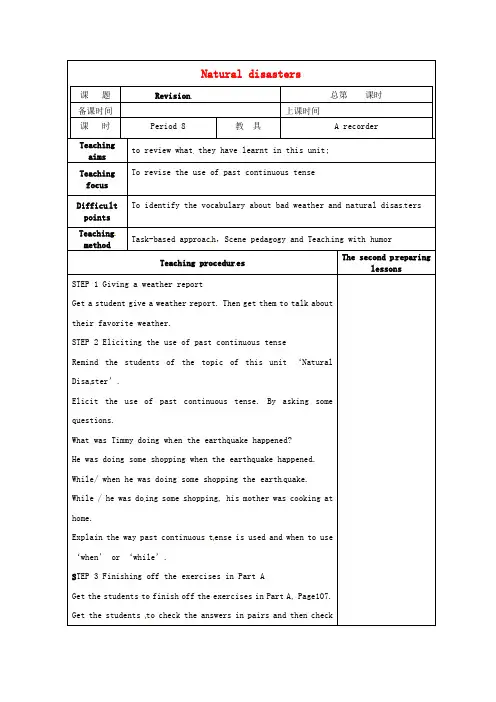
Teaching procedur es
The second p reparing lessons
STEP 1 Giving a weather report
Get a student give a weather report. Then get them to talk about their favorite weather.
Natural disasters
课题
sion
总第课时
备课时间
上课时间
课时
Period 8
教具
A recorder
Teaching aims
to review what they have learnt in this unit;
Teaching focus
To revise the use of past continuous tense
What was Timmy doing wh en the earthquake happened?
He was doing some shopping when the earthquake happened.
While/ when he was doing some shopping the earth quake.
Difficu lt points
To identify the vocabulary about bad weather and natural disas ters
Teaching method
Task-based approac h,Scene pedagogy and Teach ing with humor
STEP 2 Eliciting the use of past continuous tense
牛津译林版英语八年级上册:Unit 8 Natural disasters. 教案7
Unit 8 Natural disastersLesson 7【教学目标】1.To learn to organize ideas for writing an article for the school newsletter.2.To write an article about natural disasters.【教学重难点】1.To learn to organize ideas for writing an article for the school newsletter.2.To write an article about natural disasters.【教学过程】Step 1 Lead-in1.Explain the context. Sandy wants to write an article about a natural disaster for the school newsletter. She wants to write about the snowstorm that hit Beijing this week. Let’s help her, OK?2.Show some pictures about the snowstorm. Talk about them with the whole class and encourage students to make some sentences according to these pictures and key words provided beside each picture.Step 2 Writing structure1.Ask students to think about how we can organize these ideas to describe the snowstorm. Tell them planning ahead carefully is very important to create a powerful piece of writing. We can make flow charts to help organize our ideas before we start writing.2.Point out when we want to write an article, first of all, we should choose a topic, and we should decide what to write about. This time we are going to write about a snowstorm. There should be three main parts in such an article: Introduction, during the snowstorm, and after the snowstorm.3.Students talk about what should be written about in each part in groups.4.Show them some questions and say these questions can help them organize their ideas.5.Do a pair work. Ask students to read through the questions in Part B carefully and try to find out the answers in Part A.They should finish two tasks. Task 1, ask and answer these questions orally with their partner. For example, A: When and where did the snowstorm happen? B: It hit Beijing on Friday, 28thJanuary.Task 2, write the correct letters in the boxes to complete the flow chart.Then invite some pairs to ask and answer these questions in front of the class.6.Say we have helped Sandy complete her flow chart. Now let’s help her complete her article for the school newsletter. Ask students to complete Part C.7.Analyze the structure of this article with the whole class. Ask them to match the four paragraphs with the three main parts of this article.Then make a conclusion: Para 1 is the introduction of the snowstorm. Para2 and 3 describe what happened during the snowstorm. And Para 4 describes what happened after the snowstorm.Step 3 Practice1.Say we have helped Sandy complete an article about a snowstorm. Ask students to write an article about a natural disaster by themselves2.Show some pictures about different natural disasters. Ask students to choose any one they would like to write about.3.Ask some individuals to show his/her flow chart and talk about it with the whole class.4.Students complete their articles.Step 4 Homework1.Collect all the useful phrases in this unit.2.Go over the new words in this unit3.Finish the relative exercises.。
译林版八年级英语上册Unit 8 Natural disaster 第2课时 Reading(1)教案
译林版八年级英语上册Unit 8 Natural disaster教案第2课时Reading(1)一、教学目标1、能听懂并掌握有关地震发生过程前后的词汇。
2、培养学生根据关键词和语境猜测大意的能力。
3、能够根据关键词复述课文。
二、教学重点学会扫渎和精读的方法。
三、教学难点能够根据关键词复述课文。
四、教学过程(一)Lead-in(师)1.T:We’ve learnt something about natural disasters and accidents. Do you remember the names of any different kinds of disasters?Let students revise the names of the disasters.2.Lead in.T: Now I’m going to show you a video.Can you tell me what kind of disaster it is ?The teacher plays video and lead in.(生)Answer the questions about the disasters and revise them.(二)Presentation(Pre-reading)(师)1.Teachers show the pictures about the earthquake andpresent the new wordsand phrases :In the early morning,feel a slight shake, start to shake, scream in fear, run out of the building, run in all direction, falldown, feel nervous, a moment of fear, shout for help, move away2. Let students do Part B1.(生)1.Learn the new words and phrases.2. Do Part B1.(三)While Reading(师)1.Lead in.T:There was an earthquake in Taiwan in 1999. Thousandsof people lost their lives in the earthquake.A boy called Timmy survived . Let’s listen to the story to see what happened to him.2. Play the tape and let students do Part B3.3.Play the tape again and letStudents answer questions.Paragraph 1(1) What was Timmy doing when the earthquake started?(2)What did he feel at first?Paragraph 2(3)What was the real noise like?(4)What did Timmy try to do?(5)What happened to the buildings?Paragraph 3(6)Where was Timmy when the shaking ended?(7)How did Timmy feel?(生)1. Do Part B3.2.Answer the questions.(四)Post reading(师)1.Let students read the story after the tape, then read together.2.Let students do Part B2.3. Let them retell the story according the pictures.4. Let students do Part B4.(生)1. Read the story after the tape, then read together.2. Do Part B2.3. Retell the story according the pictures.4. Do Part B4.(五)HomeworkTell the students to read the story more and complete other exercises.五、教学反思。
江苏省丹阳市后巷实验中学八年级英语上册《Unit8NaturaldisastersComicstripandWelcometotheUnit》教案(新
1 Comic strip and Welcome to the unit Teaching aims: (1) Learn the common names of natural disasters. (2) Learn to tell the difference between a natural disaster and an accident. (3)Learn to cherish life and love the nature. Teaching difficulties (1) Learn the common names of natural disasters. (2) Learn to tell the difference between a natural disaster and an accident. Teaching procedures: Step 1 Free talk What festival is it today? Merry Christmas, boys and girls. What’s the weather like today? Step 2 Task 1---Watch and answer 1.Watch the video and answer the question: How is the weather in their dialogue? 2.Check the answer.( It’s rainy. / It’s raining.) Step 3 Task 2--- Read and answer 1.Read the dialogue by themselves and answer more questions: (1)What was Hobo doing when it started to rain? (2)Did Hobo hear the rain? (3)What did Hobo want Eddie to do? 2.Ask the students to read the dialogue after the tape. Step 4 Task 3--- Work in pairs 1.Read the dialogue in roles. 2.Act out the dialogue. Step 5 Task 4--- Complete the passage. Ask the students to fill in the blanks. Step 6 Presentation Show some pictures to learn some words about natural disasters: thunder and lightning, storm, flood, wash away villages, earthquake, snowstorm, typhoon, sandstorm, thousands of. Step 7 Task 5--- Tell the difference between natural disasters and accidents. 1.Finish Part A on Page 93. 2.Check the answer. Step 8 Task 6--- Listen and read 1.Listen to the tape and fill in the blanks. 2.Read the conversation after the teacher. Step 9 Task 7--- Group work 1.Ask the students to make a new dialogue with their partner. 2
【K12教育学习资料】八年级英语上册 Unit 8 Natural disasters Task教案
教学设计详案
二次备课内容
Step1. Show learning aims.(1')
Step2.. Guide students to get con nected information from the notes.
(2).What did Sandy share with Millie?
(3).Did the snow snow heavily?
(4)After the storm, what were people doing?
2.Sandy is writing an article for the school newsletter. Help her complete her article using the notes in Part A.(5′
Show Guide One
1.Sandy wants to write about the snowstor m that hit Beijing this we ek. Readher notes below and answer the following questions. (3′
(1).What was Sandy doing when Mr Wu came in?
Step3. Guide students to understand the article and know how to write an article about a natural disaster.
Show Guide Two
1.Readthe article aloud and understand it.(5′