
小学六年级英语常考句型大全
第 1 页 共 15 页 学英语主要句型汇总 I 询问姓名、年龄:name,How old 1. ----What’s your name? ----你叫什么名字? ----My name is ________. ----我叫……。 2. ----What’s his name? ----他的名字是什么? ----His name is Mike. ----他的名字是麦克。 3. ----What’s her name? ----她的名字是什么? ----Her name is Chen Jie.----她的名字是陈婕。 4. ----How old are you? ----你几岁了? ----I’m 12. ----我十二岁。 5. ----How old is he/she? ----他/她几岁了? ----He/She is 23. ----他/她23岁。
II 询问颜色:colour 1. ----What colour is it? ----它是什么颜色的? ----It’s yellow and white. ----黄白相间。 2. ----What colour are they? ----它们是什么颜色的? ----They’re green. ----绿色的。
III 询问时间或日期:When 1. ----What time is it now? 第 2 页 共 15 页
----现在几点钟? ----It’s nine o’clock.. It’s time for English class. ----九点。该上英语课了。 (----It’s eight o’clock. It’s time to go to bed.) (----八点。该上床睡觉了。) 2. ----What day is it today? ----今天星期几? ----It’s Monday. ----星期一。 ----What do we have on Mondays? ----我们星期一上哪些课? ----We have Chinese, English, math … ----语文、英语、数学…… 3. ----When is your birthday? ----你的生日是什么时候? ----It’s October 1st, our National Day. ----十月一日.国庆节。 4. ----When do you do morning exercises? ----你们什么时候做早锻炼? ----I usually do morning exercises at 8:30. ----我们通常8:30做早锻炼。
第 3 页 共 15 页
IV 询问方位或地方:Where 1. ----Where is my toy car? ----我的玩具汽车在哪儿? ----It’s here, under the chair. ----在这儿.在椅子下面。 2. ----Where is the canteen? ----餐厅在哪儿? ----It’s on the first floor. ----在一楼。 3. ----Where are the keys? ----钥匙在哪儿? ----They’re in the door. ----在门上。 4. ----Excuse me. Where is the library, please? ----对不起.请问图书馆在哪儿? ----It’s near the post office. ----在邮局附近。 5. ----Where are you from? ----你从哪儿来? ----I’m from China. ----我从中国来。 6. ----Where does the rain come from? ----雨是 第 4 页 共 15 页
从哪儿来的? ----It comes from the clouds. ----它是从云层里来的。
V 询问数量或价钱:How many , How much 1. ----How many kites can you see? ----你可以看见几只风筝? ----I can see 12. ----我可以看见十二只风筝。 2. ----How many crayons do you have? ----你有多少支彩笔? ----I have 16. ----我有十六支。 3. ----How many people are there in your family? ----你家有几口人? ----Three. ----三人。 4. ----How much is this dress? ----这条连衣裙多少钱? ----It’s ninety-nine yuan. ----九十九元。 5. ----How much are these apples? ----这些苹 第 5 页 共 15 页
果多少钱? ----They’re thirty-five yuan. ----三十五元。
XVI “How”问句:How tall, How heavy, How long 1. ----How tall are you? ----你有多高? ----I’m 160 cm tall. I’m taller than you. ----我有160公分。我比你高。 2. ----How heavy are you? ----你有多重? ----I’m 48 kg. You’re heavier than me. ----我有48公斤。你比我重。 3. ----How do you go to school? ----你怎么上学? ----Usually I go to school on foot. Sometimes I go by bike. ---我通常步行上学。有时候骑自行车。 4. ----How can I get to Zhongshan Park? ----我怎么到中山公园去? ----You can go by the No. 15 bus. ----你可以乘坐15路公汽。 (----Go straight for five minutes. Then turn left. It’s on 第 6 页 共 15 页
the left.) ----直走五分钟。然后左转。公园就在左边。 5. How long 有多长?
VIII询问身体状况或情绪:feel, matter 1. ----How do you feel? ----你感觉如何? ----I feel sick. ----我觉得不舒服。 ----How does Chen Jie feel? ----陈洁感觉如何? ----She’s tired. ----她很疲倦。 2. ----What’s the matter? ----怎么了? ----My throat is sore. / I have a sore throat. ----我的喉咙疼。 3. ----How are you, Sarah? You look so happy. ----你好吗.莎拉?你看起来这么伤心。 ----I failed the math test. ----我的数学考试没有通过。
VI 询问想吃的东西:would like 第 7 页 共 15 页
1. ----What would you like for breakfast / lunch / dinner ? ----你早餐/中餐/晚餐想吃点什么? ----I’d like some bread and milk / rice and soup. ----我想吃面包和牛奶/米饭和汤。 2. ----What’s for breakfast / lunch / dinner? ----早餐/中餐/晚餐吃什么? ----Hamburgers and orange juice. ----汉堡包和橙汁。
VII 询问天气状况:weather 1. ----What’s the weather like in Beijing? ----北京的天气如何? ----It’s rainy today. How about New York? ----今天是雨天。纽约呢? ----It’s sunny and hot. ----今天是晴天.天气很热。
IX 询问职业、身份或人物:Who , What 1. ----What’s your father / mother? ----你的父亲 / 母亲是做什么的? ----He’s a doctor. / She’s a teacher. ----他是一名医生。/ 她是一名教师。 第 8 页 共 15 页
2. ----What does you mother / father do? ----你的母亲 / 父亲是做什么的? ----She’s a TV reporter. / He’s a teacher. He teaches English. ----她是一名电视台记者。/他是一名教师。他教英语。 3. ----Who’s that man / woman? ----那位男士 / 女士是谁? ----He’s my father. / She’s my mother. ----他是我父亲。 / 她是我母亲。 4, ----Who’s this boy / girl? ----那个男孩儿 / 女孩儿是谁? ----He’s my brother. / She’s my sister. ----他是我兄弟。 / 她是我姐妹。 5. ----Who’s your art teacher? ----你们的美术老师是谁? ----Miss Wang. ----王老师。 ----What’s she like? ----她长什么样儿? ----She’s young and thin. ----她很年轻、苗条。
X 询问兴趣、喜好:favourite
小学英语毕业复习PEP六年级下英语重点句型分析

六年级下重点句型Unit 11. That’s the tallest dinosaur in this hall. 那是这个厅里最高的恐龙。
2. It’s taller than both of us together. 它比我俩加起来还高。
3. How tall are you? 你有多高?4. I’m 1.65 metres. 我身高1.65米。
5. What size are your shoes, Mike? 迈克,你穿多大号的鞋?6. Your feet are bigger than mine. My shoes are size 37.你的脚比我的大。
我穿37号的鞋。
7. How heavy are you? 你体重多少?8. I’m 48 kilograms. 我体重48公斤。
Unit 21. How was your weekend? 你周末过得怎么样?2. It was good, thank you. 很好,谢谢。
3. What did you do? 你(周末)干什么了?4. I stayed at home with your grandma. 我和你奶奶待在家里。
We drank tea in the afternoon and watched TV. 我们喝了下午茶,还看了电视。
5. Did you do anything else? 你还做了其他什么事吗?6. Yes, I cleaned my room and washed my room. 是的,我打扫了房间,还洗了衣服。
7. I want to buy the new film magazine. 我想买期新的电影杂志。
8. What did you o last weekend? Did you see a film?你上周末干什么了?你看电影了吗?9. No, I had a cold. I stayed at home all weekend and slept.没有,我感冒了。
全国通用六年级下册英语小学英语常用的62个英语句型

小学英语(yīnɡ yǔ)常用的62个英语(yīnɡ yǔ)句型句型(jù xínɡ)1:There+be +主语+地点(dìdiǎn)状语/ 时间(shíjiān)状语There’s a boat in the river.河里有条船。
句型2:What’s wrong with+sb. / sth. ?What’s wrong with your watch?你的手表有什么毛病?句型3:How do you like...?How do you like China?你觉得中国怎么样?句型4:What do you like about...?What do you like about China?你喜欢中国的什么?句型(jù xínɡ)5:had better(not)+动词(dòngcí)原形You’d better ask that policeman over there.你最好(zuì hǎo)去问问那边的那个警察。
句型(jù xínɡ)6:How+adj. / adv. +主语(zhǔyǔ)+谓语!What a/ an+adj. +n. +主语+谓语!How cold it is today !今天多冷啊!What a fine picture it is!多美的一幅图画呀!句型7:Thank+sb. +for(doing)sth.Thank you for coming to see me.感谢你来看我。
句型8:So+be/ 情态动词/ 助动词+主语He is a student. So am I.他是一个学生,我也是。
句型(jù xínɡ)9:... not ... until ...He didn’t have supper until his parents came back. 直到他的父母回来(huí lái)他才吃饭。
小学英语常用句子【三篇】

【导语】海阔凭你跃,天⾼任你飞。
愿你信⼼满满,尽展聪明才智;妙笔⽣花,谱下锦绣第⼏篇。
学习的敌⼈是⾃⼰的知⾜,要使⾃⼰学⼀点东西,必需从不⾃满开始。
以下是为⼤家整理的《⼩学英语常⽤句⼦【三篇】》供您查阅。
【第⼀篇】句型1:There+be +主语+地点状语/ 时间状语There’s a boat in the river. 河⾥有条船。
句型2:What’s wrong with+sb. / sth. ?What’s wrong with your watch?你的⼿表有什么⽑病?句型3:How do you like...?How do you like China?你觉得中国怎么样?句型4:What do you like about...?What do you like about China?你喜欢中国的什么?句型5:had better(not)+动词原形You’d better ask that policeman over there. 你去问问那边的那个警察。
句型6:How+adj. / adv. +主语+谓语!What a/ an+adj. +n. +主语+谓语!How cold it is today !今天多冷啊!What a fine picture it is!多美的⼀幅图画呀!句型7:Thank+sb. +for(doing)sth.Thank you for coming to see me. 感谢你来看我。
句型8:So+be/ 情态动词/ 助动词+主语He is a student. So am I. 他是⼀个学⽣,我也是。
【第⼆篇】句型9:... not ... until ...He didn’t have supper until his parents came back. 直到他的⽗母回来他才吃饭。
句型10:⽐较级+and+⽐较级The baby cried harder and harder. 那孩⼦哭得越来越厉害。
新编广州版小学英语六年级上册重点短语和重点句型
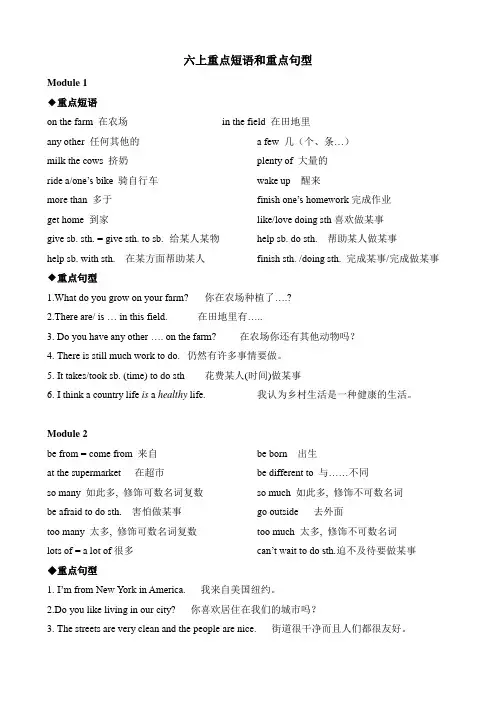
六上重点短语和重点句型Module 1◆重点短语on the farm 在农场in the field 在田地里any other 任何其他的 a few 几(个、条…)milk the cows 挤奶plenty of 大量的ride a/one’s bike 骑自行车wake up 醒来more than 多于finish one’s homewor k完成作业get home 到家like/love doing sth喜欢做某事give sb. sth. = give sth. to sb. 给某人某物help sb. do sth. 帮助某人做某事help sb. with sth. 在某方面帮助某人finish sth. /doing sth. 完成某事/完成做某事◆重点句型1.What do you grow on your farm? 你在农场种植了….?2.There are/ is … in this field. 在田地里有…..3. Do you have any other …. on the farm? 在农场你还有其他动物吗?4. There is still much work to do. 仍然有许多事情要做。
5. It takes/took sb. (time) to do sth 花费某人(时间)做某事6. I think a country life is a healthy life. 我认为乡村生活是一种健康的生活。
Module 2be from = come from 来自be born 出生at the supermarket 在超市be different to 与……不同so many 如此多, 修饰可数名词复数so much 如此多, 修饰不可数名词be afraid to do sth. 害怕做某事go outside 去外面too many 太多, 修饰可数名词复数too much 太多, 修饰不可数名词lots of = a lot of很多can’t wait to do sth.迫不及待要做某事◆重点句型1. I’m from New York in America. 我来自美国纽约。
小学六年级英语一般将来时四个句型

一、肯定句——主语+ be +going to do主语+will dobe动词包括:am,are,is例. I am going to play football tomorrow. 我明天将要踢足球。
I will play football tomorrow.=I plan to play football tomorrow.He is going to watch TV tomorrow morning. 他明天早上打算看电视。
He will watch TV tomorrow morning.=He plans to watch TVtomorrow morning.She is going to visit her teacher next week. 她下周要去探望她老师。
She will visit her teacher next week.=She plans to visit her teacher next week.练习:1.他今晚计划读书。
二、否定句——主语+be +not +going to do主语+will +not +do例.I am not going to play football tomorrow.I will not going to play football tomorrow.He is not going to watch TV tomorrow morning.He will not watch TV tomorrow morning.练习:三、一般疑问句——Be +主语+going to doWill +主语+do提示:一般疑问句就是把肯定句中的be和will放在句首例.Are you going to play football tomorrow?Will you play football tomorrow?Is he going to watch TV tomorrow morning?Will he watch TV tomorrow morning?Is she going to visit her teacher next week?Will she visit her teacher next week?练习:四、特殊疑问句——疑问词+be +主语+going to do疑问词+will +主语+do疑问词包括:what,when,how,where,why提示:特殊疑问句=疑问词+一般疑问句——先确定用哪个疑问词例.What are you going to do tomorrow? What will you do tomorrow?When are you going to watch TV? When will you watch TV?Where are you going tomorrow? Where will you go tomorrow?Why is she going to visit her teacher? Why will she visit her teacher?。
小学英语三至六年级重点句型
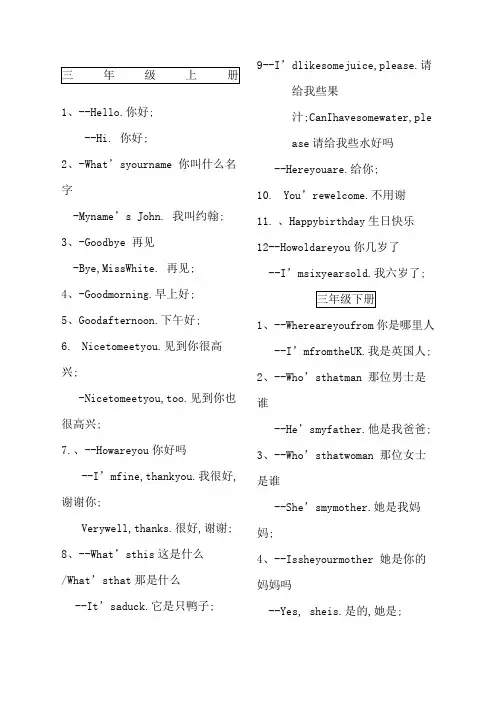
1、--Hello.你好;--Hi. 你好;2、-What’syourname 你叫什么名字-Myname’s John. 我叫约翰; 3、-Goodbye 再见-Bye,MissWhite. 再见;4、-Goodmorning.早上好;5、Goodafternoon.下午好;6. Nicetomeetyou.见到你很高兴;-Nicetomeetyou,too.见到你也很高兴;7.、--Howareyou你好吗--I’mfine,thankyou.我很好,谢谢你;Verywell,thanks.很好,谢谢;8、--What’sthis这是什么/What’sthat那是什么--It’saduck.它是只鸭子;9--I’dlikesomejuice,please.请给我些果汁;CanIhavesomewater,please请给我些水好吗--Hereyouare.给你;10. You’rewelcome.不用谢11.、Happybirthday生日快乐12--Howoldareyou你几岁了--I’msixyearsold.我六岁了;1、--Whereareyoufrom你是哪里人--I’mfromtheUK.我是英国人;2、--Who’sthatman 那位男士是谁--He’smyfather.他是我爸爸;3、--Who’sthatwoman 那位女士是谁--She’smymother.她是我妈妈;4、--Issheyourmother 她是你的妈妈吗--Yes, sheis.是的,她是;5、--Isheyourfather 他是你的爸爸吗--No, heisn’t. 不,他不是;6、--Whereismypencilbox 我的铅笔盒在哪里--It’sinyourdesk.在你桌子里;、--Isitinyourbag 在你的包里吗--No,itisn’t. / Yes, itis. 不,不在;/是的,在;7. --Doyoulikeoranges 你喜欢橙子吗--No, Idon’t. /Yes, Ido. 不,我不喜欢;/是的,我喜欢;8、--Howmanykitesdoyousee你看见了多少个风筝呀--I see 12 我看见了12个;9、--Howmanycrayonsdoyouhave 你有多少支蜡笔--I have 16. 我有16支;1、--Whereisit 它在哪里--It’snearthewindow.就在窗户旁边.2、--What’sinyourbag 你书包里有什么--AnEnglishbook,a maths book,threestorybooksand….一本英语书,一半数学书,三本故事书和;;;3、--Whatcolourisit 它是什么颜色的--It’sblueandwhite.它是蓝白色的;4、--What’shisname 他的名字是什么--HisnameisZhangPeng.他的名字是张鹏;5、--Issheinthelivingroom 她在客厅里吗--No,sheisn’t.不,她不在;6、--Wherearethekeys 钥匙在哪儿--Aretheyonthetable 它们在桌子上吗--No, theyaren’t.They’reinthedoor.不,不在;它们在门上;7、What’sfordinner 晚餐吃什么8、--Whatwouldyoulike 你想吃什么--I’dlikesomesoupandbread, please. I’dlike =Iwouldlike我想要汤和面包;9、--Isthisyouruncle 这是你叔叔吗--Yes,itis. 是的;10、--What’syouraunt’sjob 你婶婶做什么工作--She’sanurse;她是名护士;1、--Where’stheteachers’office 教师办公室在哪里--It’sonthesecondfloor.它在二楼;2、--Isthistheteachers’office 这是教师办公室吗--No,itisn’t.不,不是;3、--Doyouhavealibrary 你们学校有图书馆吗-- Yes,wedo.是的,有;4、--Whattimeisit 几点了--It’s 6 o’clock.It’stimefordinner.六点了;5、--CanIgooutsidenow 现在我能出去吗--It’scoldoutside.外面冷;--Yes,youcan./No,youcan’t 可以;/不行;6、--What’stheweatherlikeinNewYo rk 纽约天气怎么样--It’srainy.是下雨天;--Isitcold 天冷吗--No,itisn’t不,不冷7、--Arethesecarrots 这些是胡萝卜吗--Yes,theyare.是的;8、--Whatarethese 这些是什么--They’retomatoes.他们是西红柿;9、--Whatarethose 那些是什么--They’rehorses.他们是马; 10、--Aretheyhens 它们是母鸡吗--No,theyaren’t.不,不是;--They’reducks.不,不是;它们是鸭子;11、--Aretheseyours 这双鞋是你的吗--No,theyaren’t不,不是;--They’reChenJie’s.它们是陈杰的;12、--IsthisJohn’s 这是约翰的吗--No,itisn’t. It’sMike’s不是;它是迈克的13、--Whosecoatisthis 这是谁的外套--It’smine.它是我的;14、--Whosepantsarethose 那条裤子是谁的--Theyareyourfather’s它们是你爸爸的.15、--CanIhelpyou 我能为您做点什么--Yes.Theseshoesarenice.是的,这双鞋不错;16、--Howdoyoulikethisskirt 这条短裙你觉得怎么样--It’sverypretty.它很漂亮17、--How much is this skirt 这条短裙多少钱--It’s$89. 它是89美元;1、--Is he young 他年轻吗--No, he isn’t. 不,他不年轻;2、--What’s she like 她什么样--She’s kind. 她很和蔼;3、--What do you have on Thursday 星期四你有什么课4、--I have maths, English and music. 我有数学、英语和音乐课;4、--what would you like to eat 你想吃什么--A sandwich, please. 请给我一个三明治;5、--What would you like to drink 你想喝什么--I’d like some water. 我想喝点水;6、--what’s your favourite food 你最喜欢吃什么食物--Noodles. 面条;7、--What can you do for the party你们能为联欢会做什么--I can sing English songs;我会唱英文歌;8、--Can you do any kung fu你会武术吗--Yes,I can. 是的,我会武术;9、--Is there a river in the forest 森林里有河吗--No,there isn’t. 不,森林里没有河;10、--Are there any tall buildings in the nature park自然公园里有高楼吗--No,there aren’t. 不,自然公园里没有高楼;1、---Whatdoyoudoontheweekend 你周末做什么---IoftenwatchTV. 我经常看电视;2、---Whichseasondoyoulikebest,Mi ke 迈克,你最喜欢哪个季节---Winter. 冬天;3、---Why doyoulike summer 为什么你喜欢夏天- --BecauseIlikesummervacation 因为我喜欢暑假4、---Whenistheparty 聚会什么时候举行---It’sinApril. 在四月;5、---WhenisAprilFool’sDay 愚人节是哪天---It’sonApril1st. 它在4月1日;6、---Whenisyourbirthday 你的生日是哪天---MybirthdayisonApril4th.我的生日是4月4日;7、---Ishedrinkingwater 它在喝水吗--No,heisn’t. He’seating.不是;它在吃东西;8、---Whataretheydoing 它们在干什么---They’re eatinglunch 它们在吃午饭1、--Whereisthemuseumshop 博物馆商店在哪里--It’snearthedoor.在大门附近;2、--Howcanwegetthere 我们怎么到哪儿--Turnleftatthebookstore.到书店左转;3、--Howdoyoucometoschool 你怎么来学校的--Usually, Icomeonfoot.通常我走路来;4、--Whatareyougoingtodotomorrow 你明天打算做什么--I’mgoingtohaveanartlesson.我要上美术课;5、--WhatarePeter’shobbies 彼得有什么爱好--Helikesreadingstories.他喜欢读故事;6、--DoesheliveinSydney 他住在悉尼吗--No, hedoesn’t,不,他没有;--Yes, hedoes.是的.7、--Whatdoeshedo他是做什么的--He’sabusinessman.他是商人;8、--Wheredoeshework 他在哪儿工作--Heworksatsea.他在海上工作;9、--Howdoeshegotowork 他怎么上班--Hegoestoworkbybike.他骑自行车上班;1、---Howtallareyou 你有多高---I’mmetres. 我身高米; 2、---Howheavyareyou 你体重多少---I’m48kilograms. 我体重48公斤;3、---Howwasyourweekend 你周末过得怎么样---Itwasgood,thankyou. 很好,谢谢;4、---Whatdidyoudo 你周末干什么了---Istayedathome我待在家里;5、---DidyougotoTurpan 你们去吐鲁番了吗---Yes,wedid. 是的,去了;6、---Howdidyougothere 你们怎么去的---Wewenttherebyplane. 我们坐飞机去的;。
小学六年级英语写作必备句型
以下是为⼤家整理的关于⼩学六年级英语写作必备句型的⽂章,供⼤家学习参考! 1. It must be pointed out that it is one of our basic State policies to control population growth while raising the quality of the population. 2. It is (has been) estimated that the worlds population could reach 6 billion by the end of the century. 3. It must be kept in mind that there is no secret of success but hard work. 4. It can be seen from this that there is no difficulty in the world we can overcome. 5. As is known man is the product of labor. 6. It is a common saying that man who has a settled purpose will surely succeed. 7. It is clear that the enemy has no desire for peace. 8. It is hard to imagine how Edison managed to work twenty hours each day. 9. Its hard to say whether the plan is practicable. 10. There is no doubt that others will help you if you have any difficulties. 11. It seems certain that they have made a series of experiments. 12. It is said that bats have been using radar for millions of years. 13. To tell the truth, many mistakes we made could have been avoided. 14. As we know, it was not until recently that the problem was solved. 15. It must be admitted that you havent done what you promised to do. 16. In my opinion, this computer is different from that one you saw. 17. It is certain that we have a long way to go. 18. All this shows that nothing can prevent us from reaching our aims. 19. As far as we know, it took him more than a year to write the book. 20. It has been proved that every substance, no matter what it is, is made up of atoms. 21. It has been decided that we are going to build a railway whose base must be completed within his year. 22. It is obvious (evident) that the success of the innovation depends on our concerted efforts. 23. To be frank, whether you like it or not, you have no other choice. 24. It is natural that one may have trouble expressing complicated ideas in simple English. 25. What is more important, the agreement they have negotiated is being carried out. 26. We will be successful as long as we persevere. 27. Frankly speaking, what you call the truth may not apply to things happening here. 28. It is true that we must redouble our efforts; otherwise we cannot catch up with the developed countries. 29. I take it for granted that they will support this idea. 30. In a certain sense, a successful scientist is a person who is never satisfied with what he has achieved. 31. The oceans do not so much divide the world as unite it. 32. There is no denying the fact that the new management method has greatly increased the production. 33. There is no denying the fact that the new management method has greatly increased the production. 34. Upon hearing the unexpected news, he was so surprised that he couldnt utter a word. 35. As the saying goes, nothing in the world is difficult for one who sets his mind to it. 36. Our goal must be attained. Our goal can unquestionably be attained. 37. Noting can prevent us from realizing the four modernizations. 38. Now in China, more and more families can afford to buy high-grade goods, such as washing machines, TV sets, video orders. 39. No matter how difficult English may be, you should do your best to learn it. 40. It can be said that without knowledge of science and technology, it is impossible to build socialist modernizations. 作⽂常⽤句型 (⼀)段⾸句 1. 关于……⼈们有不同的观点。
人教版PEP小学英语六年级上册重点句型及语法知识汇总
人教版PEP小学英语六年级上册重点句型及语法知识汇总Unit 1 How can I get there?重点单词XXX。
post office邮局,XXX。
XXX。
XXX。
crossing十字路口。
turn left左转。
turn right右转。
gostraight直走。
map地图。
compass指南针。
GPS全球定位系统。
stars星星。
XXX意大利餐厅。
getto到达。
重点句型1.---Where is the restaurant?餐厅在哪里?It’s next to the park on Dong fang Street.它在东方路,在公园附近。
2.---How can we get there?我们怎么去哪里?XXX left XXX.书店左转,然后病院右转。
3.He now has GPS.他现在有GPS。
4.What an interesting film!何等风趣的片子!方位词复:XXX紧挨着,near在。
邻近,XXX在。
背面,XXX在。
旁边,in front of在。
前面。
Unit 2 Ways to go to school重点单词on foot走路。
by bike骑车。
by bus乘公交。
by train乘火车。
XXX乘地铁。
by ship搭船。
by XXX乘飞机。
slow down 慢下来。
XXX交通灯。
traffic rules交通划定规矩。
go/come to school上学。
by sled坐雪橇。
byferry坐轮渡。
pay n to留意。
traffic lights交通灯。
and wait at a red light红灯停等一等。
slow downand。
at a yellow light黄灯减速并停下。
Go XXX。
重点句型1.---How do you come to school?你怎么上学?----Usually。
I come on foot.通常我走路来的。
PEP小学六年级英语there-be-句型讲解与练习
A. some, not
B. some, any
C. any, not
D. any, no
11〕There ____a desk and fifty-five chairs in
the classroom.
A. are
B. is
12〕There ___ fifty-five chairs and a desk in the
4〕There __A___ some students in the classroom. A. are B. is
5〕There __A___ a pencil, a book and two pens on the
table.
A.is
B. are
6〕There __B_ two apples, one orange and one banana
15〕There _____ a pencil-case and many pencils in Tom’s schoolbag. A. is B. are C. have D. be
16〕 There _____ a doll in the toy box.
A. is
B. are
17〕There _____ some bread on the plate.
3〕There were a lot of rain here last month. (was )
4〕Is there any chairs in the room?
( Are )
5〕Are there some clouds in the sky? ( any )
按要求改写句子
1〕There are a few parks nearby. (改写为否认句) .
小学六年级下册英语句型.doc
小学六年级下册英语句型一、一般陈述句1、b e结构(is ,am ,are)的一般陈述句:主语+谓语(be)+宾语例子:I am a student.You are a boy.He (She, It) is smart.2、由动词构成的一般陈述句:主语+谓语(动词:时态)例子:I often swim in the lake.(一般现在式)I am swimming in the lake now.(现在进行式)I swam in the lake yesterday. (过去式)I will swim in the lake tomorrow. I am going to swim in the lake next week.(将来式)He swims in the lake.(一般现在式)He is swimming in the lake now.(现在进行式)He swam in the lake yesterday. (过去式)He will swim in the lake tomorrow. He is going to swim in the lake next week. (将来式)3、由there be构成的一般陈述句:there+be例子:There is a man in the room.There are many students in the room.二、否定句1、由be结构(is ,am ,are)的一般否定句:主语+谓语(be)+not+宾语I am not a student.You are not(aren't) a boy.He (She, It) is not(isn't) smart.2、由动词构成的否定句:主语+谓语的否定式(动词:时态)I don't often swim in the lake.(一般现在式)I am not swimming in the lake now.(现在进行式)I didn't swim in the lake yesterday. (过去式)I will not swim in the lake tomorrow. (将来式)I am not going to swim in the lake next week.He doesn't swim in the lake.(一般现在式)He is not swimming in the lake now.(现在进彳亍式)He didn't swim in the lake yesterday. (过去式)He will not swim in the lake tomorrow. (将来式)He is not going to swim in the lake next week.3、由there be构成的一般否定句:there+be+notThere is not(isn't) a man in the room.There are not(aren't) many students in the room.三、一般疑问句1、b e 结构(is ,am ,are)I am a student. Are you a student? Yes, I am. No, I am not.You are a boy. Are you a boy? Yes, I am. No, I am not.He (She, It) is smart. Is he (she, it) smart? Yes, he (she, it) is. No, he (she, it) isn't.2、动词I often swim in the lake. Do you often swim in the lake? Yes, I do. No. I don't.I am swimming in the lake now.Are you swimming in the lake now. Yes, I am. No, I am not.I swam in the lake yesterday.Did you swim in the lake yesterday? Yes, I did. No. I didn't.I will swim in the lake tomorrow.Will you swim in the lake tomorrow? Yes, I will. No, I won't.I am going to swim in the lake next week.Are you going to swim in the lake next week? Yes, I am. No, I am not..He swims in the lake. Dose he swim in the lake. Yes, he dose. No, he doesn't.He is swimming in the lake now.Is he swimming in the lake now? Yes, he is. No, he isn't.He swam in the lake yesterday.Did he swim in the lake yesterday? Yes, he did. No. he didn'tHe will swim in the lake tomorrow.Will he swim in the lake tomorrow? Yes, he will. No, he won't.He is going to swim in the lake next week.Is he going to swim in the lake next week? Yes, he is. No, he isn't..3、there be 结构There is a man in the room.Is there a man in the room? Yes, there is. No, there isn't.There are many students in the room.Are there many students in the room? Yes, there are. No, there aren't.四、特殊疑I可句(what、who、whose、which、when、where、how、why等特殊疑问词开头的疑问句)。