
新目标英语八年级下Unit1导学案
Unit 1 Will people have robots ?学案Section A Period One课时目标导航知识目标:robot, won’t=will not, they’ll=they will, everything, paper, use, less, fewer, pollution, tree, in people’s homes, be free, live to be, in 100 years,more/less pollution,free time 句型:1.陈述句There will be more pollution.Kids will study at home computers.2.一般疑问句Will there be less pollution? Y es, there will./ No, there won’t.3.否定句Kids won’t go to school.能力目标:1.能掌握will引导的一般将来时肯定与否定形式对将来发生的事情进行预测,并准确表达。
记住:will /won’t+动词原型2.正确区别fewer& less的用法,less修饰不可数名词,fewer修饰可数名词。
必做题一.英汉互译:1.机器人()2.每件事物()3.纸()4.树()5.污染()6.活到。
()7.be free( ) 8.in 100 years ( ) 9.in people’s homes ( ) 二.用所给词的适当形式填空:1. They are trying to do more work with _________ (few) people.2.The water _________ (pollute) here is very serious.3.People will live ________ (be) 200 years old in 100 years.4.I have ________ (many) books than Li Lei.选做题请根据句意,用more/less/fewer填空1.We can use cars ______ and plant _______ trees to fight pollution.2.Kim likes reading, so he spends _______ money on books than the other things.3.If we have robots, we can finish the work with ______ people and _______ time.4.I have _______ apples than you.Y ou should give me some.5.Our city will become more beautiful. I think there will be ______ tall buidings and ______pollution in it.提高题请用括号里所给动词的适当形式填空1.There________ ( be) a sports meeting in our school next week.2.Mary is unhappy because she ___________ (not have) any day off next week.3.The Greens __________ (go) to France two years ago.They ________ (come) back in amonth.4.Maria often ___________ (walk) to school. But she __________ (ride)her bicycle to schoolnext week.5.Tony __________ (wan) to be a boss of a big company in three years. I don’t think his dream_________ (come) true.Section A Period T wo课时目标导航知识目标:buiding, she’ll=she will, be free,in high school,in college,five years ago, in five years 句型:What do you think Sally will be in five years ?I think there will be more tall buidings.理解:作插入语时,意为“你认为”,放在特殊疑问句词后,疑问句的其他部分应用陈述句语序。
能力目标:1.运用上述句型,能够准确表述将要发生的事情2.正确运用一般过去时、一般现在时和一般将来时必做题一.根据句意及首字母或汉语提示完成单词。
1.There will be no money one day. Everything will be f__________ .2.She is writing something on a piece of p__________ .3.One day people will fly to the moon for a v___________ .4.There are two tall ___________ (建筑物) over there .5.She will study in ___________ (大学) in two years.二.单项选择1.What do you think ___________ ?A. Tom like bestB.does Tom like bestC.Tom likes best2.There ______ more people in the future .A. will haveB.will beC.is going to have3.---- ______ will you finish doing the dishes ? ----- In ten minutesA.How longB.How oftenC.How soon4.There will be _______ pollution this year than last year.A.fewerB.muchC.less5.I think people here are friendly. Do you agree ________ me?A.withB.toC. on选做题用所给单词的适当形式填空:1.I won’t ________ (be) free next Monday.2.They are _________ (visit) New Y ork for their vacation.3.Maria __________ (stay) with me this afternoon.4.We all __________ (enjoy) the party last Sunday.5.Look! What _______ they _________ (do) now.提高题根据短文内容和首字母提示,补全文中单词In the year 2050 everyone will have a pocket(袖珍) c ____1___ . The computer will give people the a_____2__ to many problems. We will also have pocket t_______3_ .When we call people, we will be able to see them at the s______4_ time.Maybe a lot of people will l_____5__ and work under the sea. Machines will do most o_____6__ the work, and people will h_____7__ more vacations. They may w_____8__ only two or three a week. They will be able to f_____9__ to the moon and spend their holidays there. How interesting it w_____10__ be!Section B Period Three课时目标导航知识目标:astronaut, rocket, space, space station, fly, took, moon, in an apartment, fly rocket to the moon句型:Where do you live?I live in an apartment.能力目标:1.正确理解上述短语和句型2.能独立完成本节课的听力任务3.能用一般现在时、一般过去时和一般将来时描述个人经历及愿望必做题一.将下列单词归类1.Job(职业):__________________________________________________2.Transportation(交通工具):______________________________________3.Places to live(居住场所):________________________________________二.根据2a&2b的听力材料内容完成下列选择题Conversation1.Where does Joe live ? ( )A.in a house across the streetB.in an apartment across the streetC.in an apartment behind the streetConversation2. Where did Joe live ten years ago? ( )A.In a house in the countryB. In a big house in the cityC. In an apartment in the cityConversation3. Where will Joe live in ten years ? ( )A.On the earthB.On the moonC.On a space station选做题根据句意及首字母提示完成单词1.We will live on a s________ station in the future.2.Nie Haisheng is a great a___________ .3.I’ll fly r_______ to the moon.4.The m________ goes round the earth.5.He will f______ to Shanghai next week.提高题根据提示用一般过去时、一般现在时和将来时写写自己的经历和愿望(For example: I lived…. I live….. I will live…)Section B Period Four课时目标导航知识目标:I’ll=I will, fall, fell, fall in love with, alone, pet, parrot, probably, go skating, suit, be able to, dress, casually, which, even, the World Cup, wrote,keep a pet, win awards,from now句型:This paper says“I’ll be an engineer in ten years.”I think Lin Wei wrote that.I think that Frace will win the next World Cup.能力目标:用will引导的一般将来时,谈论十年以后的生活必做题一.英汉互译1.养只宠物狗()2.爱上()3.单独居住()4.太小( )5.去滑冰()6.next month ( )7.in ten years( ) 8.the next World Cup( )9.from now( ) 10.be able to( )二.根据3a短文回答下列问题1.What will Ming be in ten years ?__________________________________________________________________2.What does Ming think of Shanghai?__________________________________________________________________3.Why can’t Ming have any pets now?__________________________________________________________________4.Where will Ming go on vacation in the future?___________________________________________________________________选做题句型转换,每空一词1.Y ou can see flowers here and there in the park.(改为同义句)Y ou can see flowers ____________ in the park.2.To work out the problem is hard. (改为同义句)It ________ _________ ___________ work out the problem.3.He ‘ll live in Paris.(就划线部分提问)__________ __________ he live?4.lives, his house, big, he, alone, that, in (.) (连词成句)_________________________________________________________________5.It will be sunny tomorrow.(就划线部分提问)________ _________ the weather __________ __________ tomorrow?Section B Period Five (self-check@ reading)课时目标导航知识目标:myself, interview, predict, future, prediction, came, come true, sound, company, thought, fiction, unpleasant, scientist, in the future, howerver,hundred, hundreds of,alread, made, factory, simple,such, bored, everywhere, human, shape, huge,earthquake, snake, look for, possible,,electric, toothbrush, seem, impossible,housework, rating, in 25 to 50 years, over and over again句型:1. For example, it’s easy for a child to wake up and know where he or she is.It +be +adj.+(for sb.)+to do sth.2.For example, there are already robots working in factories.There is/are+sb./sth.+doing sth.3.That may not seem possible now, but computers, space rockets and even electrictoothbrushes seemed impossible a hundred years ago.seem(+to be)+adj./n.好像是,似乎是。
新外研版八年级英语下册导学案Module 2-Experiences(Unit1-Unit3)
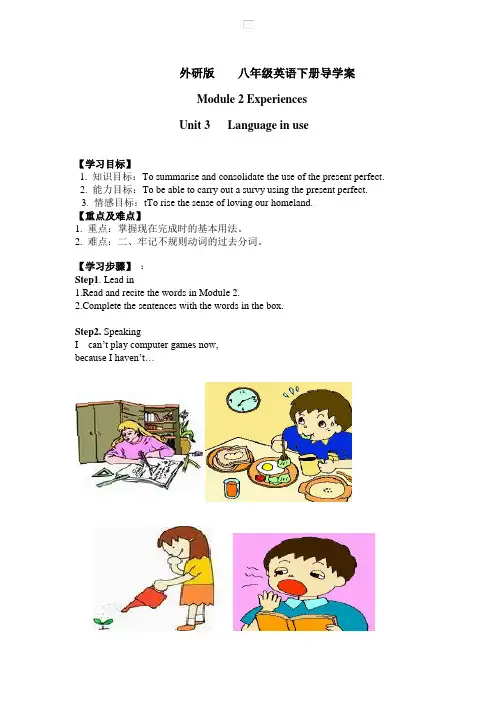
外研版八年级英语下册导学案Module 2 ExperiencesUnit 3 Language in use【学习目标】1. 知识目标:To summarise and consolidate the use of the present perfect.2. 能力目标:To be able to carry out a survy using the present perfect.3. 情感目标:tTo rise the sense of loving our homeland.【重点及难点】1. 重点:掌握现在完成时的基本用法。
2. 难点:二、牢记不规则动词的过去分词。
【学习步骤】:Step1. Lead in1.Read and recite the words in Module2.plete the sentences with the words in the box.Step2. SpeakingI can’t play computer games now,because I haven’t…Step3. Write a questionnaire about your experiences.Have you ever …had a Western meal?lived in another city?entered a singing competition?travelled by train?travelled to the seaside?tried seafood?cooked dinner for your parents?------Yes, I have. / No, I haven’t.Step4 Complete the sentences.1. He/She _____________________ a Western meal.2.He/She ______________________ in another city.3.He/She ______________________ a singing competition.4. He/She _____________________ by train.5.He/She ______________________ the seaside.6.He/She ______________________ seafood.7.He/She ______________________ for his/her parents.Step5. Complete the postcard. Use the list of Things to do in China to help you.Things to do in China!------go to Beijing,see the Beijing Opera,climb the Great Wall,eat Beijing duck,visit the Palace MuseumStep6 Activity4Dear David,I’m having a wonderful time in China. I’ve done so many things!I’ve__________________________________________________________________________________ ___________________________________________________________ There’s only one thing I haven’t don e :I...______________________________________Bye for now,RobStep7. Complete the sentences with the words in the box.afford, competition, pronounce, spell, tower1.I wrote a story for a(n) ___________ in my English class and I won a prize.2.Alice can _______ very well, and what's more, she can write beautifully.3.Some English words are difficult to ____________.4.We visited an ancient palace with a tall_______ and a beautiful garden.5.Mary wants to visit the US, but the plane tickets are very expensive and she cannot ______ to go.Step8.Listen and check (√) the correct answer.Places visitedPeople China Europe USAWinnieDianaBobStep9. Listen again and answer the questions.1. ( ) How many times has Winnie been to the US?A. two timesB. three timesC. four times2. ( ) Where would Diana like to go again?A. the USB. EnglandC. China3. ( ) Which part of China has Diana travelled around?A. NorthB. SouthC. West4. ( ) How did Diana travel there?A. by boatB. by trainC. by plane5. ( ) Has Bob ever visited Germany?A. No, he hasn’tB. Yes, he has【知识结构】(一)、Grammar现在完成时如果你想说“我已经看过某部电影,所以不想看了” “某人曾经做过什么事情”等等,该如何表达呢?首先请看下面的句子:(1)I have seen the f ilm. I don’t want to see it again.(2) Have you ever read a travel brochure?(3) I have never visited the USA.以上句子的谓语动词有一个共同的特点就是“have/has+动词的过去分词”, 用于表示在以前的某个时间曾经做过的、发生的事情,这种行为对目前有某种影响,如(1); 还可以表示到目前为止曾经经历或没经历的事情,如(2)(3)。
人教版八年级英语下册《Unit 1 What’s the matter》导学案1

本文由一线教师精心整理/word 可编辑1 / 1《Unit 1 What ’s the matter 》导学案1课题 Unit 1 What ’s the matter? Section A导学目标: 1. 疾病与事故伤害的询问与应答:What ’s the matter with …? I have a cold. 2. 情态动词 should 询问及陈述建议 3. 健康与急救常识 4.关爱他人重点:健康问题及提出相关建议的语言结构 难点:词汇量多导学过程 导学过程1. 询问某人患了何种疾病或遇到什么麻烦“怎么了?” What ’s the matter? What ’s the matter with you? 还可以有如下替换:What ’s your trouble? What ’s the trouble with you? What ’s your problem? What ’s the problem with you? What ’s up? What ’s wrong with you?2. 疾病,伤害及救治的表达(1)用 “have/get a(n) +疾病名称” 表示患病:have a cold, have a fever, have a cough, get astomachache, get a toothache, catch a cold(2)用 “be/feel + 形容词”表示不适:be/feel tired, be/feel sick, head feels hot(3)用“get ”表示受伤: get hurt , get cut in the hand, get hit by a ball(4)用“hurt /cut/break+具体部位”表示伤害:hurt my leg, cut her finger, break his arm(5)用“hurt /cut 等+反身代词”表示伤着自己:hurt myself , cut himself(6)用“take (更常见 )/get ”表达诊治:take one ’s temperature, take some medicine, take/get anX-ray(picture)(7)用see 或 go to 表达就医:go to the hospital看医生 go to a doctor go to see a doctor go to the doctor ’s see the doctor 看牙医 go to a dentist go to see a dentist go to the dentist ’s see the dentist3. should (should n’t)(1). 委婉地提出意见或建议时,“应该,应当”You should eat lots of healthy food. (你应该多吃些健康的食品) Should I help you clean the park? (我应该帮你打扫公园吗?) What should I do for them? (我应该为他们做些什么?) (2). 表示义务责任,“应该,应当”You should pay for the books. (你应当付书钱) (3). 命令或要求,语气比较强烈。
英语新目标八年级下册unit 1 Will people have robots 课文及导学案
Unit 1 Will people have robots? 课文及导学案SECTION A1a SENTENCES1.People will have robots in their homes.2.People won‟t use money. Everything will be free.3.Books will only be on computers, not on paper.4.Kids won‟t go to school. They‟ll study at home on compute rs.5.There will only be one country.6.People will live to be 200 years old.1c PAIRWORKA: Will people use money in 100 years?B: No, they won‟t. everything will be free. Will people live to be 200 years old?A: Y es, they will.Grammar Focus—Will there be less pollution? —No, there won‟t. There will be more pollution.—Will there be fewer trees? —Y es, there will.—Kids won‟t go to school. Kids will study at home on computers.3aFive years ago, Sally was in high school. She played soccer. She had a cat.Today, Sally is in college. She plays the guitar. She has a dog.In five years, Sally will be a doctor. She will play tennis. She will have a car.SECTION B3aIn ten years, I think I‟ll be a reporter. I‟ll live in Shanghai, because I went to Sh anghai last year and fell in love with it. I think it‟s really a beautiful city. As a reporter, I think I will meet lots of interesting people. I think I‟ll live in an apartment with my best friends, because I don‟t like living alone. I‟ll have pets. I can‟t have any pets now because my mother hates different pets.I might even keep a pet parrot. I‟ll probably go skating and swimming every day. During the week I‟ll look smart and probably will wear a suit. On the weekend, I‟ll be able to dress more casually. I think I‟ll go to Hong Kong on vacation, and one day I might even visit Australia.SELF CHECK2 Predicting the future can be difficult. There are many famous predictions that never came true. Before 1929, there was no sound in movies. The head of one of the biggest movie companies in the United States predicted that no one would want to see actors talk. Of course, he was wrong! In 1977, the head of the largest computer company in the United States said, …“No one will want to have a computer in his or he r home.” He thought that computers would never be used by most people.SECTION 2 While Y ou ReadDo you think you will have your own robot?In some science fiction movies, people in the future have their own robots. These robots are just like humans. They help with the housework and do the most unpleasant jobs.Some scientists believe that there will be such robots in the future. However, they agree it may take hundreds of years. Scientists are now trying to make robots look like people and do the same things as us. Japanese companies have already made robots walk and dance. This kind of robot will also be fun to watch.But robot scientist James White disagrees. He thinks that it will be difficult for a robot to do the same things as a person. For example, it‟s easy for a child to wake up and know where he or she is. Mr. White thinks that robots won‟t be able to do this. But other scientists disagree. They think that robots will be able to talk to people in 25 to 50 years.Robot scientists are not just trying to make robots look like people. For example, there are already robots working in factories. These robots look more like huge arms. They do simple jobs over and over again. People would not like to do such jobs and would get bored. But robots will never get bored.In the future, there will be more robots everywhere, and humans will have less work to do. New robots will have many different shapes. Some will look like humans, and others might look like snakes. After an earthquake, a snake robot could help look for people under buildings. That may not seem possible now, but computers, space rockets and even electric toothbrushes seemed impossible a hundred years ago. W e never know what will happen in the future!语法精讲(一)一般将来时1.主语+am/ is/ are going to +动原do2.主语+助动词will+ do (若主语为第一人称,也可用I/ We + shall do)3.部分动词如:come, go, leave, move, start, arrive, fly等常用进行时结构be+ doing 表示将来;4.表示将要有……, 用:There is/ are going to be +主语+其他;或There will be +主语+其他;E.g.: People will have robots in the future.否:People robots in the future.一般疑问句:people robots in the future?回答:Y es, . / No, .划线提问:people in the future?同义句:People robots in the future.(二)many/ much—more—most 表数量多,可修饰可数名词复数或不可数名词few—fewer—fewest 表数量少,只修饰可数名词复数little—less—least 表数量少,只修饰不可数名词用上述词的适当形式填空:1.They’ll do their work well with money.2.There are / buildings in our city than their city.3.There will be pollution if we plant trees.4.There are too many people here. It’s too crowded.5.I feel better now.6.He’s new here. He has friends, does he?(三)alone: adj./ adv. 表示形体上“单独的,独自地”lonely: adj. 表示精神上“孤独的,寂寞的”1.She is afraid to go out at night.2.It’s hard for him to finish the work .3.She lives and that makes her feel sometimes.(四)except: prep. 除……之外;(不包含…)All the students finished the homework except Nick. (指Nick未完成作业)She goes to work every day except Sunday. (Sunday 除外)(五)It‟s +adj.+ for sb. to do…= 主语+find (think, believe…) it +adj. to do…对某人来说做…太…了E.g.: Maybe these children find it hard to think for themselves when they’re older.= Maybe it’s hard for these children to think for themselves when they’re older.基础夯实一.根据音标和句意拼写单词1.I think r will do housework instead of people.2.Money is important, but money isn’t3.He / / a letter to his brother yesterday.4.He is a worker. He works in a5.Don’t worry about me. I can look after / /.6.He is too young to himself.二、选择填空:1.I saw a boy when I walked along the river.A. swimB. to swimC. swimmingD. swims2.are going home on a train.A. Mr. TurnerB. Mr. Turner’sC. The TurnersD. The turners’3.All the fruit is free. Y ou can eat .A. as many as possibleB. as much as possibleC. as more as possibleD. as many as possibly4.We need time and freedom ourselves after whole day’s work.A. relaxB. relaxesC. relaxingD. to relax5.We find easy to get along with him.A. isB. itC. thisD. that6.Wang Liqin the national team in 1998 and then he a lot of ping pong matches.A. joins; takes part inB. joins; took part inC. joined; takes part inD. joined; took part in7.People use money to buy food, books, bicycles and other things they need.A. a hundred ofB. hundreds ofC. two hundreds ofD. hundred of8.We’ll go for a picnic if it this Sunday.A. don’t rainB. doesn’t rainC. won’t rainD. isn’t raining9.Are you here on business or fun?A. inB. onC. atD. for10.The TV program was very and we all got .A. boring; boredB. bored; boringC. bored; boredD. boring; boring11.To be here at Christmas time is a dream that has .A. be trueB. comes trueC. come trueD. came true12.Please who broke the window.A. findB. look forC. look atD. find out13.I will see you on the moon .A. a dayB. every dayC. one dayD. everyday14.There will a concert in our city.A. haveB. hasC. isD. be15.—Do you like the city life or the country life?—It’s hard to say. In the city it is interesting, but in the country there is pollution.A. less; moreB. more; lessC. more; fewerD. much; much16.My life will be better than it is now.A. a lotB. a lot ofC. a fewD. more17.What will happen to our human 100 years from now?A. 100 years agoB. 100 years before nowC. since 100 years agoD. in 100 years18.This coat doesn’t fit him well, as he has a huge body and the coat is small.A. so; suchB. so; soC. such; suchD. such; so三、用括号内所给词的适当形式填空We can see robots in some places. There are robots 1 (work) in factories. They do simple jobs over and over again. People don’t want 2 (do) such jobs. In some restaurants, we can see robots 3 (say) hello to people or serving dishing. Japanese companies have already made robots (walk) and dance. It’s fun 5 (watch). In the future, there (be) more robots everywhere, and humans will have (little) work to do.四、句型转换1.There is going to be a new building here in 2 years. (同义句)There a new building here 2 years .2.She can sing the song in French. (同义句)She the song in French.3.It took her 500 yuan to buy the ticket. (同义句)She 50 yuan / the ticket.She 50 yuan the ticket.4.My parents will go to Beijing in two years. (对划线部分提问)your parents to Beijing?5.He seems to like this book. (同义句)he likes this book.6.Cities will be big and crowded in the future. (否定句)Cities very big crowded in the future.7.We’ll go out for a walk with you. (同义句)We out for a walk with you.8.The weaher will be sunny tomorrow. (对划线部分提问)the weather tomorrow?五、完成句子1.学习使用计算机对你有好处。
八年级英语下册全册导学案

八年级下学期英语教学工作划任课教师:罗雷一、指导思想以“英语课程标准”为宗旨,适应新课程改革的需要,面向全体学生,提高学生的人文素养,增强实践能力和创新精神。
正确把握英语学科特点,积极倡导合作探究的学习方式。
培养学生积极地情感态度和正确的人生价值观,提高学生综合素质为学生全面发展和终身发展奠定基础。
二、全期教学总目标学生应有较明确的英语学习动机和积极主动的学习态度。
能听懂教师对有关熟悉话题的陈述并能参与讨论。
能读供七至八年级学生阅读的简单读物和报纸杂志,克服生词障碍,理解大意。
能根据阅读目的运用适当的阅读策略。
能与他人合作,解决问题并报告结果,共同完成学习任务。
能在学习中互相帮助,克服困难。
能合理计划和安排学习任务,积极探索适合自己的学习方法。
在学习和日常交际中能注意到中外文化的差异。
三.教材简要分析全书共有十个单元,各单元话题灵活,贴近生活实际。
本册书将学习的一些语法知识点有:一般将来时、过去进行时、现在完成时、间接引语、时间状语从句、条件状语从句、反意疑问句等。
每个单元分A和B两个部分,每个部分都提供了一篇阅读文章,用以训练学生的阅读能力,扩大学生的词汇量和阅读量。
四、学情简要分析我班有29人,通过一年半的英语学习,大多数学生已能听懂有关熟悉话题的语段和简短的故事。
能与教师或同学就熟悉的话题交换信息。
能读懂短篇故事,能写便条和简单的书信。
但由于各种因素的影响,学生发展参差不齐。
有少数学生因为基础不够好,学习很吃力而自暴自弃,这给教学带来不少困难。
五、提高教学质量的可行措施及教改措施一)面向全体学生,注重素质教育。
二)以学生为主体,尊重学生个体差异。
三)采用活动途径,倡导体验与参与。
四)开发课程资源,拓展学用渠道。
具体来说:1.认真专研教材和课标,精心备课,认真上好每一堂课。
确定每堂课的基础内容,预备内容和拓展内容,满足不同层次学生的不同需求。
2.充分利用现有的现代化教学设备,加强直观教学,提高课堂效率。
新外研版八年级英语下册导学案Module 10-On the radio(Unit1-Unit3)

外研版八年级英语下册导学案Module10 On the radioUnit1 I hope that you can join us one day一、学习目标:1.知识目标:(1)掌握下列词汇:director, avoid, background, background, national, international, interview, on air, presenter(2)掌握下列句型及短语:①Thank you for showing us around.②When it’s o n, it means we’re on air.③Come this way.④It gets crazy in here.⑤show sb. around ⑥on air⑦avoid doing sth.⑧make noise ⑨in the backgroun⑩ keep studying2.能力目标:能够听懂和读懂在广播中常用的词汇、短语和句型,并将节目与常用词汇对应起来。
3.情感目标:初步了解新闻传媒,了解媒体人的工作。
二、学习重、难点:1.重点:掌握宾语从句,掌握动词后接(to)+v.或v.ing的形式。
2.难点:掌握动词(to)+v.或v.ing的形式作宾语三、自主学习:1.词汇速记引领,带领(v)________ 避免,防止(v)________背景(n)__________国家的,国内的(adj)______direct(v) → _____(n)导演,主管,经理present(v) → __________(n)主持人2.短语互译be on________ avoid doing sth___________ make noise_____________come this way_____________ over there______________带某人参观______________(广播或电视)播出_________________四、学习过程:Step1. Warming-upFree talk: Do you listen to the radio?Do you like listening to the sports news programme?Do you like listening to the news programme?Do you like listening to music?Which presenter do you like best?Step2.Pre-listening1.Listen and check(√ ) the types of news you hear.culture government sports weather2.Listen again and complete the sentences.(1)Zhang Li reads ______________________________________ on Radio Beijing.(2)The president of Russia will stay in China for________________.(3)The match is between _______________and_________________.Step3.Fast-listeningListen and answer:1.What should we avoid doing in the background?2.Do they collect the latest national and international news in the newsroom?Step4.Careful-listeningListen again and complete the notes.1.When the red light is on,it means______________________________________.2.We collect_____________________________and write reports in the newsroom.3.You should________________________________if you want to be a presenter.4.This is also where we_________________________with the big sports stars.plete the sentences with the words in the box.1.Newspaper and television programmes often have__________with famous people.2.More and more ___________students are coming to China to learn Chinese.3.Every country has its own ________hero—a person who did something very important for the country and its people.4.Try to_______drinking too much tea or coffee, or you will not be able to sleep well.5.Could you speak a l ittle bit louder,please?It is very noisy in the ________________.Step6.Work in pairs.Ask and answer questions about the radio.1.What do you like listening to?2.What do you not like listening to?3.What programme did you listen to the last time you turned on the radio?4.What do you need to do if you want to be a presenter?nguage points.1.show v. 引领,带领【语境领悟】*Thank you for showing us around. 感谢你带领我们参观。
人教新目标英语八年级下册第一单元教案
人教版英语八年级下Unit 1 Will people have robots ?Teaching goals:1. Words&phrases: robot, paper, less, fewer, simple, unpleasant, factory, seem, etc .2. will 构成的一般将来时态的陈述句、否定句、疑问句及回答.3. There be 句型的一般将来时.4. more , less , fewer 的用法.5. 学习一般将来时态的相关知识,学会对未来进行预测.6. 对five years ago ,today ,in five years 简洁回顾与展望的方式,贴近实际符合学生心理,激发学习兴趣.7. 通过时间对比复习一般过去时态、一般现在时态,巩固一般将来时.Important and difficult points :1. will构成一般将来时态的句式。
2. There be 句型的一般将来时态。
3. more , fewer , less 的用法。
4. How to make predictions .Period 1Teaching procedures:Step 1 Leading in1. Greetings: Welcome to school .What’s the date today ? Who’s on duty today ?Do you enjoy your winter holiday ?Do you finish your homework ?Do you want to live on the moon ?Can you guess what will happen in ten years ?Collect the Ss’ answers and say something about their predictions .Step 2 Pre-taskSB Page 2 ,1a .1. Look at the picture :How will the world be different in the future ,100 years from now ?We’re going to talk about sth in 100 years .2. Read each predictions to the class .Explain the new vocabulary .3. Read the instructions .Make sure Ss know what they should do .4. Do it by themselves .5. Talk about the answers with the class .Explain :一般将来时态构成: will / be going to +动词原形There be 句型的将来时态形式 There will be more cars in the futrue•everything ,something,为不定代词,如果在句中做主语,则谓语动词要用单数•修饰形容词则放在形容词前。
2014新版新目标英语 八年级下册教案 Unit 1 What's the matter?Period 3
T: Here are some accidents that some people had. Please match the accidents with the picturesin 1a.
Ask students to learn new words and phrases by asking and answering.
Step 3 Self Check 2
Show the questions and answers in Self Check 2 on the screen, say: These are theirquestionsand answers, but the order isn’t right. Please put them in order to make a conversation.
虎门外语学校教师备课笔记活页文本
2013—2014学年第二学期第____周星期____第____节总第课时
备课组:初二科目:英语主备教师:叶拓
单元课题
Unit1Plf Check
课时安排
1
备课札记
教学目标
(知识与能力、过程与方法、情感态度与价值观)
(1)Function:①Learn to talk about different accidents and health problems.
Step 6 Practice
First, have students read the conversation between the nurse and the teacher in 1d and tell them:“What happened?”is another way of saying“What’s the matter?”Then, have them make up new conversations in pairs by using the information in 1b and1c. The teacher walks around and gives them some help if they need.
新外研版八年级英语下册导学案Module 1(Unit 1~Unit 3)
外研版 八年级英语下册导学案Module 1 Feelings and impressionsUnit 1 It smells delicious.【学习目标】1. 知识目标:能够正确运用表示感觉和知觉的系动词,并且识记本单元的单词、重点短语: Smell, soft, sour, lovely, try, have a try, sound, salt,favourite 等等。
2. 能力目标:能够听懂本单元中表示感觉和知觉的系动词(sound, smell, look,taste, feel)表述的内容并能与图片匹配。
3. 情感目标:通过学习表达对事物的感觉能够更好地理解别人,从而更懂得关爱别人。
【重点及难点】1. 重点:掌握句子的系表结构:linking verb+adj. (系动词+形容词)。
2. 难点:运用表示感觉和知觉的系动词表达对事物的感觉。
【学习步骤】 :一、 课前预习【自主学习】I 、完成下列关于五官及其感觉的图示:We use our eyes / noses / hand s / mouths / ears to …Five senses ,, , , eye, lookII.结合课本2页的对话,试着翻译下列词组、重点句子。
1.①②想要做某事2. 在顶部3. 恐怕4. ①②一点儿5. 做完了6. 试试看7. 在中间8. 对甜食的爱好9. 确信10. 草莓酱11. 今天是我的幸运日二、课堂学习过程【合作探究】Step 1. Read the conversation on page 2, and complete the table.food How ... ?looks so nice ,smellstastessmells ,tastestastefeel in the middlesoundcaketastestastesStep 2. Practise speaking like this:E.g. The pizza looks/smells/tastes...【归纳总结】上述句子中的look、smell、taste、feel、sound 叫做,他们与be动词一样也被叫做系动词。
八年级英语导学案Unit1Lesson1 What’s the weather like
Lesson1 What’s the weather like ?学(学习目标)【学习目标】1. 掌握的词汇:rather storm rise (rose \risen) set2. 识别的词汇及短语:thunder sunrise sunset能力目标:能灵活运用所学词汇和句型描述各种天气情感目标:learn to make a weather report教学重点:重点短语和句型What’s the weather like ?It will be …/It is …What’s the temperature?教学难点: to make a weather report测(基础知识)1读课文,勾画出文中的重难点和疑难点,准备与同学共同探讨(1.)a weather report _____________(2.)degrees ________________ (3.)clouds__________ (4.)rather__________ (5.)shower_________ (6 )a thunder storm_________2 Read the text again and find out some useful expressions:on the radio_______________ (2)go down____________(3)come up__________________(4)相当凉爽___________________(5)我不希望如此________________(6)听我说_____________________(7)a good weather reporter_______________ (8)a weather report____________3. Read the text again and find out the meaning of the sentences: (小组展示)Is it going to rain today, Danny?_______________________________There will be some showers this afternoon._______________________________________Tell us what time it will rise and set!(4) It is ten degrees ____________________________(5) I hope not ____________________(6) )I am scared of thunder.________________________教(重难点)单词和词语探究snow课文原句:It’s not snowing. (2)There is some snow on the grass. (3)It will be snowy.思考:snow 有几种词性?______________________________________________Scared 课文原句:I’m scared of thunder!思考:你能写出同义句吗?________________________________________be scared/afraid to do sth 意为“害怕做某事”be scared/afraid that 后接句子rather课文原句:It’s rather cool today, isn’t it? 这是个反义疑问句,由两部分组成,中间用逗号隔开。
新版新目标英语八年级下册what's-the-matter-导学案
(Section A 1a—1c) 预习+展示+反馈(课时1)【学习目标】1、拼读、识记新单词:matter, sore, stomachache, foot, neck, stomach.(重点)2、识记、运用短语:What’s the matter? have a cold, have a stomachache, have a sore throat 3、能通过听力训练完成1b的听力任务。
(难点)课堂流程:【学习流程一】预习交流(课前完成)1、翻译并能正确读出1a中的单词。
2、看图片在1a中为身体的每一部分标上正确的字母。
3、预习测评:(1)分小组朗读1a中的单词。
(2)A: What’s the matter? B: . (选择)A. I have a pen.B. It’s interesting.C. I have a cold.【学习流程二】:展示点评一、预习展示:对学完成1a组内展示答案。
二、新课展示:1、1a:对学、群学朗读图片里的对话。
(分组展示)2、1b: 听录音,给名字标序号。
(对、群学,组内展示)。
1c:模仿1c中的对话两个人一组进行会话表演,力争脱稿。
【学习流程三】:反馈测评一、英汉互译:怎么啦?感冒胃疼put on get myself out of bedsore back have a toothache sore throat二、单项选择:( )1、---?---I have a toothache and I don’t feel like eating anything.A. How are you?B. What can I do for you?C. What’s the matter with you?D. How do you like it?( )2、---I have cold, so I can’t go for a picnic with you.---I’m sorry to hear that.A. aB. anC. theD. /( )3、---The meat is delicious.---Yes, but don’t eat.A. too much; too muchB. much too; too muchC. too much; much tooD. much too; much too( )4、—______?— Nothing serious, but a bit tired.—Better have a rest now, dear.A. Is that allB. Is there anything elseC. What’s thisD. What’s the matter with you( )5、【2013湖北孝感】—_________?—I have a headache and I don’t feel like eating anything.A. How are youB. What can I do for youC. What’s the matter with youD. How do you like it( )6、【2011.云南昆明】27. —What’s the matter with Tina?—_______________.A. She is away.B. She is cool.C. She has a sore throat.D. She should take some medicine(Section A 2a—2d) 预习+展示+反馈(课时2)【学习目标】1、正确拼读单词:fever, lie, rest, cough, X-ray, toothache, headache, break, hurt(重点)2、识记、运用短语:lie down; take one’s temperature; have a fever; take breaks(take a break).3、能运用学过的知识给别人做出疾病应对办法。