
2020春五年级英语下册Unit4Seeingthedoctor教案(新版)牛津译林版
Unit4See the doctor 一、单元分析: 本单元话题是看病,教学重点是表示建议的情态动词should和否定式shouldn’t的用法。有关询问和描述病情的句型What’s wrong with you?和I have a headache/…也是本单元的另一个重点教学内容。 二、单元目标: 1.会听说读写词组:brush one’s teeth, drink water, eat sweets,have a rest ,take medicine 2.学会疑问句型“What’s the matter with you?”和“What should I do”,以及对它们的答语。 3.了解并掌握情态动词的用法。 4.读准字母组合ch的发音。 三、教学重点: 1. 能理解Story time的内容,并会复述。 2.会使用如下两个句型,并能在日常对话中使用: What’s wrong with you? I have… What should I do? You should. 3.掌握情态动词的用法。 4.掌握字母ch组合的发音。 四、教学难点: 1.会复述Story time的内容。 2.会自如shiy9ong如下两个句型,并能在日常对话中使用。 What’s wrong with you? I have… What should I do? You should. 3.了解并掌握情态动词的用法。 4.单词medicine temperature的发音。 五、课时划分: 课时安排:共六课时 第一课时:Story time 第二课时:Grammar time & Fun time 第三课时:Cartoon time & Culture time 第四课时:Sound time, Checkout time & Ticking time 第五、六课时:单元复习和课时练及默写 六、教学准备: 课件、磁带、录音机等。
第1课时 一、教学目标: 基础知识 1.能正确理解,掌握对话内容,并能朗读,表演对话。 2.能正确听说读写词组:see the doctor, have a rest,take some medicine,drink some warm water 3.初步掌握句型 what’s wrong with you ? I have. 基本技能 1.在生活中能正确运用本课的重点句型 2.培养学生听说读写能力和交际能力。 综合素质 通过情景的设置和对话表演,激发学生在生活中乐于使用英语的兴趣。 二、教学重难点: 1.能正确理解,掌握对话内容,并能朗读,表演对话。 2.掌握词组:see the doctor,have a rest, take some medicine, drink some warm water和句型What’s wrong with you? I have…What should I do? You should. 3.培养学生听说能力和交际能力。 三、教学准备: 课件、磁带、录音机。
教学设计(主备) 复备 Step1 Warming up T:1.Where do you live? 2.How do you come to school? 3.How do you get to school? Step2 Presentation 1.T:YL wants to visit SH’s home.But SH is ill. She wants to see the doctor.教师板书课题。 2.教师出示挂图,让学生用中文描述一下图片信息。 3.学生自由度课文,并找出新单词,试着根据音标拼读。 4.教师领读,学生跟读,注意语音语调的模仿。 5.学生分角色朗读课文。 6.教师出示表格,学生观看课文动画。 Name What’s wrong with her? should 7.四人一小组讨论并完成表格,教师检查并完成板书。 Name What’s wrong with her? should have a rest at home take some medicine drink some warm water 8.教师根据表格情况,模仿复述课文。 9.学生根据表格情况,复述课文,教师给予评价。 10.教师讲表格中的内容擦去,男女生根据表格上的部分信息进行角色扮演复述课文。 Step 3 Consolidate the knowledge 随堂小练习 1.汉译英 就医 休息一会 二 根据中文提示完成句子 1.You should (服药) 2.You should (喝一些水) Step 4 Summary 本节课我们学习了就医用语:What’s wrong with you ?以及答语;我们还学习了以should引导的建议用语,希望学生课后能够用合适的句型互相操练巩固新句型。 Step5 Homework 1.词组抄写三遍,默写一遍 2.复述课文 板书设计 Unit 4 Seeing the doctor a headache a fever have… take… drink… 教后记:
第2课时 一、教学目标: 基础知识 1.会听说读写新单词:medicine, sweet, anything,新词组brush one’s teeth,eat sweets. 2.学会由should引导的否定句:Sb. Shouldn’t do sth. 3.继续复习巩固询问病情句型和建议句型:What’s wrong with you? I have got… What should I do? You should… 基本技能 1.能够自由的运用本单元的重点句型交流。 2.学会用句型给别人建议。 综合素质 训练学生的语言技能,培养学生的阅读理解能力。
二、教学重难点: 1.两个重点句型的熟练运用。 2.掌握medicine的发音。 3.掌握并运用should引导的否定句的构成。 三、教学准备: 课件、磁带、录音机等。 教学设计(主备) 复备 Step 1 Warming-up T:1.What’s wrong with SH? 2.What should she do? Step2 Presentation 1.T:What’s wrong with Mike?What should he do? 2.教师出示挂图,让学生用中文描述一下图片信息。 3.学生自由读课文,并找出新单词,试着根据音标拼读。 4.教师领读,学生跟读,注意语音语调的模仿。 5.学生分角色朗读课文。 6.教师出示表格,学生观看课文动画。
Name What’s wrong with her? should
7.四人一小组讨论并完成表格,教师检查并完成板书。 Name What’s wrong with her? should have a rest at home take some medicine drink some warm water
8.教师根据表格情况,模仿复述课文。 9.学生根据表格情况,复述课文,教师给予评价。 10.教师讲表格中的内容擦去,男女生根据表格上的部分信息进行角色扮演复述课文。 11.教师出示Fun time的内容,同桌两人利用教材提供的句型互相问答。 例如图片一:What’s wrong with you? I have a cough. What should I do,doctor? You should take some medicine and drink some water.You shouldn’t eat ice creams 12.学生交流答案,教师评价 Step3 Consolidate the new knowledge 教材练习 1.P38 Ask and answer What’s wrong with Su Hai?… What should she do?… What’s wrong with Mike?… Why does he have a toothache?… What should he do?… 2.P38 Think and answer 1. I have a and a . I should at home. I should and too. 2. I have a I cannot I should not I should in the morning and before bedtime. 随堂小练习 一.汉译英 1去看牙医 2吃太多的糖果 二.根据中文提示完成句子。 1.You should not (吃太多的糖果) 2.You should (刷牙) Step 4Summary 本节课我们学习了就医用语:What’s wrong with…?及其答语,我们还学了以should not 引导的否定句,希望学生课后用合适的句型互相操练巩固新句型。 Step5 Homework 1.词组抄写三遍,默写一遍 2.复述课文 板书设计: Unit4 Seeing the doctor
Shouldn’t eat too many sweets A toothache doctor: brush your teeth in the morning
Should and before bedtime
第3课时 一、教学目标:
基础知识 1.能正确理解本单元的语法点。 2.能够掌握字母组合 “ch”的发音,并能在各题型中灵活运用。 3.让学生掌握华氏温度和摄氏温度的知识。 基本技能 1.能够正确灵活使用本单元的语法点。 2.培养学生听、说能力和交际能力。 综合素质 1.让学生体验学习,参与课堂,合作交流的乐趣。 2.通过情景的设置,激发学生在生活中使用英语的乐趣。
五年级下册英语教案-Unit4 Seeing the doctor Story time |译林版(三起)
英语(五年级下册)Unit 4 Seeing the doctorStory timeTeaching contents 教学内容Story timeTeaching aims and learning objectives 教学目标1. 能听懂、会读、会说check, dentist, anything, bedtime, brush one’s teeth, drink water, eat sweets, have a rest, take medicine, fever, headache, toothache。
2. 能听懂、会读、会说日常用语What’s wrong with…?、… have/has a …、What should … do?、You/he/ she should …。
3. 能正确地理解并朗读对话内容,在教师的引导和帮助下尝试复述课文内容。
4. 能初步运用本课所学的词汇和日常用语询问病情,给不同的病症提出建议。
Focus of the lesson and predicted area of difficulty 教学重点和难点教学重点:能正确地理解并朗读对话内容,在教师的引导和帮助下复述课文内容。
教学难点:能初步用句型What’s wrong with…?、… have/has a…、What should …do?、You/he/ she should …询问病情,给不同的病症提出建议。
Teaching procedures 教学过程Step 1 Greeting & Warm-up1. Sing a song: Body song(播放歌曲二遍)2. BrainstormingT: This song is about the parts of our body. Do you still remember them? Look at the picture and review the parts of our body. (教师任意点图片中的身体器官,学生依次回答)S1/S2/S3: head, ear, hand, foot …【设计意图:通过琅琅上口的歌谣,不仅活跃课堂气氛,同时温故知新,复习之前学过的身体部位名称。
牛津译林版五年级英语下册Unit 4 Seeing the doctor--身体部位-课件
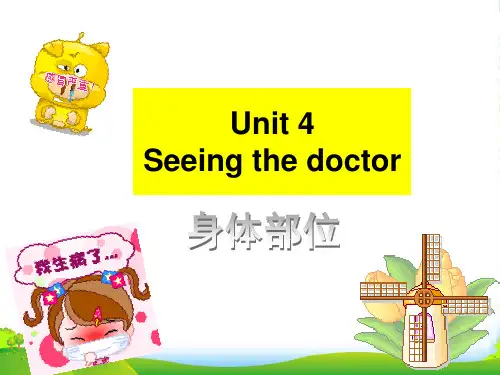
My ear hurts.
(× )
4.
Lynn wants to go to school. ( × )
5.
I feel good.
(∨ )
Practice:
Act out the story. 表演故事
• 12、首先是教师品格的陶冶,行为的教育,然后才是专门知识和技能的训练。 • 13、在教师手里操着幼年人的命运,便操着民族和人类的命运。2022/5/52022/5/5May 5, 2022 • 14、孩子在快乐的时候,他学习任何东西都比较容易。 15、人自身有一种力量,用许多方式按照本人意愿控制和影响这种力量,一旦他这样做,就会影响到对他的教育和对他发生作用的环境。
Question: What does the doctor tell Lynn?
No! I fell good now.
Question:
What happens(发生) suddenly(突然) in the picture? Why do you think(认为) Lynn feels better(好多了)?
Uny
knee
toe foot
hand
hair
finger
mouth
head
nose
eye ear face shoulder
stomach
leg
arm
Story: Lynn sees a doctor
Mum, I don’t feel good. I’m sick.
Bye!
Thank you, Dr. Liu. Good-bye.
Let’s talk:
Is Lynn sick?
Read the story. Tick or cross.读故事,判断正(∨)误(×)。
小学英语牛津译林苏教版五年级下册(新版)Unit4 Seeing the doctor第一课时优质课课件
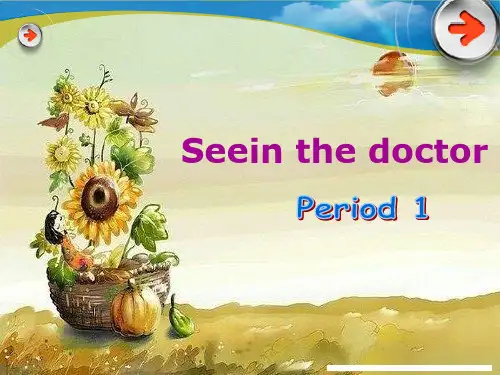
根据提示同桌讨 论补全对话吧。
Yes.
Mr:What’s wrong with Su Hai? Liu:She has a ... Mr:Why does ... have a ...? Liu:... Mr:What should ...do? Liu:...
Mr:What about Mike? What's wrong ...? Liu:He...
Mr:Why...?
Mr:What should...?
Liu:...
Liu:...
根据提示找好朋友讨论, 越多建议得越多分哦~~
Let's say more
Suggestion(建议): drink hot water not eat too much meat take medicine
Doctor:What’s wrong with...?
Step 4 Perຫໍສະໝຸດ ormmacea.Let's read with the tape in a whole.
跟录音一起读, 看谁的语速、语音、语调最准哦。
b.Let's act.
Step 5 Practice and Consolidation
Hi, Liu Tao. Su Hai and Mike aren;t at school today. Do you know why?
Let's repeat. Let's read in 2.
check
Step 3 learn part 2
Read in your groups. Circle somethe more new words. Discuss answers.
最新译林牛津版小学英语五年级下册Unit4 Seeing the doctor说课稿
Good morning, my dear judges!It’s my great pleasure to be here sharing my lesson with you.My lesson is about ‘Seeing the doctor’. By the study of this lesson, the students can learn the knowledge about how to describe physical condition in English and how to deal with their physical problems.I divide my lesson into 5 parts: teaching material, teaching objectives, key points and difficult points, teaching methods and teaching process.First, teaching material. The text is the story time of Unit4 in Oxford English 5B.According to the teaching material, I put forward the following teaching objectives:1.Knowledge objective. a. The students can hear, read and use the words aboutthe name of illness, such as headache, toothache, and the phrases about brush one’s teeth, drink water, eat sweets, have a rest and take medicine.b. Students can use proper structures to ask and answer the others’ health. ---What’s wrong with you?---I have …… (a headache / a toothache)---What should I do?---You should / shouldn’t …… ( have a rest / take some medicine) 2.Ability objective. The students can talk about their health condition inEnglish and use proper phrases and structures of this lesson to express their thoughts so that their communicative ability can be improved.3.Emotion ability. Put the moral education in the language study and guidestudents to protect their health and know the importance of health and arouse the students’ interest in English study.Next, I will talk about the key points and difficult points of this lesson.The key points and difficult points is to describe physical conditions and the way how to deal with health problems in English.In order to achieve the teaching objectives, I will make use of Audio-visual teaching method, Communicative teaching method, Task-based teaching method and the Situational teaching method so that the students can obtain the knowledge actively by probe study and cooperative study.Now I will focus on my teaching process.In order to realize the teaching process systematically , properly and efficiently. I divide the teaching process into 6 steps.Step1. Warming up1.Sing and enjoy a song called ‘Head and shoulders, knees and toes’. (singing a song can make students feel pleased and satisfied, and can arouse the students’exciting motion. Meanwhile singing a song can arouse the students’performance desire, participation desire and lead the students into a thick English studying atmosphere. What’s more, the lyrics can make students remind the words about the body parts.)2. Create a real situationI will arrange the class into the location of a hospital. I will act as a doctor. The students act as the patients.( the real situation can lead students to a real language atmosphere and cater to understanding the English words and phrases.)Step2. Presentation and Practice1.Free talkT: When we are ill, where are we going?S: Hospital.T: Who will help us in hospital ?S: Doctor, nurse.T: If you have a toothache. Who would you go to see in hospital?S: Dentist.(a free talk can lead to this lesson naturally, it also can remind students to review the knowledge they learned before)2. Present the new words1)Show some picturesI will show some pictures about the different performance of illness, such as headache , toothache. I also will show some phrases’pictures , such as brush one’s teeth, drink water, eat sweets, have a rest and take medicine on PPT. Then I write the words and phrases on the blackboard and teach students to read the words and phrases again and again so that the students can read the words and phrases correctly and fluently.3. Present the sentence patternsShow a picture that someone has a headache, and then have a talk.T: What's wrong with him?T: He has a headache.T: What should he do?T: He should take medicine. He shouldn't work too late.write the sentence patterns on the blackboard---What’s wrong with you?---I have …… (a headache / a toothache)---What should I do?---You should / shouldn’t …… ( have arest / take some medicine)Then show another picture about someone has a toothache, and have a talk withstudents.T: What's wrong with him?S: He has a toothache.T: What should he do?S: He shouldn't eat sweets. He should brush his teeth4. Do some drillsI will give students some pictures about different people in different illness. And then ask students have a talk with their partner by using the new phrases and sentence patterns we learned.(In this step, the students can be more familiar with the words phrases and sentence patterns.)Step3. Present the dialogue1.Listen to the dialogue and answer the questions.1)Who have a headache?2)Who does Mike go to see?2.Read the dialogue and do exercise T/F1)SuHai has a fever. (T)2)SuHai should drink some cold water. (F)3)Mike has a toothache because he eats too many sweets. (T)4)Mike should brush his teeth only in the morning. (F)5) 3. Act out the dialogue in pairsI will ask some pairs act out the dialogue according to some related pictures. (In this step, students can be more familiar with the text.)Step4. Consolidation and Extension1. Do a guessing gameAsk students take a peace of paper that write some phrase in a box.. And one act it out before all the classmates, the other guess what phrases did he or she pick.(The game can avoid the lifelessness and boredom from pure mechanical drills. It creates the conditions of a relaxed and natural atmosphere for children drills.)2. Watch a videoLet students watch a video about health of human3.DiscussAfter watching the video and then give students two questions1)What will the influence do if we don’t pay attention to our health?2)How can we protect our health?Ask students talk about these questions in group and choose one to present their group ideal. After that I will have a conclusion.(In this step, I can put the moral education into this lesson.)Step5. Blackboard DesignThis is my blackboard design.Step6. AssignmentAbove is the lecture of my lesson, Thank you!。
Unit4 Seeing the doctor(单元解读)五年级英语下册(译林版三起)
五下Unit 4 Seeing the doctor单元解读一、单元教材分析本单元在英语核心素养的育人价值下进行,围绕单元主题“人与自我”范畴中的“生活与学习”展开教学。
教学重点是表示建议的情态动词should 和否定式shouldn’t 的用法。
有关询问和描述病情的句型What’s wrong with you? 和I have a headache. 也是本单元的另一个重点教学内容。
二、单元教学目标1.会听说读写词组:brush one’s teeth, drink water, eat sweets, have a rest , take medicine2.学会疑问句型“What’s the matter with you?”和“What should I do”,以及对它们的答语。
3.了解并掌握情态动词的用法。
4.读准字母组合ch 的发音。
三、教学重点1. 能理解Story time 的内容,并会复述。
2. 会使用如下两个句型,并能在日常对话中使用:What’s wrong with you? I have ....What should I do? You should.3. 掌握情态动词的用法。
4. 掌握字母ch 组合的发音四、教学难点1.会复述Story time 的内容。
2.会自如使用如下两个句型,并能在日常对话中使用。
What’s wrong with you? I have。
What should I do? You should.3.了解并掌握情态动词的用法。
4. 单词medicine temperature 的发音五、课时安排:(4 课时)第1课时: Story time (text,Ask and answer,Think and write)第2 课时: Grammar time&Fun time第3课时: Cartoon time & Sound time第4 课时: Culture time, Checkout time&Ticking time课时说明:第1课时:Story time:讲述的是苏海感冒去看医生的过程以及迈克去看牙医的过程由此引起新单词feel, check, should和新短语brush one’s teeth, drink water, eat sweets, 以及新句型What’s wrongwith you? I have… / I feel…。
Module 4 Seeing the doctor 教案

Module 4 Seeing the doctorUnit 1 I haven’t done much exercise since I got my computer.【教材分析】Module 4的主要内容为运用现在完成时来描述自己和他人的经历,例如看病经历、运动经历等。
从全书来看,本模块承接上一模块对现在完成时的学习和运用,内容有层次的展开,学生容易接受。
【教学目标】Knowledge objective:1. 词汇: cough, fever, headache, stomachache, toothache, ill, this, since, cold, catch a cold,take sb’s temperature, fast food, health, take2. 现在完成时中for短语和since短语的使用。
Ability objective:能听懂和阅读关于介绍看病经历的语言材料,能通过相关词汇和图片描述自己和他人的看病经历;能编写关于看病的对话。
Moral objective:学会倾听他人的看病经历,理解他人的喜怒哀乐;养成关心、帮助他人的良好品质。
【教学重点】现在完成时的for短语和since短语。
【教学难点】1. 现在完成时的瞬间动词和延续性动词。
2. 现在完成时的for短语和since短语的区别。
【教学方法】PWP method, task-based method and interactive approach【教学手段】A tape recorder, multimedia and some pictures【教学过程】Teaching Procedures:Step 1 Lead-inSs look the pictures and answer the questions.Step 2 Consolidate new wordsLook and say. The teacher shows the pictures of new words and let the students to say as quickly as possible.Step 3 Match the words in the box with the pictures.1. Look at the words first.2. Choose the right word for each picture.Step 4 ListeningListen to Part 2 and check what’s wrong with Betty and Daming.Step 5 Reading1. Listen to the dialogue and mark True or False.1) Daming has got a bad cold. ( )2) Daming has no fast food. ( )3) Daming usually has breakfast every day. ( )4) Daming hasn’t done much exercise. ( )5) Daming got a computer last year. ( )2.Read and complete the table about Daming.3. Please find out sentences which have for or since in the dialogue.Step 6 Language pointsSs should master the main points from the passage in Part 3.1. I feel ill. 我感觉我生病了。
五年级下册英语教案-Unit 4 Seeing the doctor period 4-译林版三起
五年级下册英语教案-Unit 4 Seeing the doctor period 4-译林
版三起
教学内容
1.学习并能够正确使用医生询问病情和提出建议的简单语句
2.学习如何在医生办公室中交流
3.教授关于身体部位的单词
4.教授如何表达和请求医疗建议
教学目标
1.能够使用正确的单词识别和描述不同身体部位以及针对不同症状提供仅供参考的建议
2.能够在交流中使用正确的语言表述症状和需要
3.完成听、说、读、写方面的综合训练,提高英语交流和阅读理解能力
教学重点
1.激活并扩充学生有关身体部位和病症的词汇量
2.帮助学生通过实际对话全面掌握医疗交流中的常用语言表达
教学准备
•课本和PPT演示
•交互式教学手段,如小组讨论和角色扮演
•纸张和笔
教学过程
教学引导
•让学生回顾上一节课学过的内容,即关于如何诊断和治疗的基本语言表达新知呈现
•通过PPT演示或课本展示相关疑问句,如。
Unit4 Seeing the doctor(第4课时)(教学设计)-2022-2023学年英语五
Unit4 Seeing the doctor(第4课时)(教学设计)一、教学背景本课是英语五年级下册的第四单元,本节课的教学内容为“在医院看病”,本课的教学目标是能够学会填写病历单、能够叙述自己生病的症状、并能够表达医生的建议和要求。
为此,本节课旨在让学生通过语音、听、说、读、写的五个方面达到对本节课所学知识的理解和掌握。
二、教学重点和难点本节课的教学重点如下:1.能够填写病历单;2.能够叙述自己生病的症状;3.能够表达医生的建议和要求。
本节课的教学难点如下:1.生病症状的描述;2.医生的建议和要求的表达。
三、教学过程设计1. 教师引导学生谈论生病的原因1.教师和学生进行对话,谈论生病的原因,如感冒、发烧等。
2.帮助学生掌握新的单词和表达方式。
2. 学生填写病历单1.教师让学生阅读医生所写的一则病历单。
2.引导学生思考和描述自己的病症。
3.学生自己填写病历单。
3. 学生模拟医生问询1.学生分组,其中一组模拟医生,其他组模拟患者。
2.医生询问患者的病症,患者回答。
3.医生根据患者的回答,提出医学建议,患者回答。
4.每组进行一次模拟问询。
4. 学生编写对话并进行表演1.学生自己编写一组对话并表演出来。
2.教师对学生的表演给予评价。
5. 作业1.以填写病历单为题,编写一篇短文并发表在班级的微信群里。
2.下节课前,预习下一课的教学内容。
四、教学手段1.全学班教学法;2.小组合作学习法;3.问答式教学法;4.学生自主学习和展示。
五、教学评价1.本节课可以通过小组讨论和互相表演,激发学生的兴趣,提高课堂氛围。
2.通过让学生编写自己的对话和文章,提高学生的语言表达能力,从而更好地掌握与本单元相关的单词和表达方式。
3.教师可以通过观察学生的课堂表现和听取学生对课堂内容的评价来评估本节课的教学效果。
六、教学反思本节课注重培养学生的语言表达能力,通过模拟医生问询,让学生更好地掌握了描述病症和医生建议的表达方式。
同时,通过让学生编写自己的对话和文章,激发了学生的兴趣,提高了课堂的积极性。
Unit 4 Seeing the doctor Story time Fun time(教学设计)
Unit 4 Seeing the doctor Story time Fun time教学设计本课是关于看病的话题,引导学生学会表达身体不舒服的症状,以及听懂、使用基本的医疗术语。
通过讲故事,使学生了解医院和医生的工作,为今后可能遇到的医疗问题提供基础知识。
教学目标•学生能够熟练使用与疾病相关的单词•学生能够流利使用病情表述和简单的医学术语•学生能够听懂和看懂简单的医学对话和说明•学生了解医院和医生的职责教学内容1.疾病相关的单词:headache, stomachache, fever, cough, cold, flu等等2.病情表述:I have + illness3.医学术语:take some medicine, have a check-up, get an injection等等教学步骤步骤1:引入•播放一段视频,了解医院是什么地方,医生和护士在医院中担任什么角色。
步骤2:讲故事•初步介绍看病的场景,让学生产生看病的兴趣。
•通过讲故事,让学生更深入地了解医生和医院。
•故事选取可以引出各种病症和治疗方法的内容,让学生在听故事的过程中自然掌握相关词汇和术语。
步骤3:词汇学习•教授病症相关的单词,让学生能够正确地拼写和发音。
•让学生掌握病情表述的正确方式。
步骤4:术语学习•使用术语表,讲解常见的医学术语,让学生掌握基本的就医用语。
步骤5:角色扮演•两人一组,模拟看病场景,学生互相询问病情,并描述对应的医疗过程和对应医学术语。
步骤6:评价•回顾故事,让学生描述其中包含的基本医学知识和概念,并进行问答或小测验。
学生评价•学生可以演绎场景并准确使用相关词汇。
•学生可以成功模拟就医过程和使用医学术语。
•学生可以理解课程内容,在语言能力和医学基础知识方面有所提高。
家庭作业•学生需要回答几个问题,以巩固所学知识:医生和护士在医院中有什么不同的职责?在哪些情况下需要去看医生?在医生看完你并给出治疗建议后,你需要做些什么?资源•视频资源:医院的介绍•术语表:医学用语•作业题:家庭作业。
苏教版译林牛津版五年级英语5下U4 Seeing the doctor 4优秀课课件
take off
put on
brush her teeth
too many sweets
watck eat drink
Why is Tim ill? Healthy?/unhealthy?
1.He gets up late in the morning, so he runs to school every day. ( ) 2.He reads English for fifteen minutes every morning. ( ) 3.He likes eating meat, but he doesn’t like vegetables. ( ) 4.He and his father play badminton every afternoon. ( ) 5.He doesn’t wash his hands before meals. ( ) 6.He often eats snacks(零食) when he watches TV. ( ) 7.He likes playing with his toys when he does his homework. ( ) 8.He likes reading in the toilet or on the school bus. ( ) 9.He never brushes his teeth before he goes to bed. ( ) 10.He drinks a lot of Coke and eats many hamburgers. ( ) 11.He likes reading in the sun. ( ) 12.He often says “please” and “thank you”. ( )