
人教PEP六年级英语上册Unit6_C_Story_time公开课教案
课题
Unit 6 How do you feel Part C Story time
教学设计
课型
故事课
课时安排
40分钟
一、教材分析
本课来自人教PEP(三年级起点)六年级上册,是本册书第六单元的第五课时。这是一节故事阅读生,他们思维活跃,有很强的求知欲望,愿意和同伴们一起交流合作。喜欢有一定挑战和竞争性的课堂。
1. Fun time 7: Make a mind map
Ssmakethemindmap.
2. Fun time 8: Tell the story
Sstellthestorywithhelpofthemindmap.
(设计意图:通过思维导图的方式和用思维导图讲故事的方式,让学生能够更有逻辑性地感知文本并尝试对文本进行再创造。)
Step2 Pre-reading
1.ObserveZip’spicture,askSstofindout“Howdotheyfeel?”
Q:“HowdoesZipfeel?”“HowdoesZoomfeel?”
T:Lookatthepicture.Whoisshe?“HowdoesZipfeel?”
SsActasZipandZoom,actoutpicture4.
(设计意图:1.学生观察图片并讨论出Zip的情绪变化和原因,使用本单元的重点句型,还训练了学生探究原因的思维品质。2.本幅图是本故事矛盾冲突的爆发点,学生通过小剧场的形式体验了这个矛盾冲突。除此之外,也避免了学生因为长时间学习而疲惫,可以帮助他们集中注意力继续接下来的学习。)
Ss:...
T:What’syourfavouriteTVshow?
HowdoyoufeelwhenyouwatchyourfavouriteTVshow?
Ss:...
(4)Makingpopcorn
T:Whatisthispicture?
Ss:...
T:Thisispopcorn.Doyouknowhowtomakepopcorn?First,wegetsomepopcornseeds,thenweputitintoamicrowave,thenaftermaybe2minutes,wewillhavepopcorn.(Tmakesthepopcornintheclassroom)
Discuss:Zipisveryangry,whatshouldZipdo?
(设计意图:1.学生通过思考和讨论,展开头脑风暴,为生气的人提出建议,练习了本单元的核心句型“Youshould…”2.学生通过头脑风暴的形式思考并讨论生气时的建议,他们也了解了当自己生气时可以做那些事情让自己冷静下来。)6. Fun time 6: Role-play
3. Fun time 3: Read and think
4. Fun time 4:Let’s read
(1)Saythewords.
ShowingwordandactiononthePPT,Sssay“happy,angry,sad,surprised”withaction.
(2)Actout.
ShowingactionsonthePPT,Sssaythewordsandactitout
(3)Actandguess.
OnestudentactsasZipandtriestofindZoomindifferentplacesinsideofthehouse.
(设计意图:学生通过这个活动,复习了四年级词汇“livingroom,kitchen,bedroom,study”。学生身临其境地在寻找Zoom的过程中感受Zip担心的情绪,可以更好地帮助他们融入这个故事中。)
Step 3 While-reading
1. Fun time 1: What’s missing?
(1)Presentthe1stpictureandcoverthewordsandpictureofpopcorn.AskSstoguess,
“What’s missing in this picture?”
(2)Watchashortvideoofthe1stpicture.
(3)Sstrytofindout“What’smissinginthispicture?”
T:What’smissinginthispicture?
Ss:…
T:Readafterme,please.“favourite,favourite”
(1)Ssreadthestorytogether;boysreadasZoom,girlsreadasZip.
(2)Ssworkingroupsof4andpractice.Theywillhave2minutestoprepare.
(设计意图:通过角色扮演,学生进一步感知文本。)
Step 4: Post-reading
(设计意图:对课文教学的进一步扩展,学生通过家庭作业练习英语故事梳理和写作的能力。)
九、教学流程
Step 1 Greeting and Warm-up
Step2 Pre-reading
Step 3 While-reading
1. Fun time 1:What’s missing
2. Fun time2: Read and fill in the blanks
2. Fun time 2: Read and fill in the blanks
Ssreadfirst4picturesofthisstory;Tasksthemtopayattentiontothechangeofthetime.Sswillalsofinishtask1ontheirworksheet.Sswillhave2minutestofinishthistask.
(4)学生能够制作思维导图并使用思维导图来讲述本故事。
3.情感、策略、文化等目标
要关注别人的感受,关心他人。乐于助人,并使用正确的方法去帮助别人。
四、教学重点
1.会读并且理解本文本。
2.通过观察绘本感受角色情绪。使用句型“He/Sheis…”谈论情绪,并使用“Youshould…”给出建议。
五、教学难点
Ss:…
2.Prediction
Presentthefirstpictureofthisstory.AskSstofindoutthecharacters,placeandlocationofthisstory.
Q:Whoarethey?
Wherearethey?
Whataretheydoing?
(设计意图:学生通过观察故事第一页图片,找出本故事的人物、地点和事件。通过观察不完整的图片,引发学生的好奇心。预测故事情节,学生不仅练习了观察和预测的能力,在接下来的学习中也能够更好地理解这个故事。)
(3)Picture5
①Q1:WhereisZoom?
Sswatchthevideoofpicture5-6,andthenanswerthequestion.
②Q2:HowdoesZipfeelnow?Why?
③Q3:HowdoesZipfeelnow?WhatshouldZipdo?
④Mini-play
3. Fun time 9: Let’s think
How do you think of this story?
How do you think of Zoom?
How can Zoom to help Zip better?
(设计意图:让学生学会赏析故事,对学生进行情感教育“我们要乐于助人,但是要注意方式方法。”)
Step 5:Homework
1. Tell the storywith the help of the mind map.
(使用思维导图来讲述这个故事。)
2. Write down 5 suggestions for someone is angry. Use the sentence “You should…”(为一个正在生气的人写下你的5条建议。使用句型“You should…”)
1.使用预测、略读、精读等技巧来理解文本。
2.制作思维导图并借助思维导图的帮助来复述故事。
六、学习策略:讲授,讨论,直观演示等。
七、教学准备:多媒体课件,爆米花实物,微波炉,图片,作业单。
八、教学步骤
Step 1 Greeting and Warm-up
1.GreettheSsasusual.
2.Warm-up(Let’splay)
通过对学生的学习能力、学情和本课内容的分析,我对教学内容做了如下调整:1.在文本阅读的过程中,根据本单元的单元知识目标,加入了“HowdoesZip
feel?”“Why?”“WhatshouldZipdo?”这几个句型的反复操练,通过操练,再次复习了本单元的重点句型。
2.在课本故事中图4Zip去寻找Zoom在哪里,为了让学生更好的感知Zip担心的心情,我进行了文本重构,加入了Zip到客厅、卧室、书房和浴室四个地点去寻找Zoom的场景。
3.在文章图6中,Zoom安慰Zip不要生气,我引导学生进行头脑风暴,让学生
尽量说出生气时可以做什么。复习了本单元的核心句型“Youshould…”
三、教学目标
1.知识目标
(1)学生可以正确朗读单词“favourite”“popcorn,plant,grow”。
(2)学生可以正确朗读句型“I’msohappy.”“I’malittleworriednow.”“Don’tbe
Boysandgirlsareintwogroups.Eachgroupwillhave20seconds.Onestudentactthewordandanotherstudenttrytoguesstheword.
人教PEP版六年级英语上册《Unit 1》全单元教案教学设计小学优秀公开课
人教PEP 版六年级英语上册教学设计Unit 1 How can I get there?单元整体分析本单元是人教版英语六年级上册的第一单元,单元的话题是“How can I get there?”本单元通过不同的场景,提供了表达地点、问路的句型结构。
教学中三个版块:A 部分,B 部分和C 部分。
A 部分包括重点词汇和情景对话,共两个课时。
第一课时呈现了吴一凡和Robin 的谈话,引出表示地点的词汇。
.第二课时吴一凡和Robin 的谈话,引出句型Where is the...? It’s…A部分重点掌握词汇和询问地点并回答的句型。
B 部分包括重点词汇、情景对话和读和写,共三个课时。
第一课时呈现Mike 问路的对话,引出关于路线的一些词汇。
第二课时吴一凡和Mike 看完电影讨论吃饭地点在哪,呈现了问路并回答的句型How can we get there? Turn left/right....,并进一步表达句型Where is the ...? It’s next to...第三课时通过图片了解辨别方位的方法。
通过吴一凡、Mike 和Robin 寻找意大利餐馆,拓展本单元所学句型。
B 部分重点是掌握词汇和问路及回答的句型How can we get there? Turn left/right... C 部分包括听力测试、介词词组的总结和故事,共一课时。
重点是复习巩固本单元所学重点词汇和句型。
在课堂教学中,首先要整体把握本单元教学内容,教学重点和教学难点,了解学生学情。
然后围绕本单元主题“How can I get there?”展开教学设计。
本单元的教学内容与学生的生活相关,在组织语言教学时要注意设计生活化,充分利用教材已经设定的情境展开教学,引导学生在合作学习中表达和语用所学句型。
鼓励学生自编对话巩固所学知识。
同时还要引导学生自己归纳介词词组,启发学生的思维。
本单元所需要掌握的词汇中science, post office 中的office,在四年级、五年级的教材中已经学过。
人教版pep小学英语六年级上册_新pep小学英语六年级上册教案(优秀8篇)
人教版pep小学英语六年级上册_新pep小学英语六年级上册教案(优秀8篇)新pep小学英语六年级上册教案篇一教学目标知识目标:能够进行物品归属的问话与答语,并能根据物体的远近,正确使用this和that。
能力目标:能听懂,会说要求的单词和句子情感价值:进一步提高对英语学习的热情,培养更加稳定的学习兴趣。
能积极主动地参与课堂活动,在情景对话中大胆开口,主动模仿。
教学重点学习和练习正确书写四会单词和四会句子。
教学难点正确使用代词this和that。
课时数 2教学过程 1.热身 / 复习(Warming-up / Revision)1)播放课本附录中的歌曲I want to be your friend, 渲染课堂气氛。
2)把小动物面具挂在墙上,让学生说出它们是什么动词,是谁的。
2.新课导入(Presentation)1)展示本课教学挂图,让学生观察,并提出问题:What are Peter and Lisa doing?What are they talking about?2)播放本课录音,让学生听,然后讨论自己的猜测是否正确。
3)再放录音,让学生仔细听:谁扮演bear?谁的头饰找不到了?最后找到了吗?4)指导学生跟读录音。
5)让学生四人一组分角色表演会话。
6)鼓励学生戴面具到讲台上来表演。
3.趣味操练(Practice)1)教师将全班划分成6~8个小组,每组发一张白纸,每张白纸的最上面都写有“失物招领处”。
要求每组画出3~4种物品,供其它组认领。
2)每组分成两部分,一部分当失主去其它组找丢失物品,另一部分留在本组提供物品。
用所学句型进行交际活动。
3)播放本课投影片,让学生边看边配音。
4. 拓展活动(Additional activities)1)回家听本课录音,模仿语音语调。
2)把本课对话改编或故事,讲给父母听。
课后反思新pep小学英语六年级上册教案篇二教学功能:Talking about past activitiesTarget Language: Did you…?Yes, I did. / No, I didn’t.教学目标:Vocabulary: dear, met (meet), ran (run)Pronunciation: /i:/, /I/, /e/, / /Song: Where did you go?教学过程:一、Warm-up1. Review verb phrases.2. Review Unit 1.二、Introduction1. Prepare a postcard with a picture of own city and ask the children: What’s this? What is the place? What can you see?2. Show the back of the postcard and tell the children that Lingling wrote a letter on it.三、Presentation1. Play the cassette and pause after each utterance for the children to repeat and tick the actions: went to the park, met John, bought ice creams, went home, ran to the bus, dropped.2. Play the cassette again and ask the children answer the following questions: Who wrote the postcard? Whom did Lingling send the postcard to?3. Write down the words: met, bought, went, ran, dropped and ask the children to guess the original form.4. Finish activity 2. Ask the children to ask and answer in pairs.四、Sing a song1. Ask the children to look at the pictures carefully.2. Play the cassette and ask the children to listen carefully.3. Teach the sentences of the song one by one.4. Play the cassette several times and ask the children to sing along.五、Homework1. Read the letter and sing the song.2. Finish activity 6: sentence relay.2021版pep小学英语六年级上册教案篇三单元教学目标1、能力目标(1)能听懂会说认读本单元关于形容词比较级的单词。
人教PEP版六年级英语上册《Unit6_A_Let’s_learn名师说课稿》
人教PEP版六年级英语上册《Unit6_A_Let’s_learn名师说课稿》一. 教材分析人教PEP版六年级英语上册《Unit6 A Let’s learn》主要讲述了日常生活中的交通工具。
通过本节课的学习,学生能够掌握有关交通工具的词汇,如bus, trn, car, bike等,以及表达出行方式的句型“How do you go to school?” “I go to school by bus.”。
同时,本节课还涉及到一般现在时的表达方式,如“I usually go to school by bus.”。
二. 学情分析六年级的学生已经具备了一定的英语基础,能够听、说、读、写一些简单的单词和句型。
但是,对于一些复杂的交通工具词汇和表达出行方式的句型,学生可能还需要进一步的引导和练习。
三. 说教学目标1.知识目标:学生能够掌握有关交通工具的词汇,如bus, trn, car, bike等,以及表达出行方式的句型“How do you go to school?” “I go to school bybus.”。
2.能力目标:学生能够用英语询问和描述日常生活中的交通工具及出行方式。
3.情感目标:培养学生热爱生活,关注出行的习惯。
四. 说教学重难点1.重点:掌握有关交通工具的词汇和表达出行方式的句型。
2.难点:一般现在时的表达方式,如“I usually go to school by bus.”。
五. 说教学方法与手段本节课采用情境教学法、任务型教学法和小组合作学习法。
通过设置生活中的出行场景,引导学生运用英语进行交流,提高学生的语言运用能力。
同时,利用多媒体课件和图片,帮助学生直观地理解和学习交通工具词汇。
六. 说教学过程1.热身(5分钟):教师与学生进行简单的英语对话,询问学生平时的交通工具,引导学生谈论日常出行方式。
2.导入(10分钟):教师展示一张学校的图片,引导学生说出自己平时的交通工具,引入本节课的主题。
人教PEP版英语六年级上册课件Unit 1-5

Let’s watch the video.
点击画面 播放视频
Watch again and answer the questions.
1. Where is the London Eye? It’s next to the film museum near the Thames.
2. How much food did he eat? He ate three large portions and one small one.
3. Why does Zoom want to eat tanghulu?
His stomach hurt.
点击画面 播放视频
The London Eye
What is it?
Review some words.
turn left
turn right
go straight
crossing
What is it?
Review some words.
cinema
bookstore science museum hospital
02
新知讲解
Presentation
between
The science museum is next to the bookstore.
…
next to below beside
behind
near in front of
Story time Zoom wants to get some food, but he doesn’t know the way to the shop. He asks the way. Can he get the food?
新版PEP英语六年级上册Unit 6 The story of rain第2课时导学案(彩图)
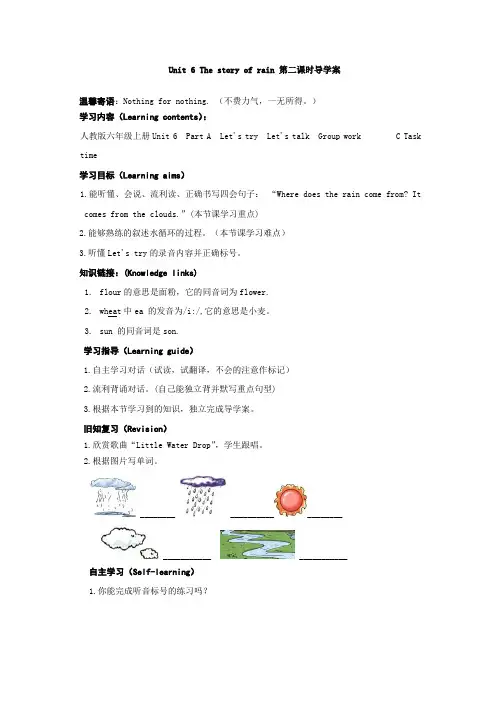
Unit 6 The story of rain 第二课时导学案温馨寄语:Nothing for nothing. (不费力气,一无所得。
)学习内容(Learning contents):人教版六年级上册Unit 6 Part A Let's try Let's talk Group work C Task time学习目标(Learning aims)1.能听懂、会说、流利读、正确书写四会句子:“Where does the rain come from? It comes from the clouds.”(本节课学习重点)2.能够熟练的叙述水循环的过程。
(本节课学习难点)3.听懂Let's try的录音内容并正确标号。
知识链接:(Knowledge links)1.flour的意思是面粉,它的同音词为flower.2.wheat中ea 的发音为/i:/,它的意思是小麦。
3.sun 的同音词是son.学习指导(Learning guide)1.自主学习对话(试读,试翻译,不会的注意作标记)2.流利背诵对话。
(自己能独立背并默写重点句型)3.根据本节学习到的知识,独立完成导学案。
旧知复习(Revision)1.欣赏歌曲“Little Water Drop”,学生跟唱。
2.根据图片写单词。
________ _____________________________ ___________ 自主学习(Self-learning)1.你能完成听音标号的练习吗?2.请你大声的读71页对话三遍,然后将对话补充完整。
A: _______ does the rain come from? B: It _______ from the clouds.A: Where does the ______ come from? B: It comes from the vapour.A: Where does the vapour ______ _______? B: It comes from the water _____ the river. A: How can the water become vapour?B: The sun shines and the water _______ vapour.3.你能翻译出这个对话吗?请将汉语意思写在课本上。
六年级上册英语教案Unit1Storytime人教PEP
The eighth lessonTeaching contents: Story timeTeaching aims:To understand the story of this part, and Ss can perform the story.To train the Ss to obey the traffic rules.Teaching focus:Ss can understand the story and train their good reading habit.Teaching difficulty:1.Students can perform the story in roles.Teaching methods: Read and performTeaching aids:1.Tape recorder and tape2.The head portraits of Zip ,Zoom and policeman3.Some pictures of bike ,car ,taxi and traffic lightsTeaching procedure:Step 1. Review1.Duty report2.Make a survey .做个调查Ask: How do you go to school? Get Ss to answer and make a statistics. How many Ss go to school by car /by bus /on foot.3.Review the traffic rules.Step 2. Presentation1. Show a picture of a people who is walking, ask: What is he doing? (He is walking.)Do you like walking? I like walking .Because it’s a good exercise.Write good exercise on the Bb.2. Play the game of let’s play.Ask a student say: stop, wait, go .The other Ss do the actions.T: You are good children because you know the traffic rules .Let me do it.I make some wrong actions, when the Ss remind me, write be against the traffic rules on theBb. Say .I am against the traffic rules.Step 3.ReadAsk Ss to look at the pictures on page 13, introduce Zip and Zoom to them. Then play the tape and Ss read after it.Then try to ask then some questions: 1.How many dollars do they have?2. Where are they going?3. Do the go by taxi? Why not?If they cannot answer, give them some help.Step 4.PerformanceSs read the story again .Then get them perform the story.If someone does very well, give them praise cards.Step 5 .ExtensionAsk the Ss, if you are Zip and Zoom, How you go to the restaurant.Get Ss to discuss this question.Homework :Finish Part 5 on page 6 of the activity book.Bb design:Good exerciseBe against the traffic rulesTeaching reflection:。
人教PEP版六年级英语上册《Unit6_A_Let’s_talk优质说课稿》
人教PEP版六年级英语上册《Unit6_A_Let’s_talk优质说课稿》一. 教材分析《人教PEP版六年级英语上册Unit6 A Let’s talk》主要讲述了关于动物的特点。
本节课的主要内容是让学生能够听懂、会说、会读关于动物的句子,并能够运用所学知识进行简单的交流。
通过学习本节课,学生能够进一步巩固一般现在时态的运用,并且能够运用所学知识进行动物特点的描述。
二. 学情分析六年级的学生已经具备了一定的英语基础,对于一般现在时态的运用已经有了一定的了解。
但是,学生在动物特点的表达方面还存在一定的困难,因此,在教学过程中,需要重点引导学生运用英语表达动物的特点。
三. 说教学目标1.知识目标:学生能够听懂、会说、会读关于动物的句子,并能够运用所学知识进行简单的交流。
2.能力目标:学生能够运用一般现在时态描述动物的特点。
3.情感目标:学生能够对英语学习保持浓厚的兴趣,增强学习的自信心。
四. 说教学重难点1.重点:学生能够听懂、会说、会读关于动物的句子,并能够运用所学知识进行简单的交流。
2.难点:学生能够运用一般现在时态描述动物的特点。
五. 说教学方法与手段在本节课的教学过程中,我将采用任务型教学法,通过设置各种任务,引导学生主动参与学习,提高学生的学习兴趣和学习积极性。
同时,我会运用多媒体教学手段,如图片、视频等,帮助学生更好地理解和记忆动物的特点。
六. 说教学过程1.热身(5分钟):通过播放一首关于动物的歌曲,让学生复习已学的动物词汇,并引入本节课的主题。
2.呈现(10分钟):通过展示各种动物的图片,引导学生说出动物的名称,然后呈现本节课的主要句型,让学生听懂并能够模仿说出口。
3.操练(10分钟):通过各种游戏和活动,让学生充分练习本节课的主要句型,如“What does he/she look like? He/She looks like…”等。
4.巩固(10分钟):通过小组活动,让学生运用所学知识进行动物特点的描述,如“My animal looks like a… It has…”等。
六年级上册英语课件-Unit 2 C Story time人教PEP
1. sea 2. bad 3. Chinese 4. people 5. same 6. right 7. after 8. two / to 9. number 10. buses
Have a try! 11. right (同音词) _____ 12. first (基数词)____ 13. wrong (反义词)___ 14. bike (同义词)___ 15. these (单数) __ 16.in front of(反义词)__ 17. them(主格) ____ (主格)___
3
1
4
2
on go
bus train foot
Cross the street
Have a try!
1. see(同音词) _____ 2. good(反义词)____ 3. China(形容词)_____ 4. people(复数)___ 5. different(反义词) __ 6. left (反义词)___ 7. before(对应词) ____ 8. too(同音词)______ 9. No. (完整形式) ____ 10.bus(复数) __
11. write 12. one 13. right 14. bicycle 15. this 16. behind 17. they 18. we
Homework: 1.听读故事,选择其中的两段背 诵。 2.从本单元里找出更多符合连读 规律的句子或短语并读一读
Unit2 Ways to go to school Part C let’s check Story time
学习目标
1. 能够正确听、说、朗读:”How does Wu Yifan go to the park ? He goes by…”. 2. 能够正确听、说认读单词和词组, 如:miss cross,different,left,right,doubledecher,wrong等。 自学目标:在文中找出所给短语,并尝 试翻译
人教PEP五年级英语上册Unit4_C_Story_time 公开课教案
教材内容:Unit4 C Story time江西公开课教案教材:人教PEP小学英语五年级上册P45单元主题:What can you do?课型:故事课一、教学内容本课教学内容是人教PEP五年级上册Unit4 What can you do? C Story time部分,教学故事Rat and Snake。
本部分呈现的是田鼠如何机智地摆脱被蛇吃掉的厄运,在紧张的故事情节发展中复习巩固本单元核心词汇与句型:What can you do? I can ... Can you ...? Yes, I can / No, I can’t. 以及多个动词及动词词组。
教师帮助学生通过图片和上下文理解句子的意思,如:Don’t throw me into the lake, please! Silly snake! 这一故事教学的目的是让学生在阅读中进一步复习和巩固本单元的知识,并得以有效拓展。
二、教学目标1. 知识目标(1) 词汇:rat, snake, tasty, lake, silly, away;(2) 句型:基础句型What can you do? I can ... Can you ...? Yes, I can. / No, I can’t. 拓展句型I can ... for you. There’s a ... Don’t ...2. 能力目标(1) 能够理解并朗读故事;(2) 能在教师的帮助下表演故事。
3. 情感与态度(1) 运用本单元所学核心语言讲述趣味故事,引起学生学习英语的兴趣,扩大学生阅读量。
(2) 让学生了解动物与人类应是和谐、共处的关系。
(3) 根据《中华人民共和国野生动物保护法》,教育学生保护、拯救珍贵、濒危野生动物,发展和合理利用野生动物资源,来维护生态平衡。
三、教学重点使学生在相对真实、完整的语境中接触、体验、理解语言。
四、教学难点能够在图片和情景的帮助下,引导学生去讲故事;引导学生观察故事中主人翁和所处的环境。
人教PEP版六年级英语上册《Unit6_A_Let’s_talk名师说课稿》
人教PEP版六年级英语上册《Unit6_A_Let’s_talk名师说课稿》一. 教材分析《人教PEP版六年级英语上册Unit6_A_Let’s_talk》主要讲述了关于动物的话题。
通过本节课的学习,学生能够掌握动物的名称以及描述动物特征的词汇和句型。
教材通过图片、对话和练习等形式,激发学生的学习兴趣,培养学生用英语进行交流的能力。
二. 学情分析六年级的学生已经具备了一定的英语基础,能够听、说、读、写简单的英语句子。
但部分学生在发音和听力方面还存在困难,需要加强练习。
此外,学生对动物话题感兴趣,有利于激发学习积极性。
三. 说教学目标1.知识目标:学生能够掌握关于动物的词汇,如panda, tiger, elephant,giraffe等,以及描述动物特征的句型,如I have two big ears and four legs.2.能力目标:学生能够在图片或情景的帮助下,用英语简单描述动物的特征。
3.情感目标:培养学生关爱动物,保护环境的意识。
四. 说教学重难点1.重点:动物词汇的掌握和描述动物特征的句型运用。
2.难点:正确发音和听力理解。
五. 说教学方法与手段1.情景教学法:通过图片、角色扮演等形式,创设情境,让学生在实际语境中学习英语。
2.游戏教学法:通过趣味游戏,激发学生的学习兴趣,巩固所学知识。
3.任务型教学法:引导学生参与课堂活动,完成具体任务,提高实际运用英语的能力。
六. 说教学过程1.热身(5分钟):通过唱英文歌曲《Old MacDonald Had a Farm》,激发学生的学习兴趣,导入动物话题。
2.Presentation(10分钟):展示各种动物的图片,引导学生说出动物的名称,并用英语描述动物的特征。
3.Practice(10分钟):分组进行角色扮演,让学生模拟对话,练习描述动物特征的句型。
4.Consolidation(10分钟):设计趣味游戏“Animal Charades”,让学生通过肢体语言猜测动物,巩固所学知识。