
莎士比亚Sonnet 18 (for students) 华南师范大学课件
Sonnet 18

Sonnet 18Sonnet 18 is one of the most beautiful sonnets written by Shakespeare, in which he has a profound meditation on the destructive power of time and the eternal beauty brought forth by poetry to the one he loves. A nice summer’s day is usually trans ient, but the beautifying in poetry can last forever. Thus Shakespeare has a faith in the permanence of poetry.The sonnet starts with a question that might lead to a very ordinary conceit; instead it introduces a profound meditation on time, change, and beauty. Normally, to compare the beloved to the days of early summer or to the dazzling beauty of the glorious sun would be considered high praise (here hyperbole is employed). However, the poet considers this comparisons inadequate, for just like the shortness of summer, man’s youth and beauty will fade away.The poet expresses a very bold idea: that beautiful things can rely on the force of literature to reach their eternity’ and literature is created by man, thus it declares man’s eternity. This idea is n ot only possessed by Shakespeare; it is also a spark of the European Renaissance movement.This poem is written in the stanza of fourteen iambic pentameter lines. The rhyming scheme is abab cdcd efef gg.When, in disgrace with Fortune and men’s eyes,I all alone beweep my outcast state,And trouble deaf heaven with my bootless cries,And look upon myself and curse my fate,Wishing me like to one more rich in hope,Featured like him, like him with friends possessed,Desiring this man’s art, and that man’s s cope,With what I most enjoy contented least,Yet in these thoughts myself almost despising,Haply I think on thee, and then my state,Like to the lark at break of day arisingFrom sullen earth, sings hymns at heaven’s gate;For thy sweet love remem b’red such wealth bringsThat then I scorn to change my state with kings.。
05第9讲Sonnet 18

Unit 2 William Shakespeare 1564-1616 Sonnet 18
Shall I compare thee to a summer's day?
a
Thou art more lovely and more temperate:
b
c d c
By chance, or nature's changing course untrimmed: d
But thy eternal summer shall not fade, Nor lose possession of that fair thou ow'st, When in eternal lines to time thou grow'st, So long as men can breathe or eyes can see,
I would like to compare you to a Summer’s day. But you are more lovely and milder, because the rough winds on a Summer’s day shake and damage the darling buds of flowers in May, and the beautiful time in Summer is too short.
Rough winds do shake the darling buds of May,
b
a
And summer's lease hath all too short a date:
sonnet 18赏析
• 3. Man of superb intelligence, a close observer of men and manners, he easily sees through people. He could penetrate below the surface of things. He is forever.
h
12
The Tragedy of Hamlet, Prince of Denmark
• Hamlet is regarded as Shakespeare’s most popular and greatest play on the stage.
• Hamlet is also considered the summit of shakespeares art. The story comes from an old danish legend.
h
15
• To get ride of hamlet, claudius send him to england and sends assasins to kill him on the voyage. But hamlet succeeds in coming out of it alive and returns to denmark again.
专八英国文学 莎士比亚 sonnet18

Meter:
Shall I compare thee to a sum mer’s day ? Thou art more love ly and more tem perate. a b
Rough winds do shake the dar ling buds of may,
And sum mer’s lease hath all too short a date.
பைடு நூலகம்
• But thy eternal summer shall not fade, • Nor lose possession of that fair thou ow’st, • Nor shall Death brag thou wand’rest in his shade, • When in eternal lines to time thou grow’st
rough: violent; terrible darling: lovely; dear; charming lease: Here it is figuratively used, meaning “lifetime”. hath: old use for “has” date: period of time In fact, the violent winds do destroy the lovely buds of May, and summer lasts for only a very short period of time.
Appreciation
• Shall I compare thee to a summer’s day? • Thou art more lovely and more temperate.
【英美文学课件】-莎士比亚-Shakespeare Sonnets

9
Back to soபைடு நூலகம்nets.
• Well, it is a poetic form. • But it has a certain structure as well as a rhyming pattern.
10
Rhyming patterns
• The Shakespearean sonnet has three quatrains followed by a couplet, the scheme being: abab cdcd efef gg. • More head scratching?
(Iambic penta meter )
6
• It is percussive and attractive to the ear and has an effect on the listener's central nervous system. An Example of Pentameter from Shakespeare: but SOFT what LIGHT through YONder WINdow BREAKS
14
Homework
• 1. What is a sonnet? • 2. What is iambic pentameter? • 3. What is the rhyming pattern of a Shakespearean sonnet?
15
11
Quatrain?
• Quatrains are four line stanzas of any kind • I have divided the following sonnet into the three quatrains. • You will also see the rhyming pattern • marked out for you.
莎士比亚文集sonnet18

Sometime too hot the eye of heaven shines, 休恋那丽日当空, And often is his gold complexion dimm'd, 转眼会云雾迷蒙。 And every fair from fair sometime declines , 休叹那百花飘零, By chance or nature‘s changing course, untrimm’d: 催折于无常的天命。
Rough winds do shake the darling buds of May, And summer's lease hath all too short a date. Sometime too hot the eye of heaven shines, And often is his gold complexion dimm'd, And every fair from fair sometime declines , By chance or nature‘s changing course , untrimm’d:
Analogy 类比
It is also a form of comparison, but unlike sim ile or metaphor which usually uses compariso n on one point of resemblance, analogy draw s a parallel between two unlike things that ha ve several common qualities or points of rese mblance.
Sonnet 18
William shakespeare
莎士比亚十四行诗第十八首
莎士比亚十四行诗第十八首莎士比亚十四行诗第十八首Sonnet 18 铁冰译文1 Shall I compare thee to a summer's day? 我该不该把你比作怡人的夏天?2 Thou art more lovely and more temperate: 你却比她更加可爱更加温情。
3 Rough winds do shake the darling buds of May, 五月的娇蕊总是被狂风吹断,4 And summer's lease hath all too short a date: 夏天也只是一道短暂的美景。
5 Sometime too hot the eye of heaven shines, 苍穹的目光有时会过于灼热,6 And often is his gold complexion dimm'd; 那金色的脸庞也常黯淡无光。
7 And every fair from fair sometime declines, 人间一切瑰丽终将失去秀色,8 By chance, or nature's changing course, untrimm'd; 湮没于不测风云和世事沧桑。
9 But thy eternal summer shall not fade, 但是,你常青的夏季永不消逝,10 Nor lose possession of that fair thou owest; 你拥有的美丽也将永不折损,11 Nor shall Death brag thou wander'st in his shade, 或许死神的阴影会笼罩着你,12 When in eternal lines to time thou growest; 你却和这不朽的诗句千古长存。
13 So long as men can breathe, or eyes can see, 只要人类还在呼吸、眼睛还在欣赏,14 So long lives this, and this gives life to thee. 我的诗就会活着,令你生命绽放。
sonnet 18
∨—∨—∨—∨—∨—a ∨—∨—∨—∨—∨—b ——∨—∨—∨—∨—a ∨—∨—∨—∨—∨—b ∨—∨—∨—∨—∨—c ∨—∨—∨—∨—∨—d ∨—∨—∨—∨—∨—c ∨—∨—∨—∨—∨—d ∨—∨—∨—∨—∨—e ∨—∨—∨∨∨—∨—f ∨∨——∨—∨∨∨—e ∨∨∨—∨—∨—∨—f ∨—∨—∨—∨—∨—g ∨—∨—∨—∨—∨—g
1 Addressed to a man or woman? 2 Shakespeare is gay? 3 The beauty of what?
Man’s Beauty
• What a piece of work is a man! How noble in reason! How infinite in faculty! in form, in moving, how express and admirable! in action how like an angel! in apprehension how like a god! the beauty of the world! the paragon of animals! And yet to me, what is this quintessence of dust? man delights not me; no, nor woman neither, though, by your smiling, you seem to say so. ----------William Shakespeare “Hamlet”
you Shall I compare thee to a summer’s day ?
能不能让我来把你比作夏日?
Thou art more lovely and more temperate:
莎士比亚十四行诗之十八
➢ 我是否可以把你比喻成夏天? Shall I compare thee to a summer's day?
➢ 虽然你比夏天更可爱更温和: Thou art more lovely and more temperate:
➢ 狂风会使五月娇蕾红消香断, Rough winds do shake the darling buds of May
十四行诗是源于意大利民间的一种 抒情短诗,文艺复兴初期时盛行于整 个欧洲,其结构十分严谨,分为上下 两部分,上段为八行,下段为六行, 每行十一个音节,韵脚排列:abba abba,cdc ded。
莎士比亚的十四行诗的结构却更严谨,
他将十四个诗行分为两部分,第一部分为 三个四行,第二部分为两行,每行十个音 节,韵脚为:abab, cdcd,efef,gg。这样的 格式后来被称为“莎士比亚式”或“伊丽 莎白式”。对诗人而言,诗的结构越严禁 就越难抒情,而莎士比亚的十四行诗却毫 不拘谨,自由奔放,正如他的剧作天马行 空,其诗歌的语言也富于想象,充满感情。
莎士比亚十四行诗 之十八
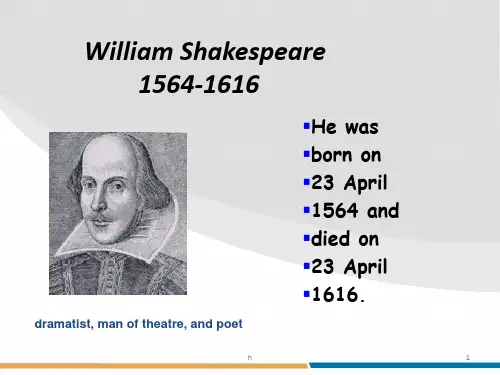
威廉·莎士比亚 (W.WilliamShakespeare,1564-1616) 是欧洲文艺复兴时期最重要的作家,杰出 的戏剧家和诗人,他在欧洲文学史上占有 特殊的地位,被喻为“人类文学奥林匹克 山上的宙斯”。 他亦跟古希腊三大悲剧家 艾思奇利斯(Aeschylus)、索福克里斯 (Sophocles)及幼里匹蒂斯(Euripides)合 称戏剧史上四大悲剧家。
而莎士比亚的十四行诗大约创作于 1590年至1598年之间,其诗作的结构技巧 和语言技巧都很高,几乎每首诗都有独立 的审美价值。莎士比亚在运用这个诗体时, 极为得心应手,主要表现为语汇丰富、用 词洗练、比喻新颖、结构巧妙、音调铿锵 悦耳。而其最擅长的是最后两行诗,往往 构思奇பைடு நூலகம்,语出惊人,既是全诗点睛之作, 又自成一联警语格言。在英国乃至世界十 四行诗的创作中,莎士比亚十四行诗是一 座高峰,当得起空前绝后的美称。
William Shakespeare(sonnet 18)
• What is a sonnet? Sonnet is a fourteen-line lyric poem, usually written in rhymed iambic pentameter. It follows very strict patterns of stanza divisions and rhymes and generally expresses a single theme or idea. • Two major types of sonnet: 1: The Petrarchan or Italian sonnet 2: The Shakespearean or English sonnet
Shakespeare’s sonnet sequence 1609: Shakespeare’s Sonnets, Never Before Imprinted It contains 154 sonnets, roughly divided into 3groups: 1. No. 1-17: a variation on one theme--a handsome young man is being persuaded to marry and beget offspring who will preserve his beauty in a new generation, though he himself will lose it as he grows old . 2. No. 18-126: a variety of themes associated with a handsome young man.. 3. No. 127-154: a new series about a married young woman with dark hair and complexion, the so-called “dark lady”.