
人教版七年级英语上册 Unit 6 Do you like bananas 重点解析
Let’s have some ice-cream.
让我们吃些冰激凌吧。
[归纳] have是多义词,归纳如下: (1) 有,拥有;如:
I have a new watch.
我有块新手表。
(2) 吃,喝;如:
Let’s have some milk and some bread.
让我们喝些牛奶,吃些面包。
David: Hmm … and do you like hamburgers for dinner? Cindy: Oh, no, they're not healthy. I like chicken for dinner.
David: OK, well, one last question - do you eat ice-cream after dinner? Cindy: Err … I like ice-cream … but I don't eat it. I don't want to be fat.
我们想喝些橙汁。(不可数名词)
Grammar Focus many much Countable and Uncountable Countable uncountable nouns nouns nouns
(可数名词)
(不可数名词)
(既可数又不可数名 词)
hamburgers, milk tomatoes, some oranges, bread pears, bananas
可数名词复数形式的构成 1
名词特点 词尾加法
词尾读音方法
1. -s在清辅音后读[s] 2. -s在浊辅音后读[z] 3. -s在元音后读[z]
例词
一般情况下
加-s
desks apples trees
boxes watches knives wives
以-s, -x, -sh, -ch 结尾的 以 f 或 fe 结尾的
sure adv. (用作副词)当然;肯定;一定 常用来回答一般疑问句,意为“当然; 的确”,相当于yes或certainly。只是 sure 在英国英语中较为常用,而在美国 英语中常用certainly。
— Are you going with us? 你和我们一起去吗? — Sure. 当然啦。
Difficult items: countable nouns and uncountable nouns.
the Simple Present Tense 一般现在时态
(1)be 动词
主语+ (2)have 动词
动词一般现在时的否定句式
am is are + not +表语
主语+
(3)实义动词
breakfast
lunch
dinner/supper
What do you have/like for …..?你早餐/午
餐/晚餐吃/喜欢什麽? I have/like…for breakfast/lunch/dinner(supper). 我早餐/午餐/晚餐吃/喜欢….
Mary’s breakfast
week n. 周;星期 Sunday is the first day of the week. 星期日是一周的第一天。
last week 上礼拜 this week 本周 next week 下周
think about 思考,思索
(一般是短时间的较仔细的考虑)
What do you think about that?
(3) 构成固定短语:
have a look 看一看
I like …… He/ She likes ……
I don’t like…… He/She doesn’t like……
dinner n. (中午或晚上吃的)正餐 dinner 指一日中的主餐,可中午吃,也 可晚间吃。但多用于指宴请客人的正式 的一餐。(西方人常指晚餐) It’s time for dinner. 该吃晚饭了。 dinner party 宴会 dinner table 餐桌 dinner time 吃饭时间
David asks the volleyball star, Cindy Smith, about her eating habits. ask sb. About sth. 询问某人关于某事 She asks me about my teacher.
ask 短语 1 ask for 请求,要求 Don’t always ask for help. 2 ask sb. to do sth. My mother asks me to do my homework. 3 ask sb. About sth. 询问某人关于某事 She asks me about my teacher. David asks the volleyball star, Cindy Smith, about her eating habits.
主谓宾结构
句式 肯定句 否定句 一般疑问句 肯定回答 否定回答 结构 主语+行为动词原 形+其他 例句 We speak Chinese.
主语+don’t+行为 We don’t speak 动词原形+其他 Chinese. Do+主语+行为动 Do you speak 词原形+其他? Chinese? Yes,主语+do. No,主语+don’t Yes,主语 do. Yes, we do. No, we don’t.
ice cream, salad
Important items: --I like salad. Do you like salad? --Yes, I do. No, I don’t.
--Does he/she like salad? --Yes, he/she does. No, he/she doesn’t.
= He eats eggs for breakfast.
区别: 1、eat多指“吃”,是日常用语,使用很普通, 可单独使用。作“喝”讲时,只表示喝汤。 My sister eats fast.
2、have既可以指“吃”,也可以指“喝”,语 气较弱,但用于社交场合比eat客气。一般不单独 使用。
David asks the volleyball star, Cindy Smith, about her eating habits.
加-s
有生命的事 物加-es 无生命的事 物加-s
以o 结尾的
Countable nouns and uncountable nouns 可数名词和不可数名词 uncountable nouns不可数名词 ( 1) 定义:是指不能计数的名词。 不可数名词前不可以用 a , an 限定。 ( 2)
不可数名词前不可以用 one, two , three… 限定。 ( 3) ( 4) 不可数名词没有复数形式。
加-es
改f或fe为v 再加-es
-es读[iz] -ves读[vz]
可数名词复数形式的构成 2
名词特点 词尾加法
词尾读音方法
例词
以辅音字母 改y为i 再 加y结尾的 加-es
以元音字母 加y结尾的
families -ies读[iz] dictionaries -s读[z]
-es读[z] -s读[z] boys keys tomatoes potatoes photos radios
作主语时, 谓语动词要用单数形式。例 如: A little water is in the glass. 玻璃杯里有一点水。 How much is the broccoli? 花椰菜多 少钱?
用代词指代不可数名词时, 用单数it, 不能用复数they或 them。例如: I like tea. Do you like it? 我喜欢茶。你喜欢吗?
David: Hello, Cindy. What do you like for breakfast? Cindy: I love fruit. I think it's healthy.
David: OK. So what fruit do you like? Do you like bananas? Cindy: Well, I don't like bananas. But I like oranges and apples. David: What about lunch? Do you like salad? Cindy: Yes, I really like it.
Countable nouns and uncountable nouns 可数名词和不可数名词 Countable nouns 可数名词 定义:是可以计数的名词。 ( 1) 可数名词前可以用 a , an 限定,表一个….。 ( 2) 可数名词前可以用 one, two , three… 限定。 ( 3) ( 4) 可数名词有复数形式。
(2)an ice cream 一个冰淇淋 ice cream 冰淇淋(指成份) (3)a salad 一碟沙拉 salad 沙拉(指成份)
【温馨提示】 有些词既可作可数名词, 也可作不可数 名词, 但表达的意思有所不同。例如: These are oranges. 这些是橙子。(可数名词)
We want to have some orange.
Countable nouns and uncountable nouns 可数名词和不可数名词 Countable and uncountable nouns 既可数又不可数名词 定义:在某些情况下能计数,在某些情况下 不能计数的名词。 e.g. (1)a chicken 一只鸡 chicken 鸡肉
Tom’s lunch
Bob’s dinner
Mary has/likes eggs, an apple and a bananas for breakfast. Tom has/likes ... for lunch.
河南省七年级英语上册Unit6Doyoulikebananas总结(重点)超详细
河南省七年级英语上册Unit6Doyoulikebananas总结(重点)超详细单选题1、Hurry up!Some _____ and ____ are on sale in the supermarket.A.tomato; eggB.tomatoes; eggC.tomatoes; eggsD.tomato; eggs答案:C句意:快点!超市里一些西红柿和鸡蛋在降价销售。
tomato西红柿,可数名词单数;tomatoes是复数形式;egg 鸡蛋,单数;eggs是复数形式。
空前的some意思是“一些”,修饰可数名词复数,两个空都要用复数形式,故应选C。
2、Sandy really likes eating meat, but she doesn't like eating________. A.breadsB.vegetablesC.chickens答案:B句意:桑迪真的很喜欢吃肉,但是她不喜欢吃蔬菜。
考查名词。
bread面包,不可数名词,不加s。
vegetables蔬菜,可数名词,通常用复数形式。
chicken鸡肉,不可数名词;chicken如果加s变复数,表达的意思是“小鸡”。
根据“likes eating meat, but she doesn't like”后面句子是转折,表达“喜欢吃肉但是不喜欢吃蔬菜”。
故选B。
3、—Mr.Smith, can I ask you a ? I can’t find the answer.—Yes. What is it?A.questionB.habitC.nameD.number答案:A句意:——史密斯先生,我能问你一个问题吗?我找不到答案。
——好的。
它是什么?考查名词辨析。
question问题;habit习惯;name名字;number数字。
根据下文“我找不到答案”可知上句是:我能问你一个问题吗?故选A。
4、How much ________ do we need to make a banana milk shake? A.bananasB.applesC.coffeeD.milk答案:D句意:做香蕉奶昔需要多少牛奶?考查名词。
人教版初中英语七年级上册Unit 6 Section B(1a-1e)教学教案和教学反思
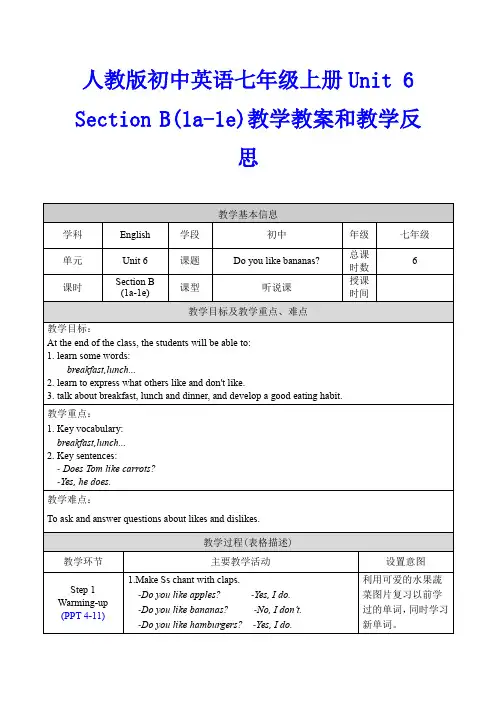
2.Check answers.
3.Ask Ss:
How many others words can you add to the lists?
4.Make Ss talk in groups, and write as many fruit and
vegetables as possible.
but he doesn't like ___________. My _____ likes
eating _________, but she doesn't like ________. ____
_____________________________________________
_______________________________________.
板书设计
Unit 6 Do you like bananas?
Section B (1a-1e)
orange eggs ice-cream banana rice
salad apple hamburger chicken carrots
breakfast lunch dinner
- Does Tom like carrots?
教学重点:
1.Keyvocabulary:
breakfast,lunch...
2. Key sentences:
- Does Tom like carrots?
-Yes, he does.
教学难点:
To ask and answer questions about likes and dislikes.
学生通过观看这些图片并对这些图片进行一日三餐的汇总。头脑风暴汇总、积累更多相关词汇。
七年级英语上册 Unit 6 Do you like bananas(第5课时)Section B(2a-3b)课件 (新版)人教新目标版

二、根据句意及汉语提示写单词。
6.Dale's brother _w_a_n__ts_(想要) an apple. 7.My son has good eating _h_a_b_i_t_s (习惯). 8.Fruit and vegetables are __h_e_a_lt_h_y_(健康的) food. 9.You can ask me some __q_u_e_s_ti_o_n_s_(问题). 10.The picture is __r_e_a_ll_y__(真正地) nice.
Unit 6 Do you like bananas?
第五课时 Section B(2a~3b)
1.Sports star eats well.体育明星吃得好。 (1)sports star体育明星。 (2)eats是eat的第三人称单数形式。在一般现在时中,当主语是 第三人称单数,就用动词的第三人称单数形式。 (3)well adv.好,主要用于修饰动词。 2.ask sb. about sth.向某人询问某事 3.her eating habits她的饮食习惯 此处eating作定语。eg: I have good eating habits.我有好的饮食习惯。
4.healthy 形容词,意为“健康的”,其名词形式为health,其反义词为 unhealthy。 5.I don't want to be fat.我不想长胖。 want“要,想要”,常用结构有:want sth.“想要某物”;want to do sth.“想做某事”,want sb. to do sth.“想要某人做某事”。 6.What do you like for breakfast?你早餐喜欢什么? (1)for 介词,意为“为了,给”,在句型“have…for breakfast/lunch/dinner”中表示“某人吃什么。” (2)breakfast前面不能用冠词,一日三餐前一般不加冠词。
初一上册英语第6单元句式精讲名补教案 Unit 6 Do you like bananas
初一上册英语补习班名补教案目标提高班名师培优精讲【教学标题】Unit 6 Do you like bananas?【教学重点】1、Unit 6重点短语及句式的掌握;2、助动词在陈述句和疑问句中的使用。
【教学难点】1、主语+like(don’t like)+sth句式的掌握;2、What+询问的具体事物的名称+do/does+主语+ like/dislike句式的理解及运用。
【进门得分】Ⅰ. 从所给单词中选出恰当的填入空白处。
like, likes, don’t, doesn’tSandy: What do you like to eat, Mei?Mei: Well, I 1 salad, but I 2 like tomatoes.Sandy: And your friend? What does he like to eat?Mei: He 3 oranges and bananas. He 4 like hamburgers.Bobby: And I really 5 ice cream.【教学内容】1. -Do you like bananas?-Yes, I do./No, I don’t.1)本句中的like是动词,它的意思是“喜欢”,和本单元学习的play,have,watch一样都是有实际意义的动词。
当句子的谓语是实义动词时,在一般现在时中,它的一般疑问句是用助动词来构成,当句子的主语是第一人称第二人称单复数,或者第三人称复数时,用助动词do放在句子的开头,并且要大写。
它的回答是:Yes, 主语+do. / No, 主语+don’t.例如:-Do you like apples? 你们喜欢苹果吗?-Yes, we do. 是的,我们喜欢。
No, we don’t. 不,我们不喜欢。
2)当句子的主语是第三人称单数时,用助动词does放在句子的开头并且大写,此时,句中的谓语动词的三单形式要还原为原形。
初中英语《Unit6Doyoulikebananas》单元教学设计以及思维导图

Unit 6 Do you like bananas适用年级人教版新目标七年级上册所需时间课内共用4课时;课外共用1课时。
主题单元学习概述本单元教材取决于《义务教育英语课程标准》功能意念项目表第2项态度(attitude)中的第24条喜欢与不喜欢(likes and dislikes)。
这是学生初次接触这一话题,它与学生的生活息息相关,所以学生学起来比较容易接受,比较易于应用。
本单元的中心话题是Food.主要语言功能项目是Talk about likes and dislikes。
教材以紧扣话题的5个听力练习(1b,2a,2b SectionA;1c,1d Section B)2个对话(2d Section A; 2b Section B)为载体,在具体的语言环境中呈现了行为动词like的一般现在时的肯定句、否定句、一般疑问句的构成以及简单的回答。
本单元包括一些食物的词汇,通过学习这些词汇,学生学会区分可数名词与不可数名词;另外,通过谈论自己及他人一日三餐的喜欢吃的食物,学生将了解健康食品,并且根据喜好进行合理的营养配餐。
同时,教材还在74页安排了语音训练,包括元音字母Aa,字母组合ai, ay, al, aw 的发音规则,名词复数的读音及单词的重音。
本单元的学习重、难点:(1)语言知识方面:立足语言实践活动,在完成任务的过程中掌握谈论喜好和厌恶以及表述一日三餐的词汇;掌握Grammar Focus 中出现的以及What about…? Let’s…等语言结构。
(2)语言技能方面:1)开展多种任务型的听力活动,使学生获得理解、识别和处理与谈论喜好、厌恶相关的信息。
2)展开各种任务活动,使学生具备较熟练地运用所学语言谈论喜好与厌恶,描述一日三餐的合理搭配的能力。
3)引导同步阅读,使学生理解与主题相关的语言材料,并增强学生运用语言获取更多信息的能力。
4)进行写作练习,使学生具备初步的综合运用语言的能力。
新版七年级初一上册第六课英语Unit 6 Do you like bananas
He/ She/ It likes… He / She/ It doesn’t like…
PPT模板下载:/moban/ 节日PPT模板:/jieri/ PPT背景图片:/beijing/ 优秀PPT下载:/xiazai/ Word教程: /word/ 资料下载:/ziliao/ 范文下载:/fanwen/ 教案下载:/jiaoan/
1.---Does Tom like bananas? ---_____, No ____ he _______. doesn’t But Rose does.
likes 2.My mother ______salad. But I don’t like.(like 3.Do you like apples ___________? (apple) doesn’t 4.She _______ like ice cream. 5.They like hamburgers.(一般疑问句) Do they like hamburgers?
lunch Tom’s
Tom’dinner s
Sandra has/likes eggs, apples and bananas for breakfast. Tom has/likes … for lunch.
返回
He has … He doesn’t have… He likes … He doesn’t like…
2. salad是西餐中一道经典的凉拌菜。传统的沙拉是将洗 净、切成块状或片状的生蔬菜(通常包括生菜、黄瓜 和西红柿等)与沙拉酱混合,均匀搅拌即可。沙拉也 有水果沙拉(fruit salad)、土豆沙拉(potato salad)、海鲜沙拉(seafood salad)等各个品种。
Exercises
人教版初中初一七年级英语上册 名师教学课件 Unit 6 Do you like bananas (
John likes strawberries and apples.
Complete the sentences. 1.你喜欢沙拉吗? 是的,我喜欢。
__D_o__you __l_ik__e__salad? Yes, I __d_o____ .
Bob Gina
Reading time
Read the conversation in 2d. Then answer the questions.
1. Does John like hamburgers?
Yes, he does.
2. What does Jack don’t like?
Jack doesn’t like salad.
3. He (like / likes) bananas, but he (don’t / doesn’t) like oranges.
4. We (likes / like) hamburgers, but we (don’t / doesn’t) like chicken.
5. They (likes / like) pears, but they (don’t / doesn’t) like strawberries.
Thank You
新疆伊犁新源县扬新中学 李绍君
人教版 英语 七年级上册
Section A (2d-3c) Grammar & practicing
新疆伊犁新源县扬新中学 李绍君
Learning goals 1. 了解可数名词与不可数名词、单数名词与复数名词
2. 学会用like谈论喜好 •3. 学会使用一般疑问句及其回答 •Do you like strawberries? •Yes, I do/No, I don't. •Does he like pears? •Yes, he does/No, he doesn't. •He likes… He doesn’t like…
七年级英语上册 Unit 6 Do you like bananas Section A例题与讲解
七年级英语上册 Unit 6 Do you like bananas SectionA 例题与讲解 (新版)人教新目标版Section A突破词汇 Section A sure adv . 当然;肯定;一定→P95 Section B breakfast n . 早餐;早饭 →P102 How about...?(提出建议)……怎么样?→P96healthy adj . 健康的 →P103 Section B eat v . 吃→P101 want v .需要;想要 →P103 well adv . 好;令人满意地→P102 fat adj . 肥的;肥胖的 →P104 把握句型 1.Do you like oranges?你喜欢橙子吗?2.Sure.How about burgers ,vegetable salad ,and some fruit? 好吧。
咱们吃汉堡、蔬菜沙拉和水果怎么样?3.I don't want to be fat.我可不想变胖。
熟悉 语法 1.实义动词的一般现在时。
2.名词。
学会 交际 学会在日常生活中谈论好恶。
写作 练笔 学写某人喜爱或厌恶某物的短文。
2dJack :Hey ,John's birthday dinner is next week.[1]Let's think about the food.Tom :[2]Sure.How about burgers ,vegetable salad ,and some fruit? Bill :Sounds good.John likes hamburgers.Jack :Oh ,I don't like salad.Bill :But John likes salad ,and it's his birthday.Jack :Yes ,you're right.What about the fruit?Tom :I think John likes strawberries and apples.Bill :OK.[3]Let's have strawberries and apples then.2d杰克:嗨,约翰的生日聚餐就在下周。
英语七年级上册Unit6Doyoulikebananas人教版七年级上unit6课件
I couldn’t think of the name of that man. 我想不出那人的名字来了。
Let’s think of some questions about life. 让我们对生活设想一些问题吧。
4. sure adv. (副词)当然;肯定;一定 常用来回答一般疑问句,意为“当然; 的确”,相当于yes或certainly。只是 sure 在英国英语中较为常用,而在美国 英语中常用certainly。
Jack: Hey, John’s birthday dinner is next week.
Let’s think about the food.
Tom: Sure. How about burgers, vegetable salad,
and some fruit?
2d
Bill: Sounds good. John likes hamburgers.
last week 上礼拜
this week 本周
next week 下周
3. think about 思考,思索
(一般是短时间的较仔细的考虑) What do you think about that? 你认为怎么样? I’ll have to think about it. 我得想一想。
think of 想到;想象;设想 多用来指“想起,认为”。
Countable nouns Uncount- Countable and
able uncountable
nouns nouns
hamburgers, e_g_g_s milk _o_r_a_n_g_e_s__a_p__p_le_s_ bread _b_a_n_a_n__a_s__p_e_a_r_s_ rice _ca_r_r_o_t_s__t_o_m_a__to_e_s _v_e_g_e_t_a_b_le_s______
人教版七上Unit6 Do you like bananas 单元测试及解析
人教版七上Unit6 Do you like bananas 单元测试注意事项:1.答题前填写好自己的姓名、班级、考号等信息2.请将答案正确填写在答题卡上第I卷(选择题)一、单选题—No, he ______.A. Do; doesn’tB. Do; don’tC. Does; doesn’t2.The lunch in our school ______ good.A. areB. isC. am3.Do you like _______ soccer?A. playB. playing theC. to play4.Look! Some broccoli _______ on the plate(盘子), and the vegetables _______ in the basket(篮子).A. are; isB. are; areC. is; are5.We want to have ______ great dinner this evening.A. aB. theC. /6.John ______ eggs and bananas _____ breakfast.A. has; withB. have; forC. has; for7.Please take some ______ to your parents.A. tomatosB. tomatoC. tomatoes8.—What _____ do you like?—Broccoli.A. fruitB. vegetableC. dessert9.Do you have _____ healthy food every day?A. moreB. lots ofC. many10.Tim is a ______ boy and he studies(学习) ______ at school.A. good; wellB. good; goodC. well; well二、阅读理解B)。