
外研版小学英语(三起)五年级上册教案(表格式)
1 课 题 Module 1 Unit1 Did you come back yesterday? 总授时数( )节 授课时间 年 月 日 第( )周 星期 (此行由执教老师填写)
参 考 教 案 增 减 教 学 目 标
1、让学生掌握基本句型: Did you come back yesterday?-No, we came back last Sunday. 2、让学生描述过去发生的事情。
重 点 难 点 教学重点: 让学生掌握基本句型: Did you come back yesterday?-No, we came back last Sunday. 教学难点:让学生描述过去发生的事情。 课 前 准 备 pictures, cards, tape recorder, computer
教 学 过 程 Step I. Warming-up Listen and act T: Come to the blackboard! Walk back! play football,watch TV,play computer games ,go swimming… Ss: Do actions Step II. Revision 1.Guess: What did Miss Liu do yesterday? T do actions, Ss guess and use sentences describe. For examples: 1).(教师做做饭的动作) 学生用英语描述:You cooked yesterday. 2). (教师做打电脑的动作) 学生用英语描述:You played computer games yesterday. Step III. Presentation 1.出示课文教学挂图, T: Who can you see? S1:I can see Amy. S2:I can see Sam and Lingling. S3:I can see another boy. He’s John. T: Are Lingling 、Sam and Amy in England or in China? S1: They are in London. S2: I think they are in a park . T: Good job. 2.listen and answe T: Did Sam and Amy come back yesterday? S1: No, they came back last Sunday. 讲解come back (教师站在教室中间向学生发指令)T: Walk to the blackboard. (学生向黑板走去),教师招手并对学生说: Come back.如此几次,学生理解了come back的意思。 T: What did they buy in the park? S2: They bought some ice creams. (教师出示图片,学生明白了ice cream的意思) 2
T: What happened after that? S3: Lingling dropped her ice cream. 讲解drop (教师拿一本书装做不小心掉在地下) T:Oh. I dropped my book. (告诉学生drop的过去式是dropped) 3. Teacher writes the words on the blackboard. Then read after teacher. (教师通过肢体语言与动作让学生理解了come back drop ice cream等单词的含义,并通过教师领读,学生自读加深了印象) 4.Follow the tape recorder read the dialogue. (学生跟读课文然后以四人为单位分角色朗读,教师评出最佳朗读组) 5. (出示图片) T: Look at the picture. This is Sam’s family. Yesterday evening, they were very busy. Let’s say: What did they do yesterday evening? (给学生两分钟准备) T: What did Sam do yesterday evening? S1: Sam watched TV S2: He helped his dad. T: Can you ask questions like me? Ss: Yes. S3: What did Amy do yesterday evening? S4: She painted a picture StepⅣ Practice 1.(展示图片).T: Who is she? Yes, it’s me. On summer vacation my family went to Qingdao .We went there by car. My daughter and I went swimming in the sea. We ate some seafood. At there, we had a good time. 2. Talk about the summer vacation 1) I want to know where did you go on summer vacation 2) When did you come back? 3) How did you go there? 4) What did you eat? 5) What did you wear? … (在大屏幕上出示这些句子,告诉学生在交谈中可以通过这些问题来询问其他同学的暑假生活)
作 业 设 计
板 书 设 计
教 学 反 思 3
课 题 Module 1 Unit2 We boght ice creams. 总授时数( )节 授课时间 年 月 日 第( )周 星期
参 考 教 案 增 减
教 学 目 标
1、让学生掌握基本句型: Did you come back yesterday?-No, we came back last Sunday. 2.能运用Did you ....?句型询问对方是否做过某事,对方根据具体情况做出应答Yes,I did/No, I didn’t.培养学生在具体情景中正确运用语言的交际能力。
重 点 难 点 能熟练运用Did you...?句型对过去发生的事情进行推测 课 前 准 备 教学卡片,挂图,教学VCD
教 学 过 程 Step1: Warm-up 1. Game: (1)教师快速出示动词或动词词组,让学生快速做出该动作。 (2)让学生从另一组动词过去式中找出与图片配对的单词,学习和巩固不规则动词过去式,EG:go –went,meet-met, run-ran, buy-bought,eat-ate 2.Free talk 如:Where did you go on vacation? What did you do? Did you......? When did you come back? Step2: Pre-task 1. 教师出示提前收集的名胜风景区明信片,提问:Did you go to ...? Did you see ....? Did you buy....? 2. 教师出示英国伦敦的名胜风景明信片,提问:Where did Lingling go? 学生回答:London ,教师问:Where did she go? What did she see/meet/buy?学生回答后,教师引导出课文活动5的歌曲,Listen to a song from Amy,学唱歌曲 3. 教师展示伦敦明信片,并介绍:This is from Amy to Daming.What did she say? Let’s go and see,Then please write about your yesterday to Amy or your friends: 让我们一起瞧瞧怎样写明信片。 Step3: While –task 1. 播放课文录音,并让学生回答课文活动的文体。 2. 让学生再听一遍录音,并勾出dear, love, went to the park, met John, bought ice creams, went home,ran to the bus, dropped, 并请学生跟读。 3. 完成活动6的游戏 4. Group work 5. 完成课文活动7 STEP4 Post-task 4
教 学 过 程 1. 学生四人一组展开活动,轮流讲述自己快乐的昨天,用过去式描述自己做了哪些事情,学生进行信息交换,评出最快乐的一天向全班汇报。 2. 教师介绍Daming’s letter---写给Amy的回信 I met our China teacher by the river yesterday. She walked with her cat. Then we saw a rabbit and a hen. They played with an apple. 作 业 设 计 板 书 设 计
教 学 反 思
五年级英语上册Module9Unit2Ifeelhappy教案外研版三起
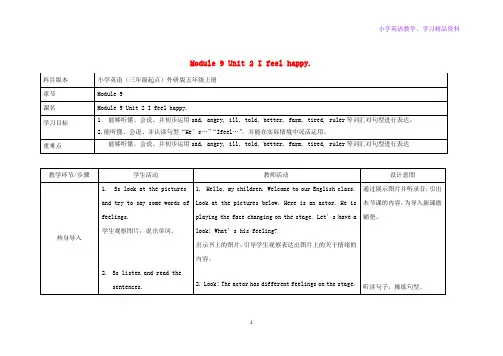
2.Now please watch a video and try to answer the
questions below:
What feelings can you find?
引导学生看视频并尝试表达出本课的具体内容,
2.Well done, everyone! We can find four feeling words in the video. They are tired, happy, sad and angry. Now look at the pictures below, please match the sentences with the corresponding pictures.
出示书上的图片,引导学生观察表达出图片上的关于情绪的内容。
2.Look!The actor has different feelings on the stage.
So today we will talk about feelings.Let’s listen and read the sentences.
引导同学们根据课文所学的内容,看图并跟同伴进行口语练习,试着将有关情绪的句子表达并书写出来。
2.Now pleaselistento the pronunciation of theletters.
Then try to repeat and read the words.
引导学生一起来听听这些字母的发音,试着跟读
Module9Unit2Ifeel happy.
科目版本
小学英语(三年级起点)外研版五年级上册
章节
Module9
课名
Module9Unit2Ifeel happy.
外研版(三起点)英语五年级上册-优质教案-Module 2 Unit 1 What did you buy

2016年教学设计英语科《Module 2 Unit 1 What did you buy?》教学设计一、教学简析:本课为外研版小学英语五年级上册Module 2 Unit 1 What did you buy?新授课第一课时,属于会话教学,本单元教学充分利用旧知识,从而降低学习难度,使知识得以循环巩固,并为下一模块的教学做铺垫。
二、学情分析:五年级学生已经学了两年英语,拥有一定的词汇量和英语知识功底,他们不仅仅停留在学习单词的基础上,他们渴望学到更多更有用的英语知识,他们的英语学习兴趣也非常高涨,因此老师应该抓住这些特点合理设计教学计划,努力提高学生的英语成绩。
三、设计理念:在教学中,主要采用任务型教学和情景式教学相结合。
“任务型”课堂教学模式是将英语的教学目标整合到一个或多个具体的活动任务当中,使学生在使用英语完成任务的同时,在不知不觉中学会英语,更主要的是培养学生在完成任务的过程中提高运用英语的学习紧迫感。
另外,通过让学生自带学具,为学生创设较为真实的语言情景让学生来运用所学的知识,使学生感受到如临其境,触境生情。
四、教学目标:1、知识目标:能够听说认读单词和句子,如:food list cheese need…What did you buy?How many…?2、能力目标:能够询问他人所买物品,如:What did you buy能够询问他人所买物品的数量,如:How many bananas did you buy?3、情感目标:通过看听说演唱等活动,使学生产生学习英语的兴趣,树立学好英语的信心。
五、教学重、难点:重点:使学生掌握新单词,并能在情境中运用。
难点:能够用英语询问他人所买物品以及物品数量。
六、教具准备:单词卡片、录音机、多媒体课件等。
七、课时安排:40分钟完成。
八、教学方法:本单元教学主要运用直观教学法、情境教学法、任务教学法和模仿练习法等等。
九、教学过程:Step 1 Warm-up(热身导入)课前歌曲(Fruit)Greeting:T:Good morning, boys and girls!Ss: Good morning, teacher!T: How are you?Ss: Fine, and you?T: I’m fine. Now let’s listen to a song and then sing it together, ok?Ss: OK!齐听、唱歌曲(Fruit)(设计意图:活跃课堂气氛,创设英语氛围,激发学生的学习兴趣)Step 2 Presentation:(知识呈现)1、教学新单词通过出示Mr Smart和Sam对话的模拟情景,引出新单词:list food cheese(1)出示单词list并领读指读T:If you want go shopping.You can make a shopping list. 紧接延伸: Such as: name list名单; book list书本目录.(2)出示单词cheese并领读指读T:Read together.bananas,apples,pears,and cheese. (3)(指着模拟超市说)At the supermarket.We have some apples,bananas,(出示这些食物课件)noodles,meat。
五年级英语上册Module3Unit1Wheredidyougo教案外研版(三起)
Module3 unit1 Where did you go?一、教材剖析本模块持续学惯用过去时叙述过去发生的事情,本单元是第三模块的第一单元,主要体现本模块所要学习的主要内容,课文经过电话对话,大明咨询Amy, Samand Lingling在英国周末的活动,本单元主要学习一般过去时态,要修业生学会用动词的过去式:visit-visited,go- went ,send- sent, take-took , 说明过去发生的事情。
并在小组内学会问答:What didyou do at the weekend ? We visited lots of places. Where did you go? We went to theBritish Museum .How did you go to these places?We went by bus.等有关句子。
教课目的:知识目标:1. 学习单词British, museum ,thanks,weekend,place,museum,how,best,tookTrip,river,hour,minute,twenty.2.用一般过去时表达过去发生的事情What did you do at the weekend ? We visited lots of places. Where did you go? Wewent to the British Museum.能力目标:1、学会运用一般过去时表达过去发生的事情,特别要掌握部分不规则动词的过去式。
2.经过学习培育学生听、说、读、写和灵巧运用语言的能力,培育学生的竞争和参加合作的意识。
感情目标:经过学习动词的过去式,培育学生敢于张口说英语,并让学生理解时间的难得,学会集理安排自己的作息时间。
学习策略:1.景点资料、单词卡片、课文语境设置情形学习新单词和短语。
2.采纳激励性评论,在教课活动中充足激发学生的求知欲和表现欲,经过小组合作学习,培育学生自主运用语言的能力。
外研版小学五年级英语教案

外研版小学五年级英语教案在语法里,时或时态表示行为发生的时间和说话时的关系。
一般分为过去式、现在式、将来式,通常也有与表示动作进行或终止的进行式和完成式等体貌一起相连用的情况。
下面由我为大家整理了关于外研版小学五年级英语教案,供大家参考。
外研版小学五年级英语教案1:We lived in a small house.教学目标:1、知识目标:(1)New words: life ,different, ago, any, television, grandchildren, us,grandmother, lady(2)New sentences:There were/weren’t …. There are….We lived…many years ago. We live…now.2、能力目标:(1)能根据情境正确使用There be ……,We lived…many years ago. Welive…now.句型谈论生活、学习中的事物(2)培养学生听、说、读、写的能力。
教学重点::如何让学生在课堂上学会 There be …, We lived…many years ago. Welive…now.句型并能在生活中灵活运用该句型。
教学过程:一.预习检测写出下列动词的过去式。
do_____ is____ are_____live_____ have______ watch____二.合作探究,学习课文。
1)播放课文录音,让学生在听录音的同时找出课文中出现的新单词与新句型。
2)进行游戏“火眼金睛找生词新句”。
让学生以竞赛抢答的形式快速找出课文中出现的新单词与新句型。
3)在让学生初步了解了课文内容后,教师再次播放录音,让学生大声跟读课文。
巩固练习;重点句式操练Listen and say。
先让学生听录音,跟读句子,明确本课的重点句式,然后让他们灵活运用句式:Thereis/are……/There was/were……造句。
外研版三起小学英语五年级上册教材分析及教学进度表
外研版三起小学英语五年级上册教材分析及教学进度表一、教材总体介绍及分析(三年级起点)第五册共由10个学习模块和1个复习模块组成。
每个模块包括两个单元,第一单元是新语言呈现单元,第二单元是语言扩展和语言练习单元。
在语言学习过程中,学生将要学习、掌握与话题内容相关的单词和短语65个,若干主要语言结构(见教师用书内容目次部分),以及6首歌曲和4首韵律诗和歌谣。
除这些主要教学内容以外,课文中部分的单词、词组和句式只是为了语境的需要而设置的,可视学生能力情况而要求掌握。
二、学生分析五年级的孩子虽然活泼可爱,求新求异的愿望也比较强烈。
但随着学习任务的加重,学生的学习兴趣在逐渐降低。
在这一学段教师要帮助学生确立正确的学习态度,把握有效的学习方法和学习策略,养成良好的学习习惯。
在课堂教学中教师不能只通过丰富多彩的课堂教学活动(如:游戏,竞赛,表演等),激发他们学习英语的兴趣,还应当注重帮助学生突破学习困难,获得学习知识的快乐。
在本学段教师要特别关注学困生,尽可能地避免两极分化的加剧。
三、总体教学目标根据学生的年段特点,学生对英语学习有持续的兴趣和爱好。
能在图片、图像、手势的帮助下,听懂简单的话语、录音材料和配图小故事;能运用所学语言就本册所学习的话题进行简短对话。
能根据所学内容表演小对话和歌谣。
能听、说、读、写模块单词表中所列出的65个四会单词,能听、说、认读单词表2中非黑体部分单词。
知道字母在单词中的读音;了解44个音素的发音(其中元音音素18个,辅音音素26个);了解简单的拼读规则。
能借助图片读懂简单的小故事或短文,并养成按意群阅读的习惯。
能正确朗读所学故事或短文(对能力强的学生可要求其背诵)。
能模仿范例写句子。
在学习中乐于参与、积极合作、主动请教。
乐于了解与本册话题有关的中国和异国文化、习俗及差异。
对本册教材中出现的大量语法现象教师应在课堂教学中通过创设情境使学生知道并理解其语义和语用功能,引导学生通过观察、归纳、总结这些语法现象的构成并能基本正确地运用,但教师不讲解语法概念。
最新外研版小学英语五年级上册Wheredidyougo公开课教学设计
最新外研版小学英语五年级上册Wheredidyougo公开课教学设计Where did you go?教学设计一、教学目标:1. 知识目标:ffff(1)要求大部分学生能理解,部分学生能掌握的词汇:weekend,place, British Museum, how, best, took, river, hour, minute, trip, along.(2)要求大部分学生能理解,部分学生能掌握句型:What did you do at the weekend? Where did you go?2. 技能目标:(1)能读懂、理解课文大意并回答出相关问题;(2)能运用所学句型询问过去所做的事情,去过的地方,并能回答提问。
3. 情感目标:激发学生学习英语的积极性,培养学生学习的自主性,养成他们乐于交流、乐于合作的品质。
4. 学习策略:1)能积极与他人合作,共同完成学习任务;2)能积极运用所学的知识进行表达和交流。
二、教学重点和难点:重点:1、正确理解课文。
2、用过去时提问并能描述上周末发生的事情。
难点:以what, where引导的一般疑问句过去时。
三、教学辅助:单词卡、多媒体课件、课堂评价,CD-ROM.四、教学过程:(一)Warm up1. Sing a song “Where did you go?”(设计意图:融相关性,趣味性,参与性,激励性为一体的WU,能让学生在轻松愉快氛围中感受学习英语的乐趣。
)2. Free talk:T: What day is today?Ss: Today is ….T: How many days in a week?Ss: Monday, Tuesday, Wednesday, Thursday, Friday and Saturday.T: Yes, for us, Saturday and Sunday are weekend.(板书)What did you do last Weekend?S1:I watched TV.(二)Presentation1. Before ListeningA game: I say you guessT: Today we’re going to learn more about London. Now let’s play a gameI say you guess:1 It can go round and round. What is it?2 It’s very tall and big. What is it?3 It’s a big room, you can see lots of old things there. What is it? S3: It’s British Museum。
英语外研版(三起)五年级上册M5U1There are only nineteen crayons
There are only nineteen crayons.教案乐山市井研县马踏镇中心小学校一.学情分析五年级的学生年龄大概在12岁左右,他们整体认知水平和语言运用能力都有较大地提升和发展,但是,学生在语言知识的综合运用方面存在着一定的差距。
有些孩子们能有意识、主动地学习,但同时也有个别孩子出现厌烦英语的情绪,尤其男生比例较大,所以要充分考虑他们学习英语的兴趣,在小组合作中,以优带进,并注重在练习中分层次练习。
二.教学目标1. Knowledge objectives:(1) the key sentences :There are only nineteen crayons. But there are twenty children in the class. There are twenty-one crayons.(2) 四会单词:crayon, begin, floor 三会单词:thirteen, fourteen, fifteen, sixteen, seventeen, eighteen, nineteen2.Ability objectives:(1) There are only nineteen crayons.(2) Try to apply the drills in their daily life. "how many ---?" "There is/are…"3. Moral objectives: In the real context, the children can flexible application.三.教学重难点Teaching key points and difficulties1.Key points: Sentence: There are only nineteen crayons.Words: crayon , begin , floor2. Difficulties: 1)the pronunciation of these numbers: thirteen, fourteen, fifteen, sixteen, seventeen, eighteen, nineteen2) flexible application:There is or There are四.教学过程Step1 GreetingsT: Good morning, boys and girls.Ss: Good morning, Miss Dan.设计意图:通过问候,集中孩子们的注意力。
外研版五年级英语书
外研版五年级英语书篇一:外研版五年级英语上册外研版小学五年级上册Module2教学设计教学内容外研版小学五年级上册第二模块第1课时Unit1Activities1-2 教学目标1.能够听、说、认、读单词和词组list,need,first,any,cheese,how much,how many。
2.能够听、说、读、写单词:can,ate,buy,lost。
3.能够听懂问句What did you buy?How many /How much…did you…?并作出正确的回答和交流。
重点难点重点:理解和运用句子What did you buy ? We bought some apples.。
难点:how many和how much 的用法区别。
教学准备1、单词卡片2、课文教学挂图3、录音机和磁带4、人物头饰教学设计Step 1 Warm-up教师自编chant进行热身。
教师自编一个chant,先让学生理解chant的内容和大致意思,其次示范唱给学生听,最后让学生模仿和放手说唱一遍。
内容如下: Go and buy some fruit,go and buy some fruit。
OK ! OK ! OK !What did you buy ? What did you buy ?I bought some apples, I bought some apples.Great ! Great ! Great !Step 2 Preview打擂台游戏。
请五名学生到教室前面,教师任意抽取一张卡片,让这五名学生根据卡片上的内容造句,如:卡片上是did,学生可说“Did you go to school yesterday ?.....”不能正确造句的学生则被淘汰出局。
然后教师出示另一张卡片,留在台上的学生继续比赛,最后留在台上的一名学生为擂主。
Step 3 presentation1、学习Look,listen and say. 。
外研版英语五年级上册教案最新4篇
外研版英语五年级上册教案最新4篇外研版英语五年级上册教案1学情分析:学生在4B第八单元已经初步接触There is /are?in / on / near? 句型。
There is / are?in / on / near?是陈述某种客观存在物(或人)的常用句型。
学生已掌握There is/are?in / on / near?句型中is与are的用法和介词in ,on ,near的用法。
五年级的学生,天真活泼,喜欢表现自己,课堂上应该给学生广阔的舞台,让学生充分思考,合作交流和探究,充分表演,让学生品尝学习带来的快乐。
任务分析:在小学牛津英语5A新授单元中,每一单元各由八个版块组成。
这些板块既相对独立,有所侧重,又紧密联系,相互呼应。
本节课是Unit1 PartB PartC。
PartB是单词、词组教学。
PartC 是句型教学。
而教学单词应该与句子、语篇结合起来,努力做到“词不离句,句不离文。
”因此在教学方法上从学生熟悉的事物创设情景,让学生观察、思考、讨论、交流,唤起学生对旧知识的回忆,从而有步骤、有层次建构新知识。
在教学手段上采用计算机辅助教学,使课堂中所呈现的内容更接近学生的生活,提高教学效率,使教学过程中学生的实践活动得以有效实施。
根据以上分析,确定本节课的教学目标和重难点。
教学目标:1、能正确地听、说、读词汇first, reading room, table tennis, toilet, garden,swing,slide。
2、能正确地听、说、读、写词汇any, room。
3、能正确地听、说、读、写句型Is there a/an??Yes, there is. / No, there isn’t. Are there any??Yes, there are./ No, there aren’t.4、能正确运用there be句型问答和表述身边的事物。
5、通过there be句型学习和对身边的事物表述过程中加深学生对学校的了解并激发学生热爱学校的情感。
外研版三年级起始第五册第五模块Unit 1 We visited lots of places.教学设计
【百度参赛】全国中小学“教学中的互联网搜索”优秀教学案例评选教案设计小学英语新标准英语(三年级起始)五年级上册 Module 3 At the weekend.Unit 1 We visited lots of places.教学设计一、教案背景1.面向学生:学生 2.学科:英语3.课时:14.学生课前准备:自己根据音标拼读单词。
二、教学课题学习本课旨在让学生能根据设计的场景运用What did you do? Where did you go? 询问过去的事情,并能利用动词过去式熟练表达过去所做的事情。
通过引导学生了解西方的名胜古迹以及中西方的文化差异培养学生学习英语的兴趣,鼓励学生积极合作学习,突破学习重难点。
三、教材分析本单元的核心教学是能正确使用动词的过去式,利用重点句子What did you do? Where did you go?询问别人过去做过的事情。
本课是本单元的第一课时,通过Lingling与Daming通电话,展现了Lingling在英国参观名胜的经历,主要学习巩固一般过去时的用法。
同时要求学生掌握新的词汇和重点句子。
教学重、难点:重点:wheel, wonderful, understand, postcard;难点:单词The British Museum.的发音和目标句型“What did you do? Where did you go?”四、教学方法听说法,情景教学法,任务教学法,多媒体辅助教学法五、教学过程Step 1 Greet each otherStep 2 Lead-inPlay a song <where did you go?> in module 1 and sing it together. T: Last weekend I went to Chengdu. I had a lovely time there .Now, I will show you some pictures.【百度图片】/i?ct=503316480&z=&tn=baiduimagedetail&wor d=%B3%C9%B6%BC&in=15561&cl=2&lm=-1&st=-1&pn=31&rn=1& di=119670159210&ln=2000&fr=&fm=result&fmq=1330916575156_R& ic=0&s=0&se=1&sme=0&tab=&width=&height=&face=0&is=&istype= 2#pn31&-1&di119670159210&objURLhttp%3A%2F% %2F20090703%2F249955_223353098_2.jpg&fromURLhttp%3A%2F% %2Fshow%2F1%2F62%2Fcaec908bb84dde11.html& W1024&H768&T6721&S190&TPjpg //i?ct=503316480&z=&tn=baiduimagedetail&wor d=%B3%C9%B6%BC%B4%BA%CE%F5%C2%B7&in=21083&cl=2&lm=-1&st=-1&pn=13&rn=1&di=107100714600&ln=1984&fr=&fm=res ult&fmq=1330917324906_R&ic=0&s=0&se=1&sme=0&tab=&width=& height=&face=0&is=&istype=2#pn13&-1&di107100714600&objURLhtt p%3A%2F%%2Flvyou%2Fls_admin%2Fpic%2F 200951513016174.jpg&fromURLhttp%3A%2F% %2Flvyou%2Fshowjjnews.asp%3Fid%3D405&W500&H375&T9219&S 66&TPjpg/i?ct=503316480&z=&tn=baiduimagedetail&wor d=%B3%C9%B6%BC%BB%B6%C0%D6%B9%C8%C3%C5%C6%B1 &in=25092&cl=2&lm=-1&st=-1&pn=30&rn=1&di=113184481080&ln= 1954&fr=&fm=result&fmq=1330917470203_R&ic=0&s=0&se=1&sme =0&tab=&width=&height=&face=0&is=&istype=2#pn30&-1&di113184 481080&objURLhttp%3A%2F%%2Fuploads %2Farticle%2F2011-08%2F44_1312477778.jpg&fromURLhttp%3A%2 F%%2Farticle-84890.html&W800&H600&T 10135&S70&TPjpgStep 3 New words1. T: I had a dream last night: I visited lots of places with my friend, Amy .We visited lots of places, they are so beautiful. Would you like to visi t them? OK, let’s have a look together.展示大英博物馆、伦敦眼的图片,教学生词the British Museum, the London Eye. (呈现单词卡片)反复纠正发音(板书句子Where did yougo ?)反复问答: Where did you go? We went to the British Museum. We went to ...【百度图片】/i?ct=503316480&z=&tn=baiduimagedetail&wor d=%B4%F3%D3%A2%B2%A9%CE%EF%B9%DD%BA%CD%C2%D 7%B6%D8%D1%DB%CD%BC%C6%AC&in=24935&cl=2&lm=-1&st =&pn=4&rn=1&di=132158666040&ln=1015&fr=ala0&fm=ala0&fmq=1 330917634703_R&ic=&s=&se=&sme=0&tab=&width=&height=&face= &is=&istype=#pn4&-1&di132158666040&objURLhttp%3A%2F%2Fw %2Fenglish%2FUploadFiles_7827%2F200712%2F2 0071224182905246.jpg&fromURLhttp%3A%2F%. cn%2Fenglish%2F4513.html&W360&H237&T12030&S74&TPjpg /i?ct=503316480&z=&tn=baiduimagedetail&wor d=%B4%F3%D3%A2%B2%A9%CE%EF%B9%DD&in=8921&cl=2&l m=-1&st=-1&pn=0&rn=1&di=70277624040&ln=1891&fr=ala0&fm=ala 0&fmq=1330917718812_R&ic=0&s=0&se=1&sme=0&tab=&width=&h eight=&face=0&is=&istype=2#pn0&-1&di70277624040&objURLhttp% 3A%2F%%2Fbaike%2Fpic%2Fitem%2Fa8362712c d9cc64af819b880.jpg&fromURLhttp%3A%2F% %2Fimage%2Fa8362712cd9cc64af819b880&W464&H357&T9417&S2 6&TPjpg2. T: And at the weekend, my pen- friend in England sent me a postcard. Ibring it here. 展示明信片,教学生词postcard.【百度图片】/i?ct=503316480&z=&tn=baiduimagedetail&wor d=%D3%A2%B9%FA%C3%F7%D0%C5%C6%AC&in=18688&cl=2&l m=-1&st=-1&pn=5&rn=1&di=25321179270&ln=1997&fr=ala0&fm=ala 0&fmq=1330917953984_R&ic=0&s=0&se=1&sme=0&tab=&width=&h eight=&face=0&is=&istype=2#pn5&-1&di25321179270&objURLhttp% 3A%2F%%2Fimages%2F2009%2Fw26%2F27 284028A.jpg&fromURLhttp%3A%2F%%2Fdeta il%2Fauction-399795-detail.shtml&W1251&H859&T8682&S106&TPjp g3. T: There are some English words in the postcard. Do you understand? 教授understand.4. T: Y ou don’t understand? Oh, let me translate them for you. My friend told me the London Eye is a big wheel, it’s wonderful.教授生词wheel, wonderful.(板书The London Eye is a big wheel ,单词卡片:wheel,wonderful )T:who can read it ?学生读句子。