
人教版七年级英语(下册)Unit 11词汇、句型精讲
人教版 ▏七年级英语(下册)Unit 11 词汇、句型精讲
词汇精讲
1. milk
(1)milk 作名词,意为“牛奶”,是不可数名词。例如:
I’d like a cup of milk. 我想要杯牛奶。
(2)milk 作动词,意为“挤奶”。例如:
I helped the farmer (to) milk the cow. 我帮助农民挤奶。
2. feed
feed 作及物动词,意为“喂养,饲养”,其后常接表示动物名称的词作宾语。例如:
My father’s job is to feed the animals. 我父亲的工作是喂养动物。
拓展:
(1)feed..to…意为“把……喂给……吃”。feed后接饲料或者食物名称做宾语,to为介词,其后一般接动物或者小孩等名词表示对象。例如:
Please feed some grass to the cow. 请给这头奶牛喂些草。
She fed milk to the baby. 她给婴儿喂了奶。
(2)feed 可以做不及物动词,意为“食,吃”(主要指动物),与介词on构成词组,意为“以……为食,靠……为生”。例如:
Sheep feed on grass. 绵羊以草为食。
3. quite&very
词语 用法 例句
quite 语气比very弱,常用于“quite a/an +可数名词单数的结构中。 It’s quite a good idea. 那真是个好主意。
very 语气比quite强,多用于褒义形容词前,常用于Li Ming is a very good student.“a very+可数名词单数”结构中。 李明是个非常好的学生。
4. anything
anything 不定代词,意为“任何事情,任何东西”,常用于否定句和疑问句中,在肯定句中常用something。something, anything作主语时,谓语动词用单数。例如:
I can’t see anything in the box. 盒子里我看不到任何东西。
Is there anything in the box? 盒子里有一些东西吗?
5. pick
pick意为“采,摘”,常用于词组“pick up”,意为“拾起,捡起”, 当宾语为代词时,宾语应放在pick和up中间;当宾语为名词时,宾语可放中间,也可放在后面。例如:
There is a pen on the playground, please pick it up.
地上有一支笔,请捡起它。
Bob stopped to pick up a watch. = Bob stopped to pick a watch up.
Bob停下来,捡起来地上的一块手表。
拓展:
(1)pick up意为“搭载,开车去接”。例如:
The bus stopped and picked up some passengers.
公共汽车停下来,搭载了一些乘客。
Please wait at the school gate. John will pick you up there.
请在校门口等候, 约翰会到那里接你。
(2)pick up意为“偶然学会,获得”。例如:
She picked up English when she played with the American children.
她和美国小孩儿玩的时候不经意间学会了英语。
6. worry (1)worry可用作不及物动词或及物动词。作及物动词时,意为“使烦恼,使担忧”。作不及物动词时,意为“发愁,担心,烦恼”,常与介词about连用。例如:
What’s worrying you? 什么事使你烦恼?
Don’t worry about me. 不要为我担心。
(2)worry也可用作名词。既可作可数名词,也可作不可数名词。例如:
Her face showed signs of worry. 她脸上显出担忧的神情。
I have a lot of worries. 我有很多担心。
(3)worry的过去分词worried相当于形容词,意为“担心的,烦恼的”,常与be/look/feel等系动词连用。be worried about意为“为……担心”。例如:
She is worried about her sick mother. 她担心她生病的母亲。
7. luckily
luckily是副词,意为“幸运地,幸亏,侥幸”。例如:
Luckily there was a doctor on the spot.
幸运的是现场有一位医生。
拓展:
lucky是luckily的形容词形式,意为“幸运的, 吉祥的, 侥幸的”。例如:
He is a lucky dog. 他是个幸运的家伙。
luck是luckily的名词形式,是不可数名词;意为“运气, 好运, 幸运 ”。good luck to sb表示“祝某人好运”,bad luck意为“倒霉”。例如:
She had no luck finding a job. 她很不幸,找不到工作。
I wish you luck =Good luck to you! 祝你好运!
8. exciting&excited
exciting是形容词,意为“令人兴奋的”,一般用来说明事物的特征。例如:
I like football. I think it’s very exciting.
我喜欢足球。我认为它非常令人兴奋。
excited也是形容词,意为“感到兴奋的”,一般用来说明人的感受。例如:
He is very excited at the news.
因为那个消息他很兴奋。
9. slow
(1)slow 作形容词,意为“缓慢的,迟缓的”,其反义词为fast。例如:
Why are you so slow? Hurry up!It’s late.
你怎么这么慢啊?快点!要迟到了。
(2)slow 和slowly一样也可以作副词,但是用法有区别。slow一般用于口语中,不可以用于句首,只能和go, drive或pass连用且位于其后。而slowly比较常用,可以置于句首或者动词之后(或前)修饰动词。例如:
How slow the time passes! 时间过得真慢!
I told the driver to go slow. 我告诉司机慢点开车。
He slowly opened the door. 他慢慢地把门打开。
10. fast
(1)fast 作副词,意为“快地”,可以用来修饰动词或者动词短语。例如:
We got there so fast by train. 我们乘火车很快到了那儿。
(2)fast 作形容词,意为“快的”。例如:
A train is very fast. 火车很快。 拓展:fast&quickly
fast强调动作的速度快;quickly 指动作敏捷或者完成得快。例如:
Li Ming can run very fast.
李明能跑的很快。
He had breakfast quickly and then went to school.
他快速吃完早餐去上学了。
11. all in all
all in all 固定词组,意为“总的来说”,常用于句首。例如:
All in all, it is a great success. 总的来说,它非常成功。
All in all, I’m too excited. 总的来说,我太兴奋了。
拓展:常见的和all有关的词组
after all 毕竟,终究
all over 到处
not…at all 根本……不
all right 行,好的
in all 总共
12. dark
(1)dark作形容词,意为“黑暗的,昏暗的”。例如:
The room is dark and quiet. 这个房间漆黑一片,寂静无声。
(2)dark 作名词,意为“黑暗,无光(尤指夜晚)”。例如:
We stood outside in the dark. 我们站在黑漆漆的屋外。
练一练: Ⅰ. 词形转换。
1. paint (名词)__________ 2. luck (副词)________
3. love (形容词)_________ 4. interest (形容词)_______
5. fast (反义词)_________ 6. cheap (反义词)_______
Ⅱ. 根据句意、汉语意思或首字母提示补全单词。
1. She is badly ill and her mother is w______ about the health.
2. Look at the apple on the trees. Can you p______ one for me?
3. Slow down! You’re driving too f______.
4. I got many g______ on my birthday.
5. The car is too e________ for me to afford.
6. All in a______. You’re too lucky.
7. This is q______ an interesting book.
8. I gave some f______ to my mother on Mother’s Day.
9. I never go to the cities. I come from the c_______.
10. We can get milk from the c______.
Ⅲ. 用括号中所给单词的适当形式填空。
1. He went to the farm and ______ (feed) many chickens there.
2. My friend gave me a _______ (love) dog yesterday.
3. Peter and his family _______ (have) a good time in the park yesterday.
4. He ______ (milk) a cow yesterday.
5. Is there _______ (something) new in today’s newspaper?
6. The old man walked ______ (slow).
人教版英语七年级下册【推荐】Unit11Howwasyourschooltrip(学案2)

金戈铁骑 初中英语学习材料
madeofjingetieji
学习重点
1 初步接触一般过去时态和动词的过去式,并掌握助动词did开头的一般疑问句的问答。
2 通过听听力材料,了解发生在过去活动的一些动词短语及相关信息。
问题导引
亲爱的同学们,你爱旅行吗?你到过乡村旅行吗?在乡村旅行你都会做哪些事情你呢?和大伙说说看吧。
自主学习
一 英汉互译。
1 milk a cow 给奶牛挤奶 2 quite a lot of… 许多 3 grow apples 种植苹果
4 骑马 ride a horse 5 喂鸡 feed chickens 6 照相 take photos
二 写出下列动词的过去式。
1 go went 2 ride rode 3 feed fed 4 take took
5 pick picked 6 do did 7 milk milked
三 翻译下列句子,并按要求进行问答。
1 --- Did you take any photos? (作肯定回答)
--- Yes, I did. 金戈铁骑 2 ----Did they grow apples? (作否定回答)
---- No, they didn’t.
3 ---- Did he eat strawberries? (作否定回答)
----No, he didn’t.
四 完成课本1a部分。
合作探究
任务一 和小组成员一起讨论一下问题。
1 Does your school have any school trips?
2 What do you usually do on your school trip?
图片1 参观博物馆 visit museums
图片2 爬山 go to the mountains
图片3 去农场 go to the farm
图片 4 去动物园 go to the zoo
人教版丨七年级英语下册Unit11~Unit12核心词汇与句型专练

人教版丨七年级英语下册Unit11~Unit12核心词汇与句型专练
【核心词汇专练】
一、用所给单词的恰当形式填空
1. It’s polite ( )up when your teacher comes into the classroom. (stand)
2. Please ( )your homework to school tomorrow. (bring)
3. They ( ) a meeting tomorrow. (hold)
4. My mother gave me an apple with( ) .(smile)
5. The teachers always ________ at us. (smile)
6.Today ()(be) Friday and yesterday () (be) Thursday.
7.Jim ( ) (have) a good time last weekend.
8.The little girl ( )(play) ping-pong an hour ago.
9.He ( )(ride) horses last year.
10.He often ( ) (watch) TV at night.But last night he ( ) (go) to the movies with his
friends.And now he ( ) (talk) about the movie with his mother.
11.Our school trip was ( ) (real) boring. 12.The new film is really ( ) but my mother isn’t ( )in it at all.(interest)
13.The students visited the() farm and had an ( ) (excite) day.
七年级英语下册Units 1--6 期中词汇和句型精讲 人教新目标版
1
七年级英语下册Units 1--6 期中词汇和句型精讲 人教新目标版
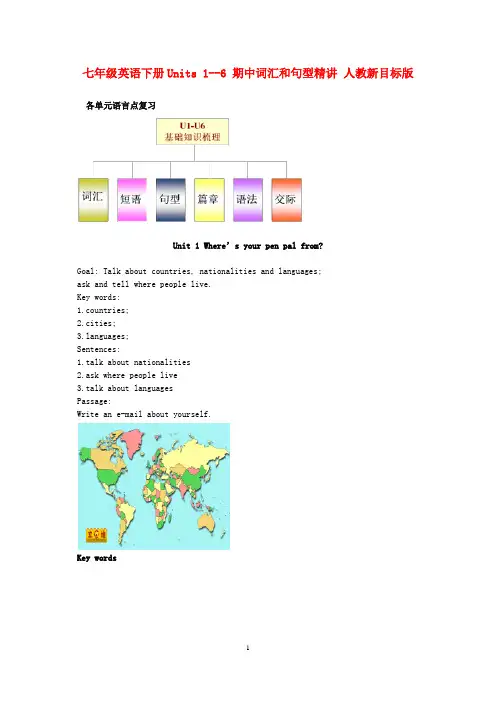
各单元语言点复习
Unit 1 Where’s your pen pal from?
Goal: Talk about countries, nationalities and languages;
ask and tell where people live.
Key words:
1.countries;
2.cities;
nguages;
Sentences:
1.talk about nationalities
2.ask where people live
3.talk about languages
Passage:
Write an e-mail about yourself.
Key words 2
·重点短语:
1.be from „= come from „ 来自
2.a little French 一点点法语
3.on weekends 在周末
4.write to sb 给某人写信
5.tell sb about„ 把关于„的情况告诉某人
6.Japanese for Kids 儿童日语
7.French for Today 今日法语
8.live in / at / on„ 住在„
Key phrases
(please write them down)
be from„/come from„ 来自„
pen pal = pen friend 笔友
speak English 讲英语
(say it in English) 用英语说它
write to„ 写信给„
likes and dislikes 爱憎; 好恶
live in 在„居住
a little 一些 (+un.)
人教版英语七年级下册Unit I'd like some noodles词句精讲精练

2020年初一英语下学期
Unit 10 I'd like some noodles
词汇精讲
1. potato
potato 可数名词,意为“土豆、马铃薯”,其复数形式为 potatoes。例如:
I don’t like potatoes. 我不喜欢马铃薯。
注意:部分以字母o结尾的名词,变为复数时,在词尾加-es。例如:
tomato (西红柿) → tomatoes hero (英雄) → heroes Negro (黑人) → Negroes
我们可以用“黑人英雄爱吃西红柿和马铃薯”这个顺口溜来记住这几个词。
2. size
size是名词,它的意思是“尺寸、大小”,既可以表示物体的大小,又可以表示服装、鞋帽的尺码、号码。What size引导的特殊疑问句经常用来询问规格或者尺码。例如:
-What size shirt do you want? 你要多大号的衬衫?
- I want size 36. 我要36号的。
3. small, medium&large
small, medium, large都可以用来表示物体的型号,small是小号,medium是中号,large是大号。这三个词可以放在表示量的词前做修饰,来说明具体的要求。例如,a bowl of的意思是“一碗”,表示“大碗、中碗、小碗”时,分别在bowl前面加上“large, medium, small”即可。例如:
-What would you like? 您想要点什么?
-I’d like a large bowl of beef noodles. 我要一大碗牛肉面。
4. special
(1)special作名词时,意为“特色菜、特价品、特别的事物”等。例如:
The train is a special for the football game. 那班火车是为足球赛开的专车。
人教版七年级下册英语期中复习 Unit 1-6重点词汇+句型 专项练习题(含答案)

第 1 页 共 34 页 人教版七年级下册英语期中复习 Unit 1-6重点词汇+句型 专项练习题
Unit 1、2重点词汇+句型 专项练习题
【重点词汇专练】
一、根据汉语提示填词
1. Are you good at (跳舞)?
2. What do you (画) on the wall?
3. He (教) us English well, so our English is very good.
4. Mrs. Black (讲) a story to her daughter every night.
5. I like swimming. But I don't want to (游泳) now. It's too cold.
二、用所给单词的恰当形式填空
1. His father sat up and got (dress).
2. It is a good habit to brush your (tooth) after each meal.
3. --- What does your aunt do?
--- She is a math (teach).
4. Do you want (play) volleyball with us?
5. Are you good at (draw)?
6. They need two (music) for their music club.
7. The girl wants to join the (swim) club.
【知识】人教版初中英语七年级下册Unit11基础知识检测题
文档来源为:从网络收集整理.word版本可编辑.欢迎下载支持.
- 1 -文档来源为:从网络收集整理.word版本可编辑. 【关键字】知识
人教版初中英语七年级下册Unit11基础知识检测题
Unit 11 How was your school trip?
Unit11根底知识检测题
一、选择填空。
( )1.Were there ____________ cows?
A. some B. any C. a lot
( )2.---Was there a sport meeting in the hall last night?
---______.
A. Yes, there was B. No, there was
C. Yes, there were D. No, there weren’t
( )3.—Were you at home yesterday?
—____________.
A. Yes, I were. B. Yes, I am. C. Yes, I was.
( )4. — Did they take any photos?
—____________.
A. No, they didn't B. No, they did C. No, they aren't
( )5.My mother ____________ some cakes for us last night.
《新目标英语》七年级下册 重点句型短语归纳
学习必备
欢迎下载
《新目标英语》七年级下册重点句型、短语归纳
Unit 1 Where’s your pen pal from?
Ⅰ、Useful expressions:
1. be from= come from 来自于2. New York 纽约3. the United States 美国4. he United Kingdom 英国
5. one’s (new) pen pal 某人的(新)笔友6. in Paris 在巴黎7. want a pen pal 想要一个笔友
8. a pen pal in China=a Chinese pen pal 一个在中国的笔友9. a very interesting country 一个非常有趣的国家
10. in November 在十一月11.speak a little (French) 说一点儿法语12. like doing sth. 喜欢做某事
13. go to the movies 去看电影14. in school / at school在学校里15. too difficult 太困难
16. write to sb. (soon) = write a letter to sb (soon)(尽快)给某人写信17. pen pal wanted 征招笔友
18. on weekends 在周末19. at school 在学校;在上学20. the long weekend 漫长的周末
21. tell sb. about yourself 告述某人关于你自己的情况22. live in 居住在---
23 .write to sb给某人写信;写信给某人24.in the world 在世界上 25、in China 在中国
26、one’s favorite subject 某人最喜欢的科目27.speak English 讲英语
初中英语新人教版七年级下册Unit1 知识点(单词+词形转换+重点短语+重点句型)2025春
七年级英语下册
Unit1知识点
一、单词
名词
1.狐狸fox
2.长颈鹿giraffe
3.雕;鹰eagle
4.狼wolf
5.企鹅penguin
6.三明治sandwich
7.蛇snake
8.脖子neck
9.鲨鱼shark
10.鲸whale
11.幸运、运气luck
12.象鼻trunk
13.游泳者swimmer
14.文化、文明culture
15.危险danger_
16.森林forest
17.象牙ivory
18.软毛fur
19.听力、听觉hearing
20.南极洲Antarctica
动词 1.猜测、估计guess
2.储蓄、保存、救save
3.捡、摘pick
4.拿、提carry
5.杀死、弄死kill
副词
1.然而、不过however
2.相当、完全quite
形容词
1.吓人的、恐怖的scary
2.巨大的、极多的huge
3.危险的、有危害的dangerous
4.爱嬉戏的、爱玩的playful
5.友好的friendly
6.瞎的、失明的blind
兼类词
1.
(名词)照顾、护理;
(动词)关心、在乎care
2.
(形容词)泰国的、泰国人的;
(名词)泰国人、泰语Thai
二、词形转换
1.Fox
(名词)狐狸
(复数形式) foxes
2.Wolf(名词)狼
(复数形式) wolves
3.Care
(名词)照顾
(形容词)careful(认真的、仔细的)
careless(马虎的)
4.Sandwich
(名词)三明治
(复数形式)sandwiches
5.Scary
(形容词)吓人的
(名词)scare(恐怖、恐慌)
6.Dangerous
(形容词)危险的
(名词)danger(危险) 7.Luck
(名词)幸运、运气
(形容词)lucky(幸运的)
(副词)luckily(幸运地)
8.Thai
人教版七年级下册英语单元语法精讲精练
金戈铁骑 初中英语学习材料
madeofjingetieji
单元同步语法
一、形容词
形容词用来修饰名词,说明事物或人的性质或特征。通常可将形容词分成性质形容词和叙述形容词两类,其位置不一定放在名词前面,有时也可放在后面。下面只介绍性质形容词。
直接说明事物的性质或特征的形容词,我们称之为性质形容词。它有比较级和最高级的变化,可以用程度副词修饰,在句中可作定语、表语或补语。如cold(冷的),happy(快乐的),tall(高的),beautiful(美丽的)等性质形容词在形容词中占大多数。eg:
She is a beautiful作定语 girl.她是个漂亮的女孩。
The girl is beautiful作表语.这个女孩很漂亮。
We’ll do our best to make our city beautiful作宾语补足语.我们将尽力使我们的城市美丽。
二、特殊疑问句
1.特殊疑问句的定义及特殊疑问词
特殊疑问句就是对句中某一特定部分进行提问的疑问句,句首用特殊疑问词,句末用问号,一般读降调。特殊疑问词包括wh开头的特殊疑问词,或how及以how开头的词组。它们分别是:who,whom,whose,which,what,when,where,why,how,how
much,how many,how long,how soon,how often,how far等。
2.特殊疑问句的两种语序
(1)当疑问词作主语或主语的修饰语时,要用陈述句语序,即主语在前,谓语在后。eg:
Who is waiting for you?谁在等你? (2)当疑问词不作主语时,要用疑问语序,即疑问词+一般疑问句?eg:
What animals do you like?你喜欢什么动物?
Where is the panda from?大熊猫来自哪里?
3.疑问副词why的用法
(1)疑问副词why引导的特殊疑问句是询问“为什么做某事;做某事的原因”,回答时一般用because引出句子。eg:
人教版七年级英语下册Unit11复习教案
人教版英语七年级下册教案
主备人:_ _ 审核人: 复备人:
授课班级 七年级 班 授课类型 复习课
本节课标题 七年级下Unit 11复习
复习目标 重点单词 :Milk、cow、horse、feed、farmer、quite、grow、pick、yesterday、luckily、excellent、anything、worry、
重点短语:milk a cow 、ride a horse、feed chickens、quite a lot、show...around、all in all、be interested in、not at all、
基本句型:-How was your school trip ? –It was great!
-Did you see any cows? -Yes, I saw quite a lot.
-Were the strawberries good ? –Yes, they were.\ No, they weren’t.
复习重点 语法:一般过去时态
复习难点 1. Be动词的一般过去时
2. 实义动词的一般过去时态
导学过程设计 备 注
导学步骤
及
主要内容 一、(师生同做)激发学生学习兴趣,组织教学,情境创设。(2分钟)
Greetings and revision.
1.Greeting the whole class as usual.
2.Revision
二、导入新课,板书课题,示学习目标。(1分钟)
Show a picture and tell Ss: This is also a farm. Last week Carol and his classmates
had a school trip. They went to the farm. What did they do on the farm? How was