
译林版牛津英语9A unit3 reading
Teenage problems Reading (I)
Millie
Simon
Kitty
Daniel
Amy
Sandy
Pair work:
What problem does he/she have? What should he/she do?
Match the words with their meanings
Mr Friend is replying to Millie’s and Simon’s letters. Help him complete the sentences with the words in the box.
To Millie
stay up plan her day carefully
What are Simon’s problems?
strict parents
not enough time for hobbies
1. How is Simon crazy about football? He loves watching football, reading about football and playing football. 2. What’s the cause of his problem? His love of football. 3. How long does Simon play football? He plays for hours and never worries about the time. 4. Why does he get into trouble? Because his parents don’t allow him to play outside after 6 p.m. 5. What does Simon think of hobbies? Hobbies can help us relax and make our lives more interesting.
don’t forget about his schoolwork stay out play football for an valuable hour or two
strict
Y: You F: Mr Friend Y: Excuse me, Mr Friend. I have a problem. Sometimes, I … and I really don’t know what to do. Can you give me some advice? F: Well. First, you can …. Second, you can also … Y: Thanks for your valuable suggestions.
homework
spare make a list of all the homework she has hobbies work out how much time she needs volleyball choose her hobby according to the time she has worth
Make an interview. Talk about your problems with Mr Friend. Work in pairs or groups.
F: You’rbe difficult. When you have problems in your life or study, you should
lots of homework
staying up late
not enough time for hobbies
What are Millie’s problems?
Letter 1:
( T ) lie has much homework every day. ( F ) lie finds it easyhard to stay awake the next day. ( F ) lie has enough spare time for her hardly has any hobbies. doubts if is worth spending so ( F ) lie finds it much time on homework. ( T ) lie dreams of a long holiday in order to have more time for her hobbies.
accept the facts,
stop worrying,
find out the cause,
get some advice,
try your best to solve them.
1. Listen to the tape, read the letters over and over again. 2. Tell friends your problems. 3. Finish off the relevant exercises
Mr Friend is replying to Millie’s and Simon’s letters. Help him complete the sentences with the words in the box.
To Simon
important go home earlier
advice playing
e 1. choice ___ g
2. stay up ___
h 3. imagine ___
4. doubt 5. cause 6. strict
b ___ a ___ c ___
f 7. develop ___ d 8. valuable ___
a. reason b. be not sure if something is true c. making sure that rules are obeyed d. very useful or important e. the right to decide which thing you want f. start to have a skill, ability, etc g. go to bed later than usual h. form a picture in your mind of someone or sth.
牛津译林版英语9A Unit3 Teenage problems知识归纳与拓展

9A Unit3 Teenage problems 【单词拓展】1.deal vi.处理,对付(deal—dealt—dealt)→deal n.大量;很多;交易2.teenage adj.青少年的→teenager n.青少年→teens n.十几岁3.choice n.选择-→choose n.选择,挑选4.awake adj.醒着的--→wake v.醒来唤醒(wake--woke—woken)5.valuable adj.宝贵的;贵重的'→value n.价值;有用;重要→valueless adj.没有价值的;不值钱的6.worry n.担心;担忧的事-→worry v.担心→worrying adj.令人担忧的→worried adj.担忧的7.pronounce vt.发音→pronunciation n.发音,读音8.silence”.安静,寂静;沉默→silent adj.沉默的;寂静的→silently adv.沉默地9.s tress”.精神压力紧张→stressed adj.紧张的,感到有压力的10.suggestion n.建议→suggest vt.建议11.hardly adv.几乎不→hard adv.努力地;辛苦地12.imagine vt.&vi.想象;设想→imagination n.想象力13.worth adj.有……的价值,值得-→worthless adj.没用的;无价值的→worthy adj.值得的14.doubt vt.怀疑-→doubtful adj.不确定的;怀疑的15.solve vt.解决→solution n.解决办法【短语归纳】1,eat less and exercise more少吃多锻炼2.have enough time to do sth有足够的时间做某事3.drive sb mad使某人发狂4.have no choice but to do sth除了做某事以外别无选择5.stay up熬夜6.stay awake保持清醒7.offer sb some suggestions给某人提供一些建议8.develop our hobbies培养我们的爱好9.stay out late在外面待到很晚10.achieve a balance获得平衡11.work out算出;解决12.agree with sb同意某人(的看法)13.solve the problem解决问题14.pay no attention to 不理睬15.seem much happier显得更加高兴16.make progress in在……上取得进步17.be of sb’s age与……同龄【句型分析】1.I dream of a long holiday so that I could have more time for my hobbies.(P36) 句中的so that用来引导目的状语从句,常与may,can,will等连用,意为“为的是”,相当于“in order that”。
英语九上牛津译林unit3:配套练习(3)及解析

英语九上牛津译林unit3:配套练习(3)及解析本卷须知1. 答题前,考生先将自己的姓名、准考证号填写清楚,将条形码准确粘贴在考生信息条形码粘贴区。
2、选择题必须使用2B铅笔填涂;非选择题必须使用0.5毫米黑色字迹的签字笔书写,字体工整、笔迹清楚。
3、请按照题号顺序在各题目的答题区域内作答,超出答题区域书写的答案无效;在草稿纸、试题卷上答题无效。
4、保持卡面清洁,不要折叠,不要弄破、弄皱,不准使用涂改液、修正带、刮纸刀。
UNIT3PERIOD3配套练习基础题型【一】单项选择〔此题共15小题;每题2分,总分值30分〕从A、B、C、D四个选项中,选出可以填入空白处的最正确选项。
〔〕1.ITHINKYOURADVICEISOFGREATVALUETOMEANDIT'SWORTH____________.A.TOTAKEB.TAKINGC.TOGIVED.GIVING〔〕2._________ISKIND________YOUTOGIVEYOURSEATTOAWOMANWITHABABYINHERARMS.A.THAT;FORB.IT;FORC.IT;OFD.THAT;,OF〔〕3.THISTYPEOFMP4ISMYFAVORITE,BUTICAN'T___________IT.A.SPENDB.COSTC.PAYD.AFFORD〔〕4.一COULDYOUTELLME__________TOHAVETHEPICNIC?一NEARTHESUNSHINEPARK.A.HOWB.WHEREC.WHYD.WHEN〔〕5.JACKLIKESTO_____OTHERSBUTNEVERWRITESTOTHEM.A.HEARB.HEAROFC.HEARABOUTD.HEARFROM〔〕6.TRUDYINVITEDMETOHERHOME.AMIALLOWEDTO_____PASTTEN?A.STAYINB.STAYOUTC.STAYUPD.STAYWITH〔〕7.–IDON'TKNOW______WITHTHISPROBLEM.IT'STOOHARD.-YOUCANASKMRWANGFORHELP.A.WHICHTODOB.WHENTODOC.WHATTODOD.HOWTODO〔〕8.--DIDYOUFINDTHESMALLVILLAGEYESTERDAY?--YES,WITHOUTANYDIFFICULTY,FORITHAS______CHANGEDOVERYEARS.A.HARDLYB.GREATLYC.CLEARLYD.NEARLY〔〕9.MYFATHERISSTRICT______MEANDHEISALSOSTRICT______HISWORK.A.WITH;INB.IN;WITHC.WITH;WITHD.IN;IN〔〕10.CANYOUFINDAWAYOFTHISPROBLEM?A.DEALWITHB.DEALABOUTC.DEALINGWITHD.DEALINGABOUT〔〕11.THATGIRLIS_____YOUNGTOKNOW_____.A.SO,WHATTODOB.TOO,WHATTODOC.SO,HOWTODOD.TOO,HOWTODO〔〕12.MYSONWANTSAPETRABBITFORLONG,BUTIHAVENOTIMETOBUY______FORHIM.A.ITB.ONEC.THISD.THAT〔〕13.---EXCUSEME,HOWCANIGETTOTHESTATION?---TURNLEFTANDTHENGOSTRAIGHTON.YOU__________MISSIT.A.MAYNOTB.NEEDN'TC.SHOULDN'TD.CAN'T〔〕14.THEREARESOMANYKINDSOFCOMPUTERSINTHESHOP.IREALLYDON'TKNOW______TOCHOOSE.A.WHATB.WHICHC.HOWD.WHERE〔〕15.--PLEASEBRINGLITTLETOMNEXTTIMEYOUCOMETOANHUI.-______,THANKYOU.A.IWILLB.IHOPESOC.THAT'SRIGHTD.MYPLEASURE【二】词汇〔此题共10小题;每题1分,总分值10分〕A、请根据句意或括号中的中文提示,英文释义,写出句中所缺单词,使句子通顺。
9A+Unit3+Teenage+problems+Reading(共27张PPT)
It's very noisy at home. The TV is always on.
My parents work all day. They don't have time for
me.
She always quarrels with her cousin. Because her cousin always makes a lot of noise
No, they don’t.
5.What problem does Simon have?
He doesn’t have enough time to play football.
Explanation
vt. 获得,达到,完成
1.Can you please advise me how to achieve n. achievement a balance between my schoolwbeosrktriactnwditmh sybhobbies?
对……要求严格
be strict with sb // in sth
1. 我妈对我要求严格.
My mother is strict with me.
2.我妈对我的学习要求严格.
My mother is strict in my study.
allow: allowed---allowing---allows Eg. Smoking is not allowed here.
be strict in sth
2.I really don’t understand why they are so strict.
offer sb sth =offer sth to sb
江苏省牛津译林版九年级上册 Unit 3 单词短语句型默写(含答案)答案版
江苏省牛津译林版9AU3单词短语句型默写一、单词默写(单词默写答案,请参照课本)备注:单词表是按照课本设计进行编写的,有需要的老师,可以自行进行删减和调整。
二、短语默写1.变胖get fat2.你怎么啦what’s wrong/the matter?3.吃太多eat too much4.为什么不少吃多锻炼why not eat less and exercise more5.得到足够的睡眠get enough sleep6.有足够多的时间做某事have enough time to do something7.电视机总是开着The TV is always on8.课堂上感觉累feel tired in class9.有亲密的朋友have close friends10.考试中得高分get high marks in exams11.使我受不了drive me mad12.更好得安排你的时间manage your time better13.别无选择,只有做……have no choice but to do……14.熬夜stay up late15.保持清醒stay awake16.准时on time17.值得做某事be worth doing18.梦想……dream of19.给某人提供一些建议offer sb some suggestions/ advice20.收到某人的来信hear from21.对……痴迷be crazy about22.陷入困境get into trouble23.对某人要求严格be strict with sb/ in sth24.在……和……获得平衡achieve a balance between25.算出work out26.根据……according to27.最好做某事it is better for sb to do/ had better do28.对某人很有价值be valuable to sb/ be of great value to三、句型1.I have a problem, but I wonder how I should deal with it.我有一个问题,但是我想要知道我应该怎样处理它。
牛津译林版9AUnit3《teenageproblems》优秀教学案例(共5课时)
2.通过口语表达和小组讨论,培养学生的交际能力,提高学生在实际情境中运用英语进行沟通的能力。
3.通过案例分析和问题解决,培养学生的批判性思维和解决问题的能力。
4.通过写作和分享,培养学生的自我表达和反思能力,提高学生用英语进行写作的能力。
(三)情感态度与价值观
1.引导学生关注自身成长过程中所遇到的问题,培养学生对青少年问题的认识和关注。
五、案例亮点
1.生活化情境的创设:本案例通过引入真实的生活情境,如学习压力、父母关系等,使学生能够更好地理解和应用所学知识。这种情境创设不仅能够激发学生的兴趣,还能够提高学生的实际应用能力,使英语学习更具有现实意义。
2.学生主动探究的学习方式:本案例引导学生提出问题、寻找答案,激发学生的思考和探究欲望。通过问题导向的方式,学生能够主动参与到学习中,培养独立思考和解决问题的能力。
4.选取小组讨论的结果进行分享和讨论,丰富学生的学习经验和视野。
(四)总结归纳
1.通过提问和讨论,引导学生对所学知识进行总结和归纳,巩固学习成果。
2.利用思维导图或概念图,将所学知识点进行整合和展示,帮助学生形成知识体系。
3.强调本节课的重要内容和知识点,提醒学生注意和复习。
4.引导学生进行自我评价和反思,让学生认识到自己的学习成果和不足之处。
3.小组合作的教学策略:本案例通过设计小组讨论和合作任务,让学生在小组内进行交流和合作,共同解决问题。这种教学策略不仅能够培养学生的团队合作意识和沟通能力,还能够促进学生之间的相互学习和共同进步。
最新牛津译林版 9A Unit3 词组和短语
英语短语和词组
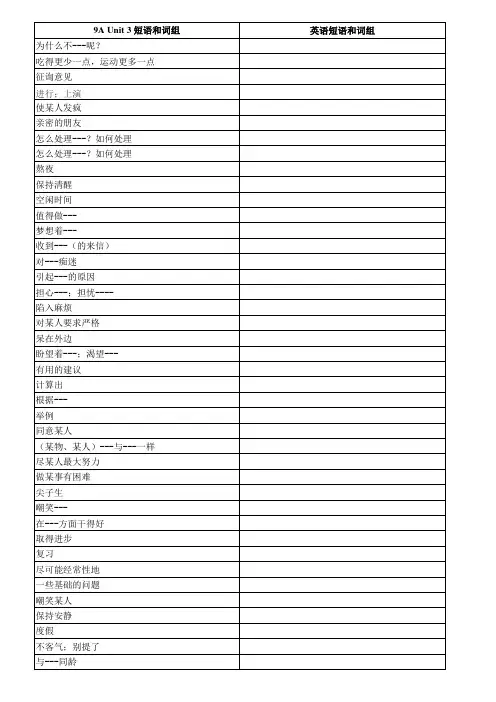
9A Unit 3 短语和词组 为什么不---呢? 吃得更少一点,运动更多一点 征询意见 进行;上演 使某人发疯 亲密的朋友 怎么处理---?如何处理 怎么处理---?如何处理 熬夜 保持清醒 空闲时间 值得做--梦想着--收到---(的来信) 对---痴迷 引起---的原因 担心---;担忧---陷入麻烦 对某人要求严格 呆在外边 盼望着---;渴望--有用的建议 计算出 根据--举例 同意某人 (某物、某人ห้องสมุดไป่ตู้---与---一样 尽某人最大努力 做某事有困难 尖子生 嘲笑--在---方面干得好 取得进步 复习 尽可能经常性地 一些基础的问题 嘲笑某人 保持安静 度假 不客气;别提了 与---同龄
牛津译林版9A Unit3 Teenage problems task课件(共20张PPT)
You also worry about exams. Your parents care too much about your marks after each exam, so you always feel stressed. (2)____________________ Why not talk to them and
Task 2: How to write a reply about how to deal with problems?
1. How many parts are there in the writing plan? 2. What are they?
the structure of the reply
5. If you are feeling stressed, you should _____. a shout at people b keep quiet c share your problem with somebody 6. The problem of stress gets worse when you _____. a keep it to yourself b relax and take a holiday c ask for friends’ help
Tip
Before writing, it’s necessary to
organize our ideas first. When writing
a reply about dealing with problems,
we need to tell others two points: • problems • suggestions
牛津英语9A Unit3单词讲解
牛津9A Unit 3 重点词汇解析1. teenage adj. 青少年的He is too old now for teenage parties.他年龄太大了, 不适于参加少年聚会。
a teenage idol. 青少年偶像n. 青少年时期2.mad adj. 发疯的,生气的1.疯了的, 发疯的, 神经错乱的Don't fight with him, he is a mad man. 别跟他打架, 他是疯子。
She must have been mad to do such a thing. 她干这种事情准是发疯了。
drive sb. mad 使(人)发狂; 害得某人精神失常The noise outside the building nearly drove me mad. 楼外的噪音几乎使我发疯。
2.恼火的, 发怒的be mad at 对...发怒When the boss gets mad, leave him alone. 当老板生气时, 不要理他。
He was mad about being waked up so early. 他因这么早就被叫醒而生气。
3.狂热的; 着迷的He is mad for fame. 他疯狂地追求名誉。
He is mad about her. 他对她着了迷。
4.愚蠢的His mad mistakes amused all of us. 他愚蠢的错误使我们大家都发笑了。
go [run] mad 发怒, 发疯3. disturb vt. 打扰,扰乱1.打扰, 妨碍, 干扰Don't disturb him. 别打扰他。
2.使焦虑, 使烦恼,使不安His passion for his cause disturbed me. 他对事业的热情使我焦虑不安。
3.扰乱, 弄乱, 搞乱I felt disturbed to hear of your illness. 听说你生了病, 我感到不安。
牛津译林版9A Unit3 Teenage problemsGrammar透析(有答案)
牛津译林版9A Unit3 Teenage problems Grammar透析(有答案)【语法一连接代词和连接副词引导的宾语从句】(1)连接代词what, who, whom, whose, which和连接副词when, where, how, why 等引导的宾语从句中,连接代词与连接副词有具体词义,并且在宾语从句中充当句子成分。
在从句中,连接代词多作宾语、主语和定语,连接副词多作状语。
【例句】1.Do you know who is singing?你知道谁在唱歌吗? ( who作主语)2.I don't know whom he is working with.我不知道他在和谁一起工作。
(whom 作宾语)注意:who与whom都指人,意思是“谁“”,其中who为主格,多在宾语从句中作主语; whom 为宾格,在从句中作宾语。
在口语中可用who代替whom作宾语。
3.We do not know whose bike this is.我们不知道这辆自行车是谁的。
(whose作定语)4.I wonder where he lives.我想知道他住在哪儿。
( where作地点状语)(2)宾语从句的语序必须是陈述语序。
【例句】She wants to know when the rain will arrive.她想知道火车什么时候会到。
(3)含有宾语从句的复合句的标点由主句决定。
【例句】No one knows what he is doing. 没人知道他在做什么。
Could you tell me how I get to the hospital? 你能告诉我怎么到达医院吗?(4)宾语从句有自己的时态。
主句时态为一般现在时,宾语从句用自己所需要的任意时态。
主句时态为一般过去时,从句也要用相应的过去时;从句讲述的是客观事实或真理,从句时态用一般现在时。
【例句】I know when he will come tomorrow.我知道明天他将什么时候来。
九年级英语9A Unit3全套精品教案 牛津版
9AUnit3 teenage problemsPeriod One(Wele to the unit/ vocabulary )●objectives1.to talk about problems and their causes2.to think about personal problems and how to deal with them.3.To understand the different meanings of the verb “to be”4.To use the verb “to get” when talking about problems●Language function and focusI’ve got a problem.=I have a problem.Eating too much makes you unhealthy. Get too many tests and examsQuarrel with sb. Family membersGet a bus=take a bus get angry=bee angryI don’t have much time to revise for tests.●Teaching methodsListening/ writing/ speaking/discussing●Teaching proceduresPart A1.Explain that most teenagers have problems. Tell students that if they ever need to talk abouttheir problems, they should talk to their teachers, friends or family. Tell students that having a problem is nothing to be ashamed if ----everyone has worries from time to time.2.Ask students work in groups. Discuss their problems and write on the paper. The teacher callsome groups to speak out the problems and help them how to solve them.3.Show the students pictures about problems. Ask individuals to speak out which problem it is.If one has spoken out, he or she can ask his or her best friend to speak out next problem.4.Ask students to work in pairs to plete Part A on Page 39. Once all students have finished, askone student at a time to read out what they have written. Listen for mistakes and mispronunciation.Part B1.tell students you want to do a survey of the problems that students in the class have. Write thefollowing headings on the board:Not enough sleepNot enough time to do homeworkToo noisy to studyLonelyArgue with cousin/classmate/parentParents are always busyRead out each problem in turn, and ask students to raise their hands if they have this problem. Make a tally of the problems that students have. This will reinforce a group feeling. Finally, make a note of the biggest problem the class has. Write the following on the board:“The biggest problem Class …Grade ... has is …”2.Explain that part B is different from the previous exercise, as students have to rank how bigthese problems are in their lives.Explain to students that number 5 means that this is a big problem for them while number 1 means it is a small problem.3.Tell students to plete Part B on their own. You may want to give the exercise as homework, asstudents may feel fortable writing about their problems in private. You could ask volunteers to give their answers but do not force students. If there are no volunteers, do not go over the answers to this exercise with the class. Keep the students’ answers confidential.4.For stronger classes, ask students to add what they consider to be the biggest problemsteenagers face to the list if these are different to those on the list.V ocabularyPart A1.Explain that the words in the box at the top of Page 44 are synonyms of the verb “to get”below the pictures, and can be used to replace “get” in each picture.2.Ask students to work in pairs to plete Part A.3.For weaker classes, ask students to read out the answer for each picture. For stronger classes,after students have read out the answers, ask them to make sentences using the phrases under the pictures.Part B1.Explain to students that they can use their answers from Part A to help then with the exercisein Part B. for weaker classes, students can work in pairs to plete Part B. For stronger classes, students can work on their own.2.For stronger classes, once students have finished, ask two students to read out the whole letter.pliment them on parts of the letter they read particularly well.3.For weaker classes, ask students if they have the same problems as Amy. Ask students to raisetheir hands if they do. For stronger classes, ask students what their advice would be for Amy. ic strip1.Play the tape for the students to find out the problem. If they can’t get the answer, the teachercan play the second time.2.Explain some language points for the whole class. Then ask them to try to perform this shortplay.Homework:1.If you have any ___________ (问题),you can ask your teacher for help.2.Eating too much is bad for our ____________. It makes us __________ (健康)3.____________ (游泳) is one of my favourite sports.4.John got up too late to have breakfast, so he felt ___________ at school.5.The meeting has bee ___________ (结束) for two hours.6.Thank you for ___________ (邀请) me to your party.7.You must look after y_________ and keep healthy, Mum and Dad.8.We have our first class at a _____________ (一分钟)to eight.Design on BbStudent s’ problemstoo noisy after classDon’don’后记:通过这堂课使我了解到学生中的各个问题和他们的想法。