
人教版英语八年级上册第三单元Unit3知识点讲练-word
第 1 页 八年级上册Unit 3 Section A Page 17 1. 两个事物进行比较可以用形容词或副词的比较级表达: (1) A + be+ 形容词比较级+ than +B (A比B更… ) Jane is taller than Kate. (2) A + 动词+ 副词比较级+ than +B (A比B更… ) Jane runs faster than Kate. 2. 形容词的比较级的构成。 (1) 比较级一般在形容词后加_________, 如:tall—taller, short—shorter, old—older (2)以辅音字母+y结尾的双音节词,应该_______________________, 如:funny—funnier, heavy—heavier. 单音节词除外,如: shy— shyer (3)如果只有一个元音字母,并且后有一个辅音字母结尾,应该___________________________, 如:big—bigger, thin—thinner (4)多音节词的比较级,应该___________________, 如:outgoing—more outgoing, beautiful—more beautiful (5)不规则词的变化需要死记: good/well---___________; bad/ill--____________, many/much---_________; little---________; far--_______ 3. (1) both….and…. 表“两者都”,连接两个主语时视为复数。如: Both you or I ______ right. ( be ) 你和我都是对的 (2) either...or…表“要么…要么…”,连接两个主语时,谓语动词遵守就近原则。如: Either you or I ______ right. ( be ) 要么你要么我是对的 4. both表“两者都”,all表“多者都” 题:_______ of my parents are teachers. We are ________ in China. 5. play the drums 打鼓 (乐器前要加the,drum要用复数,架子鼓不止一个) 6. heavy (1)重的 (2) 胖的,同义词为fat,反义词为thin. 7. 反义疑问句:前面是陈述句,用来表达自己的观点,后面反问对方以证实自己的观点。基本规律为前肯后否,前否后肯。后面的附加疑问句的构成与改一般疑问句的方法相同。如: ① He isn’t a teacher, ___________ ? ② She can dance, _________ ? ③ He likes English, __________? (1)反义疑问句的回答根据事实用Yes或No来回答,但前否后肯的很容易出错,可改成一般疑问句或前肯后否再作回答。如; He can’t sing, ___________ ? ( 如果他能,怎么回答)----- _______________ (2) this, that 和表物的不定代词做主语,用it代替;表人的不定代词用they来代替。 Something is wrong, __________ ? Everyone likes English, _____________ ? (3)反意疑问句的陈述部分带有little, few, never, hardly, seldom等否定意义的词时,问句部分用肯定式。如: There is litter water in the cup , __________ ? (4)反意疑问句的陈述部分含有由un-, im-, in-, dis-, 等否定意义的前缀构成的词语时,陈述部分要视为肯定含义,问句部分用否定形式。如: Your father is unhappy, ___________ ? (5)反意疑问句的陈述部分为I don't think+ that从句时,从句为否定意义,问句部分的动词和主语仍与that从句保持一致且用肯定式。如: I don't think that you can do it, __________? (不用do I?) (6)陈述部分为Let's……时,因为此句型用来提建议,所以问句部分习惯上用shall we?第 2 页
如: Let's go home together, shall we? (7)陈述部分为Let us……时,问句部分习惯上用will you?形式。如: Let us stop to rest, will you? (8)陈述部分为祈使句,问句部分可以用will you和won’t you。 ①Please open the window, won’t you? (肯定祈使句有时也可以用will you?提问) ②Don't make any noise, will you? (否定祈使句只能用will you ?) Section A Page 18 1. 形容词和副词 (1)形容词常译为“....的”。①常放名词前,修饰名词,如:a good boy ②也可以放系动词后做表语,用来描述主语是怎么样的。如:The boy is good. (2)副词常译为“…地”。 常放动词后,修饰动词,表“怎样地做某事”,很多副词以ly结尾,如 do well;run fast;get up early;talk loudly;speak quietly. 2. 以ly结尾的副词和形容词,一般前面加more 构成比较级,但early和friendly 例外。如: loudly→ more loudly,quietly →more quietly,early →earlier,friendly →friendlier 3. 同级比较:表两事物是一样的,形容词和副词用原形。 (1)A +be +as +形容词原形 + as +B ( A和B是一样地…) Jane is as tall as Kate. (2)A +动词+as +副词原形 + as +B ( A和B做某事一样地…) Tara works as hard as Tina. (3) not as…as = not so…as表“不如...”, 常可以与比较级转换。如: Jane is not as/so tall as Kate. (Jane不如Kate高。) = Kate is taller than Jane. (Kate比Jane更高) 3. the singing competition 唱歌比赛 4. fantastic = great 好极了的 It was fantastic/ great 5. Which 用来问“哪一个”,回答常用“The + 名词+描述性短语”,如: ________ one was Lisa ? ---- The one with shorter hair. ( A. Who B. Which C. What ) 6. win ( won )赢,后接比赛、名词、奖品做宾语,如: He won the game. He won the first place. 7. 不定式可以放be 动词后做表语,表“….是去做某事”,如 The most important thing is to learn something new. 最重要的事是去学新的东西。 Their dream is _________ a bridge. ( have ) My job was _______ chickens. (feed) 8. learn something new 学习新的东西 (形容词放不定代词后) 9. have fun = enjoy oneself = have a good time 玩得开心,过得愉快 have fun doing sth. 在做某事中过得愉快 We have fun ________ English. ( learn ) Section A Page 19 1. 比较级的几种特殊用法: (1) “比较级 + and + 比较级”或“more and more +多音节词”表示“越来越……” 如:① warmer and warmer ② more and more beautiful. (2) “the +比较级+句子, the+比较级+句子”,表示“越……,越……”。 The more we get together, the happier we’ll be. 我们越多的在一起,我们就越快乐。 (3) 修饰比较级的词有:a little, much, a lot, rather, even等,不能用very修饰比较级 He is ______ taller than me. ( A. a few B. a little C. very D. many ) (4) 两个相同对象进行比较,为了避免重复,常用that来代替前面的单数比较对象,用第 3 页
those来代替前面的复数比较对象。 The weather in Beijing is much colder than that in Hubei. (that=the weather) The trees are greener in the country are much greener than ________in the city. (5) less与more 的转换: Math is less interesting than English. (趣味性更少些) = English is ________interesting than math. (6) 在比较级中,the other 后接复数名词,表“其它的一些”;any other 后接单数名词,表“任何其它的一个”。如:① I’m louder than the other ______ in my class. (kid) ② I’m taller than any other _______ in my class. (student) (7) the + 比较级+of the two. (the用来特指“比较…的那一个”) He is ______ _______ of the two. ( tall ) 2. hard-working勤奋的; work hard 努力地工作;hard work 辛苦的工作 He is______________, he has to do some __________,but he ___________. Section B Page 20 1. be talented in 在某方面有天赋 She is talented in music. 2. do the same things as me 跟我做相同的事 3. true形容词,真实的;truly副词,真地,truth名词,事实 ①That’s_________. ② He _______ cares about me. ③Tell me the ________. 4. care about 关心,在乎 Nobody cares about me. take care of = care for = look after 照顾 I can take care of myself. 5. 使令动词有:make, let, have,它们都可以表“使、让某人做某事”,使令动词后接动词原形,即:make/ let/ have sb do sth. 如: ①It makes me ______ . (laugh) ②Let me ______ you. (help) ③He had her ______ there. ( go ) 6. laugh at 嘲笑某人 It’s not good to laugh at others. Section B Page 21 1. be like 像;look like 看起来像(强调外表) The teacher ____________ my mother to me. 2. be serious about 对…是严肃认真的 I’m serious about that. 3. do sth. together 一起做某事 We enjoy studying together. 4. 句型:It’s + 形容词+ (for sb.)+ to do sth. 表“(对于某人来说)去做某事是…的”。 It’s not easy for me __________friends. ( make) It’s not necessary to be the same. 【总结】it是形式主语,它代替后面的不定式短语。 5. make friends with sb. 和某人交朋友 I want to make friends with you. 6. as long as 只要 As long as you study hard, you’ll get good grades. 7. be the same as “与…一样”,be similar to “与…相似”,be different from “与…不同” 题:His eating habits aren’t the same as mine. = Her eating habits are mine. 8. bring out the best in me 我最好的方面表现出来 9. be/get good at 擅长,be better at 更擅长,get better at 变得更擅长 I’m getting better at tennis. (我正慢慢变得更擅长网球) 10. get good grades 取得好成绩, get better grades 取得更好的成绩 11. should表“应该”,是一个情态动词,所以后接动词原形。He should ______ hard. (study) 12. in fact 事实上 In fact, she’s funnier than anyone I know. 13. talk with/ to 和某人交谈;talk about 谈论;talk with sb. about sth. 和某人谈论有关某事物 14. share sth. with sb. 和某人分享某物 I want to share my happiness with you.
Unit3单词详解课件人教版八年级英语上册(1)

21. bring out 使显现,使表现出
这首歌表露出了某些东西。
This song brings out something.
bring out the best/worst in sb.
把某人最好/最坏的一面表现出来
请展现出你最好的一面。
Please bring out the best in you.
常用短语: even though 即使 我想要尝试一下,即使我可能失败。
I want to have a try even though I may fail.
11. talented adj. 有才能的,有才干的 比较级--more talented
他是一位天才作家。 He is a talented writer. 常用短语 be talented in
3. both adj. & pron. 两个;两个都
1) both (of) +可数复 两个都,谓语动词用复数 两本书都很好。 Both (of) books are good.
2) both of + 复数代词宾格( us; them; you) 我们俩都是学生。 Both of us are students.
arrive 也表到达,其后要加介词
arrive at
arrive in
小地点
大地点
28. break v. (使)破;裂;碎;损坏
过去式--broke
那个男孩打破了窗户。
That boy broke the window.
去年我摔断了左胳膊。
I broke my left arm last year.
clear
adj. 清楚的,明确的
人教版英语八年级上册第三单元Unit3

a. sang better
b. with shorter hair c. practice more and really wanted to win Lisa d. sang more clearly e. danced better
Role-play the conversation. Did you like the singing competition yesterday, Anna? Oh, it was fantastic! Nelly sang so well.
形容词和副词的比较级和最高级。
大多数形容词和副词有三个等级:
原级、比较级、最高级。
一、构成
1. 构成的不规则变化:
eg. good / well – better – best
bad / badly – worse – worst many / much – more – most little – less – least far – farther / further – farthest/
3. loudly adv. 喧闹地;大声地;响亮地 quietly adv. 轻声地; 轻柔地;安静地 e.g. Don’t talk so loudly. 不要这么大声说话。 All the students are sitting quietly in the library. 所有的学生都安静地坐在图书馆里。
still, a little来修饰, 表示“„„的多”,
“甚至„”, “更„”, “„一些”。如:
This city is much more beautiful than
(以不发音的字母 e 结尾的 + r ) thin thinner
人教版八年级上册英语第三单元课件
The unit will cover a range of topics related to mental health and well-being, including the impact of stress and anxiety on individuals, the importance of positive mindsets, and practical strategies for improving mental well-being.
01 Unit Theme Introduction
CHAPTER
Theme background
The theme of the unit is based on the real-life experiences and challenges faced by students during their growth and development.
Writing tasks
Assign writing tasks that require students to use the new vocabulary in their compositions or stories.un games or quizzes to test students' retention and application of the vocabulary.
Description
The teacher will guide students to identify the different parts of speech, such as nouns, verbs, adjectives, and adverbs, within a given sentence. They will then analyze the function of each part in the construction of the sentence.
人教版英语八年级上册Unit3练习(含答案)
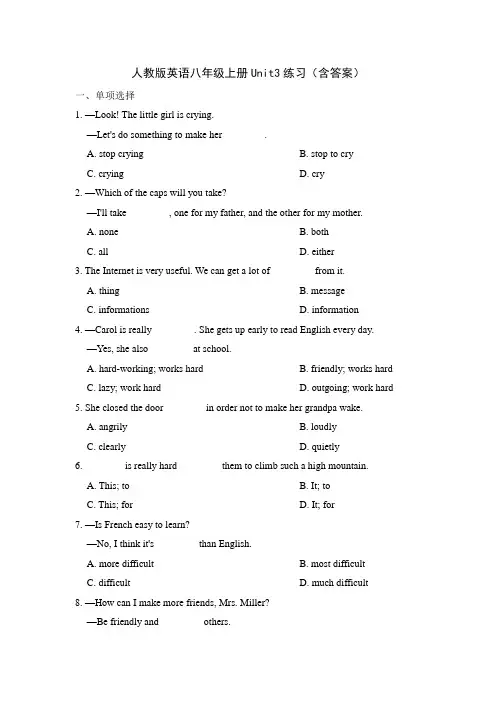
人教版英语八年级上册Unit3练习(含答案)一、单项选择1. —Look! The little girl is crying.—Let's do something to make her ________.A. stop cryingB. stop to cryC. cryingD. cry2. —Which of the caps will you take?—I'll take ________, one for my father, and the other for my mother.A. noneB. bothC. allD. either3. The Internet is very useful. We can get a lot of ________ from it.A. thingB. messageC. informationsD. information4. —Carol is really ________. She gets up early to read English every day.—Yes, she also ________ at school.A. hard-working; works hardB. friendly; works hardC. lazy; work hardD. outgoing; work hard5. She closed the door ________in order not to make her grandpa wake.A. angrilyB. loudlyC. clearlyD. quietly6. ________is really hard ________ them to climb such a high mountain.A. This; toB. It; toC. This; forD. It; for7. —Is French easy to learn?—No, I think it's ________ than English.A. more difficultB. most difficultC. difficultD. much difficult8. —How can I make more friends, Mrs. Miller?—Be friendly and ________ others.A. bring outB. care aboutC. look atD. feel like9. —Did you win the match last night?—Not really. ________ we all did our best, we lost it at last.A. ThoughB. IfC. UnlessD. Because10. —________ should get the job, Joe or Jeff?—I think Joe should get the job.A. Who do you thinkB. Do you think whoC. What do you guessD. Do you guess what二、完形填空After school on Friday, I waited at the school gate to walk home with Jemma, as usual. Then I saw ________11 talking and laughing happily with some other girls. She glance at me and left me alone there. I knew right then that I had ________12 my best friend.At dinner, Mom asked, “Is Jemma coming by tomorrow?”I shrugged and said nothing.The next morning, Mom asked, “Today is ________13. What are you and Jemma going to do?” I shrugged again. “________14 is Jemma?”Mom took a look at me. Then she said, “Will you take these magazines to Grandma, ple ase?”________15 I walked down the street, a new girl in the neighborhood came towards me, smiling. But I just went ________16 her.Grandma welcomed me at the door with a warm hug.Sitting on the sofa, I noticed a(an) ________17 of kids in old-fashioned clothes on the table. Grandma pointed at a girl with short fair hair.“That's Beth Lambert,” she said. “My best friend. Until a week before we took this photo.” I was ________18 at that.“Beth and I were best friends in school. We did everything ________19. Then one day, she made new friends and said she didn't want to hang out with me anymore. Nothing hurt ________20 that.”I didn't say anything. I couldn't. I knew I'd start ________21 if I opened my mouth.Grandma hugged me again. “Simone, sometimes friends grow ________22. It might happen to anyone,” she continued. “Then, see him?” Grandma's finger ________23 to a boy with glasses in the photo. “ He lived near me. When I was walking home by myself ________24 this boy was, too, I said ‘hello’. And we became friends.”“So, if we want to start a new friendship,” she smiled. “One ________25 is all it took.”As I was heading home, that new girl appeared again. I went towards her and spoke, “Hello.”11. A. it B. them C. her D. him12. A. lost B. hurt C. forgotten D. beaten13. A. Monday B. Friday C. Saturday D. Sunday14. A. How B. Where C. Which D. Who15. A. As B. Before C. After D. Until16. A. to B. past C. with D. against17. A. card B. photo C. poster D. advertisement18. A. glad B. angry C. satisfied D. surprised19. A. together B. outside C. differently D. quickly20. A. less than B. because of C. more than D. instead of21. A. singing B. laughing C. shouting D. crying22. A. old B. separate C. strong D. close23. A. moved B. connected C. returned D. waved24. A. so B. but C. for D. and25. A. hug B. smile C. word D. question三、阅读理解I was filled with doubts and worries until my grandfather told me to stand tall.For me, height was my trouble. I was much taller than other girls, so I often bent my body at the back of the line. I had always felt unsafe as the tallest student of my class in Bala Cynwyd. And I wasn't looking forward to entering the ninth grade.My grandfather didn't laugh at me. Instead, whenever I tried to bend myself in order to appear shorter, he would tell me, “Stand straight and tall, Alisa.” I trusted my grandfather more than anyone else in my childhood. And whenever I was afraid of something, he always told me stories of his life.My grandfather grew up in war-torn Europe. “Stand straight, stand tall” meant something else then. After the war, he went to America. He lived a hard life. “If they could do it, why couldn't I?” “Stand straight, stand tall.” he often reminded himself. Thanks to the help of a friend, my grandfather got a job. He once told me that he was very nervous at first. He was not only trying to learn this hard new job but also a new language.“Stand straight, stand tall,” he would always tell himself. I am so proud of my grandfather. After listening to my grandfather's unusual experiences, I have changed the way I look at my own life.“Stand straight, stand tall” has become not just a piece of advice to improve my posture. It also tells me to be proud of who I am.And I do.26. Alisa often bent her body because ________.A. she lived a hard lifeB. she was much taller than other girlsC. she always stood at the back of the lineD. she didn't want to enter the 9th grade27. What did Alisa's grandfather do with her trouble?A. He laughed at her.B. He asked her to bend her body.C. He told her to stand straight and tall.D. He advised her to stay away from her friends.28. Alisa's grandfather's experiences ________.A. made her feel unsafeB. taught her to accept herselfC. changed her attitude (态度) to her grandfatherD. told her his success completely depended on friends29. “Stand straight, stand tall” means ________ in the passage.A. making yourself look tallB. taking care of yourselfC. being proud of yourselfD. reminding yourself30. What's the best title for this passage?A. Stand straight, stand tallB. My grandfather's life storiesC. My colorful experiencesD. The help of a friend四、词汇运用A)根据句意及汉语提示, 填写恰当的单词31. His grandfather is very ________(严肃的) and I hardly see him laugh.32. Did you break your left ________(胳膊) in the P. E. class?33. They ________(到达) Wuhan at around 4: 00 yesterday afternoon.34. It's ________(必要的) for you to learn English well if you want to work in the USin the future.35. —I hear Mary keeps four dogs.—Yes, she loves animals. She has a kind ________(内心).B)用方框内所给单词或短语的适当形式填空36. Paul sits in the front of the classroom so that he can see the blackboard ________.37. They are friends, but they ______________ each other.38. My sister likes making friends. She often ________ her ideas with them.39. My father's car ________ down on the way yesterday.40. Li Bingjie is _______________ in swimming. She did very well in 2017 NationalGames of China.五、综合填空用方框中所给单词的适当形式填空, 完成短文As a saying goes, “A friend in need is a friend indeed.” Friendship is one of the best things in our life. A true friend is ________41 by our side and gives us his or her help and comfort when we ________42 them.It's not easy for everyone to make a true friend in the daily life. Be ________43 to choose a friend. We should choose someone ________44 has a good character. We should also avoid those people who aren't honest. If you hope that ________45 friendship can last for a long time, please choose a good friend at first.We all know that friendship is very precious. A true friend can always be ________46 and respected. If you tell a friend your ________47, he or she won't tell anyone else. Good ________48 always help each other when they are in trouble and cheer each other ________49 when they are sad.In a word, don't ________50 him or her when you have made a good friend! Let's value our precious friendship.参考答案1. A2. B3. D4. A5. D6. D7. A8. B9. A10. A 11. C12. A13. C14. D15. A16. B17. B18. D19. A20. C21. D22. B23. A24. D25. C26. B 27. C28. B29. C30. A31. serious32. arm33. reached34. necessary 35. heart36. clearly37. are different from38. shares 39. broke40. talented41. always42. need43. careful44. who45. your46. trusted47. secrets48. friends49. up50. forget。
英语人教版八年级上册Unit 3.doc

Unit3I'm more outgoing than my sisterSectionA 2d Grade 8 ITangchi Wu ming /.Teaching Goals1. Knowledge and SkillsLearn to talk about personal traits and use some adjectives and adverbs to describe and compare people.Master key words and phrases:competition,fantastic,which,clearly,win,though,something new,have fun. Master target language:It was fantastic .Nelly sang so well.I think Lisa sang better than Nelly.She sang more clearly than Nelly.Nelly danced better than Lisa.2. Process and methodsTask一based communicate.3. Attitude and values.Treat the competition correctly: the most important thing is to learn something new and have fun.II.Teaching key and difficult pointPractice using the target language.HI.Teaching aidsA tape record, multi一media computerIV.Teaching stepsStepl.Read the conversation quickly to circle the comparative forms. Ask one or more students to read the comparative formsAsk students to read the sentences with the comparative forms.Q: Why use the comparative forms?PPT: tell the differencesSang better sang more clearly danced better shorter hairStep2.Read the conversation again and fill in the blanks.PPT: The most important thing is to learn something new and have fun. A:Did you like the competition yesterday, Anna?B: Oh,it was! Nelly sang so!A:Well,l think Lisa sang than Nelly.B:Oh,one was Lisa?A: The one with hair.l think she sang than Nelly.B: Yes,but Nelly danced than Lisa.A: You can tell that Lisa really wanted to win,.B:Well,everyone wants to win.But the most important thing is to learn something new and have fun.Step3.Listen to the tape and read after it.©Give students some time to read the conversation freely , and the teacher walk around to give some help.②Ask students to work in pairs.Step4.Show timeAsk several pairs to show their conversations.The teacher and students talk about the players' strong points and shortcomings.Encourage all the students to speak English bravely.V.Teaching reflectionRole-play is the last activity of the first period. Maybe the time is not enough.Also, the students meet the comparative forms for the first time.So it isn't easy to master them well.Students need more time to practice.。
人教版英语八年级上册全册教材全解Unit-3
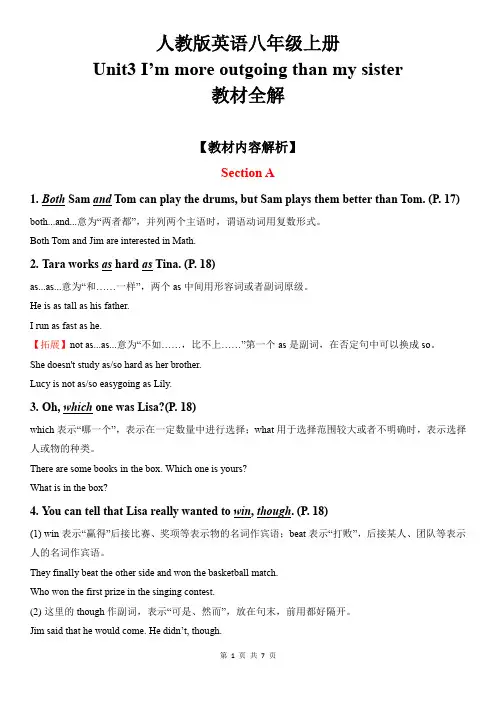
人教版英语八年级上册Unit3 I’m more outgoing than my sister教材全解【教材内容解析】Section A1.Both Sam and Tom can play the drums, but Sam plays them better than Tom. (P. 17) both...and...意为“两者都”,并列两个主语时,谓语动词用复数形式。
Both Tom and Jim are interested in Math.2.Tara works as hard as Tina. (P. 18)as...as...意为“和……一样”,两个as中间用形容词或者副词原级。
He is as tall as his father.I run as fast as he.【拓展】not as...as...意为“不如……,比不上……”第一个as是副词,在否定句中可以换成so。
She doesn't study as/so hard as her brother.Lucy is not as/so easygoing as Lily.3.Oh, which one was Lisa?(P. 18)which表示“哪一个”,表示在一定数量中进行选择;what用于选择范围较大或者不明确时,表示选择人或物的种类。
There are some books in the box. Which one is yours?What is in the box?4.You can tell that Lisa really wanted to win, though.(P. 18)(1) win表示“赢得”后接比赛、奖项等表示物的名词作宾语;beat表示“打败”,后接某人、团队等表示人的名词作宾语。
They finally beat the other side and won the basketball match.Who won the first prize in the singing contest.(2)这里的though作副词,表示“可是、然而”,放在句末,前用都好隔开。
Unit 3(单元解读课件)八年级英语上册(人教版)
迁移创新
可以用所学知识用来描述自 己和朋友的的外貌或个性特
征并进行正面对比。
12
统筹课时安排
教材板块 课型 第*课时
课时目标
学习层次
第一节SectionA 听说课 1a-2c
第二节SectionA 语法课 2d-3c
教材板块
课型
第*课时
课时目标
学习层次
第三节 SectionB
1a-1d
第四节 SectionB
2a-2c
第五节 SectionB 3a-self
check
听说课 阅读课 写作课
第三课时 1. 掌握用形容词或副词的比较级描述自己 的好朋友。 2. 学会用谚语表达自己对好朋友的观点和 看法。
第四课时 1. 掌握三篇文章描述的不同朋友的特征。 2. 如何通过预测、寻读和略读文章中找出 相关细节信息。
应设法调动学生的积极性,选 取与母语相似之处切入学习; 通过听读输入和说写输出,训 练词汇和句型,在小组对话和 同桌对话中夯实所学。
10
03
单元目标与课时安排
制定单元目标
学习理解
感知描述人的外貌或个性特征的表达 获取和梳理阅读文本中心思想。 获取听力文本里面的形容或副词的比 较级单词和语句。
应用实践
友的访谈,听后1e要 和看法,学生通过对形 Molly studies harder than 求学生利用所听信息 容词的使用,对话贴近
重新组织语言编新对 生活,能够激发学生对
her best friend.
话。
英语学习的兴趣。
18
第四课时Section B 2a-2c 课时内容解读
英语人教版八年级上册unit 3
Unit 3 I’m more outgoing than my sister.The First Period(1a-2d)一、教材内容分析:英语《新课程标准》英语新目标go for it!八年级上册第三单元主题为I`m more outgoing than my sister Section A所呈现的是人物之间的特征比较,人物的个性比较。
通过不同的比较,展现形容词比较级的一般用法,重读闭音节结尾的,辅音字母加y结尾的、多音节双音节形容加more的用法。
句型A+比较级+than B。
…as+形/副+as…。
be good at 等等。
借用日常交际用语,层层铺垫,展开听说读写,培养自主学习的能力。
一切的活动设计都围绕比较级展开。
通过比较的方法,达到对人生完美境界的自我追求。
教材内容从基本语言知识到语言综合运用层层递进,听说读写依次展开,以一种循序渐进的学习程序,引导学生在做事中有目的地学习语言。
本单元的教学目标确定为:1、掌握词汇及形容词比较级的形式。
2、掌握形容词比较级的一般用法,特殊用法。
3、能用比较级的句型表达不同的或相同的人物、事物的特征。
Teaching aims(教学目标)1.学会谈论个人外貌特点及性格。
2.能够运用比较级比较人与人的外貌和性格差别。
Language points(语言点)1.要求掌握以下句式:I am more outgoing than my sister.Tina is longer than TinaSam has longer hair than Tom.She also sings more loudly than Tara.2.要求掌握以下词汇及短语:outgoing, better, loudly, quietly, more loudly, play better than, both … and …情感目标:A beautiful heart is more important than a beautiful face.Difficulties(难点):用比较级比较人与人的性格和外貌差别时is 和has的正确运用。
人教版英语八年级上册Unit 3 Section
60
59
58
57
56
55
54
53
52
51
50
49
48
47
46
45
44
43
42
41
40
39
38
37
36
35
34
33
32
31
30
29
28
27
26
25
24
23
22
21
20
19
18
17
16
15
ቤተ መጻሕፍቲ ባይዱ
14
13
12
11
3b Read the sentences below. Underline the sentences from the reading that mean the same thing.
1. Neither of us did any housework for a week. For one week, she did not do any housework and neither did I.
10
9
8
7
6
5
4
3
2
1
• 扔下书包________ 一….就….________ • 过来________ 出去遛狗_____________ • 一直________ 整天____________ • as tired as______ walk away _______ • in surprise _________
I’m just as tired as you are!
• Finish the task 3c. It’s