
外研版初中英语七年级下全册学案
1 Module 1 Unit1 学案 学习目标:用现在进行时描述当前正在进行的事情。 学习任务: 第一部分 知识要点 1. 词汇: buy________ call ________ drive _________ enjoy _________ lie ________ shop _________ take _________ tell ________ wait __________ for __________ postcard __________ really _________ anyway _________ 2. 习语: talk to ___________ be on a school trip _______________ have a good time _______________ take pictures/ photos _____________ lying in the sun _______________ send sb. sth. ____________ wait for ______________ 第二部分 语法学习 如果要表达现在正在做的事情,该如何表达?请观察下面的例句: They are lying in the sun. 他们正躺在太阳下。 Are they waiting for the bus. 他们正在等公共汽车吗? 从以上例句可以看出,现在进行时的谓语形式是be +动词ing. Be动词随人称、数而变化。 1. 试写出下列动词的+ing 形式。 buy _______ lie _______ enjoy ________ have _________ run ________ write _______ wait _________ shop ________ like _________ 2. 根据汉语提示写出下列英语句子。 1) 我们正在上英语课。 We _______ ________ an English class. 2) 她不是在和她妈妈讲话。 She _______ _______ to her mother. 3) Tom 在看电视吗? _______ Tom ________ TV? 4) Tom 在干什么? What _______ Tom _______ now? 第三部分 阅读理解 1. 读课文,做第三页第4题。将人名和他们正在做的事情联机。 第四部分 课堂任务 课本第89页,练习题6,看时间,写出你在每一个时间分别正在做什么。并且互相问答。 例 : What are you doing at ….? I’m …. 第五部分 课后总结 I 用所给词的适当形式填空。 1. Look, My mother _______________(wash) clothes. 2. Lucy, lily and I ________________(watch) TV now. 3. --Where is Tom? He ______________ (lie) on the beach. 4. Listen, someone ________________(sing) in the next room. 5. It’s five o’clock, he ___________(leave) work. II 单项选择 1. Do you enjoy _______ books everyday? A. read B. reads C. reading D. to read 2. Look, Lucy is talking _______ her mother on the phone. A. to B. about C. on D. at 3. My sister enjoys lying _____ the sun. A. under B. in C. below D. on 4. Betty and I are good friends. I often send _______ emails. A. she B. her C. hers D. him 5. Tony’s birthday is on Sunday. We are shopping _______ presents. A. for B. with C. at D. to 2
Module 1 Unit 2 学案 学习任务: 第一部分 1. 词汇:写出下列单词的汉语意思并读出单词。 car _________ thing _________ leave _________ work _________ pub _________ restaurant __________ opera __________ ballet __________ sleep _________ wash __________ dress __________ start _________ midday__________ coffee __________ see __________ greeting __________ soon _________ love __________ 2. 习语:写出下列习惯用语的汉语意思。 meet friends __________ have a drink ____________ put on ____________ at the moment ___________ leave work ____________ wait for ____________ run for ___________ watch a ballet ___________ get dressed _____________ thank you for ___________ in front of _____________ look at ____________ 第二部分 阅读理解 阅读课文回答下面的问题。 1. Are people working at this moment in London? 2. What time is it now in Moscow? What are people doing at home? 3. Are people having dinner at this moment in Beijing? 4. What are the children doing at this moment in Los Angeles? 5. What are people eating and drinking at this moment in New York? 第三部分 课堂任务 请根据下面的提示写一篇短文。 假设你正在一次学校组织的去海边的旅行中。同学们正在海边进行着各种活动,例如:躺在沙滩上,享受阳光,拍照,玩游戏…. 请你用现在进行时来描述你们在海边正在做的事情,可以自由发挥。 ________________________________________________________________________________________________________________________________________________________________________________________________________________________________________________________________________________________________________________________________________________________________________________________________________________________________________________________________________________________________________________________________________________________________________________________________
第三部分 课后总结 I 补全对话 A: I have some new photos of my family. This is my father. B: What _______ he ________? A: He ____________ wine(酒). We ____________ our Christmas dinner. B: Who is she? A: She is my mother, and she __________ a song. She can sing very well. B: Who’s the little boy? A: He is my little brother. He ____________ with his new toy. You see, we____________ a good time. B: Yes, but, where are you? A: Look, I’m here. I _____________. I like ballet and I want to be a ballet-dancer. B: Wow! You ‘re dancing very well! A: Thank you. 3
Module 1 Unit 3 学习任务: 第一部分 知识要点 1. 词汇:写出下列单词的汉语意思并读出单词。 Night ________ street _________ 2. 习语:写出下列习惯用语的汉语意思。 See you later _____________ good night ___________ 第二部分 课前任务 完成课本第6页第2题(完成对话),第三题(根据图片,补全句子)。 第三部分 课堂任务 1. 第五页的明信片,并且回答后面的问题。 2. 假设你是Betty, 请给她的妈妈回复一封明信片,请阅读第7页第5部分的内容来了解明信片的格式,写作内容可以参照上一课的课堂作文。 ____________ Dear _________ ___________________________________________ ___________________________________________ ___________________________________________ ___________________________________________ ___________________________________________ ___________________________________________ ___________________________________________ ___________________________________________ See you soon. Love ______________ Martin and Helen White 22 West street London 第四部分 课后总结 单项选择 1. Do you often write ______ your pen friend? A. with B. for C. to 2. I ______ a letter _______ my parents. A. get; to B. write; from C. get; from D. write; with 3. –Could you go to buy some salt for me? --Sorry, Mom. I _________ my homework. A. am doing B. will finish C. was doing D. have finished 4.—What _______ you _____? --I’m playing computer games. A. do; do B. can; do C. are; doing D. were; doing 5. –Could you help me. Nancy? –OK. I’m ________. A. come B. comes C. to come D. coming II 不全对话 Bruno: Excuse me. What are you _______, Dave? Dave: I’m ______ my homework. Bruno: Shall we go to ________ tennis? Dave: No, I’m very busy. I have to _________ my homework first. Bruno: Do you know where Mike is? Dave: Yes. He is _________ a book in the library. Bruno: OK. I’ll ask him to play _______ me. (in the reading room) Bruno: Mike, _________ play tennis, OK? Mike: Sorry, I’d _______ to, but I’m ________ an important(重要的) book, It’s useful(有用的) for the test next week. Bruno: That’s all right.
外研版英语七年级下册:Module 12 Unit 1 It‘s so beautiful!学案设计
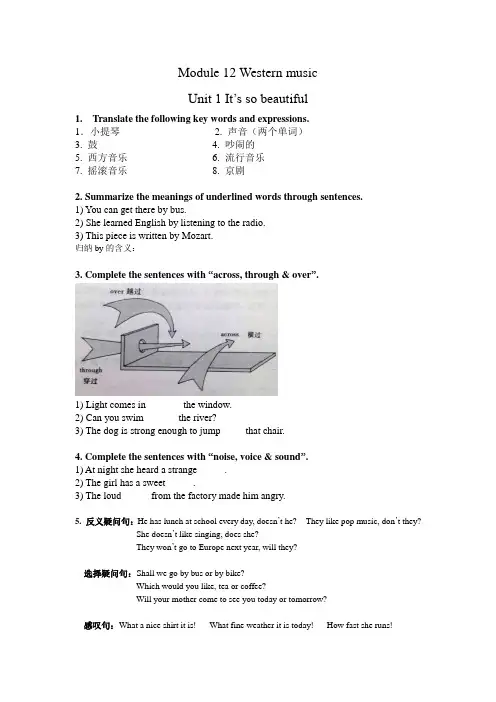
Module 12 Western musicUnit 1 It’s so beautiful1. Translate the following key words and expressions.1.小提琴________ 2. 声音(两个单词)__________3. 鼓_____________4. 吵闹的_____________________5. 西方音乐________6. 流行音乐___________________7. 摇滚音乐________ 8. 京剧_______________________2. Summarize the meanings of underlined words through sentences.1) You can get there by bus.2) She learned English by listening to the radio.3) This piece is written by Mozart.归纳by的含义:___________________________________________________3. Complete the sentences with “across, through & over”.1) Light comes in _______the window.2) Can you swim ______ the river?3) The dog is strong enough to jump ____ that chair.4. Complete the sentences with “noise, voice & sound”.1) At night she heard a strange _____.2) The girl has a sweet _____.3) The loud _____ from the factory made him angry.5. 反义疑问句:He has lunch at school every day, doesn’t he? They like pop music, don’t they?She doesn’t like singing, does she?They won’t go to Europe next year, will they?选择疑问句:Shall we go by bus or by bike?Which would you like, tea or coffee?Will your mother come to see you today or tomorrow?感叹句:What a nice shirt it is! What fine weather it is today! How fast she runs!QuizI. Fill in the blanks according to the first letters given.1. They’re listening to Western c_____ music.2. Lingling has h____ of Johann Strauss.3. Betty doesn’t listen to p____ music.4. Tony likes listening to Beijing O_____.5. Daming likes r______ music very much.II. Choose the best answer.( ) 1.The River Haihe goes _____Tianjin.A. acrossB. overC. throughD. on( ) 2. I like the music. Who’s it _____?A. toB. byC. withD. to( ) 3. ---Do you like football ______ basketball?---I like football.A. andB. withC. toD. or( ) 4. He has lunch at school every day, _____ he?A. hasn’tB. hasC. doesn’tD. does( ) 5. ______ me carefully!A. ListenB. ListeningC. Listen toD. Listening toIII. Complete the following sentences according to the Chinese. 1.谁是你最喜欢的作曲家?Who’s your _______ _______?2.你们班有多少西方古典音乐迷?How many _____ of western ______ music are there in your class?3.你最喜欢哪位音乐家?Which ______ do you like _____?4.他不喜欢流行音乐,是不是?She doesn’t like ______ music, _____ she?5.我不喜欢摇滚乐。
外研版七年级英语下册Module4unit1 学案
Module 4 Life in the futureUnit 1 Everyone will study at home.学习目标:1. 能够掌握本课重点词汇in the future, be able to ...2. 能够理解关于未来生活的对话3. 能够用will (will+do )谈论未来的学校生活Step 1: Warm upStep 2 : Free talkA: What do you use to study now?B: I use …A: What will you use to study in twenty years’time?B: I will use …Step 3 : Teach the new wordsStep4: Listen and choose Lingling’s answers to the questions 1. Will our life be different in the future?Yes, it will. / No, it won’t.2. Will our school change?Yes, they will. / No, they won’t.3. Will everything be different?Yes, it will. / No, it won’t.4. Will students need computer at school?Yes, they will. / No, they won’t.5. Will they carry lots of books to school?Yes, they will. / No, they won’t.Step5: Listen and find their ideas about the question.Will schools be different in the future?What are their ideas about the question?Step6: Practice reading the dialogueStep7: RetellMs Li and her students are talking about school life in the future. ...thinks ... will / can ...The school life in the future will be great!Step 8: Watch a video about the school in the future.Talk about what your school will be like in 10 years.Buildings: tall / high ...Playground: big, beautiful, a big garden full of flowers and trees ...Subject: many other subjects such as cooking , driving a car..Teachers or classmates : talk with them by Internet ...Homework: no homework on paper...Step9: SummaryStep 10 : A quizable level telephone need make because Betty thinks students always ______ teachers _____computers will never be _____ to check the students’______ and answer their questions by __________ or the Internet. Students need to go to school. Because school is good fun, and they can ________ friends there.。
【最新】外研版七年级英语下册M1学案
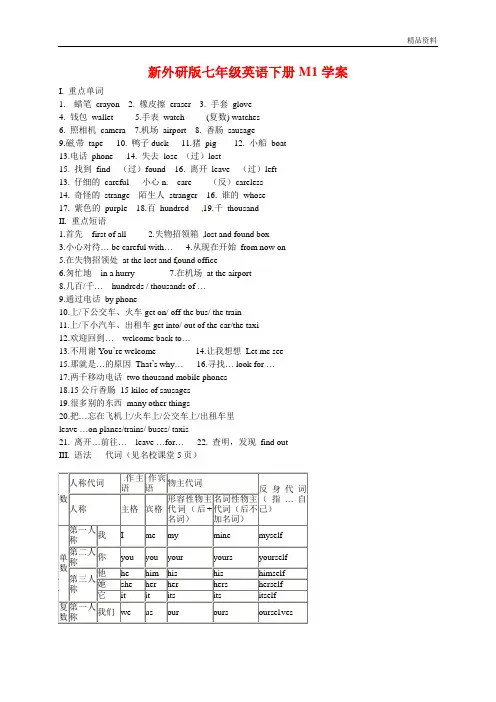
新外研版七年级英语下册M1学案I. 重点单词1.蜡笔crayon2. 橡皮擦eraser3. 手套glove4. 钱包wallet5.手表watch (复数) watches6. 照相机camera7.机场airport8. 香肠sausage9.磁带tape 10. 鸭子duck 11.猪pig 12. 小船boat13.电话phone 14. 失去lose (过)lost15. 找到find (过)found 16. 离开leave (过)left13.仔细的careful 小心n. care (反)careless14.奇怪的strange 陌生人stranger 16. 谁的whose17. 紫色的purple 18.百hundred 19.千thousandII. 重点短语1.首先first of all2.失物招领箱lost and found box3.小心对待… be careful with…4.从现在开始from now on5.在失物招领处at the lost and f ound office6.匆忙地in a hurry7.在机场at the airport8.几百/千…hundreds / thousands of …9.通过电话by phone10.上/下公交车、火车get on/ off the bus/ the train11.上/下小汽车、出租车get into/ out of the car/the taxi12.欢迎回到…welcome back to…13.不用谢You’re welcome 14.让我想想Let me see15.那就是…的原因That’s why…16.寻找… look for …17.两千移动电话two thousand mobile phones18.15公斤香肠15 kilos of sausages19.很多别的东西many other things20.把…忘在飞机上/火车上/公交车上/出租车里leave …on planes/trains/ buses/ taxis21. 离开…前往…leave …for…22. 查明,发现find outIII. 语法代词(见名校课堂5页)数人称代词作主语作宾语物主代词反身代词(指…自己)人称主格宾格形容性物主代词(后+名词)名词性物主代词(后不加名词)单数第一人称我I me my mine myself 第二人称你you you your yours yourself第三人称他he him his his himself她she her her hers herself它it it its its itself复数第一人称我们we us our ours oursel vesⅣ. 写作。
英语module8mypastlifeunit1学案(外研版七年级下)

Module 8 My past lifeUnit 1 I was born in a small village.课型:听说课【学习目标】:1.知识目标:Words and phrases: be born, first, friendly, naughty, nice,strict,well-behavedKey structures: Where were you born?I was born in a small village.2.能力目标:能掌握含有动词be(was/ were)的一般过去时的句子, 能用动词be的过去式介绍自己过去的生活,3.情感目标:通过谈论过去的生活,唤起美好回忆,珍惜现在的美好生活。
【教学重难点】:1.重点句型:Where were you born? I was born in a small village.2. 难点:系动词be的一般过去时的运用【教学过程】:[课前朗读] 朗读单词be born, first, friendly, naughty, nice,strict, well-behaved,根据音标读出单词并了解汉语意思,养成学生自主学习词汇的习惯,促使学生迅速进入学习状态。
一、预习检查a. 取学生结对、小组互查等形式来检查学生对词汇的预习情况。
b.朗读单词,注意发音。
二、情境导入“I’m 36 years old. I was born in 1974. I was born in Zhucheng. My son is 9 years old. He was born in 2001. He was born in Zhucheng, too. How old are you? When and where were you born? Talk about it, please.”让学生感知新的语法现象。
三、小听力(自主完成,合作释疑)1.Ask the students to read through the questions and answers individually.2. Listen and match(自我完成)3.Listen and check.(小组内讨论解决)4. Listen again and make complete sentences. Do Activity3.(听后说)四、大听力多层听1. 一层听:Listen to activity4, answer the following questions. 先抢答,再结对操练一般过去时的特殊疑问句及回答。
外研版七年级英语下册 Module 2 Unit 1学案
While-reading:Task 1:Answer the following questions.1. What are they talking about?2. What clubs are mentioned in the conversation?Task 2: True or false.1. Daming can’t join the Music Club because he can’t play the piano.2. Betty can join the Food and Drink Club because she likes cooking.3. Lingling can join the Dance Club because she can’t dance well.4. Tony want to join the Chinese Club because he can speak Chinese very well.5. Finally Tony decides to join the Table Tennis Club.Task 3: Complete the table.Task 4: 见课本P9 ③Task 5: Translate the following expressions into English.1.在布告栏上___________2.想要_________________3.弹钢琴_______________4.仅此而已_____________5.讲汉语_______________6.担心_________________7.打乒乓球_____________8.你呢?________________Task 6: 见课本P9 ④Post-reading:Ⅰ. 用方框中所给单词或短语完成下面的小对话。
1. A: What do you often do after school?B: I help my mother ________ the dinner.2. A: Can you play football?B: No, but I can_______________.3. A: Do you play any instruments (乐器)?B: Yes. And I can ________ very well.A: Wow! You’re great!4. A: Can you sing English songs?B: Yes, I can.A: OK. ________ your favourite one and sing in the front of the classroom.Ⅱ.根据汉语提示完成下列句子,每空一词。
七年级下册《It’ssobeautiful》学案外研版【DOC范文整理】
七年级下册《It’ssobeautiful》学案外研版Unit1It’ssobeautiful教学内容:Unit1It’ssobeautiful!课型:Listeningandspeaing教学目标:能正确使用下列句型:Isthis…or…?Doyoulie…or…?youlistentopopusic,don’tyou?It’sverydifferent,isn’tit?hatabeautifulcity!能够听懂对音乐的简单描述。
能辨别感叹句和选择疑问句的意思。
通过学习,能表达自己的喜好,并询问他人的喜好。
教学重难点:能够本课指导学生通过获取信息,培养学生技能。
采用多媒体手段辅助教学教学步骤教师活动学生活动设计意图Steponearing-upLeadinGreetings:hat’sthedatetoday?.’sLullaby---摇篮曲)foryou,let’senjoyitandseeifyouhaveeverhearditbefore.T:o,notelle,haveyoueverhearditbefore?hatindofusicis this?yes,it’straditionalesternusic.Andit’sbyozart.yfavouriteusic.hataboutyou?hat’syourfavouriteusic?Greetings.Students:justenjoytheusic.S:Haveafreetalaboutusic.以旧引新,利用音乐先引导学生训练了学生的反应在无形中培养学生大胆说英语的习惯。
StepToPre-tasIntroducetheseindofusicandshoouttheseneords:traditi onalesternusic,quiet,popusic,lively,rocusic,noisy,B eijingopera…T:Noearegoingto,listensoethingaboutallthisusic,plea selistenandnubertheordsasyouhearthe.ThenhavestudentslistenagainandfinishActivity2.Tlearnallindofusic.Listenandnubertheordsastheyhearthe.ListencarefullyagainandfinishActivity2.训练学生能力。
外研版英语七年级下册:Module 12 Unit 1 It's so beautiful! 学案(无答案)
Module 12 Western musicUnit 1 It’s so beautiful【第一课时】【学习目标】1.能够理解关于描写音乐的句子。
2.了解掌握反义疑问句的构成和使用3.能够了解不同音乐的特点【学习过程】I. Listen to the dialogue and answer the following questions1.Which modern music does Tony like?2.What does Tony’s mum think about r ock music?3.Why doesn’t Tony like traditional Western music?4.Which music does Tony’s dad think is too noisy?5.Where is Strauss from?6.Where is the Danube?III. 写出下列句子的反义疑问句1.Tom likes football very much, ____________?2.She can’t play the piano, ____________?3.You are all at home, ____________?4.Students are doing homework hard, ____________?5.The sound is different, ____________?6.There is little milk in the fridge, ____________?7.You don’t like rock music, ____________?【第二课时】【学习目标】1.能够询问和表达音乐的特点2.熟练运用反义疑问句【学习过程】I. Pair workAsk and answer what music you like or d on’t like and give a report.A: What music do you like? Why?B: I like pop. It’s lively and good to dance to. But I don’t like Beijing oper a.I think it’s too boring. What about you?Ms. Han likes pop because it’s lively and good to dance to, but she doesn’t like Beijing opera.She thinks it’s too boring.II. Make a survey.。
外研版英语七年级下册Module 1 Unit2 精品学案
.Unit2 精品学案学习目标1、学会应用名词性物主代词与形容词性物主代词。
2、掌握本单元单词和短语3、训练阅读技巧知识点导学重点短语:in a hurry 匆匆忙忙地hundreds of 数百,成百上千的look for 寻找lost and found office 失物招领处重点句子:1.People often lose things when they’re travelling or they’re in a hurry. 人们在旅行时或是匆忙时经常丢东西。
lose丧失,失去lost 是lose的过去式和过去分词in a hurry 匆匆忙忙地,在句子中作状语或表语。
Eg: They finished the work in a hurry. 他们匆忙地做完了工作。
Don’t be in a hurry. 别着急。
hurry up 赶紧,快点2.They leave things on planes, on trains, on buses and in taxis.他们把东西落在飞机、火车、公交车和出租车上。
leave: 作动词,意为离开。
Leave for sp 意为“动身去某地〞He left Paris to New York. 他离开巴黎去纽约。
作动词,意为留下、落下。
I leave my wallet at home. 我把钱包落在家里了。
作动词,意为“使保持……状态〞Who leave the door open? 谁把门翻开了?作名词,意为“假期、休假〞I want to ask for two days’ leave. 我想请两天假。
3. That’s why there are lost and found offices……That’s why+句子,意为“是……的原因〞4. Hundreds of people come here everyday. 每天有数百人来到这里。
外研版英语七年级下册:Module 12 Unit 1 It's so beautiful! 学案
Module 12 Western musicUnit 1 It’s so beautiful【第一课时】【学习目标】1.能够理解关于描写音乐的句子。
2.了解掌握反义疑问句的构成和使用3.能够了解不同音乐的特点【学习过程】I. Listen to the dialogue and answer the following questions1.Which modern music does Tony like?2.What does Tony’s mum think about rock music?3.Why doesn’t Tony like traditional Western music?4.Which music does Tony’s dad think is too noisy?5.Where is Strauss from?6.Where is the Danube?III. 写出下列句子的反义疑问句1.Tom likes football very much, ____________?2.She can’t play the piano, ____________?3.You are all at home, ____________?4.Students are doing homework hard, ____________?5.The sound is different, ____________?6.There is little milk in the fridge, ____________?7.You don’t like rock music, ____________?【第二课时】【学习目标】1.能够询问和表达音乐的特点2.熟练运用反义疑问句【学习过程】I. Pair workAsk and answer what music you like or don’t like and give a report.A: What music do you like? Why?B: I like pop. It’s lively and good to dance to. But I don’t like Beijing oper a.I think it’s too boring. What about you?Ms. Han likes pop because it’s lively and good to dance to, but she doesn’t like Beijing opera.She thinks it’s too boring.II. Make a survey.。
年外研七年级英语下册《Module 7 Unit 2 I was born in Quincy》学案
本文由一线教师精心整理/word 可编辑1 / 《Module 7 Unit2 I was born in Quincy 》学案bathroom, bedroom, garden, living room, coast, east, ago, store, movie theater / theatre, b ored, president, lake, last, comfortableAnd then give students some exercises about the new words. Complete the sentences according to Chinese and picture s. 1. This is our ________ (浴室) and that is a _______ (卧室) . 2. This is a _____ (花园) and that is a ______ (客厅) . 3. This is a ______ (湖) and that is a river.4. This is a new ________ (商店) and that is an old _________ (电影院) .5. I lived at the _____ _____ (东部海岸) ten years _____ (以前).6. Did their _____ (总统) live there _____ (最 近过去的) year?7. Was your bed _____ (舒服的) , Lingling?8. The man was _____ (厌倦的) the computer games. Step2:Warming-up and Lead inTo give some pictures and videos about Quincy to students. Let them watch and describe them. Step3:Work in pairs. Label the picture with the words from the box.bathroom bedroom garden kitchen l iving roomStep4:Read the passage of Activity 2 and choose the correct answer. 1. Betty was /wasn’t happy when she was in Quincy. 2. Two /Three US presidents were born in Quincy. 3. There were / weren’t pictures on Betty’s bedroom walls. 4. There was / wasn’t a small lake in the garden. 5. Betty was/ wasn’t in Quincy last year.Step6:Study some different usages of British English and American English.Step7:Complete the passage of Act ivity 4 with the correct form of the wor ds from the box. ago bored coast comfortable east president store。