
译林版英语九年级下册第四单元Unit 4 Grammar
译林版九年级上册英语Unit4课文翻译
译林版九年级上册英语Unit4课文翻译
推荐文章
外研版九年级下册英语Module7Unit3课文翻译 热度: 外研版九年级下册英语Module7Unit3部分课文翻译 热度: 外研版九年级上册英语Module2Unit2部分课文翻译 热度: 外研版九年级上册英语Module4Unit1部分课文翻译 热度: 译林版九年级上册英语Unit1ReadingA部分课文翻译 热度:
用英语来表达另一种语言或用另一种语言表达英语,这种英语与其它语言的互相表达活动,称为英语翻译,关于译林版九年级上册英语Unit4的课文翻译有哪些呢?接下来是店铺为大家带来的关于译林版九年级上册英语Unit4课文翻译,希望会给大家带来帮助。
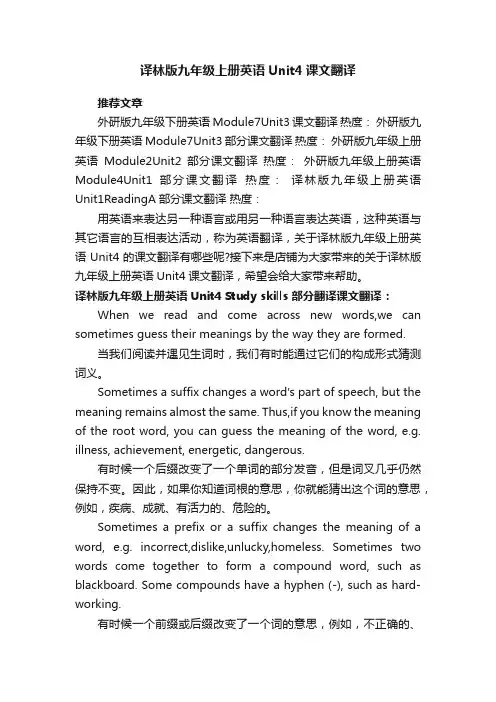
译林版九年级上册英语Unit4 Study skills 部分翻译课文翻译:
When we read and come across new words,we can
sometimes guess their meanings by the way they are formed.
当我们阅读并遇见生词时,我们有时能通过它们的构成形式猜测词义。
Sometimes a suffix changes a word's part of speech, but the
meaning remains almost the same. Thus,if you know the meaning
of the root word, you can guess the meaning of the word, e.g.
illness, achievement, energetic, dangerous.
有时候一个后缀改变了一个单词的部分发音,但是词叉几乎仍然保持不变。因此,如果你知道词根的意思,你就能猜出这个词的意思,例如,疾病、成就、有活力的、危险的。
Sometimes a prefix or a suffix changes the meaning of a
译林版高中英语选择性必修一Unit4 Grammar 练习(雅礼版)
非谓语动词高考真题语法填空篇
第一节
1. Now that we’ve discussed our problem, are people happy with the decisions _______________ (take)?
2. The children all turned ___________ (look) at the famous actress as she entered the classroom.
3. When we visited my old family home, memory came ___________ (flood) back.
4. The play ___________ (produce) next month aims mainly to reflect the local culture.
5. For breakfast he only drinks juice from fresh fruit ____________ (grow) on his own farm.
6. All of them try to use the power of the workstation _____________ (present) information in a more
effective way.
7. ____________ (bite) twice, the postman refused to deliver our letters unless we chained our dog. 8. ____________ (remind) not to miss the flight at 15:20, the manager set out for the airport in a hurry.
9. In April, 2009, President Hu inspected the warships in Qingdao, ____________ (mark) the 60th
译林版高中英语选必一Unit4 Grammar and usage 教案
1 《英语》(选择性必修·第一册)
Unit 4 Exploring poetry
Grammar and usage
江苏省通州高级中学 林红梅
I. Learning objectives
By the end of the lesson, students will be able to:
1. identify and categorize the use of to-infinities, verb-ing, and verb-ed forms;
2. summarize general rules of to-infinitives, verb-ing, and verb-ed forms;
3. use the right forms of to-infinitives, verb-ing, and verb-ed to finish tasks such as rewriting
sentences, completing an article and writing on the importance of reading poems.
II. Key competence focus
1. Learn how to use the right forms of to-infinitives, verb-ing, and verb-ed in different situations.
2. Write on the importance of reading poems using the right forms of to-infinitives, verb-ing, and
verb-ed.
III. Predicted area of difficulty
1. Use the right forms of to-infinitives, verb-ing, and verb-ed in different situations.
牛津译林版英语九年级下册Unit3Grammar说课稿
牛津译林版英语九年级下册Unit3Grammar说课稿
一、教材分析
(一)内容概述
本节课为牛津译林版英语九年级下册Unit3Grammar,主题为“现在进行时态与过去进行时态”。本节课的教学内容在整个课程体系中起到了承前启后的作用,为后续学习时态的转换和运用打下基础。
主要知识点包括:
1. 现在进行时态的构成及用法。
2. 过去进行时态的构成及用法。
3. 现在进行时态与过去进行时态的区分与转换。
(二)教学目标
1. 知识与技能目标:
(1)学生能够掌握现在进行时态和过去进行时态的构成及用法。
(2)学生能够熟练运用现在进行时态和过去进行时态描述正在进行的动作和过去某一时刻正在进行的动作。
(3)学生能够区分现在进行时态和过去进行时态,并在实际语境中正确运用。
2. 过程与方法目标:
(1)通过小组讨论、合作探究,培养学生合作学习的能力。
(2)通过练习、讲解、总结,培养学生独立思考和解决问题的能力。
(3)通过情境创设、实际应用,培养学生灵活运用时态的能力。
3. 情感态度与价值观目标:
(1)培养学生对英语学习的兴趣和热情,提高英语素养。
(2)培养学生积极向上、勤奋好学的精神风貌。
(3)通过英语学习,拓展学生的人际交往能力,增强跨文化交际意识。
(三)教学重难点
1. 教学重点:
(1)现在进行时态和过去进行时态的构成及用法。
(2)现在进行时态和过去进行时态的区分与转换。
2. 教学难点:
(1)过去进行时态的构成,尤其是过去进行时态与一般过去时的区分。
(2)在具体语境中正确运用现在进行时态和过去进行时态,尤其是描述过去某一时刻正在进行的动作。
(3)学生对于时态的掌握程度和运用能力,需要通过大量的练习和实践来提高。
二、学情分析
(一)学生特点
本节课所面向的学生为九年级学生,他们正处于青春期,具有以下特点:年龄特征上,他们具有较强的求知欲和好奇心,但注意力容易分散;认知水平上,他们已经具备了一定的英语基础,能够理解和使用简单的英语句子,但对于复杂语法结构的理解尚显不足;学习兴趣上,学生对生动有趣的英语教学内容较为感兴趣,对于抽象的语法知识可能缺乏热情;学习习惯上,学生可能习惯于机械记忆,而缺乏深入理解和实际应用的能力。因此,在教学过程中,需要注重激发学生的学习兴趣,引导他们主动探究和思考。 (二)学习障碍
Unit 4 Grammar 讲义-2021-2022学年高一英语牛津译林版(2020)必修第一册
译林版必修第一册Unit4单元语法--关系副词引导的限制性定语从句
语法精析
当先行词在定语从句中作状语时,通常要用关系副词引导定语从句。常用的关系副词有where,when,why等。
1.关系副词where
where引导的定语从句的先行词往往是表示地点的名词(如place,room,house,spot等),关系副词在从句中作地点状语。常用in which,at which,on which等代替。
They are playing in the park where(=in which) there are some flowers.
他们正在有花的公园里玩耍。
The office where(=at which) the girl works is not far from here.
这个女孩工作的办公室离这儿不远。
[温馨提示]
①有一些先行词,如point,stage,position,case,condition等,属于抽象的地点名词,如果定语从句中缺状语,需要接where引导的定语从句。
You reach a point in your project where you just want to get the thing finished.
从事任何项目你都会进入一种境界:一心想完成它。
We reached a stage where we had to answer violence with violence.
我们陷入了必须用暴力来对抗暴力的境地。
②where引导定语从句和状语从句的区别:引导定语从句时,where是关系副词,在从句中作地点状语,其前有表示地点的名词作先行词,从句修饰先行词;引导状语从句时,where是从属连词,从句修饰主句的谓语动词,where前面没有表示地点的名词。
He’s got into a situation where he is likely to lose control over the plane.(定语从句)
译林版高中英语必修三Unit4 Grammar and usage 教案

1 《英语》(必修·第三册)
Unit 4 Scientists who changed the world
Grammar and usage
I. Learning objectives
By the end of the lesson, students will be able to:
1. understand the meaning of verb-ed forms as attributives, adverbials and object complements;
2. learn how to use verb-ed forms as attributives, adverbials and object complements in different
situations;
3. write a passage using verb-ed forms, verb-ing forms and to-infinitives.
II. Key competence focus
Learn how to use verb-ed forms as attributives, adverbials and object complements in different
situations.
III. Predicted area of difficulty
1. Use verb-ed forms as attributives, adverbials and object complements in new situations.
2. Write a passage using verb-ed forms, verb-ing forms and to-infinitives.
IV. Teaching procedures
Step 1 Lead-in
T asks students to find to-infinitives, verb-ing forms and verb-ed forms in the reading passage and
【2024秋】最新版译林版七年级上册英语第四单元Unit4《单词+短语+句子》默写专项练习(含答案)
1 / 6 【2024秋季】最新版译林版七年级上册英语第四单元
Unit4《单词+短语+句子》默写专项练习(含答案)
Unit 4 School days
Welcome to the unit
核心单词
1. n. 家务事 2. n. 家庭作业
3. n. 周工作日 4. adv. 通常地
单词变形
1. health— (形容词) 2. activity— (复数)
3. my— (反身代词)
核心短语
1. 做早操
2. 进行课外活动
3. 帮助做家务 4. 起床
5. 慢跑一小段 6. 在工作日
7. 一点,少量 8. 玩得痛快
9. 交朋友
重点句型
1. do you get up in the morning on weekdays?
你在工作日早上几点起床?
2. What do you about your school day?
你最喜欢上学日的什么?
3. I'm .
我在足球俱乐部。
4. Club activities are and make friends.
俱乐部活动是我愉悦自己和交朋友的一个很好的方式。
Reading
核心单词
1. n. 学期 2 / 6 2. vi. (从……)开始vt. & vt. 开始,着手n. 开头,开端
3. n. 语言 4. adj. 令人大为惊奇的
5. n. 生物学 6. n. 大自然;天性
7. vi. & vt. 训练;练习 8. n. 田,地;领域
译林版高中英语扩展创新学程一Unit4 Grammar and usage 教案
1 《英语》(选修·第一册)
Unit 4 Fun with science
Grammar and usage
I. Learning objectives
By the end of the lesson, students will be able to:
1. identify the use of other cases of the subjunctive mood;
2. work out the rules of other cases of the subjunctive mood;
3. use the subjunctive mood to finish the task of correcting mistake and completing an article;
4. make a conversation about snowflakes using the subjunctive mood;
5. use the vocabulary: alike,*melt, *miracle,*vapour, *accumulate, *humidity.
II. Key competence focus
1. Develop the techniques of flexible use of language.
2. Improve the power of cognition and comprehension.
3. Apply learning strategies to practice.
III. Predicted area of difficulty
1. Applying the tips of subjunctive mood: other cases.
2. Guessing the words in new context.
IV. Teaching procedures
Unit 4 Growing Up--Grammar同步练习(含答案)牛津译林版九年级英语上册
1
2021-2022牛津译林版初三9A Unit 4 Growing Up--Grammar
一、单项选择
1. He never gives up, ______ he has made ______ progress in his study.
A. although; much B. although; little C. though; few D. but; a little
2. ―Have you finished reading The Wonderful Wizard of Oz?
―No. It will be two days I finish it completely.
A. until B. since C. before D. when
3. — How long do you think it’ll be __________ I can go back to work?
— Well, I think you will feel much better next weekend.
A. when B. before C. since D. after
4. I’m _________building a new zoo as I think zoos are terrible places for animals to live.
A. against B. on C. in D. for
5. You'd better_________ that bad tooth __________ out.
A. have; pulled B. to have; pull C. have; pulling D. to have; to be pulled
牛津译林版英语九年级下册Unit1Grammar教学设计
牛津译林版英语九年级下册Unit1Grammar教学设计
一、教学目标
(一)知识与技能
在本章节中,我们将围绕牛津译林版英语九年级下册Unit1的Grammar部分展开教学。通过本章节的学习,学生应掌握以下知识与技能:
1. 能够理解和运用一般现在时、一般过去时和一般将来时,描述人物在不同时间段的动作和状态。
2. 学会使用频率副词(如always, usually, often, sometimes, rarely, never等)来描述动作或习惯的频率。
3. 掌握情态动词(如can, may, must, need等)的用法,并能够运用到实际语境中。
4. 能够运用被动语态描述物体或人物受到的动作或状态。
5. 学会使用不同类型的句式(如肯定句、否定句、疑问句、祈使句等)进行表达。
(二)过程与方法
在本章节的教学过程中,教师应采用以下方法,帮助学生达成学习目标:
1. 通过小组合作、讨论、分享等形式,让学生在实际语境中运用所学的语法知识,提高学生的口语表达能力。
2. 采用任务型教学法,设计丰富多样的课堂活动,如角色扮演、故事接龙、语法填空等,激发学生的学习兴趣,培养学生的语法运用能力。
3. 引导学生通过观察、分析、总结,发现语法规则,提高学生的语法意识。
4. 创设生活化的语境,让学生在实际情境中感知、体验和运用语法知识,提高学生的语法实际运用能力。
(三)情感态度与价值观
在本章节的教学中,教师应关注以下情感态度与价值观的培养:
1. 培养学生积极的学习态度,激发学生对英语学习的兴趣,增强学生的自信心。
2. 培养学生的合作意识,让学生在小组活动中学会倾听、尊重、沟通,提高学生的团队协作能力。
3. 培养学生的跨文化意识,使学生了解并尊重不同文化背景下的语法表达习惯,提高学生的国际视野。
4. 引导学生关注生活中的英语,将所学知识运用到实际生活中,提高学生的生活品质。
二、学情分析