
人教新版五年级英语下册第五单元教案
Unit 5 Whose dog is it?第一课时教学目标1.掌握名词性物主代词-his,hers,mine,yours,ours,theirs。
2.能运用句子“It's mine/yours/hers/his.”来表明物品的所属情况。
教学重点掌握名词性物主代词的拼读与用法。
教学难点 (1)能正确区分形容词性物主代词和名词性物主代词的不同。
(2)能在语境、合作、交流中体会并理解物主代词的用法。
教学准备动作短语卡片、图片、实物投影仪、录音机及录音带。
教学过程(一)、热身(Warm-up) 1.学生欣赏 Unit 5 中的歌曲《Animals,animals are everythere》。
2.教师出示歌曲中提及的动物图片,然后进行抢答活动。
3.活动:智力大比拼活动方式:教师叫四名学生带上自己的钢笔到讲台上来并举起自己的钢笔介绍:It-s my pen。
然后教师让这几名学生背对大家,互相交换手中的钢笔,并迅速交换所站的位置。
然后请其中一个凭自己的记忆猜测钢笔的所属。
如:This is his pen. Thisis her pen. This is my pen. This is your pen.等。
(二)、新课呈现(Presentation)(二) 1.Let's learn (1)教师介绍犬展天下-Dog Show 2015 年犬展开始了,让我们去看看各类高端大气上档玖的狗狗们是谁家的? (2)学习单词 his 和 hers 课件出示 Let'slearn 部分的画面,教师指着第一只狗说:Look! This is his dog.It's his.That?s her dog. lt's hers.然后出示单词卡片 his 和 hers,并请全班跟读。
板书:his dog=his her dog=hers (3)学习单词 ours 和theirs 教师指着课本第二幅图说:This is their dog. It's theirs.然后指着某张课桌对全班说:This is their desk. It?s theirs. PPT 出示校长的照片,指着照片说:She's /He's our headmaster. He's ours.然后出示单词 ours 和 theirs 卡片,全班进行跟读和拼写。
(4)教学单词 mine 和 yours 教师指着自己的书包说: This is my bag. It's mine.指着某个人的书包并对他/她说:This is your bag. It?s yours.然后出示卡片进行单词操练。
(5)教师总结:请学生们看课件,找出两种物主代词的区别。
my pen - mine - This pen is mine. her bag= hers -This bag is hers. his eraser - his - This eraser is his. yourruler—yours - This ruler is yours. (6)活动:指指点点说说活动方式:教师随手拿起自己的一本书说:This book is mine. Can you showme your things or his/her things and say this…is mine/hers/his] yours/theirs 等。
女口:教师让学生依次拿起自己的物品或别人的物品说:It's mine/ hers/ his/ ours/theirs/ yours.进一步帮助学生熟悉和理解物主代词的含义及其用法。
2.Look,say and complete 教师出示教材第 49 页表格,要求学生认真阅读并填写表格内容,然后模仿例句完成一问一答练刁。
如:Whose book is that? It's Amy's book. The book is hers. Whose pen is that? It's John's pen. The pen is his.(三)、巩固与拓展(Consolidation and extension)活动:物归原主教师把“失物招领”中的物品展示给学生看,请学生帮忙寻找这些物品的主人,完成“物归原主”的任务。
如:Is this your…?Yes,it's mine.或 No,it isn?t. It's...(四)、家庭作业(Homework) 1.完成本课时活动手册配套的练习。
2.找出家中最珍贵的几件物品,向同桌炫耀一下这些物品的归属。
板书设计 Unit 5 Whose dog is it? his dog -his her dog-hers their dog-theirs Our dog-ours my dog-mine your dog-yours教学反思 1、本课时抢读单词、找主人的活动让学生回顾复习形容词性物主代词,为新课讲授打下基础。
2、通过 Main scene 学习,学生可以快速了解本单元知识点。
3、通过 Dog show 让学生去了解名词性物主代词更加的生动形象,更易于教与学。
4、通过活动让学生对所学知识进行操练以做到语言的正确输出。
第二课时教学目标1.能在语境中灵活应用名词性物主代词。
2.能运用句子“Whose is it?”或“Whose+名词(复数)are these?”来询问物品的所属情况。
教学重点能运用句子“Whose is it?”或“Whose+名词(复数)are these?”来询问物品的所属情况。
教学难点掌握 whose 所引导的两种句型。
教学准备动作短语卡片、图片、录音机及录音带。
教学过程(一)、热身(Warm-up) 1.Sing the song My weekend. 2.活动:晒一晒,说一说活动方式:教师在讲台上晒出学生事先准备的玩具,如:泰迪熊、熊猫、汽车、自行车等,教师指着玩具逐一说:This is not mine.然后问:Whose is it? 玩具的主人听到后要立刻站起来说:It's mine.老师接着说: Oh, it,s yours. Here you are.然后全班同学指着主人说一说:It's his.或 It's hers.说完,继续游戏。
(二)、新课呈现(Presentation) 1.Let?s try (1)教师播放Let?s try 部分的录音,学生完成听音打勾练习。
(2)教师再次播放Let?s try 部分的录音,然后问学生:Which is John's picture? 要求学生根据所听到的的内容回答。
2.Let?s talk (1)敦师播放 Let?s talk 部分的录音,请学生认真听,思考以下问题:①Which picture is Chen Jie's? ②Whose is the picture of Beijing? Whose is it?③Whose is the picture of Shanghai? Whose is it? (2)教师播放录音,学生回答这三个问题。
①The yellow picture is Chen Jie's.It's his. ②It?s Zhang Peng's.lt's his. ③It's Yifan's. It-s his. (3)看图说话。
教师指着图片说:What about the picture of Beijing/Shanghai? Whose is it? 引导学生看图说话。
如: Thepicture of Beijing is beautiful. The picture of Beijing isZhang Peng's. It's his. It's not mine. The picture of Shanghai is beautiful,too. The picture of Shanghai is Yifan's. It's his.It's not yours. (4)小结 whose 引导的两种句子。
通过练习,让学生归纳 whose 的用法。
疑问词“whose”主要对句子中的形容词性的物主代词或名词性物主代词提问。
如: That is your watch.那是你的手表。
Whose watch is that?那是谁的手表? These boxes aretheirs.这些盒子是他们的。
Whose are these boxes?达些盒子是谁的?(5)教师解释“Are these all ours?”这个句子的意思,然后教师播放录音,并请学生跟读和表演。
(6)Ask and find out.请学生模仿课本中的例句,同桌进行问答练习。
然后教师拿出从学生那里收集来的故事书、钢笔、铅笔等学习用具,要求学生用 Whose... are these?Whose ...is this?来询问物品的主人,看谁最先找到物品的主人。
(三)、巩固与拓展(Consolidation and extension)活动:寻找拍卖会上私人珍藏品的主人活动方式:教师将拍卖会竞拍下来的当红明星的私人珍藏品做成 PPT,如:1 号物品——一个 LV 包包(Yang Mi);2 号物品——一架钢琴(Zhou Jielun)。
3 号物品——一个机器人(Chen Long)。
要求学生俩俩合作,互相询问这些拍卖物的原主人。
如:Whose bag is this? Whose piano is it? Whose robot is this? It's Yang Mi's. It's hers. It?s Zhou Jielun's. It's his. It?s Chen Long's. It's his.(四)、家庭作业(Homework) 1.同桌操练 Let's talk 中的对话。
2.完成本课时活动手册配套的练习。
板书设计Unit 5 Whose dog is it?Whose... is it? Whose book is this? It?s Mike's.It's his.教学反思本课时教师通过 Free talk 让学生学会观察图片,在听力开始前对听力内容有个大概的设想,降低听力难度。
五年级英语下册 Unit5 第三课时(2)教案 人教新版
Unit5 How much is it?第三课时【教学目标】1、听说认读掌握生词:skirt shirt jacket dress T-shirt2、单词拼读;书写指导【教学重点】听说认读掌握生词:skirt shirt jacket dress T-shirt【教学难点】单词拼读;书写指导【教具准备】本课生词的单词卡片、配套的教学课件、相配套的教学录音带、学生自己的衣物、课文主题图、大小写字母卡片【教学过程】(一)热身/复习(Warm-up/Revision)1、Free talkWhat color do you like?What color is your /…?2、Let’s chantB部分的Let’s chant.的歌谣,边说边出示单词。
(二)呈现新课(Presentation)1、教师准备好一些大小不一的衣服。
说:“I think this skirt is pretty.”然后教师穿一下,说:“But it’s too big.”然后再拿起一件,说:“This one, it’s nice. It’s fits me well.”2、教师请一个孩子上来选衣服,指导孩子运用句子:This shirt is …,but it’s too….3、然后多请上几个孩子上来说。
4、小组活动孩子们把自己的衣服带来,在小组中每个孩子轮流挑选衣服,在这一过程中运用This shirt is …,but it’s too….5、观看课件,认读句子,让孩子逐句认度,小组认读。
6、教师指读生词,让孩子抢答认读。
小组比赛拼读,抽查孩子的拼读。
7、两人一小组,一个拼,一个写。
单词的抄写练习。
8、出示句子的句卡,然后孩子试读,教师提示学生注意第一个单词第一个字母大写,提示孩子注意标点和占格。
(三)趣味操练(Practice)1、拼一拼,猜一猜教师拼一个单词,让孩子迅速说出词孩子小组做游戏2、听一听,拼一拼每个小组一套字母卡片,请一个孩子说词,小组拼,比比谁最快。
人教PEP版英语五年级下册Unit 5 第二课时教案-教学设计
第二课时课时内容A Let’s learn Look, say and complete课时分析本课时是人教版五年级下册第五单元第二课时。
围绕“Dog Show”这一话题展开,主要通过对话学习词汇mine, yours, his, hers, theirs, ours,培养学生爱护动物的意识。
第一课时为本课时打下了一定的基础,本课时的重点是四会单词的掌握以及灵活运用。
本课时包括Let’s learn 和Look, say and complete两个板块。
Let’s learn通过呈现Zoom 和Zip谈论报刊墙展出的Dog Show的场景,体现了单词的词形和意义。
此版块设计的学生们比较感兴趣的动物的话题,非常符合学生的心理,贴近学生的生活,更能激发学生学习的兴趣。
Look, say and complete版块是一个综合性的语用活动,通过这个活动操练A 部分Let’s learn所学的词汇和句型,做到学以致用。
本课时虽然是新授课,但是四会单词mine, his, yours, ours在第一课时已经接触过,所以在设计教学过程时,遵循以学生为主体的原则,采用听、说、读、写、玩等多种方法调动全体学生的积极参与。
通过任务型教学法、合作探究教学法等引导学生自主学习。
课时目标(1)能够听、说、读、写单词:mine, yours, his, hers, theirs, ours。
(2)能够在语境中正确运用这六个单词。
(3)能够对物主代词进行总结归纳。
(4)培养学生爱护动物的意识。
课时重难点1.重点(1)能够听、说、读、写单词:mine, yours, his, hers, theirs, ours。
(2)能够在语境中正确运用这六个单词。
(3)能够引导学生对物主代词进行总结归纳。
2.难点(1)能够在语境中正确运用mine, yours, his, hers, theirs, ours这六个单词。
(2)物主代词的归纳。
五年级下册英语教案-Unit 5《Have a Great Trip》(Story Time)|人教

五年级下册英语教案-Unit 5《Have a Great Trip》(StoryTime)|人教(新起点)教学目标1.能够听懂、理解故事《Have a Great Trip》。
2.能够运用所学语言表达自己的旅游经历。
3.能够学会使用一些常用的旅游词汇和表达方式。
4.能够使用简单的英语句子进行短对话。
教学重点1.理解故事《Have a Great Trip》。
2.学会使用一些常用的旅游词汇和表达方式。
3.运用所学语言进行短对话。
教学难点1.能够运用所学语言表达自己的旅游经历。
2.能够使用简单的英语句子进行短对话。
教学准备1.教师:PPT、故事书、音箱、翻译软件等。
2.学生:课本、笔记本、笔等。
教学过程step 1 导入新课(5分钟)教师通过课件图片或其他方式,引导学生对旅游进行简单的了解,并引出二人对话的形式。
step 2 阅读故事(10分钟)1.教师先介绍和解释故事标题及图片,为学生理解后续故事打好铺垫。
2.教师通过朗读故事或设置文字提问的方式,帮助学生理解故事,并逐句带领学生进行理解。
3.学生独立朗读故事一次,再跟读老师,帮助学生进行音频连读模仿以及语言准确性检测。
step 3 词汇分析(5分钟)教师在黑板或白板上列出故事中出现的所有地名、景点、交通工具、旅游感受等相关词汇,让学生复述、跟读并做简单词汇记忆练习。
step 4 语言拓展(10分钟)教师通过PPT或课件工具,展示常用的旅游情景对话,例如旅游购物、餐厅点餐、询问路线等,在口语上进行语音提示、语法分析等方面的教学。
step 5 训练交流(20分钟)教师在黑板上随机分组,让学生两人一组对话练习,既可以是话题复述,也可是自创新的交流话题,在口语交流方面进行反馈和引导。
step 6 作业与课后跟踪(5分钟)教师根据教学进度,布置相关阅读练习、写作作业或口语输出练习内容,让学生在学后进行巩固强化。
并鼓励学生在课下自主透过书籍、电视、网上了解更多旅游相关资讯,产生更多学科之间的串联与拓展。
人教PEP五年级英语下册《Unit5_第1课时名师精品教案》
教材版本:PEP小学英语五年级下册第五单元课题Unit 5 Whose dog is it?课型对话课内容Part A Let’s try Let’s talk 主备人复备教师一、课程标准1. 能听懂简单的配图对话;2. 能正确朗读所学对话;3. 能在教师的帮助和图片的提示下,描述文段或表演对话,发音清楚,语调基本达意;二、教材解析Let’s try:讨论话题art show,引出本课时关于物品主人的对话问答。
Let’s talk:通过Chen Jie和Mike的对话,学习核心问答“Whose is it?It’s Zhang Peng’s.”要求学生能准确交流物品主人,理解名词性物主代词的使用环境。
三、目标预设1. 能正确朗读所学对话,做到发音清楚,语调基本达意。
2. 能在情境中运用“Whose is it?”寻找物品的主人并回答。
四、重难点预设重点:能灵活运用句型“Whose is it?It’s Zhang Peng’s.”交流物品的主人,理解名词性物主代词的使用环境。
难点:学生容易混淆名词性物主代词和形容词性物主代词。
五、评价设计1. 通过Role play, Read and complete等环节检测目标一的达成情况;2. 通过Look and answer, Ask and find out等环节检测目标二的达成情况。
六、教学设计第1课时教学环节教学预设热身/复习(Warm-up/Revision) Free talk各小组随机选派一名代表起立,介绍自己手边的某样东西,如“This is my English book.”全部介绍后,教师随机收集其中的某几样物品,提问学生: “Wh ose ... is it?”学生抢答。
呈现新课(Presentation) 1. Let’s tryListen and tick. Which is John’s picture?2. Let’s talk(1) Watch and answerWhose picture is the yellow one?学习单词mine.(2) Listen and match(图片连线) The p icture of Beijing is Zhang Peng’s. The picture of Shangha i is Yifan’s.(3) 逐句跟读跟读mine, ours,重点跟读Whose is it?(4) 播放动画,学生跟读。
最新人教版五年级英语下册第五单元unit 5 part A let's talk先学后教模式教案
Unit Five Whose dog is it?教学目标:1.能够听、说、读、写16个单词。
2.学会句型①单数This / That/It is....复数They/ These/ Those....②单数-Whose ...is this?-It’s mine/his/hers/yours/theirs/ours.复数-Whose...are these/those?-They are mine/his/hers/yours/theirs/ours.③Are these/those/they....?Yes,they are./ No they aren’t根据所学单词进行回答。
课时安排五课时第二课时教学目标:1.能根据所学句型对人物性格进行询问,并会回答.2.能够理解let's talk的大意,会读,并能小组内进行情景对话.一、板题、示标。
同学们,今天我们来一起学习第5单元Part A let’s talk 部分。
首先,明确本节课的学习目标(投影显示)。
有信心完成学习目标的同学请举手,(好,请放下。
)为了更好地完成学习目标,本节课我们将进行四场比赛,先看第一场比赛。
二、第一次“先学后教”比正确翻译短文意思。
师:请同学们看自学指导自学指导要求:默看P4页,结合单词表,5分钟后比谁能正确翻译出短文意思。
师:时间到,停,随机提问。
(接下来进行第二场比赛)个性化设计:强调:Are. These + 名词性物主代词...? 表示这些是某人的吗Yes,they are 肯定回答/ No, they aren’t 否定回答拓展: Are these hamburgers yours? (做肯定回答)三、第二次“先学后教”比哪个小组能最准确读出短文。
师:请同学们看自学指导自学指导要求:请小组讨论,短文正确读音,5分钟后比哪个小组能最准确读出短文。
师:时间到,停,分组抽测(接下来进行第三场比赛)个性化设计:强调: yellow 黄色,beautiful 漂亮的,Beijing 等城市地名首字母大写。
五年级英语下册教案-Unit 5 Part C Story time-人教PEP版
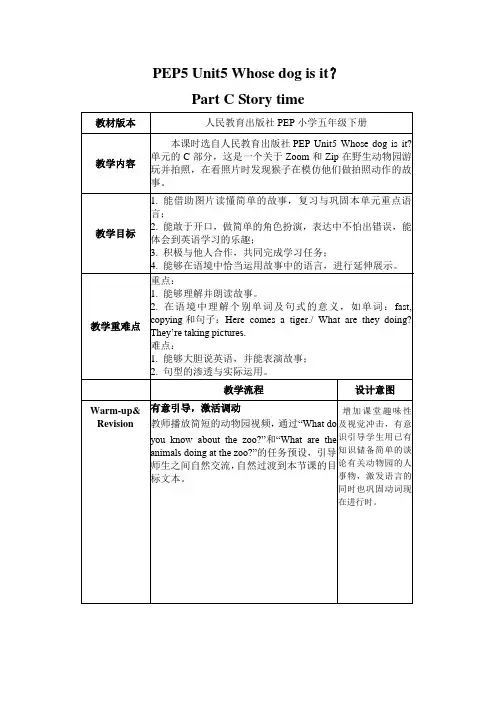
PEP5 Unit5 Whose dog is it? Part C Story time 教材版本 人民教育出版社PEP小学五年级下册
教学内容 本课时选自人民教育出版社PEP Unit5 Whose dog is it?单元的C部分,这是一个关于Zoom和Zip在野生动物园游玩并拍照,在看照片时发现猴子在模仿他们做拍照动作的故事。
教学目标 1. 能借助图片读懂简单的故事,复习与巩固本单元重点语言; 2. 能敢于开口,做简单的角色扮演,表达中不怕出错误,能体会到英语学习的乐趣; 3. 积极与他人合作,共同完成学习任务; 4. 能够在语境中恰当运用故事中的语言,进行延伸展示。
教学重难点 重点: 1. 能够理解并朗读故事。 2. 在语境中理解个别单词及句式的意义,如单词:fast, copying和句子:Here comes a tiger./ What are they doing? They’re taking pictures. 难点: 1. 能够大胆说英语,并能表演故事; 2. 句型的渗透与实际运用。
教学流程 设计意图 Warm-up& Revision 有意引导,激活调动 教师播放简短的动物园视频,通过“What do
you know about the zoo?”和“What are the animals doing at the zoo?”的任务预设,引导师生之间自然交流,自然过渡到本节课的目标文本。
增加课堂趣味性及视觉冲击,有意识引导学生用已有知识储备简单的谈论有关动物园的人事物,激发语言的同时也巩固动词现在进行时。 Presentation Practice& Production
通过视频,问题式猜测,随着情节推进,整体感知故事时间 1. 视频播放中,教师自然引线:What will happen then?创造大胆猜一猜的环节。 2. 教师再次引线:Look! There is only the tiger’s tail. Why?引导学生通过观看故事与上下文理解,抓住具体情节并能回答“It’s running so fast。 3. 视频播放中,教师继续引线:What are the two monkeys doing? 4. 运用黑板上呈现的图片与句式,进行简单的故事复述。 5. 在呈现故事的过程中,教师适时给予文本的引领与示范,学生体会朗读的技巧,如单词连读、语句的升降调。
五下英语第五单元教案人教版
五下英语第五单元教案人教版教案标题:Exploring the World教学目标:1. 通过本单元的学习,学生将能够掌握与旅行相关的词汇和表达方式。
2. 培养学生的听、说、读、写的综合语言运用能力。
3. 培养学生的合作学习和自主学习的能力。
教学重点:1. 学习与旅行相关的词汇和表达方式。
2. 训练学生的听、说、读、写的能力。
教学难点:1. 运用学到的词汇和表达方式进行实际对话和写作。
2. 培养学生的合作学习和自主学习的能力。
教学准备:1. 教学课件和多媒体设备。
2. 学生课本、练习册和教具。
3. 旅行图片和相关的实物。
教学过程:Step 1: Warm-up (5 minutes)1. Greet the students and review the previous unit briefly.2. Show some pictures of famous landmarks around the world and ask students if they know where they are. Encourage them to share any travel experiences they may have had.Step 2: Presentation (15 minutes)1. Introduce new vocabulary related to travel, such as "passport," "suitcase," "boarding pass," etc. Use real objects or pictures to help students understand the meanings.2. Present the target language structures and expressions through a dialogue between the teacher and a student or between two students. Model the pronunciation and intonation, and encourage students to repeat after you.3. Use the multimedia resources to show videos or pictures of different modes of transportation and travel destinations. Discuss the advantages and disadvantages of each mode of transportation.Step 3: Practice (20 minutes)1. Divide the class into small groups and give each group a set of travel-related role cards. Students take turns acting out the roles and having conversations using the new vocabulary and expressions.2. Provide worksheets with various activities, such as matching the words with the pictures, completing sentences using the correct words, or writing a short paragraph about their dream travel destination.Step 4: Production (15 minutes)1. Ask students to work in pairs or small groups to create their own travel brochures or posters for a chosen destination. They should include information about transportation, accommodation, attractions, and activities.2. Encourage students to present their travel brochures or posters to the class,explaining why their chosen destination is worth visiting.Step 5: Consolidation (5 minutes)1. Review the key vocabulary and expressions learned in this unit.2. Summarize the main points of the lesson and encourage students to ask any questions they may have.Step 6: Homework (5 minutes)Assign relevant exercises from the textbook or workbook to reinforce the new vocabulary and expressions. Encourage students to practice using the language in real-life situations, such as talking to family members or friends about their travel plans.教学评价:1. 教师观察学生在小组合作活动中的表现,评估他们是否能正确运用所学的词汇和表达方式进行对话。
人教pep英语五年级下册unit5大单元整体教学
人教pep英语五年级下册unit5大单元整体教学全文共6篇示例,供读者参考篇1Unit 5 - Our Beautiful EnvironmentHey there, fellow students! Are you ready to dive into another exciting unit of our English textbook? This time, we're going to explore the wonders of our beautiful environment and learn how to protect it. Get ready for some fun activities, interesting readings, and cool new words!Let's start with the warm-up section. We'll learn some useful expressions related to the environment, like "protect the environment," "reduce pollution," and "save energy." These phrases will help us understand and discuss environmental topics more easily.Next up, we have the listening part. We'll hear a dialogue between two friends talking about their school's environmental protection club. Pay close attention to the details they mention, like the club's activities and the reasons for joining. After listening, we'll practice some comprehension exercises to make sure we understood everything correctly.Then, it's time for the reading section! We'll read a fascinating article about a group of students who started a recycling project at their school. Imagine turning all those empty bottles and cans into something useful! As we read, we'll learn new vocabulary words like "recycle," "waste," and "sustainable." We'll also practice some reading comprehension skills by answering questions about the main idea, details, and vocabulary.But that's not all! In the speaking section, we'll have a chance to roleplay different situations related to environmental protection. For example, we might pretend to be members of the recycling club, trying to convince our classmates to join. Or we could act out a conversation between a parent and a child, discussing ways to save energy at home. These activities will help us practice our speaking skills while also learning important environmental lessons.The writing part is where we'll put our new knowledge into practice. We might write a letter to the school principal, suggesting ideas for making our school more eco-friendly. Or we could create a poster to raise awareness about the importance of reducing waste. Whatever the task, we'll learn how to organize our thoughts and express them clearly in writing.Throughout the unit, we'll also encounter fun activities and games related to the environment. For instance, we might play a memory game to review vocabulary words or participate in an environmental quiz to test our knowledge. These engaging activities will make learning even more enjoyable!But it's not just about the book. We'll also have the opportunity to participate in hands-on projects and field trips. Imagine visiting a local recycling center or organizing a school cleanup event. These real-life experiences will help us understand the importance of environmental protection in a practical way.By the end of this unit, we'll have gained a deeper appreciation for our beautiful environment and the role we can play in protecting it. We'll have improved our English skills in listening, speaking, reading, and writing, all while learning valuable lessons about sustainability and eco-friendliness.So, let's dive in and explore the wonders of Unit 5! Get ready to have fun, learn new things, and become environmental champions. Our planet needs us, and we're ready to make a difference!篇2Unit 5 – Our NeighborsHi there! I'm really excited to tell you all about Unit 5 in our PEP English textbook. This unit is called "Our Neighbors" and it's been a blast learning about different countries and cultures around the world.We started off by reading a fun story called "A Foreigner in China". It's about a French lady named Marie who comes to visit China. She experiences so many new things like trying delicious Chinese food, watching an amazing acrobatics show, and even learning some Mandarin phrases. My favorite part was when Marie got lost in the Forbidden City and had to ask for directions.I can totally relate to getting lost and confused in new places!After the story, we learned a ton of cool vocabulary words related to different countries and cultures. Words like "customs", "traditions", "foreigners", and "tourists". My teacher had us play this awesome game where we acted out the words using movements and expressions. It was hilarious watching my friend Danny pretend to be a confused tourist!Then we moved on to the next part which was all about festivals and celebrations from around the globe. We read about Diwali in India, Brazil's Carnival, the Dragon Boat Festival in China, and so many more. I loved learning the stories and myths behindeach festival. The Dragon Boat Festival story about Qu Yuan was my favorite. We even got to make our own little dragon boats out of paper and see whose boat could float the furthest in the sink!The grammar sections helped us practice using words like "national", "international", and "traditional" correctly in sentences. We did tons of fun activities like unscrambling sentences, writing postcards from different countries, and my teacher even brought in snacks from various cultures for us to try. The Thai mango sticky rice was delicious!For the reading part, we read all sorts of interesting passages about different countries' food, dress, music, and daily life. My best friend Aaron's family is from Korea, so I really enjoyed the reading about Korean culture. We also learned how to look up facts from books and websites to prepare cultural presentations. My group did our presentation on Indian culture and we dressed up in colorful Indian clothes that my teacher brought in!The writing section had us practice words for comparing and describing different customs and traditions. We wrote journal entries, emails to penpals, and even short stories pretending we were visiting a foreign country. I wrote about getting lost in a bigcity and having to ask the locals for help using the phrases we learned. Writing the story was my favorite part!Overall, I think Unit 5 was awesome for helping us appreciate the amazing diversity of cultures around the world. I can't wait to learn about more festivals, stories, and traditions in the next unit. Now if you'll excuse me, I have to go practice my Dragon Boat racing skills!篇3Hooray for Unit 5! My Exciting AdventuresUnit 5 of our PEP English book was so much fun! We learned all about adventures, traveling, and exploring new places. I couldn't wait to dive into the unit and go on exciting journeys through the stories and activities.It all started with the warm-up section. Our teacher showed us pictures of people hiking, camping, and going on safaris. We talked about different kinds of adventures and shared our own dreams of places we'd love to visit someday. I raised my hand and said I want to go on an African safari to see lions, elephants, and giraffes up close!Then we jumped into the first lesson about a family trip to Australia. We read a funny story about a dad who got lost in the Outback and had to be rescued by his kids. I laughed so hard imagining my own dad wandering around the desert looking confused. The story taught us great vocabulary like "outback", "kangaroos", and "bushwalking."Next up was a lesson all about exploring rainforests. We learned how hot, humid, and densely packed with plants and animals they are. Our teacher showed us amazing photos of tall trees, vines, butterflies, and even venomous snakes! We practiced describing rainforest scenes and animals using vivid adjectives. I wrote about a brightly colored bird flitting through the thick green foliage.The middle of the unit focused on outdoor adventures like rock climbing, whitewater rafting, and skiing. Personally, rock climbing looks terrifying to me! But the pictures we saw of people hanging off sheer cliffs were incredible. We did some fun roleplays pretending to go on different adventures and encouraging each other not to give up. "You can do it! Just a little further to the top!"One of my favorite parts was the lesson on the Silk Road, an ancient trade route across Asia and Europe. We imagined beingmerchants transporting precious goods like silk, spices, and jade on the long, treacherous journey. We followed maps, learned about different cultures along the route, and picked vocabulary words we thought explorers would need to know, like "caravan" and "oasis."For the project at the end of the unit, we got to plan our own dream adventure anywhere in the world! I decided to go on an archaeological dig searching for dinosaur bones. I drew illustrations of digging up a huge T-Rex skeleton in the desert and mapped out my expedition across rugged terrain. Presenting my adventure to the class was both exciting and nerve-wracking.All throughout the unit, we played fun games introducing and reviewing the vocabulary and grammar. We raced to put scrambled sentences in the right order, had competitions thinking of more descriptive words than our opponents, and even did some fun travel-themed tongue twisters that kept tripping us up. "A hiker biker hiker took a bike for a hike…"Unit 5 wasn't all just reading, writing, and games though. We also learned invaluable life skills about perseverance, appreciating nature, respecting other cultures, and being prepared for challenges ahead. Our teacher reminded us that thegreatest adventures involve taking risks, stepping out of our comfort zones, and embracing new experiences with courage and curiosity.As we wrapped up the unit, I felt like a real explorer who had journeyed to the farthest corners of the globe and back again. My imagination was fuller, my English richer, and my spirit ready for whatever adventure comes next. Maybe I'll finally get to see those giraffes on an African safari someday! But for now, I've got plenty of other exciting units and journeys awaiting me in this PEP English book. Here's to many more adventures to come!篇4My Awesome English Class: Unit 5Hey there! It's me again, your friendly neighborhood 5th grader. Today I want to tell you all about the latest unit we're covering in English class. It's called "Unit 5: My Cyber Friend" and let me tell you, it's been a blast so far!First up, we learned a bunch of cool new words related to computers and the internet. Words like "web page", "download", "upload", "email", and "password". I feel like suc篇5Unit 5 - A Hobby to ShareHi there! I'm really excited to tell you all about the new unit we just started in our PEP English class. It's called "A Hobby to Share" and it's all about different hobbies that people enjoy. I think this unit is going to be super fun and interesting!We started off by learning some new vocabulary words related to hobbies. Some of the words were familiar to me like "paint", "draw", and "collect". But there were also some new words I didn't know before like "origami", "calligraphy", and "handicraft". Our teacher showed us pictures and real examples to help us understand what each hobby involves.After learning the vocab, we did a fun activity where we had to match different tools and materials to the correct hobby. For example, we matched a paintbrush to painting, colored pencils to drawing, and folded paper to origami. It was a little tricky at first but became easier once we practiced more.Then we listened to a dialogue between two students talking about their hobbies. One student liked doing origami and taught his friend how to make a simple origami shape. The other student was really into collecting stamps and coins. I thought it was neat how they shared their interests with each other. It made me want to learn more about different hobbies too!Next up, we read a short passage about a girl named Lucy who loved handicrafts like sewing, knitting, and making jewelry. The reading talked about the different materials she used and some of the cool things she had made. After reading it, we had to answer some comprehension questions about the main idea, details, and vocabulary words from the passage.One of my favorite parts so far was when our teacher brought in examples of handicrafts made by local artisans. There were beautifully embroidered cloths, woven baskets, handmade pottery, and carved wooden figures. She let us carefully examine everything and taught us about the different techniques used. Seeing all the intricate handmade items really made me appreciate the skills involved in handicrafts.We also learned how to write a short paragraph describing our own hobbies or a hobby we'd like to try someday. I wrote about how I'm interested in learning calligraphy because I love the stylish look of beautifully written words and letters. Some of my classmates wrote about hobbies like skating, playing basketball, coding games, and more. It was fun reading about all the different interests we have.For our unit project, we have to make a short video introducing a hobby to the rest of the class. We can filmourselves doing the hobby, interview someone who's really good at it, or just explain the basics using props and visuals. I'm planning to make my video about photography since I've recently gotten into taking pictures with my mom's old camera. I'll show some of my favorite photos I've taken and explain basic tips like lighting, angles, and editing.Overall, I'm really enjoying this unit so far! It's giving me a chance to explore new potential hobbies while also sharing my own interests. I'm looking forward to watching all my classmates' videos and maybe even picking up a new hobby or two after this unit. Learning about different hobbies is a great way to appreciate the diversity of talents and pastimes people have. I can't wait to see what else we'll do!篇6Unit 5: My HobbiesHello, my dear friends! Today, let's talk about our hobbies. Hobbies are the things we love to do in our free time. They make us happy and help us relax. In Unit 5, we will learn about different hobbies and how to talk about them in English.Lesson 1: What's Your Hobby?In this lesson, we will learn how to ask and answer the question "What's your hobby?" We will also learn some common hobbies like drawing, swimming, singing, and dancing. Let's practice!Teacher: "Hello, everyone! What's your hobby?"Students: "My hobby is drawing."Teacher: "That's great! Who else has a hobby?"Students: "I like swimming!"Teacher: "Good job! What about you?"Students: "I love singing!"Teacher: "Wonderful! And what's your hobby?"Students: "I enjoy dancing!"Teacher: "Fantastic! Now, let's all say our hobbies together. Ready?"Students: "Drawing, swimming, singing, dancing!"Lesson 2: Let's Talk About HobbiesIn this lesson, we will learn how to talk about our hobbies in more detail. We will use sentences like "I like drawing becauseit's fun" or "I enjoy swimming because it keeps me healthy." Let's practice!Teacher: "Now, let's talk about our hobbies in more detail. Who wants to start?"Student 1: "I like drawing because it's fun."Teacher: "Great sentence! Who's next?"Student 2: "I enjoy swimming because it keeps me healthy."Teacher: "Well said! Anyone else?"Student 3: "I love singing because it makes me happy."Teacher: "Excellent! And what about you?"Student 4: "I enjoy dancing because it's a great way to express myself."Teacher: "Fantastic job, everyone! Keep it up!"Lesson 3: My Favorite HobbyIn this lesson, we will learn how to talk about our favorite hobby and explain why we like it the most. We will use sentences like "My favorite hobby is drawing because I can be creative." Let's practice!Teacher: "Now, let's share our favorite hobbies and why we like them the most. Who wants to go first?"Student 1: "My favorite hobby is drawing because I can be creative."Teacher: "Wonderful! Who's next?"Student 2: "My favorite hobby is swimming because I love being in the water."Teacher: "Great choice! Anyone else?"Student 3: "My favorite hobby is singing because I enjoy performing for others."Teacher: "Fantastic! And what about you?"Student 4: "My favorite hobby is dancing because it's so much fun and I can dance with my friends."Teacher: "Amazing answers, everyone! You all did a fantastic job!"ConclusionIn Unit 5, we learned how to talk about our hobbies in English. We practiced asking and answering the question "What's your hobby?" We also learned how to talk about ourhobbies in more detail and shared our favorite hobbies. I hope you had fun learning about hobbies with me!Remember, hobbies are important because they bring us joy and help us relax. What's your favorite hobby? Why do you like it? Keep exploring new hobbies and never stop doing what you love!That's all for today. See you next time for more exciting English lessons! Goodbye, my dear friends!。
pep(人教)五年级英语下册 Unit 5 教案(二).doc
Unit 5 Whose dog is it ?第一课时教学目标1.掌握名词性物主代词-his,hers,mine,yours,ours,theirs。
2.能运用句子“It's mine/yours/hers/his.”来表明所属况。
教学重难点:1.重点:掌握名词性物主代词的拼读与用法。
2.难点:(1)能正确区分形容词性物主代词和名词性物主代词的不同。
(2)能在语境、合作、交流中体会并理解物主代词的用法。
3.教学过程(一)、热身(Warm-up)1.学生欣赏Unit 5 中的歌曲《Animals,animals are everywhere》。
2.教师出示歌曲中提及的动物图片,然后进行抢答活动。
3.活动:智力大比拼活动方式:教师叫四名学生带上自己的钢笔到讲台上来并举起自己的钢笔介绍:It-s my pen。
然后教师让这几名学生背对大家,互相交换手中的钢笔,并迅速交换所站的位置。
然后请其中一个凭自己的记忆猜测钢笔的所属。
如:This is his pen. Thisis her pen. This is my pen. This is your pen.等。
(二)、新课呈现(Presentation)1.Let's learn(1)教师介绍犬展天下-Dog Show 2015 年犬展开始了,让我们去看看各类高端大气上档玖的狗狗们是谁家的?(2)学习单词his 和hers 课件出示Let's learn 部分的画面,教师指着第一只狗说:Look! This is his dog.It's his.That’s her dog. lt's hers.然后出示单词卡片his 和hers,并请全班跟读。
板书:his dog=his her dog=hers(3)学习单词ours 和theirs 教师指着课本第二幅图说:This is their dog. It's theirs.然后指着某张课桌对全班说:This is their desk. It’s theirs.PPT 出示校长的照片,指着照片说:She's /He's our headmaster. He's ours.然后出示单词ours 和theirs 卡片,全班进行跟读和拼写。
五年级下册英语教案-Unit5《HaveaGreatTrip》(FunTime)|人教(新起点)
五年级下册英语教案-Unit 5《Have a Great Trip》(FunTime)|人教(新起点)教学内容本节课选自人教版(新起点)五年级下册英语教科书,主要围绕Unit 5《Have a Great Trip》的Fun Time部分进行教学。
教学内容包括介绍旅行中常用的英语表达方式,如询问和描述旅行目的地、出行方式、住宿、活动等。
还涉及如何向他人推荐旅行地点,以及询问和提供旅行建议的对话练习。
教学目标1. 知识目标:学生能够掌握并运用与旅行相关的英语词汇和句型,如“destination”, “mode of transportation”, “hotel”, “activity”等。
2. 能力目标:学生能够运用所学知识,进行简单的旅行相关对话,并能在实际情景中灵活运用。
3. 情感目标:通过学习,激发学生对旅行的兴趣,培养他们的国际视野和跨文化交流意识。
教学难点1. 旅行相关词汇和句型的正确使用。
2. 描述旅行计划的口语表达能力。
3. 旅行建议的询问和提供。
教具学具准备1. 教学课件或黑板。
2. 旅行相关的图片或实物。
3. 学生手册和学习材料。
教学过程1. 导入:通过展示一些著名旅行景点的图片,引发学生的兴趣,导入本课的主题。
2. 新授:介绍新的词汇和句型,通过图片和实物展示,帮助学生理解和记忆。
3. 练习:进行对话练习,让学生在实际情景中运用所学知识。
4. 巩固:通过角色扮演或其他互动游戏,巩固学生的口语表达能力。
板书设计1. 旅行相关的词汇和短语。
2. 描述旅行计划的常用句型。
3. 询问和提供旅行建议的对话示例。
作业设计1. 书面作业:完成教科书上的练习题,巩固所学知识。
2. 口头作业:与同学或家人进行旅行相关的对话练习。
3. 拓展作业:选择一个自己感兴趣的旅行目的地,进行简单的介绍。
课后反思通过本节课的学习,学生应能掌握与旅行相关的英语表达方式,并能在实际情景中进行简单的对话。
在教学过程中,教师应注重学生的口语练习,鼓励他们大胆开口,提高他们的英语实际运用能力。