
冀教版 英语三年级下册Unit 2Lesson7
四年级下册英语教案Unit2Lesson7MonthsoftheYear∣冀教版

Unit 2 Days and MonthsLesson 7Months of the year“——Whose birthday is in+月份?——Mybirthday is in+月份”句型学习本课课文,让孩子们整体把握句型“——Whose birthday is in+月份?——My birthday is in+月份”的用法。
1、学习本课新单词;2、理解句型“——Whose birthday is in+月份?——My birthday is in+月份”;3、通过学习句型“——Whose birthday is in+月份?——My birthday is in+月份”掌握月份的表达。
【能力目标】通过孩子结合自己的生活经验和已学的英语知识,能用句型:“——Whose birthday is in+月份?——My birthday is in+月份”,有条理地与同学交流。
【情感目标】通过对本课的学习,让学生懂得使用本课重点句式与同学们进行交流,教会学生用使用句型“——Whose birthday is in+月份?——My birthday is in+月份”,培养学生对月份的应用能力。
(1)Story time(2)句型“——Whose birthday is in+月份?——My birthday is in+月份”【教学难点】Story timePlease describe where they are with“——Whose birthday is in+月份?——My birthday is in+月份”——Whose birthday is in May?——My birthday is in May.——Whose birthday is in June?——My birthday is in June.Step 2.Learn the text(1)听课文录音(2)Listen and watchStep 3.Watch the cartoon and answer the questionsT: Do you know months of the year?(课文导入)Questions:(1)How many months are there in each year?(2)How many seasons are there in each year?Step 4.Free talk(1)What´s your favourite month?Why?(2)What´s your favourite season?Why?Step 5. Can you describe them with“——Whose birthday is in+月份?——My birthday is in+月份”Show some pictures of months,and describe them with“——Whose birthday is in+月份?——My birthday is in+月份”Step 6.PracticeShow some pictures of months,and describe them.Step 7. Let´s do itGroup work.Ask and answer.Then write.One student say:“Whose birthday is in+月份?”,two students say:“——My birthday is in+月份”,then write down the month.Step 8.Let´s sing播放视频Step 9.Listen and writeThe teacher say some months,and the student write it.Step 10.Homework1.Recite the text and words.2.Practice the sentence“——Whose birthday is in+月份?——My birthday is in+月份”略。
2020春冀教版三年级英语下册课件-Unit 1-Lesson 5 Where+作业

习题源于《典中点》
Emma: Guess! (猜一猜!) Jack: 3.___B_____ Emma: No, it isn't. Jack: Can it swim? Emma: 4.____E____ It can say
“woof, woof ”.
A. Oh, I see. B. Is it a cat? C. What's in the box? D. What's this? E. No, it can't.
讲解来自《点拨》
拓展 如果询问多个人或事物在哪里,用 “Where are... ?” 例句: —Where are the boys? 男孩们在哪里? —They are in the park. 他们在公园里。
讲解来自《点拨》
/weə(r)/ adv. (副词) 在哪里【三会】 例句:Where is my pencil? 我的铅笔在哪里? 形近词:here 在这里
B. in
C. where
( C )5. A. yes
B. no
C. can
点拨: 3. desk和box都是名词, swim是动词。
习题源于《典中点》
四、读一读,选出合适的词,补全句子。 1. _W__h__er_e__ (Where/ What's) is the rabbit? 2. ___I_t_'s___ (Its/ It's) under the desk. 3. _W__h_a_t_'_s_ (What's/ What) in the box? 4. ____Is____ (Is/ Are) it a cat? 5. Yes, ___i_t_is___ (it is/ it isn't).
Unit 2 Lesson 7 Always Have Breakfast!(教案)英语六年级下册

Lesson 7 Always Have Breakfast!一、教材分析本课教学内容是冀教版《学英语》三年级起始版第八册Unit 2:Good Healthy to You中的一节新授课,为本单元的第一课,起到了总领的作用。
在本单元中,Mr Wood、Li Ming、Jenny和Danny介绍了健康的生活方式,包括营养饮食、加强体育锻炼以及努力工作。
内容贴近学生的实际生活,符合学生认知的需要,使他们能够很容易说出怎样做才是最健康的,体现了教材的科学性原则。
本课向同学们介绍了什么是健康以及吃早餐对人们身体的重要性,包含两部分内容。
第一部分主要围绕与健康有关的词汇healthy, strong, 阐明为什么吃早餐,然后通过讨论课文人物Danny和Kim一周内吃早餐的情况学习有关频率的特殊疑问句How often及其回答。
通过本课的学习,使同学们养成健康的生活方式。
第二部分引申拓展多吃水果、蔬菜、多运动才能更健康、更强壮。
二、教学目标知识技能目标:1.学生能够听懂、会说、认读并书写下列词汇:healthy, strong2.学生能够认读、理解并运用下列表达法:How often do you ______ _____?______ time(s) a ______.3.学生能用所学知识描述自己的日常生活。
情感态度目标:培养学生养成良好的生活习惯。
学习策略目标:通过思维导图对本节课所学内容进行归纳总结。
三、教学重、难点:教学重点:能够运用所学句型How often do you ______ _____?______ time(s) a week.教学难点:运用思维导图描述自己的日常生活。
教学过程Step ⅠClass Opening and Review1.Greeting.T: Hello, boys and girls.S: Hello, Miss Yang.T: How’s the weather?S: It’s sunny.T: How do you feel?S: I feel good...T: Now I will ask you a question. Listen to me carefully. Did you have breakfast thismorning?S: Yes, I did./No, I didn’t.T: What did you like for breakfast?S1: I had ...T: Do you know what I had this morning ? Guess.S: …T: You are so clever. I had some hot milk and bread for breakfast.【设计意图:师生间亲切的问候,开启一节美好的英语课。
精编新冀教版三年级下册英语第三和第四单元PPT课件设计
noodles 面条
【详解】单数noodle,但常以复数形 式noodles出现。 【例句】 Now I like noodles best. 现在我最喜欢吃面条。
Try 他不喜欢吃面条 。 He doesn't like noodles
.
游戏时间
当气球飞过时两队的学生大声 地读出此单词,读的最快的小 组加一分。
Test Sum-up Homework
Warm-up/Revision
Presentation
food
食物
【复数】 foods
【例句】 I don't like these foods.
我不喜欢这些食物。
Try What are these foods? 这些食物是什么?
eat
吃
【例句】Let's eat ! 让我们一起吃吧。
Would you like some beef?
No, thanks.
Let's do it
Would you like some rice?
Yes, please.
Practice
Would you like some juice?
No, thanks.
Test
一、翻译下列单词。
soup
( A ) 2. —What's your favourite fruit?
B. My favourite food is noodles.
(C ) 3. —Would you like some eggs?
C. Yes, please.
Sum-up
重点词汇
chicken 鸡肉
fruit 水果 like 喜欢
五年级上册英语Unit 2 Lesson 7 China 冀教版三起
五年级上册英语Unit 2 Lesson 7 China 冀教版(三起)学习目标1.了解中国的一些文化和地理信息。
2.学习掌握听说读写的能力。
3.提高自己的口语表达和听力能力。
课程内容Task 1: 地理知识在这一课中,我们将了解一些中国的地理知识,包括中国的位置、面积、人口、省份等等。
请阅读教科书的相关内容,并回答以下问题:1.中国的位置在哪里?2.中国的面积有多大?3.中国有多少个省份?4.中国的首都是哪里?5.中国的人口有多少?Task 2: 中国文化中国是一个历史悠久的国家,拥有自己的独特文化,如中国画、茶艺、剪纸等等。
请阅读教科书的相关内容,并回答以下问题:1.中国画是什么?2.茶艺是什么?3.剪纸是什么?Task 3: 中文学习中文是中国的官方语言,同时也是世界上最复杂的语言之一。
在这一课中,我们将学习一些简单的中文单词和短语,并练习自己的中文发音和口语表达。
请跟着老师一起学习以下单词和短语:1.你好(nǐ hǎo) - hello2.再见(zài jiàn) - good-bye3.谢谢(xiè xie) - thank you注意:以上单词中的发音可能与拼写有些不同,请注意听老师的发音,并跟着模仿。
Task 4: 阅读理解请认真阅读以下短文,并回答相应问题:中国文化中国是一个有着悠久历史的国家,有着博大精深的文化。
中国有四大发明,包括造纸术、指南针、火药和活字印刷术。
此外,中国还拥有自己独特的音乐、舞蹈、戏剧等艺术形式。
中国古代诗歌、故事等文学作品也吸引了无数人的关注。
1.中国有着多少大发明?2.请列举中国的四大发明。
总结通过本课的学习,我们了解了中国的一些地理知识和文化信息,以及学习了一些简单的中文单词和短语。
希望大家能够在之后的学习中继续加强口语表达和听力能力,更好地掌握英语。
冀教版三起英语五年级下册Unit 2 Lesson 7 Arriving in Beijing课件
多少
3.child 孩子(名词) 复数为children
4.women 女人( 名词) 是woman的复数
5.men 男人(名词) 是man的复数
6.arrive 到达(动词)
现在分词:arriving 去e加ing arrive in +大地点 arrive at +小地点
2. A man is running.(改为复数句) men are running.
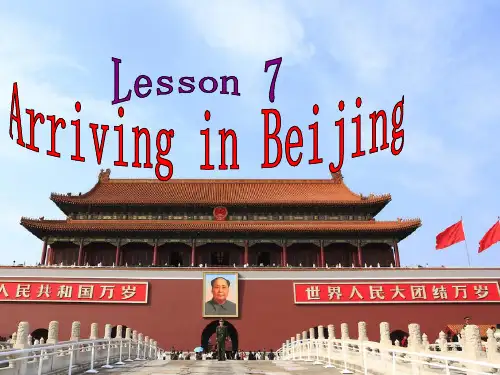
1、 When do they arrive in Bei Jing? They arrive in BeiJing at 1:17in the afternoon .
2、What the child is doing? The child is flying a kite.
单词讲解:
1.people 人们(名词)
people是集合名词,本身是复数,注 意词尾不要加s,前面不能加a或one
some people 一些人 many people 许多人
2.many 许多的;许多(形容词)
后面加可数名词的复数形式
how many 多少 +名词复数 how much 多少 +不可数名词
3、 What are the women doing? .The women are dancing.
Look and match.
1
2
3
4
5
6
( 6 )These people are walking. ( 1)These men are playing basketball. ( 2 )These women are singing. ( 3 )The girl is running. ( 5 )These children are playing. ( 4 )The woman is listening to misic.
冀教版英语三年级下册教案
冀教版英语三年级下册教案1教学目标(Objectives):1.确保学生认识和理解一些基本单词的意义和简单口头运用(To learn the meaning and simple usages of some words and phrases)。
需要掌握的词组:Tomorrow Woman2.学习使用本单元重点句型及表达(To use the typical sentences to ex press)。
需要掌握的句型:Can you play ping-pong with me?I‘m sorry,I can’t.Yes,let‘s go!3.鼓励学生大胆发言及表达(To encourage the students to express b ravely)。
4.培养学生对英语学科的兴趣(To make the students interest in Engli sh learning)。
5.增强学生听说读写译的能力(To strengthen t he ability of listenin g,speaking,reading,writing and translating)。
教学重点(Key Points):在学习了单词的基础上,以单词为载体,进行主要句型的学习,并了解其中的语法现象,根据具体情境,学会交流对话,侧重句型语法学习,交际意向和课外拓展为重点。
教学方法:游戏,音频,情景教学法,Pair-work两人小组活动,Group-work小组活动,多媒体辅助教学。
教学难点:学生处于小学阶段,对英语有了初步了解,词汇储备较少,对于三年级下学期学生的要求重点是在会读会说的基础上,能掌握一些基本单词的拼写和造句,了解一定的语法内涵,与人进行简单沟通交流。
教学准备:课件、照片素材、音频文件、教学道具。
教学设计:Step1. GreetingStep2. Warm-up/Leading(热身/课程导入)Warm-up Question1)你如何邀请别人和你一起玩耍?2)Survey:Can you play ping-pong with me?I’m sorry,I can‘t.Yes,let’s go!Step3.Present ation(呈现新课)1.Words Learning!1)老师放映课件,用中文询问同学看到了什么?同学们会看到课件上呈现的图画。
Unit2Lesson7AlwaysHavebreakfast!(教案)冀教版(三起)英语六年级下册
教案:Unit 2 Lesson 7 Always Have Breakfast!一、教学目标1. 知识目标(1)能够听懂、会说、会读本课的生词和重点句子。
(2)能够运用所学知识介绍自己的早餐并描述日常饮食习惯。
2. 能力目标(1)能够运用所学知识进行简单的日常交流。
(2)能够正确使用一般现在时描述日常饮食习惯。
3. 情感目标二、教学内容1. 主题:饮食与健康。
3. 语言技能:学生需要通过听、说、读、写等方式,运用所学知识进行日常交流。
三、教学重点与难点1. 重点:掌握本课的生词和重点句子,能够运用一般现在时描述日常饮食习惯。
2. 难点:正确使用一般现在时描述日常饮食习惯,并在实际情境中进行运用。
四、教具与学具准备1. 教具:多媒体课件、录音机、磁带。
2. 学具:课本、练习册、单词卡片。
五、教学过程1. 导入:教师通过与学生谈论日常饮食,引出本课的主题。
2. 呈现:教师展示图片,引导学生说出早餐的重要性。
3. 新课内容:教师讲解一般现在时的表达方式,如“I always havefor breakfast.”,并通过示例让学生进行练习。
4. 练习:学生分组进行角色扮演,运用所学知识介绍自己的早餐并描述日常饮食习惯。
5. 巩固:教师组织游戏活动,让学生在游戏中运用所学知识。
六、板书设计板书设计如下:Unit 2 Lesson 7 Always Have Breakfast!生词:breakfast, lunch, dinner, always, sometimes, never 重点句子:I always have bread and milk for breakfast.She never has rice for dinner.一般现在时的表达方式:I always havefor breakfast.He sometimes hasfor lunch.She never hasfor dinner.七、作业设计1. 抄写本课生词和重点句子。
冀教版(三起)英语四年级下册Unit 2 Lesson 7 Months of the Year课件
Sept.
Oct.
March Mar.
July Jul.
November Nov.
April Apr.
August Aug.
December Dec.
Activity 2: quick response
If I say the name of the festival, you should say which
2. His birthday is ____ July.
A. on
B. in
C. of
3. Let’s learn the ____ of the year.
A. month B. months C. monthes
二、连词成句。
1. is in birthday March Whose (?) W__h_o_s_e__b_ir_t_h_d_a_y_i_s_i_n_M__a_r_c_h_?__________
Look and talk
Which months have 30 days? 4, 6, 9, 11
Which months have 31 days?1, 3, 5, 7, 8, 10, 12
Which month has the least days in a year? 2
Do you know any special days in a year? Which month is it in?
Septemmber
What can you see between the two words?
Look and talk When we talk about the month, we can talk about the weather, the activity, the scenery ...