
Adjective Order
Examples:Some of the hungry gentlemenThe last great civilizationTen big round metal ringsThe beautiful Japanese ceramic vase Either of the small green apples My three lovely daughtersAn interesting wooden statue The third red plastic containerThe basic types of adjectivesAn opinion adjective explains what you think about something (otherpeople may not agree with you). Examples:silly, beautiful, horrible, difficultA size adjective, of course, tells you how big or small something is.Examples:large, tiny, enormous, littleAn age adjective tells you how young or old something or someone is.Examples:ancient, new, young, oldA shape adjective describes the shape of something. Examples:square, round, flat, rectangularA colour adjective, of course, describes the colour of something.Examples:blue, pink, reddish, greyAn origin adjective describes where something comes from. Examples: French, lunar, American, eastern, GreekA material adjective describes what something is made from. Examples: wooden, metal, cotton, paperA purpose adjective describes what something is used for. These adjectives often end with "-ing". Examples:sleeping (as in "sleeping bag"), roasting (as in "roasting tin")Sentence ExamplesSENTENCEEVALAPPEARANCE / QUALITYAGECOLORORIGIN/MATERIALNoun (or rest of sentence)Who left a foul, rotten, two-week-old banana in my desk drawer? We bought a practical, little, black-and-white plaid,polyester seat cover. They wore abeautiful, life-size,red-and-yellow feathered, Chinese-dragon costume. The artist created a fantastic, huge, mobius-shaped,shiny, stainless-steel sculpture.The intelligent, little,young, black, French poodle stood quiety. "Olodum" is known for its powerful, hypnotic, energeticSamba-reggaerhythms andperformance.Speakers rarely use more than three or four adjectives before a noun unless they are trying to be very descriptive.VariationsUsually, the word order in the "appearance" category is size , shape , condition , but other variations occur as well.APPEARANCE: SIZESHAPECONDITIONNOUN PHRASEA tall round out-of-breath man sat breathing heavily on the park bench.Also: A tall out-of -condition roundman sat breathing heavily on the park bench. Aout-of -condition tallroundman sat breathing heavily on the park bench.AdjectivesAn adjective is a word that describes, identifies, modifies, or quantifies something (a noun or a pronoun). In the phrase, "the black cat" the word black is an adjective because it describes the cat.In English, an adjective usually comes before the noun it pertains to (for example, a red apple or a cute cat.).Adjectives can be classified into many categories. In English, adjectives are generally used in the order: quantity-->opinion-->size-->age-->shape-->color-->origin-->material-->purpose. Some of these categories are (roughly in the order in which adjectives are used in English): quantity - few, no, one, two, three, four, several, many, all, some, every, each, ...opinion - good, better, best, bad, worse, worst, mediocre, awful, fantastic, pretty, ugly, clean, dirty, wasteful, difficult, comfortable, valuable, worthless, useful, useless, important, evil, angelic, rare, scarce, poor, rich, lovely, disgusting, amazing, surprising, loathesome, unusual, usual, pointless, ...personality/emotion - happy, sad, excited, scared, frightened, outgoing, funny, sad, zany, grumpy, cheerful, jolly, carefree, quick-witted, blissful, lonely, elated, ...sound - loud, soft, silent, vociferous, screaming, shouting, thunderous, blaring, quiet, noisy, talkative, rowdy, deafening, faint, muffled, mute, speechless, whispered, hushed, ...taste - sweet, sour, acidic, bitter, salty, tasty, delicious, savory, delectable, yummy, bland, tasteless, palatable, yummy, luscious, appetizing, tasteless, spicy, watery, ...touch - hard, soft, silky, velvety, bumpy, smooth, grainy, coarse, pitted, irregular, scaly, polished, glossy, lumpy, wiry, scratchy, rough, glassy, ...size, weight - heavy, light, big, small, tiny, tall, short, fat, thin, slender, willowy, lean, svelte, scrawny, skeletal, underweight, lanky, wide, enormous, huge, vast, great, gigantic, monstrous, mountainous, jumbo, wee, dense, weighty, slim, trim, hulking, hefty, giant, plump, tubby, obese, portly, ...smell - perfumed, acrid, putrid, burnt, smelly, reeking, noxious, pungent, aromatic, fragrant, scented, musty, sweet-smelling,...speed - quick, fast, slow, speeding, rushing, bustling, rapid, snappy, whirlwind, swift, hasty, prompt, brief, ...temperature - hot, cold, freezing, icy, frigid, sweltering, wintry, frosty, frozen, nippy, chilly, sizzling, scalding, burning, feverish, fiery, steaming, ...age - young, old, baby, babyish, teenage, ancient, antique, old-fashioned, youthful, elderly, mature, adolescent, infantile, bygone, recent, modern, ...distance - short, long, far, distant, nearby, close, faraway, outlying, remote, far-flung, neighboring, handy, ...shape - round, circular, square, triangular, oval, sleek, blobby, flat, rotund, globular, spherical, wavy, straight, cylindrical, oblong, elliptical, zigzag, squiggly, crooked, winding, serpentine, warped, distorted, ...miscellaneous qualities- full, empty, wet, dry, open, closed , ornate, ...brightness - light, dark, bright, shadowy, drab, radiant, shining, pale, dull, glowing, shimmering, luminous, gleaming, ...color - pink, red, orange, yellowish, dark-green, blue, purple, black, white, gray, brown, tanned, pastel, ...time - early, late, morning, night, evening, everlasting, initial, first, last, overdue, belated, long-term, delayed, punctual, ...origin/location - lunar, northern, oceanic, polar, equatorial, Floridian, American, Spanish, Canadian, Mexican, French, Irish, English, Australian, ...material - glass, wooden, cloth, concrete, fabric, cotton, plastic, leather, ceramic, china, metal, steel, ...purpose - folding, swinging, work, racing, cooking, sleeping, dance, rolling, walking, ... Example of the Sequence of Multiple Adjectives in Chart Form:Adjectives for describing people:Adjective Spanish Antonym Noun Adverbabsent-minded despistado attentive absent-mindedness absentmindedly affable afable unfriendly affability affably agreeable agradable disagreeable agreeability agreeably ambitious ambicioso lazy, unambitious ambition ambitiously approachable accesible unapproachable approachabilityannoying irritante pleasant annoying annoyingly articulate elocuente inarticulate articulate articulately artistic artístico unartistic, art artisticallyuntalentedattractive atractivo unattractive attractiveness attractively biased parcial unbiasedbonhomous cordial bonhomieboring aburrido exciting, engaging boredom boringly brave valiente cowardly bravery bravelycautious, careful cuidadoso careless, reckless,incautiouscaution, care cautiously, carefullycareless descuidado cautious, careful carelessness carelessly cheerful alegre sad cheerfulness cheerfullyclever listo dumb, stupid,foolish, unclevercleverness cleverlycompetent competente incompetent competence competently conceited engreído humble, modest conceit conceitedly considerate considerado inconsiderate consideration considerately contented satisfecho discontented contentmentcrazy loco sane craziness crazily corrupt, corruptive corrupto incorrupt corruption corruptly cowardly cobarde brave cowardliness cowardly cultured culto unculturedcunning astuto maladroit cunningness cunninglycrafty hábil naive craftiness craftilycruel cruel kind cruelty cruellycynical cínico trusting, optimistic cynicism, cynic cynically decisive decisivo indecisive decisiveness decisivelydegeneratedetestable detestable lovable detestability detestably demanding exigente undemanding demander demandingly dependable formal undependable dependability dependably direct directo reserved directly disagreeable desgradable agreeable disagreeableness disagreeably discreet discreto indiscreet discretion discretely discontented descontento contented discontentedness discontentedly dishonest deshonesto honest dishonesty dishonestly disloyal desleal loyal disloyalty disloyally disobedient desobediente obedient disobedience disobediently disorganized desorganizado organized disorganizationdisrespectful irrespetuoso respectful disrespect disrespectfully dumb tonto smart dumbness dumblyearnest concienzudo half-hearted earnestness earnestlyeasy-going tranquilo tense, excitableefficient eficiente inefficient efficiency efficientlyenthusiastic entusiasta unenthusiastic,spiritless,passionlessenthusiasm enthusiasticallyeven-handed imparcial unfair even-handedness even-handedly eccentric excéntrico normal eccentric eccentrically excitable excitable relaxed, easy-going excitability excitablyextroverted extrovertido introverted extrovert,extroversionextroversivefaithful fiel unfaithful faithfulness faithfully fair justo unjust, unfair fairness fairly fearful miedoso fearless fearfulness fearfully fearless audaz fearful fearlessness fearlessly flexible flexible inflexible flexibility flexibly forgetful olvidadizo attentive forgetfullness forgetfully frank franco reserved frankness frankly friendly amistoso unfriendly freindlinessfrivolous frívolo serious, important frivolity frivolously funny gracioso boring funniness funnilygenerous generoso stingy, miserly,ungenerousgenerosity generouslyglum apesadumbrado happy glumness glumlygood-natured bondadoso unkind good-naturedness good-naturedly gregarious sociable unsociable gregariousness gregariously grumpy gruñon easy-going grumpily happy feliz unhappy happiness happilyhard-working trabajador negligent hard-workerhighly-strung muy excitable relaxedhelpful servicial unhelpful helpfulness helpfully honest honesto dishonest honesty honestly hospitable hospitalario inhospitable hospitalityhumble humilde snobbish, conceited humilty humbly hypocritical hipócrita sincere hypocrite hypocritically literate culto illiterate literateness literately idiotic idiota smart idiot idiotically illiterate analfabeto literate illiterateness illiterately imaginative imaginativo unimaginative imagination imaginatively immoral inmoral moral immorality inmorally immature inmaduro mature immaturity immaturely impatient impaciente patient impatience impatiently impolite maleducado polite impoliteness impolitely inflexible inflexible flexible inflexibility inflexiblyinhospitable poco hospitalario hospitable inhospitableness inhospitably insane loco sane insanity insanely insecure inseguro self-confident insecurity insecurely insincere poco sincero sincere insincerity insincerely intelligent inteligente unintelligent, stupid intelligence intelligently interesting interesante uninteresting interest interestinglyintroverted introvertido extroverted introvert,introversionintroversivekind amable unkind, mean, cruel kindness kindlylascivious lascivo puritanical, proper,chastelasciviousness lasciviouslylazy vago ambiitious laziness lazilylecherous lascivo puritanical, proper,chastelecherousness lecherouslylikeable agradable unlikeable likeablenesslogical logico illogical logic logically loud ruidoso quietloveable adorable unloveableloving cariñoso unloving lovingly loyal leal disloyal loyalty loyallylustful lujurioso puritanical, proper,chastelustfullymature maduro immature maturity maturelymerciful misericordioso ruthless, merciless,heartless, unmercifulmercifulness, mercy mercifullymerciless despiadado merciful mercilessness, mercy mercilessly miserable miserable happy miserymodest modesto immodest, conceited modesty modestlynaive inocente sophisticated, streetsmartnaivety naivelynarrow-minded intolerante open-minded narrow-mindedness narrow-mindedly nervous nervioso calm, relaxed nervousness nervously obedient obediente disobedient obedience obediently obnoxious detestable inoffensive obnoxioulsy open-minded de aptitud abierta narrow-minded open-mindedness open-mindedly optimistic optimista pessimistic optimist, optimism optimistically organized organizado disorganized organizationout-going extrovertido introvertedoutspoken directo reserved outspokenness outspokenly passionate apasionado impassionate, dull passion passionately pathetic patetico cheerful pathetically patient paciente impatient patience patientlypessimistic pesimista optimistic pessimism pessimistically petty mezquino pettiness pettily pleasant agradable unpleasant pleasantly polite educado impolite politely practical practico impractical practicality practicallyprejudiced lleno de prejuicios unprejudiced,tolerantprejudice prejudicedlyquiet silencioso loudreckless imprudente cautious, careful carelessness carelessly radical radical normalrelaxed relajado unrelaxed, nervous relaxationreserved reservado unreserved reservationrespectful respetuoso disrespectful respect respectfully reliable fiable unreliable reliability reliably remorseful arrepentido unremorsefulrepentant arrepentido unrepentantresourceful con recursos unresourceful resourcefulness resourcefully rude (crude)grosero courteous rudeness rudely ruthless despiadado merciful ruthlessness ruthlessly sane cuerdo insane sanity sanely sarcastic sarcástico unsarcastic sarcasm sarcasticallyscoundrelself-confident seguro de sí mismo insecure self-confidenceself-destructive autodestructivo safesensible sensato impractical,insensiblesensibility sensiblysensitive sensible insensitive sensitivity sensitively serious serio silly, umimportant seriousness seriously shallow superficial deep, profoundshameless desvergonzado shameful shamelessness shamelessly shy timido outgoing, extroverted shyness shylysilly tonto serious sillinesssincere sincero insincere sincerity sincerely smart listo dumbsociable sociable unsociable sociability sociably snobbish, snobby snob humble, modest snobbishness snobbily spontaneous espontáneo rigid, wooden spontaneity spontaneously stingy tacaño generous stinginess stingily strong fuerte weak strength strongly stubborn terco meek stubbornness stubbornly stuck-up creído humble, modeststupid estúpido smart, clever,intelligentstupidity stupidlysurly hosco courteous surlinesstemperamental temperamental unemotional temperamentally timid tímido outgoing, extroverted timidity timidlytactful con tacto tactless tact tactfully thoughtful considerado thoughtless thoughfully tolerant tolerante intolerant tolarance tolerantly trustworthy digno de confianza untrustworthy trustworthinesstwo-faced hipócrita sincereunambitious sin ambición ambitious unambitiously unapproachable inaccesible approachableunartistic artistic unartistically unattractive attractiveunbiased biaseduncultured culturedundemanding demandingundependable dependable undependably unenthusiastic enthusiastic unenthusiastically unfair fair unfairlyunfaithful faithful unfaithfulness unfaithfully unfriendly friendlyunhappy happy unhappily unhelpful helpful unhelpfully unimaginative imaginative unimaginatively umimportant serious unimportantly unintelligent intelligent unintelligently uninteresting interesting interest uninterestingly unkind kind unkindly unloveable loveableunloving loving lovingly unmerciful merciful unmercifulness unmercifully unpleasant pleasant unpleasantly unprejudiced prejudicedunprincipled principledunrelaxed relaxedunresourceful resourceful unresourcefully unreliable reliable unreliably unremorsefulunrepentantunreserved reservedunscrupulous unscrupulously unsociable gregarious unsociably unsophisticated street smart unsophisticatedly untalented talented talent untalentedly untrustworthy trustworthy untrustworthinessvirtuous virtuoso wicked virtuously weak débil strong weakness weaklywicked malvado virtuous wickedly Useful VocabularyMen's Clothessuit(s) shirt(s) tie(s)Women's Clothesdress(es) blouse(s) skirt(s)tanktop(s)Uni-Sexcoat(s) jacket(s) t-shirt(s)trouser(s) jean(s) short(s) jumper(s) pullover(s) cardigan(s) sweatshirt(s)glove(s) mitten(s)Baby Clothesromper suit(s) nappy (nappies) Holiday/Leisure Clothesswimming trunk(s) bikini(s)swimsuit(s) swimming costume(s) bathing costume(s)Nightwearnightdress(es)nightie(s)pyjama(s) dressing gown(s) UnderwearMensboxers y-fronts Ladies (Lingerie)bra(s)pant(s) knicker(s)stocking(s) tight(s) Uni-Sexvest(s)Footwearshoe(s) sandal(s) boot(s)wellington(s) slipper(s) sock(s) Accessoriesbelt(s)handbag(s)headscarf (headscarves) scarf (scarves)glasses sunglasses watch(es)glove(s)hat(s)hanger(s)Jewellerybracelet(s)necklace(s)ring(s) earring(s) Parts of clothes。
初中英语语法基础知识大全100题
初中英语语法基础知识大全100题Grammar is the foundation of language, and a strong grasp of grammar principles is essential for effective communication in English. For middle school students, establishing a solid understanding of English grammar basics is crucial as they continue to develop their language skills. This essay will explore 100 essential grammar fundamentals that every middle school student should master.1. Parts of Speech: Nouns, Verbs, Adjectives, Adverbs, Pronouns, Prepositions, Conjunctions, and Interjections.2. Singular and Plural Nouns: Regular and irregular plural forms.3. Possessive Nouns: Forming possessive case with apostrophes.4. Proper Nouns and Common Nouns: Capitalization rules.5. Subject-Verb Agreement: Ensuring verbs agree with their subjects in number and person.6. Verb Tenses: Present, past, future, and their progressive and perfect forms.7. Irregular Verbs: Common verbs with unique past tense and past participle forms.8. Active Voice and Passive Voice: Recognizing and using both constructions.9. Transitive and Intransitive Verbs: Verbs that require objects and those that do not.10. Linking Verbs: Verbs that connect the subject to a subject complement.11. Auxiliary Verbs (Helping Verbs): Verbs that assist the main verb, such as "be," "have," and "do."12. Modal Auxiliaries: Verbs that express possibility, obligation, permission, and other modalities.13. Gerunds and Infinitives: Verbal forms that function as nouns, adjectives, or adverbs.14. Adjective Types: Descriptive, possessive, demonstrative, interrogative, and articles.15. Degrees of Comparison: Positive, comparative, and superlative forms of adjectives.16. Adverb Types: Manner, time, place, frequency, degree, and sentence adverbs.17. Comparative and Superlative Adverbs: Forming adverb comparisons.18. Personal Pronouns: Subject, object, possessive, and reflexive forms.19. Indefinite Pronouns: Words like "someone," "anyone," "nothing," and "all."20. Relative Pronouns: "Who," "whom," "whose," "which," and "that."21. Interrogative Pronouns: "Who," "what," "where," "when," "why," and "how."22. Preposition Types: Prepositions of time, place, direction, and relationship.23. Prepositional Phrases: Identifying and using prepositional phrases correctly.24. Coordinating Conjunctions: "And," "but," "or," "nor," "for," "so," and "yet."25. Subordinating Conjunctions: "Because," "since," "when," "while," "if," and "unless."26. Correlative Conjunctions: Paired conjunctions like "both...and," "either...or," and "neither...nor."27. Interjections: Expressing emotion or emphasis, such as "Ouch!" and "Wow!"28. Sentence Types: Declarative, interrogative, imperative, and exclamatory sentences.29. Simple Sentences: One independent clause with a subject and a verb.30. Compound Sentences: Two or more independent clauses joined by a coordinator.31. Complex Sentences: An independent clause and one or more dependent clauses.32. Compound-Complex Sentences: Combining compound and complex sentence structures.33. Phrases: Noun phrases, verb phrases, adjective phrases, andadverb phrases.34. Clauses: Independent clauses and dependent clauses.35. Dangling and Misplaced Modifiers: Recognizing and correcting these common errors.36. Parallel Structure: Maintaining consistency in the grammatical form of related elements.37. Sentence Fragments: Identifying and correcting incomplete sentences.38. Run-On Sentences: Recognizing and fixing two or more independent clauses joined incorrectly.39. Subject-Verb Inversion: Inverting the subject and verb in certain sentence structures.40. Negation: Forming negative statements using "not," "no," and other negating words.41. Contractions: Combining words to form shortened forms, such as "can't" and "won't."42. Capitalization Rules: When to capitalize proper nouns, titles, and the beginning of sentences.43. Punctuation: Using periods, commas, semicolons, colons, apostrophes, and quotation marks correctly.44. Appositives: Noun phrases that rename or describe another noun.45. Participial Phrases: Verb phrases that function as adjectives or adverbs.46. Gerund Phrases: Noun phrases beginning with a gerund.47. Infinitive Phrases: Verb phrases beginning with an infinitive.48. Restrictive and Nonrestrictive Clauses: Defining and nondefining relative clauses.49. Conditional Sentences: "If-then" statements expressing hypothetical situations.50. Passive Voice Transformation: Changing active voice sentences to passive voice.51. Direct and Indirect Speech: Reporting statements, questions, and commands.52. Pronoun-Antecedent Agreement: Ensuring pronouns agree with their antecedents.53. Pronoun Case: Subjective, objective, and possessive pronoun forms.54. Reflexive and Intensive Pronouns: Using "self" and "selves" pronouns correctly.55. Demonstrative Pronouns: "This," "that," "these," and "those."56. Indefinite Pronouns: "Everyone," "someone," "anything," and "nothing."57. Relative Pronouns: "Who," "whom," "whose," "which," and "that."58. Interrogative Pronouns: "Who," "what," "which," "whose," and "whom."59. Preposition Placement: Appropriate positioning of prepositions in sentences.60. Conjunction Usage: Selecting the right coordinating or subordinating conjunction.61. Adverb Placement: Properly positioning adverbs within asentence.62. Adjective Order: Following the correct order when using multiple adjectives.63. Verb Tense Consistency: Maintaining consistent verb tense throughout a passage.64. Subjunctive Mood: Using "were" instead of "was" in certain hypothetical statements.65. Gerund vs. Infinitive: Choosing between gerund and infinitive verb forms.66. Active vs. Passive Voice: Determining the appropriate voice for a given sentence.67. Subject-Verb Agreement with Collective Nouns: Singular or plural verb form.68. Compound Subject Agreement: Ensuring correct verb agreement with compound subjects.69. Dangling Modifiers: Correcting sentence structures with unclear modifications.70. Misplaced Modifiers: Placing modifiers in the appropriate position in a sentence.71. Parallel Structure in Lists: Maintaining grammatical consistency ina series of items.72. Comma Usage: Properly using commas in a variety of sentence structures.73. Semicolon Usage: Correctly applying semicolons to join independent clauses.74. Colon Usage: Appropriately using colons to introduce lists or explanations.75. Apostrophe Usage: Proper placement of apostrophes in possessive forms and contractions.76. Quotation Mark Usage: Correctly incorporating quotations and dialogue.77. Capitalization Rules: Applying capitalization guidelines for proper nouns, titles, and more.78. Abbreviation and Acronym Usage: Correctly using abbreviated forms and acronyms.79. Numbers and Numerals: Deciding when to spell out numbers versus using numerals.80. Commonly Confused Words: Distinguishing between homophones and similar-sounding words.81. Idioms and Idiomatic Expressions: Understanding and using common English idioms.82. Preposition Combinations: Mastering the appropriate prepositions to use in various contexts.83. Relative Clause Placement: Ensuring relative clauses are positioned correctly.84. Noun Clause Structure: Constructing noun clauses as subjects, objects, and complements.85. Adverb Clause Structure: Forming adverb clauses to provide additional information.86. Adjective Clause Structure: Creating adjective clauses to modifynouns and pronouns.87. Conditional Clause Structure: Constructing "if-then" statements and other conditional sentences.88. Passive Voice Transformation: Converting active voice sentences to passive voice.89. Direct and Indirect Speech: Accurately reporting statements, questions, and commands.90. Pronoun-Antecedent Agreement: Ensuring pronouns agree with their antecedents in number and gender.91. Pronoun Case: Properly using subjective, objective, and possessive pronoun forms.92. Reflexive and Intensive Pronouns: Identifying and applying the correct "self" pronouns.93. Demonstrative Pronouns: Appropriately using "this," "that," "these," and "those."94. Indefinite Pronouns: Recognizing and using universal, existential, and negative pronouns.95. Relative Pronouns: Selecting the right relative pronoun ("who," "whom," "whose," "which," "that").96. Interrogative Pronouns: Employing "who," "what," "which," "whose," and "whom" correctly.97. Preposition Placement: Ensuring prepositions are positioned properly in sentences.98. Conjunction Usage: Choosing the appropriate coordinating or subordinating conjunction.99. Adverb Placement: Determining the correct placement of adverbs within a sentence.100. Adjective Order: Arranging multiple adjectives in the proper sequence.Mastering these 100 essential grammar fundamentals will provide middle school students with a strong foundation in English language skills. By understanding the rules and conventions governing parts of speech, sentence structures, punctuation, and more, students can improve their written and oral communication, as well as their reading comprehension. Continuous practice and reinforcement of these grammar principles will equip middle school students for success in their academic and professional pursuits.。
高中英语形容词用法及大全
高中英语形容词用法及大全Adjectives are an essential part of English language. They are used to describe or modify nouns or pronouns, and they provide more information about the subject of a sentence. In this article, we will discuss the usage of adjectives in English language.1. Adjective OrderAdjectives are used in a specific order before a noun. The order is as follows: opinion, size, age, shape, color, origin, material, purpose. For example, "a beautiful small antique round red French wooden dining table." It is important to note that not all adjectives may be used before a noun.形容词顺序:在名词前,形容词需要遵循一定的顺序,这个顺序是:观点、大小、年龄、形状、颜色、起源、材料、目的。
例如,“一个美丽的小型古董圆形红色法式木制餐桌。
”需要注意的是,并不是所有的形容词都可以用在名词前。
2. Comparative and Superlative FormsAdjectives have comparative and superlative forms. The comparative form is used to compare two things while the superlative form is used to compare three or more things. For example, "John is taller than Tom" (comparative) and "John is the tallest person in the room" (superlative).比较级和最高级:形容词有比较级和最高级形式。
Adjectives and Adverbs
concerned/interested
4. As both but different in meaning-2
current
• (3) The present situation concerns all the students present. who are here who are not here • (4) There are some students absent from class and some listening to my lecture in an absent way. showing no interest • (5) The best textbook known is the best known textbook.
3. Only as postmodifiers
• 3) when modifying indefinite pronouns beginning with no-, some-, any-, every-, eg. • Do you hear something interesting?
3. Only as postmodifiers
3. Only as postmodifiers
• • • • • 1) location and time words 2) Adjectives beginning with a3) When modifying indefinite pronouns 4) Adjectives in pairs 5) Adjective phrases
BACK
2. Material nouns
• 2. material nouns and adjectives mostly ending in –en, such as medical, atomic, wooden, leaden, golden, silken, etc. • The medical student wears a silken T-shirt.
repeat order外贸术语

repeat order外贸术语1. "Repeat order, what a magical term in the world of foreign trade! It's like getting a golden ticket for business. You know, when I first started my small export business, I worked really hard to get my first customer. And when that customer placed a repeat order? Oh my god, it was like winning the lottery. It means they liked my products so much that they wanted more. For example, if I sell handmade candles. A customer bought a dozen candles from me last month, and this month they place another order for two dozen. That's a repeat order, and it's a sign that I'm doing something right!"2. "Repeat order in foreign trade is like a warm hug from an old friend. It gives you this amazing feeling of validation. Think about it. You're out there in the global market, trying to sell your goods. There are so many competitors. And then, a client comes back and says, 'Hey, I want more of what you sold me last time.' It's just incredible. Let's say you're a clothing exporter. A store in another country bought 50 pieces of your new T - shirts. A few months later, they send you a repeat order for 100 pieces. That repeatorder is like a vote of confidence in your brand."3. "Repeat order? Oh, it's the lifeblood of many a foreign trade business. It's not just about making more money, it's about building relationships. I once heard a story from a fellow exporter. He said that his first interaction with a customer was a bit rocky. But then, the quality of his products won the customer over. And when the repeat order came in, he was over the moon. It was like a new beginning for their business partnership. For instance, if you export furniture. A hotel bought some of your chairs for their lobby. Later, they place a repeat order to furnish all their rooms with your chairs. That's the power of a repeat order."4. "Repeat order in foreign trade is like a secret weapon. It can make or break your business. You see, in this cut - throat world of international trade, getting new customers is tough. But when you have customers coming back for more, it's a whole different ball game. I remember when I sold my first batch of hand - painted ceramics to a foreign store. I was so nervous. But when they placed a repeat order, I felt like I could conquer the world. Say you're a food exporter. A supermarket overseas bought your special -edition cookies. If they place a repeat order for a larger quantity, it shows they believe in your product."5. "What on earth is a repeat order in foreign trade? Well, it's the best compliment a business can get. It's as if your product is shouting out to the world, 'I'm so good, they want me again!' I was chatting with a friend who runs an import - export business. He told me that a repeat order from a major client was like a ray of sunshine on a cloudy day. His business was struggling a bit, but that repeat order gave him the boost he needed. Take the case of a tech gadget exporter. A tech store bought 100 of their new - model headphones. If they order another 200 in a repeat order, it means the product is hitting the mark."6. "Repeat order is like a magical spell in the foreign trade dictionary. It can transform your business from just surviving to thriving. I know a small - scale exporter who was always on the edge, trying to find new customers. But when he got his first repeat order, it was like a turning point. He said it felt like he had finally found the right path. Imagine you export beauty products. A salon in a foreign country bought some of your haircare products.And then they place a repeat order for a complete range of your products. That's how a repeat order can open up new opportunities."7. "Repeat order in foreign trade? It's like a key that unlocks a world of possibilities. It shows that your customers trust you. I once had a customer who was very hesitant to buy my products at first. But after trying them out, they placed a repeat order. I was so excited, it was like a dream come true. Let's say you're an exporter of sports equipment. A sports club bought some of your training gear. If they come back with a repeat order for more advanced equipment, it means they are satisfied with your service and product quality."8. "A repeat order in foreign trade is like a second chance at a great first impression. It gives you the opportunity to show your customers that you can be consistent. I've seen businesses that rely solely on repeat orders and they are doing fantastically well. I remember talking to a jeweler who exports his creations. A jewelry store bought a few of his unique necklaces. When they placed a repeat order for more pieces with different designs, it was a signthat his work was appreciated. For example, if you export leather goods. A boutique bought some of your wallets. And a repeat order for your leather bags is a great indication of your brand's appeal."9. "Repeat order, the holy grail of foreign trade! It's that moment when you know you've got something special. It's not just about the money; it's about the relationship with your customer. I met a trader once who said that his repeat orders were like the roots of a tree that kept his business stable. If you're an exporter of art supplies. An art studio bought some of your high - quality paints. When they place a repeat order for different types of brushes, it's like they are building a long - term partnership with you."10. "Repeat order in foreign trade is like a bridge between you and long - term success. It's the connection that keeps your business flowing. I have a friend who was so worried about his foreign trade business not taking off. But then he got his first repeat order, and it was like a light at the end of the tunnel. For example, if you export home decor items. A home - improvementstore bought some of your wall art. And when they place a repeat order for your decorative vases, it means they see potential in your product range for their customers."Conclusion: Repeat order in foreign trade is not just a simple business term. It's a sign of success, a mark of good relationships, and a key factor in the growth and stability of a business. It's something that every foreign trade entrepreneur should strive to achieve.。
Adjectives全英解析
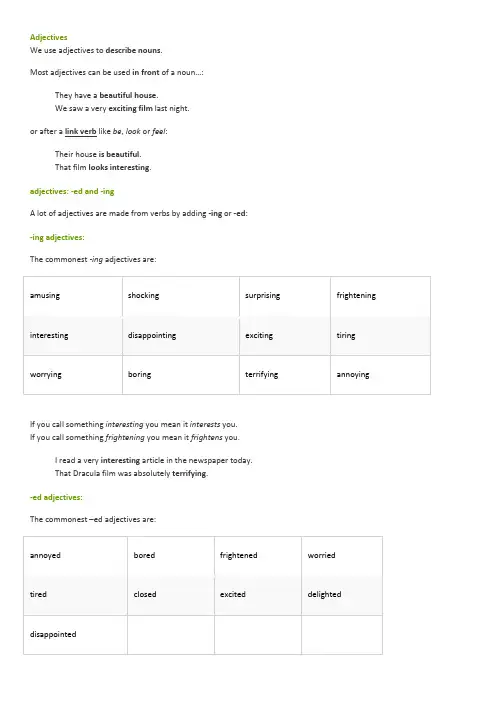
AdjectivesWe use adjectives to describe nouns.Most adjectives can be used in front of a noun…:They have a beautiful house.We saw a very exciting film last night.Their house is beautiful.That film looks interesting.adjectives: -ed and -ingA lot of adjectives are made from verbs by adding -ing or -ed: -ing adjectives:The commonest -ing adjectives are:If you call something interesting you mean it interests you.If you call something frightening you mean it frightens you.I read a very interesting article in the newspaper today.That Dracula film was absolutely terrifying.-ed adjectives:The commonest –ed adjectives are:If something annoys you, you can say you feel annoyed. If something interests you, you can say you are interested.The children had nothing to do. They were bored.order of adjectivesSometimes we use more than one adjective in front of a noun:Opinion adjectives:Some adjectives give a general opinion. We can use these adjectives to describe almost any noun:Some adjectives give a specific opinion. We only use these adjectives to describe particular kinds of noun:Food: tasty; deliciousFurniture, buildings: comfortable; uncomfortablePeople, animals: clever; intelligent; friendlyWe usually put a general opinion in front of a specific opinion:Usually we put an adjective that gives an opinion in front of an adjective that is descriptive:a nice red dress; a silly old man; those horrible yellow curtainsWe often have two adjectives in front of a noun:a handsome young man; a big black car; that horrible big dogSometimes we have three adjectives, but this is unusual:It is very unusual to have more than three adjectives.Adjectives usually come in this order:We use some adjectives only after a link verb:Some of the commonest -ed adjectives are normally used only after a link verb: annoyed; finished; bored; pleased; thrilledWe say:Our teacher was ill.My uncle was very glad when he heard the news.The policeman seemed to be very annoyedbut we do not say:A few adjectives are used only in front of a noun:We say:He lives in the eastern district.There were countless problems with the new machinery.but we do not say:intensifiersWe use words like very; really and extremely to make adjectives stronger:It’s a very interesting storyEveryone was very excited.It’s a really interesting story.Everyone was extremely excitedWe call these words intensifiers. Other intensifiers are:amazingly - exceptionally - incredibly - remarkably - particularlyWe also use enough as an intensifier, but enough comes after its adjective:If you are seventeen you are old enough to drive a car.I can’t wear those shoes. They’re not big enough.Intensifiers with strong adjectives:When we want to describe something or someone as exceptional you can use a strong adjective. Strong adjectives are words like:Enormous; huge = very bigTiny = very smallBrilliant = very cleverAwful; terrible; disgusting; dreadful = very badCertain = very sureExcellent; perfect; ideal; wonderful; splendid = very goodDelicious = very tastyWe do not use very with these adjectives. We do not say something is "very enormous" or someone is "very brilliant". With strong adjectives, for intensifiers we normally use:absolutely - exceptionally - particularly - really - quiteThe film was absolutely awful.He was an exceptionally brilliant child.The food smelled really disgusting.We use much and far as intensifiers with comparative adjectives in front of a noun:France is a much bigger country than Britain.He is a far better player than Ronaldo.We use these words as intensifiers with superlatives:easily - by far - farThe blue whale is easily the biggest animal in the world.This car was by far the most expensive.mitigatorsMitigators are the opposite of intensifiers. When we want to make an adjective less strong we use these words:fairly - rather - quiteBy the end of the day we were rather tired. The film wasn’t great but it was quite exciting. and in informal English: prettyWe had a pretty good time at the party.We call these words mitigators.absolutetotal - completeutter - perfectrealWe say:He’s a complete idiot.They were talking utter nonsense.We can use noun modifiers to show what something is made of:a gold watch; a leather purse; a metal boxWe often use noun modifiers with nouns ending in -er and -ing:an office worker; a jewellery maker; a potato peeler; a shopping list; a swimming lesson; a walking holiday.We use measurements, age or value as noun modifiers:a thirty kilogram suitcase; a two minute rest; a five thousand euro platinum watch; a fiftykilometre journey;We often put two nouns together and readers/listeners have work out what they mean. So:•an ice bucket = a bucket to keep ice in•an ice cube = a cube made of ice•an ice breaker = a ship which breaks ice•the ice age = the time when much of the Earth was covered in ice.Sometimes we find more than two nouns together:London office workers; grammar practice exercisesPosition of noun modifiersNoun modifiers come after adjectives:The old newspaper sellerA tiring fifty kilometre journey。
order、ever、even的用法

order、ever、even的用法order在这里是动词,意思是"点菜"。
另外在餐厅里还有一句话是比较常用的,侍者通常会说"Can I take the order now?"这里的order也是"点菜"的意思,但是是名词。
order的用法总结如下:order的用法1)v. 命令,吩咐,订(定)购,叫菜,点菜。
例如:The doctor ordered him to stay in bed for a couple of days. 大夫嘱咐他卧床一两天。
The manager ordered that the gate should be locked. 经理嘱咐大门要锁好。
You can order tickets by telephone.可以电话订票。
He ordered a cup of coffee.他要了一杯咖啡。
2)n. 命令(可数),订货(可数),秩序(不可数),顺序(不可数)。
例如:The policemen received an order and set out at once. 警察接到命令立刻出发了。
He has placed an order for 100 copies of the book. 他已经预定了一百本这种书。
He found everything in the house in good order. 他发现屋子里秩序井然。
Arrange the books in order of size.按大小顺序摆好书。
3)order还常构成in order to do something或in order that…。
例如:He works hard in order to(so as to)succeed.为了成功努力工作。
I lent him 5 pounds in order that he might buy the book. 我借给他5英镑以便让他买这本书。
定语英语语法
定语英语语法Adjective English Grammar。
Adjectives are an essential part of the English language. They add depth, detail, and description to our sentences, making them more vivid and engaging. In this document, we will explore the various aspects of adjective English grammar, including their types, placement, and usage.1. Types of Adjectives:Adjectives can be classified into several categories based on their characteristics. Some common types include:Descriptive Adjectives: These adjectives describe the qualities or characteristics of a noun. For example, "beautiful," "tall," and "intelligent" are all descriptive adjectives.Demonstrative Adjectives: These adjectives point out or indicate specific nouns. Examples include "this," "that," "these," and "those."Possessive Adjectives: These adjectives show ownership or possession. They include words like "my," "your," "his," "her," "our," and "their."Quantitative Adjectives: These adjectives indicate the quantity or amount of a noun. Examples include "many," "few," "all," "some," and "several."Interrogative Adjectives: These adjectives are used to ask questions about a noun. For instance, "which," "what," and "whose" are interrogative adjectives.2. Placement of Adjectives:In English grammar, adjectives are typically placed before the noun they modify. However, there are exceptions to this rule. Here are a few guidelines for adjective placement:Opinion Adjectives: Opinion adjectives, such as "beautiful," "delicious," or "interesting," usually come before the noun. For example, "a beautiful flower" or "an interesting book."Size Adjectives: Size adjectives, like "big," "small," or "large," also precede the noun. For instance, "a big house" or "a small car."Age Adjectives: Adjectives denoting age, such as "young," "old," or "new," generally come before the noun. For example, "an old friend" or "a new laptop."Shape Adjectives: Adjectives describing shapes, such as "round," "square," or "triangular," precede the noun. For instance, "a round table" or "a square box."Color Adjectives: Adjectives indicating color, like "red," "blue," or "green," usually come before the noun. For example, "a red dress" or "a blue sky."Origin Adjectives: Adjectives denoting origin, such as "Italian," "Chinese," or "American," can either precede or follow the noun. For instance, "an Italian restaurant" or "a restaurant Italian."3. Usage of Adjectives:Adjectives serve various purposes in English grammar. Here are a few important points to consider:Comparative and Superlative Forms: Adjectives can be used to compare two or more nouns. The comparative form is used to compare two things, while the superlative form is used to compare three or more things. For example, "She is taller than her sister" (comparative) and "He is the tallest person in the room" (superlative).Adjective Order: When multiple adjectives are used to describe a noun, there is a specific order in which they should be placed. The general order is: opinion, size, age, shape, color, origin, material, and purpose. For example, "a beautiful small antique wooden table."Adjective Clauses: Adjective clauses are groups of words that function as adjectives and provide additional information about a noun. They usually begin with relative pronouns such as "who," "which," or "that." For instance, "The girl who won the competition is my friend."In conclusion, understanding adjective English grammar is crucial for effective communication. By using various types of adjectives correctly and placing them appropriately, we can enhance the clarity and richness of our language. So, let's continue exploring the world of adjectives and make our sentences come alive with vivid descriptions.。
英语词类概述
Part of speech (word class) --- Introduction-----------(词类概述)词类(part of speech) ,顾名思义,就是一个词在句子中所担任的角色。
换言之,我们何时、在什么位置使用一个单词是由该单词在句子中所扮演的角色决定的。
英语词根据其词义、用法的特点,可分为实词(real word)和功能词(functional word(also called as empty word) (又称虚词)。
一、实词实词是具有明确意义的词,且大多可以转换成其他词类,数量庞大,而且经常有新词产生。
这类词包括:名词(noun)、动词(verb)、形容词(adjective)、副词(adverb)。
例如:interest (n.) 表示兴趣;interest(v.) 使…感兴趣;interesting(adj.)有趣的;interested(adv.) 对…感兴趣的。
例如:surprise (n.) 惊喜、惊奇;surprise(v.) 使…惊奇;surprised(adj.) 对…惊奇的;surprising (adj.) 让人惊奇的;surprisingly(adv.) 让人惊奇地。
实词是词汇的重点,是英语表达语义的骨干。
实词在句子中一般要重读。
1.名词(noun)1.1名词就是事物的名称。
1.2名词根据其性质又可分为:1.2.1类别名词:表事物的类别,约定俗成的名称。
e.g.: man, dog, apple, plant,animal, solid, liquid.1.2.2物质名词:water, iron, blood, sugar, fat1.2.3抽象名词:anger, happiness, luck, beauty, anxiety1.2.4时间名词:day, night, year, month, minute1.2.5专用名词:人名、地名等。
英语定语的练习
英语定语的练习In the realm of linguistics, the use of adjectives is a fundamental aspect of constructing sentences that are both descriptive and precise. When it comes to practicing English adjectives, it's essential to understand their placement and how they modify nouns. Here are some exercises to help you get a better grasp of using adjectives effectively.Exercise 1: Identifying AdjectivesRead the following sentences and underline the adjectives.1. The beautiful sunset painted the sky with warm hues.2. She wore a stylish hat that matched her elegant dress.3. The fragrant flowers filled the air with a delightful scent.Exercise 2: Adjective OrderArrange the adjectives in the correct order to complete the sentences.1. The ancient magnificent ruins are a popular tourist attraction.2. He is a talented young musician.3. She bought a small expensive vintage car.Exercise 3: Comparative and Superlative FormsConvert the following sentences to comparative and superlative forms.1. The big dog is friendlier than the small one.- Comparative: Bigger- Superlative: The biggest2. Of all the tall trees, the oldest one is the most impressive.- Comparative: Taller- Superlative: The tallestExercise 4: Adjective AgreementChoose the correct form of the adjective to complete the sentences.1. The two large books on the shelf are about history.2. The many beautiful paintings in the gallery were created by local artists.Exercise 5: Adjective ClausesComplete the sentences by adding an adjective clause.1. The old man who lives next door is very friendly.2. The young woman who works at the coffee shop is an excellent barista.Exercise 6: Compound AdjectivesIdentify and use compound adjectives in the sentences.1. The well-dressed guest at the party was the center of attention.2. The well-known author gave a fascinating talk.Exercise 7: Adjective CollocationsMatch the adjectives with the nouns to form collocations.1. A quick thinker2. A fast learner3. A slow runnerExercise 8: Adjective and Adverb DistinctionDetermine whether the word in parentheses should be used as an adjective or an adverb.1. She speaks (fluently) in three languages.2. He played the piano (beautifully).Remember, practice is key to mastering any language skill, and the use of adjectives is no exception. These exercises are designed to help you become more adept at identifying, ordering, and using adjectives in English.。
英语形容词副词练习题
英语形容词副词练习题Adjective and Adverb Exercises1. Identify the Adjective: Choose the correct adjective to describe the noun in parentheses.- The (beautiful, quickly) sunset painted the sky with (soft, loud) colors.2. Adjective Order: Arrange the adjectives in the correct order to form a well-structured sentence.- The (old, large, wooden, historical) ship sailed gracefully across the (blue, calm) ocean.3. Comparative and Superlative Forms: Convert the adjectives into their comparative or superlative forms as required.- The (tall) tree is the (tallest) in the park.- The (fast) car is faster than the (slower) one.4. Adverb Placement: Place the adverb correctly to modify the verb.- She (quickly, quietly) finished her homework.- He (carefully, loudly) explained the concept.5. Adverb of Manner: Use adverbs to describe how an action is performed.- The athlete (gracefully) completed the difficult gymnastics routine.- The pianist (expertly) played the challenging piece.6. Adverb of Frequency: Choose the correct adverb to indicate how often an action occurs.- She (rarely, frequently) visits her grandparents.- They (occasionally, always) go on vacation in the summer.7. Adverb of Degree: Use adverbs to express the extent or degree of something.- The story was (extremely, slightly) interesting.- He was (completely, partially) unaware of the situation.8. Adverb of Time: Choose the adverb that correctly indicates when something happens.- The concert (yesterday, tomorrow) was a great success.- She will (soon, late) arrive at the meeting.9. Adjective or Adverb?: Determine whether the word in parentheses should be an adjective or an adverb.- The (quick, quickly) runner won the race.- The (happy, happily) child played in the park.10. Negative Adverbs: Use the correct negative form of the adverb.- She did not (quickly, quickly) finish her homework.- He (rarely, quickly) makes mistakes.11. Adverbial Clauses: Use adverbs to connect clauses andshow the relationship between them.- Although he was tired, he (nevertheless, quickly) completed the task.- Because she was late, she (hastily, slowly) ate herbreakfast.12. Conjunctions with Adverbs: Use conjunctions to link sentences and adverbs to show the relationship.- He (not only, also) finished his work, but he did it (quickly, carefully).Remember to always consider the context when choosing between an adjective or an adverb, and ensure that the form you choose correctly conveys the intended meaning.。