
译林版牛津英语八年级下册Unit 6
=provide sb. with sth.
e.g. He was very poor because he’d to provide food for seven children.
他很穷,因为他要给七个孩子提供食物。
Step 7 Homework
(6)What did those volunteers do for the Games?
Paragraph4 :
(7)Who is Li Hai?
(8)Did Li Hai win a gold in the end?
(9)How did Li Hai feel after the competition?
(1) need sth to do sth需要某物来做某事
e.g. I need some tools to finish the work.我需要一些工具来完成这份工作。
(2) some more food更多一些食物
数量意义词+more+名词:表更多……
e.g. two more apples再两个苹果
Have you ever been a volunteer?
Have you ever helped people who need help?
Step 3 Welcome to the unit
1.The Class 1, Grade 8 students have found some pictures of people who need help.
Write the correct words under them. Then put a tick in the boxes if you have ever helped these people.
blind, deaf, disabled, elderly, homeless, poor
2.Amy and Daniel are talking about people who need help. Listen to the recording and answer the following question:
授课时间
教学目标
To know the basic knowledge of the Special Olympics World Games.
To grasp some common reading skills.
To enhance the students' passion for volunteering.
Have a free talk.
Listen and answer.
Learn some language points.
Do the homework.
教后感
宝应县柳堡镇中心初级中学八年级英语(8下)教案
总课题
Unit 6 Sunshine for all
总课时
7
第2课时
课题
Reading(1)
2.Read the article by yourselves and try to finish Part B1.
Step 4 Further reading
1.Read then tell true or false(Part B3)
2. Read the reportparagraph by paragraph then answer some questions.
1.What are the Special Olympics World Gamesfor?
2.What events are included in theSpecial Olympics World Games?
3.What did those volunteers do for the Games?
宝应县柳堡镇中心初级中学八年级英语(8下)教案
总课题
Unit 6 Sunshine for all
总课时
7
第1课时
课题
Welcome to the unit
授课时间
教学目标
To understand the meanings of special groups of people.
To cultivate students’ sympathy and the ability of taking care of others.
教学重、难点
How to talk about helping people who need help
How to cultivate students’ sympathy and the ability of taking care of others.
教学准备
A tape recorder, some pictures
Try to remember the new words and phrases.
Learn the new words.
Talk about the questions.
Learn about people who need help.
Talk about the question.
Discussion in pairs.
(4)What events are included in theSpecial Olympics World Games?
Paragraph3 :
(5)How many people gave up their spare time for the 2007 Special Olympics World Games?
2.Act the dialogue out.
Step 6 Language points
1. I’m training to be a volunteer for the Olympic Games.
trainv.训练;培训
e.g. If you train hard, you'll make a good footballer.
Would Eddie and Hobo like to help people in need?
Step 5 Comic strip
1.Listen and answer the questions.
What is Hobo doing?
Will Eddie support him?
How does Hobo want Eddie to help?
课前预习
Preview the new words.
教学过程
教师活动
学生活动
旁注
Step 1 New words
Present some pictures and teach the new words.
Step 2 Free talk
1.Ask the students to talk about the questions below:
为贫困地区孩子做些事是很有意义的。
3. I want you to help me.
want sb. to do sth.想要某人做某事
e.g. Parents want us to study hard everyday.
父母想要我们每天努力学习。
4. I need some more food to eat at work.
Step 6 Practice
Have an interview aboutSpecial Olympics World Games. One will be the reporter and the other will be Li Ming.
Show the students some questions like:
教学准备
A tape recorder, small blackboards
课前预习
Read the new words after the tape.
教学过程
教师活动
学生活动
旁注
Step 1 Lead-in
T: Good morning, everyone! Yesterday we learned a lot about the people in need. Do you still remember them? OK, now let’slook at some pictures and talk about them.
(1)What events are included in theSpecial Olympics World Games?
(2) What do you think of the athletes?
3. Finish the exercises on Page82 B2.
Step 3 Fast reading
How can we help homeless people?
Work in pairs and discuss the people in Part A. Use the conversation in below as amodel.
Step 4 Free talk
1.Ask the students to talk about the question:
1.Today we will read a report on the experience of a volunteerand find the answers to the following questions:
(1)What is the name of the volunteers?
(2)What do volunteers need to do fortheSpecial Olympics World Games?
Unit 6 Task 课件 江苏省徐州邳州新世纪2021-2022学年牛津译林版英语八年级下学期

课后作业
1、Perfect the letter to ask people to help. 2、Use the useful expressions and sentences.
GOOD JOB
1. Before writing, it’s necessary for us to organize our ideas first.
2. When we write a letter for help, we need to tell others two points. who we want to help what we can do
1. Who needs help? Xiao Wei. 2. What is wrong with Xiao Wei? He has a serious blood disease. 3. What kind of help do his family need? They need money for Xiao Wei’s operation. 4. How can we help Xiao Wei? We can donate money.
Li Ming’s parents are farmers. They do not have enough money for such an operation. But his father should have the operation as soon as possible.
范文佳作
Writing
Dear all, People in poor areas need our help! They still live a life without electricity and… … … … Thanks a lot for your help! Amy
牛津译林版八年级英语下册unit6全章学案
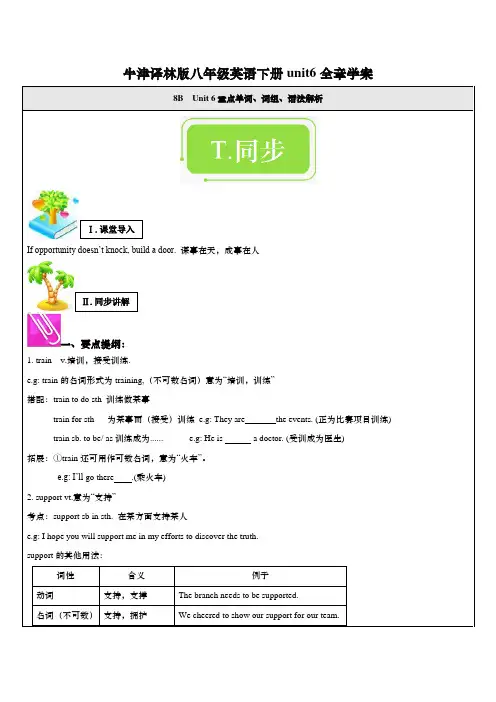
牛津译林版八年级英语下册unit6全章学案8B Unit 6重点单词、词组、语法解析Ⅰ.课堂导入If opportunity doesn’t knock, build a door. 谋事在天,成事在人Ⅱ.同步讲解一、要点提纲:1. train v.培训,接受训练.e.g: train的名词形式为training,(不可数名词)意为“培训,训练”搭配:train to do sth 训练做某事train for sth 为某事而(接受)训练e.g: They are the events. (正为比赛项目训练) train sb. to be/ as 训练成为...... e.g: He is a doctor. (受训成为医生)拓展:①train还可用作可数名词,意为“火车”。
e.g: I’ll go there .(乘火车)2. support vt.意为“支持”考点:support sb in sth. 在某方面支持某人e.g: I hope you will support me in my efforts to discover the truth.support的其他用法:词性含义例子动词支持,支撑The branch needs to be supported.名词(不可数)支持,拥护We cheered to show our support for our team.21. project n.项目,工程;课题考点:project还有“计划、方案”的意思22. lose one’s life 失去生命e.g: If we can help her, she will not lose her life.拓展:与lose相关的短语: lose one’s way = get lost; lose a game 输掉比赛23. give a helping hand 帮助,伸出援助之手e.g: If everyone gives a helping hand, the world will become better.考点:give sb. a hand = help sb24. meaningful adj.意为“有意义的”,反义词为meaningless 意为“无意义的”25. be bore with...意为“生来具有...” e.g. He was born with a weak body.26. confident adj.意为“自信的”,可以作表语或定语。
译林牛津版英语八年级下册Unit6拓展阅读:volunteer
译林⽜津版英语⼋年级下册Unit6拓展阅读:volunteer VolunteerA volunteer is someone who works for a community or for the benefit of environment primarily because they choose to do so. The word comes from Latin, and can be translated as "will" (as in doing something out of ones own free will). Many serve through a non-profit organization – sometimes referred to as formal volunteering, but a significant number also serve less formally, either individually or as part of a group.A volunteer work is not and should never be a required work.A volunteer may or may not get paid or receive compensation for services rendered.[1] General Andrew Jackson's Tennessee V olunteers were paid by the General personally, although he did seek reimbursement at Washington for his expenditures.V olunteering comes in many forms: serving food at the local homeless shelter, providing computer technical support to a non-profit organization, acting in a leadership capacity on a charitable organization's board of directors or coordinating the emergency response in the case of a disaster. Around the world volunteer centers exist to support the voluntary sector and make a difference in the communities that they serve.IkandoIkando is a small non-governmental organisation (NGO) that specializes in volunteer & intern recruitment on behalf of organisations in need. It was set up by Laura Daly in 2004. Their objective is to help more people gain the life changing, life affirming experiences that volunteering can give. They are committed to enabling skill transfer, enabling organisations in the developing world to access different skill sets and to helping volunteers realize the value they can add using the skills they hold.They hope their volunteers will become responsible global citizens as a result of their experience with Ikando, promoting the need for social change and raising awareness in their home communities on the issues they encountered. Africa has a lot to offer but also needs support, the support it rightfully deserves.Hospital volunteers work without regular pay in a variety of health care settings, usually under the supervision of a nurse. Most hospitals train and supervise volunteers through a specialized non-profit organization called an auxiliary. The director of the auxiliary is usually a paid employee of the hospital.A hospital volunteer is sometimes nicknamed a candy striper. This name is derived from the red-and-white striped jumpers that female volunteers traditionally wore. The name and uniform are used less frequently now.V olunteers' services are of considerable importance to individual patients as well as the health care system in general. Some people volunteer during high school or college, either out of curiosity about the health-care professions or in order to satisfy mandatory community-service requirements imposed by some schools. Others volunteer at later stages in their life, particularly after retirement.Candy Stripers originated as a high-school civics class project in East Orange, NewJersey, in 1944. The uniforms were sewn by the girls in the class from material provided by the teacher - a red-and-white-striped fabric known as "candy stripe". (source: Adele Huck McCain, a student in the class). The students chose East Orange General Hospital as the home for their class project.DutiesDuties of hospital volunteers vary widely depending upon the facility. V olunteers may staff reception areas and gift shops; file and retrieve documents; provide administrative backup; help visitors; visit with patients; or transport various small items like flowers, medical records, lab specimens, and drugs from unit to unit. Because of health-care laws and insurance liability, volunteers are often limited to clerical duties, or other activities which don't require direct contact with patients.A few hospitals ask their volunteers to help out with janitorial duties, like cleaning beds. Other "advanced volunteers" include patient-care liaisons and volunteer orderlies. These volunteers must operate on the orders of a nurse or a physician and are given special training to permit them to work with patients. They are also more common in large hospitals, particularly university-affiliated hospitals and teaching hospitals, as they allow pre-medical students to gain experience in patient care while taking pressure off a busy care team.Some hospitals keep all their volunteers in one place (a dispersal unit) and assign them to tasks based on real-time labordemand, while other hospitals assign volunteers to a single unit for the duration of their service.Female volunteers traditionally wore pink-and-white jumpers, while male volunteers traditionally wore light-blue tunics or shirts over dark slacks. Today, male and female volunteers often wear a uniform shirt or a short-sleeved shirt with slacks. Some volunteers (particularly "advanced volunteers" described above) will wear scrubs, but this is usually avoided so volunteers are not confused with medical personnel. All volunteers wear ID tags within the hospital and these will prominently indicate the volunteer's status and position.VolunteerismChildren cart dirt and debris away during a community clean-up day in Yaoundé, Cameroon.Volunteerism is the willingness of people to work on behalf of others without being motivated by financial or material gain. Volunteers may have special training as rescuers, guides, assistants, teachers, missionaries, amateur radio operators, writers,and in other positions. But the majorities work on an imprompt basis, recognizing a need and filling it, whether it be the dramatic search for a lost child or the everyday giving of directions to a lost visitor.[citation needed] In economics, voluntary employment is unpaid employment. It may be done for altruistic reasons, for example charity, as a hobby, community service or vocation, or for the purpose of gaining experience. Some go so far as to dedicate much of their lives to voluntary service. One way in which this is done is through the creation of a Non-Profit Franchise.Professional skillsSkills-based volunteerism is a term used to describe volunteering where the volunteer uses their professional skills. This is in contrast to generic volunteerism where specific skills are not necessary. The average hour of traditional volunteerism is valued by the Independent Sector at between $18-20 an hour. Skills-based volunteerism is valued at $40-500 an hour depending on the market value of the time. PoliticsIn almost all modern societies, the most basic of all values is people helping people and, in the process, helping themselves. But a tension can arise between volunteerism and the state-provided services, so most countries develop policies and enact legislation to clarify the roles and relationships among stakeholders, and to identify and allocate the necessary legal, social, administrative and financial support. This is particularly necessary when some voluntary activities are seen as a challenge to the authority of the state, e.g. on 29 January2001, President Bush cautioned that volunteer groups should supplement, not replace, the work of government agencies.[citation needed] Volunteerism that benefits the state but challenges paid counterparts raises the ire of labor unions representing the paid counterparts as in the case of volunteer fire departments, particularly in combination departments.There are two major benefits of volunteerism:1.economic: activities undertaken by volunteers would otherwise have to befunded by the state or by private capital, so volunteering adds to the overalleconomic output of a country and reduces the burden on governmentspending.2.social: volunteering helps to build more cohesive communities, fosteringgreater trust between citizens and developing norms of solidarity andreciprocity that are essential to stable communities.The social capital represented by volunteering plays a key role in economic regeneration. Where poverty is endemic to an area, poor communities have no friends or neighbours to ask for help, so voluntary mutual aid or self-help is their only safety net. This model works well within a state because there is a national solidarity in times of adversity and more prosperous groups will usually make sacrifices for thebenefit of those in need. But there are difficulties when this is to apply across national borders. One well-meaning state cannot simply send volunteers into another state. This would breach sovereignty and deny respect to the national government of the proposed recipients. So, when states negotiate the offer and acceptance of aid, or requests for aid, motivations become important, particularly if donors may postpone assistance or stop it altogether. Three types of conditionality have evolved: ?financial accountability: donors like to insist that there be transparency in the management offunding to ensure that what is done by the volunteers isproperly targeted.policy reform: some donors insist that the governments of developing countries adopt certain social, economic or environmental policies, the mostcontroversial relating to the privatisation of services traditionally offered bythe state.development objectives: some donors have attempted to force developing countries to adjust specific time-bound economic objectives.Some international volunteer organisations define their primary mission altruistically as fighting poverty and improving the living standards of people in the developing world, e.g. Voluntary Services Overseas has almost 2,000 skilled professionals working as volunteers to pass on their expertise to local people so that, when they return home, their skills remain. When these organisations work in partnership with governments, the results can be impressive. But when other organisations or individual First World governments support the work of volunteer groups, there can be questions as to whether their real motives are poverty alleviation or wealth creation for some of the poor or policies intended to benefit the donor states. This confusion exists because experience shows[who?] that what is volunteered can distort the foreign and economic policy of the country receiving the aid. The economies of manylow-income countries suffer from "industrialisation without prosperity" and "investment without growth". This arises because "development assistance" guides many Third World governments to pursue "development" policies that have been wasteful, ill-conceived, unproductive or even so positively destructive that they could not have been sustained without outside support.[1]Indeed, some of the offers of aid have distorted the general spirit of volunteerism, treating local voluntary action as “contributions in kind”, i.e. as conditions requiring local people to earn the right to donor “largesse” by modifying their behaviour. This can be seen as patronising and offensive to the recipients because the aid expressly serves the policy aims of the donors rather than the needs of the recipients.The track record shows that making any aid conditional on policy reforms is often ineffective. Conditionality only works when there is a strong domestic commitment to reform and the recipient governments are democratic, i.e. they are accountable to their own electorates. Volunteer organisations and their funding donors should respect the governments of the countries they wish to help and build on the deep-rooted traditionsof people to help one another, and thereby provide an important ingredient for social and democratic development. CriticismA growing body of literature examines the negative effects of volunteerism around the world. As early as the 1960s Ivan Illich offered an analysis of the role of American volunteers in Mexico in his speech entitled, "To Hell With Good Intentions". His concerns, along with critics such as Paulo Freire and Edward Said, revolve around the notion of altruism as an extension of Christian missionary ideology and the sense of responsibility/obligation driving the concept of noblesse oblige, first developed by the French aristocracy as a moral duty derived from their wealth. Simply stated, these both propose the extension of power and authority over indigenous cultures around the world. Recent critiques of volunteerism come from Westmier and Kahn (1996) and bell hooks (née Gloria Watkins) (2004). There is also growing concern about the effects of neoliberalism in the field of volunteerism, as witnessed by the increasing influence of corporations on the social programming of nonprofit community organisations, particularly through youth work.Volunteer VacationThere are many different organizations out there now that allow to take a vacation with the purpose of volunteering. More and more popular lately these volunteer vacations are great ways for people tight on cash to travel. These trips are also great ways to give back to the world.。
初中英语牛津译林版八年级下册同步测试(含答案)Test for Unit 6
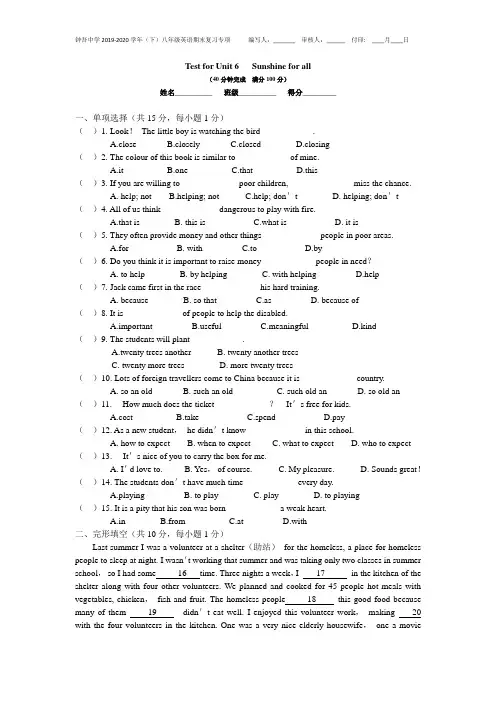
Test for Unit 6 Sunshine for all(40分钟完成满分100分)姓名__________ 班级__________ 得分_________一、单项选择(共15分,每小题1分)()1. Look!The little boy is watching the bird____________.A.closeB.closelyC.closedD.closing()2. The colour of this book is similar to____________ of mine.A.itB.oneC.thatD.this()3. If you are willing to _____________poor children, _____________miss the chance.A. help; notB.helping; notC.help; don'tD. helping; don't()4. All of us think _____________dangerous to play with fire.A.that isB. this isC.what isD. it is()5. They often provide money and other things _____________people in poor areas.A.forB. withC.toD.by()6. Do you think it is important to raise money____________ people in need?A. to helpB. by helpingC. with helpingD.help()7. Jack came first in the race _____________his hard training.A. becauseB. so thatC.asD. because of()8. It is _____________of people to help the disabled.A.importantefulC.meaningfulD.kind()9. The students will plant____________.A.twenty trees anotherB. twenty another treesC. twenty more treesD. more twenty trees()10. Lots of foreign travellers come to China because it is ____________ country.A. so an oldB. such an oldC. such old anD. so old an()11. ---How much does the ticket ____________?---It's free for kids.A.costB.takeC.spendD.pay()12. As a new student,he didn't know _____________in this school.A. how to expectB. when to expectC. what to expectD. who to expect ()13. ---It's nice of you to carry the box for me. --____________A. I'd love to.B. Yes,of course.C. My pleasure.D. Sounds great!()14. The students don't have much time____________ every day.A.playingB. to playC. playD. to playing()15. It is a pity that his son was born ____________a weak heart.A.inB.fromC.atD.with二、完形填空(共10分,每小题1分)Last summer I was a volunteer at a shelter(助站)for the homeless, a place for homeless people to sleep at night. I wasn't working that summer and was taking only two classes in summer school,so I had some 16 time. Three nights a week,I 17 in the kitchen of the shelter along with four other volunteers. We planned and cooked for 45 people hot meals with vegetables, chicken,fish and fruit. The homeless people 18 this good food because many of them 19 didn't eat well. I enjoyed this volunteer work,making 20 with the four volunteers in the kitchen. One was a very nice elderly housewife,one a movieactor,one a young teacher,and the other a college student,21 me.I talked to a lot of homeless people at the shelter. Their life stories 22 me with sympathy (同情).One woman worked for almost 3 years for a small company,and then she lost her job. She looked for a new job,but couldn't find one, for she was too 23 . She could do nothing but 24 her furniture-sofas,chairs,and tables so that she could pay for her food. Then,she had no money for her flat and had to sleep in her car. Next,she had to sell her car. Alone,afraid and 25 , she finally came to the shelter.()16.A.spare B. plenty C. few D.little()17.A.helped B.joined C.slept D.talked()18.A.ordered B.needed C.bought D. provided()19.A. usually B.seldom C.never D.sometimes()20.A.decisions B.wishes C.friends D.changes()21.A.as B.like C.for D. besides()22.A.full B.filled C.helped D.gave()23.A.fat B.thin C. old D.poor()24.A.buy B. lend C. borrow D.sell()25.A.homeless B.poor C.crazy D. surprised三、阅读理解(共20分,每小题2分)AA tower (塔) was put up in California in America. It was to remember a small boy. The boy was killed. His family was on vacation in Italy when it happened.When the boy died,his parents donated his body parts. The body parts helped save 7 people living in Italy. The people in Italy were very moved. They wanted to thank the boy's family in some way. They sent 140 bells to them. The bells reminded the family of all the love the people in Italy had for them and their dead son. An artist built a 18-foot-high tower from the bells and put it up by the sea. When the wind blows,it makes the bells ring.The parents want the tower to be a comfort for anyone who visits. The father still remembers how special his son was. He hopes people will keep giving body parts to those that need them. He wants to keep sharing the love that his son had. .()26. The boy lost his life when he____________ .A. was on holiday in ItalyB. was working in ItalyC. was at homeD. was at school()27. How many people did the boy9s body parts help save?A. 7.B. 130.C. 18.D. 1.()28. The word “moved”means _____________ .A. changedB. surprisedC. touchedD. sad()29. What did the people in Italy do for the family?A. They donated money to the family.B. They sent the family lots of bells.C. They built a tower for the boy.D. They donated body parts to the family. ()30. Which of the following is true?A. It's a sad story about an Italian family.B. The tower is just for the family to visit.C. The parents want other children to share their son's toy.D. The parents want others to share the love their son had.BAs a volunteer teacher,I travelled a long way to a small village school in Longzhou,Guangxi. On my way there,I thought about the village,the school,and the children there. However,my heart sank when I arrived there. It wasn't what I expected. It didn't look like a school at all!The school had only three rooms. the first one for Grades 1,2 and 3,the second one for Grades 4,and 6 and the third one for me.The children welcomed me warmly on my first day. They asked me a lot of questions,and told them stories about myself and my life in Shanghai. The next day,I gave them a test to find out their level. To my surprise,though the test was very easy,over half of the students failed it,yet they all wanted to learn new things. I knew they needed me.I was busy working every day. I could see that they were making progress with my help. I have also learnt a lot from them. understand their lives better,and we are now good friends.I have worked in Longzhou for a year now and would like to continue working here()31. The writer is volunteer teacher from____________.A.GuangxiB.XiamenC. ShanghaiD.Shanxi()32. The writer found there were only____________ rooms in that school.A.twoB.threeC.sixD.four()33. In paragraph,the words my heart sank mean that the writer____________.A. felt sadB. was happyC. got angryD. became excited()34. The writer found the students'level was _____________after the first testA.zeroB. higher than she expectedC. lower than she expectedD. the same as she expected()35. Which is the best title for this article?A.A volunteer teacherB. A village schoolC. The children in GuangxiD. My experience四、填空(共20分,每小题2分)A)根据括号中所给汉语写出单词,使句子意思完整正确。
Unit 6 复习课件牛津译林版英语八年级下册
7. closely adv. 密切地 close adv. 近地 adj. 亲密的,直系的
例: 我们应该密切合作来实现我们的愿望。
_W__e__sh__o_u_ld__w_o_r_k__c_lo_s_e_ly__t_o_r_e_a_li_z_e_o_u_r__w_i_s_h______________.
support sb. support sth. support sb. to do sth. with one’s support without one’s support
例: 我认为没有你父母的帮助你是完成不了这项工作的。
I don’t think you will finish the work
It is kind of you to help me. = You are kind to help me.
It is healthy for you to take more exercise. = Taking more exercise is healthy for you.
It is generous of you to donate your money to people in need. = You are generous to donate your money to people in need.
_w_i_th_o_u_t_y_o__u_r _p_a_re_n_t_s_’_h_e_lp______________________.
活动前和活动中的互相支持和帮助是非常必要的。
It’s necessary for you _t_o__su_p__p_o_rt_a_n_d__h_e_l_p_e_a_c_h_o_t_h_e_r_____________
牛津译林版英语八年级下册U6 Reading (I) 教案
《英语》(八年级下册)Unit 6 Sunshine for allReading ( I )I. Teaching aims and learning objectivesBy the end of the lesson, students should be able to:1. learn to predict the main idea from the title, pictures and caption;2. learn to use such reading strategies as skimming, scanning and inferring pronoun reference in reading the text;3. have a clear picture of the text structure;4. realize the importance of joining public welfare activities and help others.II. Teaching contents1. New words and phrases: expect, chance, similar, necessary, training, task, coach, gold, silver,background, closely, achieve, prize, volunteer, adult, intellectual,disability, event, athlete, confident, give up2. New structures: It’s fantastic to work as a volunteer.It was necessary for these volunteers to receive training before doing the task.It was very brave of him to join the competition.To Li Hai, the most important thing is not to win a gold or silver, but to takepart.Li Hai tried his best and finished fourth.It’s great for us to work closely with these special athletes.III. Focus of the lesson and predicted area of difficultyHow are the ideas in the text organized?IV. Teaching proceduresStep 1 Pre-reading1. Watch and answerPlay a clip of video about the 2014 New Jersey Special Olympics. The students are expected to answer the question: What world games is the video about?2. Read the title and make a predictionAsk the question: When you read the title Volunteering for the Special Olympics World Games, what do you want to know?Possible questions:(1) Who volunteered for the Special Olympics World Games?(2) Why did he/she volunteer for the Special Olympics World Games?(3) What did he/she do for the Special Olympics World Games?(4) What are the Special Olympics World Games for?(5) When and where did the Special Olympics World Games take place?/Which SpecialOlympics World Games did he/she volunteer for?(6) How did the volunteer feel after volunteering for the Special Olympics World Games? 3. Make a prediction from the pictures and captionLet the students look at the three pictures on Pages 80 and 81 and try to find the answers to the two questions:(1)When and where did the Special Olympics World Games take place?(2)What did the volunteer (he/she) do for the Special Olympics World Games?Ask a follow-up question:Where did you get the answer?/What led you to make such a guessing?(1) Answer to Q1: The Special Olympics World Games took place in Shanghai, in 2007. Igot the answer from the picture and its caption in the upper-right corner on Page 81.(2) Answer to Q2: From the two pictures at the bottom of Pages 80 & 81, we guess thevolunteer probably did some work that had something do with swimming.【设计意图:在正式进入文本阅读之前,让学生阅读标题、观看图片及文字说明,基于标题和图片大胆预测,提取重要信息,激发学生主动阅读的欲望。
2022年牛津译林版八年级英语下册Unit6 单元测试题(附答案)
Unit6 单元测试题( ) 1.Mr. Jiang, as ______ elderly man, took part in the Special Games for ____ elderly, and finished _______ second in the race.A. a; the; theB. an; the; /C. an; an; theD. the; an; /( ) 2. Before working as a businessman, his first ________ was to be a volunteer for the Shanghai Special Olympics World Games.A. workB. taskC. jobD. duty( ) 3. We students can _______ food and old clothes to the homeless people, and the teachers can __________ learning skills for the poor children.A. provide; giveB. provide; offerC. offer; giveD. give; provide( ) 4. As you know, we can organize our ideas in different ways according to the type of writing.For example, when we describe a place or an object, we use _______.A. Time orderB. Space orderC. General to specificD. Specific to general( ) 5. The ______ boy has been in hospital for about two months. The doctor says he has a serious heart ________.A. sick; diseaseB. ill; illnessC. sick illnessD. ill; disease( ) 6. Mr. White says the doctors will __________ on my mother, and it will ____ about 200,000 yuan.A. have a check; takeB. provide an opeation; spendC. do an operation; costD. take a good care; spend( ) 7. —The volunteers really provided the athletes with support.—Exactly. __________ they helped make the event!A. What a great successB. What great successC. How a great successD. How great success( ) 8. As a top student in our class, itt’s good ____ Jim to help us when we’re in need, and also good _____ him to exercise for an hour every day.A. of; ofB. for; forC. for; ofD. of; for( ) 9. —How many letters have you got from your online friends since last year?—_______. We’re just chatting with each other when we’re free.A. NothingB. NoneC. NoD. No one( ) 10. —What do you think of Jack when has save the boy from the river?—I think it’s _______ of him to do so, for the boy was in great danger.A. importantB. necessaryC. braveD. honest( ) 11. Daniel ________ the Party last month, and _________ our activities to help people at the community center.A. joined in; took p art inB. joined; joined inC. took part in; joinedD. joined in; took part in( ) 12. —Look! The two brothers are arguing about what to do next.—Oh, well. In fact, the _____ brother’s idea is _________ the younger’s.A. older; the same asB. elder; similar toC. elderly; as good asD. older; different from( ) 13. It was a hard time for those students because of losing the game, but they did not ______ hope.A. give upB. give offC. give inD. give out( ) 14. It’s dangerous_________ a close look at the tiger in zoo.A. for us takingB. of us to takeC. of us takingD. of us to take( ) 15. After the earthquake in Sichuan, all the local governments were trying to help the ________people to rebuild (重建) their homes.A. carelessB. hopelessC. uselessD. homeless( ) 16. The people who are confident have more _____ to make them successful.A. educationB. chancesC. excusesD. prizes( ) 17. —Please speak louder. My grandfather is a little ______.—Sorry. I ________.A. blind; doB. disabled; won’tC. deaf; willD. worried; don’t( ). 18. —Yes. I agree. If my neighbors are busy, I can look after their children for them.—_________________________ like that.A. It’s useful for them to do thingsB. It’s wise of them to do thingsC. It’s wrong of you to do thingsD. It’s helpful of you to do things二、完形填空(共12分,每小题1分)阅读下面短文,从短文后各题所给的A、B、C、D四个选项中,选出最佳选项。
牛津译林版八年级英语下册 Unit 6词组和单词
序号
汉语意思
英文单词
序号
汉语意思
英文单词
1
接受训练;培训
24
黄金;金牌
2
奥林匹克运动会
25
银;银牌
3
支持
26
自信的
4
有意义的
27
背景
5
瞎的
28
密切地
6
聋的
29
实现,达到
7
残疾的
30
奖赏,奖品
8
年老的
31
捐献
9
无家可归的
32
慈善;慈善机构
10
志愿做,义务做
33
机构,组织
在电话中交谈
talk on the phone
42
一名大学生
a college student
43
一名小学老师
a primary school teacher
44
一个培训计划
a training plan
45
住在遥远的村庄
live in villages far away
46
参加志愿者活动
take part in volunteer project
70
特奥会为有智残的成人和孩子一个向世人展示他们技能的机会。
The Special Olympics World Games give children and adults withintellectualdisabilities a chance to show their skils to the world.
11
期盼什么
what to expect
2022年牛津译林版八年级英语下册Unit6-7单元测试
Unit6—unit7 单元测试一、单项选择(共30小题;每小题1分,满分30分)从A、B、C、D四个选项中,选出可以填入空白处的最佳选项。
( )1. You need to take notes at the meeting to make sure _________a pen and some paper with you.A. bringB. to bringC. bringingD. not bring( )2. If we Chinese work together, China Dream will___________.A. come trueB. come outC. realizeD. achieve( )3. I have great ___________in finishing the work by myself. Can you help me?A. funB. successC. troubleD. interest( )4. The man needs us to donate blood ___him, but we don’t have enough. Can you help raise blood _____him?A. to, toB. to, forC. for, forD. for, to( )5. Jim is kind _______everyone. It's kind ________him to help me.A. to, forB. for, forC. to, ofD. of, of( )6. I’m afraid you can’t go in. The room______.A. is paintedB. has paintedC. is being painted D is painting( )7. The colour of this book is different from ________of mine.A. thatB. thoseC. itD. one( )8. --- My father’s new cellphone can be used ______ e-mails.--- Is he used _____ on such a small screen?A. to send; to writeB. for sending; to writeC. to send; to writingD. to sending; to writing( )9. The girl __________singing when we passed by.A. heardB. was heardC. was heard toD. heard to( )10. We have an hour__________ homework to do, and a lot of time__________ activities every day.A. of; forB. for; ofC. of; ofD. for; for( )11. The ______ boy has been in hospital for about two months. The doctor says he has a serious heart ________.A. sick; diseaseB. ill; illnessC. sick; illnessD. ill; disease( )12. Their homework _____ half an hour ago.A. was handed inB. was handedC. will be handed inD. was hand( )13.Daniel ________ the Party last month, and _________ our activities to help people at the community center.A. joined in; took part inB. joined; joined inC. took part in; joinedD. joined in; took part in( )14. —Look! The two brothers are arguing about what to do next.—Oh, well. In fact, the _____ brother’s idea is _________ the younger’s.A. older; the same asB. elder; similar toC. elderly; as good asD. older; different from( )15. —Please speak louder. My grandfather is a little ______.—S orry. I ________.A. blind; doB. disabled; won’tC. deaf; willD. worried; don’t( )16.--What are on show in the museum?--Some photos ________ by African children.A. are takenB. have been takenC. takenD. were taken( )17. It _____ in a small village last month.A . happenedB was happenedC happen D. had happened ( )18. We found the ground ____ snow.A. cover withB. is covered withC. was covered withD. was covering( )19. –How are you today, Mike?-I’m _________ now. I don’t think this medicine is good for me.A. badlyB. betterC. wellD. worse( )20. The piece of music _______ great.A. soundsB. sounded C is sounded D. is sounding( )21. Many students write to Language Doctor to _________ advice about learning English.A. look throughB. ask forC. give upD. worry about( )22. Volunteers _________ different backgrounds feel _________ part of one big family.A. from, asB. come from, asC. come from, likeD. from, like( )23. Could you __________?A. offer me some advice sB. offer me some adviceC. offer to me some advicesD. offer to me some advice( )24. ____________ is important for you __________ easily if you want to achieve success.A. It, to not give upB. That, not to give upC. It, not to give upD. That, to not give up( )25. Don’t worry. You ______ plenty of time to decide.A. will giveB. have givenC. will be givenD. are giving( )26. I’m _________ a child. I can __________.A. no longer, look after meB. no more, take care of myselfC. no more, take care of meD. no longer, look after myself( )27. Millie is my best friend. I _______ often __________ to her party.A. is invitedB. am invitedC. are invitedD. was invited( )28.—Dad,I was the first to reach the top of the hill.—Good job, Mary. I’m_______of you.A. afraidB. proudC. tiredD. careful( )29. We should ________good eating habits.A. growB. developC. increaseD. find( )30. These children are ________ from the city.A. mostlyB. mostC. mainlyD. main( )21. _____ TV drama You Who Came From the Stars t ells a love story between a 400-year-old alien(外星人) and _____Asian human girl.A; an B. The; the C. A; the D. The; an( )22. — What charity works to provide children with food and education?—, right?A. B. C. D.( )23. —Were you sick after six hours’ journey on the coach?—Of course. I ________ quickly as soon as it stopped.A.got upB. got onC. got offD. got to( )24. —Did you go to Jack’s birthday party?—No, I ______.A. am not invitedB. wasn’t invitedC. haven’t invitedD. didn’t invite( )25. — Sir, please put out your cigarette (香烟).— Sorry. I the sign.A. don’t noticeB. didn’t noticeC. haven’t noticedD. won’t notice( )26. When I was ______ my way home, I met a stranger _____ my way.A.in ; onB.on ; inC.by ; inD. in ; in( )27. —Jim,I went to the concert last night. How big the hall is!—Yes,it is _________ to hold more than one thousand people.A. big enoughB. enough bigC. too bigD. too small( )28.When I got home, I was made ________ my homework by my mother.A. to doB. doingC.doD. did( )29. It’s really you to drive so fast on such a rainy day. Slow down!A. crazy forB. crazy ofC. brave forD. brave of( )30. I like using WeChat.Because I find _____ easier for us to communitate with each other.A .it B. that C. this D. them( )31. —Few well-known singers came to the concert, did they?—_______.Many famous stars came, such as Jackie Chan, Jay Chou and so on.A. No, they didn’t.B. Yes, they did.C. No, they did.D. Yes, they didn’t.( )32. —Jane got an “A” in the math test.—_____________.She works the hardest in our class.A.Many hands make light work.B. The grass is always greener than the other side.C. Early birds catch the worm.D. Don’t put all your eggs in one baskets.( )33.The Greens ________in Pairs and now they ________ in China.They like China.ed to live; are used to livingB. are used to living; used to liveC. use to live ; used to liveD. used living ; used to living( )34. —Why can’t I drink the milk in the carton in the fridge,Mom?—It smells _________.A. badB. badlyC. delicious.D.well( )35. —Let’s go and listen to Mr Smith’s speech on Western culture,shall we?—___________ It’s getting to the end.A. Why not?B. That’s all right.C. I’m afraid not.D. Never mind.二、完型填空。
牛津译林版英语八年级下册(初二下学期) Unit6 Task课件(共24张PPT)
give some care
love and help
We should take action to help
call on more people to help them
------
How to call on more people?
Peter has read an article about a middle school student in the newspaper. He wants to write a letter to ask for help. He is organizing his ideas first.
people with a serious disease
n. 疾病 illness
operation n. 手术
give a helping hand
Discussthem?
donate money/
We should do
used things
something to help:
people? 9. Who should we write to?
Writing Time
1. Be kind and helpful to the people around us.
2. Perfect the letter to ask people to help. Use the useful expressions and sentences.
Who needs help What’s wrong with the person who needs help
How can we help?
n. 引言; 介绍
Introduction Who needs help? Information about the person or group in need