
新目标八年级英语下册UNIT 6教学设计
一、教学内容及分析
(3) 谈论人们的业余爱好。
2、情感态度与价值观:用英语积极交流日常感兴趣的话题,体验交流的兴趣。
通过运用课文中的重点句型去交流。
五、教法选择、学法指导
六、课时及教学内容安排
教学内容
课时安排
教法选择
教学评价
period 1
小组合作学习
任务型教学
情景视听法
观察法
归纳法
观察
提问
激励
period 2 任务型教学阅读法
小组对话
激励
提问
period 3 任务型教学阅读法
写作法
提问
谈话
period 4 任务型教学写作训练练习法
独立作业相互交流
reading period5 任务型教学阅读法
提问
激励
教学内容
课时
period 1
教学对象
八年级学生
执教者
一、教材内容分析
二、教学目标(知识,能力,情感态度、价值观)
三、重点难点
4.初步感悟现在完成进行时态的意义和结构。
四、教法选择、学法指导
六、教学过程
教学任务
教师活动
学生活动
设计意图
step1lead-in
(3minutes)
1greetthestudents.
2 lead-in
通过学生回答熟悉的问题导入新课,出示新的语言目标。
(1o minutes)
利用图片,在语境中学习单词,初步感悟语言目标。
step3listening
( 6minutes)
2.students only listen the first time.
通过听力再现语言目标,加深对语言目标的理解。
(10minutes)
1.为学生提供了一个用目标语言去交际的机会(注意人称的变化)。
2.归纳现在完成时态的结构:have\has +been+doing
step5listening
(6mintes)
2.students only listen the first time.
通过听力又现语言目标,并为下一环节的语言操练作铺垫。
(7mintes)
2.利用flash 让学生再次感悟现在完成时态意义,从而让学生试着去归纳现在完成时态概念。
(3minutes)
1. summarize:今天我们学习了什么时态?它的结构是什么?
2. 用目标语言去谈论你喜欢的运动。
1. have \has +been +doing
培养学生归纳总结的能力。
板书设计
教学内容
课时
period 2
教学对象
八年级学生
设计者
一、教材内容分析
本节课是在学生初步学习现在完成进行时态的基础上,通过阅读,对话进一步加深对现在完成时态的理解和运用。
在对话的过程中再现了一般过去时态,通过比较,弄清楚两种时态的用法。
二、教学目标(知识与能力,情感态度与价值观)
3.比较现在完成进行时态和过去时态。
三、重点、难点
四、教法选择与学法指导针对本节课内容,利用多媒体课件及任务型阅读法,小组合作交际来完成教学任务,重视对学生听、说、读、写技能以及良好阅读习惯的培养。
六、教学过程
教学任务
教师活动
学生活动
设计意图
( 3minutes)
duty report
再现本单元的目标语言,同时给学生提供了说的机会。
step2 reading(3a)
(15minutes)
4. listen to the passage and repeat it.
1. 训练学生的快速阅读,培养学生的语音和语调。
(5minutes)
培养学生计算时间的能力。
(7minutes)
1. 复习一般过去时态。
2. 在比较中掌握两种时态。
(8mintues)
2.report.
把过去时态和现在完成进行时态安排在一个对话中旨在让学生比较两种时态。
(5minutes)
巩固两种时态。
(2minutes)
1. 今天你们学到了什么?
2. 读课文去感悟它的写作技巧.
3. 复述课文。
1. 反复读课文。
2. 复述课文。
3. 培养学生的归纳总结能力。
4. 养成良好的复习习惯。
七、板书设计
教学内容
课时
period 3
教学对象
八年级学生
提供者
一、教材内容分析
二、教学目标(知识,技能,情感态度与价值观)
三、重点难点
四、教法选择与学法指导
本节课,运用听、说、读、写,任务型教学法,培养学生听、说、读、写技能,重视对阅读方法和技巧的指导。
尽可能多挖掘学生潜力,使师生,生生极好配合,以提高学生的阅读水平。
六、教学过程
教学过程
教师活动
学生活动
设计意图
step1
organization lead-in
(3minutes)
1. greetings.
2. ask students to retell the passage.
retell the passage.
回顾知识。
step2 1a,1b
(5minutes)
在语境中教单词,即巩固了本单元的语言目标,有学习了新单词,同时给学生提供了一个交际的机会。
step3 listening 2a,2b
(6minutes)
2. play the tape.
训练学生的听力技巧
( 5minutes)
step5 reading 3a
(15minutes)
3. let students listen to the tape and repeat it.
4. explain key phrases.(见幻灯片)
2. ss repeat the passage.
把图片和单词搭配起来凸显直观性。
让学生跟读课文旨在训练学生的语音语调。
2. let ss go through the information in 2a.
教会学生用已有材料去写作
step7
(1minute)
2. do a survey about students’ hobby.
七、板书设计
教学内容
课时
period 4
教学对象
八年级学生
提供者
一、教材内容分析
本节为自查课,旨在检查学生对重点词的运用,以及对目标语言的正确使用。
通过做练习和写作来检查。
二、教学目标(知识,技能,情感态度与价值观)
三、重点难点
四、教法选择与学法指导
本节课用自查,写作,任务型教学法巩固语言目标和重点词汇,培养学生自查,自我反思和调控的能力。
六、教学过程
教学过程
教师活动
学生活动
设计意图
step1
organization lead-in
(3minutes)
1. greetings.
2. let a ss do a duty report about their hobbies.
1. greetings.
2. duty report.
激发学生兴趣。
(8minutes)
1. ss fill in the blanks.
提高学生运用能力。
task 3
(15 minutes)
复习本单元重点词汇及句型,巩固所学知识。
task 4
(15minutes)
(见ppt)
(注:句式正确,语句通顺,连贯,50词左右) 训练学生的写作技巧。
task 6
(4minutes):
作业分层要求,以适应不同层次的学生学习。
七、板书设计
教学内容
reading
课时
period 5
教学对象
八年级学生
执教者
一、教材内容分析
本节课为一篇阅读课,旨在培养学生的快速阅读法和对课文宏观把握的能力,以及了解中国各朝代的英语表达。
二、教学目标(知识,能力,情感态度、价值观)
2.reading a passage.
三、重点难点
四、教法选择、学法指导本节课采用任务型教学法,重在培养学生的阅读能力,以及质疑问疑的能力。
六、教学过程
教学任务
教师活动
学生活动
设计意图
step1
organization
( 5minutes)
1. do you like history?
ss talk about these questions.
激发学生兴趣,了解朝代的英语表达法。
step2
(12minutes)
do 3a.
检测学生对阅读技巧的运用。
step 3 key phrases.
(8minutes)
帮助学生正确使用它们。
step4 read.
(10minutes)
培养学生语篇分析能力,宏观上把握课文内容。
( 8minutes)
fill in the blank.
加深对课文重点词的运用。
(2minutes)
1. read the passage again to understand it better.
3. do exersises. 养成良好的复习习惯。
人教版新目标英语八年级下册英语课堂实录

人教版新目标英语八年级下册英语课堂实录课题:Unit 6 How long have you been collecting shells? 第一课时授课教师:陶鸿丽授课时间:2011年4月16【教学目标】:知识目标:1.Key vocabulary:marathon,skate, skating,since,collect, shell 2.Key structures: -How long have you been skating? -I’ve been skating for five hours. -How long did you skate? -I skated for two hours.能力目标:1. Enable students to talk about how long one has been doing things using the present perfect progressive tense. 2. Train students ability of listening andspeaking .情感态度与价值观:To be interested in communicating in English.【重点与难点】: 1. Master the present perfect progressive tense. 2. Tell the difference between for and since.【教学过程】:本单元的教学内容是本册书的一大难点,学生不易理解,接受及掌握。
因此,教师应在教学方法上多下功夫,找出易于学生接受的方法。
【Step 1.Presentation.】The teacher shows a picture of Yao Ming and say: Who’s this? What do you know about Yao Ming? (这时,学生都能立刻认出姚明来,因此学生的兴致很高,七嘴八舌地说了起来) He is a professional basketball player. He plays basketball very well. He is very famous in the world. …….Do you know Yao Ming’s sports life? When was he born? When did he start playing basketball?(此时有的学生能说出一些,但是不准确,有的学生在摇头,这时就引起学生的Now,please look at the blackboard.Then draw a time line like this:Yao Ming’s sports lifewas born started playing plays20years 1980 1989 has been playing 2009 now Then say: This is a time line. Let’s put some information on it. Yao Ming was born in 1980. (Write the information on the time line with color chalk.))He started playing basketball in 1989. He still plays basketball now.(此处用一个time line 来表示时间,既直观又易于学生理解,同时还便于以下进一步教学。
新课标Go_for_it_八下Unit_6_P4教案
教学设计新目标英语八年级下册Unit 6 An old man tried to move the mountainsPeriod 4遂宁市安居区分水镇初级中学校张富1. Analysis of teaching material:The teaching material is from PEP go for it Grade 8 B unit 6 “An old man tried to move the mountains” section B, Period 4, and it is the first time students read the play, from learning this lesson, students’ should gain a brief understanding about play and be able to know the personality of a character from his/her lines. .2. Analysis of studentsThe students may not read the play before, it is crucial to let them feel the beauty of play. So I devided this lesson into 2 periods, the first period aims at enabling students to experience the charm of play.3. Teaching methodsIn this lesson, group-work teaching method is adopted, because the group-work teaching method is highly commended in new curriculum standard, and creating a real setting for Ss to practice what they have just learned is crucial to arouse their awareness of using English to solve problems.4. Teaching aims:(1) Knowledge and ability objectives:Knowledge objectives: enable students to master the new words such as stepmother, wife, husband and so on.Ability objectives: learn to act the play.(2) Emotion and attitude objectives: To experience the charm of play.5. The important and difficult point:(1)The important point:To arouse Ss’ awearness of enjoying the beauty of play.(2) The difficult point:1. To feel the personality of a character by reading his/her lines.2. To act the play.6. Teaching procedure:。
人教新目标英语八年级下册讲义—Unit 6 An old man tried to move ……
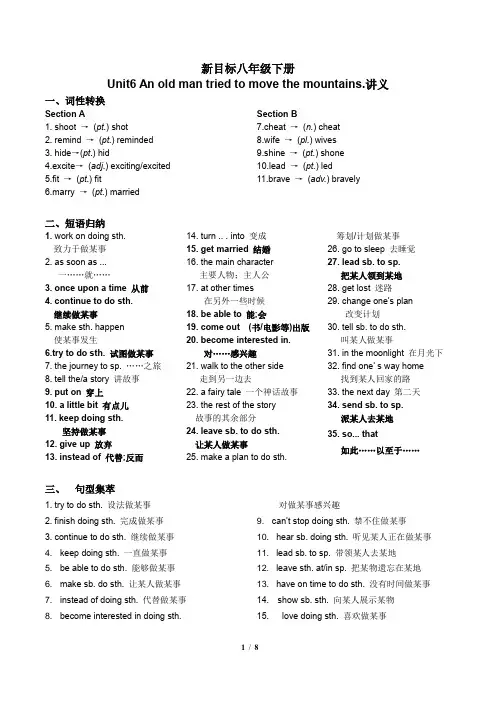
新目标八年级下册Unit6 An old man tried to move the mountains.讲义一、词性转换Section A1. shoot →(pt.) shot2. remind →(pt.) reminded3. hide→(pt.) hid4.excite→(adj.) exciting/excited5.fit →(pt.) fit6.marry →(pt.) married Section B7.cheat →(n.) cheat8.wife →(pl.) wives9.shine →(pt.) shone10.lead →(pt.) led11.brave →(adv.) bravely二、短语归纳1. work on doing sth.致力于做某事2. as soon as ...一……就……3. once upon a time 从前4. continue to do sth.继续做某事5. make sth. happen使某事发生6.try to do sth. 试图做某事7. the journey to sp. ……之旅8. tell the/a story 讲故事9. put on 穿上10. a little bit 有点儿11. keep doing sth.坚持做某事12. give up 放弃13. instead of 代替;反而14. turn .. . into 变成15. get married 结婚16. the main character主要人物;主人公17. at other times在另外一些时候18. be able to 能;会19. come out (书/电影等)出版20. become interested in.对……感兴趣21. walk to the other side走到另一边去22. a fairy tale 一个神话故事23. the rest of the story故事的其余部分24. leave sb. to do sth.让某人做某事25. make a plan to do sth.筹划/计划做某事26. go to sleep 去睡觉27. lead sb. to sp.把某人领到某地28. get lost 迷路29. change one’s plan改变计划30. tell sb. to do sth.叫某人做某事31. in the moonlight 在月光下32. find one’ s way home找到某人回家的路33. the next day 第二天34. send sb. to sp.派某人去某地35. so... that如此……以至于……三、句型集萃1. try to do sth. 设法做某事2. finish doing sth. 完成做某事3. continue to do sth. 继续做某事4. keep doing sth. 一直做某事5. be able to do sth. 能够做某事6. make sb. do sth. 让某人做某事7. instead of doing sth. 代替做某事8. become interested in doing sth.对做某事感兴趣9. can’t stop doing sth. 禁不住做某事10. hear sb. doing sth. 听见某人正在做某事11. lead sb. to sp. 带领某人去某地12. leave sth. at/in sp. 把某物遗忘在某地13. have on time to do sth. 没有时间做某事14. show sb. sth. 向某人展示某物15. love doing sth. 喜欢做某事四、重点句子1. A man told yu Gong that he could never do it. 一个人告诉愚公他绝不可能把山移走。
2020年人教版新目标 英语 八年级下册 Unit 6 An old man tried to

Lesson 6 Unit 6 An old man tried to move the mountains.一、重点单词1. This story reminds us that you can never know what’s possible unless you try to make it happen.remind sb. of/about sth. 使某人想起某事remind sb. to do sth. remind sb. that+从句提醒某人做某事这首歌使我想起了我的童年时代。
The song reminded me of/about my childhood.别忘了提醒他吃药。
Don’t forget to remind him to take medicine.他提醒我必须准时完成工作。
He reminded me that I must finish the work on time.2.I think it’s a little bit silly.a little bit意为有点儿,稍微。
后接adj.或adv.同义短语:a little; a bit; kind of注意:a little和a bit 修饰v. adj. adv.及比较级时,可互换。
a little可直接加n. a bit + of +n. 只能修饰不可数名词。
3.And as soon as the TV program came out more than 30 years ago, Western children became interested in reading this story because the clever Monkey King keeps fighting to help the weak and never gives up. Come out在此意为推出;出版;发行。
新目标英语八年级下册Unit6课件全 共64页

Li Chen
4 GROUPWORK Make a survey, interview your classmates. Ask them what sports they play .
Name
Sport When started How long
Li Ying basketball 10 years old 5 years
since后可跟句子,句子时态多用一般过去时
I have been waiting for you since I came here.
自到这儿以来我一直在等你。
Yao Ming’s sports life
was born
started playing basketball plays 17 years
用for和since填空
1.They have been learning Chinese _s_in_c_e_ 2. they came to China. 3.2. I haven’t seen her f_o_r___ a long time. 4.3. He has been living heresi_n_c_e__ 2019. 5.4. She has been doing her homeworkfor
Ten yuan.
3. How long has the skating marathon been going?
For five hours.
4. Who was the first to start?
Alison was the first to start.
5. How long has he been skating?
8. When did he start?
新目标八年级英语下册Unit 6教学设计

新目标八年级英语下册 Unit 6 教学设计一、教学目标1.能够听懂关于不同国家的风俗和传统的简单对话。
2.能够通过阅读短文来了解不同国家的风俗和传统。
3.能够用英语描述自己国家的风俗和传统。
4.能够参加小组讨论,表达自己对不同国家文化的观点。
5.能够根据提示写一篇关于自己国家传统的短文。
二、教学重难点1.教学重点:通过听、说、读、写等多种方式了解不同国家的风俗和传统,并表达自己的观点和描述。
2.教学难点:能够运用所学语言知识、句型和词汇描述和讨论不同国家的文化差异。
三、教学准备1.教材:新目标八年级英语下册 Unit 6。
2.多媒体设备。
3.小组讨论的话题和题目。
四、教学过程Step 1 导入新课1.引入新课前,询问学生是否了解过不同国家的风俗和传统。
2.引出本课的主题:不同国家的风俗和传统。
Step 2 预习导学1.让学生观看一段描述中国传统节日的视频,并提问:–What festival is it about?–How do Chinese people celebrate it?2.学生讨论问题并给出答案。
3.教师搜集学生的回答,写在黑板上。
4.提醒学生观察和回答问题时要用英语。
Step 3 新课呈现1.展示一个包含不同国家风俗和传统的幻灯片,并向学生描述每个国家的特点。
2.通过问答的方式与学生互动,引导他们了解不同国家的文化差异。
Step 4 听力训练1.放一段录音,让学生听对话,选择正确的答案。
2.听完录音后,学生与同桌讨论并给出答案。
3.教师与学生核对答案,并给予反馈。
Step 5 阅读训练1.学生阅读一篇关于日本传统节日的短文。
2.学生独立回答与短文相关的问题,并将答案写在答题卡上。
3.教师检查学生的答案,并给予反馈。
Step 6 口语训练1.学生分组进行小组讨论,针对不同国家的风俗和传统进行讨论。
2.教师设定话题并提供问题指导学生讨论,鼓励学生表达个人的观点和看法。
Step 7 写作训练1.学生根据提示写一篇关于自己所在国家传统的短文。
【人教版】新目标八年级英语上册:Unit 6 单元教学设计
【人教版】新目标八年级英语上册:Unit 6 单元教学设计一. 教材分析人教版新目标八年级英语上册Unit 6主要围绕“野生动物”的主题展开,通过学习本单元,学生能够掌握关于野生动物的词汇和表达方式,提高运用英语进行交流的能力。
教材以真实情境的图片和生动的故事引起学生的兴趣,同时培养学生的环保意识。
本单元包括词汇、对话、阅读和写作等丰富多样的教学内容,为教学提供了广阔的空间。
二. 学情分析八年级的学生已经具备了一定的英语基础,能够运用简单的英语进行日常交流。
但是,学生在口语表达和写作方面还存在一定的困难,需要通过大量的练习来提高。
此外,学生对野生动物的了解相对有限,通过本单元的学习,可以拓宽他们的视野,增强环保意识。
三. 教学目标1.知识目标:学生能够掌握本单元的生词和短语,理解课文内容,掌握阅读技巧。
2.能力目标:学生能够运用所学知识进行口语交流和写作,提高英语应用能力。
3.情感目标:学生能够增强对野生动物的关爱,提高环保意识。
四. 教学重难点1.重点:本单元的生词和短语,以及课文内容的理解。
2.难点:学生在实际情境中运用所学知识进行口语交流和写作。
五. 教学方法采用任务型教学法,通过设定各种真实的任务,引导学生参与课堂活动,提高学生的英语应用能力。
同时,运用小组合作学习法,培养学生的团队合作精神,激发学生的学习兴趣。
六. 教学准备1.教师准备:提前熟悉教材内容,设计教学活动,准备教学素材。
2.学生准备:预习教材,了解本单元主题。
七. 教学过程1.导入(5分钟)利用图片或视频展示一些野生动物,引导学生谈论他们所知道的野生动物,激发学生的兴趣。
2.呈现(10分钟)教师通过PPT展示本单元的生词和短语,让学生朗读并理解其含义。
然后,教师呈现课文内容,引导学生跟读并理解课文大意。
3.操练(15分钟)教师设计各种情景,让学生运用所学知识进行口语交流。
如:模拟在动物园的对话、讨论保护野生动物的方法等。
4.巩固(10分钟)教师给出一些关于野生动物的图片,让学生用英语描述它们。
新目标八年级英语下册Unit6教学反思
新目标八年级英语下册Unit6教学反思•相关推荐新目标八年级英语下册Unit6教学反思(精选11篇)在社会发展不断提速的今天,教学是重要的工作之一,反思自己,必须要让自己抽身出来看事件或者场景,看一段历程当中的自己。
如何把反思做到重点突出呢?以下是小编精心整理的新目标八年级英语下册Unit6教学反思,欢迎阅读,希望大家能够喜欢。
新目标八年级英语下册Unit6教学反思篇1我想今后单词的学习还应该再用心去思考怎样更好地让学生记住这些新词。
最好是词不离句,不离篇。
我想我可以把文章改编为填新单词、短语和适当形式等练习。
充分利用可用资源第一次快速阅读感知全文,回答三个问题时,我应该多关注那些没有集中注意力的学生,并及时给予帮助,由于与学生不熟,只有通过此方法,才能发现哪些学生需要老师帮助。
本来第二次阅读和听力分开的,由于时间紧凑,经过和其他老师讨论,把“读”改为了“听”,个人认为这个改动具有实效性。
第三次阅读我也是把课文的3b做了改动,有两个原因:第一,我不熟悉学生的基础情况;第二,我根据我们学生的基础能力情况和乡村学生的基础情况。
把3b的直接填写内容,改为了搭配题,降低题目难度,保持学生学习的积极性和兴趣。
个人认为这个做法符合实际教学需要。
前面几个活动都是语言的输入,这个环节是语言输出,本来这是这堂课的亮点和难点。
设计新颖,富有创造性,但是遗憾的是我安排的时间还是有点紧。
时间较短不能充分发挥学生的创造性和发展学生的语言综合运用能力。
一节好课需要认真的一遍又遍的去推敲,尽量做到准备准确、精确。
新目标八年级英语下册Unit6教学反思篇2针对上周一些现状,我主要从以下几个方面入手:一、观察分析,了解基础了解学生的现有基础,精心备课、上课。
针对基础参差不齐的学生进行分层次教学,避免有一定的基础的学生对重炒旧菜,索然无味;同时对于毫无基础的学生精心施教,夯实基础。
二、主动学习,音标先行英语学科的学习过程主要包括预习、上课、复习。
最新人教版新目标英语初二下册Unit 6 单元教案
Unit 6 An old man tried to moved the mountains.Period 1 Section A 1a-2c.Teaching aims:The useful words:shoot, stone, remind, a little bit, silly, instead of, weak, godExpressions:How does the story begin?What happened next?What do you think of the story of Yu Gong?What could Yu Gong d o instead of moving the mountains?Ability aims:1. To train the Ss’ ability of telling stories in their own words.2. To train the Ss’ listening abilities by catching the key words.Teaching important and difficult points:Ss can tell the story in their own words.Teaching procedures:Before class: Know about these stories, and try to say their names in EnglishStep 1 Lead in1.Listen to a song .T: What’s the name of the story?T: Do you know other traditional Chinese stories?Step 2 presentationShow Ss to the pictures, and teach them the names of the story , at the same time, teach them some new words.Hou Yi Shoots the Suns Journey to the West Yu Gong Moves a Mountain Nu Wa Repairsth e Sky….Step 3 Work on 1a1. Look at the pictures in 1a, then read the names of the story in the box.2. Ss discuss with their partners and match the names of the stories with the pictures.Journey to the West b Yu Gong Moves a Mountain dHou Yi Shoots the Suns a Nu Wa Repairs the Sky cStep 4 Work on 1b.1. Know about Yu Gong Moves a Mountain2. T: Tell Ss they will hear a great Chinese traditional story. Listen and see who know the name of the story.3. Play the recording for the Ss to listen.4. Ss who know the name of the story may hand up.5. Play the recording again. Let Ss check the facts they hear.6. Check the answers .Step 5 Pair work1. Read the questions in the box in 1c.2. Ss discuss the questions with their partners.3. Let some pairs ask and answer the questions.e.g. A: How does the story happen?- 1 -B: There were two very tall mountains in front of their house.A: What happened next?B: A very old man tried to move the mountains.A: Where would they put all the earth and stone from the mountains?B: They would put them into the sea.Step 6 Work on 2a and 2bWork on 2a:T: Let’s continue to listen to the story.1. Look at the pictures in 2a. Discuss the things they are going to do. When you listen to the story, pleasenumber the pictures.2. Play the recording for the Ss to listen and number the pictures.3. Play the recording again to check the answers.Work on 2b:1. Let Ss read the sentences below. Explain some main sentences for the Ss. Make sure they know what to do.2. Play the recording for the Ss to circle the correct words in the brackets.3. Play the recording again to check the answers.Answers: 1. children 2. weak 3. talking 4. two 5. knowStep 7 Pair work1. Tell Ss to make a story chain. Ss tell the story one by one with the pictures in 2a.2. Let some Ss tell the story to the class.3. See which groups’ story is better.Step 8 Homework:Tell the story Yu Gong Moves a Mountain in English to your parents.Once upon a time, there was a very old man…Period 2 Section A 2d GrammarTeaching aims:The useful words:stepsister, prince, couple, smile, marry , get married, fit, fall in love; unless, as soon as, so…that Expressions:Because they were so big that it took a long time to walk to the other side.Unless he can hide his tail, he can’t turn himself into a person.As soon as the man finished talking , Yu Gong said that his family could continue to move the mountains after he died.Ability aims:1. To train the Ss’ ability of telling stories in their own words.2. To understand “unless; so…that…; as soon as…”.Teaching important and difficult points:1. To train the Ss’ ability of telling stories in their own wor ds.2. To understand “unless; so…that…; as soon as…”.Teaching procedures:Step 1 Revision Review the story of Yugong.Step 2 Role-play1. Read the conversations and answer the questions.○1What does Wang Ming think about the story of Yu Gong?○2What about Claudia’s opinion?○3What way can Yu Gong use according to Claudia?○4Do they agree with each other at last ?○5What’s the teacher’s opinion?2. Ask Ss to role-play the conversation in groups.Step 3 Grammar focus1. Read Grammar Focus.2. Understand unless; as soon as; so ... thatStep 4 New wordsLook at the big screen and learn the new words and expressions:stepsister ; prince ; fit ; couple; smile ; marry ; fall in loveStep 5 Work on 4a:1. Tell Ss to read the sentences in 4a and try to fill in the blanks with unless, as soon as, so…that.2. chech the answers.Step 6 Work on 4b:1. Tell Ss to read the sentences in 4a and try to fill in the blanks2. Check the answers with the Ss.Step 7 Telling storiesStep 8 Homework1. Recite the conversation in 2d after school.Period 3 Section A (3a-3c)Teaching aims:The useful words:object, magic, stick, hide, ta il, turn…into, excite, western ;turn intoExpressions:The Monkey King is not just any normal monkey.Ability aims:1. To train the Ss’ ability of reading.2. To understand the sentences like “But unless he can hide his tail, he cannot turn himselfinto a person. ”Teaching important and difficult points:1. To train the Ss’ ability of reading.2. To understand the sentences like “But unless he can hide his tail, he cannot turn himselfinto a person. ”Teaching procedures:Step 1 Warm up and lean-in.1. Listen to a song.2. Look at the pictures and answer the questions.Which book is talked about? Journey to the West;Who is the main character? Monkey King best.3. Watch a video about the Monkey King and introduce the Monkey King..- 3 -Step 2 While reading .1. Read the article quickly and match the main ideas.2. Work on 3b:What he can do:① He can make 72 changes to his shape and size, turning himself into different animals and objects② He can make his magic stick small or large.What he can’t do:Unless he can hide his tail, he can’t turn himself into a person.3. Work on 3cStep3 HomeworkMake sentences with these wor ds.be able to; make 72 changes, turn…into; so…that; came out; become interested in;keep doing sth.Period 4 Section B 1a---1dKnowledge aims:1.Get the students to learn the words and phrases:gold, emperor, silk, underwear, nobody, stupid, cheat2.Learn and know the sentences below:1).Once upon a time, there was an emperor…2).People couldn’t see the clothes unless they were clever.3).Nobody wanted to sound stupid, so everyone said his new clothes were wonderful.3. Learn to tell a story in English.4. Let students have a chance to know the difference between Chinese culture and foreignculture.Ability aims:1、To train students’ listening and speaking skills2、Listening to get the general idea and the detailed information.3. Speaking to practice oral English.Emotional aims:Remember to dare to say the truth. We should be honestKey points:1.Learn and know how to spell and use the new words in the text.2. Listening practice. Train ing students’ listening skill and the ability to catch keyinformation.3. Rewrite The Emperor’s New Clothes.Difficult points:1.Listening practice.2. Rewrite The Emperor’s New Clothes.Teaching procedure:Step 1 Warm up1. Pair-workWe have known a few Chinese traditional stories, which story do you like best? Please tellyour partner about your favorite story.T: Show one picture of the story The Emperor’s New Clothes.2. Ask some questions about it.1). Look at the picture. Do you know this story?What’s the name of this story?S1: The Emperor’s New Clothes.2). Can you tell the story briefly?Show a cartoon ab out The Emperor’s New Clothes to students so that they can understandthe story better.Step 2 Presentation1.Present the new words on the big screen and learn the new words together.2. Ss read and try to remember the new words.silk emperor underwear gold stupid cheat3. Matching (1a)1). Ask one student read words in 1a. Tell Ss to match the words with the letters in the pictures in 1b.2). Let some Ss tell their answers. Then check together.3). Try to remember the new words.Step 3 Practice (Listening)1.Work on 1b1). Tell Ss to look at the pictures in 1c. Tell them these are the pictures from the story: The Emperor’sNew Clothes. Listen to the tapes and number the pictures.2). Play the recording for the Ss just one time, and ask students to number the pictures.3). Check the answers:2.Work on 1c:1). Let Ss read the sentences in 1c first. Tell Ss to listen again and fill in the blanks with the rightwords.2). Play the recording again for the Ss to listen and write the words.3). Check the answers with the class.Keys: clothes, brothers, give, kept, looked, saw, shouted, wearingStep4 ProductionExercise: Read the listening material and try to answer the questions?1. What’s the name of the story?2. Is it a traditional Chinese story?3. What’s the emperor’s hobby?4. Why were the new clothes special?5. How do we know that the two brothers were really trying to cheat the emperor?6. Why didn’t every one say that the new clothes were really nice?7. Who said that the emperor wasn’t wearing any clothes?Keys: 1. It’s The Emperor’s New Clothes.2. No, it isn’t. It’s from Europe.3. He liked new clothes. He loved buying and looking at his new clothes.4. Because people couldn’t see the new clothes unless they were clever.5. Because they kept all the gold and silk for themselves.6. Because they didn’t want other people to know that they were stupid.7. A young boy.Step 5 Rewrite the story- 5 -1. Rewrite the story of The Emperor’s New Clothes. Use the information in 1c and 1d.2. Let some students tell the story to the class.Step6 HomeworkTry to write an ending on the basis of The Emperor’s New Clothes.Period 5 Section B 2a-3bKnowledge aims:1.Words:stepmother, wife , husband, whole, scene, stone, shine, ground , lead, voice, inside, bravea fairy tale, inside the house, the rest of , make a plan, get wood, come back, never mind, inthe forest2. Sentences :One year, the weather was so dry that no food would grow.Unless we do , we won’t find our way out.When the moon is shini ng bright, we’ll be able to see the stones.As soon as the moon rises, we can follow them instead.Ability aims:1. Ss can make and talk about predictions2. Ss can summarize key parts of a story3. Ss can understand the whole article and rewrite the play.Emotional aims:Whatever you do Wherever you go ,Be independent and never give up!Teaching key points:1. To learn about the western fairy play, read and understand the whole play ,then try toperform2. To develop their reading skills such as skimming, scanning,summarizing language pointsTeaching difficult points:(1) It is the first time for students to read the text type –play. Understand the form of westernfairy tales and perform the play.(2) To acquaint Ss with the moral messages it contains.(3) Develop the ability of skimming and scanning.Teaching procedure:Step1 Warm-up and lead in .1.T: A fairy tale is an old ,traditional story.In this unit we have learned some fairy tales. Lookat the pictures, do you know these fairy tales?Tell Ss their English names and lead in reading aloud.2. Introduce the three fairy tales.3.Then tell them: Today we will continuelearning another fairy tale ---Hansel and Gretel.Step2 before reading.1. Look quickly through this text, answer the questions.2. How do you know that?3. Watch the video and answer the following questionsHow many members are there in the family? Who are they?Step 3 While reading.1.Read the first paragraph of Hansel and Gretel. Think about how the fairy tale willcontinue. Then read the rest of the story.2. Work on 2c.T: Now let’s read the play carefu lly and try to match each description below with the correct scene.Ss read the play quickly and try to match each description.3. Work on 2d Careful reading.Read the passage carefully and answer the following questions:Why does the wife tell her husband to leave the children in the forest?What does Hansel go out to get?Why does he do this in the moonlight?How do Hansel and Gretel find their way home?Why do Hansel and Gretel get lost the second time?4.At the same time write the key words from each scene and give the summary. Step 5 After reading.1.Guess what will happen and give the play an ending.Do you think they are in danger, why?What would happen when the old woman came out of the house?What will the brave children do?2. What do you think of Hansel and Gretel ?What can we learn form the fairy tale ?Step 6 Summarize and homework.- 7 -。
人教新目标版八年级英语下册unit6SectionA(1a2d)教学设计
5.口语表达:设计角色扮演、小组讨论等活动,鼓励学生运用所学时态表达个人经历和感受,提高口语表达能力。
6.写作实践:让学生根据课堂所学,撰写一篇关于自己或他人梦想的小短文,运用一般过去时和现在完成时,巩固所学知识。
2.过程与方法方面:重点在于培养学生的听力策略,如预测、关键词识别等,以提高学生在实际语境中的听力理解能力。难点在于如何引导学生有效地运用阅读策略,如扫读和精读,以快速获取文章主旨和细节信息。
3.情感态度与价值观方面:重点在于激发学生对梦想的追求,并培养学生面对困难时的积极态度。难点在于如何通过教学活动,让学生内化这些价值观,并将其转化为实际行动。
2.学生能够理解并运用一般过去时和现在完成时描述过去发生的事情,以及过去的事情对现在造成的影响。
3.学生能够通过听力训练,提高获取关键信息的能力,如:理解人物的经历、梦想和成就等。
4.学生能够在阅读过程中,运用阅读策略(如:预测、扫读、精读等)获取文章大意,提高阅读理解能力。
(二)过程与方法
1.通过小组合作、讨论、分享等形式,培养学生合作学习的能力和口语表达能力。
4.学生互相批改作文,分享优秀作品,教师给予点评和指导。
(五)总结归纳(500字)
1.教师引导学生回顾本节课所学内容,总结一般过去时和现在完成时的用法。
2.学生分享学习心得,讨论如何将所学知识应用到实际生活中。
3.教师强调梦想的重要性,鼓励学生为实现梦想而努力奋斗,面对困难时保持积极态度。
4.教师布置课后作业,要求学生运用所学知识,撰写一篇关于梦想的短文,巩固课堂所学。