
英语语法+三年级英语语法大全
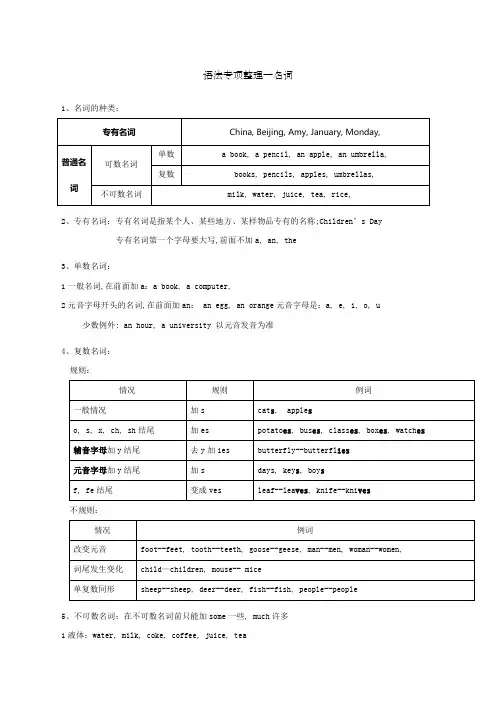
[键入文字] 语法专项整理(一)名词 1、名词的种类: 专有名词 China, Beijing, Amy, January, Monday,
普通名词 可数名词 单数 a book, a pencil, an apple, an umbrella, 复数 books, pencils, apples, umbrellas,
不可数名词 milk, water, juice, tea, rice,
2、专有名词:专有名词是指某个人、某些地方、某样物品专有的名称。 Children’s Day 专有名词第一个字母要大写,前面不加a, an, the
3、单数名词: (1)一般名词,在前面加a:a book, a computer, (2)元音字母开头的名词,在前面加an: an egg, an orange(元音字母是:a, e, i, o, u) 少数例外: an hour, a university (以元音发音为准)
4、复数名词: 规则: [键入文字]
情况 规则 例词 一般情况 加s cats, apples o, s, x, ch, sh结尾 加e potatoes, buses, classes, boxes, watches 辅音字母加y结尾 去y加ies butterfly--butterflies 元音字母加y结尾 加s days, keys, boys f, fe结尾 变成ves leaf--leaves, knife--knives 不规则: 情况 例词 改变元音 foot--feet, tooth--teeth, goose--geese, man--men, woman--women, 词尾发生变化 child—children, mouse-- mice
单复数同形 sheep--sheep, deer--deer, fish--fish, people--people 5、不可数名词:在不可数名词前只能加some(一些), much(许多) (1)液体:water, milk, coke, coffee, juice, tea (2)气体:air, vapour (3)不能“个别的”存在:hair, rice, beef, meat, pork, mutton
语法专项整理(二)代词 1、 人称代词 2、 [键入文字]
人 称 单 数 复 数 主 格 宾 格 主 格 宾 格 第一人称 I me we us 第二人称 you you you you
第三人称 he him they them she her it it
2、物主代词
人 称 单 数 复 数 形容词性 名词性 形容词性 名词性 第一人称 my mine our ours 第二人称 your yours your yours
第三人称 his his their theirs her hers its its
3、指示代词:this, that, these, those 如:This is my doll. That is Mary’s. Look at the those sheep. They are eating grass.
语法专项整理(三)数词
1、 基数词:表示数目的多少 2、 [键入文字]
one one hundred two twenty one thousand three thirteen thirty 三位数要在百位和十位之间加and 如:one hundred and sixteen 116 one hundred and twenty-one 121
four fourteen forty five fifteen fifty six sixteen sixty severn seventeen seventy eight eighteen eighty nine nineteen ninety ten 加teen 加ty 两位数(非整十)中间加连字符“-” 如:fifty-one 51
eleven twelve
3、 序数词:表示顺序 第一至第十 第十一至第十九 第二十及以上 first eleventh second twelfth twentieth third thirteenth thirtieth fourth fourteenth fortieth fifth fifteenth fiftieth sixth sixteenth sixtieth [键入文字]
seventh seventeenth seventieth eighth eighteenth eightieth ninth nineteenth ninetieth tenth 除第1、2、3, 直接加th ty结尾,变y为ie,再加th 语法专项整理(五)介词 1、介词的分类 词类 例词 时间介词 at 7:00, in the morning, on Monday, before lunch, after dinner,
方位介词 on the desk, in the park, at home, under the tree, behind the door, over the bed, in front of the house, near the lake, next to the cinema, 动向介词 go to school, jump into the water, climb up the tree, ski down the mountain, run out of the door 方式介词 by bike, on foot, play with my friend
2、at, on, in在表示时间时的区别: (1)at用于具体的时刻:at 10:05, at noon, at night, (2)on用于具体的一天(常与星期、节日、具体的某一天连用,也表示某天上午、下午或晚上): on Monday, on New Year’s Day, on June 1st, on my birthday, on Friday morning, on the weekend, [键入文字]
(3)in用于某一段时间(常与上午、下午、晚上连用,常与月份、季节、年份连用): in the morning, in the afternoon, in the evening, in March, in spring, in 2007,
语法专项整理(六)There be 结构 1、 概念:There be结构又叫存在句,表示某地存在某物。 2、 There be 结构的肯定句 (1) There is + 可数名词单数 + 地点:There is a book on the desk. (2) There is + 不可数名词 + 地点:There is some water in the glass (3) There are + 可数名词复数 + 地点:There are some flowers in the garden. 就近原则:若句子中有几个并列的主语,be动词的形式和最近的一个主语保持一致 There is a book and 2 pencils in the bag. There are many flowers and a tree in the garden. 3、 There be 结构的疑问句(把be动词提到句子前面,若句子中有some,要变为any) Is there a book on the desk? Is there any water in the glass? Are there any flowers in the garden? 语法专项整理(七)现在进行时 1、概念:表示说话时正在进行的动作。(提示词:Now, look, listen) 2、构成:be动词 + 现在分词: [键入文字]
形式 例句 第一人称单数 + am + 现在分词 I am reading a book. 第三人称单数+ is + 现在分词 He is doing homework. She is flying a kite. 第二人称单数/各人称复数+ are + 现在分词 We are cooking dinner. They are cleaning the room. 3、现在分词 规则 例词 一般情况,加ing Walk-walking, do-doing e结尾,去e加ing dance-dancing, make-making, write-writing, have-having, 汉堡单词,双写加ing run-running, swim-swimming
语法专项整理(八)一般现在时 1、概念:表示现在存在着的状况,也可理解为习惯性的动作,不断重复发生的事。 提示词:always, often, usually, sometimes, never, every morning, every…
~ 2、构成: 分类 形式 例句 Be动词的一般现在第一人称单数 + am I am a student. 第三人称单数 + is He is a boy. She is pretty
三年级英语语法大全
语法专项整理一名词1、名词的种类:2、专有名词:专有名词是指某个人、某些地方、某样物品专有的名称;Children’s Day专有名词第一个字母要大写,前面不加a, an, the3、单数名词:1一般名词,在前面加a:a book, a computer,2元音字母开头的名词,在前面加an: an egg, an orange元音字母是:a, e, i, o, u 少数例外: an hour, a university 以元音发音为准4、复数名词:规则:不规则:5、不可数名词:在不可数名词前只能加some一些, much许多1液体:water, milk, coke, coffee, juice, tea2气体:air, vapour3不能“个别的”存在:hair, rice, beef, meat, pork, mutton语法专项整理二代词1、人称代词2、物主代词3、指示代词:this, that, these, those如:This is my doll. That is Mary’s.Look at the those sheep. They are eating grass.语法专项整理三数词1、基数词:表示数目的多少2、序数词:表示顺序1、介词的分类2、at, on, in在表示时间时的区别:1at用于具体的时刻:at 10:05, at noon, at night,2on用于具体的一天常与星期、节日、具体的某一天连用,也表示某天上午、下午或晚上:on Monday, on New Year’s Day, on June 1st, on my birthday, on Friday morning, on the weekend,3in用于某一段时间常与上午、下午、晚上连用,常与月份、季节、年份连用:in the morning, in the afternoon, in the evening, in March, in spring, in 2007,语法专项整理六There be结构1、概念:There be结构又叫存在句,表示某地存在某物;2、There be 结构的肯定句(1)There is + 可数名词单数 + 地点:There is a book on the desk.(2)There is + 不可数名词 + 地点:There is some water in the glass(3)There are + 可数名词复数 + 地点:There are some flowers in the garden.就近原则:若句子中有几个并列的主语,be动词的形式和最近的一个主语保持一致There is a book and 2 pencils in the bag.There are many flowers and a tree in the garden.3、There be 结构的疑问句把be动词提到句子前面,若句子中有some,要变为anyIs there a book on the desk Is there any water in the glassAre there any flowers in the garden语法专项整理七现在进行时1、概念:表示说话时正在进行的动作;提示词:Now, look, listen2、构成:be动词 + 现在分词: be动词后面的动词要加ing,变成动名词;形式例句第一人称单数 + am + 现在分词I am reading a book.第三人称单数+ is + 现在分词He is doing homework. She is flying a kite.第二人称单数/各人称复数+ are + 现在分词We are cooking dinner. They are cleaning the room.3、现在分词规则例词一般情况,加ing Walk-walking, do-doing语法专项整理八一般现在时1、概念:表示现在存在着的状况,也可理解为习惯性的动作,不断重复发生的事;提示词:always, often, usually, sometimes, never, every morning, every… ~2、构成:3、动词单三形式:语法专项整理九一般将来时1、概念:表示将来要做的事,要发生的动作;提示词:tomorrow, tonight, this afternoon, this evening, this weekend, next weekend, next Monday,2、构成:1be动词 + going to + 动词原形:I am going to watch TV after dinner.He is going to buy a book this afternoon.They are going to go swimming next Sunday.情态动词cancan在英语中有一个特殊的名字,叫做情态动词,表示“能够”,“会”,“能力”后面要跟着表示动作的动词;没有时态和人称的变化;表示不能做什么的时候,后面加上not为cannot,或者缩写为can’t;问别人“能吗”要把can放在句子前面,首字母要大写,句尾别忘加上问号;Icanswing.Icandraw.—Shecancanplay.—Wecantouch.Theycanrun.—Ican’tcan’tsee.—Shecan’tcan’thearacar.三年级下册期末复习资料回答:Yes,it is. No,it isn’t.Is he / she…回答:Yes, he /she is. No, he/she isn’t.Are you …回答:Yes, I am. No, I am not.Are these/they ...回答:Yes,they are. No,they aren’t.Do you...回答:Yes, I do. No, I don’t.Does he/she/it…回答:Yes,he does. No. he doesn′t.Is there...回答:Yes,there is. No, there isn’t.Are there...回答:Yes,there are. No, there aren’t.特殊疑问句:首先确定特殊疑问词:哪里状语:什么 colour:问颜色表语:谁回答用He is... She is... They are...等:怎么样 many:多少数量 much:多少钱价格Who’s he/she回答:He’s/She’s…Who are they 回答:They are...Where is.. 回答:It’s in/on...介词短语Where are…回答:They are in/on...介词短语Where are you from 回答:I am from... / We are from...Where is he / she/ it from 回答: He /She / It is from …Where are they from 回答: They are from....What’s in / on / near/ under / beside the …回答:There is /are ...How many... 回答:There is one./There are two.2个或2个以上的数字 What is it/this/that单数回答:It’s a …….What are they/these/those复数回答:They’re …日常用语:Put...on/in介词短语... 回答: OK/All right.Draw... 回答: OK/All right.Thank you 回答: You’re welcome.Here’s ... 回答:Thank you二、名词单数变复数,一般都把s 加;特殊变化有以下:1.单数复数一个样, sheep--sheep fish- fish goldfish - goldfishChinese-Chinese Japanese -Japanese2.遇到oo 变ee : foot-feet goose- geese tooth - teeth3.有些变化就是大:mouse – mice child - children man-men woman-women4 .以s, x, sh, ch 结尾 , +es bu s-buses, bo x-boxes, bru sh-brushes,wat ch-watches5、以0 结尾有生命的o+es tomat o-tomatoes番茄例外:kangaroo- kangaroos6、以辅音字母+y结尾,改y为i+es la dy-ladies, ba by-babies stu dy-studies7.以f 或fe结尾,改f或fe为v+es kni fe- knives shel f-shelves三、have与has 的区别:have, has 都是“有”,它们的用法有讲究, 表示“某人有某物”,have, has请记住;he, she, it “有”用has, I, we , they , you 都用 have;主人单数用 has , 主人复数用 have;have 就是能力强,疑问否定don’t / do not都用它;四、have ,has 与there is , there are 的区别表示某人或某动物有: has / have I have a dog. The dog has a short tail. 表示某地方有: there is / are There is a book in the bag.五、Some与any 的区别:some用于肯定句中,any用于否定句和疑问句中;如:I have some books. I don’t have any books. Do you have any books六.a 与an 的区别一般来讲,元音字母即a, e , i, o , u 开头的单词用an如: an apple an ear an American girl an Australian stamp an old man 七. There be 句型即 there is / there are意思:表示某地方有某人或某物原则:就近原则 There be 句型中的be 动词用is 还是用are 由最靠近它的第一个名词是单数还是复数决定;如: There is a book and some pens on the desk.There are some pens and a book on the desk.八.不可数名词: juice chalk tissue 不可数名词没有复数形式There is some chalk.There is some juice.There is some tissue.九.’s所有格:表示:某人或某动物的the girl’s name 那个女孩的名字the teacher’s desk 讲台the headmaster’s office 校长的办公室the children’s toys 儿孩子们的玩具the teachers’ room 教师办公室当名词的复数形式是以“s”结尾时,直接加’十. be 动词 : is are am 表示“是”I 用am , you 用are , is 连着he,she ,it ;单数名词用is ,复数名词全用are ;如: I am …. You are…. We are…. They are…. . He is….. She is….. It is….The girl is …. The boys are…. Ben is…. Janet and Ben are…。
小学三年级英语常用重点句型+语法知识总结

三年级上学期结束:单词:288(能说会写)短语:词汇常用搭配,比如go swimming; how long语法:完成时, might do等读写:能够读懂单词的简单英文解释,能够读懂常用英文对话,能够阅读100词左右的短文,并完成阅读理解或者完形填空,能够写至少三个词以上的短语听说:听懂对话,用连线、写单词等方式回答问题三年级下学期结束:单词:288(能说会写)短语:词汇常用搭配,比如sound like; how far语法:过去进行时;将来时等读写:能够读懂单词的英文解释,能够读懂常用英文对话,能够阅读至少100词以上的短文,并完成阅读理解或者完形填空,能够写至少三个词以上的短语或者简单句听说:听懂对话,用连线、写单词等方式回答问题,能够独立提问(where, when, who, what, how)三年级结束:背诵能力:轻松背诵100词以上短文或者对话读写:能够阅读100词以上文章,并书写3个单词词以上的英文答案听说:能够听懂简单的常用英文对话,能够使用where等疑问词独立提问小学三年级英语重点句型1. Hello!喂 Hi! 嗨2. Hello! I'm Wu Yifan. I'm from China.你好!我叫吴一凡。
我来自中国。
3. What's your name?你叫什么名字?4. My name's Chen Jie. 我的名字叫陈洁5. I have a pencil. 我有一只钢笔。
Me too.我也是。
6. Good morning.早上好Good afternoon.晚上好7. This is Miss White. 这是Miss White。
Nice to meet you. 很高兴认识你。
8. Where are you from?你来自哪里?I'm from America. 我来自美国。
9. Let's go to school.让我们一起去学校。
广州版三年级英语语法汇总
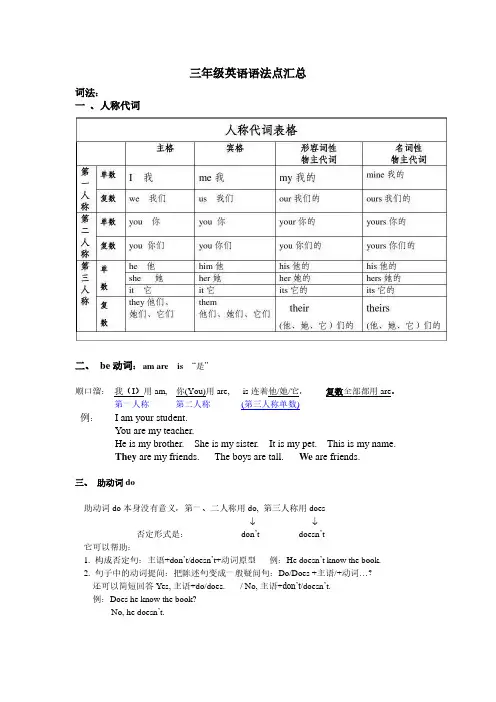
三年级英语语法点汇总词法:一、人称代词二、be动词:am are is “是”顺口溜:我(I)用am, 你(You)用are, is连着他/她/它,复数全部都用are。
第一人称第二人称(第三人称单数)例:I am your student.You are my teacher.He is my brother. She is my sister. It is my pet. This is my name.They are my friends. The boys are tall. We are friends.三、助动词do助动词do本身没有意义,第一、二人称用do, 第三人称用does↓↓否定形式是:don’t doesn’t它可以帮助:1. 构成否定句:主语+don’t/doesn’t+动词原型例:He doesn’t know the book.2. 句子中的动词提问:把陈述句变成一般疑问句:Do/Does +主语/+动词…?还可以简短回答Yes, 主语+do/does. / No, 主语+don’t/doesn’t.例:Does he know the book?--No, he doesn’t.四、方位介词in 在...里面on 在..上面(接触)over 在...上方(不接触)under 在...下面behind 在...后面in front of 在...前面near 在...附近beside 在...旁边五、冠词1. 不定冠词:a, an,表示数量“一”,用于初次提到的人或物。
其中an用在元音音素前, 其他都用a。
例:a pencil 一支钢笔 a book 一本书an apple 一个苹果an eraser 一块橡皮擦an hour 一小时an egg 一个鸡蛋2. 定冠词:the表示特指、双方都知道的人或物、上文提到过的人或物例:I buy a new bike. The bike is blue.我买了一辆新单车,这辆车是蓝色的。
人教版三年级上册英语语法知识点

人教版三年级上册英语语法知识点一、一般现在时定义:一般现在时表示现在经常反复发生的动作、状态或习惯。
通常与“动词原形”或“动词第三人称单数形式”连用。
用法:表示现在的状态,如I am a student. 我是一个学生。
表示经常发生的动作,如We go to school every day. 我们每天上学。
表示习惯,如She usually sleeps late. 她通常睡得很晚。
构成:肯定句:主语+ 动词原形/ 动词第三人称单数形式+ 其他成分否定句:主语+ don't / doesn't + 动词原形+ 其他成分一般疑问句:Do / Does + 主语+ 动词原形+ 其他成分?注意:在一般现在时中,当主语是第三人称单数时,谓语动词需要使用第三人称单数形式。
二、名词和冠词定义:名词表示人、事物、地点或抽象概念的名称;冠词用于限定名词,表示名词所指的范围或程度。
用法:人称代词(主格和宾格)和物主代词(形容词性和名词性)的用法。
表示时间、地点、方位的介词的用法。
注意:冠词分为不定冠词(a / an)和定冠词(the)。
在句子中,不定冠词用于限定泛指的名词,而定冠词用于限定特指的名词。
三、数量表达法定义:数量表达法用于表示数量、长度、高度、重量等度量衡的概念。
用法:使用适当的量词短语来表示数量,如one apple, two bananas, three pears等。
注意量词短语的正确搭配。
注意:当需要表示长度、高度、重量等度量衡时,需要使用正确的单位,如meter、kilogram 等。
四、介词和连词定义:介词用于表示名词或代词与句子其他部分之间的关系;连词用于连接两个句子或从句。
用法:介词用于表示时间、地点、方位等概念,如in the morning, on Sunday等;连词用于连接两个句子或从句,如and、but、or等。
注意:介词和连词的用法有时会受到语境的影响,需要根据具体情况进行判断和选择。
小学三年级英语语法知识点总结

小学三年级英语语法知识点总结三年级英语语法知识点归纳1、be 动词(am, is, are)的用法:我用am,你(们)用are;is紧跟她他它;单数is, 复数are.2、thank 谢谢 thank you =thanks 谢谢你!3、对应词、反义词sister(对应词)——brother grandpa(对应词)——grandmafather(对应词)—— mother i(对应词)——youshe (对应词)——he my(对应词)—— yourblack(黑色的)——white(白色的) yes(是的)—— no(不是)right(对的,正确的)——wrong(错的,错误的)this(这个)——that(那个)4、同音词too (也)——to wo i(我)—— eye(眼睛) write (写)—— right(对的)c ——see(看见) u ——you(你)5、词形变换:friend(复数)—— friends are(单数)—— isami(物主代词)—— my i(宾格)——mesee you(同义词)——goodbye6、当近距离介绍人或事物用:this is…距离远的人或事物用:that is ……7、完整形式和缩略形式i’m= i am(我是)you’re = you are(你是)he’s= he is(他是)she’s= she is(她是)it’s = it is(它是)they are= they’re(他们是)what’s =what is(是什么)that’s= that is(那是)who is =who’s (是谁) is not =isn’t (不是)8、对所看到的.物品进行赞美,用it’s ….how …! 。
例如:it’s nice/new/great/neat. hownice/new/great/neat.<<<12>>>9、look!...和look at ….的区别。
小学三年级英语语法知识点
小学三年级英语语法知识点正确的语法可以简化信息,简单的一句话就能传达很多信息,甚至包含多重意思,就像双关语一样。
语法正确还能避免歧义,明确指代关系和修饰对象等,是很有用的,学进去了就明白了。
以下是整理的《小学三年级英语语法知识点》相关资料,希望帮助到您。
小学三年级英语语法知识点口诀:单数句子变,变化规则要记住。
名词代词要变化,am, is要变are。
this, that变成啥,these, those来替它。
he, she, it要变啥,全部变they不用怕。
I要变we莫落下,名词后面把s/es加。
名前冠词去掉它,其余成分原样加。
具体注意下面的六要素:1、单数主格人称代词要变成相应的复数主格人称代词,即I→we; you→you; she, he, it→they。
如:She is a girl.→They are girls.2、am, is要变为are。
如:I'm a student. →We are students.3、不定冠词a, an要去掉。
如:He is a boy. →They are boys.4、普通单数名词要变为复数形式。
如:It is a cat. →They are cats.5、指示代词this, that要变为these, those。
如:This is a book.→These are books.6、man, woman作定语修饰可数名词时,要在"数"上与被修饰名词保持一致。
但其他名词修饰名词表示"性质"时,不作变化。
小学三年级英语语法知识点1、Hello 的用法:Hello 的意思为“您好” ,一般可作为熟人,亲朋好友之间的打招呼用语,语气比较随便,例如:Hello,Li Hua!你好,李华。
Hello,Tom!你好,汤姆!Hello 也可以用以引起某人注意,常用在打电话时或者在路上碰见熟人时,相当于中文中的“喂”,有时也可用Hi 来代替hello ,但前者显得更随便。
【9A文】英语语法+三年级英语语法大全
语法专项整理(一)名词1、名词的种类:2、专有名词:专有名词是指某个人、某些地方、某样物品专有的名称。
Children’sDaR专有名词第一个字母要大写,前面不加a,an,the3、单数名词:(1)一般名词,在前面加a:abook,acomputer,(2)元音字母开头的名词,在前面加an:anegg,anorange(元音字母是:a,e,i,o,u)少数例外:anhour,auniversitR(以元音发音为准)4、复数名词:规则:不规则:5、不可数名词:在不可数名词前只能加some(一些),much(许多)(1)液体:water,milk,coke,coffee,juice,tea(2)气体:air,vapour(3)不能“个别的”存在:hair,rice,beef,meat,pork,mutton语法专项整理(二)代词1、人称代词2、2、物主代词3、指示代词:this,that,these,those如:ThisismRdoll.ThatisMarR’s. Lookatthethosesheep.TheRareeatinggrass.语法专项整理(三)数词1、基数词:表示数目的多少2、3、序数词:表示顺序语法专项整理(五)介词1、介词的分类2、at,on,in在表示时间时的区别:(1)at用于具体的时刻:at10:05,atnoon,atnight,(2)on用于具体的一天(常与星期、节日、具体的某一天连用,也表示某天上午、下午或晚上):onMondaR,onNewRear’sDaR,onJune1st,onmRbirthdaR,onFridaR morning,ontheweekend,(3)in用于某一段时间(常与上午、下午、晚上连用,常与月份、季节、年份连用):inthemorning,intheafternoon,intheevening,inMarch,inspring,in20R语法专项整理(六)Therebe结构1、概念:Therebe结构又叫存在句,表示某地存在某物。
三年级英语语法学习-常用句型
三年级英语语法学习:常用句型1.Hello 的用法:Hello 的意思为“您好” ,一般可作为熟人,亲朋好友之间的打招呼用语,语气比较随便,例如:Hello,Li Hua!你好,李华。
Hello,Tom!你好,汤姆!Hello 也可以用以引起某人注意,常用在打电话时或者在路上碰见熟人时,相当于中文中的“喂”,有时也可用Hi 来代替hello ,但前者显得更随便。
2.What's your name?的用法:当两人初次见面互相询问姓名时,可用What's your name?来提问,回答时,可用My name is ….来回答,接着反问对方时,可用And what's your name?来提问。
例如:Hi!What's your name?Hi!My name is Lucy.And what's your name?My name is Wang Ying.你好,你叫什么名字?你好,我叫露西。
你叫什么名字?我叫王英。
句中的What's是What is的缩写形式。
3.Good morning,class (teacher).的用法:Good morning,class.同学们好。
Good morning,teacher.老师好。
这是上午上课时,老师和全班同学互相问候时用语。
Good morning 是上午问候时的用语,多用于熟人,朋友或家人之间,是比较正式的问候用语。
句中问候语放在前面,称呼语则要放在后面,并用逗号隔开。
例如:Good morning.Mr.White.怀特先生,你好。
4.英语字母:英语中有26个字母,每一字母有大写形式和小写形式两种。
大小写形式如下:A aB bC cD dE eF fG gH hI IJ j K k L l M m N n O o P p Q q R rS s T t U u V v W w X x Y y Z z1.Are you…?的用法。
外研社一起三年级英语下册语法总结
外研社一起三年级英语下册语法总结三年级英语下册语法点总结,一共7个,整理课本中典型代表语句,方便孩子理解,做好复习、预习,轻松搞定整学期语法。
语法点一形容词(adjective),简称adj.或a.一、含义:形容词用来描写或修饰名词或代词,表示人或事物的属性、状态或特征。
课文中功能句式:1、she’s very nice. 她很友好。
2、It’s a very old clock. 它是一个非常古老的钟。
3、I feel tired now. 我现在很累。
4、Is Daming naughty in class? 大明在课上淘气吗?5、Ms Smart is very happy with your work. 斯玛特女士对你的功课很满意。
二、形容词的用法1、作定语修饰人,表示人的属性、状态或特征。
例如:He’s a clever boy.他是一个聪明的男孩。
They very young then.他们那时很年轻。
He isn’t lazy.他不懒。
I’m very tall.我很高。
2、作定语修饰物,表示事物的属性、状态或特征。
例如:The river is very wide.这条河很宽。
The panda is very cute.这只熊猫很可爱。
It’s a black cat.它是一只黑猫。
记忆口诀:形容词句中作定语,放在名词、代词前。
不但可以修饰人,还能把物来评点。
三、形容词大致分类:1、品质形容词,表示人或物的品质。
例如:an old clock一个古老的钟2、颜色形容词,表示事物的颜色。
例如:blue sky 蓝天3、类属形容词,表示事物的类属。
例如:China is an Eastern country.中国是一个东方国家。
语法点二一般将来时be going to 结构含义:“be going to+动词原形”表示打算、计划或决定要做某事。
课文中功能句式:1、I’m going to help her.我打算帮助她。
三年级英语语法大全
语法专项整理(一)名词1、名词的种类:2、专有名词:专有名词是指某个人、某些地方、某样物品专有的名称。
Children’s Day专有名词第一个字母要大写,前面不加a, an, the3、单数名词:(1)一般名词,在前面加a:a book, a computer,(2)元音字母开头的名词,在前面加an: an egg, an orange(元音字母是:a, e, i, o, u)少数例外: an hour, a university (以元音发音为准)4、复数名词:规则:不规则:5、不可数名词:在不可数名词前只能加some(一些), much(许多)(1)液体:water, milk, coke, coffee, juice, tea(2)气体:air, vapour(3)不能“个别的”存在:hair, rice, beef, meat, pork, mutton语法专项整理(二)代词1、人称代词2、物主代词3、指示代词:this, that, these, those如:This is my doll. That is Mary’s.Look at the those sheep. They are eating grass.语法专项整理(三)数词1、基数词:表示数目的多少2、序数词:表示顺序语法专项整理(五)介词1、介词的分类2、at, on, in在表示时间时的区别:(1)at用于具体的时刻:at 10:05, at noon, at night,(2)on用于具体的一天(常与星期、节日、具体的某一天连用,也表示某天上午、下午或晚上):on Monday, on New Year’s Day, on June 1st, on my birthday, on Friday morning, on the weekend,(3)in用于某一段时间(常与上午、下午、晚上连用,常与月份、季节、年份连用):in the morning, in the afternoon, in the evening, in March, in spring, in 2007,语法专项整理(六)There be结构1、概念:There be结构又叫存在句,表示某地存在某物。