
人教版八年级英语上册Unit1SectionB 1a--1d教学设计
年级 八年级 科目 英语 任课教师
李波
授课时间
9月9日
课题 Unit 1 Where did you go on vacation? Section B 1a-1d 授课类型
听说课
一、教材分析
1a-1b是听前的图文匹配练习,要求将图片与相应的形容词匹配,并找到
成对的反义词1c-1d为听力练习,其内容依然是度假,但信息更丰富,
谈到对事物的看法和感受。
二、学情分析
今年所带班级是上年度的五个班打乱合并为四个班当中的八年级1班,
学生来自不同班级,也是不同的教师所教。学生两级分化加大,少数学
生上课态度消极,无精打采,对英语学习的兴趣不浓。本节课听力难度
较大,在上课时要根据学生反映调整策略,如实在听不懂就阅读听力材
料。
三、教学目标
1语言知识目标:
能掌握以下句型:
① Where did…?
② What did…?
③ How was…? / How were…?
④ Did she/he…?
2. 情感态度价值观目标:
学生了解我国不同地方的人们上学的方式,了解还有一些贫困地区的
孩子们需要我们去帮助他们。
四、教学重点
难点
重点
1.进行听力训练,提高综合听说能力。
2.阅读短文,获得相关信息,提高学生们的综合阅读能力
编号:4
难点
. 听力训练和听力技巧培养。
五、教学过程
设计
Ⅰ. Warming- up and revision
Ⅱ.Writing
Work on 1a:
1. Point to the six words. delicious, expensive, exciting, cheap, terrible,
boring
2. Read the words and let Ss read after the teacher.
3. Point to the last picture and say: This is a cake. It’s delicious. Then do the
same thing for all six pictures.
4. Let Ss match each word with a picture. Then check the answers with the
students.
Work on 1b:
1. Explain the meaning of “ ☺ words” and “ words.”
2. Let Ss discuss the words they know and write them down on the line.
3. Let some Ss read out their words to the class. (Or let some Ss write their
words on the blackboards.)
Ⅲ. Listening
Work on 1c:
1. T: Now let's work on 1c. First, let one student read the questions aloud.
Make sure all the Ss know the meanings of the questions.
2. Play the recording for the first time. Ss only listen.
3. Then play the recording for the second time. Ss listen and answer the
questions.
4. Then play the recording for the third time for the Ss to check the answers.
5. Ss listen to the tape and circle the words and phrases they hear.
6. Check the answers: (Look at the big screen.)
Work on 1d:
1. Tell Ss this time they have to write down what Lisa said about her
vacation, the people, the fun park, the food and the store.
2. Then play the recording for the second time. Ss listen and write down the
words.
3. Then play the recording for the third time for the Ss to check the answers.
听力指导:在听时要抓重点内容。第一次听要求我们回答问题,因此在
听的时候,应重点将与这些问题相关的内容方面的听清,其他作为非重
点内容。另外,要注意要速记下重点内容。
在完成1d部分时要注意听的重点是放在Lisa对这五个方面的事情所做评
价,因此应听清楚那些形容词。
Ⅳ. Retelling Lisa’s vacation
Lisa’s vacation was________. She ____ to Hong Kong with her ______. She went to a
____ park. It was really _______. And she went _______.The stores were _________,
but she bought _________ for her best friend. The people there were __________.
Lisa and her parents had dinner there. She thought the food was very _________. She
had a good time . She thought _________was excellent.
六、练习及检
测题
补全对话。
A:Hi,Vera. 16.______________________
B:It was great.
A:17. _________________
B:I went to Tokyo with my family on vacation.
A:Really?Wow!18. _____________________
B:We went to a lot of museums and met many
interesting people.
A:19. ___________________
B:Yes,I did. I bought something nice for my mother.
A:20. ______________________
B:It was delicious. I love Japanese food!
七、作业设计
一、根据句意选用下列词填空。
cheap,terrible,delicious,expensive,exciting
1.I didn't buy the iPhone 6 because it was too _________.
2.Who cooked the fish?It was _________.
3.We had an ________ trip to Zhangjiajie.
4.He didn't go to school because he felt ________.
5.My family doesn't have much money so we often buy
_____ things.
二、根据句意用所给词的适当形式填空。
1.—How ____ (be) the people there?
—They were kind to us.
2.—Where did you go last Sunday?
—I ____ (go) to Shanghai to visit my friend.
3. __________ (not do) my homework yesterday.
4.—How was his trip to Taiyuan?
—It was ______ (bore).Because I did nothing.
5.Did you _____ (watch) the football game last night?
人教版英语八年级上册 Unit 1 Section B ( 1a-1e)教学设计
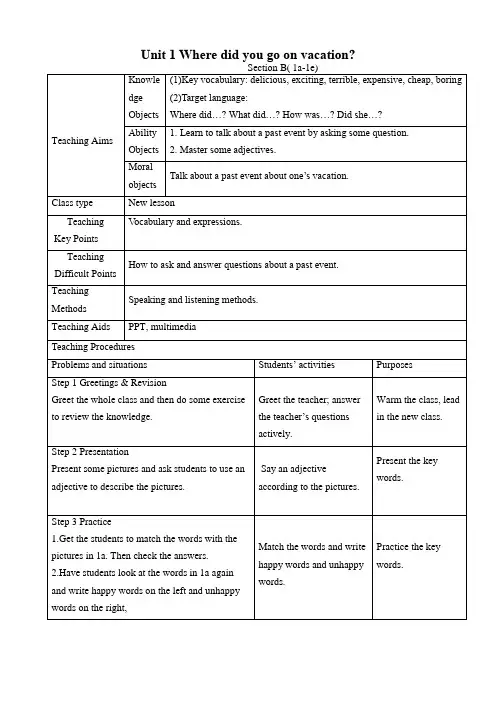
Blackboard Design
Unit 1 Where did you go on vacation?
SectionB(1a-1e)
1.Key vocabulary: delicious, exciting, terrible, expensive, cheap, boring
(2)Target language:
Where did…? What did…? How was…? Did she…?
Ability Objects
1. Learn to talk about a past event by asking some question.
2. Master some adjectives.
Step 3 Practice
1.Get the students to match the words with the pictures in 1a. Then check the answers.
2.Have students look at the words in 1a again and write happy words on the left and unhappy words on the right,
2. Check the answers of the guidance case.
Review the knowledge together.
Know what have learned in this class.
Homework Design
1. Read the conversation in 1b and 1c.
人教版英语八年级上册教案:Unit1 SectionB(1a-1e)

Unit1 SectionB(1a-1e)教案【教材版本与册数】新目标人教版八年级上册【单元名称】Unit 1 Where did you go on vacation ?【课时】SectionB 1a-1e(第3课时)【课型】Listening and Speaking(听说课)教材分析本单元围绕“节日和假日( holidays and vacations)”这一话题,展开形式多样的听、说、读、写学习活动。
能正确使用一般过去时和不定代词的用法来询问及叙述假期活动和谈论度假的感受。
本单元Section A通过谈论假期活动,首先复习、巩固对一般过去时的理解和运用,侧重与假期活动有关的词汇和语言结构的学习,以及该话题下的听说训练。
Section B 进一步拓展了此话题,由对假期活动的询问及叙述转向描述及谈论度假的感受;在语言上,除进一步综合训练、巩固sectionA所学重点语言内容外,学习正确、得体地运用相关形容词描绘假期活动,表达自己的感受成为这一部分的一项重要任务;在语言技能上,则由听、说转向综合性地听、读、写的训练。
通过本单元的学习使学生学会用得体的语言询问及叙述假期活动和谈论度假的感受,了解国内外著名游览胜地。
此部分1a-1e通过听说活动拓展单元话题,拓展和巩固了目标语言的运用。
1a-1b是听前的图文匹配练习,邀请学生将图片内容与相应的形容词匹配,并且找到成对的反义词delicious----terrible, expensive---cheap,exciting---boring;1c-1d为听力练习,其内容依然是度假,但信息更丰富,谈到对事物的看法和感受。
1e活动听力的延续,让学生将听到的信息用据“wh-”疑问词的提示串成一段话来完整的故事描述,进行语言输出。
(一)语言知识目标:1 / 15第 1 页教学目标1.语音、词汇:通过听前的活动,学生能够分辨描述性的形容词感情色彩。
delicious, expensive, exciting, cheap, terrible, boring2.语法:能正确使用一般过去时和不定代词的用法来询问及叙述假期活动和谈论度假的感受。
八年级英语Unit 1 教案

Unit 1Where did you go on vacation?本单元教材以Where did you go on vacation?为中心话题, 围绕着描述“过去发生的事情”展开, 学习和运用一般过去时态的一般疑问句Did you go/see/buy. . . ?和特殊疑问句Where/What/How. . . ?询问过去的事件, 让学生学会谈论和分享过去发生的事件。
本课教学内容与学生的实际生活密切相关, 易于引发学生运用简单的英语进行交流。
在学习活动中, 学生通过交换对过去发生的事情的描述及看法, 促进学生之间和师生之间的情感交流, 增进情谊。
Section A的主要学习内容是: 复习一般过去时态和动词的规则与不规则变化, 学习一般过去时态的一般疑问句: Did you. . . ?及不定代词的用法。
Section B安排了许多听、说、读、写的任务活动, 教师在教学中可以灵活运用这些活动, 将其中的一些活动进行变化或整合, 充分调动学生参与的积极性, 提高学生的听说读写功底。
第一课时Section A(1a-2d)Teaching Goals【教学目标】Key words & phrases:anyone, anywhere, wonderful, few, most, quite a few, go on vacationKey sentences:1. Where did you go on vacation?I went to the mountains/New York City/summer camp/the beach.2. Did you. . . ?Yes, I did. /No, I didn't.Teaching Key Points【教学重点】The vocabulary:New York City, Central Park, few, most, quite a few, on vacationTarget language:Where did you/they/he/she go on vacation?I/They/He/She went to the mountains/New York City/summer camp/the beach. Did you. . . ?Yes, I did. /No, I didn't.Teaching Difficult Points【教学难点】Use the target language above to talk about past events.Teaching Aids【教学工具】An English textbook, a tape recorder, CAI or courseware.Teaching Steps【教学过程】★Step 1Leading inGreet the class and introduce what to learn in this period.Teacher: Welcome back to school!Did everyone have a good time during the summer vacation?Today we'll begin to learn the topic where you went on vacation.Teacher: Where did you go on vacation?Students: ______.①I went to the mountains.②I visited museums.…★Step 2Pre-taskPage 1, 1a & 1b.1.Look at the picture.2.Match each activity.3.Check the answers in 1b.4.Practice reading.Page 1, 1c.1.Focus on the conversation in the box.2.Practice reading.3.Pairwork: Where did you go on vacation?I. . .4.Groupwork: Divide the class into groups of four or five. Make conversations.First S1 to S2:S1: Where did you go on vacation?S2: I. . .S1: Where did she/he go on vacation?S2: She/He. . .★Step 3While-taskPage 2, 2a & 2b.1.Play the recording for the first time. Students complete the chart in 2a.2.Check the answers. (Point to one student who raises his or her hand. )3.Play the recording a second time and say: There are three conversations. The people talk about where they went on vacation. Listen to the recording and check(√) Yes, I did or No, I didn't for each question.4.Correct the answers.★Step 4Post-taskPage 2, 2c & 2d.1.Focus on the conversation in 2c & 2d.2.Practice reading. Make students scan the conversations first.3.Teach and then make students role-play the conversation in pairs.4.Have a group of students present their conversation to the class.★Step 5Homework1.Practice the conversation on Page 2, 2d.2.Do the exercises on Page 1 in students' book.Board Design板书设计Unit 1Where did you go on vacation?The first period Section A(1a-2d)1.Key vocabulary: anyone, anywhere, wonderful, quite a few, go on vacation2.Target language:A: Where did Tina go on vacation?B: She went to the mountains.第二课时Section A(GF-3c)Teaching Goals【教学目标】Key words:something, nothing, everyone, myself, yourself, someone, seem, bored, diaryKey phrases:go out, have a good time, of course, keep a diaryKey sentences:1. Where did you go on vacation?I went to New York City.2. Did you go out with anyone?Did you buy anything special?3. How was the food?How was your vacation?Teaching Key Points【教学重点】The vocabulary:something, nothing, everyone, myself, yourself, someone, seem, bored, diary, go out, have a good time, of course, keep a diary, on vacation Target language:How was the food?Everything tasted really good!Did you go shopping?Of course!Did everyone have a good time?Oh, yes. Everything was excellent.Teaching Difficult Points【教学难点】1. Use the target language above to talk about past events.2.The usage of someone, anyone, everyone, no one, something, anything, everything, nothing.Teaching Aids【教学工具】An English textbook, CAI or courseware.Teaching Steps【教学过程】★Step 1Leading in(T—teacher S—student)T: Where did you go last weekend?S: I went to the beach.T: Did you go there with anyone?S: Yes. I went to the beach with my brother.T: Did you have a good time there?S: . . .★Step 2Pre-taskPage 3, Grammar Focus.1.Review the grammar box. Work in pairs. One asks and the other answers.2.Practice reading the sentences in the chart.★Step 3While-taskPage 3, 3a & 3b.1.Teach these new words: anyone, something, anything, everything, nothing, everyone, no one.2.Call students' attention to the conversation in 3a. Make students complete it individually.3.Choose a student to give his or her answers. Write the answers on the board.4.Correct the answers.5.Lead students to read this conversation.6.Have students work in pairs and role-play the conversation. As they talk, move around the classroom monitoring their work. Offer language or pronunciation support as needed.7.Make students complete the blanks in the e-mail message in 3b with the words in the box.8.Check the answers and then make students practice reading it.★Step 4Post-taskPage 3, 3c.Complete the task in 3c. Ask your group questions about their last vacation. Then tell the class your results.★Step 5Homework1.Review the indefinite pronouns learned in this period.2.Do the exercises on Page 2 in students' book.Board Design板书设计Unit 1Where did you go on vacation?The second period Section A(GF-3c)1.The vocabulary: something, nothing, everyone, someone, myself, yourself, go out, of course2.Target language:①A: Where did you go on vacation?B: I went to New York City.②A: Did you buy anything special?B: Yes, I bought something for my father.3.Structure: something special4.Answers to 3a and 3b.第三课时Section B(1a-1e)Teaching Goals【教学目标】Key words:delicious, exciting, terrible, expensive, cheap, boringKey sentences:1. Where did Lisa go on vacation?2. Did she do anything special there?Did she buy anything for her best friend?Did Lisa like her vacation?3. How was/were. . . ?Teaching Key Points【教学重点】The vocabulary:delicious, exciting, terrible, expensive, cheap, boringTarget language:Where did Lisa go on vacation?Did she do anything special there?Did she buy anything for her best friend?How was/were. . . ?Teaching Difficult Points【教学难点】1. 询问去过何地以及感受(评价) Where did you go?I went to the beaches. How was it?It was exciting.2.Use the target language to talk about your past events.Teaching Aids【教学工具】An English textbook, a tape recorder, CAI or courseware.Teaching Steps【教学过程】★Step 1Leading in1.Greetings.2.T: Where did you go on vacation?S: I went to summer camp.T: Did you do anything special there?S: Yes, I. . .T: Did you buy anything for your parents or friends?S: Yes, I bought. . . for. . . /No, I bought nothing.T: How was/were. . . ?S: It was/They were. . .★Step 2Pre-taskPage 4, 1a & 1b.1.Look at the six pictures.2.Match the words with the pictures.3.Students complete the task in 1b individually.4.Check the answers.★Step 3While-taskPage 4, 1c & 1d.1.Make students scan the questions in 1c.2.Play the recording for the first time. And say: Listen to the tape. Lisa is talking about her vacation. Complete the four questions.3.Play the recording a second time. Students complete the task in 1d.4.Correct the answers.★Step 4Post-taskPage 4, 1e.Ask 3 or 4 students to answer questions about Lisa's vacation. You can begin your questions with: Where did. . . ?What did. . . ?Did she. . . ?How was. . . ?How were. . . ?★Step 5Homework1.Review these sentences: Where did. . . ?Did. . . ?How was/were. . . ?2.Do the exercises on Page 3 in students' book.Board Design板书设计Unit 1Where did you go on vacation?The third period Section B(1a-1e)1.Words: delicious, exciting, terrible, expensive, cheap, boring2.Sentences:①Where did Lisa go on vacation?②Did she buy anything special?③Did she buy anything for her best friend?④Did Lisa like her vacation?3.Answers to Activity 1a:1—5f a c e b d Answers to Activity 1b: wordsdeliciousexcitingcheapwordsterribleexpensiveboring第四课时Section B(2a-2e)Teaching Goals【教学目标】Key words:activity, decide, try, bird, bicycle, building, trader, wonder, difference, top, wait, umbrella, wet, below, enough, hungry, as Key phrases:feel like, because of, go to the beach, a lot of, a little, take the train, too many, what aboutKey sentences:1. I wonder what life was like here in the past.2. What a difference a day makes!3. We waited over an hour for the train because there were too many people.Teaching Key Points【教学重点】Learn Jane's diary entries about her vacation.1. The vocabulary: activity, decide, try, wonder, difference, wait, below, enough, hungry, as, feel like, because of2. Target language: I wonder what life was like here in the past. We waited over an hour for the train because there were too many people.Teaching Difficult Points【教学难点】1. because and because of2. What a difference a day makes!3. Learn to write a diary.Teaching Aids【教学工具】An English textbook, CAI or courseware.Teaching Steps【教学过程】★Step 1Leading in1.Greetings.2.Introduce what to learn in this period, especially the articles in 2b, Jane's diary entries. Teacher begins like this: Today we'll focus on two diary entries about Jane's vacation. Through the learning you'll know how to write a diary. Let's begin now.★Step 2Pre-taskPage 5, 2a & 2b.1.Review and discuss the questions in 2a box with your partner.2.Project these new words on the screen or write them on the board and teach the new words. Ask students to repeat them. And make sure everyone knows the meanings.activity n.活动;decide v.决定;try v. & n.尝试, 设法;wonder v.想知道;difference n.差异;top n.顶部;wait v. & n.等待;umbrella n.伞;below prep. & adv. 在……下面;enough adj. 充足的;hungry adj. 饥饿的3.Make students scan the articles first. Ask students to put a mark in contents that are unfamiliar to them. Then the teacher lead students to learn these two articlessentence by sentence. Pay attention to these points: (1) decide v.决定;decide to do sth. 决定做某事;(2) try v.尝试;try doing sth. 尝试做某事;try to do sth. 尽力做某事;(3) below prep. & adv. 在……下面;(4) feel like 给……的感觉;(5) because and because of;(6) wonder v.想知道4.Practice reading.★Step 3While-taskPage 6, 2c & 2d.1.Make students read Jane's diary entries again. Fill in the chart in 2c.2.Students complete the conversation in 2d using the information in Jane's dairy entries.3.Choose 3 or 4 students to give their answers.4.Correct the answers.5.Have students work in pairs. Student A will be Anna and student B will be Jane. Act the conversation out.★Step 4Post-taskPage 6, 2e.1.Make students complete the blanks in 2e.2.Ask one student to write his or her answers on the board.3.Check the answers together with the class.4.Practice reading.★Step 5Homework1.Write a diary.2.Do the exercises on Page 4 in students' book.Board Design板书设计Unit 1Where did you go on vacation?The fourth period Section B(2a—2e)1.Key vocabulary: decide, try, wonder, difference, top, wait, below, enough, hungry, as, feel like, because of, too many2.Sentences:①I wonder what life was like here in the past.②And because of the bad weather, we couldn't see anything below.第五课时Section B(3a-Self Check)Teaching Goals【教学目标】Key words & phrases:duck, dislike, take photos, Tian'anmen Square, the Palace Museum, bring back, shopping center, have a fun time, school trip, come up Key sentences:1. How did you feel about the trip?2. It was so beautiful that we forgot about the last five hours!Teaching Key Points【教学重点】The vocabulary:dislike, take photos, Tian'anmen Square, the Palace MuseumTarget language:What did you like best?Did you dislike anything?How did you feel about the trip?Teaching Difficult Points【教学难点】Write a travel diary.Teaching Aids【教学工具】An English textbook, CAI or courseware.Teaching Steps【教学过程】★Step 1Leading in1.Greetings.2.T: Beijing is the capital of our country. It's famous for its long history and places of interest, such as Tian'anmen Square, the Palace Museum, the SummerPalace and so on. And Beijing duck is very delicious. Have you ever been to Beijing?Tell your travel to us.★Step 2Pre-taskPage 7, 3a.1.Look at the three pictures.2.Use the words and phrases in the box to complete the blanks in the article.3.Check the answers.★Step 3While-taskPage 8, Self Check.Complete the tasks in Self Check.1.Have students complete the task of Part 1. Then Choose 2 or 3 students to give their answers. Check the answers.2.Induct students to complete the passage of Part 2. Check the answers.3.Practice reading.★Step 4Post-taskPage 7, 3b & 3c.1.Make students answer the questions in 3b and take notes.2.Teach students how to write a travel diary.3.Students write a travel diary like Jane's on Page 5 using the notes in 3b.4.Choose 2 or 3 students' diaries. Make students read them out. Point out the weakness and induct the students to correct their diaries.★Step 5Homework1.Write a travel diary.2.Do the exercises on Page 5 in students' book.Board Design板书设计Unit 1Where did you go on vacation?The fifth period Section B(3a-Self Check)1.Key vocabulary: dislike, Tian'anmen Square, the Palace Museum, have a fun time, come up2.Sentences:①Did you dislike anything?②How did you feel about the trip?③My legs were so tired that I wanted to stop.。
人教版八年级英语上册Unit1SectionB(1a1e)优秀教学案例
(三)小组合作
1.分组活动:将学生分成若干小组,每组选定一个旅游地点,进行小组合作。
2.任务分配:每组成员分工合作,完成1a-1e的读、听力任务,以及相关的口语表达练习。
3.合作交流:小组成员之间进行交流讨论,共同完成任务,培养他们的团队协作能力。
在教学评价方面,我将采用多元化评价方式,以鼓励性评价为主,关注学生的进步,增强他们的自信心。通过定期检查学生的学习成果,及时了解他们在知识、技能、情感态度与价值观方面的收获,为下一阶段的教学提供有力依据。总之,本节课旨在全面提高学生的英语素养,为他们的未来学习和生活打下坚实基础。
三、教学策略
(一)情景创设
4.教学反思:教师对课堂教学进行反思,总结经验教训,为下一阶段的教学提供改进方向。
四、教学内容与过程
(一)导入新课
1.课堂初始,我会利用多媒体展示一幅世界地图,并在地图上标出一些著名的旅游景点,如北京、纽约、巴黎等。
2.引导学生谈论自己最喜欢的旅游地点,并简要介绍原因,激发学生对旅游话题的兴趣。
3.引入本节课的主题:“Where did you go on vacation?”,引导学生思考和回答。
4.成果展示:各小组展示自己的学习成果,其他小组进行评价和反馈,提高他们的表达能力。
(四)反思与评价
1.学生自评:让学生对自己的学习过程进行反思,评价自己在知识、技能、情感态度与价值观方面的收获。
2.同伴评价:学生之间相互评价,关注彼此的学习进步,培养他们的评价能力。
3.教师评价:教师对学生的学习成果进行评价,关注他们在知识、技能、情感态度与价值观方面的表现。
人教版八年级英语上册Unit1SectionB(1a1e)优秀教学案例
(完整)人教版八年级上册Unit1教学设计
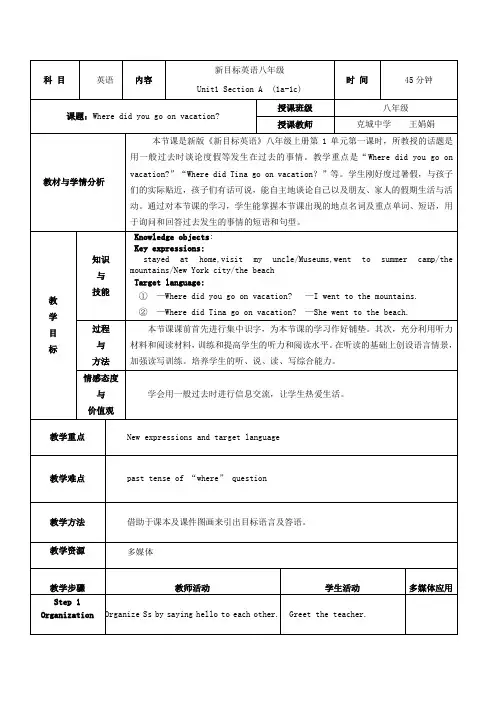
Work in pairs.
Step 8
Survey and report
1.Ask some classmates about their vacation1.Say,“Now, get into groups .Ask each other about the vacations. Talk about“Where did he\she go?”and more information
Where did he\she go on vacation?
Check the answers.
ANSWERS:
(1) went to the mountains
(2) went to New York City
(3)stayed at home
(4) visited my uncle
(5) went to summer camp
多媒体呈现所需图片
Step 4
Learn keyexpressions and play game
1.learn in pairs.
2.Play a game.
Read and memorize.
Students raise their hands to answer.
多媒体呈现游戏
Step 5
Practice
① —Where did you go on vacation? —I went to the mountains.
② —Where did Tina go on vacation? —She went to the beach.
过程
与
方法
本节课课前首先进行集中识字,为本节课的学习作好铺垫。其次,充分利用听力材料和阅读材料,训练和提高学生的听力和阅读水平。在听读的基础上创设语言情景,加强读写训练。培养学生的听、说、读、写综合能力。
【人教版】新目标八年级英语上册:Unit 1 单元教学设计
【人教版】新目标八年级英语上册:Unit 1 单元教学设计一. 教材分析人教版新目标八年级英语上册Unit 1主要围绕“How do you get to school?”这一主题展开,通过引入不同交通工具的图片和情景对话,让学生掌握一般现在时的表达方式,以及询问和回答他人如何去学校的句子结构。
教材通过丰富的语言材料,旨在培养学生的听说读写技能,提高他们的语言运用能力。
二. 学情分析八年级的学生已经掌握了基本的英语语法和词汇,具备一定的听说读写能力。
他们在学习过程中需要更多的实际语境和实践机会来提高语言运用能力。
此外,学生对于新事物的接受能力较强,但部分学生可能对英语学习缺乏兴趣,需要教师通过有趣的教学活动来激发他们的学习热情。
三. 教学目标1.知识目标:学生能够掌握一般现在时的表达方式,学会用英语询问和回答他人如何去学校。
2.能力目标:学生能够在实际情境中运用所学知识进行交流,提高听说读写技能。
3.情感目标:培养学生热爱生活,关注环保的价值观。
四. 教学重难点1.重点:一般现在时的表达方式,以及询问和回答他人如何去学校的句子结构。
2.难点:如何运用所学知识进行实际交流,提高语言运用能力。
五. 教学方法采用任务型教学法,通过引入真实情境,让学生在实际交流中掌握知识点。
同时运用分组合作、角色扮演等教学手段,激发学生的学习兴趣,提高他们的参与度。
六. 教学准备1.教材:人教版新目标八年级英语上册。
2.教具:多媒体设备、图片、卡片等。
3.教学资源:网络资源、相关视频等。
七. 教学过程1.导入(5分钟)利用多媒体展示不同交通工具的图片,引导学生谈论自己如何去学校。
教师通过提问学生,激发他们的学习兴趣。
2.呈现(10分钟)教师通过展示教材中的情景对话,让学生听懂并理解对话内容。
随后,引导学生跟读对话,纠正发音。
3.操练(10分钟)将学生分成小组,让他们模拟对话情景,进行角色扮演。
教师巡回指导,纠正错误,并给予鼓励。
2024年人教版八年级英语下册教案Unit 1 第3课时Section B (1a—1d)
第三课时Section B (1a—1d)教学目标通过本课的学习,学生能够:1.梳理本课语篇中的对话,在语境中理解并使用有关身体健康与急救话题的单词、习惯用语和固定搭配;获取对话中涉及的what、how、why等关键信息;理解并掌握本课时重点词汇:sick、knee、bandage、nosebleed等。
(获取信息)2.利用多种听力活动提升听力技能。
以话题牵引下的情景设置,进行角色表演对话练习,能进一步去判断并思考如何表达身体不适及建议,发展口语技能。
(梳理整合)3.学会运用英文描述意外事故及相关建议,清楚阐述自己的观点,提高自身思维品质。
(内化应用)4.借助小组活动,在合作探究中树立乐于助人、热爱生活的观念。
(迁移创新)语篇研读What:本课语篇是老师和护士之间的对话。
护士叙述了当天学生出现的突发状况以及她是如何处理的。
Why:让学生了解日常生活中可能出现的突发状况或遇到的意外伤害,形成自我保护的意识以及学习遇险时应该如何应对才能保证自身安全。
How:语篇是关于学校同事之间的日常对话。
护士通过描述事件来说明学生遇到突发状况的原因,这是对Section A部分语言点的复现。
语篇中还新出现了一些急救方法的表达,如washed the cut、put some medicine on it、put a bandage on it 等。
教学过程设计理念:以新课标核心素养为导向,以单元主题为引领,基于语篇的育人理念,体现新课标“学思用创”的英语学习活动观和“教—学—评”一体化设计理念。
续表续表板书设计作业设计基础型作业:Make a conversation by using the words and phrases we learned today. 实践型作业:Write a short passage about the accidents happened in your P.E.class.拓展型作业:Collect more treatments about accidents as many as possible.教学反思。
人教版英语八年级上册-Unit10-Section-B-1a-1d-教学设计精选全文完整版
An agent is a person who manages something for a famous person or a company.
answer questng II
Ask students predict and make the reasons complete by matching
教学重、难点
1. Language Focus
be happy, go to college, be famous, travel around the world, make a lot of money, get an education
2. Language Skills
The students will be able to get required information via pre-listening prediction, while-listening information acquisition and post-listening analyses and summary.
Teacher will get an education in Europe or travel around the world because it will make her happy and being happy is the most important to her.
Ask Ss what is the most important thing to him/her
The students will be able tounderstandconditional clause with ifin listening and use it.
八年级英语上册 unit 1 教学设计 人教新课标版 教案
Unit One How often do you exercise?Section AThe First Period讲解:1.一般现在时:表示经常发生的事情或习惯性的动作。
标志词:always, usually ,often , sometimes,hardly ever, never (常放在句中,be 动词后或实义动词前,sometimes 可在句首或句尾)every day , once a week , twice a month, three times a year ….(常在句尾)on weekends, on Monday, in the morning …(放在句尾)2.How often:多久一次?对once a week, twice a month, three times a year …,usually, sometimes, hardly ever, never 提问。
How many times:多少次?对once, twice ,three times …提问。
The Second Period讲解:1.high school 中学 activity survey 活动调查2.Here.there 开头的句子,若主语是名词,则主谓倒装;若主语是代词,则主谓不倒装。
E.g.:Here es the bus! Here it es!3.不定代词all +复数名词most +of the 复数名词(all 后的of 可省略)some +of 代词宾格no+复数名词或单数名词Section B教学目标:1.学会谈论饮食习惯。
2.能了解哪些饮食习惯是健康的。
3.能阅读介绍饮食习惯方面的文章。
4.学会养成良好的生活习惯和饮食习惯。
语言目标:掌握表达食品的词汇及句型:How often do you drink milk?语言功能:Talk about how often you do things.跨学科学习:学会养成良好的生活习惯和饮食习惯。
八年级英语上册-人教版-Unit 1 教案
八年级英语上册-人教版-Unit 1 教案一. 教材分析本单元的主题是“My school”,主要介绍学校的基本情况和学校生活。
通过本单元的学习,学生能够掌握有关学校的基本词汇,如classroom, teacher, student等,同时能够运用这些词汇进行简单的英语交流。
二. 学情分析八年级的学生已经掌握了基本的英语语法和一定量的词汇,对英语学习有了一定的兴趣和基础。
但部分学生在英语学习中还存在一定的困难,如口语表达能力和听力理解能力。
因此,在教学过程中,需要关注学生的个体差异,因材施教。
三. 教学目标1.知识目标:学生能够掌握有关学校的基本词汇和句型,如“This is myclassroom. This is my teacher.”等。
2.能力目标:学生能够用英语简单介绍自己的学校和生活,提高口语表达能力和听力理解能力。
3.情感目标:培养学生对学校生活的热爱和珍惜,激发学生学习英语的兴趣。
四. 教学重难点1.重点:掌握有关学校的基本词汇和句型。
2.难点:能够用英语进行简单的交流和描述。
五. 教学方法1.任务型教学法:通过完成各种任务,激发学生的学习兴趣,提高学生的参与度。
2.情境教学法:创设各种真实的学校情境,帮助学生理解和运用所学知识。
3.小组合作学习:鼓励学生相互交流、讨论,提高学生的合作能力和团队精神。
六. 教学准备1.教学素材:准备相关的图片、视频、课件等,以便在课堂上进行展示和教学。
2.教学工具:准备黑板、粉笔、多媒体设备等。
3.学生活动准备:学生提前预习教材,了解本节课的基本内容。
七. 教学过程1.导入(5分钟)利用图片或视频展示学校的场景,引导学生谈论学校的基本情况,如“This is my school. This is my classroom.”等,激发学生的学习兴趣。
2.呈现(10分钟)展示本节课的主要词汇和句型,如“This is my teacher. This is my student.”等,并用课件或板书进行解释和展示。