
[精]人教版八年级英语上册Unit1单词、知识梳理、词汇句式精讲
人教版八年级英语上册Unit1单词、知识梳理、词汇句式精讲一、单词anyone /'eniwʌn/ pron.任何人anywhere /'eniweə(r)/ adv.任何地方wonderful /'wʌndəfl/ adj.精彩的;绝妙的few/ fju:/adj.&pron.不多;很少quite a few相当多;不少(后接可数名词)most /məʊst/ adj.,adv.&pron.最多;大多数something /'sʌmθɪŋ/ pron.某事;某物nothing (=not…anything) /'nʌθɪŋ/ pron.没有什么;没有一件东西everyone /'evriwʌn/ pron.每人;人人;所有人of course /əvkɔ:s/ 当然;自然myself /maɪ'self/ pron.我自己;我本人yourself /jɔ:'self/ pron.你自己;您自己hen /hen/ n.母鸡pig /pɪg/n.猪seem /si:m/ vi.好像;似乎;看来bored /bɔ:d/ adj.厌倦的;烦闷的someone /'sʌmwʌn/ pron.某人diary /'daɪəri/ n.日记;日记簿(keep a diary)activity /æk'tɪvəti/ n.活动decide /dɪ'saɪd/ v.决定;选定(decide to do sth.)try /traɪ/ v.尝试;设法;努力(try to do sth. /try doing sth.) paragliding /'pærəɡlaɪdɪŋ/ n.空中滑翔跳伞feel like 给……的感觉;感受到bird /bɜ:d/ n.鸟bicycle /'baɪsɪkl/ n.自行车;脚踏车building /'bɪldɪŋ/ n.建筑物;房子trader /'treɪdə(r)/ n.商人wonder /'wʌndə(r)/ v.想知道;琢磨difference /'dɪfrəns/ n.差别;差异top /tɒp/ n.顶部;表面wait /weɪt/ v.等待;等候(wait for)umbrella /ʌm'brelə/ n.伞;雨伞wet /wet/ adj.湿的;雨天的because of因为below /bɪ'ləʊ/ prep.&adv.在……下面;到……下面enough /ɪ'nʌf/ adj.足够的(地)adv.充足的(地);充分的(地)hungry /'hʌŋɡri/ adj.饥饿的as /əz/ conj.像……一样;如同hill /hɪl/ n.小山;山丘duck /dʌk/ n.鸭dislike /dɪs'laɪk/v.&n.不喜爱(的事物);厌恶(的事物)Central Park 中央公园(美国纽约)HuangguoshuWarterfall /'wɔ:tə(r)fɔ:l/ 黄果树瀑布(贵州) HongKong /,hɒŋ'kɒŋ/,/'ha:ŋ,ka:ŋ/香港(中华人民共和国特别行政区)Malaysia /mə'leɪʒə/马来西亚;Malaysian /mə'leɪʒn/adj.马来西亚的;n.马来西亚人; Georgetown /ˈdʒɔ:dʒtaʊn/乔治市(马来西亚)Weld /weld/ Quay /ki:/ 海墘街Penang /pɪˈnæŋ/ Hill 槟城山(马来西亚)Tian'anmen Square /skweə/,/skwer/天安门广场the Palace /ˈpæləs/ Museum 故宫博物院Mark /mɑ:(r)k/马克(男名)Unit 1 知识梳理Unit1. Where did you go on vacation? 【重点短语】1. go on vacation 去度假2. stay at home 呆在家3. go to the mountains 上山/进山4. go to the beach 到海边去5. visit museums 参观博物馆6. go to the summer camp 去夏令营7. quite a few 相当多8. study for为……学习,9. go out 出去10. most of the time 大部分时间/绝大多数时间11. taste good 尝起来味道好12. have a good time 玩的开心13. of course 当然可以14. feel like 感觉像……/想要15. go shopping 去购物16. in the past 在过去17. walk around 绕……走18. too many 太多(可数名词前面)19. because of 因为20. one bowl of 一碗……21. find out 查出来/发现22. go on 继续23. take photos 照相24. something important 重要的事情25. up and down 上上下下26. come up 出来【重点句型】1. —Where did you go on vacation? 你到哪里去度假了?—I went to New York City. 我去了纽约城。
2. —Did you go out with anyone? 你出去带人吗?—No, No one was here. Everyone was on vacation.不,没有人在这儿。
大家度去度假了。
3. —Did you buy anything special? 你买了什么特别的东西吗?—Yes, I bought something for my father. 对,我给父亲买了一些东西。
4. —How was the food? 食物怎么样?—Everything tasted really good.每一样东西真的都好吃。
5. —Did everyone have a good time?大家玩的开心吗?—Oh, yes. Everything was excellent.对,一切都很精彩。
6. There was nothing much to do in the evening but read.晚上除了读书以外无事可做。
Unit 1 词汇精讲1. anywhereanywhere是副词,意为“在任何地方”,常用在否定句或疑问句中,而在肯定句中,则多用somewhere。
例如:He can’t find his English book anywhere.他到处找不到他的英语书。
I think he must live somewhere.我觉得他肯定住在某个地方。
2. fewfew 意为“少数的;很少的”,只修饰可数名词,表否定含义。
例如:I can see few birds in the tree. 我几乎看不到树上有鸟。
a few 意为“几个;少许”相当于several,只修饰可数名词复数,表肯定含义。
例如:He has a few friends. 他有几个朋友。
【拓展】(1) little 意为“很少;一点儿”,用于“量;额;价值”等概念,修饰不可数名词,表否定含义。
little还表示“小的”之意。
例如:There is little milk in the cup. 杯子里没有牛奶了。
A little boy is coming. 一个小男孩过来了。
(2) a little 意为“有点儿;少量”修饰不可数名词,表示肯定含义。
例如:He has a little money with him. 他随身带了点儿钱。
a little也可以用作副词,修饰形容词、副词、动词以及介词短语,表示“有点,稍稍”。
例如:He is a little tired. 他有点累了。
You should walk a little faster. 你应该走快一点。
She was only a little over fifty years old.她才五十多一点。
(3) 相关短语:quite a few = not a few 相当多的quite a little许多only a little = but a little 相当少3. most(1) most后可直接跟名词(可数或不可数),同时,也可接有形容词修饰的名词。
例如:Most boys like playing football. 大部分男孩都喜欢踢足球。
(2) most前有定冠词时,可用来修饰多音节形容词,表示最高级,意为“最”。
但是,如果most前有不定冠词a,则表示“非常;很”,相当于very。
例如:This is the most beautiful flower. 这是最漂亮的花。
She is a most beautiful girl. 她是个非常漂亮的姑娘。
(3) most后不能直接跟有定冠词、指示代词或物主代词所修饰的名词,用most of代替most。
例如:I did most of that difficult work. 那件困难的工作绝大部分都是由我做的。
Most of the time we eat fish. 绝大部分时间我们都吃鱼肉。
【拓展】(1) almost = very nearly,指在程度上相差很少,almost可与no,none,nothing,never,nobody等表示否定意义的词连用。
例如:I almost missed the flight.我差一点误了航班。
Almost no one believed what he said.几乎没人相信他的话。
(2) mostly=mainly 意为“大部分、主要地”。
例如:The students in our class are mostly from the factory.我们班的学生主要来自这家工厂。
His stories were mostly about his travels in foreign countries.他的故事大多是关于他在国外旅游的经历4. boredbored也是形容词,意为“感到厌烦的”,一般用来说明人的感受。
例如:I’m bored with the book. 我对这本书厌烦了。
英语人教版八年级上unit1知识点笔记
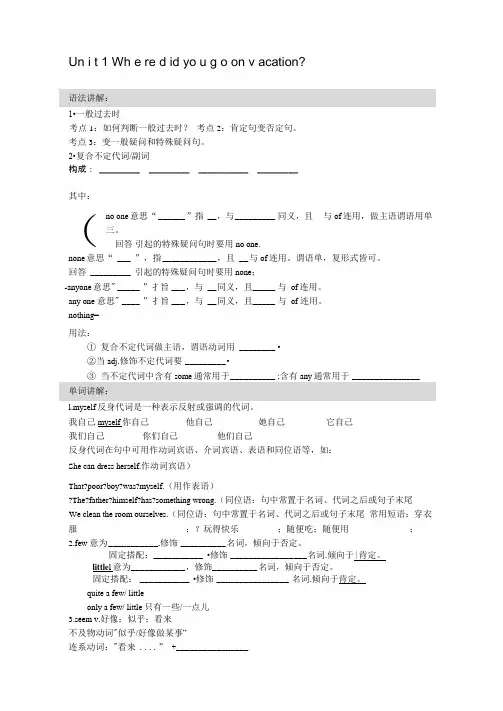
Un i t 1 Wh e re d id yo u g o on v acation?1•一般过去时考点1:如何判断一般过去时?考点2:肯定句变否定句。
考点3:变一般疑问和特殊疑问句。
2•复合不定代词/副词构成: _________ _________ ___________ _________其中:(no one意思“______ ”指 __ ,与_________ 同义,且与of连用,做主语谓语用单三。
回答引起的特殊疑问句时要用no one.none意思“ ___ ”,指____________ ,且 __ 与of连用。
谓语单,复形式皆可。
回答 _________ 引起的特殊疑问句时要用none;-anyone意思" _____ ”扌旨___ ,与 __ 同义,且_____ 与of连用。
_any one 意思" ____ ”扌旨___ ,与 __ 同义,且_____ 与of 连用。
nothing= _________________用法:① 复合不定代词做主语,谓语动词用 ________ •②当adj.修饰不定代词要_________ •③ 当不定代词中含有some通常用于__________ ;含有any通常用于_______________我自己myself你自己他自己她自己它自己我们自己你们自己他们自己反身代词在句中可用作动词宾语、介词宾语、表语和同位语等,如:She can dress herself.作动词宾语)That?poor?boy?was?myself.(用作表语)Thefatherhimselfhassomething wrong.(同位语:句中常置于名词、代词之后或句子末尾We clean the room ourselves.(同位语:句中常置于名词、代词之后或句子末尾常用短语:穿衣服;?玩得快乐;随便吃;随便用;2.few 意为___________,修饰__________ 名词,倾向于否定。
八年级人教版英语上册Unit1知识点课件

remember doing sth(记得做过某事)
(3) begin/ start to do/ doing 开始做...
eg:He began/ started to learn to play chess
when he was a child.
(4) stop to do sth. 停下来正在做的去做另一件 事
2)不可n: 惊讶,惊叹
eg:I am listening to his story with wonder. (3)wonderful 精彩的a wonderful game/ program.
8.enjoyable adj.有乐趣的,令人愉快的 (1)enjoy + 后缀able(comfortable) (2)enjoy doing sth 喜欢做某事 (3)enjoy oneself=have fun=have a good
eg:He is waiting for his father to go shopping.
(3)can't wait to do sth迫不及待做某事( can't help doing sth情不自禁做某事)
(4)wait moment/second/minute 稍等 11.(1) different adj.不同的 be different from 和..不同 the same as与...相同
1.三个到达 (1) arrive at =小地点 arrive at the station
arrive in +大地点 arrive in America (2) get to 到达 get to my home(如果后是形 物+地点副词,不省介词) (3)reach +地点 (4) 地点副词 home/ here/ there 前省略介词 arrive/ get/ reach home/ here/ there
人教版英语八年级上第一单元Unit1Wheredidyougoonvacation知识点梳理

人教版英语八年级上第一单元Unit1Wheredidyougoonvacation知识点梳理Unit 1 Where did you go on vacation?知识梳理一、词型转换Section A1.wonder →(adj.) wonderful2.I →(反身代词) myself3.you →(反身代词) yourself4.yourself →(pl.) yourselves5.seem →(pt.) seemedSection B1.activity →(pl.) activities2.decide →(n.) decision3.try →(pt.) tried4.bike →(同义词) bicycle5.build →(n.) building6.difference →(adj.) different7.like →(反义词) dislike8.below →(反义词) above二、短语归纳Section A1.go to Central Park 去中央公园2.on vacation 在度假3.buy something special 买特别的东西4.meet someone interesing 遇见有趣的人5.go out with someone 和某人一起出去6.take quite a few photos 拍相当多的照片7.most of the time 大多数时间8.go shopping 去购物9.keep a diary 记日记10.of course 当然;自然Section B1.have a good time 玩得高兴;过得愉快2.go to the beach 去海滩3.feel like 感觉像4.the houses of the Chinese traders 中国商人的房子5. a lot of new buildings 许多新的建筑物6.in the past 在过去7.over an hour 一个多小时8.too many people 太多的人9.get to the top 到达顶部10.because of the bad weather 因为不好的天气11.one bowl of fish 一碗鱼肉12.another two hours 另外两个小时13.the top of the hill 山顶14.learn something important 学习重要的东西Self Check1.go to the countryside 去乡下2.in the shopping center 在购物中心3.have a fun time 玩得高兴;过得愉快4.after three hours 三个小时以后5.keep going 一直走6.twenty minutes later 20分钟后重点句子1.Where did you go on vacation?你去哪儿度假的?2.Long time no see.好久不见。
八年级上册人教版英语unit1知识点

八年级上册人教版英语unit1知识点在八年级上册的人教版英语中,unit1主要涉及到课文内容的学习,以下是本单元的知识点详解。
一、课文概述本单元的课文名为“My name’s Gina”,是一篇自我介绍性质的文章,主人公Gina通过这篇文章向大家介绍了自己以及她的家庭、朋友等方面的情况。
同时,这篇课文也涵盖了一些常用的英语句型及单词,适合初学者学习。
二、词汇学习1. 名词article(文章)、class(课程)、photo(照片)、desk(书桌)、city(城市)、country(国家)、place(地方)、restaurant (餐厅)、friend(朋友)、parent(家长)、brother(兄弟)、sister(姐妹)、name(名字)、age(年龄)等。
2. 动词be(是)、study(学习)、live(生活)、come(来)、have (有)、like(喜欢)、think(想)、watch(观看)、seem(似乎)等。
3. 形容词和副词good(好的)、interesting(有趣的)、funny(有趣的)、friendly(友好的)、happy(快乐的)、sad(难过的)、different (不同的)等。
三、语法学习1. 一般现在时的用法一般现在时是英语中最基础也是最常用的时态,表示经常发生的事情、某种状态以及一些习惯性的动作等。
例如:- I live in Beijing.(我住在北京。
)- He often goes to the library.(他经常去图书馆。
)- She likes playing basketball.(她喜欢打篮球。
)2. be动词的用法be动词是英语中最常用的动词之一,它表示“是”或“存在”的意思。
在一般现在时中,be动词有三种形式,分别是am、is和are,根据主语的不同而变化。
例如:- I am a student.(我是一个学生。
)- She is from Shanghai.(她来自上海。
Unit1 sectionA 知识点讲解 人教版英语八年级上册
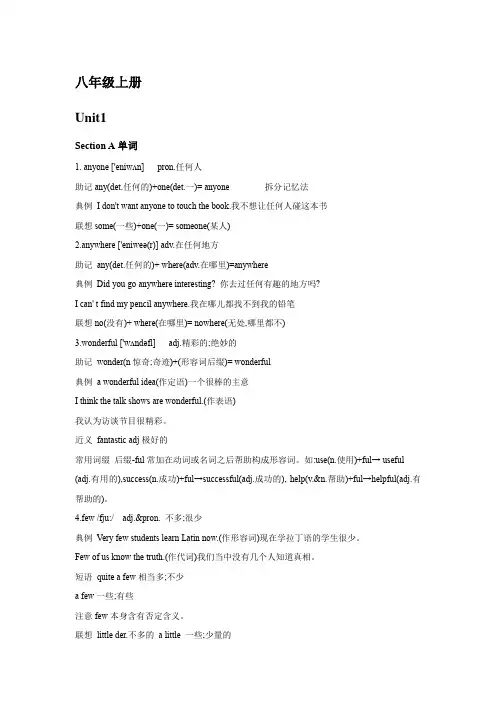
八年级上册Unit1Section A单词1. anyone ['eniwʌn] pron.任何人助记any(det.任何的)+one(det.一)= anyone 拆分记忆法典例I don't want anyone to touch the book.我不想让任何人碰这本书联想some(一些)+one(一)= someone(某人)2.anywhere ['eniweə(r)] adv.在任何地方助记any(det.任何的)+ where(adv.在哪里)=anywhere典例Did you go anywhere interesting? 你去过任何有趣的地方吗?I can' t find my pencil anywhere.我在哪儿都找不到我的铅笔联想no(没有)+ where(在哪里)= nowhere(无处,哪里都不)3.wonderful ['wʌndəfl] adj.精彩的;绝妙的助记wonder(n惊奇;奇迹)+(形容词后缀)= wonderful典例a wonderful idea(作定语)一个很棒的主意I think the talk shows are wonderful.(作表语)我认为访谈节目很精彩。
近义fantastic adj极好的常用词缀后缀-ful常加在动词或名词之后帮助构成形容词。
如:use(n.使用)+ful→ useful (adj.有用的),success(n.成功)+ful→successful(adj.成功的), help(v.&n.帮助)+ful→helpful(adj.有帮助的)。
4.few /fju:/ adj.&pron. 不多;很少典例Very few students learn Latin now.(作形容词)现在学拉丁语的学生很少。
Few of us know the truth.(作代词)我们当中没有几个人知道真相。
人教版八年级上英语人一单元重点知识点整理
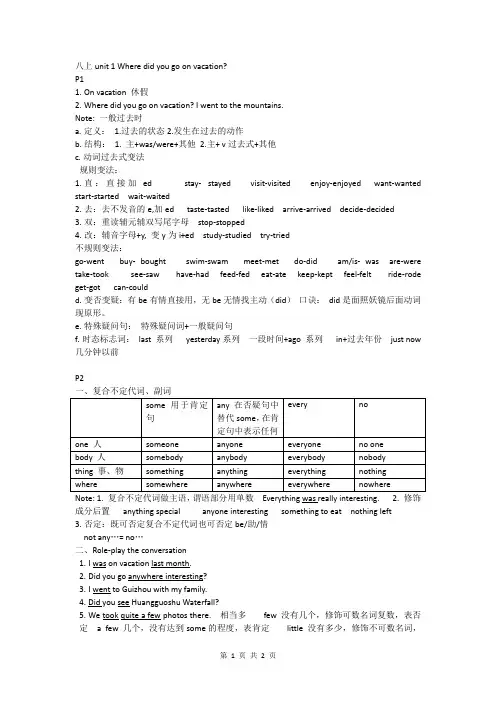
八上unit 1 Where did you go on vacation?P11.On vacation 休假2.Where did you go on vacation? I went to the mountains.Note: 一般过去时a.定义:1.过去的状态2.发生在过去的动作b.结构:1. 主+was/were+其他2.主+ v过去式+其他c.动词过去式变法规则变法:1.直:直接加ed stay-stayed visit-visited enjoy-enjoyed want-wanted start-started wait-waited2.去:去不发音的e,加ed taste-tasted like-liked arrive-arrived decide-decided3.双:重读辅元辅双写尾字母stop-stopped4.改:辅音字母+y, 变y为i+ed study-studied try-tried不规则变法:go-went buy-bought swim-swam meet-met do-did am/is-was are-were take-took see-saw have-had feed-fed eat-ate keep-kept feel-felt ride-rode get-got can-couldd.变否变疑:有be有情直接用,无be无情找主动(did)口诀:did是面照妖镜后面动词现原形。
e.特殊疑问句:特殊疑问词+一般疑问句f.时态标志词:last 系列yesterday系列一段时间+ago 系列in+过去年份just now 几分钟以前P2一、复合不定代词、副词Everything was really interesting.成分后置anything special anyone interesting something to eat nothing left3.否定:既可否定复合不定代词也可否定be/助/情not any…= no…二、Role-play the conversation1.I was on vacation last month.2.Did you go anywhere interesting?3.I went to Guizhou with my family.4.Did you see Huangguoshu Waterfall?5.We took quite a few photos there. 相当多few 没有几个,修饰可数名词复数,表否定 a few 几个,没有达到some的程度,表肯定little 没有多少,修饰不可数名词,表否定 a little 一点,表肯定口诀:有a则有,无a则无quite 相当P51.到达: arrive in +大地点arrive at+小地点reach+地点get to2.决定做某事:decide to do sth3.try doing : 尝试做某事,事情通常不难4.feel like 感觉像5.for lunch 午餐6.enjoy doing 喜欢,享受做某事7.walk up to the top 向上走到山顶8.start doing=start to do 开始做某事begin doing=begin to do9.because 连词+句子有because不用so,有so 不用because. because of+n. 短语of 是介词10.enough money 最够多的钱enough修饰名词位于名词前,修饰形容词副词位于形容词副词之后good enough, fast enough11.The food tasted great. taste 尝起来感官动词作系动词,后接表语。
Unit1语法课件人教版英语八年级上册
1.规则动词过去式的变化
规则
一般在词尾加 -ed 以 e 结尾的加 -d 以“辅音字母+y”结尾的, 先变“y”为“i”再加 -ed
重读闭音节词词尾只有一个 辅音字母时,先双写这个辅
音字母,再加 -ed
示例 help→helped, play→played
live→lived, hope→hoped carry→carried, study→studied
代 指物(以-
词 thing结尾)
Is there anyone in the room?
I can’t see anything in the dark room.
复合不定代词与形容词连用时, 形容词必须放在复合不定代词之后,
语法上称作“后置”。如something important—— 重要的事
3. Everything was excellent.一切都很棒。 考点3 复合不定代词作主语
否定句
主语+was/were+not+其 主语+didn’t +行为动词(原形)+其
他
他
一般疑问句 Was/Were+主语+其他? Did+主语+行为动词(原形)+其他?
特殊疑问句 特殊疑问词+was/were+ 特殊疑问词+did+主语+行为动词
主语+其他?
(原形)+其他?
I bought a book for my father.
Find out the compound indefinite pronouns
Where did you go on vacation? I went to New York City.
Unit1单词讲解课件人教版英语八年级上册
I teach myself English. She teaches herself English. He teaches himself English.
by oneself 靠某人自己/ 独自
• I finished the work by myself. • She often sits by herself and reads.
•去任何有趣的地方 go anywhere interesting •去某个安静的地方 go somewhere quiet
注意:当形容词修饰不定副词时,形容词 要放在其后面。
• 1. wonderful adj.精彩的;绝妙的 We had a wonderful time last night.
总结: 复合不定代词表示单数概念, 作主语时,谓语动词用单数形式。
含有some的复合不定代词的用法:
• 1. 用于肯定句 There is someone outside the door.
• 2. 用于表示请求、建议等的疑问句中或问 话者希望 得到肯定回答时 Would you like something to drink ?
bored adj. 厌倦的;烦闷的
• get bored = be bored 感到烦闷的/感到厌倦的 • I was / got bored of the job. • She was / got bored with her friend. • 易混淆词:boring • What a boring afternoon! • How bored I am!
(谓语同名are词保持一致) adv. I like it most.
Unit1单词讲解课件人教版英语八年级上册
7
5. most
①pron. 大多数 指代可数名词或不可数名词,常与of连用。 若most of后接复数名词作主语,谓语动词用复数形式;若接单数 名词或不可数名词作主语,谓语动词用单数形式。 e.g. Most of my friends/them like pop music. 大部分的我的朋友
e.g. I wonder who he is. 4. quite a few 相当多;不少 = many 修饰可数名词复数
e.g. Quite a few students took part in the sports meeting (which is)
held in our school. * quite a little 相当多;不少 = much 修饰不可数名词
4
2. anywhere
①adv. 复合不定副词
A. 常用于疑问句和否定句中,意为“在某处,到某处”,代替
somewhere。
e.g. Did you go anywhere interesting during your summer vacation?
I cannot find my pen anywhere. = I can find my pen nowhere.
It's lucky we booked a room; otherwise we will have nowhere to
stay now/will not have anywhere to stay.
3. wonderful adj. 精彩的;绝妙的
wonder (n. 惊叹;惊奇) + -ful (形容词后缀)
人教版八年级英语上unit1-2复习课件
although conj. mind n. together adv. die v. dentist n. magazine n. however adv. almost adv. none pron. less adv.& adj.& pron. point n.
返回
1.多久一次 2.帮助做家务 3.买东西 二、4.在周末 重 5.几乎从不 6.每周一次 点 7.每周三次 词 8.每月两次 组 9.一周几次 10.不得不,必须 11.去看电影 12.每天 13.用互联网 14.有空
the Internet. She is very healthy. She exercises three or four times a week. She likes playing basketball,playing soccer, and running. She walks to school every day. She has good eating habits, too. She eats lots of vegetables and fruit every day.
书面表达
假如你最好的朋友Mary,她的各方面习惯都很好。请 从以下几个方面向大家介绍一下她的生活习惯: 1.在学校很努力,经常在家看书,有时上网。 2.身体很健康,每周锻炼三四次,每天步行上学。 3.饮食习惯很好,每天吃很多蔬菜和水果。
英语·新课标(RJ)
One possible version: Mary is my best friend. She studies hard at school,and she often reads some books at home. Sometimes she surfs