
牛津译林版英语八下Unit 5《Good manners》(Grammar)ppt课件
18. 埃米太粗心了,离开时没把帽子带走。 Amy is too careless to take her hat with her when she left. = Amy is (very) careless. She didn’t take her hat with her when she left. = Amy is so careless that she didn’t take her hat with her when she left. = Amy is not careful enough to take her hat with her when she left. 19. 彼特太慢了,没能记下所有的要点。 Peter was too slow to write down all the main points.
8. 忙于某事 be busy with sth 忙于干某事 be busy doing sth 9. 你够大了,应该学礼仪了。 You are old enough to learn about manners. = You are so old that you can learn about manners. = You are old. You can learn about manners.
Unit 5 Good manners Grammar
小组合作朗读:
1. 讨论 n. _____ _____ (v.__________) discussion discuss 2. 表达 vt._________ (n. expression _________) express 3. 使得人人大笑 make everyone laugh 4. (她)独自 on her own = by herself= alone 5. 参加讨论 join the discussion 6. 清晰地表述自己 express oneself clearly 7. 所有的要点 all the main points
14.西蒙够礼貌的,能在公共场所排队等侯。
Simon is polite enough to queue in public.
= Simon is very polite. He can queue in public. = Simon is so polite that he can queue in public. 15.埃米够滑稽的,课后能使大家大笑。 Amy is very funny. She can make everyone laugh. =Amy is funny enough to make everyone laugh. =Amy is so funny that she can make everyone laugh.
to be+adj.+ enough + to infinitive
Translate the sentences 1.你等了好长时间而不生气真有足够的耐心。 You are patient enough to wait for a long time without geห้องสมุดไป่ตู้ting angry. 2. 你够大的可以学习有关礼貌的知识了。 You are old enough to learn about manners.
16.英国人很有礼貌,不在公共场所大叫。 British people are too polite to shout loudly in public. = British people are so polite that they don’t shout loudly in public. = British people are very polite. They don’t shout loudly in public. 17. 英国太远了,珍妮不会自己去。 The UK is very far away. Jenny can’t go there on her own. = The UK is too far away for Jenny to go there on her own. = The UK is so far away that Jenny can’t go there on her own.
12.桑迪很细心,能注意到她周围的小变化。 Sandy is careful enough to notice small changes around her. = Sandy is very careful. She can notice small changes around her. = Sandy is so careful that she can notice small changes around her. 13.基蒂很大方,能与他人分享东西。 Kitty is very generous. She can share her things with others. = Kitty is generous enough to share her things with others. = Kitty is so generous that she can share her things with others.
10. 丹尼尔够仁慈的,随时会帮助他的朋友们。 Daniel is kind enough to help his friends any time. =Daniel is very kind. He can help his friends any time. = Daniel is so kind that he can help his friends any time. 11.米莉够耐心的,别人讲话时能认真听。 Millie is patient enough to listen carefully when others speak. = Millie is so patient that she can listen carefully when others speak. = Millie is very patient. She can listen carefully when others speak.
合集下载
牛津译林版英语八年级下学期Unit5 Good manners reading 课件
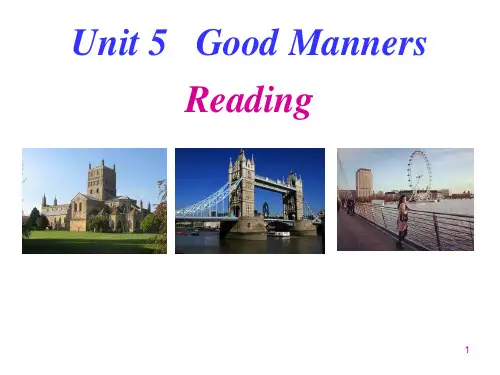
15
How do you find the main idea?
The text is an interview about Manners in the UK.
“When in Rome” ?
16
Discussion
The interview is about Manners in the UK. Why is the title “When in Rome” ?
P66-67
Read quickly and choose.
1. What type of text(文本) is it?
A. A diary.
B. News.
C. An interview. D. A report.
2. What is it about?
A. Manners in Rome.
B. Manners in the UK.
a kiss.
20
Careful-reading
How do they start a conversation?
Read Lines 7-9 How to start a conversation
talk about subjects
avoid subjects
w___e__a_t_h__e__r___ _h__o__li_d__a__y__s__ __m___u__s__i_c____ _b__o__o__k__s_____
….
Daniel: Ok. Thanks, Jenny. Now we’ve learnt more about manners in the UK. I’m sure they‘re helpful to us.
Jenny: I hope so. Just as the saying goes, “When in Rome, do as the Romans do.”
How do you find the main idea?
The text is an interview about Manners in the UK.
“When in Rome” ?
16
Discussion
The interview is about Manners in the UK. Why is the title “When in Rome” ?
P66-67
Read quickly and choose.
1. What type of text(文本) is it?
A. A diary.
B. News.
C. An interview. D. A report.
2. What is it about?
A. Manners in Rome.
B. Manners in the UK.
a kiss.
20
Careful-reading
How do they start a conversation?
Read Lines 7-9 How to start a conversation
talk about subjects
avoid subjects
w___e__a_t_h__e__r___ _h__o__li_d__a__y__s__ __m___u__s__i_c____ _b__o__o__k__s_____
….
Daniel: Ok. Thanks, Jenny. Now we’ve learnt more about manners in the UK. I’m sure they‘re helpful to us.
Jenny: I hope so. Just as the saying goes, “When in Rome, do as the Romans do.”
牛津译林版8B Unit5 Good manners Reading课件(共18张PPT)
Interview Jenny in groups.
1. How do you greet each other? 2. How do we usually start a conversation? 3. Do we always queue? 4. What do we do if someone is in our way?
avoid后常跟v.⁃ing形式,构成avoid doing sth.结构, 意为“避免做某事”。 avoid sth. avoid doing sth. 避免某事 避免做某事
根据汉语意思完成英语句子。 (1) 我们必须认真做作业避免错误。 We must do our homework carefully to avoid mistakes _______________.
touch vt. 触摸, 碰 e.g. You can’t touch that thing. 你不能碰那个东西。 If 引导条件状语从句
4. Do they always queue in public?
5. How do people behave politely in public? 6. Are they polite all the time at home? 7. Do they speak or laugh loud in public?
Language points
5. They think it’s rude to push in before others. cut in It is + adj + (for sb) + to do sth. (对某人来说,)做某事…… push v. 推, 挤 和push相对应的词是pull,可意为“拉,拖, 拔” 。 e.g. Don’t push the door. Pull it, please. 不要推门。请拉开。 push in 插队,加塞 美国人常用“cut in”
牛津译林版英语八下Unit 5《Good manners》(welcome)ppt课件

1.足够大地可以去学礼仪 old enough to learn about manners 与他人分享你的东西 share your things with others 3.打断他人 cut in on others 4.活到老学到老 You’re never too old to learn 5.到处丢垃圾 drop litter everywhere
We shouldn’t… drop litter everywhere eat in the library
write in the books
What does Eddie teach Hobo? First, always share things with others. Second, don’t cut in on others. Always wait politely. What does Eddie really want from Hobo?
Do Match the right the right pictures things in with public thein phrases places Choose the things to do public places
drop litter leave the tap running keep quiet in the everywhere pick flowers in the library obey traffic rules park queue for your turn
2.First, always share your things with others . ________ share 意为“分享、合用”,作及物动词或 不及物动词。作及物动词时结构有:share sth ; share sth. with sb. ; share sth. between sb . shares the ⑴Everyone in the house __________ bathroom。 这房子里的人共用这间浴室。 ⑵They__________ shared the cake . 他们分吃了那个蛋糕。 share with ⑶May I _________the umbrella ________ you ? 我可以和你合用这把伞吗?
牛津译林版8B Unit5 Good manners Comic strips & Welcome to the unit课件(共26张PPT)
Good manners
Comic strips & Welcome to the unit
They are greeting their teachers.
They are standing in a line.
She is picking up the litter.
They are reading books quietly.
Task 6:Homework
1.Recite the dialogues.
2.Search more information about good manners in different countries.
Task 5:Homework.
1.Write a passage of at least 60 words on the topic “To be a student with good manners”. 2. Send your homework to me.My e-mail address is wyl678@
eat write in the books
Make a dialogue
1.Each group can choose one place.
A B C D E
2.Make a dialogue after the model. A:Can we ...in/on/at the...? B:I’m afraid not.We should.... A:Anything else? B:....
Comic strip
Comic strips
Task 1:Answer the question.
Who should learn about manners?
Comic strips & Welcome to the unit
They are greeting their teachers.
They are standing in a line.
She is picking up the litter.
They are reading books quietly.
Task 6:Homework
1.Recite the dialogues.
2.Search more information about good manners in different countries.
Task 5:Homework.
1.Write a passage of at least 60 words on the topic “To be a student with good manners”. 2. Send your homework to me.My e-mail address is wyl678@
eat write in the books
Make a dialogue
1.Each group can choose one place.
A B C D E
2.Make a dialogue after the model. A:Can we ...in/on/at the...? B:I’m afraid not.We should.... A:Anything else? B:....
Comic strip
Comic strips
Task 1:Answer the question.
Who should learn about manners?
牛津译林版八年级英语下册Unit 5 Good manners (Welcome)精品课件(22张)

8B Unit 5 Good manners
Welcome to the unit
A game
If it is right, stand up. If it is wrong,
Is it right or wrong to do so?
right
wrong
Try to use the following expressions: had better (not)…… must / mustn’t should / shouldn’t can / can’t …… Please always …… Don’t …… Never ……
Let’s remember……
Discuss in a low voice.
(good manners)
You can do better than the film stars.
drop litter
spit (吐痰)
jump the queue
step(踩) on the
seat with shoes on
Public places
We must protect the environment.
Good manners or bad manners?
√
You’d better queue for your turn . You should never jump the queue.
Good manners or bad manners?
×
Don’t leave the tap running. We should save water all the time.
Think and write
What other good manners can you share with us?
Welcome to the unit
A game
If it is right, stand up. If it is wrong,
Is it right or wrong to do so?
right
wrong
Try to use the following expressions: had better (not)…… must / mustn’t should / shouldn’t can / can’t …… Please always …… Don’t …… Never ……
Let’s remember……
Discuss in a low voice.
(good manners)
You can do better than the film stars.
drop litter
spit (吐痰)
jump the queue
step(踩) on the
seat with shoes on
Public places
We must protect the environment.
Good manners or bad manners?
√
You’d better queue for your turn . You should never jump the queue.
Good manners or bad manners?
×
Don’t leave the tap running. We should save water all the time.
Think and write
What other good manners can you share with us?
【最新】牛津译林版八年级英语下册Unit5 Good manners Integrated skills 精品课件(共31张PPT)

Public signs
2.What do we often use public signs for ?
● Help explain things and give us useful
information
►Help us find our _w__a_y______ ►Tell us about the _p_l_a_c_e_s__ around us ►Keep us _s_a__fe____ from danger ►Warn us __n_o_t_t_o__d_o___ something
8.禁止乱丢
8.no littering
1.完成导学案习题 2.完成第7课时预习导航
No photos
Where can we see it?
It’s usually seen in places like
parks No littering
Where can we see it?
It’s usually seen in the street
No parking
Task4:Listen and answer
Public signs
Task1 :Presentation and practice(1)
1. Check our preview work. ⑴ 读并默写下列单词。 ① 公开的,公共的 _p_u_b_li_c_ ② 解释e_x_p_la_i_n_ ③警告,告诫 _w_a_r_n__ ④停车 p_a_rk_i_n_g_ ⑤乱丢杂物 _li_tt_e_r __
WWeesshhoouullddnq'tupeusehfoinr bouefrotrueront.hers.
We sWhoeuslhdonu'tldlesaavveetwheatearp. running.
牛津译林版八级英语下册课件:Unit 5 Good manners Integrated skills (共22张PPT)
W__e_s_h_o_u_l_d__k_e_e_p_q_u_iet
_ in the library.
_W__e_s_h_o_u_ld__d_r_o_p_l_it_te_r_ in the bin.
Listen and answer
Shout in the museum
No!
We shouldn’t shout in the museum!
No photos in (2)_p_l_a_c_es__li_k_e_m__u_s_e_u_m__s
No parking in (3)_t_h_e_s_t_r_ee_t__________
No littering in (4)_p_u_b_l_ic_p_l_a_c_es_l_ik_e__p_ar_k_s
Where can we see these public signs?
hospitals parks schools hills museums streets
Sign Meaning
Usually seen
No smoking in (1)_p_l_a_c_e_s_l_ik_e__h_o_s_p_it_a_ls_
Here are some examples:
_N__o__l_i_t_t_e_r_i_n__g__ _N__o__s_m__o__k_i_n_g__
_N__o__p__h_o__t_o_s___ _N__o__p_a__r_k_i_n__g__
Pair work
A: What does this sign mean? B: It means …. A: What does it tell us to do/not to do? B: It tells us (not) to …. A: Where can we usually see it? B: We can see it ….
牛津译林版八年级英语下册Unit 5 Good manners (Welcome)精品课件(22张)
谢谢观赏
You made my day!
我们,还在路上……
不习惯读书进修的人,常会自满于现状,觉得再没有什么事情需要学习,于是他们不进则退。经验丰富的人读书用两只眼睛,一只眼睛看到纸面上的话,另 一眼睛看到纸的背面。2022年3月30日星期三2022/3/302022/3/302022/3/30 书籍是屹立在时间的汪洋大海中的灯塔。2022年3月2022/3/302022/3/302022/3/303/30/2022 正确的略读可使人用很少的时间接触大量的文献,并挑选出有意义的部分。2022/3/302022/3/30March 30, 2022 书籍是屹立在时间的汪洋大海中的灯塔。
Good manners or bad manners?
×
We can’t pick flowers in the park . We need to protect plants.
Good manners or bad manners?
√
Always keep quiet in the library. We shouldn’t make any noise in it.
Need 3 turns
Try to use the following expressions: had better (not)…… must / mustn’t should / shouldn’t can / can’t …… Please always …… Don’t …… Never ……
Write down as many as you can.
Discuss in a low voice.
(good manners)
You can do better than the film stars.
You made my day!
我们,还在路上……
不习惯读书进修的人,常会自满于现状,觉得再没有什么事情需要学习,于是他们不进则退。经验丰富的人读书用两只眼睛,一只眼睛看到纸面上的话,另 一眼睛看到纸的背面。2022年3月30日星期三2022/3/302022/3/302022/3/30 书籍是屹立在时间的汪洋大海中的灯塔。2022年3月2022/3/302022/3/302022/3/303/30/2022 正确的略读可使人用很少的时间接触大量的文献,并挑选出有意义的部分。2022/3/302022/3/30March 30, 2022 书籍是屹立在时间的汪洋大海中的灯塔。
Good manners or bad manners?
×
We can’t pick flowers in the park . We need to protect plants.
Good manners or bad manners?
√
Always keep quiet in the library. We shouldn’t make any noise in it.
Need 3 turns
Try to use the following expressions: had better (not)…… must / mustn’t should / shouldn’t can / can’t …… Please always …… Don’t …… Never ……
Write down as many as you can.
Discuss in a low voice.
(good manners)
You can do better than the film stars.
牛津译林版英语八下Unit 5《Good manners》(reading 1)ppt课件
say “sorry” or “thanks”
drink or eat in the class listen to the teachers carefully push in before others keep your voice down in shout or laugh loudly in public public put the books back after reading
Finish B2 on Page 68
Choose T or F
T 1. People say “hello” or “nice to meet you” when meeting for the
first time.
F 2. They usually greet others with a kiss.
2.Are people polite at home? Why?
Yes. They say “please” or “thank you” all the time.
Choose T or F
T 1. People say “hello” or “nice to meet you” when meeting for the
Start a conversation
talk about the oks…
avoid talking about age, weight or money
be in public
queue for one’s turn never push in before others
Unit 5 Good manners
Reading 1
Boys
PK
Girls
Tell me the good manners or the bad manners you’ve known
牛津译林版八年级英语下册《Unit5 Good manners》课件(2) (2)
2. We form the simple past tense by adding ‘-ed ’ to regular verbs.
提示:一般过去时常与表示过去的 时间状语连,如:yesterday, last night, a month ago, yesterday afternoon, last week, ten years ago
ago adv. 以前 the day before 前天
yesterday centimetre n. (=cm) <英>厘米,公分
<美>centimeter dodo n. 渡渡鸟
一、什么情况下使用一般过去时?
1. We use the simple past tense to talk about things in the past.
四、谓语动词为实义动词的一般过 去时的句子结构
1) 肯定句 主语+谓语动词过去式…… He heard a whisper. They went to the park again last Sunday.
2) 否定句 主语 + didn’t +谓语动原形 …… I didn’t go to the park yesterday
look looked
1. 一般在动词原形 play played
末尾加-ed
start started
2. 结尾是e的动词 加-d
live lived hope hoped use used
规则动词过去式的构成
构成规则
例词
3. 末尾只有一个辅音 字母的重读闭音节
词, 先双写这个辅 音字母, 再加-ed
Finish Part B on page 62.