
牛津译林版英语八下Unit 5《Good manners》(reading 1)ppt课件
say “sorry” or “thanks”
drink or eat in the class listen to the teachers carefully push in before others keep your voice down in shout or laugh loudly in public public put the books back after reading
Finish B2 on Page 68
Choose T or F
T 1. People say “hello” or “nice to meet you” when meeting for the
first time.
F 2. They usually greet others with a kiss.
2.Are people polite at home? Why?
Yes. They say “please” or “thank you” all the time.
Choose T or F
T 1. People say “hello” or “nice to meet you” when meeting for the
Start a conversation
talk about the oks…
avoid talking about age, weight or money
be in public
queue for one’s turn never push in before others
Unit 5 Good manners
Reading 1
Boys
PK
Girls
Tell me the good manners or the bad manners you’ve known
Good manners
obey traffic rules keep quiet in the library queue for your turn
Skimming
1.How do people behave politely in public?
They queue.
They don’t push in before others.
They say “sorry” when bumping into someone
They say “ excuse me” when they are in others’ way and wait until others move They keep their voice down,
No, they only greet relatives or close friends with a kiss
3.How do people start a conversation? They talk about the weather, holidays, music, books or something else. 4.Do they talk about age, weight or money? No, they always avoid subjects like age, weight or money
Skimming
What is this conversation about? Good manners in the UK.
Scanning 1.How do people greet others for the first time? They say “hello” or “nice to meet you” and shake hands. 2.Do they greet people with a kiss?
F 3. They start a conversation with talking about age, weight .
F 4. They don’t queue for anything.
T 5. They say “sorry” if they bump into others.
cut in
In one’s way
Not push past you
Say “excuse me” Wait until you move never shout or laugh loudly
be at home
be polite as well too say “please” or “thank you” all the time
Bad manners
drop litter everywhere leave the tap running pick flowers in the park cut in on others write in the books
share things with others
keep clean in the park
T 5. They say “sorry” if they bump into others.
T 6.They never shout or laugh loudly in public. F 7. They sometimes say “please” or “thank you” at home.
the proper way to greet people when meeting for the first time
right
say “hello” or “nice to meet you” Shake your hand greet relatives or close friends with a kiss
first time.
F 2. They usually greet others with a kiss.
F 3. They start a conversation with talking about age, weight .
F 4. They don’t queue for something.
八年级英语下册 Unit 5 Good manners Reading I 牛津版
Do they greeTtoppeiocp1le(wLiintehsa1k-9is)s?
Lines 5-6
How do they start a conversation?
Lines 7-9
Do people theTroepbiceh2a(vLeinpeosl1it0e-l1y7in) public? Lines 10-13
They talk about the weather, holidays, music, books or something else.
Read Lines 10-17, and answer the questions.
1. How do British people behave in public ? They behave politely in public.
Task 2: Scanning
Read lines 18-22 and choose the right answer.
too
British people are polite at home as well.They say _____ all the time.
(A) please
(B) ok
Anything else?
Lines 14-17
British people are very polite at home as well, aren’t
they?
Topic 3 (Lines 18-22)
Lines 18-19
Any other tips for us if we are going to the UK?
An interview with Jenny, who has recently visited the UK.
牛津译林版八年级英语(下)教案 Unit 5 Good manners Reading 2 教案

徐州市教学改革实验学校教师备课设计页课题8下Unit 5 Good manners Reading 2 课型Reading教具Recorder and multimedia 总课时数40 完成时间4.21教学方法Task-based approach,Scene pedagogy andTeaching with humor主备人Zhang Xizhi授课时间4.29教学目标知识与能力:1To grasp the expression about the text.2 To train the Ss’ comprehension ability3 To learn some language points过程与方法:1.to listen to the reading the answer some questions.2.to get the Ss to talk about the manners in UK without books.情感态度与价值观:To develop the Ss’good manners in different countries.教学重点难点1.To grasp the expressionabout the text.2. To train the Ss’comprehension ability3. To learn some languagepoints教学活动内容活动组织过程改笔【前置学习】1、回顾复习:1.如果有人挡住了我们的路,我们该怎么办?2.在公共场所要尽量压低声音。
3.在英国和别人打招呼的合适方式是什么?2、自学教材P66-67知识点和难点3、自学检测:Dictation【自主探究】Step1 Revision1 How do British people greet each other?/…?2 Create new situations and make students say something more about customs in the UK.Mini-dictionaryavoid(1ine 9) vt.stay clear from;keep away from (避免)Please avoid talking about her age.conversation(1ine 7) n.an informal talk (<非正式>交谈,谈话)You can start the conversation first.loudly (line 22) adv.with relatively high volume (大声地)This lady never talked loudly in public.proper (1ine 2) adj.socially and normally acceptable;right.appropriate or correct (符合习俗的;正确的)She is always proper in her behaviour.public (1ine 10) n. ordinary people in society in general (民众,群体)The palace is now open to the public.saying (1ine 25) n. a well-known phrase or statement (成语, 谚语) To translate the sentencesmake students say somethingmore about customs in theUKCheck out thehomework and thepreview.To go over theexpressions in theconversation.To talk about themanners in UK,then inMy grandpa knows a lot of English sayings.subject (line 9) n. a thing or person that is being discussed or described (话题;主题) This book includes many different subjects.touch (line15) vt. put your hand or another pan of yore body onto sb/sth (触摸、碰) You cannot touch that thing·as well, in one’s way, in public, push in, shake sb’s hand(1) My classmates love music. I love it ________________. (as well)(2) It is impolite to _________________before others. (push in)(3) We should not speak loudly_____________. ( in public )(4) Chinese people usually ______________when they meet you for the first time.(shake your hand)(5) Please do not stand___________________ . I am in a hurry. (in my way)Step2. Practice1 Think and discuss about the customs in China, and make students finish the exercise ofPart C on P 69 We’ve learnt about the good manners In the UK。
牛津译林版英语八下U5 Reading 1 a (共28张PPT)
have afternoon tea
['prɒpə]
stir (搅拌) it in a proper way
√
A. right
B. wrong
Daniel is hosting the school radio show this week. He is interviewing a Grade 9 student, who has recently visited the UK.
______________
______________
avoid subjects
______________
weather
______________
holidays
age
music books ______________ something ______________else
______________
( Lines 10--22)
At home:
Good manners say “please” and “thank you” all the time _____
queue
push in
sorry
excuse me voice down At home touch shout push laugh
“please” or “thank you”
( Lines 23--26)
When in Rome,do as the Romans do. ( do as the local people do )
入乡随俗
Post-reading
British people usually say “hello” or shake your hand “nice to meet you ” and _____ _____ _____(1) when they meet you for the first time. They only greet _______ (2) or close relatives friends with a kiss.They conversation like to start a ___________ (3) with subjects like the weather, holidays, music or books. They avoid _____(4) talking about age, weight or money.
牛津译林初中八年级下册英语 Unit 5 Good manners Reading II课件

根据汉语意思完成英语句子。 (1) 我们必须认真做作业避免错误。
We must do our homework carefully to _a_v_o_id__m__is_t_a_k_e_s __. (2) 王先生设法避免让他的经理生气。 Mr Wang tried to _a_v_o_id__m__a_k_in_g__ his manager angry.
What’s the proper way to greet people in the UK?
How do people start a conversation in the UK? Do they behave politely in public?
British people are very polite at home as well, aren’t they?
the proper way to greet people 2. 握某人的手 shake sb’s hand 3. 第一次见到你
meet you for the first time 4. 以亲吻的方式跟人打招呼
greet people with a kiss
5. 在公共场合举止文明
behave politely in public 6. 撞到某人 bump into someone 7. 挡住某人的路 in one’s way 8. 一直 all the time 9. 保持低声调 keep your voice down 10. 正如那句谚语所说
e.g. Mary explained why she was late, but we didn’t accept her excuse. 玛丽解释了为什么他迟到了,但是 我们没有接受她的借口。
译林版八年级英语下册Unit5 Good manners-Reading 练习
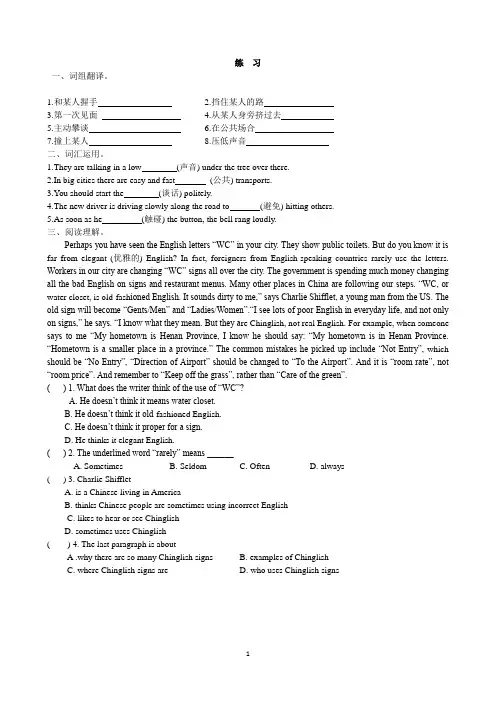
一、词组翻译。
1.和某人握手2.挡住某人的路3.第一次见面4.从某人身旁挤过去5.主动攀谈6.在公共场合7.撞上某人8.压低声音二、词汇运用。
1.They are talking in a low (声音) under the tree over there.2.In big cities there are easy and fast (公共) transports.3.You should start the (谈话) politely.4.The new driver is driving slowly along the road to (避免) hitting others.5.As soon as he (触碰) the button, the bell rang loudly.三、阅读理解。
Perhaps you have seen the English letters “WC” in your city. They show public toilets. But do you know it is far from elegant (优雅的) English? In fact, foreigners from English-speaking countries rarely use the letters. Workers in our city are changing “WC” signs all over the city. The government is spending much money changing all the bad English on signs and restaurant menus. Many other places in China are following our steps. “WC, or water closet, is old-fash ioned English. It sounds dirty to me,” says Charlie Shifflet, a young man from the US. The old sign will become “Gents/Men” and “Ladies/Women”.“I see lots of poor English in everyday life, and not only on signs,” he says. “I know what they mean. But they a re Chinglish, not real English. For example, when someone says to me “My hometown is Henan Province, I know he should say: “My hometown is in Henan Province. “Hometown is a smaller place in a province.” The common mistakes he picked up include “Not Entry”, which should be “No Entry”, “Direction of Airport” should be changed to “To the Airport”. And it is “room rate”, not “room price”. And remember to “Keep off the grass”, rather than “Care of the green”.( ) 1. What does the writer think of the use of “WC”?A. He doesn’t think it means water closet.B. He doesn’t think it old-fashioned English.C. He doesn’t think it proper for a sign.D. He thinks it elegant English.( ) 2. The underlined word “rarely” means ______A. SometimesB. SeldomC. OftenD. always( ) 3. Charlie Shifflet ______A. is a Chinese living in AmericaB. thinks Chinese people are sometimes using incorrect EnglishC. likes to hear or see ChinglishD. sometimes uses Chinglish( ) 4. The last paragraph is about_______A .why there are so many Chinglish signs B. examples of ChinglishC. where Chinglish signs areD. who uses Chinglish signs一、词组翻译1. Shake one’s hand2. In one’s way3.meet for the fir st time4.push past sb.5.start a conversation6.in public7. bump into sb.8.keep one’s voice down二、完成单词1. voice2.public3.conversation4.avoid5.bumpped三.阅读理解C B B B。
牛津译林版八年级英语下册 Unit 5 Good manners Reading课件
British people think it is rude to (5) _p_u_s_h_i_n___
before others. They always (6) _q_u_e_u_e_. They say “sorry” if they (7) b__u_m_p__i_n_to__ you in the street. When they want you to (8) _m__o_v_e_, they say “excuse me”. They do not like to shout or laugh
someone
say
“excuse me”
if
someone is in their way.
keep the voice down
age, weight or
talk about money
push in
before others
touch or push past. shout or laugh loudly
welcome them
Enjoy the video and know something about manners in the UK.
Read the title quickly and then answer the questions.
1 What are they talking about?
In public: queue for something push in before others say “sorry” if they bump into others push past people shout or laugh loudly
At home: say “please” and “thank you” all the time
牛津译林版8B unit 5 reading课件 (共26张PPT)
Jenny. 1. Who is Daniel talking to?
Good manners in the UK. 2. What is the conversation about?
Topic 1
nes1--6
How to greet people How to start a conversation
have a conversation
[' kɒnvə'seɪʃ(ə)n]
a small talk
[ə'vɒɪd]
avoid talking about the age…
try not to do something
behave politely in public
queue for one‟s turn
Match the words with the meanings
a. a small talk b. try not to do 1. proper ____ e something 2. greet ____ f c. go in front of other a 3. conversation ____ people who are waiting 4. avoid ____ b d. hit someone or 5. push in ____ c something by accident e. right or correct 6. bump ____ d f. say hello to someone or welcome them
When we are in a strange place, we should do as the local people do.
If you meet… for the first time, how will you greet …/ start your conversation?
牛津译林版8B Unit5 Good manners Reading课件(共15张PPT)
English people behave properly in public as ________ ________ ________ they do at well as home
When you want to start a conversation with an Englishman, try not to talk about subjects like money or age. When you want to start a conversation with an avoid _______ talking about subjects like Englishman , _______ money or age.
Check the answers
Dear Ann: Welcome to our school! I have heard you don‟t know how to behave politely ______(polite) in China, I am going to give you some advice. First, when we meet our teachers, the roper way to greet them is to bow and say p_______ Shaking (shake) hello to them with a smile. _______ hands is not a usual way to greet our onversation classmates. If you want to start a c________ void with them, you should a________ talking about unhappy things.
牛津译林版初中英语八年级下册Unit5重点单词、短语、句型、电子书汇总
牛津译林版初中英语八年级下册Unit5重点单词、短语、句型、电子书汇总8B Unit5 Good manners【词汇拓展】1. polite adj. → politely(adv.)2. proper adj. → properly(adv.)3. loud adj. → loudly (adv.)4. say v. →saying (n.) 谚语5. discuss v. →discussion (n.)6. park v. →parking (n.) 停车7. polite adj. →impolite (反义词)8. warn v. → warning (n.)【重点短语】1. cut in on sb/sth 打断(谈话),插嘴2. drop litter everywhere 到处扔垃圾3. keep quiet 保持安静4 leave the tap running 使水龙头一直流着5. pick flowers 摘花6. obey traffic rules 遵守交通规则7. invite sb to do sth 邀请某人做某事8. keep the library clean 保持图书馆干净9. the proper way to do sth 做某事的恰当方式10. say hello to sb 向某人问好11. for the first time 第一次12. talk about 谈论13. in public 在公共场合14. laugh loudly 大声地笑15. by accident 偶然地,意外地16. greet each other 互相问候17. any time 任何时候;随时18. on one's own 单独19. join the discussion 加入到讨论中20. express oneself clearly 清楚地表达自己21. write down 写下,记下22. be busy with/doing sth 忙于(做)某事23. warn sb of sth 警告某人某事24. keep sb away from danger 使某人远离危险25. no smoking 禁止吸烟26. soon after 不久以后27. in order to 为了28.make one's dream e true 使某人的梦想成为现实29. practise doing sth 练习做某事30. the purpose of ……的目的31.above all 首要的是32. in one's way挡住某人的路【重点句子】1.霍波,你已经够大了,所以你应该学点礼貌。
初中英语牛津译林版八年级下 Unit5 Reading1:WheninRome(共21张PPT)
1. shake your hand 3.conversation 5.push in 7. bump into 9.in public 11.all the time
2. relatives 4. avoid 6.queue 8.move 10. polite 12.the Romans
Further thinking what should we do if we go to a new place?
behave vt. & vi. 表现 public n. 民众,群体 in public 公开地,在别人面前 push vi. & vt. 推,挤 push in <英> 插队,加塞
=<美> cut in bump vi. & vt. 撞,碰 in one’s way 挡住某人的路 touch vt. 触摸,碰
excuse vt. 原谅,宽恕 excuse me 劳驾 till conj. 到…...时,直到...…为止 as well (as) 也,还有 loudly adv. 大声地 as conj. 正如,如同 saying n. 谚语,格言 Roman n. 罗马人 by accident 偶然,意外地
I'm trying to find out if you've remembered what Jenney talked about on the radio.
I need 11 volunteers to come to the front and choose a note,then read your note and say
• 3.Asking for helpp_o_l_it_e__ly(礼貌地)is very important. • 4. He can find a_p_r_o_p_e__r_(正确的)way to solve the problem. • 5. You should _a__v_o_i_d_ (避免 ) making mistakes in your