
仁爱版英语八年级下册unit6topic2
Unit 6 Enjoying Cycling Topic 2 How about exploring Tian’anmen Square?
(考试时间:90分钟,满分:100分)
第一部分第二部分第三部分总分题号
ⅠⅡⅢⅣⅠⅡⅢⅣⅠⅡⅢ
得分
第一部分听力(20分)
Ⅰ. 听句子,选择正确答语。
每个句子读一遍。
(5分)
( )1. A. That’s OK. B. Don’t worry. C. No, thanks.
( )2. A. Yes, I know Helen.
B. Yes, this is Helen speaking.
C. Yes, I’m here.
( )3. A. No, they’re too busy.
B. Yes, they should.
C. No, they won’t.
( )4. A. You bet! B. We have no time. C. Oh, you look very happy.
( )5. A. Yes, of course. B. OK, I’d like to. C. You are right.
Ⅱ. 听对话,选择正确答案。
每段对话读两遍。
(5分)
( )6. Where will Lily live if she goes to Canada for her vacation?
A. In Tony’s house.
B. In a hotel.
C. In Tony’s friend’s house.
( )7. Who is looking forward to meeting the teacher?
A. Mike.
B. Jenny.
C. Jim.
( )8. Why does Bill look happy?
A. He will go to Dalian.
B. He will go to Hangzhou.
C. He will go to Nanjing.
( )9. Where will Betty visit?
A. She will visit the Ming Tombs.
B. She will visit the West Lake.
C. She will visit the Great Wall.
( )10. How will David explore the northeast of China?
A. By bus.
B. By bike.
C. By car.
Ⅲ. 听两段对话,选择正确答案。
每段对话读两遍。
(5分)
听第一段对话,完成第11,12小题。
( )11. How will Nancy go to London?
A. By ship.
B. By train.
C. By air.
( )12. When will Nancy come back?
A. On March 12th.
B. On March 19th.
C. On March 5th.
听第二段对话,完成第13-15小题。
( )13. Who will Jordan visit?。
仁爱版八年级英语下册课件 Unit 6 Topic 2 Section A

Have a match
1.Would you help me make a plan to explore Beijing before he comes?
2. Would you like to come to China for your vacation?
3. How about exploring Tian’anmen Square?
Tonight I am busy with the homework. prapare sth. for sb. 为某人准备某物 prapare for sth.=get ready for sth.为某事做准备 prepare to do sth.=get ready to do sth.准备做某事
Lead in
What are they doing? They are talking on the phone. What are they talking about?
Learning 1a Listen, look and say.
Darren: Hello! This is Darren. I'd like to speak to Michael.
4√
5√
visit the Great Wall
meet their friend
v. to get or accept sth. from sb. 收到
receive a postcard
Learning
1c
Read 1a and number the following sentences. Then try to retell it.
Language points
5. Would you help me make a plan to explore Beijing before he comes? 在他来之前,你能帮我制定一个考察北京的计划吗? 这是一个由连词before引导的时间状语从句。 before“在……之前”,根据具体语境还可意为 “还没来得及/ 还没有……就……;……才……”等。 after“在……之后”表示主句动作发生在从句动作之后。 e.g.昨天我们离开学校的时候,我们打扫了教室。
(完整版)仁爱英语八年级下Unit6topic2测试题及答案
仁爱英语八年级下Unit6 topic2测试题及答案八年级Unit 6 topic 2 测试题(考试时间:90分钟,满分:100分)第一部分听力(20分)Ⅰ. 听句子,选择正确图片。
每个句子读一遍。
(5分)Ⅱ. 听句子,选择正确答语。
每个句子读一遍。
(5分)( )6. A. That’s OK. B. Don’t worry. C. No, thanks.( )7. A. Yes, I know Helen.B. Yes, this is Helen speaking.C. Yes, I’m here.( )8. A. No, they’re too busy.B. Yes, they should.C. No, they won’t.( )9. A. You bet! B. We have no time. C. Oh, you look very happy.( )10. A. Yes, of course. B. Yes, I’d like to. C. Perfect.Ⅲ. 听对话,选择正确答案。
每段对话读一遍。
(5分)( )11. Where will Lily live if she goes to Canada for her vacation?A. In Tony’s house.B. In a hotel.C. In Tony’s friend’s house.( )12. Who is looking forward to meeting the teacher?A. Mike.B. Jenny.C. Jim.( )13. Why does Bill look happy?A. He will go to the moon.B. He will go to Hangzhou.C. He will go to Nanjing.( )14. Where will Betty visit?A. She will visit the Ming Tombs.B. She will visit the West Lake.C. She will visit the Great Wall.( )15. How will David explore the northeast of China?A. By bus.B. By bike.C. By car.Ⅳ. 听短文,选择正确答案。
仁爱版八年级英语下册说课稿:Unit6Topic2SectionD

5.给予学生积极的反馈和鼓励,增强他们的自信心和学习动力。
三、教学方法与手段
(一)教学策略
本节课我将采用以下主要教学方法:任务型教学法、合作学习法和情境教学法。任务型教学法能够将语言学习与实际任务相结合,让学生在完成任务的过程中自然地学习和使用语言,这有助于提高学生的语言实际运用能力。合作学习法鼓励学生分组合作,共同完成任务,这不仅能够促进学生之间的交流,还能够培养学生的团队协作能力。情境教学法通过模拟真实语境,让学生在特定的语言环境中学习和实践,这有助于提高学生的语言理解和表达能力。选择这些方法的理论依据在于,它们都能有效地激发学生的学习兴趣,促进学生的主动参与,从而提高教学效果。
(二)新知讲授
在新知讲授阶段,我将按照以下步骤逐步呈现知识点,引导学生深入理解:首先,通过PPT展示长城的基本信息和相关词汇,让学生对长城有一个初步的认识。然后,我会引导学生阅读课文,通过寻找主题句、划重点词汇等方式,帮助学生理解文章的大意和细节。接着,我会组织学生进行小组讨论,分享各自对文章的理解和感受,以促进更深层次的理解。最后,我会通过讲解和示例,帮助学生掌握阅读策略和技巧,如如何根据上下文猜词义、如何归纳总结等。
(二)学习障碍
在学习本节课之前,学生可能已经具备以下前置知识或技能:基础的英语语法知识,简单的阅读理解能力,以及对中国历史文化的基本了解。然而,学生可能存在的学习障碍包括:
1.对长城历史和文化的了解不深,可能缺乏足够的背景知识。
2.阅读长篇文章时,可能存在理解困难,难以抓住文章的主旨和细节。
3.阅读策略和方法可能不够成熟,需要引导和训练。
(二)媒体资源
我将使用以下教具、多媒体资源或技术工具来辅助教学:PPT演示文稿、长城图片、视频资料和在线互动平台。PPT演示文稿用于呈现课程内容和重点信息,帮助学生在视觉上更好地理解和记忆;长城图片和视频资料能够直观地展示长城的历史风貌,增强学生的学习兴趣和代入感;在线互动平台则为学生提供了一个实时交流的空间,让他们能够更便捷地进行合作和讨论。这些媒体资源在教学中的作用是丰富教学内容,提高教学直观性,以及促进学生的参与和互动。
仁爱版八年级英语下册课件 Unit 6 Topic 2 Section B
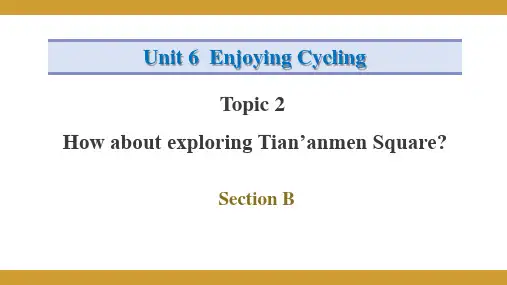
B. Tian’anmen Rostrum
A
C. Chairman Mao Memorial Hall
D
E D. Great Hall of the People
E. National Museum
C
Learning
North
★
Northwest
Northeast
West
East
Southwest South
Tom covered his face with a book.
2. It's 880 meters long from north to south and 500 meters wide from east to west.它南北长880米,东西宽500米。
英语中长,宽,高的表达方式:数词+长度单位+长、宽、高 e.g 三米长、宽、高。Three meters long/wide/high.
Learning 1a Listen, look and say.
Darren: Hello, Kangkang. Could you tell me something about Tian'anmen Square? Kangkang: Sure. It is in the center of Beijing City. It's the largest city square in the world. It covers 440 000 square meters. It's 880 meters long from north to south and 500 meters wide from east to west. It can hold one million people. Darren: That's amazing! Are there any great buildings? Kangkang: Certainly. We can see the Monument to the People's Heroes in the center of the square. In the north of the square, we can see Tian'anmen Rostrum. There Chairman Mao Zedong announced the founding of the People's Republic of China in 1949. Darren: The square must be quite meaningful to all Chinese people. Kangkang: Yes, and we can see some other great buildings there. Darren: Wow, I can't wait to see it. By the way, how far is it from here to Tian'anmen Square? Kangkang: It's about one and a half hours by bike.
仁爱版英语八年级下册:Unit 6 Topic 2. How about exploring Tia

Unit6 Enjoying Cycling Topic3 Bicycle riding is good exercise.【学习目标】学习有关骑自行车的话题,并了解骑自行车的好处通过对交通事故的学习,让学生懂得遵守交通规则的重要性。
【学习重难点】了解骑自行车的好处;让学生懂得遵守交通规则的重要性【学习过程】自学方法根据首字母提示填空。
1.P__________ shouldn’t put their heads and hands out of the windows while the train is moving.2.He must be c_________ to drive so fast. It’s so dangerous.3.Where is my watch? I can’t find it a_____________.4.You must s___________ down at a crossing or a sharp turn.5.The math problem is too difficult. It’s i_____________ for me to work it out.6.Birth and d___________ are opposites.知识点击1.I think traffic in Beijing is crazy. 我认为北京的交通很拥挤。
crazy本意是“不理智的,疯狂的”。
在句中意思是“拥挤的”,故traffic is crazy,意思是“交通拥挤。
”相当于“Traffic is heavy/busy/terrible.”。
In some big cities, traffic is crazy. 在一些大城市,交通很拥挤。
2.If people obey the traffic rules, there will be fewer accidents.如果人们遵守交通规则,交通事故就会减少。
仁爱版英语八年级下册:Unit 6 Topic 2. How about exploring Tia

Unit6 Enjoying Cycling Topic3 Bicycle riding is good exercise.Section B【学习目标】学习并巩固if引导的条件状语从句的运用,进一步学习交通规则,学会识别更多的交通图标。
【学习重难点】学会识别更多的交通图标。
【学习过程】自学方法根据首字母提示填空。
1.Keep away! The building is in d___________ of collapsing (垮塌) at any time.2.It’s safer to ride wearing l__________ clothes at night.3.It’s safe for us to wear helmets when we ride m__________ on the road.4.Our parents tell us that we should always cross the road at the c_____________.5.The s__________ on the wall said “No spitting”.知识点击1.If we break the traffic rules, we may get a fine and even be in danger. 如果我们违反交通规则,我们会被罚款,甚至会处于危险之中。
fine (n.) 罚金,罚款。
如:I got a £40 fine for speeding. 我因超速驾车被罚了40英镑。
(1)fine 作动词,意思是“处某人以罚金”,常用短语:fine sb.for doing sth. 因某事而处某人以罚款。
(2)fine 作形容词时,含义有很多:“健康的,优质的,令人满意的,天气晴朗的等”2.It warns us to be more careful. 它提醒我们要更小心。
仁爱版英语八年级下册英语u6t2sa笔记
仁爱版英语八年级下册英语u6t2sa笔记Unit 6 TechnologyTopic 2: Smart LivingSection A1. Internet of Things (IoT)- Definition: network of devices, vehicles, and home appliances that contain electronics, software, actuators, and connectivity which allows them to connect, interact and exchange data- Examples: smartwatch, smart TV, smart fridge, Amazon Echo, Nest thermostat- Advantages: convenience, efficiency, automation, customization, personalization, cost savings- Concerns: security, privacy, reliability, compatibility, complexity, dependency, job loss2. Smart Home- Definition: a home that is equipped with internet-connected devices that can be remotely controlled and automated- Examples: smart thermostat, smart lighting, smart locks, home security system- Advantages: energy savings, safety, convenience, comfort, entertainment, peace of mind- Concerns: cost, complexity, connectivity issues, hacking, privacy invasion, potential malfunctions3. Wearable Technology- Definition: electronic devices that can be worn on the body as accessories or clothing items and have the ability to connect to the internet and collect data- Examples: fitness tracker, smartwatch, augmented reality glasses, smart clothing- Advantages: fitness tracking, health monitoring, hands-free operation, convenience, information sharing- Concerns: privacy concerns, potential health risks, addiction, social isolationSection B1. Virtual Reality (VR)- Definition: an artificial environment that is created with software and presented to the user in a way that makes them feel like they are experiencing it firsthand- Examples: Oculus Rift, HTC Vive, Google Cardboard, PlayStation VR- Advantages: immersive experiences, educational and training applications, entertainment, therapy- Concerns: motion sickness, expensive equipment, limited accessibility, potential addiction2. Augmented Reality (AR)- Definition: the overlay of digital content onto the physical world via a smartphone or other device- Examples: Pokémon Go, Snapchat filters, IKEA Place- Advantages: enhanced user experiences, instructional and promotional uses, improved safety and visualization- Concerns: privacy, data collection, distraction, potential addiction 3. Artificial Intelligence (AI)- Definition: the simulation of human intelligence and decision-making by machines- Examples: voice assistants (Siri, Alexa), chatbots, facial recognition, self-driving cars- Advantages: automation, efficiency, accuracy, personalization, improved decision-making- Concerns: job loss, bias, privacy invasion, lack of transparency, ethical dilemmas.。
仁爱版英语八年级下unit6topic2sectionc教案
Unit 6 Enjoying CyclingTopic 2 How about exploring Tian'anmen Square?第三课时 (Section C-1a,1b,1c)教学设计思路:本课继续学习时间状语从句和方位词。
首先让学生介绍学校的平面图来复习方位词。
然后通过讲故事的方式一边复习时间状语从句并学习更多的引导词,同时把新词汇展示出来。
解决了词汇以后呈现1b图片让学生预测故事情节。
随后让学生读1a来检验预测结果并同时完成1b,1c。
接着组织学生处理1a中的重难点,最后再次运用图片来引导学生复述1a 完成本课时的教学任务。
Ⅰ. Teaching aimsKnowledge aims: 1.继续学习时间状语从句。
Skill aims: 2.(1)能够运用时间状语从句描述事件发生的先后顺序。
(2)能够根据关键词来复述短文。
Emotional aims: 3.Culture awareness: 4.Ⅱ. The key points and difficult points1.Key points:(1)Words and expressions :bicycle, space, push, direction, step, slowly, beside, sadly arrive at ,be full of, be surprised at, more and more... , assoon as, too...to... , not... until...(2)Sentences:After parking their bicycles, they walked to Tian'anmen Square.While the crowd was pushing Darren in all directions, someone stepped on his feet.As soon as the three boys saw each other, they all jumped around happilyAs they were exploring happily, more and more people came to the square.He was too worried to think about what to do.points:(1)正确运用时间状语从句主从句部分的时态。
仁爱英语八年级下Unit 6 Topic 2 Section B知识点详解
Unit6Topic2SectionB知识点讲解1. It's 880 meters long from north to south and 500 meters wide from east to west.它南北长880米,东西宽500米。
英语长、宽、高表达方法:基数词+长度单位+长/宽/高三米长three meters long5米宽five meters wide4米高four meters high2.Wow, I can wait to see it.哇,我迫不及待想看看它。
can't wait表示一种迫切心情,意为: 多么想,等不及后面一般接动词不定式。
我多想立刻乘飞机去广州。
I can't wait to fly to Guangzhou at once.3. --By the way, how far is it from here to Tian'anmen square?--It's about one and a half hours by bike.--顺便问一下从这里到天安门广场有多远?--骑自行车大约一个半小时。
①how far用来询问距离、路程it代指距离北京距离上海有多远?How far is it from Beijing to Shanghai?=How far is Beijing from Shanghai?②此句是表示路程的表达法,路程表达法可以采取两种表达方式。
A. 用长度单位表达。
这儿离上海有1000千米。
It's 1000 kilometers away from Shanghai.B. 用时间表达。
从我家到学校步行大约需要20分钟。
It's about 20 minutes' walk from my home to my school.③one and a half hours 一个半小时还可表示为one hour and a half④链接两三个two or three三四个three or four步行10分钟的路程10 minutes on foot=10 minutes' walk4.The Chairman Mao Memorial Hall lies to the southeast of the Great Hall of the People while it lies to the southwest of the national museum.毛主席纪念堂位于人民大会堂东南端国家博物馆西南端。
仁爱版英语八年级下Unit6 Topic2 Section D参考教案
1 / 9 Unit6 Topic2 SectionD 参考教案 Ⅰ. Material analysis 本节课建议用1课时学完。主要活动为Section D 的1a。 本课通过阅读 Michael的旅行日记,复习时间状语从句的用法。要求学生通过本课的学习活动掌握黑体单词和短语have fun doing sth., everywhere和Thank goodness. 学会写旅行日记的同时,培养学生热爱旅游、积极探索的态度,并向学生渗透迷路的应对策略,让学生树立安全意识,遇事不要惊慌,学会保护自己。 Ⅱ. Teaching aims Knowledge aims: 1. 学生能正确拼读并运用黑体单词和短语。 2. 学生能学会如何写旅行日记。 3. 学生能熟练掌握时间状语从句的用法。 Skill aims: 1. 能听懂有关旅游经历的短文或对话,并从中获取信息。 2. 能使用英语简单陈述自己旅游与探险的心得与感受。 3. 能读懂旅行日记,并从中获取需要的信息。 4. 能用英语简单写自己的旅行日记。 Emotional aims: 2 / 9
1. 具有积极参与课堂上各种英语实践活动的兴趣。 2. 培养学生热爱旅游、积极探索的态度,树立安全意识,遇事不要惊慌,学会自我保护。 Ⅲ. The key points and difficult points Key points: 1. 学习有关叙述旅游经历的词汇、短语和句式的表达。 2. 掌握时间状语从句的用法。 Difficult points: 用英语写自己的旅行日记。 Ⅳ. Learning strategies 1. 善于创设情景,在情景中提高语言交际能力,突显语言交际功能。 2. 在日常学习中不断开阔视野,扩大知识面。 3. 善于分组活动,在小组内积极与他人协作,取长补短,共同完成学习任务。 Ⅴ. Teaching aids Computer multimedia projector. Ⅵ. Teaching procedures 3 / 9