
中国海洋大学2005年博士英语真题
PARTⅠ Cloze (15) Directions: There are 15 questions in this part of the test. Read the passage through. Then, go back and choose one suitable word or phrase marked A, B, C or D for each blank in the passage. Blacken the corresponding letter of the word or phrase you have chosen on your Answer Sheet.
At least since the Industrial Revolution, gender roles have been in a state of transition. As a result, cultural scripts about marriage have Undergone change. One of the more obvious 1 has occurred in the roles that women 2 Women have moved into the world of work and have become adept at meeting expectations in that arena, 3 maintaining their family roles .of nurturing and creating a (n) 4 that is a haven for all family members. 5 many women experience strain from trying to "do it all," they often enjoy .the increased 6 that can result from playing multiple roles. As women's roles have changed, changing expectations about men's roles have become more 7 . Many men are relinquishing their major responsibility 8 the family provider. Probably the most significant change in men's roles, however, is in the emotional 9 of family life. Men are increasingly 10 to meet the emotional needs of their families, 11 their wives. In fact, expectations about the emotional domain of marriage have become more significant for marriage in general. Researeh on 12 marriage has changed over recent aecades points to the increasing, importance of the emotional side of-the relationship, and the importance of sharing in the e emotion work" 13 to nourish marriages and other family relationships. Men and women want to experience marriages that are interdependent, 14 both partners nurture each other, attend and respond to each other, and encourage and promote each other. We are thus seeing marriages in which men's and women's roles are becoming increasingly more 15 . 1. A. incidents B. changes C. results D. effects 2. A. take B. do C. play D. show 3. A. by B. while C. hence D. thus 4. A. home B. garden C. arena D. paradise 5. A. When B: Even though C. Since D. Nevertheless 6. A. rewards B. profits C. privileges D. incomes 7. A. general B. acceptable C. popular D. apparent 8. A. as B. of C. from D. for 9. A. section B constituent: C. domain D. point 10. A. encouraged B. expected C. advised D. predicted 11. A. not to mention B. as well as Cincluding D. especially . 12. A. how B. what C. why D. if 13 A. but B. only. C. enough D. necessary 14. A. unless B. although C. where D. because 15. A. pleasant B. important C. similar D. manageable PART Ⅱ Reading Comprehension (30) Directions: There are 5 reading passages in this part. Each passage is followed by some questions or unfinished statements. For each of them there are four choices marked A, B, C and D. You should decide on the best choice and mark your answer on the ANSWER SHEET by blackening the corresponding letter in the brackets. Passage 1 The first navigational lights in the New World were probably lanterns hung at harbor entrances. The fast lighthouse was put tip by Massachusetts Bay Colony in 1716 on Little Brewster Island at the entrance to Boston Harbor. Paid forand maintained by "light dues" levied on ships, the original beacon was blown up in 1776. By then there were only a dozen or so true lighthouses in the colonic. Little over a century later, there were 700 lighthouses. The first eight erected on the West Coast in the 1850's featured the same basic New England design: a Cape Cod dwelling with the tower rising from the center or standing close by. In New England and elsewhere, though., lighthouses reflected a Variety of architectural styles. Since most stations in the Northeast were built.on rocky eminences, enormous towers were not the rule. Some were made of stone and brick, others "of wood or metal. Some stood on pilings or stilts: some were fastened to rock with iron rods. "Farther south, from Marylandthreugh the Florida Keys, thecoast was low and sandy. It was often necessary to build tall towers there -- massive structures like the majestic Cape Hatteras. North Carolina. lighthouse, which was lit in 1870. At 190 feet it is the tallest brick lighthouse in the country. NOt withstanding differences in appearance and construction, mostAmerican lighthouses shared several features: a light, living quarters, and sometimes a bell ( or, later; a foghorn). They also had something else in common: a keeper and, usually, the keeper's family. The keeper's essential task was trimming the lantern wick in order to maintain a steady, bright flame. The earliest keepers came from every walk of life --- they were seamen, farmers, mechanics, rough mill hands -- and appoint ments were often handed out by local customs commissioners as political plums. After the administration of lighthouses was taken over in 1852 by the United States Lighthouse Board, an agency of. the Treasury Department, the keeper corps gradually became highly professional. 16 What is the best tide for the passage? A. The Lighthouse on Little Brewster Island B: The Life of a Lighthouse Keeper C.Early Lighthouses .in the United States D. The Modem Profession of Lighthouse-Keeping 17. Why does the author mention the Massachusetts Bay Colony? A. It was. the headquarters of the Untied States Lighthouse Board. B. Many of the tauest.lighthouses were built there. C. The first lantern wicks were developed there. D. The first lighthouse in North America was built there. 18. It can be inferred from the passage that lighthouses in the Northeast did not need high towers because . A. ship there had high masts B. coastal waters were safe C. the coast was straight and unobstructed D. the lighthouse were built on high places 19. According to the passage, where can the tallest brick lighthouse in the United States be found? A, Little Brewster Island B. The Florida Keys
2005年真题及参考答案
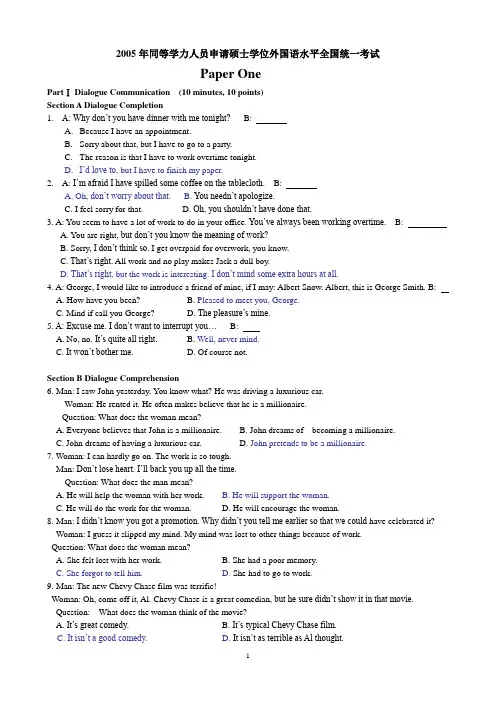
2005年同等学力人员申请硕士学位外国语水平全国统一考试Paper OnePartⅠ Dialogue Communication (10 minutes, 10 points)Section A Dialogue Completion1.A: Why don‟t you have dinner with me tonight?B:A.Because I have an appointment.B.Sorry about that, but I have to go to a party.C.The reason is that I have to work overtime tonight.D.I‟d love to, but I have to finish my paper.2.A: I‟m afraid I have spilled some coffee on the tablecloth.B:A. Oh, don‟t worry about that.B. You needn‟t apologize.C. I feel sorry for that.D. Oh, you shouldn‟t have done that.3. A: You seem to have a lot of work to do in your office. You‟ve always been working overtime. B:A. You are right, but don‟t you know the meaning of work?B. Sorry, I don‟t think so. I get overpaid for overwork, you know.C. That‟s right. All work and no play makes Jack a dull boy.D. That‟s right, but the work is interesting. I don‟t mind some extra hours at all.4. A: George, I would like to introduce a friend of mine, if I may: Albert Snow. Albert, this is George Smith. B:A. How have you been?B. Pleased to meet you, George.C. Mind if call you George?D. The pleasure‟s mine.5. A: Excuse me. I don‟t want to interrupt you…B:A. No, no. It‟s quite all right.B. Well, never mind.C. It won‟t bother me.D. Of course not.Section B Dialogue Comprehension6. Man: I saw John yesterday. You know what? He was driving a luxurious car.Woman: He rented it. He often makes believe that he is a millionaire.Question: What does the woman mean?A. Everyone believes that John is a millionaire.B. John dreams of becoming a millionaire.C. John dreams of having a luxurious car.D. John pretends to be a millionaire.7. Woman: I can hardly go on. The work is so tough.Man: Don‟t lose heart. I‟ll back you up all the time.Question: What does the man mean?A. He will help the woman with her work.B. He will support the woman.C. He will do the work for the woman.D. He will encourage the woman.8. Man: I didn‟t know you got a promotion. Why didn‟t you tell me earlier so that we could have celebrated it? Woman: I guess it slipped my mind. My mind was lost to other things because of work.Question: What does the woman mean?A. She felt lost with her work.B. She had a poor memory.C. She forgot to tell him.D. She had to go to work.9. Man: The new Chevy Chase film was terrific!Woman: Oh, come off it, Al. Chevy Chase is a great comedian, but he sure didn‟t show it in that movie. Question: What does the woman think of the movie?A. It‟s great comedy.B. It‟s typical Chevy Chase film.10. Woman: You haven‟t said a word about my dress, Dave. Don‟t you like it?Man: I‟m sorry I didn‟t say anything about it sooner. I don‟t think I‟ve seen anything like is before.Question: What does the man probably think of the dress?A. It is in fashion.B. It surely is unique.C. It is a bit old-fashioned.D. It surely suits her.Part Ⅱ Vocabulary (10 minutes, 10 points)Section A11.Should English classes be compulsory at the elementary or primary school level in countrieswhere it is not the native language?A. requiredB. necessaryC. selectedD. permanent讲义3.Next semester, Susan must take three compulsory courses.A. formalB. voluntaryC. practicalD. required12.In the end, both attacks and defenses of the free market and conventional economics haveimmense philosophical implications.A. traditionalB. novelC. capital-centeredD. consumption-centered 讲义9. Tiny atomic electric batteries have certain advantages over the ______ storage batteries.A. universalB. inclusiveC. indefinite22. The girl of ten has such exceptional abilities that everyone is jealous of her.A. regularB. specificC. extraordinary13.Applicant will be asked to provide information on how they will disseminate information toother students at their university or college.A. discloseB. deliverC. spreadD. analyze14.In general, the British people belong to one of the more affluent countries of Europe and enjoy ahigh standard of living compared to the rest of the world.A. plentifulB. powerfulC. friendlyD. wealthy15.To absorb a younger work force, many companies offered retirement plans as incentives forolder workers to retire and make way for the younger ones who earned lower salaries.A. rewardsB. opportunitiesC. motivesD. stimuli讲义2. The fun of playing the game was a greater incentive than the prize.A. motiveB. initiativeC. excitementD. entertainment16.Their business flourished at its new location a year later owing to their joint efforts and hardwork.A. prevailedB. failedC. boomedD. shrank讲义:11. The Timber rattlesnake is now on the endangered species list, and is extinct in two eastern states in which it once ______.A. thrivedB. swelledC. prospered17.The pressure on her from her family caused her to resort to the drastic measures.A. turn toB. keep toC. stick toD. lead to18.I shall never forget the look of intense anguish on the face of his parents when they heard thenews.A. stressB. dilemmaC. miseryD. surprise19.If minor disputes are left unsettled, tough ones will pile up sooner or later.A. accumulateB. vanishC. lingerD. emerge20.The police tried in vain to break up the protest crowds in front of the government building.A. unskillfullyB. violentlyC. ineffectivelyD. eventuallyyour department.A. satisfactionB. gratitude D. sincerity讲义:1. I' d like to take this opportunity to extend my heart-felt gratitude to the host.A. increaseB. prolongC. intensifyD. express22.The objective of this popular consultation is to determine, , the final political status of theregion, whether to remain part of the country as a special district, or to part from it.A. once upon a timeB. once and againC. all at onceD. once and for all从前一而再,屡次断然地, 坚决地23.The two countries will assign counter-drug officials to their respective embassies ona basis.A. fundamentalB. similarC. reciprocal 互惠的D. reasonable24.Tennessee‟s population is nearly two-fifths rural, and no single city or group ofcities the state.A. dominatesB. managesC. manipulatesD. controls25.We all know that in a situation like this a cool head is .A. called forB. called offC. called onD. called up讲义:9. A well-written composition ______ good choice of words and clear organization among other things.A. calls onB. calls forC. calls upD. calls off26.The destruction an earthquake causes depends on its and duration, or the amount ofshaking that occurs.A. altitudeB. magnitudeC. multitudeD. aptitude讲义:35. In my opinion, you can widen the ______ of these improvements through your active participation.A. dimensionB. volume D. scope27.The El Nino has affected the regional weather and temperature over much of the tropics,sub-tropics and some mid-latitude areas.A. externallyB. consistentlyC. insistentlyD. internally28.During all these years of absence he had a tender feeling for his mother and the family.A. enclosedB. huggedC. enrichedD. cherished29.The choice for a consumer, therefore, is the choice among the available ones that willenable him or her to maximize utility.A. optimalB. optionalC. opticalD. optimistic30.Mrs. Smith tears when she heard her daughter had died in the road accident.A. broke inB. broke upC. broke throughD. broke intoPart Ⅲ Reading Comprehension (45 minutes, 25 points)Passage OneIt was Friday, the day of the field trip on which Miss Joan would take her class to pick apples.Miss Joan enjoyed picking apples with her students. She smiled as she led her students to the bus that would take them to the Greenly Apple Orchard(果园).The bus ride was bumpy and the kids were a little noisy, but still Miss Joan was smiling.The bus stopped in front of the Greenly Orchard Store and the class got off quickly and quietly. Miss Joan made sure everyone was there. “What a glorious,sunny, apple picking day,” Miss Joan announced with her grandest smile.Mr. Greenly was there to greet them. “Let see, there are eighteen children and two adults atMiss Joan held u p the brochure in her hand. “It says that the price is two dollars each,”she pointed ort. “That‟s what I collected from everyone.”“We‟ve had to raise the price,” Mr. Greenly stated.“You sent me this brochure after we made our reservation,” Miss Joan complained, “and it says two dollars!”“Miss Joan, if you look at the bottom of this brochure,” Mr. Greenly said, “you‟ll notice a very important statement.”Sure enough, in very tiny letters, it said, “Prices are subject to change without notice.”Miss Joan was determined to keep her good mood. She took a twenty dollars bill out of her own purse and handed it to Mr. Greenly with the forty dollars she had in an envelope.“Now children, do you all have your baskets?” Miss Joan called out. “Remember, you can pic k as many apples six apples each.”“I beg your pardon!”Miss Joan was not smiling now. “The brochure says,…ALL YOU CAN PICK‟!”Mr. Greenly pointed to the tiniest letters Miss Joan had ever almost seen. It also says, “Terms and conditions of group reservat ions are subject to change without notice.”Miss Joan‟s good mood was now history. She didn‟t want to set a bad example for her students, so she said in a calm and quiet voice, “We‟re going home, give me our money back, please.”31.How many dollars did Miss Joan hand to Mr. Greenly?A. 20.B. 40.C. 60.D. 1832.The phrase “subject to change without notice” suggests .A.Mr. Greenly could change the terms at will.B.the customers should read the brochure carefullyC.Mr. Greenly could determine what apples to be picked.D.the customers should be informed beforehand.33.The students could not pick as many apples as they would like because .A.they were children.B. there were not enough apples.C. they had made a group reservation.D. they would eat up too many apples.34.“Miss Joan‟s good mood was now history?”(the last paragraph) means .A.Miss Joan had been happy until that moment.B.Miss Joan was no longer interested in history.C.Miss Joan taught her students the history of the orchard.D.Miss Joan was good at concealing her feelings35.What can we learn about Miss Joan from the story?A. She did not read the brochure carefully.B. She made a reservation after seeing the brochure.C. She lost her temper in the end.D. She didn‟t know h ow to complain.Passage TwoBoth civilization and culture are fairly modern words, having come into prominent use during the 19th century by anthropologists(人类学家), historians, and literary figures. There has been a strong tendency to use them interchangeably as though they mean the same thing, but they are not the same.Although modern in their usage, the two words derived from ancient Latin. The word civilization is based on the Latin civis, of a city. Thus civilization, in its most essential meaning, isit would seem that certain insects, such as ants or bees, are also civilized. They live and work together in social groups. So do some microorganisms. But there is more to civilization, and that is what culture brings to it. So, civilization is inseparable from culture.The word culture is derived from the Latin verb colere, till the soil. But colere also has a wider range of meanings. It may, like civis, mean inhabiting a town or village. But most of its definitions suggest a process of starting and promoting growth and development. One may cultivate a garden; one may also cultivate one‟s interests, mind, and abilities. In its modern use the word culture refers to all the positive aspects and achievements of humanity that make mankind different from the rest of the animal world. Culture has grown out of creativity, a characteristic that seems to be unique to human beings.One of the basic and best-know features of civilization and culture is the presence of tools. But more important than their simple existence is that the tools are always being improved and enlarged upon, a result of creativity. It took thousands of years to get from the first wheel to the latest, most advanced model of automobile.It is the concept of humans as toolmakers and improvers that differentiates them from other animals. A monkey may use a stick to knock a banana from a tree, but that stick will never, through a monkey‟s clevernes s, be modified into a hook or a ladder. Monkeys have never devised a spoken language, written a book, composed a melody, built a house, or painted a portrait. To say that birds build nests and beavers(海狸)their dens is to miss the point. People once lived in caves, but their cleverness, imagination, and creativity led them to progress beyond caves to buildings.36. What does the author think of the words “civilization”and “culture”?A. They are identical.B. They are different concepts.C. They can often be used interchangeably.D. They are defined differently by different people.37. According to the author the word “civilization” originally refers to .A. people‟s way of life in citiesB. people‟s ability to live together in citiesC. a type of social organizationsD. an advanced level of social life38. The Latin verb colere originally means “”.A. live in a cityB. develop oneselfC. promote growthD. cultivate the land39. The author believes that creativity .A. is a unique feature of civilized beingsB. brings forth the improvement of toolsC. is the result of human developmentD. helps the advance of culture40. The author mentions monkeys in the last paragraph to show that .A. monkeys are the same as birdsB. people once lived in caves like monkeysC. monkeys can never develop into human beingsD. man is different from other animals such as monkeysPassage ThreeThe huge growth of global “ecotourism”industry is becoming an increasing concern for conservationists with mounting evidence that many wild species do not respond well to contact with human beings. Overexposure to tourists has been linked to stress, abnormal behaviour and adverse health effects in species such as polar bears, dolphins and gorillas(大猩猩),says a report in New Scientist.While regulated ecotourism can help conservation efforts by encouraging people to manage endangered species and their habitats, many projects are poorly designed and unregulated, it says.environmentally friendly policies and operations.”While regulated ecotourism can help conservation efforts by encouraging people to manage endangered species and their habitats, “many projects are p oorly designed and hint they are based on environmentally friendly policies and operations.”Ecotourism is growing by 10 to 30 percent a year and an estimated 20 percent of tourists are thought to visit a conservation-based project. Philip Seddon, of the University of Otago in New Zealand, said that although most tourist projects conformed to basic guidelines on land use and not scaring wildlife, their full impact was rarely considered.“Transmission of disease to wildlife, or subtle changes to wildlife health through disturbance of daily routines or increased stress levels may translate to lowered survival and breeding,” he said. Research at the University of Auckland has shown that dolphins become restless and overactive when many tourist boats are present. When three or more boats are near, the dolphins rest for 0.5 percent of the time, compared with 68 percent when they are accompanied by a single boat. The findings are backed up by studies of dolphins in Britain. Researchers at the University of Manitoba in Canada have found that male polar bears easily disturbed by tourist vehicles, with a possible effect on their heart rate and metabolism(新陈代谢). That could reduce body fat levels and fitness, critical for survival.In Africa, gorillas have picked up parasites introduced to their habitat by tourists and mongooses(蠓)have caught lung diseases from human beings. Experts said that the answer to the problems was better regulation and supervision of ecotourism. The Galapagos Islands, where visitor numbers are strictly controlled, is a good model.41. Ecotourism is meant to .A. have tourists help in the conservation of wildlifeB. have wild species respond well to contact with humansC. make wild species reduce stress and abnormal behaviourD. make conservationists more concerned with wildlife42. According to New Scientist, many ecotourist projects .A. really encourage people to protect wildlife and its habitatB. strictly follow environmentally friendly policiesC. actually lack proper examination and official approvalD. seriously damage the habitats of endangered species43. What will happen to wildlife ul timately if the present “ecotourism” practice goes on?A. It will disturb their life.B. It will affect their health.C. It will increase their stress.D. It will threaten their survival.44. According to the passage, the growth in the global “ecotourism” industry .A. reflects an increasing concern for conservationB. arouses a growing concern for conservationC. coincides with a mounting concern for conservationD. originates from a grater concern for conservation45. According to the passage, a solution to the “ecotourism” problem is to .A. encourage people to manage endangered speciesB. reduce the exposure of wildlife to human beingsC. help wild animals increase their fitnessD. prevent wildlife from catching human diseasesComputers can beat chess champion Gary Kasparov at his game, count all the atoms in a nuclear explosion, and calculate complex figures in a fraction of a second, but they still fail at the slight differences in language translation. Artificial Intelligence computers have large amounts of memory, capable of storing huge translating dictionaries and extensive lists of grammar rules. Yet, today‟s best computer language translators have just a 60 percent accuracy rate. Scientist s are still unable to program the computer with human-like common sense reasoning power.Computer language translation is called Machine Translation, or MT. While not perfect, MT is surprisingly good. MT was designed to process dry, technical language that people find tedious to translate. Computers can translate basic phrases, such as “You foot bone‟s connected to your ankle bone, your ankle bone‟s connected to your leg bone.” They can translate more difficult phrases, such as “Which witch is which?” Computers can also accurately translate “Wild thing, you make my heart sing!” into other languages because they can understand individual words, as long as the words are pre-programmed in their dictionary.But highly sensitive types of translating, such as important diplomatic conversations, are beyond the scope of computer translating programs. Human translators use intuitional meaning, not logic, to process words and phrases into other languages. A human can properly translate the phrase, “The pen is in the pe n(围养禽畜的圈),” because most humans know that it means that a writing instrument is in a small enclosed space. Many times, computers do not have the ability to determine in which way two identical words in one sentence are to be used.In addition to using massive rule-programmed machines, computer programmers are also trying to teach computers to learn how to think for themselves through the “experience” of translating. Even with these efforts, programmers admit that a “thinking” computer might not ever be invented in the future.46. Computers today are capable of .A. defeating the best chess player in the worldB. telling subtle differences between languagesC. translating over 60 percent of difficult textsD. doing human-like common sense reasoning47. According to the passage, which of the following is NOT true?A. Computers can translate dry and difficult phrases.B. Computers can understand sensitive language.C. Computers can translate technical language.D. Computers can understand pre-programmed words.48. The major problem with computer translating programs is that computers .A. can not translate illogical sentencesB. do not have a large enough capacity of memoryC. can not understand grammatical rulesD. do not have intuition to process language49. To improve machine translation, computer programmers are trying to .A. use powerful rule-programmed computersB. teach computers to think by practiceC. have computers compile translating dictionariesD. add explanations of words in computer programs50. The passage suggests that .A. the accuracy rate of machine translation cannot be raisedB. it is impossible for computers to think as humans doC. only technical language is suitable for machine translationD. it is impossible to determine of identical wordsSeveral years ago during the dot-com passion, Manhattan lawyer John Kennedy sometimes wore a dark blue suit to meet potential Internet clients. But he soon realized that his conservative clothes were a strike against him before he even shook hands. So he began to do business in casual, open-shirt clothes.But now the tables have turned. Today Silicon Valley executives are the ones often coming out in suits. No wonder that Fortune 500 executives are dusting off their silk ties and pants.” I would say there is a trend now toward a little more business dress,” said Kennedy. “I find myself wearing suits more.”While there isn‟t a rush toward formal office wear, clothiers and executives say the workplace uniform is heading that way. In many offices, men are wearing jackets, ties and pants more frequently than a year age. Top women executives never went as casual as men, so the shift doesn‟t affect them as dramatically.“Business casual” took several years to catch on. It started with casual Fridays, evolved to casual summers, then became casual everyday. A return to the button-down look also will take time, observers say. Lehman Brothers is one of the few major firms that has officially returned to a formal dress policy, at least for offices that clients visit. Men were told to wear suits and ties and women to wear suits or dresses. The shift is due to a rethinking of work environments and more contacts with clients as the firm has grown.Observers mention many factors driving the trend. Internet companies helped lead the dress-down movement and other industries followed suit to attract workers. But with the collapse of many dot-coms, the relaxed look is becoming a style to avoid. Moreover, as the economy stumbles, more people are hunting for jobs or trying to keep the ones they have, and appearance counts.US President Bush wears a coat and tie in the White House office and expects his staff to dress “professionally,” which some say sets a tome for the nation.Chuck Wardell, managing director of a recruiting firm, believes a lot of employees like a stiffer uniform. “They‟re going to work. They don‟t want to feel like they‟re going to a picnic.”51.”Business casual” was prevalent several years ago because _____.A. the Manhattan law business grew very quicklyB. shaking hands with clients became popularC. the country was fighting the conservativesD. the Internet companies boomed then52. When the “bu siness ca sual” prevailed, _____.A. businessmen wore ties only in workplaceB. businessmen didn‟t wear ties at allC. businesswomen didn‟t wear formally in workplaceD. businesswomen still wore formally everywhere53. The Fortune 500 executives__________.A. set the trend toward more casual wearB. are particular about what they wearC. begin to wear suits more often than beforeD. are usually indifferent to fashion trend54. At the beginning of the “business casual” trend, business people wore casually___________.A. when meeting clientsB. on weekendsC. in summerD. almost every day55. It is implied in the passage that the change of business dress from the casual to the formalreflects_____.A. the changed of people‟s taste in fashionB. the ups and downs of the fashion industryC. the ups and downs of the Internet companiesD. people‟s different preference in business dressPart IV CloseThe United States has historically had higher rates of marriage than those of other industrialized countries. The current annual marriage 56 in the United States ---about 9 new marriages for every 1,000 people ---is 57 higher than it is in other industrialized countries. However, marriage is 58 as widespread as it was several decades ago. 59 of American adults who are married 60 _ form 72 percent in 1970 to 60 percent in 2002.This does not mean that large numbers of people will remain unmarried 61 their lives. Throughout the 20th century, about 90 percent of Americans married at some 62 in their lives. Experts_ 63 that about the same proportion of today‟s young adults will eventually marry.The timing of marriage has varied 64 over the past century. In 1995 the average age of women in the United States at the time of their first marriage was 25.The average age of men was about 27.Men and women in the United States marry for the first time at an average of five years later than people did in the 1950s. 65 ,young adults of the 1950s married younger than did any previous 66 in U.S. history. Today‟s later age of marriage is 67 the age of marriage between 1890 and 1940. Moreover, a greater proportion of the population was married (95 percent)during the 1950s than at any time before 68 .Experts do not agree on why the “marriage rush” of the late 1940s and 1950s occurred, but most social scientists believe it represented a 69 to the return of peaceful life and prosperity after 15 years of severe economic 70 and war.56. A. rate B. ratio C. percentage D. poll57. A. potentially B. intentionally C. randomly D. substantially相当大的58. A. not any longer B. no more C. no longer D. not any more59. A. A proportion B. The proportion C. The number D. A number60. A. declined B. deteriorated C. deduced D. demolished61. A. past B. passing C. throughout D. through62. A. period B. level C. point D. respect63. A. project B. plan C. promise D. propose64. A . unexpectedly B. irregularly C. flexibly D. consistently65. A. Besides B. However C. Whereas D. Nevertheless66. A. descendants B. ascendants C. population D. generation67. A. according to B. in line with C. based on D. caused by68. A. and after B. or after C. or since D. ever since69. A. refusal B. realization C. response D. reality70. A. repression B. aggression C. restriction D. depressionPart V Error Detection71. It is an accepted custom for guests to take their gifts to the wedding reception when the coupleinvited them to attend.72. Some international students use a cassette recorder to make tapes of their classes so that theycan repeat the lectures again.73. Despite of diligent efforts to promote domestic production during the war years, the ContinentalArmy had to rely primarily on captures and imports for much of its military hardware and even for clothing.74. In a sense, farmers began primitive genetic engineering at the dawn of agriculture, which theykept seeds from their best plants, gradually improving the quality of successive generations.。
2005年全国硕士研究生入学考试英语试题及答案

2005年全国硕士研究生入学考试英语试题及答案Section ⅠUse of EnglishDirections:Read the following text. Choose the best word(s) for each numbered blank and mark A,B,C or D on ANSWER SHEET 1(10 points)The human nose is an underrated tool. Humans are often thought to be insensitive smellers compared with animals, 1 this is largely because, 2 animals ,we stand upright. This means that our noses are 3 to perceiving those smells which float through the air, 4 the majority of smells which stick to surfaces. In fact5 , we are extremely sensitive to smells,6 we do not generally realize it. Our noses are capable of7 human smells even when these are8 to far below one part in one million.Strangely, some people find that they can smell one type of flower but not another, 9 others are sensitive to the smells of both flowers. This may be because some people do not have the genes necessary to generate 10 smell receptors in the nose. These receptors are the cells which sense smells and send 11 to the brain. However, it has been found that even people insensitive to a certain smell 12 can suddenly become sensitive to it when 13 to it often enough.The explanation for insensitivity to smell seems to be that brain finds it14 to keep all smell receptors working all the time but can 15 new receptors if necessary. This may 16 explain why we are not usually sensitive to our own smells we simply do not need to be. We are not 17 of the usual smell of our own house but we 18 new smells when we visit someone else's. The brain finds it best to keep smell receptors 19 for unfamiliar and emergency signals 20 the smell of smoke, which might indicate the danger of fire.1. [A]although [B]as [C]but [D]while2. [A]above [B]unlike [C]excluding [D]besides3. [A]limited [B]committed [C]dedicated [D]confined4. [A]catching [B]ignoring [C]missing [D]tracking5. [A]anyway [B]though [C]instead [D]therefore6. [A]even if [B]if only [C]only if [D]as if7. [A]distinguishing[B]discovering [C]determining[D]detecting8. [A]diluted [B]dissolved [C]determining[D]diffused9. [A]when [B]since [C]for [D]whereas10. [A]unusual [B]particular [C]unique [D]typical11. [A]signs [B]stimuli [C]messages [D]impulses12. [A]at first [B]at all [C]at large [D]at times13. [A]subjected [B]left [C]drawn [D]exposed14. [A]ineffective [B]incompetent [C]inefficient[D]insufficient15. [A]introduce [B]summon [C]trigger [D]create16. [A]still [B]also [C]otherwise [D]nevertheless17. [A]sure [B]sick [C]aware [D]tired18. [A]tolerate [B]repel [C]neglect [D]notice19. [A]availabe [B]reliable[C]identifiable[D]suitable20. [A]similar to[B]such as [C]along with [D]aside from1. [答案][C][分析]这是一道语义辨析题,首先排除选项[A]although,因为although 用作连词一般引导让步状语从句。
2005年复旦大学考博英语真题及详解【圣才出品】

2005年复旦大学考博英语真题及详解Part I Listening Comprehension (15%)(略)Part ⅡVocabulary and Structure (10%)Directions:There are 20 incomplete sentences in this part. For each sentence there are four choices marked A, B, C and D. Choose the one that best completes the ‘sentence. Then mark the corresponding letter ‘on Answer Sheet I with a single line through the center.21. The feeling of ______ that followed her victory’ was cut short by her father’s sudden death.A. initiationB. intricacyC. interrogationD. intoxication【答案】D【解析】句意:她取得胜利的陶醉之情让父亲的突然去世给中断了。
initiation发起,创始。
intricacy错综复杂,难解。
intoxication陶醉,兴奋。
interrogation询问,审问。
22. An independent adviser has been brought in to ______ between the two sides involved in the conflict.A. conciliateB. waverC. vacillateD. linger【答案】A【解析】句意:一个独立的顾问被叫来调停冲突双方。
conciliate安抚,平息怒火。
waver 犹豫,摇摆不定。
2022年考研考博-考博英语-中国海洋大学考试预测题精选专练VII(附带答案)卷20

2022年考研考博-考博英语-中国海洋大学考试预测题精选专练VII(附带答案)第1套一.综合题(共25题)1.单选题Successful innovations have driven many older technologies to extinction and have resulted in higher productivity, greater consumption materials through the economy and increased quantities of metals and other substances in use per capita. The history of industrial development abounds with examples.In 1870, horses and mules were the prime source of power on US farms. One horse or mule was required to support four human beings — a ration that remained almost constant for many decades. At that time, had a national commission been asked to forecast the horse and mule population for 1970, its answer probably would have depended on whether its consultants were of an economic or technological turn of mind. Had they been “economists”, they would probably have projected the 1970 horse or mule population to be more than 50 million. Had they been “technologists”,they would have recognized that the power of steam had already been harnessed to industry and to land and ocean transport. They would have recognized further that it would be only a matter of time before steam would be the prime source of power on the farm. It would have been difficult for them to avoid the conclusion that the horse and mule population would decline rapidly.1.According to the passage, what supplied most of the power on U.S. farms in 1870?2.Which of the following is NOT mentioned by the author as a consequence of new technological developments?3.It can be inferred from the passage that by 1870().4.In the second paragraph, the author suggests that “economists” would().问题1选项A.AnimalsB.HumansC.EnginesD.Water问题2选项A.Older technologies die away.B.The quality of life is improved.C.Overall productivity increasedD.More raw materials become necessary问题3选项A.technology began to be more commercialB.the steam engine had been inventedC.the U.S. horse population was about 10 millionD.a national commission on agriculture had been established问题4选项A.plan the economy through yearly forecastsB.fail to consider the influence of technological innovationD.consult for the national commission on the economy问题5选项A.He is excited about themB.He accepts them as naturalC.He is disturbed by themD.He questions their usefulness【答案】第1题:A第2题:B第3题:B第4题:B第5题:B【解析】1.细节事实题。
05年硕士研究生入学考试英语试题及答案

05年硕士研究生入学考试英语试题及答案Directions:Read the following text. Choose the best word(s)for each numbered blank and mark A, B, C or D on ANSWER SHEET 1(10 points) The human nose is an underrated tool. Humans are often thought to be insensitive smellers pared with animals, 1 this is largely because, 2 animals, we stand upright. This means that our noses are 3 to perceiving those smells which float through the air, 4 the majority of smells which stick to surfaces. In fact 5, we are extremely sensitive to smells, 6 we do not generally realize it. Our noses are capable of 7 human smells even when these are 8 to far below one part in one million. Strangely, some people find that they can smell one type of flower but not another, 9 others are sensitive to the smells of both flowers. This may be because some people do not have the genes necessary to generate 10 smell receptors in the nose. These receptors are the cells which sense smells and send 11 to the brain. However, it has been found that even people insensitive to a certain smell 12 can suddenly bee sensitive to it when 13 to it often enough.The explanation for insensitivity to smell seems to be that brain finds it 14 to keep all smell receptors working allthe time but can 15 new receptors if necessary. This may 16 explain why we are not usually sensitive to our own smells we simply do not need to be. We are not 17 of the usual smell of our own house but we 18 new smells when we visit someone else's. The brain finds it best to keep smell receptors 19 for unfamiliar and emergency signals 20 the smell of smoke, which might indicate the danger of fire.1.[A]although[B]as[C]but[D]while2.[A]above[B]unlike[C]excluding[D]besides3.[A]limited[B]mitted[C]dedicated[D]confined4.[A]catching[B]ignoring[C]missing[D]tracking5.[A]anyway[B]though[C]instead[D]therefore6.[A]even if[B]if only[C]only if[D]as if7.[A]distinguishing[B]discovering[C]determining[D]detecting8.[A]diluted[B]dissolved[C]determining[D]diffused9.[A]when[B]since[C]for[D]whereas10.[A]unusual[B]particular[C]unique[D]typical11.[A]signs[B]stimuli[C]messages[D]impulses12.[A]at first[B]at all[C]at large[D]at times13.[A]subjected[B]left[C]drawn[D]exposed14.[A]ineffective[B]inpetent[C]inefficient[D]insufficient15.[A]introduce[B]summon[C]trigger[D]create16.[A]still[B]also[C]otherwise[D]nevertheless17.[A]sure[B]sick[C]aware[D]tired18.[A]tolerate[B]repel[C]neglect[D]notice19.[A]availabe[B]reliable[C]identifiable[D]suitable20.[A]similar to[B]such as[C]along with[D]aside from SectionⅡReading ComprehensionPart ADirections:Read the following four texts. Answer the questions below each text by choosing A, B, C or D. Mark your answers on ANSWER SHEET 1(40 points)Text 1Everybody loves a fat pay rise. Yet pleasure at your own can vanish if you learn that a colleague has been given a bigger one. Indeed, if he has a reputation for slacking, you might even be outraged. Such behaviour is regarded as“all too human”, with the underlying assumption that other animals would not be capable of this finely developed sense of grievance. But a study by Sarah Brosnan and Frans de Waal of Emory University inAtlanta, Georgia, which has just been published in Nature, suggests that it all too monkey, as well.The researchers studied the behaviour of female brown capuchin monkeys. They look cute. They are good-natured,co-operative creatures, and they share their food tardily. Above all, like their female human counterparts, they tend to pay much closer attention to the value of“goods and services”than males. Such characteristics make them perfect candidates for Dr. Brosnan's and Dr. de waal's;study. The researchers spent two years teaching their monkeys to exchange tokens for food. Normally, the monkeys were happy enough to exchange pieces of rock for slices of cucumber. However, when two monkeys were placed in separate but adjoining chambers, so that each could observe what the other was getting in return for its rock, their became markedly different.In the world of capuchins grapes are luxury goods(and much preferable to cucumbers)So when one monkey was handed a grape in exchange for her token, the second was reluctant to hand hers over for a mere piece of cucumber. And if one received a grape without having to provide her token in exchange at all, the other either tossed her own token at the researcher or out of the chamber, or refused to;aept the slice of cucumber Indeed,the mere presence of a grape in the other chamber(without an actual monkey to eat it)was enough to reduce resentment in a female capuchin.The researches suggest that capuchin monkeys, like humans, are guided by social emotions, in the wild, they are aco-operative, groupliving species, Such co-operation is likely to be stable only when each animal feels it is not being cheated. Feelings of righteous indignation, it seems, are not the preserve of people alone, Refusing a lesser reward pletely makes these feelings abundantly clear to other members of the group. However, whether such a sense of fairness evolved independently in capuchins and humans, or whether it stems form the mon ancestor that the species had 35 million years ago, is, as yet, an unanswered question.21. In the opening paragraph, the author introduces his topic byA. posing a contrast.B. justifying an assumption.C. making a parison.D. explaining a phenomenon.22. The statement“it is all too monkey”(Last line, paragraph l)implies thatA. monkeys are also outraged by slack rivals.B. resenting unfairness is also monkeys'nature.C. monkeys, like humans, tend to be jealous of each other.D. no animals other than monkeys can develop such emotions.23.Female capuchin monkeys were chosen for the research most probably because they areA. more inclined to weigh what they get.B. attentive to researchers'instructions.C. nice in both appearance and temperament.D. more generous than their male panions24.Dr. Brosnan and Dr. de Waal have eventually found in their study that the monkeysA. prefer grapes to cucumbers.B. can be taught to exchange things.C. will not be co-operative if feeling cheated.D. are unhappy when separated from others.25. What can we infer from the last paragraph?A. Monkeys can be trained to develop social emotions.B. Human indignation evolved from an uncertain source.C. Animals usually show their feelings openly as humans do.D. Cooperation among monkeys remains stable only in the wild.Text 2Do you remember all those years when scientists argued that smoking would kill us but the doubters insisted that we didn't know for sure?That the evidence was inconclusive, the science uncertain?That the antismoking lobby was out to destroy our way of life and the government should stay out of the way?Lots of Americans bought that nonsense, and over three decades, some 10 million smokers went to early graves.There are upsetting parallels today, as scientists in one wave after another try to awaken us to the growing threat of global warming. The latest was a panel from the National Academy of Sciences, enlisted by the White House, to tell us that the Earth's atmosphere is definitely warming and that the problem is largely man-made. The clear message is that we should get moving to protect ourselves. The president内容仅供参考。
2005-考研真题
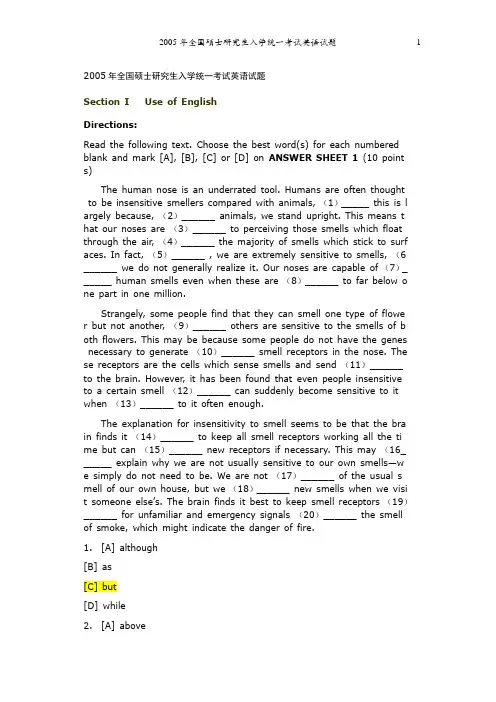
2005年全国硕士研究生入学统一考试英语试题Section I Use of EnglishDirections:Read the following text. Choose the best word(s) for each numbered blank and mark [A], [B], [C] or [D] on ANSWER SHEET 1(10 point s)The human nose is an underrated tool. Humans are often thought to be insensitive smellers compared with animals, (1)_____ this is l argely because, (2)______ animals, we stand upright. This means t hat our noses are (3)______ to perceiving those smells which float through the air, (4)______ the majority of smells which stick to surf aces. In fact, (5)______ , we are extremely sensitive to smells, (6 ______ we do not generally realize it. Our noses are capable of (7)_ _____ human smells even when these are (8)______ to far below o ne part in one million.Strangely, some people find that they can smell one type of flowe r but not another, (9)______ others are sensitive to the smells of b oth flowers. This may be because some people do not have the genes necessary to generate (10)______ smell receptors in the nose. The se receptors are the cells which sense smells and send (11)______ to the brain. However, it has been found that even people insensitive to a certain smell (12)______ can suddenly become sensitive to it when (13)______ to it often enough.The explanation for insensitivity to smell seems to be that the bra in finds it (14)______ to keep all smell receptors working all the ti me but can (15)______ new receptors if necessary. This may (16_ _____ explain why we are not usually sensitive to our own smells—w e simply do not need to be. We are not (17)______ of the usual s mell of our own house, but we (18)______ new smells when we visi t someone else’s. The brain finds it best to keep smell receptors (19)______ for unfamiliar and emergency signals (20)______ the smell of smoke, which might indicate the danger of fire.1. [A] although[B] as[C] but[D] while2. [A] above[B] unlike[C] excluding[D] besides3.[A] limited[B] committed[C] dedicated[D] confined4.[A] catching[B] ignoring[C] missing[D] tracking5.[A] anyway[B] though[C] instead[D] therefore6.[A] even if[B] if only[C] only if[D] as if7.[A] distinguishing[B] discovering[C] determining[D] detecting8.[A] diluted[B] dissolved[C] dispersed[D] diffused9. [A] when[B] since[C] for[D] whereas10. [A] unusual[B] particular[C] unique[D] typical11. [A] signs[B] stimuli[C] messages[D] impulses12. [A] at first[B] at all[C] at large[D] at times13. [A] subjected[B] left[C] drawn[D] exposed14. [A] ineffective[B] incompetent[C] inefficient[D] insufficient15. [A] introduce[B] summon[C] trigger[D] create16. [A] still[B] also[C] otherwise[D] nevertheless17. [A] sure[B] sick[C] aware[D] tired18. [A] tolerate[B] repel[C] neglect[D] notice19. [A] available[B] reliable[C] identifiable[D] suitable20. [A] similar to[B] such as[C] along with[D] aside fromSection II Reading ComprehensionPart ADirections:Read the following four texts. Answer the questions below each text b y choosing [A], [B], [C] or D. Mark your answers on ANSWER SHEE T 1(40 points)Text 1Everybody loves a fat pay rise. Yet pleasure at your own can vani sh if you learn that a colleague has been given a bigger one. Indeed,if he has a reputation for slacking, you might even be outraged. Suc h behaviour is regarded as “all too human,” with the underlying assu mption that other animals would not be capable of this finely develop ed sense of grievance. But a study by Sarah Brosnan and Frans de W aal of Emory University in Atlanta, Georgia, which has just been publi shed in Nature, suggests that it is all too monkey, as well.The researchers studied the behaviour of female brown capuchin monkeys. They look cute. They are good-natured, co-operative creatur es, and they share their food readily. Above all, like their female hum an counterparts, they tend to pay much closer attention to the value of “goods and services” than males.Such characteristics make them perfect candidates for Dr. Brosna n’s and Dr. de Waal’s study. The researchers spent two years teaching their monkeys to exchange tokens for food. Normally, the monkeys were happy enough to exchange pieces of rock for slices of cucumber. However, when two monkeys were placed in separate but adjoining c hambers, so that each could observe what the other was getting in re turn for its rock, their behaviour became markedly different.In the world of capuchins, grapes are luxury goods (and much pr eferable to cucumbers). So when one monkey was handed a grape in exchange for her token, the second was reluctant to hand hers over for a mere piece of cucumber. And if one received a grape without ha ving to provide her token in exchange at all, the other either tossed her own token at the researcher or out of the chamber, or refused to accept the slice of cucumber. Indeed, the mere presence of a grape i n the other chamber (without an actual monkey to eat it) was enoug h to induce resentment in a female capuchin.The researchers suggest that capuchin monkeys, like humans, are guided by social emotions. In the wild, they are a co-operative, grou p-living species. Such co-operation is likely to be stable only when ea ch animal feels it is not being cheated. Feelings of righteous indignati on, it seems, are not the preserve of people alone. Refusing a lesser reward completely makes these feelings abundantly clear to other me mbers of the group. However, whether such a sense of fairness evolv ed independently in capuchins and humans, or whether it stems from the common ancestor that the species had 35 million years ago, is, as yet, an unanswered question.21. In the opening paragraph, the author introduces his topic by ________.[A] posing a contrast[B] justifying an assumption[C] making a comparison[D] explaining a phenomenon22. Th e statement “it is all too monkey” (Last line, Paragraph l) implies that ________.[A] monkeys are also outraged by slack rivals[B] resenting unfairness is also monkeys’ nature[C] monkeys, like humans, tend to be jealous of each other[D] no animals other than monkeys can develop such emotions23. Female capuchin monkeys were chosen for the research most probably because they are ________.[A] more inclined to weigh what they get[B] attentive to researchers’ instructions[C] nice in both appearance and temperament[D] more generous than their male companions24. Dr. Brosnan and Dr. de Waal have eventually found in their studythat the monkeys ________.[A] prefer grapes to cucumbers[B] can be taught to exchange things[C] will not be co-operative if feeling cheated[D] are unhappy when separated from others25. What can we infer from the last paragraph?[A] Monkeys can be trained to develop social emotions.[B] Human indignation evolved from an uncertain source.[C] Animals usually show their feelings openly as humans do.[D] Cooperation among monkeys remains stable only in the wild. Text 2Do you remember all those years when scientists argued that smo king would kill us but the doubters insisted that we didn’t know for s ure? That the evidence was inconclusive, the science uncertain? That the antismoking lobby was out to destroy our way of life and the gov ernment should stay out of the way? Lots of Americans bought that n onsense, and over three decades, some 10 million smokers went to e arly graves.There are upsetting parallels today, as scientists in one wave after another try to awaken us to the growing threat of global warming. T he latest was a panel from the National Academy of Sciences, enliste d by the White House, to tell us that the Earth’s atmosphere is defini tely warming and that the problem is largely man-made. The clear m essage is that we should get moving to protect ourselves. The preside nt of the National Academy, Bruce Alberts, added this key point in th e preface to the panel’s report: “Science n ever has all the answers. B ut science does provide us with the best available guide to the future, and it is critical that our nation and the world base important policie s on the best judgments that science can provide concerning the futu re consequences of present actions.”Just as on smoking, voices now come from many quarters insistin g that the science about global warming is incomplete, that it’s OK to keep pouring fumes into the air until we know for sure. This is a da ngerous game: by the time 100 percent of the evidence is in, it may be too late. With the risks obvious and growing, a prudent people wo uld take out an insurance policy now.Fortunately, the White House is starting to pay attention. But it’s obvious that a majority of the president’s advisers still don’t take glob al warming seriously. Instead of a plan of action, they continue to pre ss for more research -- a classic case of “paralysis by analysis.”To serve as responsible stewards of the planet, we must press for ward on deeper atmospheric and oceanic research. But research alone is inadequate. If the Administration won’t take the legislative initiativ e, Congress should help to begin fashioning conservation measures. A bill by Democratic Senator Robert Byrd of West Virginia, which would offer financial incentives for private industry, is a promising start. Ma ny see that the country is getting ready to build lots of new power pl ants to meet our energy needs. If we are ever going to protect the a tmosphere, it is crucial that those new plants be environmentally sou nd.26. An argument made by supporters of smoking was that ________.[A] there was no scientific evidence of the correlation between smoking and death[B] the number of early deaths of smokers in the past decades was insignificant[C] people had the freedom to choose their own way of life[D] antismoking people were usually talking nonsense27. According to Bruce Alberts, science can serve as ________.[A] a protector[B] a judge[C] a critic[D] a guide28. What does the author mean by “paralysis by analysis” (Last line,Paragraph 4)?[A] Endless studies kill action.[B] Careful investigation reveals truth.[C] Prudent planning hinders progress.[D] Extensive research helps decision-making.29. According to the author, what should the Administration do aboutglobal warming?[A] Offer aid to build cleaner power plants.[B] Raise public awareness of conservation.[C] Press for further scientific research.[D] Take some legislative measures.30. The author associates the issue of global warming with that of smoking because ________.[A] they both suffered from the government’s negligence[B] a lesson from the latter is applicable to the former[C] the outcome of the latter aggravates the former[D] both of them have turned from bad to worseText 3Of all the components of a good night’s sleep, dreams seem to be least within our control. In dreams, a window opens into a world wh ere logic is suspended and dead people speak. A century ago, Freud f ormulated his revolutionary theory that dreams were the disguised sh adows of our unconscious desires and fears; by the late 1970s, neuro logists had switched to thinking of them as just “mental noise” -- the random byproducts of the neural-repair work that goes on during sle ep. Now researchers suspect that dreams are part of the mind’s emot ional thermostat, regulating moods while the brain is “off-line.” And o ne leading authority says that these intensely powerful mental events can be not only harnessed but actually brought under conscious control, to help us sleep and feel better, “It’s your dream,” says Rosalind Cartwright, chair of psychology at Chicago’s Medical Center. “If you do n’t like it, change it.”Evidence from brain imaging supports this view. The brain is as a ctive during REM (rapid eye movement) sleep -- when most vivid dre ams occur -- as it is when fully awake, says Dr, Eric Nofzinger at the University of Pittsburgh. But not all parts of the brain are equally inv olved; the limbic system (the “emotional brain”) is especially active, while the prefrontal cortex (the center of intellect and reasoning) is re latively quiet. “We wake up from dreams happy or depressed, and tho se feelings can stay with us all day.” says Stanford sleep researcher D r. William Dement.The link between dreams and emotions shows up among the patie nts in Cartwright’s clinic. Most people seem to have more bad dreams early in the night, progressing toward happier ones before awakening, suggesting that they are working through negative feelings generated during the day. Because our conscious mind is occupied with daily lif e we don’t always think about the emotional significance of the day’s events -- until, it appears, we begin to dream.And this process need not be left to the unconscious. Cartwright b elieves one can exercise conscious control over recurring bad dreams. As soon as you awaken, identify what is upsetting about the dream. Visualize how you would like it to end instead; the next time it occur s, try to wake up just enough to control its course. With much practic e people can learn to, literally, do it in their sleep.At the end of the day, there’s probably little reason to pay attenti on to our dreams at all unless they keep us from sleeping or “we wa ke up in a panic,” Cartwright says. Terrorism, economic unc ertainties and general feelings of insecurity have increased people’s anxiety. Tho se suffering from persistent nightmares should seek help from a thera pist. For the rest of us, the brain has its ways of working through ba d feelings. Sleep -- or rather dream -- on it and you’ll feel better in t he morning.31. Researchers have come to believe that dreams ________.[A] can be modified in their courses[B] are susceptible to emotional changes[C] reflect our innermost desires and fears[D] are a random outcome of neural repairs32. By referring to the limbic system, the author intends to show ________.[A] its function in our dreams[B] the mechanism of REM sleep[C] the relation of dreams to emotions[D] its difference from the prefrontal cortex33. The negative feelings generated during the day tend to ________.[A] aggravate in our unconscious mind[B] develop into happy dreams[C] persist till the time we fall asleep[D] show up in dreams early at night34. Cartwright seems to suggest that ________.[A] waking up in time is essential to the ridding of bad dreams[B] visualizing bad dreams helps bring them under control[C] dreams should be left to their natural progression[D] dreaming may not entirely belong to the unconscious35. What advice might Cartwright give to those who sometimes havebad dreams?[A] Lead your life as usual.[B] Seek professional help.[C] Exercise conscious control.[D] Avoid anxiety in the daytime.Text 4Americans no longer expect public figures, whether in speech or i n writing, to command the English language with skill and gift. Nor d o they aspire to such command themselves. In his latest book, Doing Our Own Thing: The Degradation of Language and Music and Why We Should, Like, Care, John McWhorter, a linguist and controversialist of mixed liberal and conservative views, sees the triumph of 1960s cou nter-culture as responsible for the decline of formal English.Blaming the permissive 1960s is nothing new, but this is not yet another criticism a gainst the decline in education. Mr. McWhorter’s aca demic speciality is language history and change, and he sees the grad ual disappearance of “whom,” for example, to be natural and no moreregrettable than the loss of the case-endings of Old English.But t he cult of the authentic and the personal, “doing our own thi ng,” has spelt the death of formal speech, writing, poetry and music. While even the modestly educated sought an elevated tone when they put pen to paper before the 1960s, even the most well regarded wri ting since then has sought to capture spoken English on the page. Eq ually, in poetry, the highly personal, performative genre is the only fo rm that could claim real liveliness. In both oral and written English, t alking is triumphing over speaking, spontaneity over craft.Illustrated with an entertaining array of examples from both high and low culture, the trend that Mr. McWhorter documents is unmistak able. But it is less clear, to take the question of his subtitle, why we should, like, care. As a linguist, he acknowledges that all varieties of human language, including non-standard ones like Black English, can be powerfully expressive -- there exists no language or dialect in the world that cannot convey complex ideas. He is not arguing, as many do, that we can no longer think straight because we do not talk prop er.Russians have a deep love for their own language and carry large chunks of memorized poetry in their heads, while Italian politicians t end to elaborate speech that would seem old-fashioned to most Englis h-speakers. Mr. McWhorter acknowledges that formal language is not strictly necessary, and proposes no radical education reforms -- he is really grieving over the loss of something beautiful more than useful. We now take our English “on paper plates instead of china.” A shame, perhaps, but probably an inevitable one.36. According to McWhorter, the decline of formal English ________.[A] is inevitable in radical education reforms[B] is but all too natural in language development[C] has caused the controversy over the counter-culture[D] brought about changes in public attitudes in the 1960s37. The word “talking” (Line 6, Paragraph 3) denotes ________.[A] modesty[B] personality[C] liveliness[D] informality38. To which of the following statements would McWhorter most likelyagree?[A] Logical thinking is not necessarily related to the way we talk.[B] Black English can be more expressive than standard English.[C] Non-standard varieties of human language are just as entertaining.[D] Of all the varieties, standard English can best convey complex ideas.39. The description of Russians’ love of memorizing poetry shows theauthor’s ________.[A] interest in their language[B] appreciation of their efforts[C] admiration for their memory[D] contempt for their old-fashionedness40. According to the last paragraph, “paper plates” is to “china” as ________.[A] “temporary” is to “permanent”[B] “radical” is to “conservative”[C] “functional” is to “artistic”[D] “humble” is to “noble”Part BDirections:In the following text, some sentences have been removed. For Questi ons 41-45, choose the most suitable one from the list A-G to fit into each of the numbered blanks. There are two extra choices, which do not fit in any of the gaps. Mark your answers on ANSWER SHEET 1.(10 points)Canada’s premiers (the leaders of provincial governments), if they have any breath left after complaining about Ottawa at their late Jul y annual meeting, might spare a moment to do something, together, to reduce health-care costs.They’re all groaning about soaring health budgets, the fastest-gro wing component of which are pharmaceutical costs.41. ________What to do? Both the Romanow commission and the Kirby commit tee on health care -- to say nothing of reports from other experts -- recommended the creation of a national drug agency. Instead of each province having its own list of approved drugs, bureaucracy, procedu res and limited bargaining power, all would pool resources, work with Ottawa, and create a national institution.42. ________But “national” doesn’t have to mean that. “National” could mean i nterprovincial -- provinces combining efforts to create one body.Either way, one benefit of a “national” organization would be to n egotiate better prices, if possible, with drug manufacturers. Instead of having one province -- or a series of hospitals within a province -- n egotiate a price for a given drug on the provincial list, the national ag ency would negotiate on behalf of all provinces.Rather than, say, Quebec, negotiating on behalf of seven million p eople, the national agency would negotiate on behalf of 31 million pe ople. Basic economics suggests the greater the potential consumers, t he higher the likelihood of a better price.43. ________A small step has been taken in the direction of a national agency with the creation of the Canadian Co-ordinating Office for Health Tech nology Assessment, funded by Ottawa and the provinces. Under it, a Common Drug Review recommends to provincial lists which new drug s should be included. Predictably, and regrettably, Quebec refused to j oin.A few premiers are suspicious of any federal-provincial deal-makin g. They (particularly Quebec and Alberta) just want Ottawa to fork ov er additional billions with few, if any, strings attached. That’s one reas on why the idea of a national list hasn’t gone anywhere, while drug c osts keep rising fast.44. ________Premiers love to quote Mr. Romanow’s report selectively, especially the parts about more federal money. Perhaps they should read what he had to say about drugs: “A national drug agency would provide go vernments more influence on pharmaceutical companies in order to co nstrain the ever-increasing cost of drugs.”45. ________So when the premiers gather in Niagara Falls to assemble their us ual complaint list, they should also get cracking about something in their jurisdiction that would help their budgets and patients.[A] Quebec’s resistance to a national agency is provincialist ideology.One of the first advocates for a national list was a researcher at L aval University. Quebec’s Drug Insurance Fund has seen its costs skyrocket with annual increases from 14.3 per cent to 26.8 per ce nt![B] Or they could read Mr. Kirby’s report: “the substantial buying power of such an agency would strengthen the public prescription-drug insurance plans to negotiate the lowest possible purchase pricesfrom drug companies.”[C] What doe s “national” mean? Roy Romanow and Senator Michael Kirby recommended a federal-provincial body much like the recently created National Health Council.[D] The problem is simple and stark: health-care costs have been, are, and will continue to increase faster than government revenues.[E] According to the Canadian Institute for Health Information, prescription drug costs have risen since 1997 at twice the rate of overall health-care spending. Part of the increase comes from drugs being used to replace other kinds of treatments. Part of it arises fromnew drugs costing more than older kinds. Part of it is higher pric es.[F] So, if the provinces want to run the health-care show, they should prove they can run it, starting with an interprovincial health listthat would end duplication, save administrative costs, prevent one province from being played off against another, and bargain forbetter drug prices.[G] Of course, the pharmaceutical companies will scream. They like divided buyers; they can lobby better that way. They can use the t hreat of removing jobs from one province to another. They can ho pe that, if one province includes a drug on its list, the pressure w ill cause others to include it on theirs. They wouldn’t like a nation al agency, but self-interest would lead them to deal with it.Part CDirections:Read the following text carefully and then translate the underlined se gments into Chinese. Your translation should be written clearly on AN SWER SHEET 2. (10 points)It is not easy to talk about the role of the mass media in this overwhelmingly significant phase in European history. History and news become confused, and one’s impressions tend to be a mixture of skep ticism and optimism. 46) Television is one of the means by which the se feelings are created and conveyed -- and perhaps never before ha s it served so much to connect different peoples and nations as in th e recent events in Europe. The Europe that is now forming cannot be anything other than its peoples, their cultures and national identities. With this in mind we can begin to analyze the European television sc ene. 47) In Europe, as elsewhere, multi-media groups have been incr easingly successful: groups which bring together television, radio, new spapers, magazines and publishing houses that work in relation to on e another. One Italian example would be the Berlusconi group, while abroad Maxwell and Murdoch come to mind.Clearly, only the biggest and most flexible television companies ar e going to be able to compete in such a rich and hotly-contested mar ket. 48) This alone demonstrates that the television business is not a n easy world to survive in, a fact underlined by statistics that show t hat out of eighty European television networks, no less than 50% too k a loss in 1989.Moreover, the integration of the European community will oblige t elevision companies to cooperate more closely in terms of both produ ction and distribution.49) Creating a “European identity” that respects the different cult ures and traditions which go to make up the connecting fabric of the Old Continent is no easy task and demands a strategic choice -- that of producing programs in Europe for Europe. This entails reducing our dependence on the North American market, whose programs relate t o experiences and cultural traditions which are different from our ow n.In order to achieve these objectives, we must concentrate more o n co-productions, the exchange of news, documentary services and tr aining. This also involves the agreements between European countries for the creation of a European bank for Television Production which, on the model of the European Investments Bank, will handle the fina nces necessary for production costs. 50) In dealing with a challenge o n such a scale, it is no exaggeration to say “United we stand, divided we fall”-- and if I had to choose a slogan it would be “Unity in our diversity.” A unity of objectives that nonetheless respect the varied pe culiarities of each country.Section III WritingPart A51. Directions:Two months ago you got a job as an editor for the magazine Desi gns & Fashions. But now you find that the work is not what you expe cted. You decide to quit. Write a letter to your boss, Mr. Wang, telling him your decision, stating your reason (s), and making an apology.Write your letter with no less than 100 words. Write it neatly on ANSWER SHEET 2.Do not sign your own name at the end of the letter; use “Li Min g” instead.You do not need to write the address. (10 points)Part B52. Directions:Write an essay of 160-200 words based on the following drawing. In your essay, you should first describe the drawing, then interpret its m eaning, and give your comment on it.You should write neatly on ANSWER SHEET 2. (20 points)。
2005年对外经济贸易大学考博英语真题试卷(题后含答案及解析)
2005年对外经济贸易大学考博英语真题试卷(题后含答案及解析)题型有:1. Structure and V ocabulary 2. Error Identification 3. Cloze 4. Proofreading 5. Chinese-English TranslationStructure and V ocabulary1.The news item about the fire is followed by a detailed report made ______.A.on the spotB.on the siteC.on the locationD.on the ground正确答案:A解析:on the spot在现场;on the site 在工地;on the location 电影外景拍摄地;on the ground在地上,在决斗。
2.I didn’t say anything like that at all. You are purposely ______ my ideas to prove your point.A.revisingB.contradictingC.distortingD.distracting正确答案:C解析:distort歪曲,扭曲;revise修正,校正;contradict同……矛盾,与……抵触;distract转移。
3.______ for the timely investment from the general public, our company would not be so thriving as it is.A.Had it not beenB.Were it notC.Be it notD.Should it not be正确答案:A解析:对过去事情的虚拟,用had it not been结构。
Should it not be和Were it not... would do 结构表示对将来事情的虚拟。
2005年在职申硕(同等学力)英语真题试卷(题后含答案及解析)
2005年在职申硕(同等学力)英语真题试卷(题后含答案及解析)题型有:1. Dialogue Communication 3. V ocabulary 4. Reading Comprehension 5. Cloze 6. Error Detection 7. Translation 9. WritingPaper OneDialogue CommunicationSection ADirections: In this section, you will read 5 short incomplete dialogues between two speakers, each followed by 4 choices marked A, B, C, and D. Choose the answer that best suits the situation to complete the dialogue by marking the corresponding letter with a single bar across the square brackets on your machine-scoring ANSWER SHEET.1.A: Why don’t you have dinner with me tonight? B: ______A.Because I have an appointment.B.Sorry about that, but I have to go to a party.C.The reason is that I have to work over time tonight.D.I’d love to, but I have to finish my paper.正确答案:D解析:此句是以问句形式出现的邀请,所以要先回答去还是不去,然后解释原因。
2.A: I’m afraid I have spilled some coffee on the table cloth. B: ______A.Oh, don’t worry about that.B.You needn’t apologize.C.I feel sorry for that.D.Oh, you shouldn’t have done that.正确答案:A解析:咖啡洒在桌布上了,注意到担心的情绪,所以答案应表示劝解,即不要担心。
复旦大学2005年博士研究生入学考试英语试题
复旦大学2005年博士研究生入学考试英语试题Part ⅠListening Comprehension (15 points)(略)Part ⅡVocabulary and Structure (10 points)Directions: There are 20 incomplete sentences in this part. For each sentence there are four choices marked A, B, C and D. Choose the one that best completes the sentence. Then mark the corresponding letter on ANSWER SHEET Ⅰ with a single line through the center.21.The feeling of ______ that followed her victory was cut short hy her father's sudden death.A.initiation B.intricacy C.interrogation D.intoxication 22.An independent adviser has been brought in to ______ between the two sides involved in the conflict.A.conciliate B.waver C.vacillate D.linger23.Robert's enthusiasm for the program of social reform seems to have ______, for he seldom mentions it any more.A.broke through B.come up C.worn off D.fallen out24.Talented ______ he is, he is not yet ready to turn professional.A.since B.as C.until D.while25.It is very ______ of Miss Bingley to refuse to give any money to the church appeal when she could so easily afford it.A.considerate B.miserly C.belligerent D.touchy26.Obviously what she did was wrong, but I don't think it ______ quite such severe punishment.A.slashed B.surmised C.warranted D.evaluated27.______ the time available to us, we will have to submit the report in draft form.A.Giving B.To give C.Having given D.Given28.On a warm sunny day the river seems ______ and benign, and it's hard to believe it can be dangerous.A.treacherous B.perilous C.placid D.turbulent29.The woman ______ the washing machine to see what the problem was, but couldn't put it back together again.A.dismantled B.dispensed C.dissolved D.dissipated30.Local residents claimed that the noise from the concert was causing a public ______.A.nuisance B.nuance C.novelty D.notification31.The candidate knew he could win the election when he saw the ______ with which his supporters worked.A.zeal B.innocence C.magnetism D.indifference32.______ your help, I might have failed in getting this high-paid job.A.Thanks to B.But for C.Owing to D.Apart from33.Police believe that many burglars are amateurs who would flee if an alarm sounded or lights ______.A.came out B.came to C.came on D.came in34.Even though strong evidence has proved the nicotine to be ______, the tobacco company still insists that its products are harmless.A.minute B.soluble C.communicable D.addictive35.He ______ the men’s faces closely, trying to work out who was lying.A.slashed B.smacked C.slammed D.scrutinized36.She was portrayed in the press as a ______ sort of character who was only interested in men for their money.A.lofty B.deliberate C.courteous D.grasping37.The table has a plastic coating which prevents liquids from ______ into the wood beneath.A.rambling B.permeating C.eroding D.chasing38.Going out for a walk when it's pouring with rain is a ______ idea.A.conducive B.ludicrous C.flashy D.transient39.The lorry was lodged in a very ______ way, with its front wheels hanging over the cliff.A.precarious B.repulsive C.fastidious D.oblivious40.Her mother taught her never to ______ if someone insulted her, as it would only make the situation worse.A.retaliate B.deport C.outdo D.foilPart ⅢReading Comprehension (40 points)Directions:There are 4 reading passages in this part. Each passage is followed by some questions or unfinished statements. For each of them there are four choices marked A, B, C and D. Choose the best answer and mark the corresponding letter on ANSWER SHEET Ⅰ with a single line through the center.Passage OneAlways at the beginning of any particular hunt there was one solemn ceremony to perform: an earnest consultation between all the hunters as to which spoor was most worthwhile following. The Bushmen would sit on their heels like elder statesmen discussing the size, mood, sex, and direction of the animals, study the wind, the sun, the hour and the weather generally. When they had picked out one particular spoor they revealed their decision by flicking their hands over it loosely from their wrists and making a sound like the wind between their teeth. They would do that, too, whenever spoor was fresh and promising and the gesture came so clearly from a background of meaning that we never saw it without an mediate quickening of our own pulses.The decision made, they would set out at a steady trot, until there was evidence that their quarry was near. Sometimes they would stalk it, first on their knees and finally full on the stomach, until the animal came within range of their bows. Frequently, if seen, they would make no effort to hide themselves but go slowly, hands behind their backs, imitating the movements of ostriches pecking casually at the food in the veld. When hunting in a group they seemed to prefer shooting in pairs, coming up together on their knees like shadows within a bush. Without a word being spoken but by some process of wordless intercommunication of purpose, simultaneously they would let fly their arrow at the animal, the bowstrings resounding with a wild harp-like twang. That done they would stand up at leisure. They never expected the animal to drop dead at once, knowing they would have to wait until the poison began to do its deadly work.But the first thing to establish was that the arrows had found their mark. The arrows were made in three sections for this very reason. First, the poisoned head was made in one short hollowed piece which fitted into another slightly larger one which was joined to the main shaft, notched at the far end to take the bow-string without slipping or fumbling. This made certain that the wounded animal would be unable to rid itself of the arrow by rubbing its wounded placeagainst a tree, for in this way the arrow-shaft either parted from the arrow-head on impact, or else when the animal started rubbing itself against trunks and thorn bushes. If the hunters recovered the arrows intact, of course, they made no attempt to follow the alerted quarry. But if they found only the shaft they would take up the spoor at once and the real business of the hunt began. How long it took before they closed in for the kill with their spears on an animal already half paralyzed by poison, depended on the sort of poison used, the size of the animal, and the nature and place of the wound. Sometimes the chase would last only an hour or two, but with the greatest of all quarries, the eland, it sometimes took a whole day.I have never seen a killing which seemed more innocent. It was killing in order to live. On their faces there was always an expression of profound relief and gratitude when the hunter's quest had been fulfilled. There was also a desire to complete the killing as quickly as possible. I have watched their faces many times while performing this deed and I could see only the strain of the hunt, the signs of fatigue from running all day under a cloudless sky in a high temperature, together with a kind of dedicated expression, but no gloating, or killing for the sake of killing.41.According to the passage the hunters kill their prey by ______.A.following their spoor B.shooting them with spearsC.trapping them D.shooting them with poisoned arrows42.What did the writer find exciting to see?A.Animals being chased and killed.B.The hunter's hand gestures signaling a target.C.The way the arrows are made.D.The way hunters find their quarry.43.The writer considers the hunters as ______.A.sportsmen B.humane killersC.childlike savages D.cunning ostrich impersonators44.According to the passage, the hunters imitate ostriches because ______.A.they want to gain the trust of their intended preyB.they would like to entertain each other after a hard day's workC.ostriches are easier to imitate than elandsD.if seen they could hide their heads in the ground45.If the hunters found only the shaft of an arrow, it meant most importantly ______.A.there was an animal dying somewhereB.the arrow was well madeC.the arrow was badly madeD.they would never find arrow-headPassage TwoAs they turned into Upshot Rise where his parents lived, Jack let go of Ruth's hand. Upshot Rise was not a hand-holding street. When you turned into it, you wiped your feet and minded your manners. Each house was decently detached, each privet hedge crew cut and correct. Each drive sported a car or two, and the portals of most of the houses were framed by white pillars that had probably been delivered in polythene bags. Behind each set of white curtains lived people who touched each other seldom. Some had retired and moved into the suburb for the landscape and the silences. Whilst others had begun there, sprouting from the white sheets in the white beds behind the white curtains, who knew nothing of dirt except that of conception and delivery.Jack' parents fitted neither of these categories. They were refugees from Nazi Germany. Not the mattress-on-the-the-donkey-cart type of refugee, winding in tracking-shot down the interminable highway, but respectable well-heeled emigrants.The flight of the Mullers had been in the early days, without panic and with all their possessions. Jack's father's business had been an export affair to England so that there was little upheaval in their change of address. Both his father and his mother spoke English fluently, and through the business were already well connected with the upper strata of English social life. They travelled first class from Ostend to Dover, and early in the morning when only the white cliffs were looking, they made a deft spelling change to their name, and landing as the Millar family, they spoke to the customs officer in faultless English, declaring their monogrammed silver. Upshot Rise was a natural home for them. It was almost a duplicate of the Beethovenstrasse where they had lived in Hamburg, quiet, silent, and reliable. Like Upshot Rise, it lay in a dream suburb, a suburb of dream houses, a spotlessly clean nightmare.Jack and Ruth walked enjoined up the hill. They turned into the house that took in the bend of the road. Jack tried to silence the click of the gate as he opened it to let Ruth through. He knew that his mother would be waiting for the noise behind the bedroom window. It was the first timeshe would see Ruth and Jack wanted to give her no time advantage. He wanted them to meet at the door and see each other at the same time.46.It can be concluded from the passage that Upshot Rise has ______.A.a strong community spiritB.a problem with nosey neighborsC.a sterile feel and appearanceD.residents with a flair for self-expression47.The word “well-heeled” in paragraph 2 can be replaced by ______.A.stingy B.rich C.conceited D.well-intentioned48.Jack and Ruth did not hold hands as they turned into Upshot Rise because ______.A.Jack had sweaty handsB.holding hands was considered immoral behaviorC.holding hands was not correct behavior for Upshot RiseD.they were too shy49.How did Jack's parents adjust themselves to their new home?A.They began to study English.B.They invented new names for themselves.C.They rarely went out.D.They made an alteration to their name.50.Which of the following statements is true according to the passage?A.Jack's parents suffered much discomfort in the course of their moving to England.B.Jack's parents were persecuted for being German.C.Jack's parents hated Upshot Rise as much as their old home.D.Jack's parents fitted naturally into Upshot Rise.Passage ThreeMedicine achieved its splendid eminence by applying the principle of fragmentation to the human condition. Our bodily ills have been split up and relegated to different experts: an itch to the dermatologist, a twitch to the neurologist and if all else fails, a visit to the psychiatrist. For this last, intangible function the family doctor has been taken over by the specialist confessional.Abroad, the family doctor is almost extinct. In Germany, every doctor “specializes.” In Israel,you queue at one desk for a cut finger, at another for a sprain, and a third for shock—even if all three symptoms resulted from one accident. In Britain, both the growing importance of hospital facilities and the reluctance of G. P. s to unit their resources has gone far towards making the surgery an overloaded sorting depot for hospital clinics. There is no room for the amateur—be it in delivering a baby or calming a neurotic.Consultants and G. P. s begin the same way, as medical students obliged to cultivate detachment. But whereas a family doctor gets inv olved in the intimate details of his “parish”, the consultant need only meet aspects of the patient relevant to his specialty. The more he endeavours to specialize,the more extraneous phenomena must be shut out. Beyond the token bedside exchanges he need not go. Consequently, in a surgical ward, there are no people at all:only an appendectomy, a tumor, two hernias, and a “terminal case” (hospitals avoid the word “dying”). To make impersonality easier, beds are numbered and patients are known by numbers. Remoteness provides the hospital with a practical working code.Nurses too have evolved their own defense system. Since they care for individuals, they could with dangerous case become too involved. The nursing profession has therefore perfected its own tec hnique of fragmentation, “task assignment.” This enables one patient's needs to be split up among many nurses. One junior will go down a row of beds inserting a thermometer into a row of mouths. Whether the owners are asleep or drinking tea is irrelevant, the job comes first.In her final year, a student will undertake the premedication of patients on theatre-list. She has by that time learnt to see them as objects for injection, not frightened people.Nursing leaders realize the drawbacks in this system. There has been talk of group assignment to link nurses with particular patients and give some continuity. But the actual number of experiments can be counted on one hand. Nurses, as they often plead, touchingly, “are only human.” They shun responsibility f or life and death. If responsibility is split into a kaleidoscope of routines, it weighs less on any one person.51.In this passage, the writer is ultimately suggesting that ______.A.healthcare has become more efficientB.healthcare has become less caringC.hospitals have too many specialistsD.there should be more opportunities for amateurs in hospitals52.According to the passage nurses are ______.A.overpaid and uncaring B.overworked and unfairly criticizedC.overwhelmed and undervalued D.uncaring but efficient53.The writer holds that hospitals abroad are ______.A.more efficient than those in BritainB.much cleaner than those in BritainC.ultimately no better than those in BritainD.ideal examples of an ideal healthcare system54.According to the writers the attempts by nursing leaders to improve the system are ______.A.a step in the fight direction B.impressiveC.few D.flawed55.The word “shun” in the last paragraph means ______.A.dodge B.claim C.appreciate D.undertakePassage FourIn the 1350s poor countrymen began to have cottages and gardens which they could call their own. Were these fourteenth-century peasants, then, the originators of the cottage garden? Not really: the making and planting of small mixed gardens had been pioneered by others, and the cottager had at least two good examples which he could follow. His garden plants might and to some extent did come from the surrounding countryside, but a great many came from the monastery gardens. As to the general plan of the small garden, in so far as it had one at all, that had its origin not in the country, but in the town.The first gardens to be developed and planted by the owners or tenants of small houses town cottages as it were, were almost certainly those of the suburbs of the free cities of Italy and Germany in the early Middle Ages. Thus the suburban garden, far from being a descendant of the country cottage garden, is its ancestor, and older, in all probability, by about two centuries. On the face of it a paradox, in fact this is really logical enough: it was in such towns that there first emerged a class of man who was free and who, without being rich, owned his own small house: a craftsman or tradesman protected by his guild from the great barons, and from the petty ones too. Moreover, it was in the towns, rather than in the country, where the countryside provided herbsand even wild vegetables, that men needed to cultivate pot-herbs and salads. It was also in the towns that there existed a demand for market-garden produce.London lagged well behind the Italian, Flemish, German and French free cities in this bourgeois progress towards the freedom of having a garden; yet, as early as the thirteenth century, well before the Black Death, Fitz Steven, biographer of Thomas a Becket, was writing that, in London: “On all sides outside the house of the citizen s who dwell in the suburbs there are adjoining gardens planted with trees, both spacious and pleasing to the sight.”Then there is the monastery garden, quoted often as a “source” of the cottage garden in innumerable histories of gardening. The gardens of the great religious establishments of the eighth and ninth centuries had two origins:St. Augustine, copying the Greek academe did his teaching in a small garden presented to him for that purpose by a rich friend. Thus the idea of a garden-school, which began among the Greek philosopher-teachers, was carried on by the Christian church. In the second place, since one of the charities undertaken by most religious orders was that of healing, monasteries and nunneries needed a garden of medicinal herbs. Such physic gardens were soon supplemented by vegetable, salad and fruit gardens in those monasteries which enjoined upon their members the duty of raising their own food, or at least a part of it. They tended next to develop, willy-nilly into flower gardens simply because many of the herbaceous plants grown for medicinal purposes, or for their fragrance as strewing herbs, had pretty flowers—for example, violets, marjoram, pinks, primroses, madonna lilies and roses.In due course these flowers came to be grown for their own sakes, especially since some of them, lilies and roses notably, had a ritual or religious significance of their own. The madonna lily had been Aphrodite's symbolic flower, it became Mary's; yet its first association with horticulture was economic: a salve or ointment was made from the bulb.Much earlier than is commonly realized, certain monastic gardeners were making remarkable progress in scientific horticulture—for example, in forcing flowers and fruit out of season in cloister and courtyard gardens used as conservatories—which had lessons to teach cottagers as well as castle-dwellers.56.Small city gardens were first established in certain Italian and German cities ______.A.in the central areas, unlike the earlier English gardensB.by citizens whose forebears had obtained permission from the monksC.by citizens who had surplus land by their cottagesD.on lines that anticipated cottage gardens57.What reason is given for the development of gardens in towns?A.There were special market areas in the large towns.B.The medieval citizen could cultivate the plants he wanted.C.The town dwellers longed for the edible wild plants they knew in their youth.D.The market sellers had not enough of their own cultivated herbs for sale.58.The religious orders had gardens because they ______.A.did their healing in the gardensB.liked their food strongly spiced with herbsC.required them for their healing workD.conducted their teaching mainly out of doors59.Special interest was taken in some plants, because of their ______.A.ancient originB.fragrance when crashedC.association with special seasonsD.beauty and their spiritual associations60.What cottage gardeners could learn from the monasteries was ______.A.how to control growth by special conditionsB.the need for earlier plantingC.how to choose the best plants for that climateD.the need for sheltered conditionsPart ⅣCloze (10 points)Directions:Fill in each of the following blanks with ONE word to complete the meaning of the passage. Write your answer on ANSWER SHEET Ⅱ.Even before he is 80, the aging person may undergo another identity crisis like that of adolescence. Perhaps there had also been a middle-aged crisis, but for the rest of adult life he had taken himself for 61 , with his capabilities and failings. Now, when he looks in the mirror, he asks himself, “Is this really me?” —or he avoids the mirror out of distress at 62 it reveals, those bags and wrinkles. In his new makeup he is 63 upon to play a new role in a play thatmust be improvised. Andre Gide, that longlived man of letters, wrote in his journal, “My heart has remained so young that I have the continual feeling of playing a part, the part of the 70-year-old that I certainly am; and the infirmities and weaknesses that remind me of my age act like a prompter reminding me of my lines when I tend to stray. Then, like the good actor I want to 64 , I go back into my role, and I pride 65 on playing it well.”In his new role the old person will find that he is tempted by new vices, that he receives new compensations (not so widely known), and that he may possibly achieve new virtues. Chief among these is the heroic or merely obstinate refusal to surrender in the 66 of time. One admires the ships that go down with all flags 67 and the captain on the bridge.Among the vices of age are avarice, untidiness, and vanity, which last takes the form of a craving to be loved or simply admired. Avarice is the worst of those three. Why do so many old persons, men and women 68 , insist on hoarding money when they have no prospect of using it and even when they have no heirs? They eat the cheapest food, buy no clothes, and live in a single room when they could afford better lodging. It may be that they regard money as a form of power: there is a comfort in watching it accumulate while other powers are dwindling 69 . How often we read of an old person found dead in a hovel, on a mattress partly stuffed 70 bankbooks and stock certificates? The bankbook syndrome, we call it in our family, which has never succumbed.Part ⅤTranslation(10 points)Directions:Put the following passage into English.Write your English version on ANSWER SHEETⅡ.人们发现,所有在国外旅行的人都根据他们自己的风俗习惯来评价他们的所见所闻和他们所吃的东西。
中国地质大学考博英语试卷答案05年
1.The Chinese characters for “coal” and “bad luck” have the same sound (mei), so some superstitious people areconvincedthat digging for coal means bringing bad lucks to oneself.2.Wang Weiping went to the US as a visiting scholar for a year and a half. When he returned back to Beijing, heestablishedA B Ca joint research project with the geologists on the campus where he had done his research.D3.Half of samples we brought back from our expedition to northwestern Tibet are being analysed in this lab. The otherhalf4.In recent years India has witnessed many terrible fires in factories and dormitories. The reasons of these fires areusuallyA Bclear, but this has not led to much effective action to cut the number of deaths from such disasters.C D5.After graduating from Fudan University and working for SINOPEC for five years, Li Weidong went to Australia tostudyA Bfor a MBA. He expects to get his business degree in early 2006.C D6.That construction firm has a poor safety record. When a worker gets hurt or killed, the managers usually givecertain amount of compensation to the family of the victim, but they don t take the safety problem very seriously.C D7.Thank you very much indeed for editing my latest paper and speaking to Professor Johnson about my precariousfinancialA Bsituation. I greatly appreciate all your helps.C D8.Fatalities in China’s coal mines are much too common. No matter whether the mines are large or small, the death rateA Bfrom accidents is unacceptably high. Miners need better safety, not better safety regulations.C D9.Yesterday a police stopped me on the street and asked me to show my identification papers. I had no idea why hewasA B Cstopping me and he wouldn’t explain his action. ED10.The only trip that I have ever taken abroad was to South Korea, but I have ever traveled to 18 provinces of China,includingA BCTibet, Xinjiang and Qinghai. I hope to travel to India on business next year.D11.In part because of increased demand from China and India, both which have rapidly growing economies, the prices ofoil,A Biron and other key resources have almost doubled since the early 1990s.C D12.I stepped up to the inspection window, then I showed the customs official my ticket, passport and entry card. HestudiedABmy visa for what seemed a long time before he finally handed everything back to me.C D13.Three Chinese leading geologists came to the conference and took part in a very stimulating panel discussion. It was14.Yesterday Li Weidong and I took a small truck to Tianjin to pick up some new equipments for our laboratory. On thewayA B Cback we had to change a tire.D15.It wasn’t until Anne received John’s letter from Brazil that she learned of learn of v,+prep. 得知,获悉,听说(与learn about同义)his decision to break off their engagement. HeA B Chadn’t had the courage to tell her directly, so he informed her by letter instead. ED16.Over the years I have found that Chinese students who usually have good math training tend to make bettertechnicians thanA B C17.always make it possible for him to get a good job and earn plenty of money.C D18.In order to do research in this border area we must first apply for permission from the China government. I am notsureA B Chow easy it will be for us to get such permission for work this summer. It’s already May now, after all.D19.Some geographers predict that Beijing and Tianjin will eventually grow together, becoming one gigantic urbancomplexwith 40 million inhabitants. Tianjin, which is in the southeast of Beijing, today has about half the population of the capital.C D20.Both Henan and Anhui have good rail links with the rest of China, but Anhui benefits from being closer tothe Shanghai area. Otherwise the economic problems that Henan faces are more or less the same with those of Anhui.[1] Women live longer than men. This is unfair, but true. In developed countries the average difference in lifespans is five or six years. In the poor world the gap is smaller, owing to the risks of childbirth, but nowhere is it absent. The question is why?[2] That question can be answered at two levels. An evolutionary biologist would tell you that it is because women get evolutionary bonus points from living long enough to help bring up the grandchildren. Men, by contrast, wear themselves out competing for the right to procreate in the first place. That is probably true, but not much help to the medical profession. However, a group of researchers at John Moores University, in Liverpool, England, has just come up with a medically useful answer. It is that while 70-year-old men have the hearts of 70-year-olds, those of their female peers resemble the hearts of 20-year-olds.[3] Professor David Goldspink and his fellow researchers looked at 250 volunteers aged between 18 and 80 over the course of two years. All the volunteers were healthy but physically inactive. The team's principal finding was that the power of the male heart falls by 20-25% between the ages of 18 and 70, while that of the female heart remains undiminished.[4] Each volunteer's heart function was measured before exercise and at peak exertion on a treadmill. In particular, the researchers measured blood flow and blood pressure. Their subjects were also given an ultrasonic scan to measure the size of the chambers of their hearts, the thickness of the heart's muscular wall, and its filling and emptying actions.[5] The researchers found that between the ages of 20 and 70, men lose one-third of the contractile muscle cells in the walls of their hearts. Over the same period, women lose hardly any contractile cells. There is a strong link between the number of these cells and the function of the heart. What remains a mystery is why men lose these cells and women do not.[6] A previous theory of why women outlive men suggested that the female sex hormone, oestrogen, could have a protective effect on the heart. But Dr Goldspink dismisses this idea, saying that there is no discernible drop-off in female heart function after menopause, when oestrogen levels decrease dramatically. However, oestrogen does have a beneficial effect on blood vessels. The study found that blood flow to the muscles and skin of the limbs decreases with age in both sexes. The changes in the structure of the blood vessels occur earlier in men, but women catch up soon after menopause.[7] It's not all bad news for men, though. In a related study, the team found that the hearts of veteran male athletes were as powerful as those of inactive 20-year-old male undergraduates. But can men really recover lost heart function after a lifetime of inactivity and poor diet? Is it ever too late to start exercising? “I think the answer is no,” says Dr Goldspink.“The health benefits to be gained from sensible exercise are to be recommended,regardless of age.” So if you are male and middle-aged, get on with it.1 Professor Goldspink and his colleagues discovered thatA women have stronger hearts than men doB men’s hearts are damaged by the effort to procreateC childbirth weakens women’s heartsD men’s hearts lose power as they age2 Dr Goldspink’s group used ultra-sound toA assess the characteristics and operating capacity of each volunteer’s heartB check the size of the area surrounding each volunteer’s heartC create pictures of each volunteer’s heart as it filled and emptiedD measure the efficiency of each volunteer’s heart before and after exercise on the treadmill3 According to the facts presented in the article, the female hormone oestrogenA shields the female heart from the effects of agingB promotes the flow of blood to a woman’s arms and legsC causes a decline in female heart function after menopauseD greatly improves the quality of blood in women4 At menopause, the amount of oestrogen in a woman’s bodyA rises slightlyB fluctuatesC plungesD soars5 Most males reading this article would probably conclude that they shouldA eat a richer dietB be more careful about the kind of exercise they getC give up smokingD get more exercise[1] When I was a student in the 1960s, anyone who believed that there might be life on other planets was considered a crackpot. Now all that has changed. The claim that life is widespread in the universe is not only respectable, it also underpins NASA's ambitious astrobiology program. Find another Earth-like planet, astrobiologists say, and life should have happened there too. NASA is spending billions of dollars to search for life on Mars, the most Earth-like of our sister planets. But we may not need to go all the way to Mars to find another sample of life. It could be present under our very noses. No planet is more Earth-like than Earth itself, so if life started here once, it could actually have started many times over.[2] Geologists believe life established itself on Earth about four billion years ago. Australian rocks dated at 3.5 billion years contain fossilized traces suggesting that microbes were already well established by then. But the ancient Earth wasnot a pleasant place. Huge asteroids and comets mercilessly pounded the planet; the biggest impacts would have covered our globe in burning rock vapor, boiling the oceans dry and sterilizing the surface worldwide.[3] How did life emerge amid this violence? Quite probably it was a stop-and-go affair, with life first forming during a lull in the bombardment, only to be annihilated by the next big impact. Then the process was repeated, over and over. As the bombardment began to abate and the impacts diminished in severity, isolated colonies of primitive microbes sheltering deep underground managed to survive. One of these colonies was destined to become life as we know it.[4] What about the preceding life forms? Were they all completely destroyed? It's possible that pockets of microbes could have survived in obscure hiding places until the next genesis, opening up the tantalizing prospect of two or more different forms of life co-existing on the same planet. Although they would compete for resources, one type of life was not necessarily bound to eliminate the rest. After all, "life as we know it" includes many very different species of microbes that exist side by side.[5] Thus, microbes from another genesis – life of a very alien, still unfamiliar type - could conceivably have survived on Earth until today. The chances are that we wouldn't have noticed. Under a microscope, many microbes appear similar even if they are as genetically distinct as humans are from starfish. So you probably couldn't tell just by looking whether a micro-organism is "our" life or alien life. Genetic sequencing is used to position unknown microbes on the tree of life, but this technique employs known biochemistry. It wouldn't work for organisms on a different tree using different biochemical machinery. If such organisms exist, they would be eliminated from the analysis and ignored. Our planet could be teeming with alien microbes without anyone suspecting it.[6] How could we go about identifying "life as we DON’T know it"? One idea is to look in unusual environments. Our awareness of the range of conditions in which life can thrive has been extended greatly in recent years, with the discovery of microbes dwelling near scalding volcanic vents, in radioactive pools and in total darkness far underground. Yet there will be limits beyond which our form of life cannot survive; for example, temperatures above about 130 degrees Celsius. If anything is found living in even harsher environments, we could examine it to see whether what enables it to survive is so novel that it cannot have evolved from known life.[7] Identifying alien organisms in less extreme settings would be a much harder challenge, especially if they use the same basic molecules as familiar life - nucleic acids and proteins. But there is one sure indicator. The building blocks of proteins, called amino acids, are all unbalanced in the same distinctive way. Viewed in a mirror, these "left-handed" amino acids would appear right-handed. Such mirror-image molecules exist, but the life forms we are familiar with don't use them. Most biochemists think it is just an accident that "life as we know it" selected the left-handed version. If this supposition is correct, then there is a 50-50 chance that alien life would have favored the right-handed version. Such "anti-life" would eat "anti-food": right-handed amino acids and other mirror molecules. This offers a simple way to filter out known life from alien life. Prepare a culture medium of anti-food and see if anything flourishes. Of course it's a long shot, but it is easy to try, and scientists at the Marshall Space Flight Center are now testing the response of microbes from various extreme environments to a bowl of anti-soup.[8] Even if alien life has not survived to the present day, it may still have left traces. Geochemists have identified organic detritus from ancient microbes in rocks as old as 2.7 billion years. Alien organisms might have left remnants containingodd suites of molecules or produced distinctive geochemical alterations like unusual mineral deposits. These remnants would still give us a genuine “second sample”, a form of biology that is unrelated to familiar life. By comparing the way evolution works in both cases, we could identify which features of life follow from general principles and which are just accidents of history.[9] But there is a more profound dimension to this research. Nobody knows how life began. Somehow a mixture of lifeless chemicals assembled itself into a primitive organism, presumably through a long and complex sequence of chemical reactions. Our ignorance of this process is so great that scientists can't even agree on whether it was a gigantic, one-time chance event, or the expected and frequent outcome of intrinsically life-friendly natural laws, as the astrobiologists hope. The discovery of a second sample of life on Earth would confirm that bio-genesis was not a unique event and strengthen the belief that life is written into the laws of the cosmos. It is hard to imagine a more significant scientific discovery. Our view of the universe and our place within it would be forever transformed, and we would at last have the answer to the biggest of the big questions of existence: Are we alone?6 The word “crackpot” in paragraph 1 meansA a ceramic object with a serious flawB a person with the ability to see far into the futureC someone whose views and insights show that he is far ahead of his timeD someone with strange opinions not respected by most educated people7 When he wrote this article, one objective of the author was probably toA influence the public in favor of spending more money on inter-planetary space travelB answer critics of government spending on basic scientific researchC win public support for research on fossil microbes and microbes living in extreme environmentsD criticize NASA for regarding Mars as the best place to seek confirmation that life exists or has existednot only on Earth but elsewhere in the universe8 The author hypothesizes that early life on EarthA arose many times both despite and because of the violence of the environmentB was helped to diversify by the violent environmentC had to be microbial in order to survive amid the violence of the environmentD would necessarily have survived till our times, given the nature of Earth’s environment9 If it actually exists, the “anti-life” referred to in paragraph 7A traveled to Earth from another planetB is based on “right-handed” amino acids or other right-oriented moleculesC would cancel out “life” if brought into contact with itD can readily be detected with conventional genetic sequencing techniques10 Scientists todayA think that life is a bizarre chemical accident almost certainly limited to EarthB are still unable to achieve a meaningful consensus on how life probably arose on EarthC generally share the view that life on Earth is the product of a single huge eventD agree that conditions in the universe favor the emergence of life on countless planets1. Last Saturday the ___weather____ was beautiful, so John got into his car and ____drove___ to the beach.2.Do you know when the bank ___opens___? I need to cash a ________check_______.3.The traffic in Stockholm moves ___fast_____ even at the rush hour. Usually I can get home from work in __less___than half an hour.4. Everyone ___except__ John and Silvia has seen the film. Is there anything _____else_______ to do this evening?5.Why did you send him the article by regular post? You _______should_______ simply have e-mailed it to him.6.My father has ___taught___ mathematics at a secondary school in Shanghai since 1980. My mother has a__job/career_ as chief accountant in a small manufacturing _______factory_______.7.Alan got very ___excited___ when he heard the news. He turned red in the face and started to shout. I was afraid he________would_______ have a heart attack. It _____took_______ him a long time to calm down.8.We brought some toys for the children to play _____with_________. All three girls seemed to have_____fun_______. We heard them laughing and giggling all afternoon.9.You’ll have to keep very still ______during_/in_______ the performance. The musicians are particularly eager thatthe people in the audience not make ____noise____ while they are playing the two new pieces by the Russiancomposer.10.I’m not very good at telling ______jokes________. Even when the ones I tell are extremely funny, no one__nearly____ laughs. Stories, on the other hand, are no problem for me to tell.11.On Monday I start my new job. I’m really __looking___ forward to it. I can’t _____wait _________ to meet my newcolleagues and ___find____ out what my duties are.12.I don’t _____approve_________ of smoking. It’s such a disgusting ___thing/action___! It’s especially disturbingwhen young people smoke. Don’t they read? Aren’t they aware of the _______danger________ of getting cancer from cigarettes?13.The court has decided that John Adams is guilty _____of_______ stealing from the company that he _____used____to work for. He is being sent to ______prison______ for five years.14.Did you have any __trouble__ finding my office? A lot of visitors _____complain____ about how hard it is to locate.15.It’’t __go/hurry__ now, they’ll be late and the instructor will beannoyed.16.A: How can we get rid of this foul smell?B: ______Keep________ opening all the doors and windows. Maybe that will ______help/work____.17.The authorities ought to put a traffic light here. A light would help to ______avoid_________ accidents.18.One of my roommates is from Jilin and the other is from Baotou. It isn’t surprising that _______none_______ ofthem knows how to cook Sichuan food.19.Our TV set is out of _______order________. The repairman is coming to look at it tomorrow.20.The project was _____planned_____ to be completed last month, but we were __unable__ to finish the work onschedule. _____Fortunately_______________, the authorities were willing to give us an extension.21.Jane is ________such/really______ a liar that you can never trust anything she says.22.We often lend _______each______ other DVDs of foreign films.23.The more you eat, the ______fatter_________ you get.24.Look at all the puddles on the street! It ___must____ have rained pretty hard last night. It’s ___surprising___ that Ididn’t hear any rain falling while I was in bed. Did you?25._Few__ governments can afford to support research in particle physics nowadays. It is hugely expensive. Even theAmerican government is ______ difficult _________ to provide money for new particle physics projects.26.How can I call John ___without___ his telephone number? You can’t call someone _unless__ you have his phonenumber, and John’s is unlisted, so there’s no way to get it that I know of.。