
牛津译林版英语八下unit2travelling全单元教案
Step 6Practicing
Read the dialogue.
Work in pairstotalkabout the places in Part A
Reading2
课时
1
授课时间
2016 年3 月10日
教学目标
Tograsp the main idea of the article further and better.
Tograsp the important vocabularyandsentences in the article.
To finish some exercises to grasp these language points further.
2).How did they get to the park
3).What did they meet on the way to a restaurant
4).What did Kitty think the 4-D film was like
5).What did Kitty buy for her classmates
课 题
8B Unit 2 Travelling
Welcome to the unit & comic strip
课时
1
授课时间
2016年3月7日
教学目标
To know about some famous places of interest all over around.
To talk about some famous places of interest.
hurry to +sp. 匆忙去某地
hurry to do sth. 匆忙做某事
ran after them and couldn’t stop taking photos .
Can’t stop doing sth.
情不自禁做某事,忍不住做某事
Step4Practice
Translatesome phrases and sentences.
To grasp the difference betweenhave/has been and have/has gone.(difficulty)
预习要求
To revise the article in reading
教学内容及活动设计
二次复备及教学随感
Step1 Checking
Translate the following sentences into English ones.
3.完成《课课练》
预习Reading
教 学 反 思
教研组长审核意见:
课 题
8B Unit 2 Travelling
Reading1
课时
1
授课时间
2016 年3 月8日
教学目标
Toknow about Kitty’s trip inHong Kong.
Tograsp the main idea of the article.
Step5Test
Complete Parts 2-3 in Period 3(课课练)
Step6 Homework
Finish off the exercises in the Exercise Book. Try to recite the text.
教 学 反 思
课 题
8B Unit 2 Travelling
1、我买了几个钥匙环。
2、你曾去过那儿吗
3、我情不自禁地拍了许多照片。
4、自上星期以来,我们没有互相见面。
5、我们匆忙去了一家饭店吃了一顿快餐。
6、Jack去了图书馆。
7、你去过三亚吗
Step2 Lead—in
Jack去了图书馆。
Jack has gone to the library.
你去过三亚吗
Tolearn about some famous places of interest all over the world and love travelling.
教 学
重难点
Toknow about Kitty’s trip inHong Kong.(importance)
To finish some exercises according the articles.(importance)
Step 7Lead-in
place of interest do youwant to visit Why
you want to know where Eddie is going
Step 8Learning
Listen and answer
is Eddie going
Does Hobo wantto go too
预习要求
To search for the Totalk about some famous places of interestaround the worldon the Internet.
教学内容及活动设计
二次复备及教学随感
Step 1 Checking
Show some pictures and let the Ss say the names of theplaces of interest
Step 2Lead–in
1 Do you like travelling
2 What do your feelwhen you go on a trip
3 When do you usually go on a trip
4 Where do you want to go
5 Have you ever been to the following places of interest
Step3 Learning
Learn language points:
arehaving a fantastic time here.
该词组的同意词组有:
Have a good/nice /great/ wonderful time
Enjoy oneselfHave great fun
met some Disney characters,
Tofeel the beauty of the world.
教 学
重难点
To know aboutsome famous places of interest all over around.(Importance)
To talk about some famous places of interest.(Difficulty)
Step2 Lead—in
Have a free talk :
1. There are manyplaces of interest inChina. What places of interest have you visited
2.Have you ever been toHong Kong
Step3 Learning
教 学
重难点
Tograsp the important vocabularyandsentences in the article.(Importance)
To finish some exercises to grasp these language points further.(Difficulty)
Then
At the end of the day
Step2 Lead—in
Have a free talk :
What did Kitty think of Hong KongDisneyland
Can you find some sentences to tell about her happiness
1.Learn some new wordswith the help of some pictures.
2. Skimming
Read the article as quickly as they can and
Answer the questions.
1).How long did Kitty and her parents spend in Hong Kong Disneyland
教 学
重难点
Tolearn tousehave/has been and have/has goneto talk about the places that they’ve been.(importance)
To grasp the difference betweenhave/has been and have/has gone.(importance)
Read the interview again and complete PartB3 and B4
Step5Test
完成【课课练】14页一、二大题
Step6Homework
1.回忆本课所学内容。
2.完成《课课练》的T1,2
教 学 反 思
教研组长审核意见:
课 题
8B Unit 2 Travelling
such asSnow White and Micky Mouse.
Such as 例如,列举整体之中部分人或物,用逗号与前面内 容隔开,只能放在例子的最前面。
For example 例如, 列举整体中的一个人或物,前后都用逗 号,它在句子中的位置比较灵活。
牛津译林版英语八下《Unit 2 Travelling》word学案
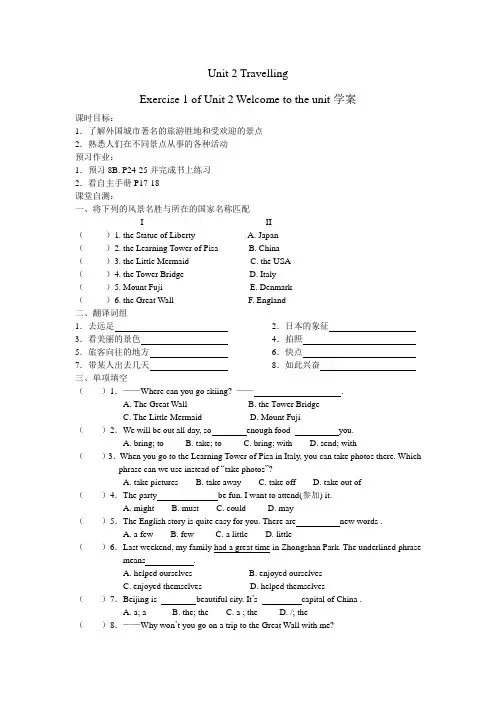
Unit 2 TravellingExercise 1 of Unit 2 Welcome to the unit学案课时目标:1.了解外国城市著名的旅游胜地和受欢迎的景点2.熟悉人们在不同景点从事的各种活动预习作业:1.预习8B. P24-25并完成书上练习2.看自主手册P17-18课堂自测:一、将下列的风景名胜与所在的国家名称匹配I II()1. the Statue of Liberty A. Japan()2. the Learning Tower of Pisa B. China()3. the Little Mermaid C. the USA()4. the Tower Bridge D. Italy()5. Mount Fuji E. Denmark()6. the Great Wall F. England二、翻译词组1.去远足2.日本的象征3.看美丽的景色4.拍照5.旅客向往的地方6.快点7.带某人出去几天8.如此兴奋三、单项填空()1.——Where can you go skiing? ——.A. The Great WallB. the Tower BridgeC. The Little MermaidD. Mount Fuji()2.We will be out all day, so enough food you.A. bring; toB. take; toC. bring; withD. send; with()3.When you go to the Learning Tower of Pisa in Italy, you can take photos there. Which phrase can we use instead of “take photos”?A. take picturesB. take awayC. take offD. take out of()4.The party be fun. I want to attend(参加) it.A. mightB. mustC. couldD. may()5.The English story is quite easy for you. There are new words .A. a fewB. fewC. a littleD. little()6.Last weekend, my family had a great time in Zhongshan Park. The underlined phrase means .A. helped ourselvesB. enjoyed ourselvesC. enjoyed themselvesD. helped themselves()7.Beijing is beautiful city. It’s capital of China .A. a; aB. the; theC. a ; theD. /; the()8.——Why won’t you go on a trip to the Great Wall with me?——Because I there .A. have beenB. will goC. went toD. is going to四、句型转换1.I think you are good at Chinese.(改为否定句)I Chinese. 2.I’ve been to Beijing many times.(对划线部分提问)to Beijing. 3.I want to join the Dancing Club.(改为同义句)I want to the Dancing Club.4.I am going on a trip.(改为同义句)I am .6.Jim and Tom are taking photos. (对划线部分提问)are Jim and Tom ?五、句子翻译1.你能把我的英语书带到这儿来吗?2.让我带你出去几天。
牛津译林版英语八年级下册Unit2Travellingwelcome优秀教学案例

五、案例亮点
1.情景创设:通过展示真实旅行情境的图片和视频,激发学生的学习兴趣和想象力,使学生能够更好地理解和运用所学词汇和句型。
2.问题导向:通过提出旅行相关的问题,引导学生思考和表达,激发学生的探究欲望,提高学生的思维能力和语言表达能力。
2.设计小组讨论活动,让学生就旅行话题展开讨论,如"Where would you like to travel?",鼓励学生表达自己的观点和想法,提高学生的交流和表达能力。
3.通过小组合作,教师可以引导学生学会分享、合作,培养良好的团队精神和交流沟通能力,同时增加学生之间的互动和交流。
(四)反思与评价
四、教学内容与过程
(一)导入新课
1.教师可以通过展示一张自己旅行的照片,引起学生对旅行话题的兴趣,并提出问题:"Do you like traveling? Why?",激发学生的思考和交流欲望。
2.利用多媒体技术,播放一段旅行视频,让学生感受旅行的乐趣和魅力,并提出问题:"What did they do in the video? Can you guess their feelings?",引导学生运用已有知识进行预测和表达。
牛津译林版英语八年级下册Unit2Travellingwelcome优秀教学案例
一、案例背景
牛津译林版英语八年级下册Unit2 "Travelling"旨在通过学习旅行相关的词汇和表达,提高学生的语言运用能力和对实际生活中旅行话题的理解。本单元的核心句型是"What did you do? I stayed in a hotel./I visited the Great Wall./I took a boat trip.",同时涉及不同国家的旅游特色介绍。
八年级英语下册 Unit 2 Travelling Grammar知识点拨 译林牛津版 教案

Unit 2 Travelling一、教学内容:Unit 2 TravellingGrammar二、教学目标:掌握Unit2的词法结构和用法:1. so…that /such…that/enough to/too…to…2. have/has been in, have/has been to, have/has gone to3. 延续性与短暂性动词经典讲解Grammar 1:so…that /such…that/enough to/too…to…解释:如此……以至于……so+ adj. /adv. +that从句或such+单/复数名词+that从句例:It’s so hot in summer that we can’t do without the air conditioner.夏天的天气热的我们少不了空调。
The teacher spoke so fast that I couldn’t understand what he was saying.老师讲得太快以致于我听不懂他在说什么。
He is such a genius that he doesn’t have to study much for exams.他是个天才,所以他考试都不用怎么念书。
They are such good basketball players that everybody wants to watch their games.他们个个都是很棒的篮球员,所以每个人都想去看他们打球。
表示:足以做某事enough to… 如: He is old enough to do it.意思是太……而不能too...to… 例: He is too young to go to school.中考so…that, too…to和enough to都是初中英语教材中的重要结构,在一定条件下它们可以相互转换,并经常成为中考考查的热点之一。
译林版英语八年级下册Unit 2 Travelling教案
译林版英语八年级下册Unit 2 TravellingComic strip & Welcome to the unit教案I. Teaching aims and learning objectivesBy the end of the lesson, students should be able to:1. master the new words, phrases and sentence structures;2. describe different places of interest;3. develop the ability to work in groups.II. Teaching contents1. New words and phrases: travelling, hey, the Great Wall, the Leaning Tower of Pisa,The Little Mermaid, the Statue of Liberty, the Sydney Opera House, Tower Bridge2. New structures: I’m going to South Hill for my holiday.I’ve been there before.Get ready.I’m getting all my things.I don’t think it’ll be a holiday for me.III. Focus of the lesson and predicted area of difficulty1. To master the new words, phrases and sentence structures.2. To talk about places of interest from around the world.IV. Teaching proceduresComic stripStep 1 Lead-inWatch a videoT: Let’s watch a short video first.T: We see many places of interest in the video. Do you want to see them with your own eyes? Do you like travelling/traveling?T: Most of you love travelling. Eddie and Hobo love travelling too. They’re planning a holiday now. Let’s listen to their conversation and find out where they’re going.1. Listen and answer(1) Where is Eddie going?(2) Does Hobo want to go too?(3) What does Hobo want to bring?2. Watch and discuss(1) Why does Eddie agree to take Hobo?(2) Why doesn’t Eddie think it will be a holiday for him?Step 3 Practice1. Listen and repeatT: Now let’s read after the tape. Pay attention to your pronunciation and intonation.2. Complete the passageEddie is going on a trip to South Hill. Hobo has been there before and he wants to Eddie. Eddie agrees. Hobo is very and he all his things with him.Poor Eddie! It will not be a for him, because he has to Hobo’s heavy bag.3. Read and act4. Group discussionT: Hobo wants to bring everything with him when he goes on holiday. Is it necessary? What do you usually bring with you when travelling?Welcome to the unitStep 1 Lead-in1. Places of interest in YangzhouT: Do you know these places of interest in Yangzhou? Have you ever been to these places?T: What other places of interest did you visit in China?2. Places of interest in ChinaT: You have been to so many places of interest. Now I will show you more pictures of places of interest in China.1. The six places of interestThe Great Wall 长城 Beijing China Tower Bridge 塔桥 London Britain Sydney Opera House 悉尼歌剧院 Sydney Australia Statue of Liberty 自由女神像New York America Leaning Tower of Pisa 比萨斜塔 Pisa ItalyLittle Mermaid 美人鱼雕塑 Copenhagen Denmark T: What’s this?S: It’s the Great Wall/the Statue of Liberty/…T: Where is it?S: It’s in Beijing, China/New York, the USA/…T: What’s special about it?S: It’s the longest wall in the world./It is a present from France. It stands for liberty./…2. Read the names of the six places of interest3. Finish part A4. Match the places of interest with their countries5. Play a guessing game(1) It is the longest wall in the world. (the Great Wall)(2) It is a present from French people. It stands for liberty. (the Statue of Liberty)(3) It is leaning. It may fall down some day. (the Leaning Tower of Pisa)(4) The girl has a fish’s tail inst ead of legs. (the Little Mermaid)(5) Its roof looks like a ship’s sails. It is in Australia. (the Sydney Opera House)(6) It is a large bridge over the River Thames in London. It has twin towers. (Tower Bridge)Step 3 Practice1. Listen and answerT: Listen to Part B carefully and answer the following questions.(1) What are Daniel and Millie talking about?(2) What’s special about it?2. Make up new conversationsT: Please work in pairs and make up new conversations. You can use the information in Part A to help you.3. Make a reportT: I know you have been to many other famous places. Please write a short passage about one of them. You can include the following information: What is it? Where is it? What is special about it?Then I’ll choose some of yo u to make a report before the class.4. Talk about travellingT: Most of you like travelling. Please work in groups and talk about what you can get from travelling?V. Homework1. Find more information about places of interest.2. Preview Reading.。
6牛津译林版英语八年级下册Unit2Travelling优秀教学案例
3.教师评价:我会对学生的学习过程和结果进行全面的评价,关注他们的知识掌握程度、技能运用水平、情感态度和价值观等方面。评价结果将以鼓励性、发展性的语言给出,以激发学生的学习兴趣和自信心。
2.学生能够在学习和实践过程中,培养良好的合作意识和团队精神,提高他们的人际交往能力和沟通能力。
3.学生能够通过了解不同国家的旅游景点和风土人情,增强对世界多元文化的尊重和包容,培养良好的跨文化交际能力和全球观念。
三、教学策略
(一)情景创设
1.真实情境:在教学之初,我将会利用多媒体展示不同国家的旅游景点图片和视频,让学生仿佛置身其中,激发他们的学习兴趣和欲望。通过这种方式,学生可以更直观地了解本单元的主题,从而更好地融入后续的学习活动。
2.学生能够通过观察、讨论和实践等环节,深入了解旅游相关词汇和语法知识的用法,提高他们的语言运用能力和实际操作能力。
3.学生能够在教师的指导下,运用多媒体教学手段,如图片、视频等,进行听力训练和口语练习,提高他们的听力和口语技能。
(三)情感态度与价值观
1.学生能够通过学习本单元的内容,增强对旅游文化的兴趣和热爱,提高他们的文化素养和人文素养。
2.交流互动:在小组合作的过程中,学生需要进行充分的交流和互动,分享自己的观点和经验,倾听他人的意见和建议。通过这种方式,学生可以提高他们的沟通能力,增强合作意识。
(四)反思与评价
1.学生自主反思:在教学过程中,我会鼓励学生对自己的学习过程进行反思,如“我在学习中遇到了哪些困难?我是如何克服这些困难的?”等。通过这种方式,学生可以更好地了解自己的学习情况,找到不足之处,提高自我调整和自我完善的能力。
Unit2Travelling教学设计3牛津译林版英语八年级下册
Postreading
1. Activities can be used if you are interested:
2. Ask Ss to guess the place you give.
3. Talk about the theme park.
4. Describe one of your trips to the park.
当堂检测反馈:(见学案)
家庭作业:
1. Recite the key phrases and learn the language points by heart.
2. Try to say something interesting to parents about Hong Kong Disneyland.
4) The performers all wore different costumes and waved to people while they marched across the park, singing and dancing all the way.
5) The children clapped and screamed with joy.
3. To recognize and understand vocabulary about travelling.
2.过程与方法
To retell the main idea of the text
3.情感、态度与价值观
To understand the use of some words through the exercises.
XXX中学课堂教学设计
XXXX年月日
牛津译林版八年级下册Unit2《Travelling》说课稿
牛津译林版八年级下册Unit 2《Travelling》说课稿一. 教材分析《牛津译林版八年级下册Unit 2 Travelling》是一篇关于旅行的文章,通过描述不同人的旅行经历和目的,让学生了解和掌握与旅行相关的词汇和表达方式。
本篇文章题材贴近学生的生活,能够激发学生的学习兴趣,同时培养学生的阅读能力和语言运用能力。
二. 学情分析八年级的学生已经具备了一定的英语基础,能够理解和运用一些基本的英语知识。
但是,对于一些与旅行相关的词汇和表达方式,他们可能还比较陌生。
因此,在教学过程中,需要注重引导学生理解和运用这些新词汇和表达方式。
三. 说教学目标1.知识目标:学生能够掌握本课的生词和短语,理解文章的主旨大意,能够运用所学知识进行简单的英语交流。
2.能力目标:学生能够提高阅读理解能力,能够运用所学知识进行写作和口语表达。
3.情感目标:学生能够培养对旅行的兴趣,增强对不同文化的认识和理解。
四. 说教学重难点1.重点:学生能够掌握本课的生词和短语,理解文章的主旨大意。
2.难点:学生能够运用所学知识进行写作和口语表达,以及对文章中一些细节内容的理解。
五. 说教学方法与手段1.交际法:通过小组讨论、角色扮演等形式,让学生在实际语境中运用所学知识,提高口语表达能力。
2.任务型教学法:通过完成各种任务,让学生在实践中学习和发展语言能力。
3.情境教学法:通过创设各种情境,让学生在真实的语境中学习和运用语言。
六. 说教学过程1.导入:通过展示一些旅行图片,引导学生谈论自己的旅行经历,激发学生的学习兴趣。
2.阅读理解:学生独立阅读文章,回答相关问题,检查学生对文章内容的理解。
3.新课导入:讲解本课的生词和短语,让学生通过例句理解并运用这些词汇。
4.课堂活动:通过小组讨论、角色扮演等形式,让学生运用所学知识进行实际操作。
5.写作练习:让学生根据文章内容,写一篇关于自己旅行的作文。
6.总结:对学生的学习情况进行总结,对学生的表现进行评价。
译林版版英语八年级下册第二单元全套教案
Unit 2 TravellingWelcome to the unitTeaching aims:1. To know foreign city famous tourist resort and popular attraction2. Be familiar with the scenic spot and the countryTeaching procedures:Step 1 Lead-inDo you like travelling?Do you know any famous tourist attractions in Yancheng?Step 2 Listen and answer more questions.1. Is Eddie happy in the first picture? Why?2. Where is Eddie going?3. Does Eddie want to go too?4. What does Hobo want to bring?5. Does Eddie feel happy at last? Why?Step 3 Let students look at the picture then act the dialogue out.Step 4 ExplanationI don’t think it’ll be a holiday for me.我想对我而言这不会是什么假期了。
这是个否定前移的句子,主句中的否定词实际是否定了从句中的内容。
当主句含有I think, I believe等词语时,通常否定前移。
e.g. I don’t think it is a good idea.我认为那不是个好主意。
Step 5 PresentationShow some pictures about some places of interest in China.e.g. The New Fourth Army MemorialYancheng Nature ReserveMilu Deer Nature ReserveStep 6 Welcome the unitTask If you have a chance (机会) to travel abroad (出国旅游), where will you go?Then show some pictures about some popular attraction in foreign Countries: the Leaning Tower of Pisathe Statue of LibertyMount Fujithe Little Mermaidthe Tower BridgeStep 7 Read and guess1. It is the longest wall in the world.2. It is a present from French people. It stands for Liberty.3. It sounds like pizza. It is leaning. It may fall down some day.4. The girl has a fish’s tail instead of legs.5. It is the busiest performing arts centre in the world.6. It is a large bridge over the River Thames in London. It has twin towers. Step 8 Work in pairsA: What’s this, Millie?B: It’s the Little Mermaid.A: Where is it?B: It’s in Copenhagen, the capital of Denmark.A: What’s spe cial about it?B: It comes from the story by Hans Christian Andersen.A: Have you ever been there? B: No, I haven’t.Step 9 Do some exercises根据中文提示完成句子:1. Eddie ________________. (去南山度假)2. A: I _____________________. (以前去过那儿)3. A: What’s she doing?B: She ______________________ (正在收拾她所有的东西) 。
牛津译林版英语八下Unit2《Travelling》说课稿
牛津译林版英语八下Unit 2《Travelling》说课稿一. 教材分析牛津译林版英语八下Unit 2《Travelling》主要讲述了关于旅行的相关话题。
本单元通过介绍不同类型的旅行方式、旅行计划、旅行中的注意事项等,帮助学生掌握与旅行相关的词汇和表达方式,提高学生的听说读写能力。
教材内容丰富,贴近学生生活,有利于激发学生的学习兴趣。
二. 学情分析八年级的学生已经具备了一定的英语基础,对于日常生活中的基本表达已经能够熟练运用。
但是,对于一些关于旅行的专业词汇和表达方式可能较为陌生。
因此,在教学过程中,需要关注学生的个体差异,针对不同学生的学习需求进行引导和帮助。
三. 说教学目标1.知识目标:学生能够掌握与旅行相关的词汇和表达方式,如旅行方式、旅行计划、旅行注意事项等。
2.能力目标:学生能够听懂、会说、会读、会写关于旅行的句子,提高学生的听说读写能力。
3.情感目标:通过本单元的学习,学生能够培养对旅行的兴趣,提高对英语学习的热情。
四. 说教学重难点1.重点:学生能够掌握与旅行相关的词汇和表达方式。
2.难点:学生能够运用所学的词汇和表达方式进行实际交流,编写关于旅行的短文。
五. 说教学方法与手段1.交际法:通过模拟真实场景,让学生在实际交流中运用所学知识。
2.任务型教学法:通过完成各种任务,激发学生的学习兴趣,提高学生的参与度。
3.多媒体辅助教学:利用多媒体课件、图片、视频等丰富教学手段,提高学生的学习兴趣。
六. 说教学过程1.导入:以一段关于旅行的视频导入,激发学生的学习兴趣。
2.新课呈现:通过展示图片、实物等,引入本节课的主题,引导学生学习相关词汇和表达方式。
3.课堂练习:设计不同类型的练习,让学生在实际交流中运用所学知识。
4.小组活动:学生分组进行讨论,分享各自的旅行经历,促进学生之间的交流。
5.课堂小结:对本节课所学内容进行总结,帮助学生巩固记忆。
6.课后作业:布置相关任务,让学生课后进行练习,巩固所学知识。
【最新】牛津译林版八年级英语下册Unit 2 Travelling教案4
Unit 2 Travelling 教案课题:Grammar教学目标:1.知识目标:学习词汇:sand, countryside, over, marry, dead学习词组:on the first day of, Ocean Park, dolphin show学习句子:Millie and Amy have been to South Hill.Kitty and her family have gone to Hong Kong.I see Andy playing on the sand too.Mr Dong has lived here for many years.Mr Dong has lived here since he was born.2. 技能目标:1) 区别运用have/has been 和have/has gone。
2) 学习现在完成时延续性的动作或状态的表示方法。
3) 理解非延续性动词和延续性动词的不同用法,以及他们之间的转换。
3. 情感目标:学会使用恰当规范的语言。
在与他人对话中学会准确表达自己的思想。
教学重点:have been 和have gone.理解非延续性动词和延续性动词的不同用法,以及他们之间的转换。
教学难点:进一步区分理解非延续性动词和延续性动词的不同用法,以及他们之间的转换。
教学教具:录影机,多媒体,实物等。
教学过程:Step1:预习指导与检测,见导学案。
Step2:展示目标,见导学案。
Step3:课堂导学与互动:任务一:Using have/has been and have/has goneWhere has Kitty been?Has she ever been to Hong Kong Disneyland?Has she ever been to...?任务二:Work out the ruleWe use ‘have (has) been’ to express the idea that someone went to some place and has already come back.1. Millie and Amy have been to South Hill. They want to go there again.2. Sandy has never been to South Hill. She wants to go with them.We use ‘have (has) gone’ to express the idea that someone went to a place but has not yet returned.1. Kitty and her family have gone to Hong Kong. They will come back next week.2. Suzy is not at home at the moment. She has gone to the bookshop.任务三:Daniel and Millie are chatting at a weekend. Complete their conversation with the correct forms of the verbs in bracket.Daniel: I haven’t seen Mr Wu for days. Where (1) ______ he ______ (go)?Millie: He (2) __________ (go) to Tianjin to attend a meeting.D: (3) _____ you _____ (be) anywhere recently?M: Yes, I (4) __________ (be) to Hainan with my parents.D: Oh, that’s great! (5)______ you _______ (be) to Sanya?M: Sure, we (6) __________ (be) to the beach there. Look at these photos.D: The beach is beautiful. I see Andy playing on the sand too.M: Yes. We went there with his family.D: I see. By the way, shall we invite Andy to go for a picnic tomorrow?M: Andy isn’t here this weekend. He and his parents (7) _________ (go) to the countryside. The y will be back tomorrow afternoon.任务四:判断下列句子的正误( ) 1. I have been to the library to borrow the famous book, it’s on my bookshelf now.( ) 2. Daisy has been to the supermarket and I don’t know when she will be back.( ) 3. A: Where is Mr. Clark, why can’t I see him?B: He has been to the hospital, he feels a little ill.( ) 4. Dad has gone to the office. I don’t know how to spend the lonely time.( ) 5.Simon has never gone to Europe, he hopes some day he can go there for a holiday. 小组活动,请某一个组员到老师办公室去拿作业本,组长问Where has … gone?过了一会儿,他(她)从办公室回到了教室,组长问他(她):Where have you been? Or Where were you?(你们能区别have been和have gong吗?小组讨论一下,请互相帮助哟!)任务五:Verbs with for and sinceQuestions about reading:How long hasn’t Kitty seen Millie?How long has Kitty been in Hong Kong?任务六:Work out the rulefor + 时间段since + 时间点任务七:非延续性动词/短暂动词与延续性动词begin/start have/has been onstop /finish have/has been overcome/go/arrive have/has been in/atleave have/has been awayborrow have/has keptjoin have/has been a member of/ have/has been inbuy have/has hadget married /marry have/has been marrieddie have/has been deadopen have/has been openclose have/has been closedfall asleep have/has been asleepturn on/off have/has been on/offfall ill have/has been illcatch a cold have/has had a coldget to know have/has knownbegin to learn have/has learnedget up have/has been upbecome interested in have/has been interested inreturn/come back/go back have/has been backExercisesStep4:总结提升1.你是如何掌握本课的学习内容的?__________________________________________________________________2.方法点拨:__________________________________________________________________Step5:当堂反馈见导学案。