
译林版七年级英语下册Unit 2 Grammar教案
课题 Unit 2 Neighbours
Grammar 课时 4
教学目标 1. 知识目标:1. New words: shall, fire
2. Useful expressions: the day after tomorrow, make a fire
2. 能力目标:1. To develop an understanding of the simple future tense with
‘will’ and ‘shall’.
2. To develop an understanding of the simple future tense with
‘be going to’.
3. To use “will”‘be going to’ and “shall”to talk about future
plans.
教 学
重、难点 1. 一般将来时的肯定句、否定句和一般疑问句的构成
2. will/shall 和be going to 的区别
教、学具 Some pictures, PPT
预习要求 Learn about the use of the simple future tense
教师活动内容、方式 学生活动内容、方式 旁注
Step1. Lead-in
1. Ask the students some questions about the future and
get them to answer the questions by using the future
tense.
What will you do this afternoon?
Where shall we meet tomorrow morning?
Will you be a teacher when you grow up?
2. Get the students to complete the sentences
1) We hope you___________(come )to my party
tomorrow.
2) _______she_____(go) to Yangzhou next month?
3) Tom_________(be)18 years old next year.
4) Where ______ you_____(visit) the day after
tomorrow ?
5) What_______(be) you going to do after class ?
6) —_______he _______ (play) basketball the day
after tomorrow ?
—Yes, he is.
Step2. Presentation
Answer with their own
information
Do some exercises
Learn and understand
1. Explain the simple future tense to the students
1) 一般将来时的两种基本结构
(1)由will/shall构成的一般将来时的结构
(2)由be going to构成的一般将来时的结构
2) 常用于一般将来时的时间状语
soon, tomorrow, the day after tomorrow, this
afternoon, this evening, this year, in the future, in
two weeks/days, next week/month/year/summer
3) 两种基本句型的区别
“主语+be going to+动词原形”表示一个事先考虑好的意图,相当于中文的“打算,计划,准备”;而“will/shall”则表示一种意愿,是未经考虑的意图。
4) 使用一般将来时要注意的一些情况
(1)如果将来时中的时间状语是in 引导的一段时间,则用 how soon (多久以后)来提问。
(2)There be 结构的将来时:There will be…/There
is going to be…
Step3. Practice
1. Get the students to complete the exercises on P23 &
P24
2. Get the students to read the two dialogues.
3. Do some additional exercises
句型转换:
1) I will visit the museum tomorrow. (否定句,一般疑问句, 提问)
2) She is going to ask him for help this evening.
(否定句,一般疑问句, 提问)
动词填空:
1) We ______ (meet) outside the school gate
tomorrow.
2) How _____ they ______ (visit) the History
Museum next week?
3) Look! The sun ___________ (shine) in through
the window.
4) He _________ (sit) on the balcony and
________ (look) out at the park at present.
5) Mr white ________(take) you to Shanghai next
month.
6) There ______(not be) a new film in the cinema
Complete the
exercises
Practice reading the
dialogue
Do some exercises
tomorrow evening.
7) He _______(come) to our school for a visit the
day after tomorrow.
Step4. Homework
1. Review the contents of this lesson.
2. Do the Ex of the workbook.
教后记
新目标七年级英语下册Unit 2教案
Unit2 Where’s the post office?
一.教学目标
1.知识目标
1).重点词汇
* post office, hotel, video arcade, bank, park, supermarket, street, pay phone, avenue
* new, clean, quiet, big, small, dirty, old, busy
* left, right, next to, across from, near, between
2). 语言目标
* Is there a bank near here ? Yes, there’s a bank on Center Street.
* Where’s the supermarket ? It’s next to the library.
* Is there a pay phone in the neighborhood ? Yes, it’s on Bridge Street on the right.
* Where 引导的特殊疑问句
* 肯定陈述
* 表示方位的介词
3).语言功能
在街道上问路与指路
2.能力目标
通过本单元的学习,掌握问路与指路的基本语句,并能运用于现实生活中。
3.策略目标
1).联系上下文,利用情景思维。
2).转换具体信息。
4.情感目标
1).培养方位感。
2).在社会这个大家庭中,注重人际关系与交往,养成助人为乐的好习惯。
二.教学重、难点
1.重点: 1).表方位的介词:near、across from、next to、between、on
2).问路与指路的基本语句
2.难点:
1).本单元词汇量较大( 生词表中列出44个单词,9条短语;课文中还有一些短语)。
2).个别句子有一定难度,如:
七年级英语下册Unit2NeighboursGrammar教案(新版)牛津版

1 Unit 2 Neighbours
Grammar
I. Teaching aims and learning objectives
By the end of the lesson, students should be able to:
1. know what the simple future tense is;
2. learn how to use the simple future tense correctly;
4. talk about things that will happen in the future.
II. Teaching contents
New words and phrases: shall, fire, the day after tomorrow, make a fire
III. Focus of the lesson and predicted area of difficulty
1. To use the simple future tense correctly.
2. To talk about the actions that will happen in the future.
IV. Teaching procedures
A Simple future tense with will and shall
Step 1 Revision
1. Enjoy a song
T: First, please enjoy a song. Let’s sing together. How will the school be today?
2. About Simon
(1) Where does Simon live?
(2) What do you think of his neighbours?
(3) Do you think Simon is lucky to live in such a neighbourhood? Why?
牛津译林版七年级下Unit 2 Neighbours 教案
1 / 2
Unit 2 Neighbours
Lesson 5
【教学目标】
知识目标
能了解朗读时常见的连读方式。
能力目标
能使用正确的连读方式朗读句子。
情感目标
如何在朗读中正确时候用连读。
【教学重难点】
如何在朗读中正确时候用连读。
【教学过程】
Step I 呈现
1.播放一段英美人士说话的片段,让学生听听他们在说什么。
2.学生反复辨听后,给学生提供文本,让他们朗读。启发学生发现两种朗读方式的不同,从而引导出英美人士说话时的连读现象。教师说:We often link sounds together when we speak
English. Can you find out the wayside of linking sounds together?
3.教师呈现图片,引入本课内容。教师说:Look at this picture. What can you see? 学生回答:I can see an apple.
一家三口的图片:Look at the little boy. He’s tom. Who are these two people? They are tom’s
father and mother.
几只狗和一条鱼的图片:Look at the dogs. Do they like eating fish? Of course not. They don’t
like eating fish. So they go away.
4.教师指导学生正确朗读四组短语。启发学生发现连读的规律。阅读示例。
We usually link a consonant sound with a vowel sound.
When the first word with in –r or –re and the next word begins with a vowel sound, we join
译林版高中英语必修三Uint2 Grammar and usage (II) 教案(雅礼版)
Unit 2 Natural disasters
Grammar and usage (II)
To-infinitives as attributives and adverbials of result
内容分析:
本板块围绕单元话题, 引导学生在关于“经历飓风”的采访中观察、识别、探究动词不定式做定语和结果状语的用法;在此基础上,让学生自主归纳出该语法项目的核心规则;随后通过句子和语篇两个层面的练习,巩固动词不定式做定语和结果状语的用法;最后要求学生使用动词不定式完成一段对话。
教学目标:
By the end of this section, students will be able to:
1. identify and categorize the use of to-infinitives as attributives and adverbials of
result;
2. summarize general rules of to-infinitives as attributives and adverbials of result;
3. apply the rules and to use to-infinitives to complete or make sentences.
教学重难点:
1. To summarize the general rules;
2. To apply the rules correctly and properly.
教学过程:
Step 1 Homework checking
a. object b. object complement
c. attributive d. adverbial of purpose e. adverbial of result
______1. I’m sorry that I cannot come to your birthday party tomorrow as I have an
译林版高中英语必修三Unit2 Grammar and usage 教案
1 《英语》(必修·第三册)
Unit 2 Natural disasters
Grammar and usage
I. Learning objectives
By the end of the lesson, students will be able to:
1. understand the functions of to-infinitives as attributives and adverbials of result;
2. use to-infinitives as attributives and adverbials of result properly in different situations;
3. rewrite a passage using to-infinitives.
II. Key competence focus
Use to-infinitives as attributives and adverbials of result correctly and properly.
III. Predicted area of difficulty
1. Use to-infinitives as attributives and adverbials of result in new situations.
2. Rewrite a passage using to-infinitives.
IV. Teaching procedures
Step 1 Lead-in
T: Hello, everyone. Last period we read two news reports about the lucky escapes from two
natural disasters. First, I’d like to show your some sentences in these two news reports.
译林牛津版初中英语七年级下册Unit 8 第3课时Grammar教学案(含课时练习)
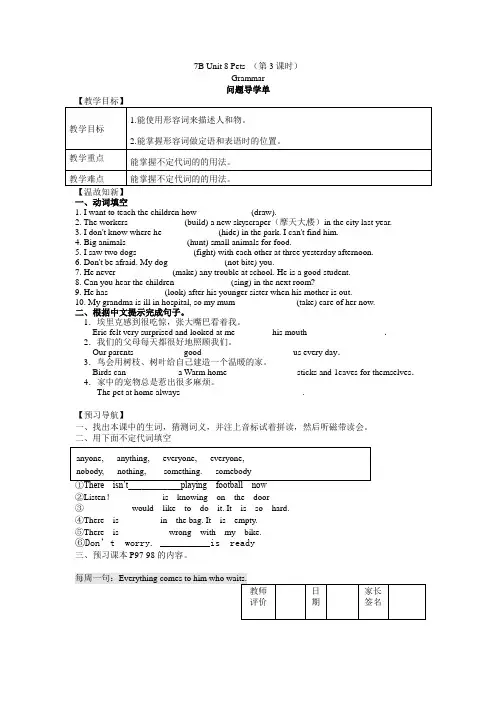
7B Unit 8 Pets (第3课时)
Grammar
问题导学单
【教学目标】
教学目标 1.能使用形容词来描述人和物。
2.能掌握形容词做定语和表语时的位置。
教学重点 能掌握不定代词的的用法。
教学难点 能掌握不定代词的的用法。
【温故知新】
一、动词填空
1. I want to teach the children how____________ (draw).
2. The workers ____________ (build) a new skyscraper(摩天大楼)in the city last year.
3. I don't know where he ____________ (hide) in the park. I can't find him.
4. Big animals _____________ (hunt) small animals for food.
5. I saw two dogs ____________ (fight) with each other at three yesterday afternoon.
6. Don't be afraid. My dog ____________ (not bite) you.
7. He never ____________ (make) any trouble at school. He is a good student.
8. Can you hear the children ____________ (sing) in the next room?
9. He has ____________ (look) after his younger sister when his mother is out.
10. My grandma is ill in hospital, so my mum _____________ (take) care of her now.
译林版高中英语选必二Unit2 Grammar and usage 教案
1
《英语》(选择性必修·第二册)
Unit 2 Sports culture
Grammar and usage
I. Learning objectives
By the end of the lesson, students will be able to:
1. understand passive voice in the past continuous and past perfect tenses and know the
regulations of them.
2. use the passive voice in the past continuous and past perfect tenses skillfully in topics.
3. use the passive voice in the past continuous and past perfect tenses to communicate with
classmates freely.
4. acknowledge the sportsmanship through reading a blog written by Nicole.
II. Key competence focus
Master and practice the passive voice in the past continuous and past perfect tenses.
III. Predicted area of difficulty
Use the passive voice in the past continuous and past perfect tenses skillfully in topics.
IV. Teaching procedures
Step 1 Lead-in
T greets the class.
【译林版七年级英语下册教案】Unit2ReadingII
Reading II
新课导入
Revision
Complete the passage.
Amy: Hi, Simon. (1) ______ are your neighbors like?
Simon: They ’ re kind and (2) _______. Some of them are (3) __________.
They often meet at the (4) __________ center and share their different (5)
_____. They help us with all kinds of (6) _________.
Amy: (7) ______ do they meet?
Simon: Usually they have a “ helping hands ” meeting at the weekend.
Amy: Are they going to have a meeting this weekend?
Simon: Yes. There ’ s something wrong with my (8) __________. I ’ m going to ask a
computer (9) ________ to check it. My cousin Annie ’ s(10) _______ is
broken, so she ’ s going to ask someone to (11) ____ it.
Amy: Can you find (12) _______ to help you with your homework?
Simon: Yes. Some (13) _______ students are ready to help.
Amy: That ’ s really nice. Do the (14) __________ help the old people too?
牛津译林版七年级英语上册Unit-2 grammar语法课时教案
牛津译林版七年级英语上册
7A Unit2 Let's play sports ----Grammar
Teaching aims
1. 了解常用语言形式的基本结构和常用表意功能
2. 在实际运用中体会和领悟语言形式的表意功能。
Teaching objectives
Knowledge objectives:
1. To grasp what the simple present tense is and when to use it.
2. To learn to use the verb to do in the simple present tense.
Ability objectives:
To talk about sb./ sth. using the verb to do in the simple present tense.
Teaching procedure
StepⅠ. Revision
Say:I am your English teacher. You are my students. We are in Class3, Grade 7.
This is our classroom. It is big and new. There are thirty students in our class.
Bella is our monitor(班长).Ms Han is our head teacher. We are happy.
总结:我们常使用“to be” 的一般现在时谈论事实和状态。
StepⅡ. Presentation
Say: Kobe plays basketball very well. Many students like him. They often watch
his games on TV. In my free time, I like watching TV too. But my friend
译林版英语七年级下册_Unit2_Reading精品教案
1 / 6
Unit2 Reading精品教案
Period1
教学目标:1. Understand the knowledge about the centre of a town.
2. Be able to introduce in English.
重点:To know about the neighbourhood.
难点;To talk about the neighbourhood they live.
新课导入
通过讨论下面问题导入新课。
1. Where do you live?
2. How many buildings are there in your neighborhood?
3. What do you have around your neighborhood?
4. Do you like living there?
5. Do you often help your neighbors?
6. What are your neighbors like?
新课讲授
Step 1 New words
要求学生快速阅读对话部分,并找出对话中的生词。然后,教师进行讲解。
helpful community skill problem something engineer check broken
someone fix anyone college
Step 2 Warming up
1) Who’s your neighbor?
What does he/she do?
What do you think of him/her?
Do you welcome him/her to your home?
Do you always help each other?
2) Look at community centre posters, and then answer the questions.