
八年级英语上册unit1wheredidyougoonvacation知识点课件
Section A
Section B
Section A
Section B
Section A
Section B
3.We took quite a few photos there.(教材P2)我们在那里拍了不 少照片。 [解读] quite a few 意为“很多;不少”,该短语可单独使用,也可修饰 可数名词复数,表示数量很多。 I have quite a few friends in Nanjing. 我在南京有很多朋友。 拓展quite a little 意为“很多;不少”,修饰不可数名词。 There is quite a little water on the floor. 地板上有很多水。
Section A
Section B
4.And because of the bad weather,we couldn’t see anything below.(教材P5)并且因为糟糕的天气,底下的东西我们什么都看不 到。 [解读1] because of 为介词短语,意为“因为”。 He didn’t go to the cinema because of the cold weather. 因为天气冷,他没有去看电影。
考查星级 ★★ ★ ★★ ★ ★ ★★ ★★ ★
1.decide 的用法 2.feel like 的用法 Section B & Self 3.difference 的用法 Check 4.because of 5.below 的用法 6.enough 的用法 语法聚焦 一般过去时的用法 复合不定代词的用法
Section A
Section B
3.What a difference a day makes!(教材P5)一天的差异是多么大 呀! [解读] difference为可数名词,意为“差别;差异”,其形容词形式为 different,意为“不同的”,常用短语be different from...,意为“与……不 同”。 There are a lot of differences between the two pictures. 这两幅图画之间有许多不同之处。 English names are different from Chinese names. 英国人的姓名与中国人的姓名不同。
第三人称 herself,himself,itself themselves
②反身代词主要表示强调,把谓语动作反射到主语或宾语上,在 句中主要做宾语或同位语。 I bought a new pen for myself yesterday. 昨天我为自己买了一支新钢笔。
Section A
Section B
Section A
Section B
名师解题
Section A
Section B
Section A
Section B
Section A
Section B
2.Did you go with anyone?(教材P2)你和其他人去的吗? [解读] anyone为复合不定代词,意为“任何人”,常用于否定句或疑 问句中。 We can’t see anyone in the library. 我没看见图书馆里有人。 Is anyone in?有人在家吗? 注意anyone表示“任何人”时也可用于肯定句中。 It’s a piece of cake.Anyone can answer the question. 小菜一碟,任何人都会回答这个问题。
Section A
Section B
名师解题
Section A
Section B
Section A
Section B
5.I bought something for my parents,but nothing for myself.(教 材P3)我给我的父母买了一些东西,但是给自己什么都没买。 [解读] myself为反身代词,意为“我自己”。在句中常做宾语、表 语或同位语。反身代词的人称要跟句子主语一致。 归纳含有反身代词的常用短语:
Section A
Section B
Your father seems quite happy. 你的父亲看起来很高兴。 He seems a nice boy.他看起来是个好男孩。 It seems like a good idea.这个主意好像不错。 Li Fang seems to know everything. 李芳好像什么都知道。 It seems that he is very sad.他似乎很难过。 [解读2] bored做形容词,意为“厌倦的;烦闷的”,主语通常是人。 I felt bored because I had nothing to do. 因为我没事可做,所以我感到烦闷。
Section A
Section B
拓展①反身代词有人称和数的变化,单数词尾为-self,复数词尾为 -selves。第一、二人称是“形容词性物主代词+self(selves)”,第三人 称用“宾格形式人称代词+self(selves)”。如下表:
人称数 第一人称 第二人称 myself yourself 单数 复数 ourselves yourselves
Section A
Section B
Section A
Section B
专题一:一般过去时用法大观 本单元语法为一般过去时,现把其用法归纳如下:
Did you have a party the other day? 前几天你们开派对了吗? The boy opened his eyes for a moment,looked at the captain,and then died. 男孩把眼睛张开了一会儿,看看船长,然后就去世了。 Mrs.Peter always carried an umbrella. 彼得太太总是带着一把伞。 I didn’t know you were in Paris. 我不知道你在巴黎。
Unit 1
Where did you go on vacation?
知识点 1.anything special 2.anyone 的用法 3.quiet a few Section A 4.most 的用法 5.动词不定式做状语 6.反身代词及其用法 7.seem 的用法 8.bored 的用法
★ ★ ★ ★★ ★ ★★ ★★ ★★
Section A
Section B
1.Did you buy anything special?(教材P2)你买了什么特别的东 西吗? [解读] anything为复合不定代词,意为“任何事物;任何东西”,主要 常用于疑问句、否定句和条件状语从句。anything special表示“特 别的东西”,形容词修饰复合不定代词时要置于不定代词之后。 Is there anything new in the newspaper? 报纸中有什么新内容吗? 注意anything用在肯定句中时,表示“任何事”。 I can do anything for you. 我能为你做任何事情。
Section A
Section B
归纳
They can’t decide whom to invite. 他们不能决定邀请谁。 Let’s first decide where we should go. 我们先决定一下到哪里去。
Section A
Section B
2.I felt like I was a bird.(教材P5)我感觉我是一只鸟。 [解读] feel like意为“……的感觉;感受到……”,其中的like为介词, 意为“像……”,其后可用名词、代词或动词-ing形式。 The interview only took ten minutes,but it felt like hours. 面试只花了十分钟,但是我觉得像几个小时似的。 拓展feel like还可意为“想要……”,后跟名词,相当于want/would like,feel like后跟动词做宾语时应用动词-ing形式;而want和would like后接动词不定式。 I don’t feel like eating anything. 我不想吃任何东西。 I want to drink some water. 我想要喝点儿水。 He would like to go for a walk.他想去散步。
Section A
Section B
名师解题
Section A
Section B
Section A
Section B
5.My father didn’t bring enough money,so we only had one bowl of rice and some fish.(教材P5)我爸爸没带足够的钱,所以我 们仅仅吃了一碗米饭和一些鱼。 [解读] enough做形容词,意为“充足的,充分的”。 We need enough workers to do the work. 我们需要足够的工人来做这项工作。 拓展
There are enough seats(seats enough)for them all. 有足够的座位让他们都坐下。 He walks slowly enough.他走得够慢的了。
Section 可用very修饰,但可以用quite修饰。 We have quite enough time. 我们有足够的时间。
Section A
Section B
易混辨析
Section A
Section B
Section A
Section B
Section A
Section B
Section A
Section B
4.I just stayed at home most of the time to read and relax.(教材 P2)我大部分时间只是待在家里读书、放松。 [解读1] most of the time意为“大部分时间”,其中most为代词,意为 “大部分;大多数”,常与介词of连用,构成“most of+名词或代词的复 数形式/不可数名词”,它做主语时,谓语动词形式取决于most of所修 饰的名词。 [解读2] to read and relax为动词不定式做状语,表示目的。 I often get up early to catch the early bus. 为了赶早班车,我经常早起床。
Unit 1 Where did you go on vacation? 知识点人教版英语八年级上册
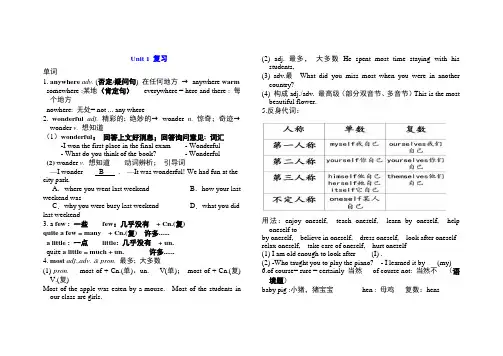
Unit 1 复习单词1. anywhere adv. (否定/疑问句) 在任何地方→anywhere warm somewhere :某地(肯定句)everywhere = here and there : 每个地方nowhere: 无处= not ... any where2. wonderful adj.精彩的; 绝妙的→wonder n.惊奇;奇迹→wonder v. 想知道(1)wonderful:回答上文好消息;回答询问意见; 词汇-I won the first place in the final exam - Wonderful- What do you think of the book? - Wonderful (2) wonder v. 想知道动词辨析;引导词—I wonder ____B____. —It was wonderful! We had fun at the city park.A.where you went last weekend B.how your last weekend wasC.why you were busy last weekend D.what you did last weekend3. a few : 一些few:几乎没有+ Cn.(复)quite a few = many + Cn.(复) 许多......a little : 一点little: 几乎没有+ un.quite a little = much + un. 许多......4. most adj.,adv. & pron. 最多; 大多数(1) pron. most of + Cn.(单)、un. V(单);most of + Cn.(复) V.(复)Most of the apple was eaten by a mouse. Most of the students in our class are girls. (2) adj. 最多,大多数He spent most time staying with his students,(3) adv.最What did you miss most when you were in another country?(4) 构成adj./adv. 最高级(部分双音节、多音节)This is the most beautiful flower.5.反身代词:用法:enjoy oneself, teach oneself, learn by oneself, help oneself toby oneself, believe in oneself, dress oneself, look after oneself relax oneself, take care of oneself, hurt oneself(1) I am old enough to look after ____(I) .(2) -Who taught you to play the piano? - I learned it by ___(my) 6.of course= sure = certainly 当然of course not: 当然不(语境题)baby pig :小猪,猪宝宝hen : 母鸡复数:hens7. seem: 似乎,好像(1) seem (to be ) + adj./n. 似乎/ 好像...... They seem very happy.(2) seem do sth. 好像做某事N ow it's cloudy. it seems to rain (rain).(3)It seems + that从句。
八上英语Unit1《Where did you go on vacation》知识
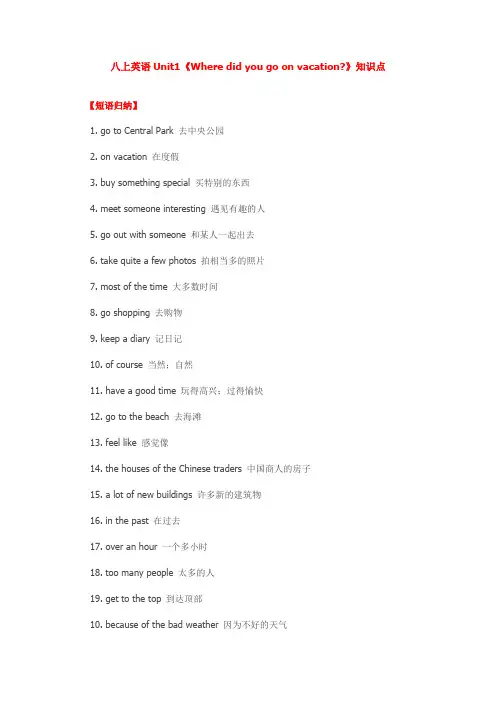
八上英语Unit1《Where did you go on vacation?》知识点【短语归纳】1. go to Central Park 去中央公园2. on vacation 在度假3. buy something special 买特别的东西4. meet someone interesting 遇见有趣的人5. go out with someone 和某人一起出去6. take quite a few photos 拍相当多的照片7. most of the time 大多数时间8. go shopping 去购物9. keep a diary 记日记10. of course 当然;自然11. have a good time 玩得高兴;过得愉快12. go to the beach 去海滩13. feel like 感觉像14. the houses of the Chinese traders 中国商人的房子15. a lot of new buildings 许多新的建筑物16. in the past 在过去17. over an hour 一个多小时18. too many people 太多的人19. get to the top 到达顶部10. because of the bad weather 因为不好的天气21. one bowl of fish 一碗鱼肉22. another two hours 另外两个小时23. the top of the hill 山顶24. learn something important 学习重要的东西25. go to the countryside 去乡下26. in the shopping center 在购物中心27. have a fun time 玩得高兴;过得愉快28. after three hours 三个小时以后29. keep going 一直走30. twenty minutes later 20分钟后【重点句子】1. Where did you go on vacation? 你去哪儿度假的?2. Long time no see. 好久不见。
八年级英语上册Unit1Wheredidyougoonvacation基础知识点归纳总结(带答案)
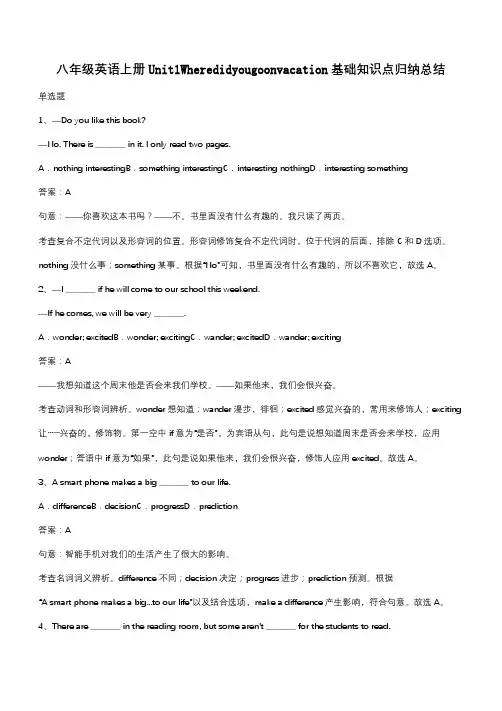
八年级英语上册Unit1Wheredidyougoonvacation基础知识点归纳总结单选题1、—Do you like this book?—No. There is ________ in it. I only read two pages.A.nothing interestingB.something interestingC.interesting nothingD.interesting something答案:A句意:——你喜欢这本书吗?——不。
书里面没有什么有趣的。
我只读了两页。
考查复合不定代词以及形容词的位置。
形容词修饰复合不定代词时,位于代词的后面,排除C和D选项。
nothing没什么事;something某事。
根据“No”可知,书里面没有什么有趣的,所以不喜欢它,故选A。
2、—I ________ if he will come to our school this weekend.—If he comes, we will be very ________.A.wonder; excitedB.wonder; excitingC.wander; excitedD.wander; exciting答案:A——我想知道这个周末他是否会来我们学校。
——如果他来,我们会很兴奋。
考查动词和形容词辨析。
wonder想知道;wander漫步,徘徊;excited感觉兴奋的,常用来修饰人;exciting 让……兴奋的,修饰物。
第一空中if意为“是否”,为宾语从句,此句是说想知道周末是否会来学校,应用wonder;答语中if意为“如果”,此句是说如果他来,我们会很兴奋,修饰人应用excited。
故选A。
3、A smart phone makes a big ________ to our life. A.differenceB.decisionC.progressD.prediction答案:A句意:智能手机对我们的生活产生了很大的影响。
八年级上册英语123单元知识点

八年级上册英语123单元知识点Unit 1 Where did you go on vacation?一、重点单词。
1. anyone.- 用法:不定代词,意为“任何人”,常用于疑问句和否定句中。
例如:Did you meet anyone interesting on your vacation?(你在假期中遇到有趣的人了吗?)2. anywhere?- 用法:副词,意为“在任何地方;到任何地方”,常用于疑问句和否定句中。
例如:I can't find my keys anywhere.(我到处都找不到我的钥匙。
)3. wonderful.- 词性:形容词,意为“精彩的;绝妙的”。
例如:We had a wonderful time at the party.(我们在聚会上玩得很开心。
)4. few.- 用法:形容词,意为“不多;很少”,修饰可数名词复数,表示否定意义。
例如:There are few students in the classroom.(教室里几乎没有学生。
)- 对比:a few表示“一些;几个”,表示肯定意义。
例如:There are a few apples on the table.(桌子上有几个苹果。
)5. most.- 用法:- 形容词,意为“最多的;大多数的”。
例如:Most students like English.(大多数学生喜欢英语。
)- 副词,意为“最;非常”。
例如:This is the most beautiful flower in the garden.(这是花园里最漂亮的花。
)二、重点短语。
1. go on vacation.- 含义:去度假。
例如:They went on vacation last month.(他们上个月去度假了。
)2. stay at home.- 含义:待在家里。
例如:I stayed at home and watched TV yesterday.(我昨天待在家里看电视了。
Unit1Wheredidyougoonvacation知识点总结人教版八年级英语上册
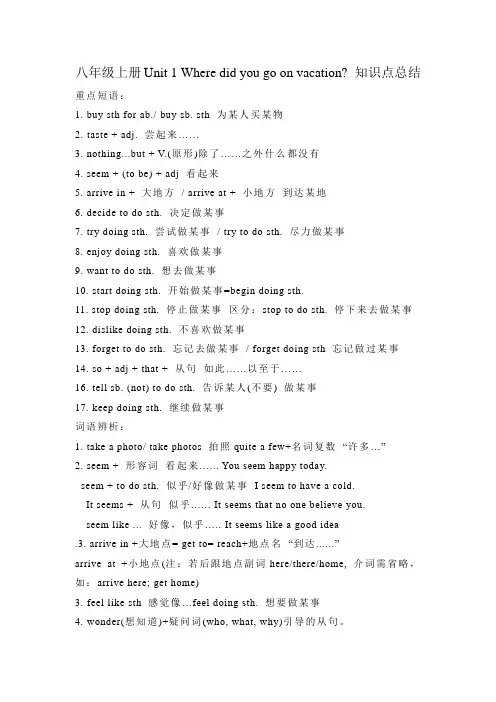
八年级上册Unit 1 Where did you go on vacation? 知识点总结重点短语:1. buy sth for ab./ buy sb. sth 为某人买某物2.taste + adj. 尝起来……3. nothing...but + V.(原形)除了……之外什么都没有4. seem + (to be) + adj 看起来5. arrive in + 大地方/ arrive at + 小地方到达某地6. decide to do sth. 决定做某事7. try doing sth. 尝试做某事/ try to do sth. 尽力做某事8. enjoy doing sth. 喜欢做某事9. want to do sth. 想去做某事10. start doing sth. 开始做某事=begin doing sth.11. stop doing sth. 停止做某事区分:stop to do sth. 停下来去做某事12. dislike doing sth. 不喜欢做某事13. forget to do sth. 忘记去做某事/ forget doing sth 忘记做过某事14. so + adj + that + 从句如此……以至于……16. tell sb. (not) to do sth. 告诉某人(不要) 做某事17. keep doing sth. 继续做某事词语辨析:1. take a photo/ take photos 拍照quite a few+名词复数“许多…”2. seem + 形容词看起来…... You seem happy today.seem + to do sth. 似乎/好像做某事I seem to have a cold.It seems + 从句似乎..…. It seems that no one believe you.seem like ... 好像,似乎….. It seems like a good idea.3. arrive in +大地点= get to= reach+地点名“到达......”arrive at +小地点(注:若后跟地点副词here/there/home, 介词需省略,如:arrive here; get home)3.feel like sth 感觉像…feel doing sth. 想要做某事4.wonder(想知道)+疑问词(who, what, why)引导的从句。
初二英语上册(人教新目标)Unit1Wheredidyougoonvacation_知识点总结

初二英语上册〔人教新目标〕Unit 1 Where did you go on vacation?知识点总结一、重点词汇anyone·原文再现Did you go with anyone?有人和你一起去吗?·根本用法pron. anyone 任何人,相当于 anybody,通常用在否认句、疑问句或条件从句中。
如:I won ’ t tell anyone I saw you here.我不会告诉任何人我在这儿见过你。
Why would anyone want that job?为什么会有人想要那份工作呢?·知识拓展 ---同类词some-any-no-every-指人someone 有人anyone 任何人no one 没有人everyone 人人somebody anybody nobody everybody指物something 某物anything 任何事nothing 没有事everything 一切事指地点 somewhere某地anywhere 任何地方nowhere 无处,没有地方 everywhere 到处注意:(1)由 some-, any-, no-, every-构成的符合不定代词作主语时,都作单数看待,其谓语动词用第三人称单数形式。
(2)不定代词假设有定语修饰,该定语要置于其后,作后置定语。
如:I ’ d like something to drink.我想要些喝的。
Is there anything interesting in the book?这本书中有有趣的东西吗?anywhere·原文再现Oh,did you go anywhere interesting?哦,你去过某个有趣的地方吗?·根本用法adv./pron. anywhere 什么地方,任何地方,常用在否认句或疑问句中。
肯定句中常用 somewhere,其修饰词也常常放在其后面。
八上unitwheredidyougoonvacation语法知识讲解复习课件
(3动词过去式变化规则:
1.一般在动词末尾加-ed如:pull-pulled cook-cooked
2.结尾是e加d,如:taste-tasted
3.末尾是辅音字母加一个元音字母和一个辅音字母的 重读闭音节,应双写末尾的辅音字母,再加-ed,如: stop-stopped
4.以辅音字母+y结尾的,变y为i, 再加-ed,如: study-studied
2)There are quite a few birds in the forest. 在那片森林里有很多鸟。
2. I just stayed at home most of the time to read and relax. most意为大多数后跟可数名词或不可数名 词均可
e.g. Most students go to school on foot. 大多数学生步行去上学。
try to do / try doing
try to do sth.设法做某事尽力做某事: He tried to finish the work ahead of time. 他设法提前完成这件工作 try doing sth.试着做某事,试验做某事: -I usually go there by train. -Why not try going by boat for a change --我通常乘火车去那儿。--为什么不换乘船呢? 区别:try to do侧重尽力,为了达到目的而努力。try
I can’t find it _a_n_y_w_h_e_r_e___. 9.Would you like have something?
语法点 2一般过去时
1.定义:一般过去时表示过去某个时间发生的动作 或存在的状态常和表示过去的时间状语 (yesterdaylast week, last month…)连用一般过 去时也表示过去经常或反复发生的动作。
Unit1where+did+you+go+on+vacation知识点讲义 人教版+英语八年级上册
Unit 1 Where did you go on vacation?【短语归纳】1、go on vacation 去度假 9、Central Park 中央公园2、quite a few 相当多; 不少 10、one bowl of 一碗……3、of course 当然; 自然 11、taste good 尝起来味道好4、go to the beach 到海边去 12、have a good time 玩的开心5、because of 因为 13、find out 查出来/发现6、go to summer camp 去夏令营 14、walk around 四处走动7、feel like 给……的感觉; 感受到 15、go shopping购物8、Tian' anmen Square 天安门广场 16、in the past 在过去【单元知识点】1. Where did you go on vacation? 你去哪里度假了?1) 这是有疑问副词 where引导的特殊疑问句,where用来询问地点和场所,放在句首。
2) go on vacation 意为“去度假”。
2. visited my uncle 看望了我的叔叔visit 是及物动词,意为“拜访;探望”,后接表示人的名词或代词。
visit 还可以意为“参观;游览”,后接表示地点的名词。
例: I visited my grandmother last week. 上周我去拜访了我的外婆。
拓展: visitor意为“参观者; 游客”。
例: These visitors come from America.3. buy anything special 买特别的东西。
1) buy及物动词, 意为“买; 购买”。
其过去式为 bought拓展: buy sth. for sb.= buy sb. sth. 意为“给某人买某物”。
例: My uncle bought me a bike.= My uncle bought a bike for me.2) anything不定代词,意为“某事;某件东西”,主要用于疑问句或否定句中。
Unit-1--Where-did-you-go-on-vacation-知识点汇总
Unit 1 Where did you go on vacation 重点语法:一,一般过去时用法:表示过去某时发生的动作或状态。
以句中表示过去的时间状语作为标记词。
例如:构成:谓语动词用过去式。
Eg:He went to the beach yesterday。
否定句:一般疑问句:特殊疑问句:动词过去式变形:规则变化练习:1,用所给词的适当形式填空1. We_________(play)basketball yesterday afternoon.2. My uncle_________(live) in Beijing in 2000.3. They_______(plan)to build a new bridge last year.4. I _______(study) for a test last night.5. Lily’s father_______(work)in the office two years ago.,2,句型转换,1,I was late for school yesterday.(改成否定句)2,His father had lunch in his factory.(改成一般疑问句)3,They went to the mountains on vacation.(改成否定句)4,Ann put her book in the desk just now.(划线部分提问)3,单项选择( )1. ---________did you go on vacation---Hong Kong.A. WhatB. HowC. WhereD. When( )2. I_____my homework last night. I went to the cinema with my parents.A. didB. didn’tC. didn’t doD. don’t do( )3. ---Did they clean the house yesterday afternoon---_________. They cleaned it this morning.A. No, they don’tB. Yes, they didC. No, they didn’t C. Yes, they do( )4. ---_____Tom and Jim_____a walk yesterday evening---No, they____.A. Do; take; doesn’tB. Did; take; didn’tC. Did; take; didD. Do; take; don’t ( )5. ---The coat looks good on you. Where______you______it---In a supermarket.A. do; buyB. did; buyC. will; buyD. does; buy二、复合不定代词Did you go with anyone Did you find anything special用法:1,作主语时,谓语动词用单数Everone (be)here.2, 被形容词修饰时,形容词必需后置。
Unit1Wheredidyougoonvacation知识点归纳人教版英语八年级上册
30.find out找出;查明
31.bye for now再见,就此止笔
32.go on继续
33.take photos照相
34.something important重要的事
35.up and down上上下下
e up出来/升起
37.wait for等待
38.in excitement兴奋地
(15)seem+(to be)+ adj.看起来……
(16)arrive in+大地点/ arrive at+小地点到达某地
(17)decide to do sth.决定去做某事
(18)
(19)
(20)want to do sth.想去做某事
(21)/ start to do sth.准备开始做某事
(6)How + adj. + a/an +名词单数+主谓
(7)too many +名词复数/ too much +不可数名词太多
(8)feel likedoing想要做某事/enjoy doing喜欢做某事/keep doing继续做某事
(9)beБайду номын сангаасause of+名词/代词/名短
(10)because +句子
14.most of the time大部分时间
15.have a good time玩得高兴
16.of course当然
17.in the countryside在乡下
18.keep a diary记日记
19.go + Ving go shopping去购物/go paragliding去跳伞