
cfa三级考试所有考点汇总
全球最大的CFA(特许金融分析师)培训中心 总部地址:上海市虹口区花园路171号A3幢高顿教育 电话:400-600-8011网址:finance.gaodun.cn微信公众号:gaoduncfa 1
cfa三级考试所有考点汇总 关于cfa考试的三级内容,所涉范围最广,也最深入。IPS题目更具难度,在难以攻克下,败在其考试二次不过者,大有人在。所以,在准备考cfa三级时,就应对其有一个较为完全的了解。方可更具自己的较弱的知识点进行强补,并对其他考点充分复习。
Topical Outline CFA Candidate Body of Knowledge (CBOK) I. Ethical and Professional Standards A. Professional Standards of Practice B. Ethical Practices II. Quantitative Methods A. Time Value of Money B. Probability C. Probability Distributions and Descriptive Statistics D. Sampling and Estimation E. Hypothesis Testing F. Correlation Analysis and Regression G. Time Series Analysis H. Simulation Analysis I. Technical Analysis III. Economics A. Market Forces of Supply and Demand B. The Firm and Industry Organization C. Measuring National Income and Growth 全球最大的CFA(特许金融分析师)培训中心 总部地址:上海市虹口区花园路171号A3幢高顿教育 电话:400-600-8011网址:finance.gaodun.cn微信公众号:gaoduncfa 2
D. Business Cycles E. The Monetary System F. Inflation G. International Trade and Capital Flows H. Currency Exchange Rates I. Monetary and Fiscal Policy J. Economic Growth and Development K. Effects of Government Regulation L. Impact of Economic Factors on Investment Markets IV. Financial Reporting and Analysis A. Financial Reporting System (IFRS and GAAP) B. Principal Financial Statements C. Financial Reporting Quality D. Analysis of Inventories E. Analysis of Long-Lived Assets F. Analysis of Taxes G. Analysis of Debt H. Analysis of Off-Balance-Sheet Assets and Liabilities I. Analysis of Pensions, Stock Compensation, and Other Employee Benefits J. Analysis of Inter-Corporate Investments K. Analysis of Business Combinations 全球最大的CFA(特许金融分析师)培训中心 总部地址:上海市虹口区花园路171号A3幢高顿教育 电话:400-600-8011网址:finance.gaodun.cn微信公众号:gaoduncfa 3
L. Analysis of Global Operations M. Ratio and Financial Analysis V. Corporate Finance A. Corporate Governance B. Dividend Policy C. Capital Investment Decisions D. Business and Financial Risk E. Long-Term Financial Policy F. Short-Term Financial Policy G. Mergers and Acquisitions and Corporate Restructuring VI. Equity Investments A. Types of Equity Securities and their Characteristics B. Equity Markets: Characteristics, Institutions, and Benchmarks C. Fundamental Analysis (Sector, Industry, Company) and the Valuation of Individual Equity Securities
D. Equity Market Valuation and Return Analysis E. Special Applications of Fundamental Analysis (Residual Earnings) F. Equity of Hybrid Investment Vehicles VII. Fixed Income A. Types of Fixed-Income Securities and their Characteristics B. Fixed-Income Markets: Characteristics, Institutions, and Benchmarks C. Fixed-Income Valuation (Sector, Industry, Company) and Return Analysis 全球最大的CFA(特许金融分析师)培训中心 总部地址:上海市虹口区花园路171号A3幢高顿教育 电话:400-600-8011网址:finance.gaodun.cn微信公众号:gaoduncfa 4
D. Term Structure Determination and Yield Spreads E. Analysis of Interest Rate Risk F. Analysis of Credit Risk G. Valuing Bonds with Embedded Options H. Structured Products VIII. Derivatives A. Types of Derivative Instruments and their Characteristics B. Forward Markets and Instruments C. Futures Markets and Instruments D. Options Markets and Instruments E. Swaps Markets and Instruments F. Credit Derivatives Markets and Instruments IX. Alternative Investments A. Types of Alternative Investments and their Characteristics B. Real Estate C. Private Equity/Venture Capital D. Hedge Funds E. Closely-held Companies and Inactively Traded Securities F. Distressed Securities/Bankruptcies G. Commodities H. Tangible Assets with Low Liquidity X. Portfolio Management and Wealth Planning 全球最大的CFA(特许金融分析师)培训中心 总部地址:上海市虹口区花园路171号A3幢高顿教育 电话:400-600-8011网址:finance.gaodun.cn微信公众号:gaoduncfa 5
A. Portfolio Concepts B. Management of Individual/Family Investor Portfolios C. Management of Institutional Investor Portfolios D. Pension Plans and Employee Benefit Funds E. Investment Manager Selection F. Other Institutional Investors G. Mutual Funds, Pooled Funds, and ETFs H. Economic Analysis and Setting Capital Market Expectations I. Tax Efficiency J. Asset Allocation (including Currency Overlay) K. Portfolio Construction and Revision L. Equity Portfolio Management Strategies M. Fixed-Income Portfolio Management Strategies N. Alternative Investments Management Strategies O. Risk Management P. Execution of Portfolio Decisions (Trading) Q. Performance Evaluation R. Presentation of Performance Results 各位考生,2015年CFA备考已经开始,为了方便各位考生能更加系统地掌握考试大纲的重点知识,帮助大家充分备考,体验实战,网校开通了全免费的高顿题库(包括精题真题和全真模考系统),题库里附有详细的答案解析,学员可以通过多种题型加强练习,通过针对性地训练与模考,对学习过程进行全面总结。
CFA全部三级考试所涉及的知识结构体系

CFA全部三级考试所涉及的知识结构体系•CFA课程的原始设计是一个供考生自修的学习计划,CFA协会依据资产管理实务上常用的专业知识编订出一个考生需要学习的“知识主体”(Candidate Body of Knowledge,简称CBOK),再将其分为三级各十八周的学习计划,CFA协会估计考生须在每个18周的学习计划中,每周须投入10~15小时,即准备时间须要4~5个月,学习时数合计180~270个小时,应在考前一个月完成前述学习计划,以便最后一个月复习课程内容及做考题,故一级CFA考试整个学习流程约六个月。
••虽然依据CFA协会的设计,CFA是一个自修课程,并未强制要求考生必须参加教育培训课程方可报考,然而对大部份繁忙的考生来说,参加专业的课程还是公认最有效率的方法。
考生在选择课程时,宜特别要注意讲师对CFA考试的了解程度、相关CFA课程教学经验是否充足、过去学员的表现及编制的讲义是否能有效地整理出课程重点等等。
••Topical Outline••CFA Candidate Body of Knowledge (CBOK)••I. Ethical and Professional Standards•A. Professional Standards of Practice•B. Ethical Practices••II. Quantitative Methods•A. Time Value of Money•B. Probability•C. Probability Distributions and Descriptive Statistics•D. Sampling and Estimation•E. Hypothesis Testing•F. Correlation Analysis and Regression•G. Time Series Analysis•H. Simulation Analysis•I. Technical Analysis••III. Economics•A. Market Forces of Supply and Demand•B. The Firm and Industry Organization•C. Measuring National Income and Growth•D. Business Cycles•E. The Monetary System•F. Inflation•G. International Trade and Capital Flows•H. Currency Exchange Rates•I. Monetary and Fiscal Policy•J. Economic Growth and Development•K. Effects of Government Regulation•L. Impact of Economic Factors on Investment Markets ••IV. Financial Reporting and Analysis•A. Financial Reporting System (IFRS and GAAP)•B. Principal Financial Statements•C. Financial Reporting Quality•D. Analysis of Inventories•E. Analysis of Long-Lived Assets•F. Analysis of Taxes•G. Analysis of Debt•H. Analysis of Off-Balance-Sheet Assets and Liabilities•I. Analysis of Pensions, Stock Compensation, and Other Employee Benefits•J. Analysis of Inter-Corporate Investments•K. Analysis of Business Combinations•L. Analysis of Global Operations•M. Ratio and Financial Analysis••V. Corporate Finance•A. Corporate Governance•B. Dividend Policy•C. Capital Investment Decisions•D. Business and Financial Risk•E. Long-Term Financial Policy•F. Short-Term Financial Policy•G. Mergers and Acquisitions and Corporate Restructuring ••VI. Equity Investments•A. Types of Equity Securities and their Characteristics•B. Equity Markets: Characteristics, Institutions, and Benchmarks•C. Fundamental Analysis (Sector, Industry, Company) and the Valuation of Individual Equity Securities•D. Equity Market Valuation and Return Analysis•E. Special Applications of Fundamental Analysis (Residual Earnings)•F. Equity of Hybrid Investment Vehicles••VII. Fixed Income•A. Types of Fixed-Income Securities and their Characteristics•B. Fixed-Income Markets: Characteristics, Institutions, and Benchmarks•C. Fixed-Income Valuation (Sector, Industry, Company) and Return Analysis•D. Term Structure Determination and Yield Spreads•E. Analysis of Interest Rate Risk•F. Analysis of Credit Risk•G. Valuing Bonds with Embedded Options•H. Structured Products••VIII. Derivatives•A. Types of Derivative Instruments and their Characteristics •B. Forward Markets and Instruments•C. Futures Markets and Instruments•D. Options Markets and Instruments•E. Swaps Markets and Instruments•F. Credit Derivatives Markets and Instruments••IX. Alternative Investments•A. Types of Alternative Investments and their Characteristics•B. Real Estate•C. Private Equity/Venture Capital•D. Hedge Funds•E. Closely-held Companies and Inactively Traded Securities •F. Distressed Securities/Bankruptcies•G. Commodities•H. Tangible Assets with Low Liquidity••X. Portfolio Management and Wealth Planning•A. Portfolio Concepts•B. Management of Individual/Family Investor Portfolios•C. Management of Institutional Investor Portfolios•D. Pension Plans and Employee Benefit Funds•E. Investment Manager Selection•F. Other Institutional Investors•G. Mutual Funds, Pooled Funds, and ETFs•H. Economic Analysis and Setting Capital Market Expectations•I. Tax Efficiency•J. Asset Allocation (including Currency Overlay)•K. Portfolio Construction and Revision•L. Equity Portfolio Management Strategies•M. Fixed-Income Portfolio Management Strategies•N. Alternative Investments Management Strategies•O. Risk Management•P. Execution of Portfolio Decisions (Trading)•Q. Performance Evaluation•R. Presentation of Performance Results。
2020年cfa三级考什么?cfa三级什么时候考?
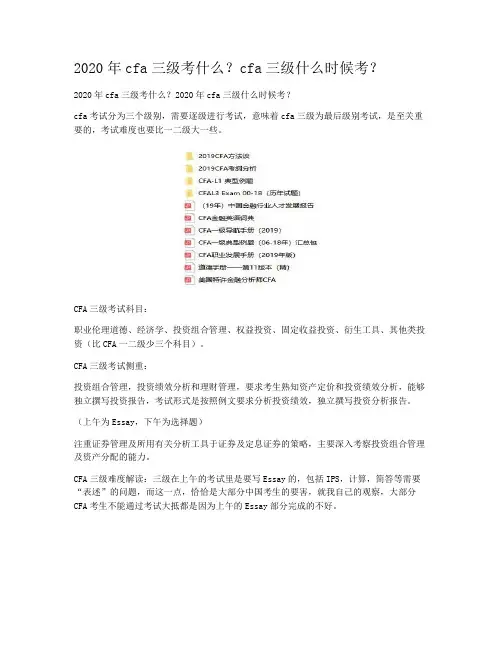
2020年cfa三级考什么?cfa三级什么时候考?2020年cfa三级考什么?2020年cfa三级什么时候考?cfa考试分为三个级别,需要逐级进行考试,意味着cfa三级为最后级别考试,是至关重要的,考试难度也要比一二级大一些。
CFA三级考试科目:职业伦理道德、经济学、投资组合管理、权益投资、固定收益投资、衍生工具、其他类投资(比CFA一二级少三个科目)。
CFA三级考试侧重:投资组合管理,投资绩效分析和理财管理,要求考生熟知资产定价和投资绩效分析,能够独立撰写投资报告,考试形式是按照例文要求分析投资绩效,独立撰写投资分析报告。
(上午为Essay,下午为选择题)注重证券管理及所用有关分析工具于证券及定息证券的策略,主要深入考察投资组合管理及资产分配的能力。
CFA三级难度解读:三级在上午的考试里是要写Essay的,包括IPS,计算,简答等需要“表述”的问题,而这一点,恰恰是大部分中国考生的要害,就我自己的观察,大部分CFA考生不能通过考试大抵都是因为上午的Essay部分完成的不好。
所以CFA三级考生要特别注重Essay部分的练习。
CFA三级考试中加入的IPS写作考察模块能迅速反应出考生的实操能力。
CFA三级IPS写作介绍:CFA三级备考建议和策略:1.多总结知识点,形成系统化知识库三级跟一二级想考察的东西也不太相似,也就是说CFAinstitute把考生当成了analyst,想看分析问题的能力如何。
而三级考试很多问题都是很贴近现实投资决策的,考生作为一个投资经理要结合这些信息来给出相对应的投资建议。
2.原版书课后题对三级的考试题起着指导性作用三级特有的,协会每年公布的去年的上午题称为历年试题。
做起来会觉得特别奇怪,感觉无从下手,这样的题目往往在课后题中可以找到一些相似情况、类似题。
相关CFA内容推荐阅读。
CFA一、二、三级考纲对比总结_金程版

【CFA一级考纲对比总结】一、新增部分:1、SS3 R11新增内容b. distinguish between one-tailed and two-tailed tests of hypotheses;2、SS4 R13新增内容e. describe the concept of equilibrium (partial and general), and mechanisms by which markets achieve equilibrium;3、SS8 R28新增内容f. explain the requirements for segment reporting, and calculate and interpret segment ratios;4、SS10 R34新增内容a. describe reasons for investors to assess the quality of cash flow statements;5、SS12 R42新增内容c. describe defined contribution and defined benefit pension plans;6、SS15中的新增R52、R53、R54。
SS15变动最大,本章内容全部更改。
7、SS16变动较大,更改了大标题,新增R55全部内容。
二、删除内容:1、SS5 R18删除内容j. identify the past, current, or expected future business cycle phase of an economy based on economic indicators.2、SS9 R32删除内容j. describe defined contribution and defined benefit pension plans;3、SS11 R36删除内容f. describe and account for the relative popularity of the various capital budgeting methods and explain the relation between NPV and company value and stock price;4、SS15中删除R52、R53、R54、R55。
CFA考试一二三级复习攻略大全
2.投入学习的时间相应调整学习时间的安排,有侧重的并有效的来规划学习时间。
CFA每个级别都有18个章节,考生每周最少要花10-15个小时,持续18个星期的时间来学习协会指定的内容,考生制定的考前时间规划表要在考前30-45天完成所有知识的第一次学习。
考前最后4-6周的时间,考生要巩固前面所学的内容,做好习题的演练,其中一定要包括协会的samplequestion和mockexam。
3.精读CFA的知识体系(CandidateBodyofKnowledge简称CBOK)和协会的教材(curriculum)细分并详述了投资行业各个部分的要点。
建议考生一般先看SchweserStudyNotes,将每一个Session都学习之后,如果有不理解的知识点,可以通过Curriculum对相应的内容进行查看。
对于一级考生,重点学习Level1的SchweserStudyNotes辅助CFA协会官方教材的章节习题及道德手册就可以了。
4.计算器的使用熟练掌握CFA指定的金融计算器,仅三种计算器(BAIIPlus、BAIIPlusProfessional、HP12C)可带入考场,推荐考生使用性价比较高的德州仪器BAIIPlus。
5.复习阶段学习是一个逐步积累的过程,要成体系的看待自己学习的知识。
考生要不断夯实基础,温故知新。
考生都要不断的温习以前学过的知识。
6.习题冲刺阶段针对考试,CFA协会每年都会提供online questions,帮助考生做好相关准备,大致预测考试所需时间。
模拟试题都会紧扣考纲,题型和结构都满足CFA协会的相关要求。
Level 2准备时间了两个月,成绩全A。
这个就是我说反面教材的例子了。
一级轻松到手之后,飘飘然了,立刻报了来年二级,但是直到四月还在看第一本Notes。
如果说一级用三个月准备还算合理,那二级准备两个月就和自杀是差不多的节奏。
结果到后来我就急了,两个月时间,要完成我读三遍Notes的目标,就必须废寝忘食。
cfa三级2024

cfa三级2024摘要:1.CFA三级考试简介2.2024年CFA三级考试时间表3.CFA三级考试备考策略4.CFA三级考试通过率及意义5.2024年CFA三级考试报名指南正文:CFA(Chartered Financial Analyst)是全球金融领域最具权威的专业资格认证,分为三个级别。
CFA三级考试是最后一轮,通过后可获得CFA特许金融分析师称号。
本文将为您详细介绍2024年CFA三级考试相关信息,包括时间表、备考策略、通过率及意义等,并为您提供报名指南。
1.CFA三级考试简介CFA三级考试旨在评估候选人对投资工具、公司金融、经济学、财务报表分析、伦理与职业行为标准等领域的综合应用能力。
三级考试内容涵盖了资产估值、财富管理、投资组合管理、风险管理、金融科技等多个领域。
2.2024年CFA三级考试时间表根据CFA协会公布的时间表,2024年CFA三级考试共分为两个窗口期,分别为5月和11月。
具体考试日期将在报名结束后公布。
考生需在规定时间内登录CFA协会官网进行报名。
3.CFA三级考试备考策略CFA三级考试要求较高,备考至关重要。
以下是一些建议:(1)制定合理的学习计划:根据自身情况,合理安排学习时间,确保各科目均衡掌握。
(2)参加培训课程:CFA协会提供线上及线下培训课程,帮助考生系统学习三级考试所需知识。
(3)多做练习:通过模拟试题、练习题,提高解题速度和准确率。
(4)注重伦理道德:CFA三级考试伦理部分占比较高,考生需重视道德准则和职业行为标准。
4.CFA三级考试通过率及意义CFA三级考试通过率逐年波动,但整体较低。
据统计,全球范围内三级考试首次通过率一般在40%左右。
然而,这并不意味着CFA三级考试难以攻克。
通过艰苦的努力和科学备考,许多考生最终成功获得CFA特许金融分析师称号。
CFA三级考试意义重大。
首先,三级考试涵盖了投资领域的方方面面,有助于提升个人综合能力。
其次,持有CFA资格证书意味着更高的职业竞争力,有助于获得更好的职业发展机会。
CFA考试《CFA三级》历年真题精选及详细解析1007-26

CFA考试《CFA三级》历年真题精选及详细解析1007-261、Ward is scheduled to visit the corporate headquarters of Evans Industries. Ward expects to use the information he obtains there to complete his research report on Evans stock. Ward learns that Evans plans to pay all of Ward’s expenses for the trip, including costs of meals, hotel room, and air transportation. Which of the following actions would be the best course for Ward to take under the Code and Standards?【单选题】A.Accept the expense-paid trip and write an objective report.B.Pay for all travel expenses, including costs of meals and incidental items.C.Accept the expense-paid trip but disclose the value of the services accepted in the report.正确答案:B答案解析:The correct answer is B. The best course of action under Standard I(B)—Independence and Objectivity is to avoid a conflict of interest whenever possible. Therefore, for Ward topay for all his expenses is the correct answer. Answer C details a course of action in which the conflict would be disclosed, but the solution is not as appropriate as avoiding the conflict of interest. Answer A would not be the best course because it would not remove the appearance of a conflict of interest; even though the report would not be affected by the reimbursement of expenses, it could appear to be.2、Are the three compliance procedures reviewed by Campanelli consistent with both the required and recommended standards of the CFA Institute Asset Manager Code of Professional Conduct?【单选题】A.No, the procedures regarding record retention are inconsistent.B.No, the procedures regarding portfolio review are inconsistent.C.No, the procedures regarding investigation of complaints are inconsistent.正确答案:C答案解析:C is correct. According to the recommendations of Section D(2) of the Asset Manager Code,where possible, the CCO should be independent from the investment and operations personnel and should report directly to the CEO orthe board of directors.3、The strategy that is most likely to benefit from the environment described by Monts in Statement 3 is to:【单选题】A.rotate from consumer non-cyclical to consumer cyclical sectors.B.increase exposure to the crossover sector.C.shift the portfolio’s positions to shorter duration corporate bonds.正确答案:C答案解析:Curve-adjustment trades take place when the portfolio manager expects credit spreads will widen (either overall or in a particular sector). The specific strategy is to shift the portfolio’s exposure to shorten spread duration by selling longer maturity corporate bonds and buying shorter maturity bonds, which lowers the contribution to spread duration.4、Sigma can most likely reduce credit risk in its OTC derivatives positions by changing which of the following practices?【单选题】tingB.Frequency of marking to marketC.Limiting counterparty exposure正确答案:B答案解析:Sigma typically enters two-year contracts and doesnot mark to market until expiration of the contract. Increasing the frequency of the marking to market will decrease credit risk. When a contract is marked to market, the party for whom the contract has a positive value receives payment from the counterparty, thus eliminating credit risk. Consequently, more frequent marking to market decreases credit risk.5、Based on Exhibit 1, Kiest’s liabilities would be classified as:【单选题】A.Type I.B.Type II.C.Type III.正确答案:A答案解析:A is correct. Type I liabilities have cash outlays with known amounts and timing. The dates and amounts of Kiest’s liabilities are known; therefore, they would be classified as TypeI liabilities.6、If Motelli’s current investment account of €250,000 is invested in an asset which is expected to earn annual interest of 6.5 percent and no capital gains, what is his expected after tax accumulation in 15 years?【单选题】A.€578,664.B.€586,547.C.€642,960.正确答案:B答案解析:B is correct. The after tax wealth accumulation for annually taxable income isFVIFi = [1 + r(1 – ti)]nFV = €250,000 × FVIFi = €250,000 × [1 + 0.065(1 – 0.10)]15= €586,5477、Based on Exhibit 1, which of the portfolios will best immunize SD&R’s single liability?【单选题】A.Portfolio 1B.Portfolio 2C.Portfolio 3正确答案:B答案解析:B is correct. In the case of a single liability, immunization is achieved by matching the bond portfolio’s Macaulay duration with the horizon date. DFC has a single liability of $500 million due in nine years.Portfolio 2 has a Macaulay duration of 8.9, which is closer to 9 than that of either Portfolio 1 or 3.Therefore, Portfolio 2 will best immunize the portfolio against the liability.8、Ng’s response to Kepler’s question about the most efficient portfolio management strategy should be:【单选题】A.full replication.B.active management.C.an enhanced indexing strategy.正确答案:C答案解析:C is correct. Under an enhanced indexing strategy, the index is replicated with fewer than the full set of index constituents but still matches the original index’s primary risk factors. This strategy replicates the index performance under different market scenarios more efficiently than the full replication of a pure indexing approach.9、Considering Zubov’s statements to the investment committee regarding Hoven University’s endowment, he is least likely correct with respect to:【单选题】A.liquidity need.B.total return objective.C.risk tolerance.正确答案:C答案解析:The endowment’s risk tolerance is low to moderate, not high, because the endowment’s contribution represents 25% of the university’s operating budget. Thus, a modest drop in the endowment’s value may have a significant impact on university operations. Another factor supporting a lower risk tolerance is the use of a simple spending rule. The absence of a smoothing rule means the endowment has less tolerance for short-termportfolio risk. Although a return objective of 7%–7.5% may ostensibly be used to support a higher risk tolerance, the risk of a short-term drawdown poses a much larger risk and thus, on balance, a low to moderate risk tolerance is more appropriate for the endowment.10、Are Pearson\\\\\\\\'s statements regarding the disadvantages of the historical method for estimating VaR most likely correct?【单选题】A.No, the second statement is not a disadvantage.B.No, the first statement is not a disadvantage.C.Yes.正确答案:B答案解析:The nonparametric feature of the historical method is an advantage, not a disadvantage. The historical method requires minimal probability-distribution assumptions compared with other methods.。
CFA三级中文精讲
第14章全球投资业绩准则
1.1简介 1.2 0~5部分条款 1.3 6~8部分条款 1.4验证与检查 1.5估值原则 1.6 GIPS广告指导方针 1.7税后回报
作者介绍
这是《CFA三级中文精讲③》的读书笔记模板,暂无该书作者的介绍。
读书笔记
这是《CFA三级中文精讲③》的读书笔记模板,可以替换为自己的心得。
目录分析
第9章另类投资的组合管理
1.1另类投资概述 1.2房地产★ 1.3私募股权★★ 1.4大宗商品★★ 1.5对冲基金★★★ 1.6管理型期货基金★ 1.7困境证券★
第10章风险管理
1.1风险管理概述★ 1.2风险度量:市场风险★★★ 1.3风险度量:信用风险★★ 1.4风险的管理★
2期权在风险管理 中的应用
CFA三级中文精讲③
读书笔记模板
01 思维导图
03 目录分析 05 读书笔记
目录
02 内容摘要 04 作者介绍 06 精彩摘录
思维导图
关键字分析思维导图
经验
投资
书
业绩
交易
基金
收益
中文
一体力
实用性 风险管理
基准
考生
风险
对冲
质量
管理
应用
方法
内容摘要
本书从考生的角度出发,集作者多年CFA培训经验于一体,力邀国内外众多金融投资专业人士精心打造,体 现了当今国内CFA考试中文解析的高水准。本书完全参照CFA协会官方指定用书编写,囊括全部核心内容和重要内 容,契合中国考生的实际情况,有利于考生快速阅读、备考。本书具有专业性、前沿性、全面性、实用性和效率 性等特点,适合作为考生备考CFA三级的参考书。
第12章交易
1.1市场结构与交易成本 1.2衡量交易成本的方法 1.3交易者的类型 1.4交易策略 1.5算法交易 1.6最优执行
CFA一二三级别考试题型汇总
CFA一二三级别考试题型汇总
CFA一共分三个级别考试,每个考试的题型和考核重点都是有所侧重的,中博-诚通帮大家梳理一下三个级别考试的题型和重点:
一级考试
考核重点:要求考生掌握投资工具和基础知识
共有240道多项选择题,设A、B和C三个选择,每道选择题分数均等
您需要妥善分配时间,每道题用约一分半钟时间作答
仔细阅读和理解每个问题,切勿只略读了部分即回答
二级考试
考核重点:要求考生掌握资产类别的回报和风险管理知识
共有20个案例,每个案例长度约为一至两页半,当中会包含图表、财务报表、统计数据等资料,考生需根据每个案例中的资料回答六道相关的选择题
总分为360分,每道选择题分数为3分
与一级考试略有不同,请细阅和分析每道问题的要求
三级考试
考核重点:要求考生掌握投资组合管理知识
上午为简答题和论述题时间,下午为案例时间
总分为360分,上午和下午各占180分
与一级考试略有不同,请细阅和分析每道应用问题的要求。
CFA考试道德部分重点汇总
CFA考试道德部分重点汇总据说即使考生其他的部分全部达到优秀(>70%正确率),如果道德部分没有通过(<50%),也还是不能通过CFA一级考试;而其他的知识性部分,即使小于50%,但是只要综合平均成绩达到了当年考试划定的分数线,就可以通过。
虽然这只是传说,但也希望考生可以对道德这一部分引起足够的重视。
道德一方面题目较长,对于英文不太好的同学来说是个小挑战,考试都是进行案例分析,熟练掌握CFA道德规范与职业行为准则的知识,迅速并准确解答这部分考题,不仅有助于从考试开始就建立起信心,也能大幅度提高通过考试的机率,是通过CFA一级考试的必要条件。
当中列举了大量的实际应用案例,对理解条目和通过考试很有帮助。
因为考生可以通过案例去理解教材中所描述的各个利益群体之间的关系,特别是对美国证券投资市场不熟悉的考生。
另外该教材在从CFA考试一级到三级都要考到,在一级打下一个扎实的基础,对于二,三级的学习也是非常有帮助的。
中博-诚通小编将道德部分概念做一整理,详情分析如下:道德规范,是纲领性的指导文件,比较抽象,并非一个实施细则,实际考试中以了解内容为目标。
考试的重点是对七条职业行为准则及其应用的理解和掌握上。
该准则的每一个条目下分别有几个子条,每个条目和子条目都要熟记,而且毫不夸张的说,几乎每一个小条都包含一个或几个考点。
在实际的考试中,通常会有一些人物和情节提供给考生,这些需要考生通过对道德规范以及职业行为准则的具体理解来判断某人是否遵守或是违反了职业道德或行为操守。
1、认识CFA考试理论学和职业道德标准CFA LEVEL 1 - 伦理学和职业标准:在雇主、投资人的对资产管理和金融分析师的关系中,信任是必然和无条件的。
投资管理专业人士要想赢得这种信任,诚信就必须是永远是不容置疑的品质。
要想赢得并保持使用CFA特许状发的权利,严格遵守AIMR的道德准则与掌握CFA计划的知识整体是同等重要的。
但是,与很多其它行业不同的是,在投资行业中,区分道德行为与非道德行为的界限并不总是十分清楚的。
cfa一级二级三级科目
cfa一级二级三级科目CFA一级二级三级科目CFA(Chartered Financial Analyst)是国际上最具权威和最难的金融证书之一,由CFA协会颁发。
CFA考试分为三级,涵盖了金融和投资领域的广泛知识,对于金融从业者来说具有重要意义。
本文将分别介绍CFA一级、二级和三级的科目内容。
CFA一级科目主要包括:“伦理与职业标准”、“量化方法”、“经济学”、“财务报表与分析”、“企业金融学”、“证券投资分析”和“金融产品”等七个科目。
首先是“伦理与职业标准”科目,该科目着重强调金融职业道德和职业行为准则。
考生需要了解道德决策框架、道德标准以及道德和职业行为之间的关系。
其次是“量化方法”科目,该科目主要涉及统计学和计量经济学的基本概念和原理。
考生需要掌握概率论、假设检验、回归分析等内容,以便在金融分析和投资决策中运用这些方法。
第三个科目是“经济学”,该科目要求考生掌握宏观经济学和微观经济学的基本知识。
考生需要了解经济学原理、市场结构、货币政策等内容,以便在投资决策中对经济因素进行分析。
接下来是“财务报表与分析”科目,该科目要求考生理解财务报表的编制和分析方法。
考生需要学习会计原理、财务报表分析、利润表、资产负债表等内容,以便从财务报表中获取有关企业经营状况和财务状况的信息。
第五个科目是“企业金融学”,该科目主要涉及企业融资和投资决策。
考生需要学习企业融资、资本预算、股票和债券估值等内容,以便在企业融资和投资决策中运用这些知识。
接下来是“证券投资分析”科目,该科目要求考生掌握证券市场的基本知识和投资分析方法。
考生需要学习证券投资基本原理、证券市场的组织和运作、投资组合理论等内容,以便进行证券投资分析和组合构建。
最后是“金融产品”科目,该科目主要涉及衍生品和替代投资工具。
考生需要学习期权、期货、掉期、互换等金融产品的基本原理和交易策略,以便在投资组合中运用这些工具。
CFA二级科目主要包括:“伦理与职业标准”、“量化方法”、“经济学”、“财务报表分析”、“企业金融学”、“证券市场”和“投资组合管理”等七个科目。