
牛津译林版英语七年级上册U4 Grammar 教案
《英语》(七年级上册)
Unit 4 My day
Grammar
I. Teaching aims and learning objectives
By the end of the lesson, students should be able to:
1. use prepositions to talk about time correctly;
2. use the adverbs of frequency correctly;
3. grasp the usage of ‘how often’;
4. use these items of grammar to talk about their daily life;
II. Teaching contents
1. New words and phrases: would, would like, life, all the best, roller skating
2. New structure: How often do they exercise?
III. Focus of the lesson and predicted area of difficulty
Know better about some usages of the prepositions of time.
Tell the difference between ‘how often’ and “how many times”.
IV. Teaching procedures
A Prepositions of time
Step 1 Presentation
1. Find out the phrases which should be put after ‘in/ on/ at’ one by one
T: Hello, boys and girls. This is our school. We know a lot about it. Today, there will be a lot of
new students coming here. Will you help them find their classroom? Here they come. And we
have three classes. They are “in”, “on” and “at”. Shall we begin?
2. Read the phrases together
3. Find out more similar phrases
4. Work out the rules
(1) in: in the evening (parts of day), in March (months), in 2013 (years), in winter (reason)
(2) on Sunday, on December 31st (days & dates), on the evening of July 4th, on Monday
afternoon (parts of a specific day), on Children’s Day (specific holidays or days)
(3) at seven, at noon, at lunchtime (time of day), at (the age of) 16 (age), at the Spring Festival
(specific holidays or festivals), at the weekend (others)
【设计意图】通过设计新生找教室的情境,让本来枯燥的语法稍显活泼些。让学生通过“分—总—分”的方式,在老师的带领下进行归纳、演绎,培养学生发现规律、主动思考、主动学习的能力和习惯,这样的过程和方法使学生掌握得更加牢固。
Step 2 Practice 1. Finish the exercises on P47 on the Students’ Book
T: Tommy is writing back to Millie. Help him complete his email with the correct propositions
of time.
2. Fill in the blanks with “in”, “on” or “at”
We don’t go to school _______ Sunday. (on)
My birthday is _______ April 1st. (on)
We’re going to see the doctor _______ four o’clock. (at)
He often takes Eddie for a walk _____ the evening. (in)
They have a long holiday ______ November. (in)
He was born ________ 1992. (in)
He likes reading newspapers _______ breakfast. (at)
She starts learning English _______ 6 o’clock. (at)
It’s cold _______ winter in China. (in)
They play the game ________ the evening of 31st October. (on)
We’ll have one party ____ next week. (/)
My friends give me some presents _____ Christmas every year. (at)
He got home _____ the morning of the 4th last month. (on)
The story happened _____ a cold winter morning. (on)
I never go to a party ____ Halloween. (on)
My father seldom has free time _____ the weekend. (at)
It sometimes snows _______ winter in Wuxi. (in)
He often takes Eddie for a walk _____ the evening. (in)
My family usually get together to have a big dinner____ the Mid-autumn Festival. (at)
He always goes to the library ____ Mondays. (on)
【设计意图】及时总结复习,为下面的习题做好充分的准备。两个练习,从书本到课外,由简到难,层层递进,旨在学生确实扎实掌握三个介词的用法。
B Adverbs of frequency
Step 1 Presentation
1. Show the six adverbs of frequency
T: Please pay attention to these words. They are adverbs of frequency. They tell us how often
things happen. But can you tell the difference among them? Look! The things happen more
and more often. From 0% to 100%.
2. Finish the exercises on Page 48 on the Students’ Book.
Simon loves playing football. He _____ plays football in the playground. (often)
Sandy doesn’t have much time to play tennis. She ______ plays tennis. (seldom)
Amy is a member of the swimming team. She ______ swims after school. (usually)
Daniel doesn’t like basketball. He _____ plays it. (never)
Kitty goes to her dancing lesson every day. She _______ dances for half an hour. (always)
Millie _________ goes roller skating, but she’s not good at it. (sometimes)
3. Work out the rules
Find out the rules of the position of these adverbs.
(1) Find out the rule 1: put the adverbs before a verb
Show two sentences to find out rule 2: put the adverbs after “to be”.
【牛津译林版】七年级上Unit2第3课时教案讲解分析习题设计
Period III: Grammar (第三课时)
第一部分 教案设计
教学内容
Grammar(第23~24页)重点学习行为动词的一般现在时的用法。
教材分析
本课时是语法课,在第一单元学习了be动词的一般现在时的基础上,进一步行为动词的一般现在时的用法,并学会灵活运用,能够与be动词的一般现在时加以区分。主要内容包括:理解行为动词的一般现在时的两种形式,掌握其肯定句、否定句、疑问句及其肯定、否定回答的基本用法;理解行为动词在一般现在时中的变化,掌握其变化规则;能用一般现在时在日常生活中进行相关的表达。
教学目标:
基础知识
掌握词汇:drawing , weekend , shop
词组:at/on weekends =at/on the weekend of course
句型:Millie gets up at 6:30 every morning. Cats eat fish. Simon likes playing football.
基本技能:
1. 理解行为动词一般现在时的用法;
2. 掌握行为动词一般现在时的肯定句、否定句、疑问句及其肯定和否定回答的基本用法;
3. 学会用一般现在时进行交际
综合素质:结合本单元的话题用一般现在时进行交流。
教学重难点及突破
重点:掌握基本的四会单词、词组及句型。
难点: 行为动词的一般现在时的肯定句、否定句、疑问句及其肯定、否定回答。
教学突破:在行为动词的一般现在时中,要特别注意注意是第三人称单数的情况,可以借助口诀帮助学生记忆。
教学准备
教师准备:多媒体课件及关于本课时语法的实例及习题 学生准备: 复习第一课用法,预习本课时语法,比较不同
教学设计
Step I Lead-in (导入部分)
1.Learn the new words by ask some questions about Li Hua .
Where does Li Hua from ? How does he look ? What does he do every day ?What does he do in his free time ? 2. Look ,who are these men in the picture? They are basketball players. They play basket very well. This is
译林u4seeingthedoctor教案
译林u4seeingthedoctor教案
1 / 15
Unit 4 Seeing the doctor
单元教材剖析:
本单元话题是看病,教课要点是表示建议的神态动词 should 和否认式
shouldn ’t 的用法。有关咨询和描绘病情的句型 What’ s wrong with you 和 I
have a headache/ 也是本单元的另一个要点教课内容。
单元教课目的:
1. 会听闻读写词组: brush one ’ s teeth, drink water, eat sweets,have a
rest ,take medicine
2. 学会疑问句型“ What’ s the matter with you ”和“ What should I do ”,以及对它们的答语。
3. 认识并掌握神态动词的用法。
4. 读准字母组合 ch 的发音。
教课要点:
1. 能理解 Story time 的内容,并会复述。
2. 会使用以下两个句型,并能在平时对话中使用: What’ s wrong with you I
have 以及 What should I do You should.
3. 掌握神态动词的用法。
4. 掌握字母 ch 组合的发音。教课难点:
1. 会复述 Story time 的内容。
2. 能在语境中正确使用句型: What’s wrong with you I have
What should I do You should.
3. 认识并掌握神态动词 should 的用法。单元课时安排:四课时
第一课时: Story time
第二课时: Grammar time& Fun time
第三课时: Cartoon time
第四课时: Sound time & Checkout time& Culture time
牛津译林版七年级上册英语:Unit 4 My day 词汇与语法基础训练

第 1 页
一、必背词汇
wake vi.& vt. 醒,醒来;唤醒
hill n. 小山
seldom adv. 很少,不常
need vt. 需要
rest n. 休息,歇息
just adv. 只是
activity n. 活动
homework n. 家庭作业
usually adv. 通常,经常
never adv. 从不,绝不
start vt.& vi. 开场,着手
quarter n. 一刻钟
past prep. 晚于
first adv. 首先
chat vi. 聊天,闲聊
each det.& pron. 每人,每个,每件
other pron. 另外,其他
practise vi.& vt. 练习;训练=practice Unit 4 My day
知识精讲 第 2 页 wish n. 希望,祝愿 vt. 希望,祝愿
life n. 〔pl. lives〕生活;生命
luck n. 好运,幸运
museum n. 博物馆
twice adv. 两次
picnic n. 野餐
once adv. 一次
dislike n. 不喜欢,厌恶
reason n. 原因,理由
ready adj. 准备好,准备完毕
learn vt.& vi. 学,学习,学会
world n. 世界
二、重点词汇
1. seldom adverb /ˈseldəm/
almost never
很少;几乎从来没有
例句:
Now that we have a baby, we seldom get the chance to go to the cinema.
有了孩子以后,我们很少有时机看电影了。
We seldom receive any apology when mistakes are made.
牛津译林7AU4词组和句型
7AU4
Comic strip-welcome to the unit
1. wake up; wake sb up=wake up sb; wake me/us/you/him/her/it/them up代词用宾格且放中间
2. It is time for breakfast.=It is time to have breakfast. ;It is time for us to have breakfast.
3. Shall we do....?=What about/hocw about doing sth?=Let’s do sth
4. go walking; take/have a walk;go on/for a walk;take sb for a walk/walk the dog=take the dog for
a walk
5. seldom go out
6. after breakfast; after doing sth; after sb does sth,...
7. need a good rest; don’t need a good rest;need to do sth=need do sth;don’t need to do
sth=needn’t do sth
8. know how to have fun; have a lot of fun=have lots of fun; have great fun=have a good time
9. get up
10. do exercise often=exercise often; do morning exercises; do eye exercises
11. have lessons=have a lesson=have a class
12. do after-school activities(plurals - activity )
unit 4 comic-reading讲解 牛津译林版英语七年级上册
1
授课标题 7A Unit 4 Comic--Reading 新课讲解
学习目标 1.掌握本单元四会短语和单词;
2.能用相应的交际用语进行日常交流
3.掌握并学会运用表示时间的介词;频度副词
重点难点 1.介绍自己在学校一天的情况
2.掌握并学会运用与时间相关的介词以及与频度相关的副词
知识讲解与练习
一、Comic strip
1.wake up醒来,唤醒(注意:当wake up接代词作宾语时,代词要放在中间)
I’m so tired. Don’t wake me up,Mum.
I don’t want to wake you up.
awake 醒着的,adj
I was still awake at four o’clock in the morning.
2.Is it time for breakfast?到早饭的时间了吗?
It’s time for sth … 是…的时候了。大多数情况可以转换为It’s time to do sth.
It’s time for lunch=It’s time to have lunch.
It’s time for me to go to school.
3.Shall we go walking in the hills?我们去山上散步好吗?
Shall we +V(原形)? 表示提出建议。
表示建议的句型有:
why not +do
Why don’t you+do
What about/how about +doing
How about going to the park?
hill n. 小山, 词组:in the hill.在山上
4. know how to have fun.知道如何享乐
该词组是由“特殊疑问词+不定式to do”构成的不定式短语,用作动词know的宾语。
Do you know how to make a kite?
牛津译林版七年级英语上册Unit-2 grammar语法课时教案
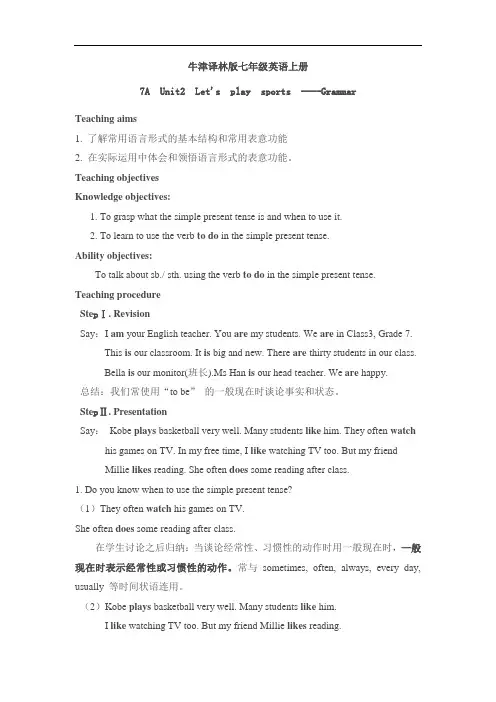
牛津译林版七年级英语上册
7A Unit2 Let's play sports ----Grammar
Teaching aims
1. 了解常用语言形式的基本结构和常用表意功能
2. 在实际运用中体会和领悟语言形式的表意功能。
Teaching objectives
Knowledge objectives:
1. To grasp what the simple present tense is and when to use it.
2. To learn to use the verb to do in the simple present tense.
Ability objectives:
To talk about sb./ sth. using the verb to do in the simple present tense.
Teaching procedure
StepⅠ. Revision
Say:I am your English teacher. You are my students. We are in Class3, Grade 7.
This is our classroom. It is big and new. There are thirty students in our class.
Bella is our monitor(班长).Ms Han is our head teacher. We are happy.
总结:我们常使用“to be” 的一般现在时谈论事实和状态。
StepⅡ. Presentation
Say: Kobe plays basketball very well. Many students like him. They often watch
his games on TV. In my free time, I like watching TV too. But my friend
七年级英语 U4 语法It is + adj.+ to do sth. Teaching Design
It is + adj.+ to do sth. Teaching Design
Part One: Teaching Background
“It is +adj.+to do sth.” is an important part of the 7A Unit 4 grammar in Oxford
English. For most Grade 7 students, grammar is a big headache, so the microlecture
introduces their favorite character Peppa to arouse their interest and uses lots of
interesting pictures to make it easier to understand and remember. Considering that
students have very weak awareness of English sentence pattern and are usually confined
to the Chinese way of thinking, the microlecture designs several kinds of exercises
varying in degree of difficulty so that students can use the pattern correctly and
confidently.
Part Two: Teaching Objectives
1. To enable students to find out the sentence pattern through observation;
2. To enable students to understand the structure of the pattern: the use of “it” as
牛津译林版英语7AUnit4Grammar优秀教学案例
牛津译林版英语7AUnit4Grammar优秀教学案例
一、案例背景
牛津译林版英语7AUnit4的主题为“Grammar”,主要内容涉及一般现在时态的构成、用法及辨析。本节课旨在帮助学生掌握一般现在时态的构成(主语+动词原形),并能运用到实际情景中进行交际。通过对本节课的学习,学生能够理解一般现在时态的概念,并能用一般现在时态描述自己的日常活动和他人的一般特征。
在教学过程中,我采用了任务型教学法,以学生为主体,注重培养学生的口语表达能力和思维能力。在导入环节,我通过展示图片和提问的方式激发学生的兴趣,引导学生思考和讨论。在呈现环节,我使用多媒体课件和实物展示一般现在时态的构成和用法,让学生在真实情境中感知和理解一般现在时态。在练习环节,我设计了一系列口语和书面任务,让学生在实践中运用一般现在时态,巩固所学知识。在反馈环节,我及时给予学生评价和反馈,鼓励他们积极参与课堂活动,提高他们的自信心。
在教学过程中,我关注到学生的个体差异,根据学生的不同水平给予不同程度的指导,使他们在原有基础上得到提高。同时,我注重培养学生的团队合作精神,让他们在小组活动中相互学习、相互帮助,共同完成任务。通过本节课的教学,学生不仅掌握了一般现在时态的语法知识,还提高了他们的口语表达能力和团队合作能力。
二、教学目标
(一)知识与技能
1. 学生能够掌握一般现在时态的构成(主语+动词原形),理解其用法和辨析。
2. 学生能够运用一般现在时态描述自己的日常活动和他人的一般特征。
3. 学生能够理解一般现在时态的概念,并在实际情景中进行交际。
(二)过程与方法
1. 通过任务型教学法,让学生在真实情境中感知和理解一般现在时态的构成和用法。
2. 利用多媒体课件和实物展示,引导学生观察、分析和总结一般现在时态的特点。
3. 设计一系列口语和书面任务,让学生在实践中运用一般现在时态,巩固所学知识。
4. 采用小组合作学习,培养学生的团队合作精神和沟通能力。
七年级u4第六课时英语作文教学
七年级u4第六课时英语作文教学
Here is an essay on the topic of "English Writing Lesson for Grade 7
Unit 4 Lesson 6" with over 1,000 words, written in English without
any additional title or punctuation marks.
In the ever-evolving landscape of education, the importance of
effective English writing instruction cannot be overstated. As
students progress through their academic journey, the ability to
communicate effectively through the written word becomes
increasingly crucial. This is particularly true for the students in grade
7, who are navigating the complexities of the English language and
honing their skills in the unit 4 lesson 6 of their curriculum.
The primary objective of this English writing lesson is to equip
students with the necessary tools and strategies to craft well-structured, coherent, and engaging compositions. By the end of the
译林版英语七上U4 Time to celebrate (Understanding ide解析版
【同步课时讲练】Unit 4 Time to celebrate
(Understanding ideas)
课时1 Starting out & Understanding ideas: Reading
重点单词
1.unusual adj. 不平常的
2. treat v. 请客,款待,招待
3. myself pron. 我本人,我亲自,我自己
4. dumpling n. 水饺
5. whole adj. 全部的,整个的
6. become v. 成为,变成
7. chef n. 厨师
8. balloon n. 气球
9. cucumber n. 黄瓜
10. hang v. 悬挂
11. lantern n. 提灯;灯笼
12. dish n. (烹制好的)菜肴,一道菜
13. joke v. 说笑话;开玩笑
14. shocked adj. 震惊的
15. laugh v. 发出笑声,(大)笑
16. pork n. 猪肉
17. round adj. 圆形的,环形的
18. shape n. 形,形状,外形
19. reunion n. 团圆,团聚
20. piece n. 片;块;段;截
21. knife n. 刀
22. smell n. 气味
23. laughter n. 笑;笑声
24. fill v. (使)充满;装满
25. meal n. 一餐;饭
26. miss v. 思念,想念,怀念(某人);错过
27. taste n. 味道,滋味
28. celebrate v. 庆祝
单词变形
1. usual—unusual (反义词)
2. Britain—British (形容词,英国的,英国人的)
3. can—could (过去式)
4. hang—hung (过去式)