
非谓语动词作状语公开课 PPT
非谓语动词作状语讲解(学生版)

非谓语动词不定式和分词作状语
一、不定式作状语可以作:
1.主要用作 。常与 连用。so as to 不用于居首。
He got up early in order to catch the first bus. 。
He sat down to have a rest.
He went to France to learn French。
2. 状语。表示 的结果。做结果状语的不定式只能出现在句子的
He hurried to the station only to find the train gone.
3.表示喜怒哀乐的形容词作表语其后的不定式作 状语。表示引起这种情绪变化的原因。
I’m sorry not to have come on Tuesday.
I am very glad to see you.
We are glad to hear the news.
二、不定式做状语时应该注意:
1.not/never too…to do, too…not to do, but/only too… to do, too ready to do, too
eager to do表示肯定意义。
He is too careful not to have noticed that.
I am only too glad to help you.
I am only never too glad to know you. He is only too ready to help others, seldom, if
ever, refusing them when they turn to him.
2.不定式做状语时,其逻辑主语一般为 ,否则用for引导主语。
非谓语动词作状语1
非谓语动词作状语
教学目的:教给学生怎么用非谓语动词
重难点:帮助学生审题,理解题意
教学法设计:讲练结合,分析总结
非谓语动词是高中语法的重点,也是难点,学生常常对此感到头疼。非谓语动词在高考和平时的学习中占非常重要的地位。非谓语动词在高考单项选择中经常出现两道题左右,对做完形填空,阅读理解很有帮助,书面表达中用上非谓语能使文章增色,增分不少, 所以一定要学好非谓语动词。
Step one: leading
先做三道题:
1. ________to the left , you'll find the post office .
2 If you ________to the left , you'll find the post office .
3. ________to the left , and you'll find the post office .
A. Turning B. To turn C. Turn D. Turned
Answer:1,A 2, C 3, C
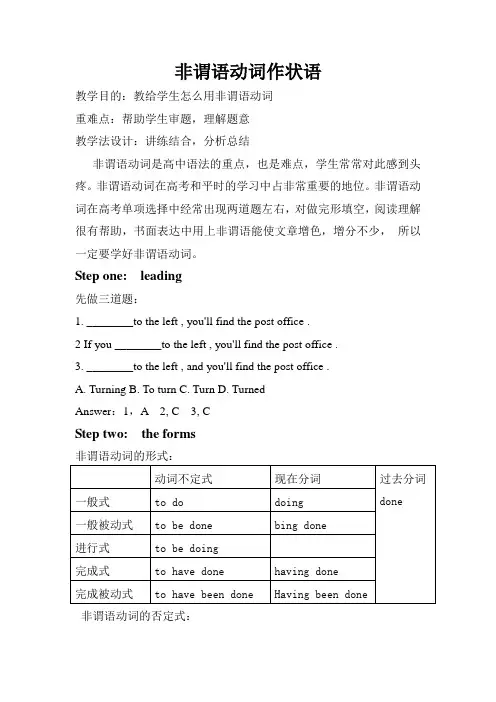
Step two: the forms
非谓语动词的形式:
动词不定式 现在分词 过去分词
done 一般式 to do doing
一般被动式 to be done bing done
进行式 to be doing
完成式 to have done having done
完成被动式 to have been done Having been done
非谓语动词的否定式:
not to do not to be done
not doing not being done
not done
非谓语有自己的逻辑主语时:
of sb. to do / for sb. to do
his not doing
step three : exercises
非谓语动词做状语

非谓语动词做状语
非谓语动词作为状语是指在句子中不能作谓语,但可以做状语的动词形式。它可以作时间、原因、条件、让步、结果等状语,可以提供句子里的信息,使句子充实而生动。
一、非谓语动词作时间状语
1.由过去分词组成的状语
过去分词表示过去发生的动作,常用于主句为一般现在时或一般将来时的句子中,作时间状语,突出主句动作应该在过去发生。如:
He left without saying goodbye, leaving me
standing there alone.
他没有说再见就走了,留下我独自站在那里。
2.由现在分词组成的状语
现在分词表示正在进行的动作,常用于主句为一般现在时或一般将来时的句子中,作时间状语,突出主句动作应该正在进行。如:
She comes to visit us every week, bringing us
some nice food.
她每周都会来看望我们,并带来一些美食。
3.由having done 组成的状语 having done 表示过去已经完成的动作,常用于主句为一般现在时或一般将来时的句子中,作时间状语,突出主句动作应该在过去完成的动作之后发生。如:
Having finished the exam, he went home and had
a good rest.
考试结束之后,他回家好好休息了。
二、非谓语动词作原因状语
由because of,due to,owing to,thanks to等引导,接名词或动词不定式,作原因状语,表示主句动作的原因。如:
Because of the heavy rain, we had to cancel our
picnic.
由于下雨,我们不得不取消野餐了。
三、非谓语动词作条件状语
由if,unless,in case,on condition that,provided (that),supposing (that)等引导,接动词不定式,作条件状语,表示“假设”的意思,表示主句动作的前提,即要想主句动作成立,必须满足什么条件。如:
非谓语动词用法精讲不定式作条件状语的用法和常见结构

非谓语动词用法精讲不定式作条件状语的用法和常见结构
非谓语动词用法精讲:不定式作条件状语的用法和常见结构
一、不定式作条件状语的用法
在复合句中,不定式可以作为条件状语来表示一种假设、前提或条件。它可以解释或说明主句中的行为或状态发生的条件。
不定式作条件状语时,常与含有情态动词should或情态动词原形must、can等的虚拟语气连用,表示主句中所述的行为或状态是一种假设或基于某种条件的结果。
以下是几种常见的结构:
1. 条件状语放在主句之前
例如:
Should you need any further assistance, please do not hesitate to contact
us.
如果您需要进一步的帮助,请随时与我们联系。
2. 条件状语放在主句之后
例如:
He cannot afford to go on vacation unless he saves more money.
除非他存更多的钱,否则他负担不起去度假。 3. 倒装结构
在条件状语中使用否定副词或词组时,为了强调,在主句中可以使用部分倒装结构。
例如:
Only by studying hard can you pass the exam.
只有努力学习,你才能通过考试。
4. if引导的条件状语从句
如果条件状语是以if引导的状语从句,可以使用以下几种结构:
a. 如果动词在句子中作谓语,动词后面直接接不定式
例如:
If you want to succeed, you must work hard.
如果你想成功,你必须努力工作。
b. 如果主语是人称代词,可以省略if,并将动词原形置于主语之前
例如:
Should I see him, I will tell him the news.
如果我见到他,我会告诉他这个消息。
二、常见结构
1. 不定式作目的状语 不定式可以表示一个行动或状态是为了实现某个目的。
非谓语动词作主宾表定状补
______________________________________________________________________________________________________________
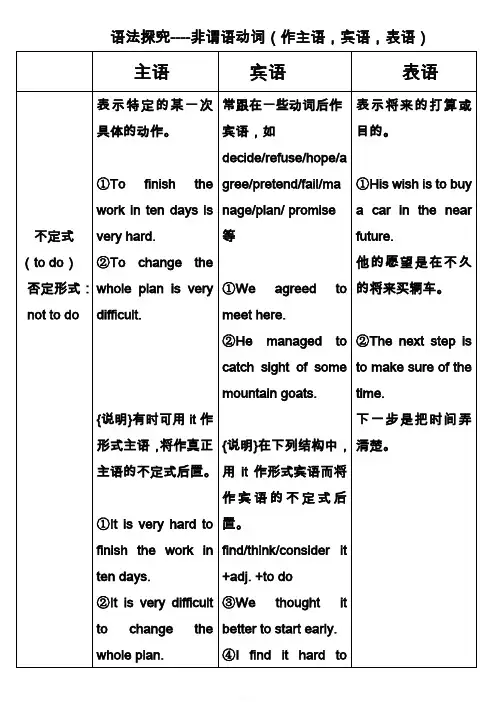
精品资料 语法探究----非谓语动词(作主语,宾语,表语)
主语 宾语 表语
不定式
(to do)
否定形式:
not to do
表示特定的某一次具体的动作。
①To finish the
work in ten days is
very hard.
②To change the
whole plan is very
difficult.
{说明}有时可用it作形式主语,将作真正主语的不定式后置。
①It is very hard to
finish the work in
ten days.
②It is very difficult
to change the
whole plan. 常跟在一些动词后作宾语,如decide/refuse/hope/agree/pretend/fail/manage/plan/ promise等
①We agreed to
meet here.
②He managed to
catch sight of some
mountain goats.
{说明}在下列结构中,用it作形式宾语而将作宾语的不定式后置。
find/think/consider it
+adj. +to do
③We thought it
better to start early.
④I find it hard to 表示将来的打算或目的。
①His wish is to buy
a car in the near
future.
他的愿望是在不久的将来买辆车。
②The next step is
to make sure of the
非谓语总结之作状语(一)
非谓语总结之作状语(一)
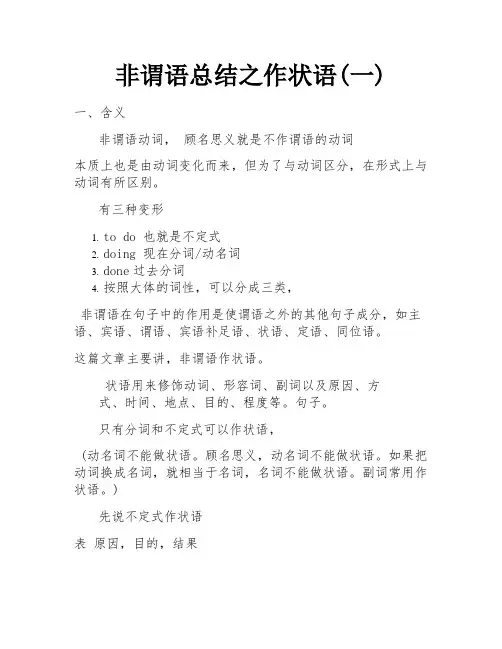
一、含义
非谓语动词, 顾名思义就是不作谓语的动词
本质上也是由动词变化而来,但为了与动词区分,在形式上与动词有所区别。
有三种变形
1. to do 也就是不定式
2. doing 现在分词/动名词
3. done过去分词
4. 按照大体的词性,可以分成三类,
非谓语在句子中的作用是使谓语之外的其他句子成分,如主语、宾语、谓语、宾语补足语、状语、定语、同位语。
这篇文章主要讲,非谓语作状语。
状语用来修饰动词、形容词、副词以及原因、方式、时间、地点、目的、程度等。句子。
只有分词和不定式可以作状语,
(动名词不能做状语。顾名思义,动名词不能做状语。如果把动词换成名词,就相当于名词,名词不能做状语。副词常用作状语。)
先说不定式作状语
表 原因,目的,结果 (谐音记忆:不(不定式)状(状语),因目果 意思就是,为什么不说话,因为我的眼睛只有苹果)
〔1〕不定式作原因状语
关键点是 :基本结构中的主系表,表语是有表示心情状态形容词充当,如:开心,伤心……
• 例: I am so happy to see you.
• 因为见到你我很高兴
〔2〕不定式作目的状语
这个不用我说,大家一看到不定式,最开始想的就是目的状语
• 例:I study hard to server people well.
• 我努力学习是为了更好地为人民服务。
〔3〕不定式作结果状语
关键点:意料之外的结果
• 例:I hurried to school, only to find the gate
locked.
• 我匆忙赶到学校,却发现门锁着。
分词作状语〔主动用doing,被动用done〕
表 原因,条件,时间,让步,方式,伴随,结果。〔谐音巧记:因挑食(时间)让柿(方式)拌着果〕
〔1〕分词作原因状语
• 例:Being ill, he didn't go to school.
非谓语动词作状语的用法
非谓语动词作状语的用法
XXX。we must work hard。Therefore。we need to put in
extra XXX.
Mike had to shout to make himself heard above the sound of
the music。In order to be heard over the loud music。Mike had to
raise his voice.
The bus ped so as to pick up passengers。The bus driver
XXX.
He got up early in order to catch the first bus。He woke up
early to make sure he could catch the first bus of the day.
I went to see him last night only to find him out。I went to
see him last night。but was surprised to find out that he was not at
home.
Mary is too tired to do the job。Mary is XXX.
He is old enough to go to school。He has reached the age
where he is XXX.
Tom was very happy to see his mother。When Tom saw his
mother。he was filled with joy.
I was surprised to find him here。I was taken aback when I
discovered that he was present.
非谓语动词作状语
非谓语动词作状语,其逻辑主语须与主句主语保持一致。若不一致,非谓语动词形式须另带主语,从而构成复合结构的形式作状语。这种结构称为“独立结构”。其中,非谓语动词主动用现在分词,被动用过去分词。
非谓语动词及其短语前面带有逻辑主语,逻辑主语的代词又是主格,故常称为“独立主格”。“独立结构”在句中起状语作用,相当于状语从句,表示时间、原因、条件、方式或伴随等情况。
功能
独立主格结构主要用于描绘性文字中,其作用相当于一个状语从句,常用来表示时间、原因、条件、行为方式或伴随情况等。例如:
表示时间
The meeting over, all of us went home. 开完会后我们都回家了。
Her work done, she sat down for a cup of tea. 她干完了活,坐下来喝茶。
表示条件
The condition being favourable, he may succeed. 若条件有利,他或许能成功。
表示原因
There being no taxis, we had to walk. 没有出租车,我们只好步行。
He wrapped her up with great care, the night being dark and frosty. 夜又黑又冷,所以他把她裹得严严实实的。
表示伴随情况
Almost all metals are good conductors, silver being the best of all. 几乎所有的金属都是良导体,而银则是最好的导体。(=Almost all metals are good conductors, and silver is the best of all.)
用法
独立主格结构主要表示谓语动词发生的时间、原因、条件或伴随情况等,相当于一个状语从句或并列句。
用作时间状语
The work done(=After the work had been done), we went home. 工作完成后,我们就回家了。
高考语法复习之非谓语动词做状语及与状语从句的相互转化与语法填空的应用
名师精编
欢迎下载
非谓语动词作状语
高考对非谓语动词作状语的考查多与对动词其他形式的考查同时进行主要包括以下几个方面的内容:
1.不定式作状语;
2.-ing分词作状语;
3.-ed分词作状语。
一、不定式结构作状语
不定式结构作状语通常有以下几种情况:
1、目的状语(分词一般不能作目的状语)
He bought a bicycle to go to town more quickly .
To catch the train ,she hurried through her work
注:表目的的不定式还常与so as或in order连用,构成so as (not) to do和in order (not) to do 结构,其中so as (not) to do 不能用于句首。
To get there in time, we got up very early.
= In order to get there in time, we got up very early.
= We got up very early (in order/so as) to get there in time.
2、原因状语
不定式结构作原因状语常用在作表语用的形容词后。
I’m sorry to hear that .
We’re proud to be young people of China .
We are glad to hear the news.
3、结果状语
不定式结构作结果状语,有时表示未曾预料到的、或令人不快的结果。(常和only连用)。
He ran all the way to the station ,only to find the train had left .
非谓语动词作状语教案
非谓语动词作状语教案
第一章:非谓语动词的概念与分类
1.1 非谓语动词的定义
1.2 非谓语动词的分类:动词不定式、分词和不定式
1.3 非谓语动词与谓语动词的区别
第二章:非谓语动词作状语的意义与用法
2.1 非谓语动词作状语的意义
2.2 非谓语动词作状语的用法:时间、原因、条件、方式、地点等
2.3 非谓语动词作状语与句子结构的关系
第三章:动词不定式作状语
3.1 动词不定式作状语的定义与特点
3.2 动词不定式作状语的常见结构与用法
3.3 动词不定式作状语与不定式作宾语的区别
第四章:分词作状语
4.1 分词作状语的定义与特点
4.2 分词作状语的常见结构与用法
4.3 分词作状语与分词作定语的区别
第五章:非谓语动词作状语的翻译与练习
5.1 非谓语动词作状语的翻译技巧
5.2 非谓语动词作状语的练习题
5.3 答案与解析
第六章:现在分词作状语 6.1 现在分词作状语的定义与特点
6.2 现在分词作状语的常见结构与用法
6.3 现在分词作状语与过去分词作状语的区别
第七章:过去分词作状语
7.1 过去分词作状语的定义与特点
7.2 过去分词作状语的常见结构与用法
7.3 过去分词作状语与现在分词作状语的区别
第八章:非谓语动词作状语的句子分析
8.1 非谓语动词作状语的句子结构分析
8.2 非谓语动词作状语的句子类型分析
8.3 非谓语动词作状语的句子实例分析
第九章:非谓语动词作状语的语法辨析
9.1 非谓语动词作状语与作宾语的语法辨析
9.2 非谓语动词作状语与作定语的语法辨析
9.3 非谓语动词作状语与作补语的语法辨析
第十章:非谓语动词作状语的综合练习与解答
10.1 非谓语动词作状语的综合练习题
10.2 答案与解析
10.3 非谓语动词作状语的实践与应用
重点和难点解析
一、非谓语动词的分类:动词不定式、分词和不定式
补充说明:动词不定式作状语时,常常表示目的、结果、原因等;分词作状语时,可以表示时间、原因、条件等;不定式作状语时,通常表示方式、地点等。