
河南省中考英语复习语法专题过关专题八动词和动词短语课件
考点帮
考点1 考点2
动词
表示请求,许可,意为"可以" may You may leave now。你可以离开了。
This watch may be Cindy's. She likes 表示可能性较小的推测,意为" pink best.这只手表可能是辛迪的。她 可能,也许",常用于肯定句中 最喜欢粉色。 用于祈使句,表示祝福和愿望 表示请求,许可,意为"可以",语 气比may更委婉 May you return soon! 愿你早日归来! Might I ask you a question?我可以问你 一个问题吗? He is away from school. He might be sick. 他没有上学,他可能生病了。 She was worried that we might get hurt. 她担心我们可能会受到伤害。
might
表示推测,意为"可能",可能性 低于may may的过去式,意为"可能"
考点帮
考点1 考点2
动词
情态动词 例句 ①We must do something to protect our environment. 我们必须做一些事 表示义务,意为"必须";否定形 情来保护我们的环境。②Children 式为mustn't,意为"禁止,不准" mustn't play with fire. 小孩子不准玩 火。 You must be tired after such a long 表示推测,意为"一定,肯定",用 journey.经过如此长途旅行后,你一定 于肯定句中 很累。 Need I leave now?我现在需要离开吗 常用于疑问句中,意为"需要" ? You needn't worry about Jim. He is 用于否定句,needn't意为"不必" not a child any more. 你不必担心吉 姆。他不再是个孩子了。 在疑问句中同I和we连用,表示 Shall we go hiking tomorrow 征求对方意见或请求 morning?明天早上我们去远足好吗? 含义及用法
考点帮
考点1 考点2
动词 易失分点 need既可作情态动词,又可作实义动词。作情态动词时,主要用于否定句
和疑问句中;作实义动词时,有人称和数的变化,后跟不定式或动名词作宾
语。 (1)need作情态动词 You needn't come again, if you don't want to.如果你不愿意,就不用再来了。 (2)need作实义动词
—May I use your ruler? 我可以用你的尺子吗?
语的辨析主要在单项选择中考查。 2.动词短语的命题点主要有:①同一介词/副词型;②同一动词型;③混合型。
考情帮
图解语法
命题点
PART 02
考点帮
考点1 动词 考点2 动词短语
考点帮
考点1 考点2
动词
▶实义动词 实义动词也叫行为动词,有实在意义,能独立作谓语。按其句法功能可分为及物动词和 不及物动词;按其延续性可分为延续性动词和非延续性动词。 1.及物动词 及物动词本身意义不完整,需要接宾语才能使其意思表达完整。及物动词常用于以下 几种结构中: (1)主语+及物动词+宾语 We planted many trees around our school. 我们在学校周围种了很多树。 (2)主语+及物动词+宾语+(as/for)+宾语补足语 They consider him as the best writer. 他们认为他是最优秀的作家。 (3)主语+及物动词+宾语+不定式 Mr. Li encouraged me to study hard. 李老师鼓励我努力学习。 (4)主语+及物动词+疑问代词/疑问副词+不定式 I don't know where to go. 我不知道要去哪里。 (5)主语+及物动词+间接宾语+直接宾语 She picked her mom some flowers. 她为母亲采了一些花。
考点帮
考点1 考点2
动词
▶系动词 系动词本身有词义,但不能单独作谓语,其后必须接表语,构成系表结构,说明主语的状 态、性质、特征或身份。具体分类如下:
类别 功能 状态系动词 表示主语所处的状态 感官系动词 表示人体感官的系动词 表示看起来/似乎处于某种 表象系动词 状态 表示主语由一种状态变换 变化系动词 到另一种状态 表示主语持续或保持某种 持续系动词 身份或状态
Would you tell me the way to the bank? 你能告诉我去银行的路吗? The man would not let her enter the hall. 那个人不让她进入大厅。
两者都可表示客气 的请求或提议,would will/would 比will更委婉 表示意愿、意志或 打算,可用于多种人 称
考点帮
考点1 考点2
动词
得分巧记 常见的可以接双宾语的及物动词有:give, show, pass, tell, bring, teach,
make等。带双宾语的及物动词,若把直接宾语置于间接宾语前,在变换时
必须加to/for,构成"及物动词+直接宾语+to/for+间接宾语"结构。如: Please pass me a glass of water.=Please pass a glass of water to me. 请给我 递一杯水。
表示能力,意为"能、会"
Mary can speak three languages.玛丽能说三种语言。
用于疑问句中,表示委婉的请 Could you lend me your dictionary?你能把词典借给我 求,could语气比can更委婉 吗? 表示不大的可能性 It could be his eraser, but I'm not sure. 这可能是他的橡 皮,但是我不确定。
must
need
shall
考点帮
考点1 考点2
动词 should 意为"应该",表示责 任和义务或劝告和 建议 You should get up earlier. 你应该早 点儿起床。
意为"最好",表示建 had better 议
have to
意为"必须,不得不", 用于强调客观需要
You'd better stay at home when it rains hard. 下大雨的时候你最好待 在家里。 My mother is ill. I have to look after her at home. 我妈妈生病了,我不得 不在家照顾她。
例词 be taste, smell, sound, look, feel
appear, seem
go, get, turn, grow, become keep, stay, remain, stand, lie
▶助动词 助动词本身没有意义或意义不完整,不可单独作谓语,只能和它后面的动词一起构成谓 语,以表示时态、语态、人称和数,还可构成否定、疑问或强调的句型。具体用法如下:
do/does/did
考点帮
考点1 考点2
动词
▶情态动词 情态动词本身有一定的词义,表示说话人的情感和态度,不可单独作谓语,必须和其他 动词连用构成谓语。情态动词有以下几个特征:(1)其后接动词原形;(2)无人称和数的 变化(have to除外,主语为第三人称单数时用has to);(3)具有助动词的作用,可构成否定 句、疑问句及用于简略答语。
考点帮
考点1 考点2
动词
2.不及物动词 不及物动词本身意思完整,无须接宾语,构成"主语+谓语"的句型,若要跟宾语,其后必须 加上相应的介词,构成"主语+谓语(不及物动词)+介词+宾语"的句型。如: We should listen to the teacher carefully. 我们应该认真听老师讲。 有些动词既可以作及物动词又可作不及物动词,如:begin, learn, read, improve, study等。 3.延续性动词和非延续性动词 (1)延续性动词也叫持续性动词,表示动作是可以持续的,可以和表示一段时间的状语连 用。如:work, live, keep, study, sleep, rain, lie, know, read等。 You can keep the dictionary for three weeks. 这本词典你可以借三周。 (2)非延续性动词也叫短暂性动词,表示瞬间动作,动作一旦发生立即结束,不能和表示 一段时间的状语连用,如:come, go, begin, close, die, borrow,stop,receive等。若和表示一 段时间的状语连用,需要用其他词代替。
目录
CONTENTS
PART 01
PART 02
考情帮
考点帮
PART 01
考情帮
考情总结 图解语法
考情帮 考情总结
分析近10年河南真题可知,动词和动词短语是河南中考英语的必考考点。通常在 命题点 单项选择、完形填空和词语运用这三类题目中考查。动词和动词短语的命题特点主
要如下:
1.实义动词词义辨析主要在单项选择和完形填空中考查,情态动词的用法和动词短
She needed to go out for a walk. 她需要出去散散步。
河南省2020中考英语复习 第二部分 语法专题过关 专题八 动词和动词短语(考情帮)素材

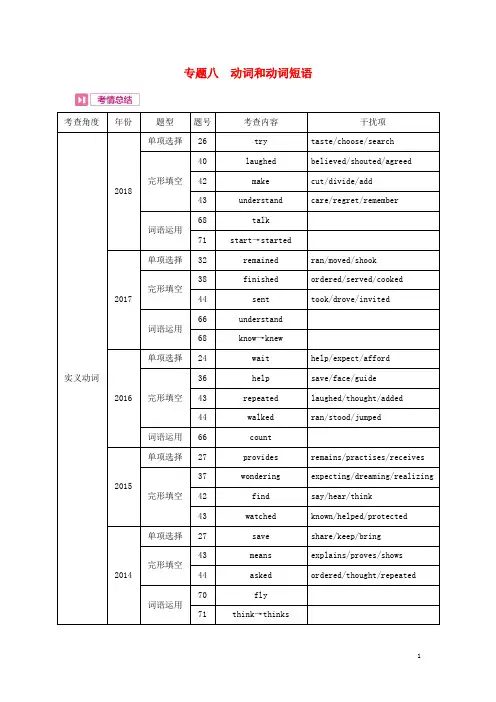
专题八动词和动词短语考查角度年份题型题号考查内容干扰项实义动词2020单项选择26 try taste/choose/search完形填空40 laughed believed/shouted/agreed42 make cut/divide/add43 understand care/regret/remember词语运用68 talk71 start→started2020单项选择32 remained ran/moved/shook完形填空38 finished ordered/served/cooked44 sent took/drove/invited词语运用66 understand68 know→knew2020单项选择24 wait help/expect/afford完形填空36 help save/face/guide43 repeated laughed/thought/added44 walked ran/stood/jumped词语运用66 count2020单项选择27 provides remains/practises/receives完形填空37 wondering expecting/dreaming/realizing42 find say/hear/think43 watched known/helped/protected2020单项选择27 save share/keep/bring完形填空43 means explains/proves/shows44 asked ordered/thought/repeated词语运用70 fly71 think→thinks2020 29 may must/need/can2020 26 Could Must/Should/Might2020 34 may will/must/shall2020 24 may can/need/shall动词短语辨析2020 单项选择32 showing offtaking off/drivingoff/setting off2020单项选择30 show up get up/stand up/hurry up完形填空45 looked up turned to/asked for/called on 2020单项选择34 look throughlook at/look after/lookaround2020 29 deal withkeep up with/agree with/comeup with2020单项选择29 get off take off/put off/turn off完形填空41 looked atshouted at/laughed at/pointedat2020单项选择30 Turn on Try on/Get on/Put on2020 27 take away put away/move away/get away2020 27 put off put on/put down/put up2020 30 picked;up put;up/turned;up/looked; up2020 28 look;uptake;away/give;back/turn;down系动词2020词语运用75 taste→tastes2020 74 be→was1.[2020河南,31]—Are you going to the cinema tonight?—I don't know. I go or I stay at home.A. will; willB. must; mustC. should; shouldD. might; might2.[2020河南,28]—I don't care what people think.—Well, you . You're not alone in this world.A.canB.mayC.shouldD.will3.[2020河南,27]—You look very pretty, if I say so.—Thanks a lot for saying that.A. mustB. mayC. willD. have to4.[2020河南,26]—What's the matter with Tom? He has been absent for two days. —Oh!He be ill.Let's go and ask Ms Brown.A. canB. needC. mayD. would5.[2020河南,26]—Dad, must we wait until the light becomes green?—Yes, I'm afraid we . That's the traffic rule.A.canB. mayC. have toD. need6.[2020河南,29]—Do you have any plans for this weekend?—I'm not sure. I go climbing Mount Yuntai.A.mustB. needC. mayD. can7.[2020河南,26] you wait a few more minutes? It'll be your turn soon.A. MustB. ShouldC. CouldD. Might8.[2020河南,34]—It's such a long way! What shall I do?—You take my car if you want.A. willB. mustC. mayD. shall9.[2020河南,24]—Excuse me, where are we going to have our class meeting?—I'm not sure. Ask our monitor, please. He know.A. canB. mayC. needD. shall10.[2020河南,28]—Excuse me, when does Flight CZ3391 take off?—One moment, please. I'll it .A.look; upB.take; awayC.give; backD.turn; down【参考答案】1—5 DCBCC 6—10 CCCBA。
河南省2019中考英语复习 第二部分 语法专题过关 专题八 动词和动词短语(考情帮)素材
专题八动词和动词短语1.[2018河南,31]—Are you going to the cinema tonight? —I don't know. I go or I stay at home.A. will; willB. must; mustC. should; shouldD. might; might2.[2017河南,28]—I don't care what people think.—Well, you . You're not alone in this world.A.canB.mayC.shouldD.will3.[2016河南,27]—You look very pretty, if I say so.—Thanks a lot for saying that.A. mustB. mayC. willD. have to4.[2015河南,26]—What's the matter with Tom? He has been absent for two days. —Oh!He be ill.Let's go and ask Ms Brown.A. canB. needC. mayD. would5.[2013河南,26]—Dad, must we wait until the light becomes green?—Yes, I'm afraid we . That's the traffic rule.A.canB. mayC. have toD. need6.[2012河南,29]—Do you have any plans for this weekend?—I'm not sure. I go climbing Mount Yuntai.A.mustB. needC. mayD. can7.[2011河南,26] you wait a few more minutes? It'll be your turn soon.A. MustB. ShouldC. CouldD. Might8.[2010河南,34]—It's such a long way! What shall I do?—You take my car if you want.A. willB. mustC. mayD. shall9.[2009河南,24]—Excuse me, where are we going to have our class meeting?—I'm not sure. Ask our monitor, please. He know.A. canB. mayC. needD. shall10.[2009河南,28]—Excuse me, when does Flight CZ3391 take off?—One moment, please. I'll it .A.look; upB.take; awayC.give; backD.turn; down【参考答案】1—5 DCBCC 6—10 CCCBA。
2015届中考英语语法复习专练课件:《专题八动词分类及动词短语》人教新目标版(1)

你要不要和我们一起去购物啊?
专题八 动词分类及动词短语
6.should和would should用于各种人称的句子中,强调义务或责任; would是will的过去形式,与动词原形构成过去将来时,可 用于多种人称,表示意愿。如: You should study harder. 你应该更加努力学习。 He said he would visit the Great Wall the next year. 他说他明年将游览长城。 7.had better had better意为“最好”,没有人称的变化,后接 不带to的不定式。如: You had better exercise more. 你最好多锻炼。 专题八 动词分类及动词短语
My plan turned out a success.
我的计划成功了。 [提醒]有些系动词也是实义动词,可单独作谓语。如:
He fell ill yesterday. 他昨天病了。
专题八 动词分类及动词短语
考点3
情态动词
情态动词表示说话人的语气、情态,无人称和数的变 化。情态动词有自己的词汇意思,但不能独立作谓语,其 后须跟动词原形。使用频率较高的情态动词有can(could), may(might), must, need, shall(should), will(would)及 半情态动词have to, had better。
吃起来)等。如: This kind of cloth feels very soft. 这种布摸起来很柔软。 专题八 动词分类及动词短语
5.变化系动词:表示主语变成什么样,主要有 become, grow, turn, fall, get, go, come, run等。如: The small town is becoming busier and busier. 小镇变得越来越忙碌。 6.终止系动词:主要有prove, turn out(结果是, 证明是)等。如:
2020版中考英语新素养突破大二轮河南专用语法过关():专题八 动词的分类

专题八 动词的分类
考点清单
考点清单
常考点清单一 谓语动词分类概述
宾语
谓语动词的种类
实义动词不 及及 物物 动动 词词 复 双合 宾宾 语语
系动词 : be,seem,sound, turn, become等
be
doing done
栏目索引
考点清单
栏目索引
考点清单
情态动词的用法: 1.can的用法 (1)表示能力,意为“能,会”。如: Can you play basketball?你会打篮球吗? (2)表示推测,常用于否定句和疑问句中。如: Li Hua can't be in the classroom. 李华不可能在教室里。 (3)表示请求或允许,多用于口语中,意为“可以”,相当于may。 如: You can go now.你现在可以走了。
栏目索引
考点清单
He turned off the light when he left. 当他离开时,他把灯关了。 He picked it up and gave it to me. 他把它捡起来并给了我。 注意 代词作宾语时必须放在动词后、副词前,当宾语是名词 时,放在副词前后均可。 ③动词+副词+介词 Let's go on with the work.让我们继续工作吧。 注意 宾语只能放在介词之后。 ④动词+名词+介词
栏目索引
考点清单
三、助动词 助动词本身无词义,不能单独作谓语。它必须和别的动词连用,帮 助表示时态、语态、否定和疑问等。常用的助动词有be,have, do,will和shall等。 1.助动词be(am,is,are,was,were) (1)“助动词be+现在分词”构成进行时。如: The students are having class.学生们正在上课。 They asked me what I was doing all the afternoon. 他们问我整个下午一直在干什么。 (2)“助动词be+过去分词”构成被动语态。如: The boy was put to bed by his mother.
河南省中考英语语法专项复习课件: 专项提升 动词的综合运用

+单三(2014.71,2013.75) 复合不定代词、疑问代词作主语+单三 动词不定式、动名词作主语+单三
不可数名词作主语+单三
上一页 返回导航 下一页
考点 变过去式
变 v.ing
用法 有明显的表过去的时间状语时 and,or,then 等连接几个并列的过去式时(2018.71) 根据上下文语境和填 was/were(2020.66) 进行时中,be+v.ing(2020.60,2017.75,2014.66,2012.73) 介词+v.ing(2019.67) 一些动词或短语+v.ing(2016.69,2015.69) v.ing 作主语
computer started.
10.After she finished reading the story, Alice wrote a review for her
school newspaper.
上一页 返回导航 下一页
二、语篇训练 A(2020·威海)
The most difficult thing for university student Ted Rogers is opening his classroom door.Ted can't do this without help because he's only six years old.He's the youngest person ever to study at Rochester University in
away.
4.The teacher kept explaining the use of the idiom to me until I
understood it.
【高中教育】河南省2019中考英语复习第二部分语法专题过关专题八动词和动词短语考情帮素材.doc

专题八动词和动词短语1.[2018河南,31]—Are you going to the cinema tonight?—I don't know. I go or I stay at home.A. will; willB. must; mustC. should; shouldD. might; might2.[2017河南,28]—I don't care what people think.—Well, you . You're not alone in this world.A.canB.mayC.shouldD.will3.[2016河南,27]—You look very pretty, if I say so.—Thanks a lot for saying that.A. mustB. mayC. willD. have to4.[2015河南,26]—What's the matter with Tom? He has been absent for two days. —Oh!He be ill.Let's go and ask Ms Brown.A. canB. needC. mayD. would5.[2013河南,26]—Dad, must we wait until the light becomes green?—Yes, I'm afraid we . That's the traffic rule.A.canB. mayC. have toD. need6.[2012河南,29]—Do you have any plans for this weekend?—I'm not sure. I go climbing Mount Yuntai.A.mustB. needC. mayD. can7.[2011河南,26] you wait a few more minutes? It'll be your turn soon.A. MustB. ShouldC. CouldD. Might8.[2010河南,34]—It's such a long way! What shall I do?—You take my car if you want.A. willB. mustC. mayD. shall9.[2009河南,24]—Excuse me, where are we going to have our class meeting? —I'm not sure. Ask our monitor, please. He know.A. canB. mayC. needD. shall10.[2009河南,28]—Excuse me, when does Flight CZ3391 take off?—One moment, please. I'll it .A.look; upB.take; awayC.give; backD.turn; down【参考答案】1—5 DCBCC 6—10 CCCBA。
中考英语语法专项复习——动词(共52张PPT)【完美版】
• 8、了解含有情态动词的被动语态的构成形 式及其基本用法;
• 9、掌握句子主谓一致的基本原则; • 10、掌握动词不定式作宾语、状语的基本
用法; • 11、了解动词不定式作主语、定语、表语
的基本用法。
二、动词考察点分项说明:
• 1、一般现在时
• ① 一般现在时常用来表示现在习惯或经常反复发生的动作, • 与always, usually, often, sometimes, every
• day (week, month)等连用;表示现在的事实或状态;
• 表示主语所具有的特征,性格和能力;以ቤተ መጻሕፍቲ ባይዱ表示客观事实或普遍 其理。
(一)、掌握动词的现在时第三人称单数、过去式、 过去分词和现在分词四种形式的构成规则;
1、动词现在时的第三人称单数的构成:
2、动词的过去式及过去分词的构成 ① 规则动词的变化:
规则动词的过去式和过去分词的构成方法是相同的。
② 不规则动词的变化。(略)
3、动词的现在分词的构成:
• (二)、掌握动词六种时态的基本结构,主要用法及区别(一般 现在时、一般过去时、一般将来时、过去进行时、现在进行时和 现在完成时)
• 3、掌握系动词be, look, feel, smell, get, become, turn, • keep等的基本用法;
• 4、了解过去将来时、过去完成时态的基本用法; • 5、掌握助动词be, do, have, shall, will的基本用法;
• 6、掌握情态动词can, must, need, may等基 本句型结构及主要用法;
• 2、一般过去时 • ①一般过去时表示过去发生的动作或存在的状态,