
人教版英语必修一Unit 4(A night the earth didn’t sleep)教学设计方案
附件: 教学设计方案模板
注:填写表格时,请您删除蓝色部分
教学设计方案
课题名称 Unit4 Earthquake Reading A Night the Earth didn’t Sleep
姓名
年级学科
一、 教学内容分析
本课的中心话题是“地震”,内容主要涉及1976年7月28日唐山大地震的震前征兆、震时情况、震后破坏、伤亡情况及震后救援。
本文重点在除培养学生语言知识能力之外,也要学习唐山人民勇敢面对自然灾害的精神,以及面对生命的脆弱,尊重生命,珍惜生命的价值
二、教学目标
语言知识: 掌握本课的生词和一些有用的表达方法;了解与地震有关的知识;在阅读中初步感受定语从句。
语言技能: 能运用所学语言知识描述地震前兆、危害及震后援救;学习阅读中略读、找读,精读的技能
情感态度: 学习唐山人民勇敢面对自然灾害的精神;以及面对生命的脆弱,尊重生命,珍惜生命的价值。
文化意识: 了解各种自然灾害的名称和地震的情况, 详细了解地震的常识,提高学生的震时自我保护意识。
重点:依据《英语课程标准》话题项目表关于自然灾害部分的话题要求(P76),了解、理解该自然灾害的情况,以达到能够交流、阅读、书面表达该类文章的能力。
难点:地震相关词汇的积累,细节阅读后达到复述的目标。
三、学习者特征分析
高一年级的学生已经积累了一部分词汇和语法基础,并掌握了一些简单的学习策略和技巧,具有初步的英语听说读写的能力。但是,学生个性和英语水平差异大,两极分化严重,因此教学设计要有梯度,由浅入深,注意层次性。课前预习中让学生先解决掉阅读中的生词,并掌握大意,另外让学生通过网络等去了解有关地震的知识,并观看唐山地震的电影。
四、教学过程
Step 1: Leading-in
First, I will show students several pictures, to review some words for natural disasters.
volcano
sandstorm
drought
flood
fire
hurricane
tsunami
earthquake
Step 2: Pre-reading
Let students work in four to discuss the question below:
Imaging your home begins to shake and you must leave it right away. You have time
to take only one thing. What will you take? Why?
Answer the question, then show some information they searched about
earthquake after class.
Step3: Fast-reading
1)Which night? Where? What?
2) Find out the topic sentence of each paragraph.
3) Read the text quickly, and divide the whole passage into three parts,
according to the three words:signs; damage;rescue
4) Matching(paras and the three words)
Step4: Careful-reading
Para1:What happened before the earthquake hit Tangshan?
Signs before the earthquake(Show some pictures on the screen and let the Ss
fill in the blanks.
Para2&3 The damages caused during the earth.
Dara:
1)________of the nation felt the earthquake .
A huge crack that was kilometres long and
metres wide cut across houses.
In terrible seconds a large city lay in ruins.
of the people died or were injured during the
earthquake.
The number of people who were killed or injured reached more
than .
All of the city’s hospitals, of its factories and buildings and
of its homes were gone.
2) True or false questions
1.The parents of many children died.
2. People were shocked.
3. There was only one quake shook Tangshan.
4. The railway tracks became useless pieces of steel.
5. Bricks and red autumn leaves covered the ground.
Para4:Rescue work after the earthquake 1)Which of the following is NOT true according to the passage?
A. Many soldiers helped to rescue the people who were trapped under the
ruins.
B. Most of the twenty thousand miners were rescued from the coal mines.
C. Workers built shelters for homeless survivors.
(2)What does the last sentence“ Slowly, the city began to breathe again.”
mean?
A. The animals began to breathe.
B. The city returned to normal gradually.
C. People who were trapped came to life.
Step5 Summary
Several days before July 28, 1976, many s______ things happened in
Tangshan. Well walls c_______, water pipes broke and b____, and animals
were too nervous to eat.
They were signs for the e__________. But people in the city of Tangshan
thought little of these. At 3:42 a.m. that day, the earth began to shake,
which d________ the city. Later that afternoon, another big earthquake
shook Tangshan. More people were killed or i______ and more buildings
f___ down. The whole city lay in r____.
Soldiers were sent to help the r_____ workers. Teams were organized
to dig out those who were t_______ and b___ the dead.
Step6 Post-reading
Discussion:Suppose there would be an earthquake, what should we do to
keep ourselves safe? (Group work)
Give several situations: at school; on the road; at home;In a building
Homework:
1. Read the text for three times, and try to retell it.
2.Do Exercise 1 & 2 on P27 Comprehending
五、教学策略选择与信息技术融合的设计
教师活动 预设学生活动 设计意图
Leading in
Discussion
Braining storming
Reading, 用温故知新的方式导入本课的话题,达到知识循环滚动运用的目的。
Pre-reading
Group discussion
Individual activity 这部分步熟悉本单元话题,通过展示搜集的关于地震常识的资料,培养学生自主学习和有效获取所需信息的能力。
Fast-reading
Listening
Skipping 通过快速阅读,让学生快速找出主题句,和文章大意。
Careful Reading
Task-based reading
Scanning 让学生用精读的阅读方法完成细节部分的学习,进一步学习的阅读方法和技能。
Post reading Summary
Retelling
Group discussion 通过summary这个环节让学生更好地掌握关键词,通过讨论环节让学生具有自我保护意识。
六、教学评价设计
Things I can do Self
Evaluation(rate
必修一unit4 The Night The Earth Didn’t Sleep学案
第 1 页 共 3 页
必修一Unit4 The Night The Earth Didn’t Sleep
While reading
Task 1
What's the main idea of the text?
The text mainly talks about _______________________________________.
Task 2
Read the text carefully and then write down the main idea of each paragraph.
Para 1: _____________________________
Para 2: _____________________________
Para 3: _____________________________
Para 4: _____________________________
Para 5: _____________________________
Task 3
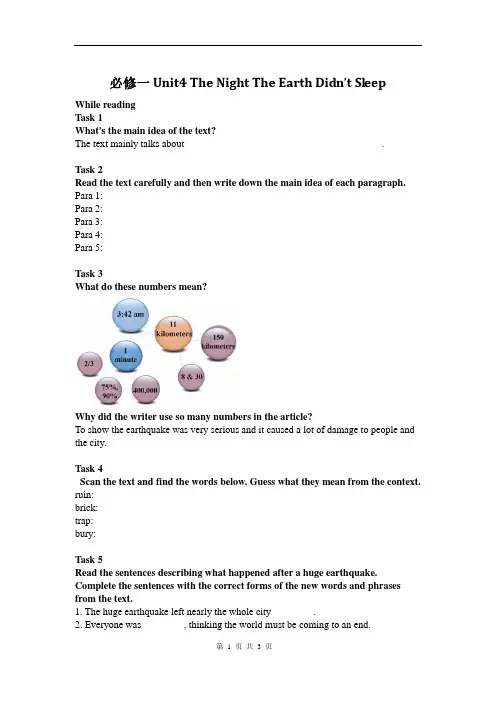
What do these numbers mean?
Why did the writer use so many numbers in the article?
To show the earthquake was very serious and it caused a lot of damage to people and
the city.
Task 4
Scan the text and find the words below. Guess what they mean from the context.
ruin:
brick:
trap:
bury:
Task 5
Read the sentences describing what happened after a huge earthquake.
人教版高中英语Unit4 Natural disasters 教学设计

人教版高中英语Unit4 Natural disasters Period2
Reading and thinking教学设计
课题 Period2
reading and
thinking 单元 Unit 4 Natural
disasters 学科 English 年级 高一
必修一
教材
分析 This teaching period mainly deal with reading and thinking .Students are
expected to the knowledge about how to find the main ideas through the topic
sentences. The teachers are expected to enable students to master some
reading skills.
教学目标与核心素养 Knowledge objectives: Enable students to acquire the basic usage of some
words and phrases.
skill objectives: Enable students have a good understanding of reading skills.
Emotional objectives: Develop students’ sense of cooperative learning and
individual capability.
Thinking quality objectives: Inspire the students’ spirit of protecting the
environment.
重点
难点 How to find the main ideas of each paragraph.
Grasp some reading skills.
人教版必修第一册UNIT4 Reading for Writing板块教案
1 人教版必修第一册UNIT4 Reading for Writing板块
教学设计
教材分析:
【What】阅读材料1 TSUNAMI HITS ASIA:OVER 6500 DEAD是一篇2004年有关亚洲海啸的新闻报道。报道中主要提及海啸发生的时间、成因(近40年来最强烈的一次地震)及其对沿海国家印度尼西亚、索马里半岛、斯里兰卡、印度、泰国等国家造成的人员伤亡情况;材料2 summary是前一篇报道的摘要,简明扼要地介绍了海啸发生的时间、地点、造成的伤亡情况。材料3:The Night the Earth didn’t Sleep为本单元第2、3节课的一篇新闻报道,主要讲述了唐山大地震发生的整个过程;
【How】新闻报道的特点是,文字简洁明了不啰嗦,所表达的观点客观中立不偏向。材料一是运用大量数词说明海啸造成的严重后果,并分国家列出。材料2 Summary部分仅用3句话概括了此次海啸情况。语言高度凝练概括。材料3 the Night the Earth didn’t Sleep 的语言精练,准确,信息含量大。文章前后逻辑关系较强,联系紧密。
【Why】新闻报道的目的是为了说明何时、何地发生了何事。这样的文体写作能让读者很快抓住文章主旨,获取信息。材料1和材料2进行对照,起到很好的比较、归纳的作用。学生不仅能够循序渐进地掌握概要写作的定义及方法。材料3以其清晰的文章脉络结构及语言组织,使得学生比较容易归纳出各段的段落大意,而这恰恰是概要写作的重要一环。
学情分析:
1.高一年级学生有一定的形象思维能力,能够进行简单的推理。但相比先被告知定义再去做练习的演绎法,学生更容易接受从现象到本质的归纳法, 2 所以读写结合的方法也正是为了适应学生的思维发展特点而采取的一种教学方法。但是,学生的总结规律,发现事物的能力还不是很强,所以需要老师给予适当的引导和帮助。
2.通过前几节课的学习,特别是第2、3节课对材料3的精读,学生已经初步掌握了一些关于自然灾害的词汇,并已经梳理出了每一段落的段落大意,学生在此基础上能够很快找出各段落中的主要信息。但将语篇各段的主要信息整合成为一篇完整的概要,还需要明确概要书写方法,需要老师给予指导。
2019新人教高中英语必修一Unit4Reading for writing公开课教案
2019新人教高中英语必修一
Unit4 Reading for writing教案
Teaching aims:
1. Enable students to get the main idea of the text and identify the type and
language features of the text.
2. Analyse the sample and summarize the key elements in writing a summary.
3. Write a summary of the passage"THE NIGHT THE EARTH DIDN'T SLEEP".
Teaching key points:
1. Help students identify the type and language features of the text.
2. Enable students to write a summary.
Teaching difficult points:
1. Get students to analyse the structures and language features of the text.
2. Enlighten students on the key steps of writing a summary.
Teaching procedure
Step I Lead-in
Watch a clip from“Video Time”.Prepare some questions before watching.
1.What is a tsunami?What causes it?
2.What damage can it cause?
Suggested answers:
1. Harbor wave.It is caused by the earthquake.
人教版高中英语必修一 Unit4课文中英对照
A Night the Earth didn’t Sleep
地球的一个不眠之夜
Strange things were happening in the countryside of northeast Hebei. For three days the water in the
village wells rose and fell rose and fell. Farmers noticed that the well walls had deep cracks in them.
A smelly gas came out of the cracks. In the farmyards the chickens and even the pigs were too
nervous to eat. Mice ran out of the fields looking for places to hide. Fish jumped out of their bowls
and ponds. At about 3:00 am on July 28 1976 some people saw bright lights in the sky. The sound of
planes could be heard outside the city of Tangshan even when no planes were in the sky. In the city
the water pipes in some buildings cracked and burst. But the one million people of the city who
thought little of these events were asleep as usual the night.
河北省东北部的农村不断有些怪事发生:三天来,村子里的井水升升降降,起起伏伏。农夫注意到,水井的井壁上有深深的裂缝,裂缝里冒出臭气。农家大院里的鸡甚至猪都紧张得不想吃食。老鼠从田地里跑出来找地方藏身。鱼缸和池塘里的鱼会往外跳。在1976年7月28日凌晨3点左右,有些人看到天上一道道明亮的光。即使天空没有飞机,在唐山城外也可以听到飞机声。在市内,有些建筑物里的水管爆裂开来。但是,唐山市的一百万居民几乎都没有把这些情况当一回事,当天晚上照常睡着了。
Book1 unit4 A night the earth didn’t sleep基础知识复习
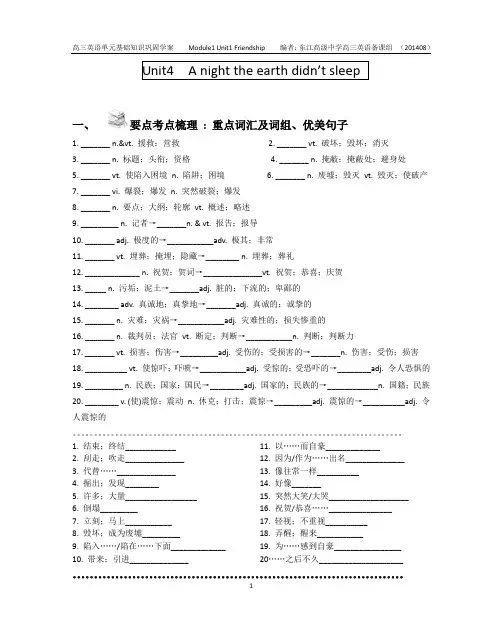
高三英语单元基础知识巩固学案 Module1 Unit1 Friendship 编者:东江高级中学高三英语备课组 (201408)
1
Unit4 A night the earth didn’t sleep
一、 要点考点梳理 : 重点词汇及词组、优美句子
1. _______ n.&vt. 援救;营救 2. _______ vt. 破坏;毁坏;消灭
3. _______ n. 标题;头衔;资格 4. _______ n. 掩蔽;掩蔽处;避身处
5. _______ vt. 使陷入困境 n. 陷阱;困境 6. _______ n. 废墟;毁灭 vt. 毁灭;使破产
7. _______ vi. 爆裂;爆发 n. 突然破裂;爆发
8. _______ n. 要点;大纲;轮廓 vt. 概述;略述
9. _________ n. 记者→_______n. & vt. 报告;报导
10. _______ adj. 极度的→___________adv. 极其;非常
11. _______ vt. 埋葬;掩埋;隐藏→________ n. 埋葬;葬礼
12. _____________ n. 祝贺;贺词→______________vt. 祝贺;恭喜;庆贺
13. _____ n. 污垢;泥土→_______adj. 脏的;下流的;卑鄙的
14. ________ adv. 真诚地;真挚地→_______adj. 真诚的;诚挚的
15. _______ n. 灾难;灾祸→___________adj. 灾难性的;损失惨重的
16. _______ n. 裁判员;法官 vt. 断定;判断→___________n. 判断;判断力
17. _______ vt. 损害;伤害→_________adj. 受伤的;受损害的→_______n. 伤害;受伤;损害
高一必修一Unit4 Earthquakes Reading-A Night the Earth Didn’t Sleep教学设计
·__| 昌一 I司 必修一Unit4 Earthquakes Reading— A Night the Earth Didn,t Sleep教学设计 我的教学设计研讨的主题是“读与 说相结合的教学”。我将以人教版高中英 语必修一Unit4,阅读课文ANighttheEarm Didn’tSleep为例,从教材分析、教法与 学法,教学过程等几方面进行设计。 课标课程标准是我们进行教学设计 的依据。课程目标强调在进一步发展学 生综合语言运用能力的基础上,着重提 高学生用英语获取信息、处理信息,分 析问题和解决问题的能力,同时关注学 生的情感,提高学生独立思考和判断的 能力。树立正确的人生观、世界观、价 值观,增强社会责任感,全面提高人文 素养。另外课程的设计与实施有利于学 生优化英语学习方式,使他们通过观察、 体验、探究等积极主动的学习方法,充 分发挥自己的潜能,提高自主学习的能 力,形成有个性的学习方法和风格。 我以课程目标(三维目标)作为本 单元教学设计和本课教学的指导思想和 教学依据。 一、教材分析发依据 l、单元背景。本单元的中心话题是 。地震”,内容涉及中国唐山地震,美国 旧金山1906年的地震,地震后重建的新 唐山,地震的基本知识。在地震或突遇 的灾难中如何自救,救人等。本单元的 语言知识和技能都是紧密围绕这一主题 设计展开的。这体现了教材内容的实用 性,使知识与现实生活紧密地联系起来, 有利于激发学生的学习动机,也有利于 提高学生的学习效果。 2、单元分析及教材处理。为了让学 生有充足的earthquakes知识和正确的情 感态度去面对地震,而且学生也能学有 所用。在wanning up,listening,speaking 中,通过听力训练和语言交际等活动, 让学生对earthquakes的知识有一定的了 解,并明白这一大灾难的破坏性。使学 生在认识的基础上进一步学习阅读课文 里有关地震来临前的征兆和地震过程中 的相关知识,并懂得在地震中如何自救, 如何救人等内容。在学习知识的同时增 强了学生的社会责任感,树立了正确的 人生观,价值观。珍爱生命,在大灾难 前要有大爱,这样也提高了学生的自身 泰质教育142 陕西省旬邑县职教中心李虹 素养。 二、教学目标 理论依据<新课程标准> 知识目标 1、理解课文的内容,深入了解有 关地震的基本常识。例如:WhatwiU happen before an earthquake?Help the students get to know how to survive in all earthquake and if you are a survivor what you should d0. 2、理解和掌握课文的语言点和重 点词汇:wellfight away,pipe,event,as ie at an end,nati0n steam, ure,extreme, destroy,brick,tracks,useless,rescue, electricity,dig out,shelters,in ruins. 3、学习有关地震的一些基本常识。 4、一般了解定语从句。 能力目标 1、培养分析主题,围绕主题阐述问 题的能力。 2、训练学生的阅读技巧和方法,提 高学生的阅读能力。 3、着重提高学生用英语获取信息, 处理信息,分析和解决问题的能力,逐步 培养学生用英语进行思维和表达的能力。 情感目标 1、通过对本文的学习使学生知道在 大地震中如何保护自己和帮助他人,从 而使他们学会如何面对灾难和正确处理 灾难。 2、通过本文的学习激发学生对生 命的感悟,使学生形成积极的情感态度, 主动思维,大胆表述,提高语言运用能力。 3、通过小组活动,培养学生的协作 精神。 教学策略 1、开放式教学策略。以有限的课堂 为载体,带学生进入广阔的知识天地。 2、任务型教学策略。在做中学,在 做中练,在做中巩固,这样使课堂更为 有效性。 3、层次性策略。由筒到繁,由难到 易。尖子生和后进生都有所顾及。 三、教学重难点 重点 1、理解课文,深入了解有关地震 的基本知识。体现自己的人生观价值观, 提高人身素养。 2、掌握课文中重要的词、短语和重 点句型,提高学生的阅读能力和技巧。 难点 l、如何用所学的知识完成学习任 务。 2、如何正确使用发表各人观点的词 汇和句型。 四、教法 (一)任务型教学的课堂教学程序 自主学习的主体模式 说明:1、Prc-task.引入话题,激 活学生知识网络和清除词汇障碍,明确 学习任务,激发英语学习兴趣。学生: 认知处于主动状态,有完成任务的欲望。 老师:学习的组织者,促进者。启发思 路的过程。 2、Task-.cycle.任务的完成过程。 学生:用英语做事,做中学,运用体验、 参与、合作、实践交流,探究等方式进 行自主学习的过程。发展听、说、读、 写综合英语技能。老师:指导者、帮助者、 参与者、合作者的角色。引导思路的过程。 3、Post-.task展示成果,交流成果 的过程。学生:体验成功,自我评价, 小组评价。认识自己,树立自信,反思 自己,调控自己。老师:评价者,总结者。 (二)教学和手段:多媒体辅助 用多媒体放一段关于20o8年四川地 震的视频,让学生看一些有关地震的图 片,这样使学生很快进入角色,使抽象 的语言变得直观,为学生运用英语进行 交际创设情景。实现师生互动、生生互 动和人机互动的多向交流。 五、学法指导和学情 学法指导(英语课程标准>把培养 学生学习英语的兴趣,树立自信心,培 养良好的学习习惯和形成有效的策略, 发展自主学习和合作精神放在首位。因 此在课堂活动中把学生分成四人一组的 学习小组,让他们围绕着课堂任务分工 合作,在活动中相互探讨、相互交流、 相互合作,从而获得知识,技能和情感 体验,发展他们的能力。创建开放式,
(完整版)高中英语人教版必修一课文内容电子版Unit4
Unit 4 A NIGHT THE EARTH DIDN’T SLEEP
Strange things were happening in the countryside of northeast Hebei. For three days the water in
the village wells rose and fell. Farmers noticed that the well walls had deep cracks in them. A
smelly gas came out of the fields looking for places to hide. Fish jumped out of their bowls and
ponds. At about 3:00 am on July 28, 1976, some people saw bright lights in the sky. The sound of
planes could be heard outside the city of Tangshan even when no planes were in the sky. In the city,
the water pipes in some buildings cracked and burst. But the one million people of the city, who
thought little of these events, were asleep as usual that night.
At 3:42 am everything began to shake. It seemed as if the world was at an end! Eleven
kilometres directly below the city one of the greatest earthquakes of the 20th century had begun. It
人教版英语必修一Unit-4(A-night-the-earth-didn’t-sleep)教学设计
附件: 教学设计方案模板
注:填写表格时, 请您删除蓝色部分
教学设计方案
课题名称 Unit4 Earthquake Reading A Night the Earth didn’t
Sleep
姓名
年级学科
一、 教学内容分析
本课的中心话题是“地震”, 内容主要涉及1976年7月28日唐山大地震的震前征兆、震时情况、震后破坏、伤亡情况及震后救援。
本文重点在除培养学生语言知识能力之外, 也要学习唐山人民勇敢面对自然灾害的精神, 以及面对生命的脆弱, 尊重生命, 珍惜生命的价值
本文重点在除培养学生语言知识能力之外,也要学习唐山人民勇敢面对自然灾害的精神,以及面对生命的脆弱,尊重生命,珍惜生命的价值
二、教学目标
语言知识: 掌握本课的生词和一些有用的表达方法;了解与地震有关的知识;在阅读中初步感受定语从句。
语言技能: 能运用所学语言知识描述地震前兆、危害及震后援救;学习阅读中略读、找读, 精读的技能
情感态度: 学习唐山人民勇敢面对自然灾害的精神;以及面对生命的脆弱,
尊重生命, 珍惜生命的价值。
文化意识: 了解各种自然灾害的名称和地震的情况, 详细了解地震的常识,提高学生的震时自我保护意识。
重点: 依据《英语课程标准》话题项目表关于自然灾害部分的话题要求(P76),
了解、理解该自然灾害的情况, 以达到能够交流、阅读、书面表达该类文章的能力。
难点:地震相关词汇的积累, 细节阅读后达到复述的目标。
难点: 地震相关词汇的积累,细节阅读后达到复述的目标。
难点:地震相关词汇的积累,细节阅读后达到复述的目标。
三、学习者特征分析 高一年级的学生已经积累了一部分词汇和语法基础,并掌握了一些简单的学习策略和技巧,具有初步的英语听说读写的能力。但是, 学生个性和英语水平差异大, 两极分化严重, 因此教学设计要有梯度, 由浅入深, 注意层次性。课前预习中让学生先解决掉阅读中的生词, 并掌握大意, 另外让学生通过网络等去了解有关地震的知识, 并观看唐山地震的电影。
Unit4 A NIGHT THE EARTH DIDN
1. Unit4 A NIGHT THE
EARTH DIDN'T SLEEP
地球的一个不眠之夜
Strange things were
happening in the
countryside of
northeast Hebei.河北省东北部的农村不断有些怪事发生:For
three days the water
in the village wells rose and fell, rose and
fell.三天来,村子里的井水升升降降,起起伏伏。Farmers noticed
that the well wallshad
deep cracks in them. A
smelly gas came out of
the cracks.农夫注意到,水井的井壁上有深深的裂缝,裂缝里冒出臭气。In the farmyards, the chickens and even
the pigs were
too
nervous to eat.农家大院里的鸡,甚至猪都紧张得不想吃食。Mice
ran out of the
fields
looking
for places
to
hide.
Fish jumped out
of their bowls and
ponds.老鼠从田地里跑出来找地方藏身。鱼缸和池塘里的鱼会往外跳。At about 3:00
am on July
28,1976,some people
saw bright lights in the
sky.在1976年7月28日凌晨3点左右,有些人看到天上一道道明亮的光。The sound
of planes could be
heard outside the city of Tangshan even
when no planes were
in the sky.即使天空没有飞机,在唐山城外也可以听到飞机声。In
the city, the