
九年级英语上册Unit1 Topic2 SectionA精品课件 最新仁爱版
chat online
go climbing
watch a movie in the open air
Where have they been in the holiday? Kangkang _____ has been ______ to an English summer school. has been Jane _____ ______ to Mount Huang. They have already come back. Maria _____ ______ to Cuba. has been She has just come bacg to a place like that, too.
I really hate going to a place like that.
A: Jane was late for school today. B: Ann was late for school, too. =
I am not good at singing.
Neither am I.
Neither / Nor + be/情态动词/助动词+主语
— Mr. Zhang is not good at singing .
A — ____________
C. So is she.
A. Neither is she.
Unit 1 The Changing World Topic 2 The population in developing countries is growing faster. Section A
e.g. jump—jumped—jumped called _______ called watched watched call _______ watch _______ _______ hated _______ hated studied studied hate _______ study _______ _______ chatted chatted was_______ been chat _______ _______ am/is _______ were _______ been are _______ find go found found _______ _______ went _______ gone made made _______ make _______ _______
Have you had supper yet?
I’m full. I have already had supper .
I’m hungry. I haven’t had supper yet.
Have you cleaned your room yet?
I have already cleaned it . It’s clean.
It’s very dirty. I haven’t cleaned it yet.
ever been to France? A: Have you ______ never been to any European countries, B: No, I’ve ______ just come back from but Michael has. He has ______ France. He likes it very much. He says he has ______ never been to such a beautiful country before. A: Have you seen him ______? yet already B: Yes, I have seen him ________.
liked _______ liked had had like _______ have _______ _______
Make up conversations similar to the example with your partner. A: Have you ever jumped rope? B: Yes. I have jumped rope. / No. I have never jumped rope.
So was Ann.
So + be/情态动词/助动词+主语
So do I.
I dance well.
— Lucy dances very well.
D — ____________
A. So Lily is. C. So is Lily. B. So Lily does. D. So does Lily.
1b Listen to 1a and mark T (True) or F (False). 1. Michael has just been to a shopping center. 2. Michael hates to go to the place because he couldn’t buy anything. 3. Kangkang and Michael went back home together. 4. Maria likes going there. ( ) ( ) ( ( ) )
B. So does she. D. Neither does she.
1c Read 1a and correct the five mistakes in the passage.
Michael and Kangkang have just gone to a shopping center. They have never been there before, but they don’t want to go there some more because there were such many people that they couldn’t find each other. Michael hasn’t found Kangkang already. Maybe Kangkang has been home already. Both Michael and Maria hate going to a place like that. 1. been 2. _____ any 3. _____ so 4. _____ yet 5. _____ gone
九年级英语上册Unit1 Topic2 SectionB精品课件 最新仁爱版
1,000,000,000
billon million thousand
2 346 780 two million, three hundred and forty-six thousand, seven hundred and eighty 82 346 580 eighty-two million, three hundred and forty-six thousand, five hundred and eighty 405 000 000 four hundred and five million 5 555 555 555 five billion, five hundred and fifty-five million, five hundred and fifty-five thousand, five hundred and fifty-five
7 198 764 502
seven billion, one hundred and ninety-eight million, seven hundred and sixty-four thousand, five hundred and two
1,000,000,000
billion
973
million
than that in developed countries. Luckily, our solve country has carried out some policies to
Unit 1 The Changing World Topic 2 The population in developing countries is growing faster.
Section B
仁爱版九年级英语上册 Unit 1 Topic 2 Section B 课件(共20张PPT)
First, try to separate the number in groups of three from right to left. Then read it in order from billion to million and thousand.
•
1,000,000,000
billion million thousand
543.7 five hundred and forty-three point seven 1 562 one thousand, five hundred and sixty-two 6 004 001 six million, four thousand and one 7 198 764 502 seven billion, one hundred and ninety-eight million, seven hundred and sixty-four thousand, five hundred and two
•
15、一年之计,莫如树谷;十年之计 ,莫如 树木; 终身之 计,莫 如树人 。2021年8月2021/8/92021/8/92021/8/98/9/2021
•
16、提出一个问题往往比解决一个更 重要。 因为解 决问题 也许仅 是一个 数学上 或实验 上的技 能而已 ,而提 出新的 问题, 却需要 有创造 性的想 像力, 而且标 志着科 学的真 正进步 。2021/8/92021/8/9August 9, 2021
1,000,000,000
billon
million thousand
2 346 780
two million, three hundred and forty-six thousand, seven hundred and eighty
仁爱版九年级英语上册 Unit 1 Topic 2 Section D 课件(共23张PPT)

Fairmont
Beijing
Do you want to live in a small town or a big city? Why?
Canada is a large country with a population of about 36 million.
I have lived here since I was three. The small town is surrounded by trees.
go _to__m_o_v_i_e_t_h_e_a_te_r,sand eat delicious food. There are many fine place _su_c_h__a_s__ Beihai Park and Tian’anmen Squarew_h_e_r_e_we can meet with friends to dance or listen to music.
Subways can take my friends and me to any part of the city.
But now the large population in Beijing has caused some problems.
Read 1 and mark T or F.
_liv_e_d__ here since I _w_a_s_ three. The small town _is_s_u_r_r_o_u_n_d_e_d_b_y_ trees.The air is fresh and clean.People live _c_lo_s_e__to__ nature and try to protect it. They are careful __w_it_h_ garbage and discourage _cu_t_ti_n_g_ trees. The local people often help each other and _h_a_v_e_f_u_n__together. But sometimes it’s hard to see friends because they live so f_a_r_a_w_a_y__.
仁爱版英语九年级上册Unit1 Topic2 SectionA 优质课教案
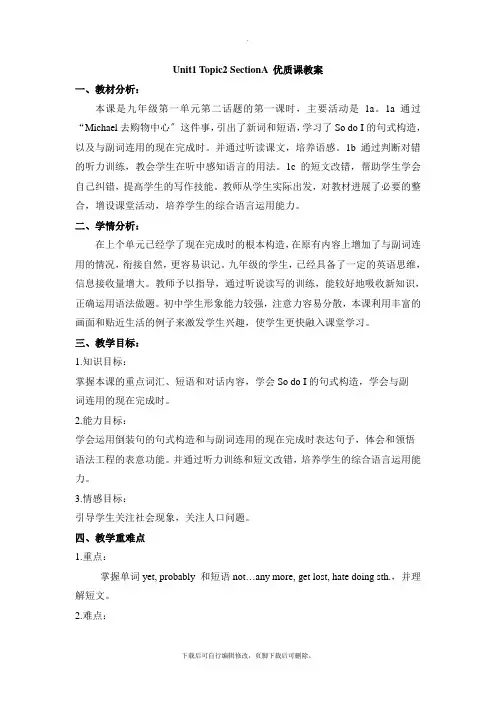
Unit1 Topic2 SectionA 优质课教案一、教材分析:本课是九年级第一单元第二话题的第一课时,主要活动是1a。
1a通过“Michael去购物中心〞这件事,引出了新词和短语,学习了So do I的句式构造,以及与副词连用的现在完成时。
并通过听读课文,培养语感。
1b通过判断对错的听力训练,教会学生在听中感知语言的用法。
1c的短文改错,帮助学生学会自己纠错,提高学生的写作技能。
教师从学生实际出发,对教材进展了必要的整合,增设课堂活动,培养学生的综合语言运用能力。
二、学情分析:在上个单元已经学了现在完成时的根本构造,在原有内容上增加了与副词连用的情况,衔接自然,更容易识记。
九年级的学生,已经具备了一定的英语思维,信息接收量增大。
教师予以指导,通过听说读写的训练,能较好地吸收新知识,正确运用语法做题。
初中学生形象能力较强,注意力容易分散,本课利用丰富的画面和贴近生活的例子来激发学生兴趣,使学生更快融入课堂学习。
三、教学目标:1.知识目标:掌握本课的重点词汇、短语和对话内容,学会So do I的句式构造,学会与副词连用的现在完成时。
2.能力目标:学会运用倒装句的句式构造和与副词连用的现在完成时表达句子,体会和领悟语法工程的表意功能。
并通过听力训练和短文改错,培养学生的综合语言运用能力。
3.情感目标:引导学生关注社会现象,关注人口问题。
四、教学重难点1.重点:掌握单词yet, probably 和短语not…any more, get lost, hate doing sth.,并理解短文。
2.难点:能正确运用So do I的句式构造和使用与ever. never. just. yet. already 等词连用的现在完成时。
五、教学过程:ng students ready for learning:师生间常规问候和交流。
2.Pre-listening:①观看视频,猜想是视频中展示的是哪个地方,引出a shopping center。
仁爱版九年级英语上册 Unit 1 Topic 1 Section C 课件(共44张PPT)

conditions in the city were poor.
Paragraph 3. China has developed rapidly since
the reform and opening-up.
Paragraph 4. It is important to remember the
1. What was/were … like in the past?
2. What has happened to… nowadays?
3. What will … be like in the future?
Draw your mind map.
In the past
At present
.
Great changes have taken place in my hometown since the reform and opening-up..
fax machine
telegram
communicate v.
communications--simple, slow
cellphone = mobile phone
communications—various , quick, easy
Task 1 Work alone
Read for main information.
Underline the topic sentence of each paragraph.
Topic sentences are
Paragraph 1. She has usseueanllytahtethechanges in
仁爱英语九年级上册语法精讲

1.现在完成时的用法:表示过去某一时间发生的动作或存在的状态,对现在仍有影响。
e.g. I have just posted the letter. 我刚把信邮寄了。
She has lost her watch. 她弄丢了手表。
2.现在完成时可以和不明确指出时间的状语连用,如already, yet,just,before, ever, lately, once等。
e.g. Have you heard from your friend lately?你最近收到你朋友的来信了吗?3.现在完成时也可以和包括现在在内的时间状语连用。
如this week, thismorning, today, thisyear等。
e.g. They have moved three times this year. 今年他们已经搬了三次家。
4.现在完成时不能和明确表示过去时间的状语连用。
如yesterday, last week, in 1999, two days ago,just now, when I came in等。
Unit 1-topic3现在完成时(Ⅲ)1.现在完成时表示从过去某一时刻延续到现在的动作或状态,常与for,since引导的状语连用。
for+一段时间,since+过去时间点或从句(从句的谓语动词用过去式)。
e.g. I have lived here for twenty years.我住在这里已有20年了。
We have built many factories since 1985.自1985年以来,我们建了许多工厂。
He has always helped me with my English since he came here.自从他到这里以后,他总是帮助我学习英语。
2.有的动词所表示的动作不是瞬间就可以完成的,要持续一段时间,这样的动词叫延续性动词。
不能延续下去的动词,叫非延续性动词或瞬间动词。
仁爱版九年级英语上册 Unit 1 Topic 2 Section B 课件(共27张PPT)
•
1,000,000,000
billion million thousand
973 nine hundred and seventy-three 3 980 three thousand , nine hundred and eighty 98 721 ninety-eight thousand , seven hundred and twentyone 768 540 seven hundred and sixty-eight thousand , five hundred and forty
300 000. 这个城市的人口将近三十万。
强调人口的具体分布或构成 (作复数) e.g. 80% of the population in China are
farmers. 中国百分之八十的人口是农民。
The population of our school __i_s__ (be) 3000. 50% of the population in our school ___a_re__ (be) female.
two thousand and eight Olympic Games
thousands of people
two point two six (2.26) meters tall
3.14 three point one four
100 one hundred 1,000 one thousand
三.修饰人口的词:
The population of China is_la_r_g_e_/_b_i_g. The population of Canada is _s_m__a_ll___.
四.population的用法:
Unit1Topic2SectionC课件2023-2024学年仁爱版英语九年级年级上册
Situation now
Living conditions __a_r_e_im__p_r_o_v_in_g__ra_p_i_d_ly_____ The natural environment _is__b_e_c_o_m_i_n_g_b_e_t_te_r__a_n_d_b_e.tter
serious The population problem is still
What a large population!
Large population caused many social problems.
People had less living space.
Large population caused many social problems.
There was more pollution.
Listen to Par.2 and fill in the blanks. 参考1c的表格
the problems caused by large population
less _l_iv_i_n_g_s_p_a_c_e___
Social problems
fewer __j_o_b___ opportunities less __w_a_t_e_r_ and _e_n_e_r_g_y crowded __c_it_ie_s___
Two thirds of the water__i_s__in the glass.
heavy __t_ra_f_fi_c___
one of the measures to deal with the problems
One-child policy 独生子女政策
Read Par.3 and mark T / F.
九上英语(仁爱版)unit1-2重要知识和语法归纳
Unit 1 T opic 1 Section A一、词汇短语1.after class 2. come back from3. feel sorry for sb.4. have been (to )。
5.have taken part in /have helped / have spent /have done /have learnt6. in a disabled children’s home7. learn sth. from sb. Eg: We learn English from him every day .8. no time to do sth. 9.work / clean -----for---10. the whole holiday二、重点句子1.Did you have a good summer holiday?2.How was your trip?3.In one place I saw children working for a cruel boss.4.I felt sorry for them.5. A: Where have you been, Jane?B: I have been to Mount Huang with my parents.5.A: Where has he/she / kangkang been?B: He has been to an English training school to improve his English.7.There goes the bell。
=The bell is ringing.8. A: Have you spent the whole holiday working there?B: Y es, I have. / No,I haven’tspend---on sth./ spend---(in)doing sth.9. A: Have you ever taken part in any activities during this summer holiday?B: Y es, I have. No,I haven’t.(否定回答) Unit 1 T opic 1 SectionB一、词汇短语1.write an article about 2. have a hard life3. In the past4. in detail5. afford6.no chance to do sth.7. What’s more 8.help support their families9.the Chinese teenagers’ lives10.has gone (to)+比较:have been (to )11.in the open air 12. lose a competition二、重点句子1.Could you please----?2.Parents couldn’t afford education for their children.3.Most children had no chance to go to school.4.Our country has developed rapidly. 。
仁爱版九年级英语上册 Unit 1 Topic 1 Section C 课件(共26张PPT)
In the 1960s, the living conditions in the city were poor.
Task 1 Work alone
1. Listen to 1a and answer the following questions
1.Who has seen the changes in Beijing?
2. China has succeeded in _s_e_n_d_in_g_
(send) Shenzhou Ⅹ into space.
3. I have _a_lr_e_a_d_y_(已经) had lunch. I am full.
Task 3 Pair work
In the past… At present…
Teaching aims and demands:
1. Go on learning the present perfect tense
pare the past Beijing with the present Beijing and learn about the great changes in China.
5.What do people use to keep in touch with their friends and relatives nowdays?
Scan the passage in 1a, then answer the question.
What’s the main idea of the passage? A. Beijing is the capital of China. B. Beijing has developed rapidly. C. Some information about old Beijing. D. My trip to Beijing.